Roads-paths near STMS being scrutinized
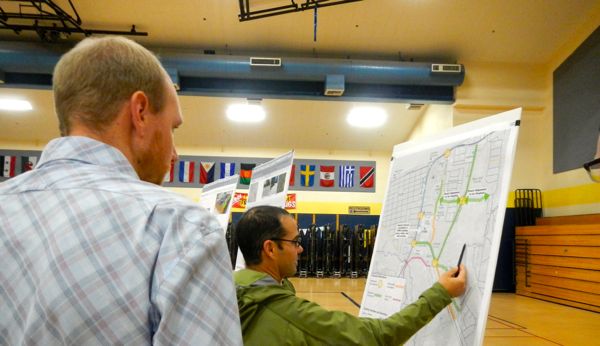
Garrett Villanueva, right, marks his trail ideas as Ben Fish with Design Workshop looks on Nov. 19. Photo/Kathryn Reed

Garrett Villanueva, right, marks his trail ideas as Ben Fish with Design Workshop looks on Nov. 19. Photo/Kathryn Reed

By Kathryn Reed

Reducing the width of travel lanes to create bike or multi-use paths around South Tahoe Middle School was a reoccurring theme during a workshop Wednesday night.

Statistics show from 2008-12 in a two-mile radius of STMS there have been 257 collisions, of which 23 involved pedestrians and 37 were cyclists. There were four fatalities, 21 involved severe injuries, 75 visible injuries and 155 complained of injuries.

Improving street crossings, and creating better bike paths and sidewalks could reduce those numbers, advocates believe.

Another problem is there are many gaps in the connections in and around the middle school. The goal is to fill those in and make what exists better.

Lake Tahoe Sustainability Collaborative was awarded a $153,625 On Our Way grant from the Tahoe Regional Planning Agency to look at how bike and pedestrian connections around STMS could be improved. The Community Mobility Group, a subgroup of the collaborative, on Nov. 19 presented alternatives to the more than 20 people who attended the workshop.

The first workshop was in October.

It was pointed out how most roads adjacent to a school have signs altering drives to the facility. Not so for STMS on either Highway 50 or Al Tahoe Boulevard. And neither requires motorists to slow to 25 mph when students are present.

Signage is the minimum the group is proposing.

To figure out what improvements to make the group has conducted community, STMS parent and student surveys, and two workshops. Traffic studies and counts have been done. Stakeholders have been consulted.

The east-west connection through Bijou Community Park is an idea that came earlier from the public.

More than 20 poster boards were scattered about the STMS multipurpose room outlining statistics and possibilities. They delved into the intersections of Al Tahoe and Highway 50, Al Tahoe and Johnson Boulevard, Lyons and 50, and Rufus Allen Boulevard and 50.

Class 1 bike trails, cycle tracks, green painting and bike lanes are being looked into.

Organizers and those stakeholders will pick a preferred alternative from all the data that has been collected. It will then be 30 percent engineered – close to shovel ready so grants could be secured for implementation.

Some of the thoughts, ideas and concerns on Wednesday included:

• Putting a diagonal crosswalk at Lyons Avenue and Highway 50;

• Wondering if user trails will go away;

• Desiring select trees to be cut to allow more sun on paths;

• Elevating a trail through Bijou Meadow instead of paving it;

• A crosswalk on Al Tahoe Boulevard to get to the future bike park;

• Shared cart path for golfers-walkers-cyclists at Bijou Golf Course, and add signs.

A long-term vision of the group is to either improve the current Trout Creek Highway 50 underpass or build a new underpass to the south.

—–

Notes:

• More info about the Lake Tahoe Sustainability Collaborative Community Mobility group may be found online.


Ticket scofflaws owe Calif. $10.2 billion

By Teri Sforz, Orange County Register

In the next year, about 20 percent of drivers will be convicted of speeding, rolling through stop signs or failing to stop at red lights, while another 8 percent will likely get off with a warning, and many more will be ticketed for parking illegally, having expired tags or some other bit of minor motor malfeasance.

Drivers will pay millions in fines and those millions may mingle in a kitty with fines and restitution paid by criminals. But California’s courts and counties are doing a spotty job of collecting this money, and the Legislative Analyst’s Office isn’t even sure it’s being counted correctly.

California’s crooks and scofflaws – including drivers who haven’t paid off tickets – owe, according to the LAO, $10.2 billion in court-ordered fines and fees.

The more sobering news, perhaps, is not necessarily that officials have collected only a fraction of the total – a comparably wee $1.8 billion – but that it’s hard to know precisely how much they’ve collected, due to “incomplete and inconsistent reporting … minimal data … miscalculation of performance measures … and a lack of evaluation,” the LAO said.

Read the whole story


Nev. legislators to tackle host of gaming issues

By J.D. Morris, Las Vegas Sun

Slot parlors, the role of technology in gambling and illegal sports betting are among the casino-related issues that the Nevada Legislature could take up when it convenes in three months.

Draft requests for several gaming bills are posted on the Legislature’s website, and while it’s still too early to predict what will actually become law, elected officials are beginning to talk about possibilities. It was a big focus at a legislative panel during last week’s gaming law conference in Las Vegas.

Gaming is an interest that transcends party lines, so the new Republican control over Carson City isn’t likely to change the agenda much, legislators said during the panel. That doesn’t mean every elected official is on the same page about what’s best for the gaming industry, but where differences arise, they may not be strictly partisan ones.

Read the whole story


S. Tahoe looking to tweak vacation rental rules

By Kathryn Reed

It depends who you talk to if there is a problem with vacation rentals in South Lake Tahoe. Some houses just seem to attract loud guests. Others are a welcome addition to neighborhoods. All may have their regulations tweaked soon.

The City Council on Nov. 18 engaged in another round of discussions about the ordinance that has been in place since 2003 and that was updated in 2011.

Noise is the No. 1 issue, with trash and parking the other major concerns.

There are 1,544 licensed vacation home rentals in the city limits, with the bulk – 316 – in the Tahoe Keys.

In the first nine months of this year there were 158 noise complaints from these rentals. That is down from 468 in 2013. Vacation home rentals account for 25 percent of the noise complaints the police department receives.

But not everyone believes this is an accurate number. Even Mayor Hal Cole said he believes the numbers are higher based on what he is told by residents.

“I think the numbers are underrepresented from personal experience,” Councilman-elect Austin Sass said. “I was told by dispatch that code enforcement wasn’t working at night and officers were busy. I think people stop calling when they hear this.”

Sass was one of 10 members of the public to speak at the Tuesday meeting.

Josh Priou with Lake Tahoe Accommodations called the number of complaints “minor”. He said his company booked 6,900 nights in those nine months, which accounts for 15 percent of the market. He added that citywide there would have been about 46,000 rental nights. Lake Tahoe Accommodations didn’t receive a complaint in that time period.

Priou said there will always be jerks, and added that the teeth in the ordinance is the threat of suspension or revocation of the permit.

Police Chief Brian Uhler, whose department oversees the permitting and enforcement of these rentals, suggested the word “overnight” be removed from the ordinance. The ordinance now limits the number of overnight guests, but not how many can be there during the day. Doing so could also alleviate some parking problems.

City Attorney Tom Watson said the legalities of doing so would have to be investigated.

A representative with Lake Tahoe Getaways said, “Guests need to have skin in the game.” In other words, cite them, not just the owner.

Noise from people in hot tubs late at night is an issue. Uhler suggested finding a way to turn off the jets at a certain hour so people would not be raising their voices to talk above them.

Others proposed if that is a constant source of the noise problem, then possibly the hot tub needs to be removed.

Also proposed was a sliding scale for the permit fee based on number of rooms as well if it is operated by an agency or owner.

Requiring bear boxes was briefly touched on, but more talk was focused on whether South Tahoe Refuse could add a route for these rentals.

Adding an enforcement officer to possibly work Thursday-Sunday nights was also broached.

The vacation home rental issue is expected to return to the council in late January or early February for action. Tuesday’s item was discussion only.


Congress prefers drivers over public transit

By Emily Badger, Washington Post

The federal tax code has a weird way of favoring people who drive to work over those who take public transit there.

If you’re a driver, the federal commuter benefit allows you to spend up to $245 of your pre-tax income each month on parking at work. If you pay to take the bus or train instead, the benefit is only about half that — $130.

For several years now, transit advocates have gone back and forth with Congress trying to equalize the benefits (or remove the bias, depending on how you look at it). And for a brief and glorious period, the Recovery Act (and some extensions) temporarily did that.

This year, however, for lack of action from Congress, the transit benefit shrank back to its old level. And now Chuck Schumer and several other members of Congress are trying to revive the issue during the lame-duck session.

Read the whole story


FCC aims to bolster Internet in schools

By Edward Wyatt, New York Times

WASHINGTON — With a goal of fiber-optic lines reaching to every school and a Wi-Fi connection in every classroom, Tom Wheeler, chairman of the Federal Communications Commission, is expected on Monday to propose a 62 percent increase in the amount of money the agency spends annually to wire schools and libraries with high-speed Internet connections.

Wheeler will propose that the annual cap on spending for school Internet needs be raised by $1.5 billion, to $3.9 billion, according to an F.C.C. official who spoke on condition of anonymity but was authorized to release details of the proposal. The initiative is part of a continuing overhaul of the Universal Service Fund and its educational component, known as E-Rate.

The new spending would lead to an increase of roughly 16 percent in the monthly fee on consumers’ phone bills. The fee is used to finance the Universal Service Fund, an $8.7 billion effort that provides phone and broadband connections for low-income populations, rural areas, and schools and libraries.

Read the whole story


Tahoe fire agencies explain prescribed burns

By Kathryn Reed

Thinning the forest and controlled burns are never going away. Those were two of the messages that were delivered by fire officials last week during an open house at the Forest Supervisors office in South Lake Tahoe.

The Tahoe Fire and Fuels Team has been created to put out a coordinated message to the public about what is happening in the basin in regards to fire – including prescribed fire.

In addition to the fire departments in the basin, other stakeholders like the Tahoe Regional Planning Agency, state parks from California and Nevada, and other public landowners are part of the group.

Representatives from county and state air districts also attended the Nov. 12 meeting.

One of the most common questions the public asks is: Why are the controlled burns occurring on a windy day?

Kit Bailey is the fire guru for U.S. Forest Service in the Lake Tahoe Basin. Photo/LTN file

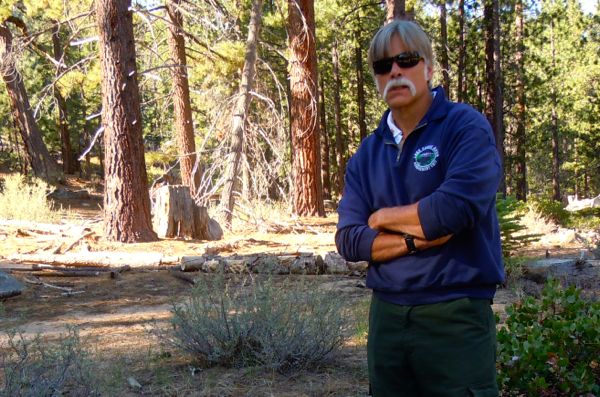
Kit Bailey is the fire guru for the U.S. Forest Service in the Lake Tahoe Basin. Photo/LTN file

“It’s a lot better fire effect when the wind is blowing. You get less scorch and mortality,” Kit Bailey, Lake Tahoe Basin Management Unit fire management officer, told Lake Tahoe News. “And it gets the smoke out.”

It’s also common to start the fires before precipitation falls.

Bailey said a successful burn requires a great deal of preparation and planning.

There are still critics of the Forest Service for how the Glenbrook burn a couple years ago was handled. Driving east up Spooner Summit the scar from that burn on the left side of the road is still visible.

“Had it burned in an uncontrolled manner, we would have lost the whole canyon,” Bailey said. “That area is still overstocked.”

The thinking is that a good winter will help that hillside look better. The drought is putting stress on all trees because the groundwater is being depleted.

Public questions centered on how much longer burns would be occurring (seasonally, but forever) and if it’s normal to see flames (yes).

The open house was a way for the various agencies to all be in one room and for the public to get their questions answered.


California officials ponder all-mail voting

By Christopher Cadelago, Sacramento Bee

When all the ballots are finally tallied from this month’s election, the proportion of Californians voting by mail is expected to break the record set in 2012, the first time more than half of the state’s electorate voted absentee.

The uptick has more Californians pushing for the state to go all the way and ditch traditional polling places. Washington, Colorado and Oregon require all of their elections to be run entirely by mail, and at least 19 others permit some of their elections to be all mail, according to the National Conference of State Legislatures.

County elections officials have touted the potential increase in voter interest and significant savings from avoiding the task of recruiting and training polling place workers. And some believe an all-mail system could even help speed up and avoid some overtime ballot-counting.

“I say, ‘yes, please,’” said Jill LaVine, the registrar of voters in Sacramento County. “I would love to go all vote-by-mail.”

Read the whole story


Nevada: No need for court to rehear gay marriage

By Ken Ritter, AP

LAS VEGAS – A federal appeals court should reject a request by the Coalition for the Protection of Marriage for a full-court rehearing of a landmark decision allowing gay marriage in Nevada, the state’s governor and an advocacy group representing eight same-sex couples said.

In strongly worded filings submitted on a Wednesday deadline to the 9th U.S. Circuit Court of Appeals, Gov. Brian Sandoval declared the same-sex marriage question settled in Nevada, and Lambda Legal lawyer Tara Borelli said the coalition had no standing to mount what she called a “final act of desperation” to prolong the case.

“While the question whether same-sex marriage can be prohibited remains in controversy elsewhere, it is not here,” Sandoval, a former U.S. District Court judge, said in a 10-page filing submitted by the Nevada state attorney general’s office. “The legal resolution of the matter in Nevada is in the public interest and should not be deferred by further proceedings.”

Hundreds of couples have married since a three-judge appeals court panel in San Francisco struck down Idaho and Nevada bans on gay marriage last month as a violation of equal-protection rights, Lambda Legal said in a 28-page document.

The ruling generated a wave of same-sex marriages in Las Vegas, which bills itself as the marriage capital of the world, but no tsunami. Same-sex couples made up a little more than 10 percent of about 2,300 couples who obtained marriage licenses around the state in the week after the gay marriage ban was dissolved.

Borelli derided the coalition’s involvement in the case as the architect of a Nevada state constitutional amendment passed in 2002 to prohibit same-sex marriage, but not a named party in the case Lambda filed in 2012. The case challenged the state law as a violation of the Equal Protection clause of the U.S. Constitution.

Monte Neil Stewart, lawyer for the Boise, Idaho-based coalition, didn’t immediately respond Thursday to messages.

“Intervenor has no direct stake in the outcome of this appeal,” Borelli wrote, “it has no standing to petition for rehearing en banc. Intervenor’s final act of desperation — attacking this court’s integrity — is wholly devoid of merit and should be rejected.”

The coalition filed documents last month claiming bias by Judges Stephen Reinhardt, Marsha Berzon and Ronald Gould; alleging that Reinhardt and Berzon weren’t randomly appointed to hear gay-marriage cases from Nevada, Idaho and Hawaii; and accusing Reinhardt and Berzon of favoring the rights of gay men and lesbians.


LTWC bursting with critters; ready to move

By Kathryn Reed

CAMP RICHARDSON – In the nearly 37 years that Lake Tahoe Wildlife Care has been nursing wild animals back to health, about 24,000 have come through the doors, with approximately 15,000 being able to return to the wild.

The South Shore facility is the only one in California certified to handle first-year bear cubs. They set a record for caring for 13 this year.

“One of the major problems we had this year is we had a lot of different species we couldn’t put together,” Tom Millham, who with his wife, Cheryl, runs LTWC.

It meant being creative with cages and having to release some animals sooner than they liked. But soon these issues will be a thing of the past.

Last week LTWC submitted an application to the Tahoe Regional Planning Agency for a special use permit to move to 27 acres on the corner of Al Tahoe Boulevard and Pioneer Trail. Marjorie Springmeyer owns the land. A lease with an option to buy agreement is in the works.

The cost of the first phase will be about $5.5 million, with the entire center being close to $15 million. Some of the money is from Barbara Hartoonian, which she left in her will. The rest is from donations – which are always welcomed.

Tom and Cheryl Millham talk about caring for wildlife and their future plans. Photo/LTN

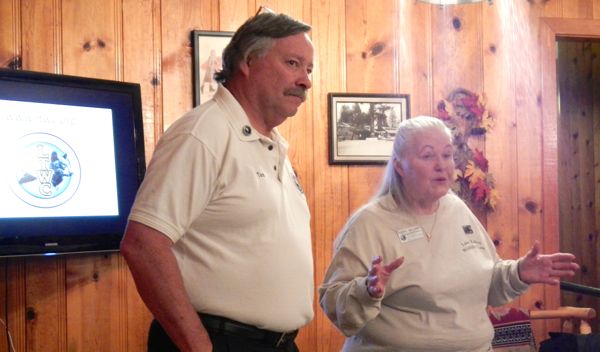
Tom and Cheryl Millham talk Nov. 11 about caring for wildlife and their future plans. Photo/LTN

The Millhams founded the renowned rehabilitation center in 1978. Last week they spoke at the Lake Tahoe Historical Society meeting at Camp Richardson Lodge about their experiences with the various animals as well as their plans to break ground in May on the center in South Lake Tahoe that would be open to the public.

Today LTWC is in the Millhams’ back yard. It’s too small to let people in other than those working to care for the animals. Plus, the whole goal is to make sure the animals don’t get too familiar with people.

It’s not easy work to care for wildlife. Baby birds eat 14 hours a day. It’s important to keep them fed because by day 25 they are ready to leave the nest.

While there are plenty of people who find coyotes to be a nuisance at best, Cheryl Millham said, “They do have a place.”

She added, “We have predators that keep our area clean. It cuts down on disease.”

Millham told the story of how a few years ago a dog from out of town came to the basin with distemper. This spread to the raccoon population, which resulted in the death of hundreds of the animals. She said just now the raccoon population is coming back.

Millham said the Mexican freetail bats are misunderstood animals.

“They eat mosquitoes, which are the most disease-carrying insect,” Millham said.

While mountain lions are not common in the Lake Tahoe Basin, LTWC was instrumental a few years ago in capturing one that was wandering around the Tahoe Keys. Once it was tranquilized, veterinarian Kevin Willitts found multiple porcupine quills in her. Some were so deep surgery was necessary. She was released in Hope Valley.

It was Li’l Smokey who was rescued in 2008 from a fire near Redding that led LTWC to get webcams in the various cages. The demand was so great to see pictures of the cub who made national headlines that the Millhams put in the technology.

It wasn’t a given the little guy would survive. Millham said his paws were like “burned steak.”

“You could see the fascia. He lost his toenails. You could see the bone,” she said.

Someone asked about the plethora of rabbits that have been seen on the South Shore in the last few years. Mostly it’s the mountain cottontail that is here. Cheryl Millham said the mild winters would allow the breed to populate and thrive.

LTWC offers training each May for people to be volunteers. More info is online.