Black Friday highlights rich-poor divide

By Shan Li, Los Angeles Times

In Northeast Los Angeles, 1,000 people huddled in the evening chill last Thanksgiving as they waited outside a Target store for the chance to snap up Black Friday deals.

Across town at the Grove, the mostly upscale stores such as Barneys and Nordstrom were closed that night. Holiday shoppers didn’t start massing until well into the next morning.

This year’s annual ritual of conspicuous consumption promises an even greater contrast.

Discounters and mid-priced chains, eager to gain an edge on competitors for limited gift budgets, have again moved their opening times earlier into Turkey Day, with Kmart leading the pack by launching specials at 6am. Higher-end retailers, however, are keeping their doors firmly shut until Friday.

Increasingly, the seasonal shopping surge has become a window into America’s class divide, in which high earners have benefited from a booming stock market and rising home prices as many others still grapple with stagnant incomes and lingering financial anxiety.

Consider these opposite scenarios: In 2013, Bloomingdale’s went against the grain by offering fewer Black Friday bargains than the year before, according to the advertising experts at bestblackfriday.com. At a Wal-Mart in Duarte, customers elbowed one another to get their hands on Crayola crayon sets, marked down to $11 from nearly $20. (A trending Twitter hashtag last Thanksgiving was #WalmartFights.)

Read the whole story


Changing food labels may reduce waste

By Roff Smith, National Geographic

LONDON—Everyone’s done it: You reach into your fridge and pluck out something tasty that you’ve meaning to eat but had half-forgotten about, only to discover that its “best before” date passed a few days earlier.

What to do? If you’re like many people, you let out a resentful sigh and toss it — better safe than sorry —  and resolve to be more watchful, less wasteful, in the future.

But did you really need to throw away that perfectly good-looking (and good-smelling) wedge of manchego or container of ice cream?

Depending on what it was, and how well it was kept, probably not, says Emma Marsh, who leads Love Food Hate Waste, a U.K.-based group that’s dedicated to tackling food waste. “More than half of the food we throw out is food we could have eaten,” she says, referring to British consumers.

Food waste is a growing global concern, with 1.3 billion tons of food — as much as a third of the food that is produced on the globe each year, worth over $750 billion — going to waste each year, according to the United Nations’ Food and Agriculture Organization. Aside from the morality of such loss in a world where an estimated 800 million people go to bed hungry each night, the economic and environmental implications are staggering. More than a quarter of the world’s agricultural land is being worked to grow food that nobody eats.


Novasel not waiting to be sworn in as supervisor to be a leader in El Dorado County

Sue Novasel is working to help District 5 even before being sworn in as the next El Dorado County supervisor. Photo/Kathryn Reed

Sue Novasel is working to help District 5 even before being sworn in as the next El Dorado County supervisor. Photo/Kathryn Reed

By Kathryn Reed

MEYERS – A half eaten muffin and near empty coffee cup sit in front her. She pauses to excuse herself to take a phone call. She steps into the cold where others can’t hear her.

This is Sue Novasel’s life. She is transitioning from candidate to supervisor of El Dorado County. On this particular day Freel Perk in Meyers is her de facto office.

Before Lake Tahoe News arrives she was consulting with a board member of the Tahoe Paradise Resort Improvement District.

Helping to resolve their problems is a top priority of Novasel’s after she is sworn in the first week of January. But already she is listening, gathering information and getting further acquainted with this and a variety of other issues.

“I study every night. I’ve called every supervisor. I’m meeting with as many electeds and department heads to get up to speed,” Novasel tells Lake Tahoe News.

Tahoe Paradise Park is near and dear to her. Her daughters played there. Her husband is a former board member. Novasel knows it could be a real community asset if some structure, direction and vision could be brought to the board and park.

With having lived in the area for 38 years, she brings a history of Meyers and the entire South Shore to the Board of Supervisors.

Setting priorities

Another major task for her is to get the Board of Supervisors to be a more cohesive unit.

“There’s some dysfunction and a lot of distractions with a supervisor being ousted and the fact the board has two new members,” Novasel said. (Michael Ranalli was elected to District 4. Shiva Frentzen is also new, having replaced Ray Nutting in September.) “I will try to get our board to act like a board. The board needs to develop strategies, policies and plans for the future.”

What she doesn’t know is if the current board or the one taking office in 41 days will be hiring the next chief administrative officer.

“They have every right to hire (someone) before the new board is sworn in,” Novasel said.

It would be a bit of an expedited process, especially with the holidays, if that were to occur. Terri Daly resigned this fall as CAO and Assistant CAO Kim Kerr is leaving at the end of December.

Novasel has experience in hiring a top official, having been on the LTUSD board when Jim Tarwater was selected.

Novasel’s other initial focus will be on economic growth – which was her mantra during the campaign.

“They should set a policy regarding business development,”Novasel said of the supervisors. “The permit process in Tahoe can always be improved.”

She said it’s all about growing the tax base.

Public safety and public health are other concerns of hers. She believes her 12 years on the school board will help her bring child centered issues to the table.

Being accessible

During the interview a couple Meyers residents approach Novasel.

Constantly being interrupted is likely something she will have to get used to. If she thought getting stopped in the grocery store to be asked about Lake Tahoe Unified School District issues was distracting, she will now have a much broader constituency to be held accountable to. Besides a larger geographic area that stretches to Pollock Pines, the District 5 supervisor is usually on the board of the Tahoe Regional Planning Agency, Tahoe Transportation District, California Tahoe Conservancy, Waste Management JPA, Recreation JPA and others.

While Novasel is bound to be busy once she takes office, she is going to be taking a few things off of her plate. She is resigning from several boards including Lake Tahoe South Shore Chamber of Commerce and Lake Tahoe Wildlife Care.

She hopes to have regular office hours in Placerville and Lake Tahoe.

But being a supervisor isn’t just representing a specific district. The West Slope has its own issues, which Novasel has been brushing up on. This includes having read the General Plan more than once.

She realizes there is a disconnect between Tahoe and Placerville. But she also said Tahoma, Pollock Pines and El Dorado Hills don’t always feel well represented.

Novasel would like to have more combined meetings with entities like her new board and the South Lake Tahoe City Council. She also wants various city-county employees to be meeting more so people are working together better.

“We all need to understand the issues,” Novasel said. “The Board of Supervisors needs to make sure the lines of communication are open. We need to know the needs of different communities.”

One thing that should make Novasel’s job easier is that Judi McCallum has decided to stay on as the District 5 assistant.


Sorting out how Caesars slid into distress

By J.D. Morris, Las Vegas Sun

The financial mess consuming Caesars Entertainment has been years in the making.

The casino company has struggled with more than $20 billion in debt for about six years. It’s lost money every year since 2009, largely because of its debt payments.

Now, the largest (and most indebted) unit of Caesars is apparently preparing to file for bankruptcy. That doesn’t mean Caesars, the largest operator of casinos in the United States, will cease to exist; it will, presumably, emerge on the other side as a restructured company.

The situation isn’t easy to understand, especially because many details are under wraps while the company negotiates with creditors. But extensive reporting from Laura J. Keller at Bloomberg News, company filings with the Securities and Exchange Commission and analyst comments help clarify some of the complexity.

Caesars is the parent company of Harrah’s Lake Tahoe and Harveys.

Read the whole story


Historic Nevada locomotive restored to life

By Guy Clifton, Reno Gazette-Journal

The Glenbrook – perhaps the most viewed locomotive in Nevada history – roared to life for the first time in 88 years last week in Carson City.

“This is, indeed, an important day in the annals of railroad preservation, for Nevada and the nation,” said Peter Barton, administrator of the Nevada Division of Museums and History, just before white steam rose above the boiler and black smoke from the stack of the historic engine.

Perhaps best known as the train that graced the front of the Nevada State Museum for four decades – a favorite artifact for thousands of school kids, railroad buffs and visitors – it has been at the Nevada State Railroad Museum since 1982.

The museum’s shop crew – headed by chief maintenance officer Chris DeWitt – spent years restoring the locomotive, piece by piece, to get it back to operational condition and on Nov. 19, the biggest hurdle to date was cleared as the engine was fired for the first time since 1926, passing a key safety inspection.

Read the whole story


South Tahoe looking to renovate rec center

The rec center's men's bathroom lacks privacy. Photos/Kathryn Reed

The South Lake Tahoe Recreation Center’s men’s bathroom lacks privacy. Photos/Kathryn Reed

By Kathryn Reed

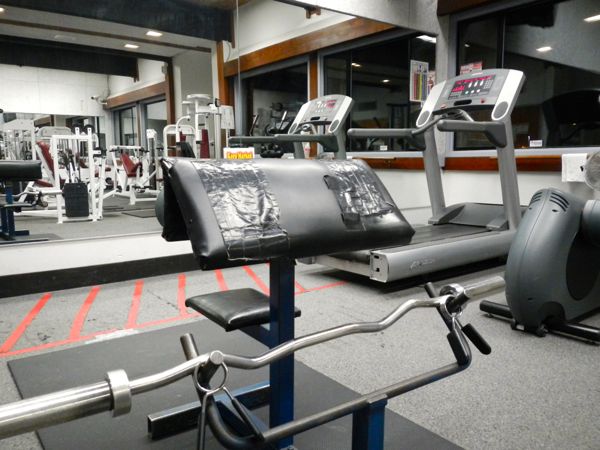
Tape on many weight room apparatuses, blocks at the swimming pool the public aren’t allowed to use, no private showers in the men’s room, two out of three showers off-limits in the women’s locker room.

This is the South Lake Tahoe Recreation Center.

It was built in 1975. Nearly 40 years later it is sorely in need of being overhauled, if not gutted and rebuilt from the ground up.

“It’s rundown and needs serious renovation,” Pete Fink, chairman of the city’s recreation commission, told the more than two dozen people at a Nov. 18 workshop.

Turning this into a green building is a goal so it is extremely energy efficient. Today the annual electric bill is about $170,000 for the building, including the pool.

Last year $37,000 had to be spent on fixing the roof.

“It seemed like it was raining more inside than out,” Fink said.

Many would like the pool to be upgraded.

Many would like the pool to be upgraded.

An aspect of the recreation master plan being developed by the city and El Dorado County calls for renovating the center. Last week was the first opportunity for the public to tour the facility and offer input as to what they would like to see changed.

Faye-Marie Pekar, Grace Usui Meyer and Jenn Boyd finished their evening lap swimming before joining the group to offer their opinions.

They told Lake Tahoe News the locker rooms should to be upgraded, the starting blocks need to be accessible to anyone, there should be a professional timing system and the number of lanes expanded beyond six.

They and others voiced the need for a swim center like Carson Valley has where there are multiple pools that would accommodate divers, swimmers and those looking for therapy sessions.

Some would like a permanent roof to replace the bubble over the pool. Bleachers would be beneficial for spectators during competitions.

Both locker rooms are a bit repulsive. Even though a major overhaul of the rec center is likely, the city is going forward with fixing the rusting, corroding women’s showers.

In the men’s locker room the urinals go to the ground in an old-school fashion. A short wall separates the two toilets, but privacy is completely lacking.

The rec center has various rooms that are used for meetings and classes. One has mirrors for dance class, but the floor in it is not conducive to dancing. And the mirrors don’t make for a professional meeting center for the entities that rent it for that purpose.

An industrial kitchen is adjacent to the gym.

Lauren Thomaselli, parks manager, suggested putting in a concession window between the kitchen and gym so food could easily by sold. She would also like to see cooking classes.

Caterers in town who need a facility that meets the health department’s requirements often rent the kitchen.

Duct tape is common on weight room equipment.

Duct tape is common on weight room equipment.

The weight room equipment looks like something found in a bygone era.

“A lot of the equipment here I’ve been told was donated by clubs that went under and it looks like it,” Peter Evenhuis, who was touring the site, told Lake Tahoe News. His suggestion is to lease equipment in the future.

The city is looking for more input on the rec center via this online survey.


‘One problem with skate skiing: It’s hard’

By Christopher Solomon, New York Times

For a long time I just didn’t “get” cross country skiing. Shuffling through the woods while dangling a scratchy wool scarf? Too stuffy, too twee, too boring — a sport better left to old Norwegians and young honeymooners. I’m not ready to stride across a Currier & Ives print, I scoffed.

Then a friend introduced me to skate skiing, “classic” Nordic’s zippy younger brother.

If traditional Nordic skiing is a walk in the woods, then skate skiing — which was born only in the 1970s — is more like trail running. It’s swooping. It’s fast. It’s graceful. It’s even a bit sexy, something its buttoned-up older brother has never been accused of.

No wonder that more runners and cyclists have discovered the discipline as a great winter counterpart. Purchase of skate skis has been on a slow, steady rise in recent years, accounting for 16 percent of cross country skis bought in 2012-13.

There’s just one problem with skate skiing: It’s hard.

Read the whole story


California Indian casinos embroiled in turmoil

By Scott Smith, AP

When it comes to controlling California’s flashy Las Vegas-style casinos, the stakes are enormous for tribes who own the gambling operations that collectively generate billions of dollars a year to sustain Native Americans up and down the state.

With this backdrop, several tribes in the past two years have fallen into nasty, sometimes violent, power struggles pitting factions and families against one another.

The most recent case, involving the Picayune Rancheria of Chukchansi Indians near Yosemite National Park, climaxed in an armed raid on Oct. 9 by one faction that caused gamblers to flee, leaving their chips on the table.

The National Indian Gaming Commission, which regulates Indian casinos, and a federal judge shut down the Chukchansi Gold Resort and Casino, citing safety concerns. Charges have been filed against 15 men — two tribal council members, the tribal police chief and a hired security team that included a former sheriff’s deputy and onetime Marine, and a former Navy Seal.

Related

In this photo taken Thursday, Nov. 20, 2014, a sign is shown at the main entrance to the shuttered Chukchansi Gold Resort and Casino in Coarsegold, Calif. Federal officials closed the casino in October citing safety reasons when an armed faction of the Picayune Rancheria of Chukchansi Indians launched a raid, attempting to take control of the casino. Experts say historical factors and a recent influx of money, which provides income, jobs, housing and benefits to many tribal members, has helped spark internal friction among tribes.
In this photo taken Thursday, Nov. 20, 2014, a sign is shown at the main entrance to the shuttered Chukchansi Gold Resort and Casino in Coarsegold, Calif. Federal officials closed the casino in October citing safety reasons when an armed faction of the Picayune Rancheria of Chukchansi Indians launched a raid, attempting to take control of the casino. Experts say historical factors and a recent influx of money, which provides income, jobs, housing and benefits to many tribal members, has helped spark internal friction among tribes. | Scott Smith AP Photo

The casino remains closed — with estimated losses in the millions each week — because rivals have yet to diffuse what U.S. District Judge J. Lawrence O’Neill of Fresno called an “explosive keg” of emotions.

“It’s a classic struggle over money and tribal rights and control for what everybody recognizes is a very lucrative enterprise,” said Denise Runge, a gambling industry researcher at Helena College University of Montana.

Congress passed the Indian Gaming Regulation Act in 1988, setting the stage for sovereign Native American governments to open full-blown casinos.

Indian casinos generated $28 billion last year from 449 casino operations in 28 states, according to the National Indian Gaming Commission.

About 65 Indian casinos in California took in one-quarter of those earnings at nearly $7 billion. California outperformed the Las Vegas Strip, which drew $6.5 billion last year, says a University of Nevada, Las Vegas, Center for Gaming Research report.

Experts say this influx of money, which provides, jobs, housing and benefits to many tribal members, has helped spark friction.

“All of a sudden, you’ve got a government with a lot of responsibility and a lot of clout that didn’t develop over decades like a lot of our other government institutions,” said Phil Hogen, former chair of the National Indian Gaming Commission.

Simmering tensions erupted last month at Chukchansi when a security team led by former tribal leader Tex McDonald stormed the casino. They were armed with firearms and stun guns and detained security officers.

Madera County Sheriff’s deputies intervened. Prosecutors filed charges, including kidnapping, false imprisonment and assault against the men. Most have been arrested or have surrendered. McDonald is in jail with bail set at $2.4 million. His attorney did not respond to requests for comment.

Meanwhile, Chukchansi’s financial losses are unclear because Indian casinos are not required to disclose earnings.

But its 1,800 slot machines could generate over $130 million annually, not including table games, hotel stays, food and drink sales, estimated Cheryl Schmit, director of Stand Up for California, which pushes for gambling laws to be properly followed.

Chukchansi’s turmoil isn’t unique. Sheriff’s deputies earlier this year headed off a standoff among armed and masked members of the Paskenta Band of Nomlaki Indians and their hired security forces. The confrontation at the Rolling Hills Casino, north of Sacramento, emerged in a struggle for control of the business and the tribe’s assets, including a $3 million jet, 162 ounces of gold and $3,300 monthly payments to adult tribal members. One faction accused the other of launching a cyberattack.

In Oroville last year, a group at the Berry Creek Rancheria protesting their disenrollment barricaded themselves inside tribal headquarters next to the Gold Country Casino & Hotel. An 11-hour standoff ended when sheriff’s deputies threw in a grenade and arrested 20 people.

Both Northern California casinos remained opened.

Tribal clashes are rooted in history, Schmit said. The U.S. government broke its promises to give Indians land, she said, and sanctioned tribal groups with members who were not affiliated. Schmit said the government sowed the seeds of conflict and hasn’t helped resolve modern disputes.

“Certainly, tribes in California have suffered generational trauma for it,” Schmit said.

O’Neill, citing concern for the casino’s out-of-work employees, expressed exasperation with the leadership vacuum of the Chukchansi tribe, the Indian Gaming Commission and his court, which has limited jurisdiction over tribal affairs.

The federal Bureau of Indian Affairs and the Indian Gaming Commission did not respond to requests seeking comment.

Tribal affairs attorney Gabriel Galanda said some lawyers are exploiting casinos to run up fees.

“It’s all by design, lawyers and lobbyists taking advantage of a void of law and order in Indian country,” said Galanda, who represented an ousted faction of the Paskenta tribe. “This is happening in too many places, too frequently. I guarantee you that Chukchansi is not the last of them.”

Read more here: http://www.sacbee.com/news/business/article4064162.html#storylink=cpy


Washoe, USFS looking to improve Meeks Bay

By Kathryn Reed

Upgrading restaurant features, linking to the new bike trail, moving cabins, improving traffic patterns. These are some of the ideas the Washoe tribe has for improving Meeks Bay Resort.

The tribe has operated the West Shore lakefront property under a special use permit from the U.S. Forest Service since 1999. It expires in 2019. But tribe officials are hoping for an extension.

Tonight the public is being asked to weigh in on what they would like to see at the resort. The resort provides day-use beach access, marina operations, cabins, and RV and tent camping.

Design Workshop is assisting the Washoe with coming up with ideas for what the improvements could look like.

Greg Weyland, business operations manager for the tribe, said they are looking at moving and upgrading the 1920s-era cabins.

“We would like to move them back and have more beach capacity,” Weyland told Lake Tahoe News.

Meeks Bay Resort upgrades are being talked about. Photo/LTN file

Meeks Bay Resort upgrades are being talked about. Photo/LTN file

The Washoe Indians have had a presence at Lake Tahoe for thousands of years and they want to keep it that way. Some of the possible changes include better telling their story to Meeks Bay guests.

With so many day users, an immediate need is to get rid of the port-a-potties and building more permanent restrooms, Weyland said.

The Wa She Shu Grill could use a walk-in cooler and freezer for added food storage.

“Our restaurant has become more popular. Sales increased quite a bit in this last season,” Weyland said. Being able to sell beer and wine at the restaurant is also a desire of the tribe’s.

In 2016, the bike path that will end at the resort is expected to be built. It is a Tahoe Transportation District-Tahoe City Public Utility District project. The tribe would then like to have bike rentals and a possible bike valet. It’s possible an older building on the premise could be used for this.

“The Forest Service is interested in having a facility that is self-supporting and provides a high quality recreation experience. Improving the visual character of the shoreline and updating water quality best management practices at the marina are of particular importance to the Forest Service,” Cheva Gabor, USFS spokeswoman, told Lake Tahoe News. “We will be working with the tribe on improving the financial sustainability of the resort, while at the same time providing for improved guest services and overall recreation experience.”

After the open house tonight the tribe will take that information as well as data it has from surveys to come up with a proposal to be presented to the Forest Service. Environmental documents will then need to be prepared.

Any improvements will depend of funding availability, and most likely would not start until 2016.

“Funding will come from multiple sources. A majority of the funds will come through the Granger-Thye fee offset program. This program allows the permittee to conduct work and maintenance onsite in lieu of their fee to the government for the special use permit,” Gabor said. “Additionally, money may come from other funding sources, such as through partnerships for water quality funding. We generally cannot compete for funding sources until after environmental documentation (NEPA) is complete.”

——

Notes:

• Open house is Nov. 24 from 5-7pm, U.S. Forest Service office at 35 College Drive, South Lake Tahoe.

• Meeks Bay Resort is online.


Growing evidence global warming driving crazy winters

By Chris Mooney, Washington Post

It may be the timeliest — and most troubling — idea in climate science.

Back in 2012, two researchers with a particular interest in the Arctic, Rutgers’ Jennifer Francis and the University of Wisconsin-Madison’s Stephen Vavrus, published a paper called “Evidence linking Arctic amplification to extreme weather in mid-latitudes.” In it, they suggested that the fact that the Arctic is warming so rapidly is leading to an unexpected but profound effect on the weather where the vast majority of us live — a change that, if their theory is correct, may have something to do with the extreme winter weather the U.S. has seen lately.

In their paper, Francis and Vavrus suggested that a rapidly warming Arctic should interfere with the jet stream, the river of air high above us that flows eastward around the northern hemisphere and brings with it our weather. Sometimes, the jet stream flows relatively directly from west to east; but other times, it takes long, wavy loops, as in the image above.

And according to Francis and Vavrus, Arctic warming should make the jet stream more wavy and loopy on average – some have called it “drunk” — with dramatic weather consequences.

Read the whole story