Weight, food, inactivity contribute to cancer risk

By Kathryn Reed

While the cause of many cancers is unknown, a person’s lifestyle can be a large contributing factor.

That was the overriding message delivered by Lynn Norton, a registered dietician with Barton Health, during a Dec. 2 lecture at Lake Tahoe Community College.

“The majority of cancer is basically preventable,” Norton said. “There are enough things in our lifestyle and with nutrition that we can do.”

She cited several studies that underlined the need to pay attention to diet, body weight and exercise.

The risk of cancer increases, Norton said, with a high body mass index. This number is based on a person’s height and weight. A healthy weight for a person who is 6-feet-tall is between 140 and 180 pounds, while someone 5-feet-6 should weigh between 115 and 150 pounds.

There are people who are overweight, and then those who fall into the obese category. In the United States people are increasingly in the worst category – obese. Thirty-four percent of the people in this country are considered obese. For those 19 and younger, the percentage is 17.

Obesity increases the risk of being diagnosed with the following cancers: esophagus, pancreatic, colorectal, breast, endometrial, kidney and gall bladder.

Garlic is said to ward off certain cancers. Photo/LTN file

Garlic is said to ward off certain cancers. Photo/LTN file

Being active is going to help reduce one’s weight, as well as reduce the risk of cancers like colon, post-menopausal breast and endometrial.

The recommendation is get 30 minutes of at least brisk walking every day, then work up to 60 minutes.

Another suggestion is to limit high calorie foods and sugary drinks. This can be attained by a diet derived mostly from plants. Norton pointed out how some veggies have more benefits than others, like garlic is a deterrent to colorectal cancer, carrots help prevent cervical cancer, and legumes ward off stomach and prostate cancers.

“Fibrous foods are dense and filling,” Norton said. “Americans eat 10 to 15 grams of fiber a day and it should be 20 to 35 grams.”

Red meat should be limited – in how often it is consumed and how much. Eighteen ounces a week is the recommendation.

When it comes to alcohol, Norton said it is considered a carcinogen. Two drinks a night for men, one for women, are the ideal amounts based on studies.

Sodium, while it’s needed, is often consumed in alarming rates at restaurants and via packaged foods.

Norton cautioned people to be wary of supplements because they are unregulated. She stressed the need to do research to know what a safe level of them is.

She said the easiest way to begin making changes is to shop differently at the grocery store by putting more grains in the basket, along with vegetables. Norton suggests buying extra chicken or fish so there are leftovers for lunch instead of eating processed food midday. Shrink the size of the specialty coffee, order veggies on a pizza and no meat, put wine in a smaller glass. And treats – make them a treat, not a staple.


Detectives revisiting 20-year-old Tahoe murders

By Ed Pearce, KOLO-TV

INCLINE VILLAGE — Twenty years ago, a retired couple was murdered in their Incline Village home. The crime remains unsolved, one of Washoe County’s “cold cases.”

But it and others like it are getting new attention. In a small storage room in the Washoe County Sheriff’s Office are shelves containing the files of this department’s unsolved major crimes. Each represents a victim, a family without closure, justice delayed, but not necessarily denied.

You see these cases aren’t sitting on the shelf, gathering dust. They’re getting new attention and that includes the murders of Charles and Nona Rauer.

Sixty-three-year-old Charles Rauer and his 56-year-old wife Nona had moved in their retirement away from the big city crime of southern Florida to the safe quiet of Tahoe’s north shore. “They were retired, living in a condo up in Incline, basically living the dream that they had,” says Washoe County Sheriff’s Detective Josh Palmer..

The dream turned to nightmare one morning in early December of 1994. Their bodies were found in their home in the 800 block of Oriole Way in Incline Village on the foruth. It’s likely they were killed in the morning of the second or third. Cause of death: blunt force trauma.

Read the whole story


El Dorado ordinance fuels outcry over pot-growing boom

By Peter Hecht, Sacramento Bee

The tense public hearing was three hours in Tuesday when a friend pushed Joyce Hall in her walker to address the El Dorado County Board of Supervisors. The frail, 100-pound woman rose, grasped the lectern with both hands and began to cry.

“You’re going to kill us,” said Hall, 57, a Garden Valley resident and medical marijuana patient who suffers from a rare immune disorder that causes severe weight loss. For the past year, a caregiver has been growing 12 marijuana plants on Hall’s property under a September 2013 county ordinance that permits individual patients to grow 200 square feet of plants in fenced off plots away from neighbors’ property lines.

But El Dorado County Sheriff John D’Agostini, who originally supported the policy, now says the county’s marijuana ordinance was a “big mistake.”

The sheriff blames the ordinance – intended as a compassionate action for local medical marijuana patients – for broadcasting a “weed friendly” message. He says it has attracted criminal profiteers who are ripping up public and private lands and cultivating hundreds of thousands of plants on a scale vastly exceeding county guidelines.

Read the whole story


Ex-Heavenly chief counting down to retirement

Blaise Carrig at Keystone, one of Vail Resorts 11 ski areas, that he is in charge of. Photo/Vail Resorts/Jack Affleck

Blaise Carrig at Keystone, one of the 11 Vail Resorts ski areas he oversees. Photo/Vail Resorts/Jack Afflec

By Susan Wood

Blaise Carrig, the skiing guru who led Heavenly Mountain Resort during a critical crossroads, is forging a new path of greener pastures – with a little white stuff mixed in for recreation sake.

That’s because soon skiing will no longer involve business.

At 63, Carrig will relinquish his post as president of Vail Resorts’ mountain division next August to work as a senior advisor. Patricia Campbell, CEO for Vail’s Breckenridge Ski Resort in Colorado, will replace him.

On the horizon for Carrig is full retirement in three years.

“I’ll miss the people. I love being around the youthful energy,” Carrig told Lake Tahoe News by phone.

He added the “juice of the business” in building chairlifts and the “energy of putting out great products.”

Waxing poetic, the Boulder resident talks about skiing as if it transcends itself. “I now love to ski the groomers as much as the moguls,” Carrig said. “And I still love steep, deep powder.”

Carrig is a beautiful skier.

“It’s incredibly compelling to be outside in the mountains. It strikes a sense of awe – to move against gravity is as close to flying as you can get,” Carrig said.

It’s the spirituality of “being in the mountains” that fills him most. “Especially Heavenly, it’s an incredibly spiritual place. To see that lake,” he said in the awe most avid Tahoe recreationalists have shared through the years.

That stark contrast of white to blue resembles a painting. That is a hobby Carrig plans to do more of in retirement, along with traveling, skiing, paddleboarding and cycling – as well as taking an excursion to Italy. In the winter, he’d like to visit various ski areas with no job to do.

When Carrig was the Heavenly chief from 2002-10, he would often get out of the office and go out on a ski to check on how his workers and the conditions were holding up. His tenure at Heavenly became one in which customer service, above all, took precedence.

Carrig started out at Sugarbush in Vermont as a ski patroller – with no notion of a ski career.

“When I started, I just wanted to pay rent and buy beer. I thought: ‘Wow, they’re paying me to ski’,” he quipped, further identifying with the ski bum label. “It’s been a great career.”

He left Sugarbush in 1997 and hasn’t returned to ski there since. In that time the ski industry has changed immensely.

“I think definitely there was a period of time when it became much more of a business. Back then you worked for the guy who founded the ski area. Now it’s more polished, more service. The ski vacation involves good lodging, good dining,” he explained.

With climate change being on the forefront of how the ski areas deal with a lack of snow, Carrig nonetheless sees a silver lining.

“I think climate change for sure has made the weather more erratic with storms more extreme. But there’s still skiing between Thanksgiving to Easter,” he said, pointing to snowmaking as having a huge impact on the survival of Western resorts such as Heavenly and Northstar. In Colorado the natural snow still “carries the day.”

He sees the industry’s future as bright.

He mentioned the evolution of ski technology as contributing to skiing’s steady market at least for the large Baby Boomer demographic. Think shaped, fatty and twin tip skis.

“One of the biggest things I’ve seen a change in is the grooming. It’s nothing like the ’70s. Now we have these high-end tillers that allow Baby Boomers to ski longer,” he said. The new grooming machines make the ski experience smoother and easier on the joints.

It appears Carrig’s careful observations will eventually be missed by those he dealt with at Vail Resorts.

CEO Rob Katz commended Carrig’s vision in the Denver Business Journal but admitted he “will miss his engagement as president.” Katz further expressed relief Carrig would at least stay on for a few years as a senior advisor.

One of Carrig’s closest peers also gave him a nod of appreciation.

“I think he’s had one of the most impressive careers in the ski industry. He’s been a key leader in the transformation of our company,” said Bill Rock, who’s undergoing a change himself. The former head of Northstar went to Utah this fall to run the newly acquired Park City Mountain Resort.

Rock identified the safety and service programs, along with key capital projects, as noteworthy initiatives Carrig has spearheaded for Vail. Carrig and Rock teamed up to advance the $30 million capital improvement program at Northstar in 2011.

“(It) allowed me to see his experience and insight in action, and it was fun to work with him directly on something so big,” Rock told Lake Tahoe News.

But all work and no play? After all, it is a recreation business.

“My favorite memories of working with Blaise are any time I got the chance to ski with him. I always learned something, and it’s amazing to see his incredible passion, experience and love for the business come through,” Rock said.


Few rules = hefty payouts for public employees

By Joanna Lin, Center for Investigative Reporting

California taxpayers spend about $40 billion a year to pay their fire chiefs, mayors, tree trimmers and thousands of other city and county employees. Some – including harbor pilots in Los Angeles – make more than $300,000 a year. Others receive as little as $190, the payout for one planning commissioner in tiny Alpine County.

Although the salaries of government employees are public, most taxpayers know little about whether these paychecks, which typically represent more than a third of communities’ spending, are fair.

No statewide standards govern how local pay is set, leaving the public in the dark about whether their city managers, for example, are paid appropriately for the job and the community.

With that in mind, The Center for Investigative Reporting analyzed four years of data – from California’s 482 incorporated cities and 58 counties – to see what factors correlated with top officials’ compensation. Most of the time, the larger a community and the higher its median rent, the more money its leaders tended to make.

But CIR’s analysis, based on data that cities and counties report to the state controller, also found that top officials in a few communities bucked the trend, earning significantly more than their counterparts in similar places.

Butte and Yolo counties are about 90 miles apart in the Sacramento Valley and similar in size and living costs. In 2012, then-Butte Sheriff-Coroner Jerry Smith earned about $183,000 – about the same as his counterparts in similar counties. But Yolo Sheriff-Coroner Ed Prieto made almost 40 percent more ­– about $256,000.

The difference is largely explained by money Prieto received in lieu of retirement pay. Prieto, a retired California Highway Patrol captain, chose not to participate in Yolo’s retirement system, so he receives extra pay equivalent to what the county would otherwise contribute to his pension, said Assistant County Administrator Mindi Nunes.

The analysis also showed that pay can spike significantly when officials leave office.

After Greg Johnson was forced to resign as city manager of Indian Wells, he became California’s highest-paid municipal employee for 2011. His severance package included a year’s salary and benefits and about $65,000 in unused vacation, administrative and sick leave. Johnson, whose desert resort town had about 5,000 residents and 39 people on its payroll, took in more than $677,000 that year, compared with his regular annual salary of nearly $255,000.

“I have to say, in hindsight, it’s a very bad contract. Something none of us will let happen again,” City Councilwoman Mary Roche said of the City Council’s approval of the severance package, according to a news report at the time.

Wade McKinney, the current city manager, can bank far fewer leave hours under his contract than his predecessor could. If he were fired, his severance package would include nine months’ salary and benefits instead of a year’s.

Cities use severance packages as a powerful enticement when recruiting new leaders. State law limits a public employee’s severance to 18 months’ salary.

It’s like an insurance policy for what can be a vulnerable position, said R. Craig Scott, an Orange County attorney who negotiates contracts for executives in the public and private sectors.

“They can, on any night the city council meets, find themselves unemployed,” he said. “By a 3-to-2 vote – they’re gone.”

In addition to promising severance pay, city manager contracts historically have not capped how much vacation time can be accrued, Scott said. That’s led to hefty payouts for some outgoing city managers.

When Buena Park City Manager Rick Warsinski retired in 2012, after working 33 years for the city, he cashed out $293,050 in unused vacation and sick time. With a salary of more than $239,000 and about $13,000 in other pay, including a cellphone allowance, he earned more than $545,000.

Some cities have capped leave accrual and shrunk severance packages since 2010, Scott said, after officials in the small Southern California city of Bell became embroiled in a public corruption scandal. Bell, where the former city manager earned more than $1 million a year, became a symbol of local government excess, prompting the League of California Cities to recommend compensation guidelines for city managers.

The guidelines call for establishing benchmark agencies, nearby communities that are similar in services provided, population served and the number of employees. The International City/County Management Association offers similar guidelines for government managers.

Other factors – such as a city’s political stability and the scope of an official’s responsibility – are “very hard to reduce to data points,” said Chris McKenzie, executive director of the League of California Cities.

Local governments don’t use uniform metrics for setting compensation, said Norman Roberts, a consultant whose Beverly Hills firm recruits public-sector executives. “You just kind of roll your eyeballs in the back of your head because there’s no rhyme or reason in half the places.”

Even when cities and counties try to establish fair compensation by benchmarking pay to outside factors, some employers and employees can cherry-pick data to get their desired paychecks.

San Bernardino is the only city in California where public safety compensation is not set by collective bargaining. Instead, police and fire department salaries are based on the average pay for comparable jobs in similarly sized cities.

How those cities are chosen is like a sports draft in reverse: Labor and management take turns striking cities from a list until only 10 remain. The initial pool of cities is based on only one factor: population.

The unique approach means that police pay this fiscal year is pegged to cities whose median rent is 14 to 102 percent higher than San Bernardino’s.

In November, local voters rejected a ballot measure to replace the benchmarking process with collective bargaining. The city, which recently entered its third year of bankruptcy, calculates that police employee salaries will grow by about 4 percent this year.

The measure would not have fixed all of San Bernardino’s financial woes, but it would have freed the city from “a financial straightjacket,” said Thomas Pierce, an economics professor at California State University, San Bernardino who served on the city’s charter review committee that recommended the proposition.

Up north in Contra Costa County, elected officials in October chose a pay benchmark that boosted their salaries by 33 percent – to more than $129,000.

The Board of Supervisors – whose members already earned about what could be expected based on Contra Costa’s size and cost of living – voted to set their salaries at 70 percent of a superior court judge’s pay. They chose the formula, which is similar to ones used by several counties in the state, after surveying how other San Francisco Bay Area counties paid their supervisors.

“Nobody wants to be at the bottom. You’re always trying to be in the middle,” said Supervisor Candace Andersen, who cast the board’s only dissenting vote. “You escalate just because everyone else has set theirs at the median.”

However, when county employees tried to use some of the same Bay Area counties to negotiate higher pay, county officials said those counties’ larger budgets made them inappropriate comparisons.

“For employees, I hate to say it, but it was a slap in the face to them,” said Andersen, who is taking the 4 percent raise that other county employees received instead of the 33 percent bump for supervisors.

Surveying salaries in other communities ratchets up pay over time, as local governments try to stay competitive, said Nestor Enrique Valencia, the current mayor of Bell. That puts some communities at a disadvantage, he said.

To even the playing field, state law should cap the amount of vacation and sick time that public employees can cash out, Valencia said. Bell limits payouts for unused vacation time to 360 hours and sick time to between 100 and 1,500 hours, depending on the type of employee.

His city now suffers, he said, for getting out in front of the issue.

“Who’s going to come work for the city of Bell,” he said, “when they know they could get these other benefits elsewhere?”

CIR reporters Jennifer Gollan and Emmanuel Martinez contributed to this story. It was edited by Jennifer LaFleur and copy edited by Stephanie Rice and Nikki Frick.




7.6% in U.S. are depressed, few seek treatment

By Karen Kaplan, Los Angeles Times

About 1 in 13 Americans was suffering from depression at some point between 2009 and 2012, yet only 35 percent of people with severe depression and 20 percent of those with moderate depression said they had sought help from a mental health professional, according to a report from the U.S. Centers for Disease Control and Prevention.

That’s troubling, the report authors write, because therapy combined with medication is “the most effective treatment for depression, especially for severe depression.” Drugs might be prescribed by a primary care doctor, but only a mental health specialist would conduct the type of therapy needed to get well.

The report, from the CDC’s National Center for Health Statistics, offers a snapshot of the nation’s mental state during recent years.

Read the whole story


Top EDC official named in suit by ex-employee

By Kathryn Reed

The woman who is acting chief administrative officer for El Dorado County is being sued by a former employee who worked for her when she was CAO in Alpine County.

Robert Levy, former undersheriff of Alpine County, in the 19-page lawsuit alleges Pam Knorr along with three supervisors at the time and a private citizen violated his civil rights, conspired to do so, discriminated against him based on age, failed to prevent discrimination and retaliation, violated the Public Safety Officers’ Procedural Bill of Rights Act, and defamed him.

“Her theory was a younger, cheaper workforce was better,” Jeanette Viduay, investigator with the Watts Law Office, told Lake Tahoe News. The Folsom-based firm is representing Levy.

Gayle Tonon of Truckee is representing all of the defendants, but did not return multiple calls.

“Generally I can say sometimes counties settle items and sometimes they choose to litigate. I think there are good reasons behind each of those choices,” Knorr told Lake Tahoe News.

She is confident in the job she did in Alpine County, stating, “I sleep like a baby every night.”

Pam Knorr, now temporarty hea of El Dorado County and fomer CAO of Alpine County, is one of the defendants in a lawsuit

Pam Knorr,  temporary head of El Dorado County and former CAO of Alpine County, is a defendants in a labor lawsuit.

Knorr deferred further comment to Tonon.

(Knorr was hired to be the human resources director for El Dorado County, and still is, in addition to be acting chief administrative officer because of CAO Terri Daly’s departure last month and Assistant CAO Kim Kerr leaving later this month. She worked for Alpine County from 2008-13.)

When Knorr left Alpine County the chairman of the Board of Supervisors wrote a glowing letter dated Aug. 9, 2013, on her behalf. In part it says, “Most importantly, Pamela took on the mantle of CAO at a difficult time for the county and made vast improvements in our operations. It was with reluctance that the Board of Supervisors accepted her resignation and she would be welcome back here at any time.”

Terry Woodrow signed the letter. Woodrow is still on the board.

Also named in the suit are former Supervisors Tom Sweeney and Phillip Bennett, current Supervisor Don Jardine, and Nancy Thornburg, volunteer assistant archivist for Alpine County.

Viduay, with the firm representing the employee who filed the suit, said, “(Levy) wants the truth to come out about Pamela Knorr. I, like him, don’t believe she should be the CEO of any county. She is like a snake charmer.”

Viduay said Knorr was able to charm three of the supervisors, which when it comes to a five-member board is all that is needed.

Levy had been undersheriff since 2000, though he worked for the sheriff’s department since 1995.

The court filings say, “In the aftermath of county and Knorr harassing, attacking, and demoting plaintiff, these defendants assigned certain of plaintiff’s job duties – including certain law enforcement tasks as well as tasks related to plaintiff’s years-long work on county communications projects – to individuals who possessed inferior job qualifications and experience, and who were significantly younger than plaintiff. As a direct, foreseeable, and proximate result of defendants’ discriminatory actions, plaintiff has suffered and continues to suffer substantial losses in earnings and related employment benefits, and has suffered and continues to suffer extreme emotional distress, humiliation, damage to his professional reputation, and diminished employment advancement opportunities in his chosen profession, all to his damage in an amount to be proven at trial.”


Enforcing digital privacy might be tough

By Marlisse Silver Sweeney, Columbia Journalism Review

Freedom from surveillance is shaping up to be a major human rights issue in the post-Snowden era. The UN human rights committee is calling for a review of how member states collect residents’ data, and a Pew study last month found that most Americans are concerned with government and corporate data collection.

For journalists, recent events such as the FBI posing as the Associated Press and an Uber executive allegedly threatening to expose the personal lives of the people writing about the company underscore the importance of digital security in the 21 century, says legal scholar Nancy Leong.

But when it comes to finding what feels like a fundamental right for journalists and civilians alike within the Constitution, the issue isn’t as simple as the inclinations of the public and UN resolutions. Though there is an argument to be made that digital privacy rights are enshrined in the supreme law of the land, legal scholar Mark Tushnet of Harvard Law says that idea is actually controversial. It stems from outdated doctrines and case-law that doesn’t reflect modern realities.

A right to privacy was first found to exist within the Constitution in the abortion cases of the 1960s and 1970s, Tushnet explained in a recent phone interview.

In Roe v. Wade, Supreme Court Justice Harry Blackmun, writing for the court, said though “the Constitution does not explicitly mention any right of privacy,” past decisions indicate a “right of personal privacy, or a guarantee of certain areas or zones of privacy, does exist under the Constitution.” To protect a woman’s reproductive privacy in this case, the Court relied on what Tushnet calls a “slew of constitutional provisions,” including the First, Fourth, and Fifth amendments.

Read the whole story


How climate has changed Earth

By Seth Borenstein, AP

WASHINGTON — In the more than two decades since world leaders first got together to try to solve global warming, life on Earth has changed, not just the climate. It’s gotten hotter, more polluted with heat-trapping gases, more crowded and just downright wilder.

The numbers are stark. Carbon dioxide emissions: up 60 percent. Global temperature: up six-tenths of a degree. Population: up 1.7 billion people. Sea level: up 3 inches. U.S. extreme weather: up 30 percent. Ice sheets in Greenland and Antarctica: down 4.9 trillion tons of ice.

“Simply put, we are rapidly remaking the planet and beginning to suffer the consequences,” says Michael Oppenheimer, professor of geosciences and international affairs at Princeton University.

Diplomats from more than 190 nations opened talks Monday at a United Nations global warming conference in Lima, Peru, to pave the way for an international treaty they hope to forge next year.

To see how much the globe has changed since the first such international conference — the Earth Summit in Rio de Janeiro in 1992 — the Associated Press scoured databases from around the world. The analysis, which looked at data since 1983, concentrated on 10-year intervals ending in 1992 and 2013. This is because scientists say single years can be misleading and longer trends are more telling.

Our changing world by the numbers:

Wild weather

Since 1992, there have been more than 6,600 major climate, weather and water disasters worldwide, causing more than $1.6 trillion in damage and killing more than 600,000 people, according to the Centre for Research on the Epidemiology of Disasters in Belgium, which tracks the world’s catastrophes.

While climate-related, not all can be blamed on man-made warming or climate change. Still, extreme weather has noticeably increased over the years, says Debby Sapir, who runs the center and its database. From 1983 to 1992 the world averaged 147 climate, water and weather disasters each year. Over the past 10 years, that number has jumped to an average 306 a year.

In the United States, an index of climate extremes — hot and cold, wet and dry — kept by the National Oceanic and Atmospheric Administration has jumped 30 percent from 1992 to 2013, not counting hurricanes, based on 10-year averages.

NOAA also keeps track of U.S. weather disasters that cost more than $1 billion, when adjusted for inflation. Since 1992, there have been 136 such billion-dollar events.

Worldwide, the 10-year average for weather-related losses adjusted for inflation was $30 billion a year from 1983-92, according to insurance giant Swiss Re. From 2004 to 2013, the cost was more than three times that on average, or $131 billion a year.

Sapir and others say it would be wrong to pin all, or even most, of these increases on climate change alone. Population and poverty are major factors, too. But they note a trend of growing extremes and more disasters, and that fits with what scientists have long said about global warming.

It’s this increase that’s “far scarier” than the simple rise in temperatures, University of Illinois climate scientist Donald Wuebbles says.

Temperature

It’s almost a sure thing that 2014 will go down as the hottest year in 135 years of record keeping, meteorologists at NOAA’s National Climatic Data Center say. If so, this will be the sixth time since 1992 that the world set or tied a new annual record for the warmest year.

The globe has broken six monthly heat records in 2014 and 47 since 1992. The last monthly cold record set was in 1916.


Path puts users in woods, off major Tahoe road

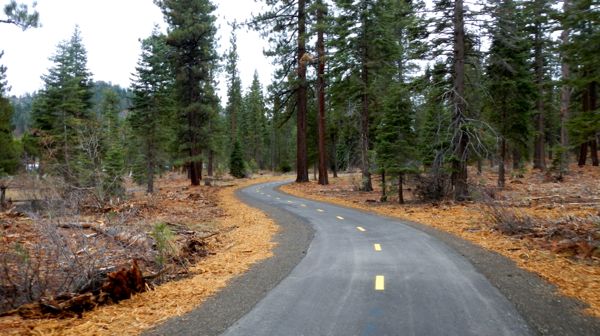
Cyclists no longer have to ride on Lake Tahoe Boulevard on the South Shore. Photos/Kathryn Reed

Cyclists no longer have to ride on Lake Tahoe Boulevard on the South Shore. Photos/Kathryn Reed

By Kathryn Reed

Sometimes riding on Lake Tahoe Boulevard between Highway 50 and the Angora burn area can be an adrenaline rush. The problem is it has nothing to do with pedaling and everything to do with drivers.

With the vehicle lanes being narrow and the shoulder non-existent, it can be scary with cars whizzing by at speeds topping 55 mph, even though the posted speed limit is 50 mph.

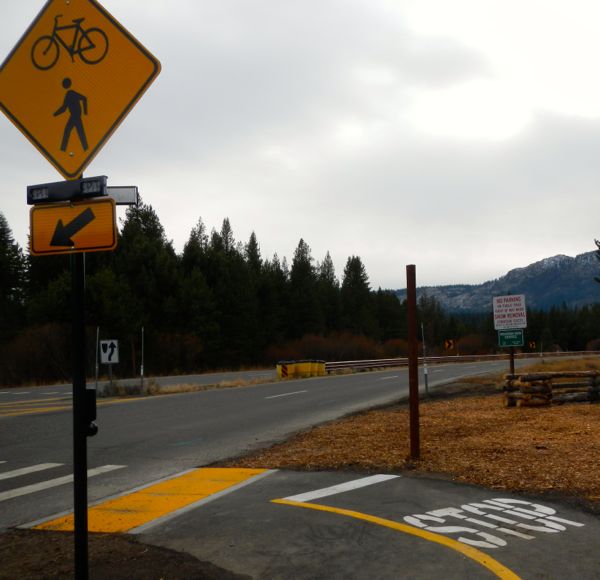
Now there is an alternative to that harrowing ride. A 1.7-mile Class 1 bike path was laid down this fall. It essentially follows what had been a dirt path mountain bikers would use.

It starts at Viking Way at the base of South Tahoe High School, meanders through the woods – with singed trees from the 2007 Angora Fire still visible, and ends at Sawmill Road.

The nearly $800,000 trail is on U.S. Forest Service land, operated by El Dorado County under a special use permit.

“There is no plan to extend a Class 1 bike path,” Donaldo Palaroan, senior civil engineer with El Dorado County, told Lake Tahoe News. “However, we do plan to construct bike lanes toward Clear View Drive where the bike lane currently ends. So, a Class 2 bike lane will be extended from Clear View Drive/Mule Deer Circle to Sawmill Road to connect with the Lake Tahoe Boulevard bike path and the Sawmill 2 bike path.”

Erosion control measures line the trail.

Erosion control measures line the trail.

While road bike riders traditionally prefer the road to a path because they can go faster and not be encumbered by other users, they have been seen on this trail.

“Bikers are hypersensitive to 3,000-pound-plus metallic objects lumbering down the road at or above of 50 mph while rocking out to Axle Rose and Slash, particularly when those objects are within an arm’s reach,” Garrett Villanueva, USFS trails specialist, told Lake Tahoe News. “So, I think some roadies will use the bike path and I think recreational or less experienced bicyclists will tend to use the path exclusively.”

Mountain bikers are also using the trail. This gets them to dirt trails in the Tahoe Mountain area. A sign at the Sawmill end includes a permanent map that lists the various trails in the area.

Walkers, dogs and inline skaters have also been populating the trail.

At the Sawmill juncture people have the choice to get onto Lake Tahoe Boulevard without any lane markings or to cross the boulevard to get onto Sawmill Road. Eventually the county is going to reduce Lake Tahoe Boulevard to one lane in each direction from Sawmill to Tahoe Mountain Road.

At the crosswalk there is a button that will trigger a flashing yellow light to warn motorists people are in the road.

The new path connects to the Sawmill Road trail.

The new path connects to the Sawmill Road trail.

Once across people have the opportunity to be on a trail for seven-tenths of a mile along Sawmill Road that was built in 2012. In 2015, the rest of the trail will be constructed. In total it will be 1.3 miles. The second half will remain on the same side as the current trail (which wasn’t always the plan) and has already been outlined. The erosion control work for the trail was done this year.

Once that section is done it’s possible to be on a bike trail from Meyers to STHS.

Future connections include going from STHS to the Y.

There is limited parking at Sawmill Road and Lake Tahoe Boulevard.