Caesars lenders reveal plan as debt talks unravel

By Kimberly Pierceall, AP

Looking for cash, Caesars Entertainment officials looked no further than the company’s flagship Las Vegas Strip hotel-casino Caesars Palace and saw $2.6 billion that could be raised by mortgaging the 4,250-room resort modeled after Ancient Rome.

The proposal was revealed this week after the company’s bank lenders were the latest creditors to walk away from talks with the hotel-casino giant to restructure a sizable amount of its debt in order to avoid a messy bankruptcy case.

Bank lenders with a first-lien on Caesars debt posted the company’s proposals online Thursday after a confidentiality agreement expired. The Caesars Palace proposal was one part of a larger proposal made to lenders to restructure Caesars’ debt during talks that began in September.

Caesars is the parent company of Harrah’s Lake Tahoe and Harveys at Stateline.

Financial analyst Alex Bumazhny with Fitch Ratings said he had never seen anything like it, but the document dump was likely indicative of how upset creditors might be by the process.

Caesars had previously revealed the general terms of its pitch, splitting Caesars Entertainment Operating Company division into two real estate investment trusts, one to own hotel-casinos and the other to lease and manage them.

The documents posted online provided more detail including the plan to make Caesars Palace its own real estate investment trust using it to raise $2.6 billion in cash in new financing. Documents also revealed how much Caesars offered to make its creditors whole through cash, debt and equity: bank lenders would recover everything owed, $5.4 billion, and noteholders would recover 93.8 percent or $5.9 billion.

Caesars Entertainment was bought in 2008 with its new owners Apollo Global Management LLC and TPG issuing billions in debt to raise cash for the purchase. As of the company’s last quarterly filing, $22.8 billion in long-term debt weighed down Caesars.

Its operating division holds most of the debt making it the focus of recent lawsuits filed by some creditors claiming the company has drained that division of assets — except Caesars Palace — by moving of its money-making hotel-casino properties to other divisions, cutting guarantees to creditors and allowing debt to mount. The creditors have claimed the company is in default on its agreements.

The company has responded in financial filings calling the claims meritless.

Bumazhny said he thought the idea to raise $2.6 billion in cash by essentially mortgaging Caesars Palace represented a hefty amount of debt to saddle one property with, saying it represented 10 times the amount of the hotel-casino’s earnings before interest, tax depreciation and amortization.

He said it was hard to say why the creditors may have walked away, except to say that the process has been complex and contentious with multiple parties involved at varying levels.

Some of the operating division’s junior creditors are owed a $223 million interest payment Monday.

Fitch Ratings has speculated that the company may skip that payment in order to keep the cash it has left to pledge to its creditors first-in-line to be paid.

“It all depends on how much time Caesars wants to buy itself,” Bumazhny said.

The company said in a financial filing Friday that it’s still in discussions with its remaining bondholders.

Bumazhny said if the company feels it’s near a deal, it may pay the $223 million it owes Monday.

Caesars spokesman Gary Thompson offered no comment on the filings or whether Caesars would pay its $223 million interest payment Monday.



Cops scan social media to assess ‘threat rating’

By Brent Skorup, Reuters

A national spotlight is now focused on aggressive law enforcement tactics and the justice system. Today’s professional police forces — where officers in even one-stoplight towns might have body armor and mine-resistant vehicles — already raise concerns.

Yet new data-mining technologies can now provide police with vast amounts of surveillance information and could radically increase police power. Policing can be increasingly targeted at specific people and neighborhoods — with potentially serious inequitable effects.

One speaker at a recent national law enforcement conference compared future police work to “Minority Report”, the Tom Cruise film set in 2054 Washington, where a “PreCrime” unit has been set up to stop murders before they happen.

While PreCrime remains science-fiction, many technology advances are already involved with predictive policing — identifying risks and threats with the help of online information, powerful computers and Big Data.

New World Systems, for example, now offers software that allows dispatchers to enter in a person’s name to see if they’ve had contact with the police before. Provided crime data, PredPol claims on its website that its software “forecasts highest risk times and places for future crimes.” These and other technologies are supplanting and enhancing traditional police work.

Read the whole story


Volunteers helping Tahoe water quality

By Kathryn Reed

A lot of gunk flows into Lake Tahoe, causing the clarity to decline and algae to grow. Most of it comes in the winter and spring via storm runoff. But the lasting effect is making the water near the beaches less inviting, especially in the summer.

None of this is news.

What is new is the concerted effort that is under way to study all of that water that is flowing to the lake. Instead of just having the states mandate that the jurisdictions reduce the amount of fine sediment reaching the lake, there is actual monitoring going on to know what is mixed in with the water and which corrective measures are or are not working.

The jurisdictions around the lake are mandated to reduce their pollutant loads. That is what all the “erosion control” projects are about. The Lahontan Regional Quality Control Board’s total maximum daily load mandate is a 65-year program with the goal of returning the lake clarity to 100 feet – the depth a white dinner plate-like disc could be seen in the 1960s.

Tahoe Resource Conservation District is the lead agency of the Regional Stormwater Management Program. TRCD is seen as a neutral third party between those dictating what must be done and those who must carry out the orders. All sides are part of the program.

“We are providing consistent data collection, management, analysis and reporting methods,” Sarah Bauwens of TRCD told a group of nearly 50 people on Dec. 10 at Lake Tahoe Community College.

A dozen urban catchments are being monitored. Data is being collected from 10 to 12 precipitation events a year, including rain, snow, rain on snow and thunderstorms.

Turbidity, or the cloudiness of the water, is being measured. Data is showing sediment doesn’t just come down with the first rush of water.

“We’ve only done one full year of monitoring. Over time we want to see if there is a downward trend in pollutant load,” Bauwens said.

She said it would take five years’ of data to detect a trend.

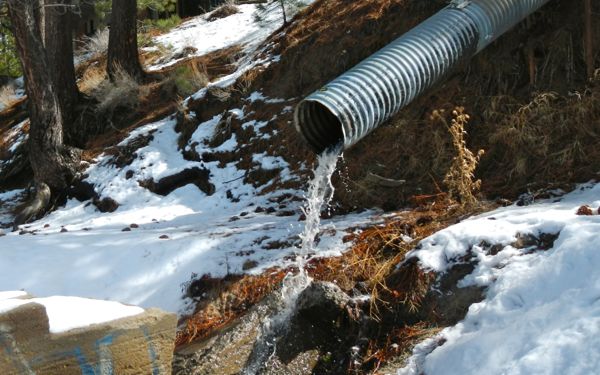
Water flows from the pipe  below the old Alta Mira building in South Lake Tahoe. Photo/LTN file

Water flows from the pipe below the old Alta Mira building in South Lake Tahoe. Photo/LTN file

In addition to fine sediment, nitrogen and phosphorous are other pollutants that are cause for concern.

The volume of water is measured.

Water samples are sent to labs.

Some of the monitoring occurs at the end of the pipes that carry runoff to the lake, some involves seeing if erosion control measures (best management practices) are working, and then there is the rapid assessment method that tests if things are working based on what the models said would happen.

This program will ideally help the stakeholders be able to make changes sooner if need be.

All of the information is being put in to a dedicated database. There is a scientific advisory group assisting with the program as well as a technical advisory committee to keep everyone up-to-date.

Also assisting with data collection are the pipe keepers, a group of volunteers working for the League to Save Lake Tahoe.

Nephelometric turbidity units, or NTU, are how turbidity is measured. The pipe at Timber Cove measured 150 NTU on Aug. 11. Before this week’s storm no water had come out of that pipe since then. South Lake Tahoe’s multi-million dollar Bijou erosion control project is being credited with the turnaround, according to Aaron Hussmann with the League.

At the end of Wednesday’s gathering there was a panel discussion with representatives from the League, Lahontan, South Lake Tahoe, TRCD and Tahoe Regional Planning Agency.

They said:

• Regular maintenance of erosion projects is having better benefits than expected.

• As technology improves, more improvements can be made.

• The first 20-years of the TMDL will shed a lot of light on what is working.

• Looking at how nature worked before all the development came is critical.

• Controlling sediment at the source is ideal.

• Requiring infiltration systems be part of development or redevelopment projects will help.

——

Notes:

  • More info about Tahoe Resource Conservation District is online.
  • More pipe keepers are needed. Info is online.


Vaccination rates up for Calif. kindergartners

By Phillip Reese, Sacramento Bee

More California kindergartners are getting their vaccinations before starting school, curbing a decadelong trend of falling immunization rates, new state figures show.

The shift comes as California experiences one of its worst whooping-cough outbreaks in generations. Health experts said several prior years of lax immunization primed the state for such an outbreak.

This year’s rise in vaccination rates corresponds to the introduction of a new “personal belief” form that must be completed by parents who don’t want to immunize their children. The result of a new state law, the form must be signed by a doctor who acknowledges telling parents about the risks and benefits of vaccinations; alternatively, parents can state that visiting a doctor violates their religious beliefs. The new form replaces a document that did not require a doctor’s signature.

Read the whole story


Nevada a leader in immigration reform

By Ana Ley and Amber Phillips, Las Vegas Sun

When President Obama gave Astrid Silva a shout-out last month, he did more than put a face on his new immigration plan.

He helped thrust Silva, and her home state of Nevada, into the national spotlight on immigration reform.

She has since used her political fame to sell the president’s divisive executive action. Her latest push came before a Senate panel Wednesday, where she accused Obama’s critics of “attacking America and everything that has made this country strong.”

“When people challenge the president’s authority, they’re attacking me,” Silva said. “They’re attacking my mom.”

Astrid is one of several Nevada players who are behind a movement that is intensifying attention on the state’s unique immigration landscape. And what happens in Nevada could impact the national conversation about changes in policy.

Read the whole story


Underhill to take command of EDSO Tahoe office

Lt. Matt Underhill will lead the Tahoe substation of the El Dorado County Sheriff's Office. Photo/Provided

Lt. Matt Underhill will lead the Tahoe substation of the El Dorado County Sheriff’s Office. Photo/Provided

By Kathryn Reed

Young, active, outdoorsy and practically a native. Those are some of the attributes of the next lieutenant to run the Lake Tahoe office of the El Dorado County Sheriff’s Office.

“I don’t really foresee changes,” Lt. Matt Underhill told Lake Tahoe News. “I want to continue the legacy of Les (Lovell) and Pete (Van Arnum) and keep strong community ties and listen to the needs of citizens and respond accordingly. They are who we work for, who we should be listening too.”

While Van Arnum retires at the end of the month, Underhill won’t actually be in the Tahoe office for at least six months, maybe a year. He will be working on the West Slope, training for his new position.

He was just recently promoted to lieutenant, having been a sergeant in the Tahoe office. (Lt. Bryan Golmitz will be in Tahoe until Underhill takes over.)

“It’s important to have someone from Tahoe in this position,” Van Arnum told Lake Tahoe News. “He has the right temperament to be a good leader, the guys respect him, and he’s real approachable.”

Underhill moved here when he was 1, then went through the local schools. He started his law enforcement career in San Diego in 1999 with the sheriff’s department and then moved to that city’s police department. In 2002, he started with EDSO. He wanted to come back to live in the mountains and raise his children here.

“Tahoe is my hometown. I plan to finish my career here,” Underhill said.

What he likes about the sheriff’s office is the variety of responsibilities the department is responsible for — including narcotics, SAR, boat patrol, all crime in the county and even vacation rentals.

At 37, he is the youngest lieutenant to lead the Tahoe substation. This could open opportunities for further advancement. In the 1980s Tahoe had a captain; now they are all in Placerville.

With the promotion comes the removal of Underhill as commander of the South Lake El Dorado Narcotics Enforcement Team. A sergeant from EDSO is expected to take over those responsibilities later this month.

While Underhill is now well versed in narcotics, it’s search and rescue where his passion lies.

“Search and rescue is close to my heart because I’m passionate about the outdoors,” Underhill said.

Skiing, mountain biking and rock climbing are the favorite ways for him to play outside.


Wind taking down trees, power lines in Tahoe

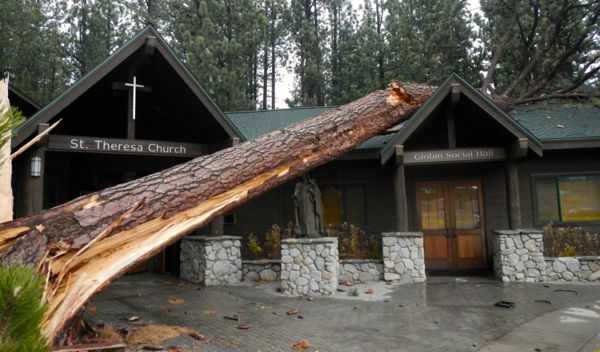
Mother Nature took a swipe  Dec. 11 at St. Theresa Church in South Lake Tahoe. Photo/Kathryn Reed

Mother Nature took a swipe Dec. 11 at St. Theresa Church in South Lake Tahoe. Photo/Kathryn Reed

Uodated 8:25pm:

There are 3,500 customers in the Sierra Tract area without power. Liberty Utilities has no idea when power will be restored.

Updated 7:15pm: The lines are in the air and power to the South Lake Tahoe-Meyers area should be restored any minute, according to LIberty Utilities. By Kathryn Reed A tree more than 200-feet tall fell onto St. Theresa Church in South Lake Tahoe on Thursday morning. City building officials are testing the integrity of the structure. From the outside the Jeffery pine looks worse – having broken – and the roof barely dented considering the force that was thrust upon it. Church officials got a call from the fire alarm company at 11:37am Dec. 11. Caution tape is surrounding the church. “We’ve had nothing to this extent before,” the Rev. Ben DeLeon told Lake Tahoe News as he sat in the dark at Grace Hall. The frozen pipes 10 years ago don’t compare to this. He sat looking a bit bewildered, knowing that Dec. 12 is one of the biggest services of the year – Lady of Guadalupe. With the number of trees falling everywhere in the Lake Tahoe Basin because of the high winds, the tree could not immediately be removed. The church was placed on a waiting list, though a company was expected out some time Dec. 11. A tree also took out three staff vehicles in the staff lot at South Tahoe High School. Lake Tahoe Unified let students out early on Thursday and has already canceled classes for Friday. At 5pm Dec. 11 Liberty Utilities said the outage in Woodfords and Markleeville caused by down lines will likely be out for six hours. Waves are so high on the lake that people have out been out surfing. Some reports are of 7-foot waves. Most of the South Shore is without power because the Meyers substation is out. This is causing 8,800 Liberty Utilities customers to be in the dark. Liberty provides power for the California side of the basin as well as Alpine County and Truckee. The main and back-up lines at Marshall Trail going to the Meyers substation went down, but the poles are standing. Crews are on the scene. The estimated time for power to return is by 7pm. South Lake Tahoe offices and Barton Memorial Hospital are operating on generators, as are all the Stateline casinos. The Flight Deck restaurant at the airport is doing a brisk business because the fryer is working and sandwiches don’t require heat. Lights are on near the state line, with the Starbucks having a consistent line. NV Energy provides power on the Nevada side. Thousands of customers are still without power, with no estimated time of power to come back. “We try to get people back in service as quick as we can. It’s like any other construction job; you never know what might come up,” Karl Walquist with NV Energy told Lake Tahoe News. On the Nevada side, the biggest outage is on Kingsbury Grade, which is affecting 1,500 customers. In Glenbrook, 321 customers are without power; 145 in Zephyr Cove along Lakeview Drive and Pharris Lane; and 45 on Winding Way between Zephyr Cove and Glenbrook. Carson City and Reno are also having trouble because of the weather. Winds in the basin were heavy throughout the night and have continued into Thursday morning, but calmed down by mid-afternoon. Rain started to fall on the South Shore about 10am. The winter storm warning is still in effect from 1pm today through 1pm Friday. Utility crews are expecting more power outages as the wind continues and rain turns to snow, especially because this is a warm storm so the snow will be heavy.


Nev. awarded share of federal preschool grant

By Trevon Milliard, Las Vegas Review-Journal

Nevada is one of 18 states splitting $226 million in federal grants to develop public preschool programs in 2014, according to an announcement by the U.S. Secretary of Education Arne Duncan and U.S. Department of Health and Human Services in a press call Tuesday.

Half of the 36 states that applied were named grant recipients.

“This investment in young children is a game-changer for the next generation of Nevada’s students,” state Superintendent of Public Instruction Dale Erquiaga said.

But Nevada will be given a relatively small piece of the pie. At $6.4 million, its Preschool Development Grant for the first year is about half the $12.6 million average.

Read the whole story


Youngsters dive into special classroom

 Larry Phippen teaches Bijou fourth-graders how to be better swimmers. Photos/Kathryn Reed

Larry Phippen teaches Bijou fourth-graders how to be better swimmers. Photos/Kathryn Reed

By Kathryn Reed

Holding on to the side of the pool the youngsters kick as hard as they can, causing Larry Phippen to close his eyes with all that water headed in his direction.

He’s telling them to turn their heads and breath. Later they grab kickboards to make their way across the width of the pool. Other times they are going after rings at the bottom of the pool.

The noise from all of these kids at the South Lake Tahoe pool is deafening under the dome.

“I think this is a great opportunity. It doesn’t matter who the person is. If they are going to a public school, it’s important for a city when they have a facility like this to offer something back to the community where it doesn’t cost anything,” Phippen told Lake Tahoe News. He is the instructor for this swim program and is also a coach with the private Tahoe Swim Club.

Jasmine Perez kicks along the wall.

Jasmine Perez kicks along the wall.

Since the mid-1980s the city and Lake Tahoe Unified School District have had a partnership where every fourth-grader has the opportunity to learn to swim at no cost to the student.

The kids are divided into beginner, intermediate and advanced groups. Each class receives one week of instruction for about an hour a day.

“A lot of families have never been to the swim center. And a lot of kids have never been swimming before today,” Rebecca Musalo, Bijou Community School teacher, told Lake Tahoe News.

Hugo Perez is in the beginner group, which is staying in the shallow end where everyone can touch the bottom. Some in this group, like Hugo, have swum before but are not proficient, while others are new to the sport.

Hugo likes floating on his back the best.

“I feel like I’m in a bed on the water,” Hugo told Lake Tahoe News.

The hardest part was learning to turn his head in the water to breathe.

Hugo Perez practices floating on his back.

Hugo Perez practices floating on his back.

His dad, Hugo Perez Sr., was on the pool deck watching with admiration. This is how he chose to spend his day off – watching his son become more adept at an activity that he likes.

Safety in and around water is the overriding lesson all levels are taught. This includes being able to tread water and float on their back.

Everyone helping the kids is a certified safety water instructor. The program is nationally recognized by the American Red Cross Learn to Swim Program.

“What surprises me around here is you have a lot of public free access to beach areas, but not a lot of guards,” Phippen said, underlining the importance of being self-reliant. “We teach them how they can survive in water and feel comfortable.”

At the end of the week, each student is given a handout stating what level they are at and what program would be ideal for them if they chose to take more lessons at the recreation center. The city offers swim lessons throughout the year.


House OKs Calif. drought bill that faces Obama veto

By Bettina Boxall and Evan Halper, Los Angeles Times

The U.S. House on Tuesday passed a California drought bill, despite a veto threat from the Obama administration and its expected demise in the Senate in the final days before Congress adjourns.

The 230-182 vote was largely a symbolic gesture in the years-long effort by House Republicans to weaken endangered species protections that have restricted water deliveries from the Sacramento-San Joaquin Delta to San Joaquin Valley agribusiness and urban Southern California.

The measure, which was introduced last week after House GOP negotiations with Sen. Dianne Feinstein (D-Calif.) fell apart, was opposed by environmentalists, the White House and Gov. Jerry Brown’s administration.

“This is no time to re-ignite water wars, move water policy back into the courts, and try to pit one part of the state against another,” California Natural Resources Secretary John Laird wrote in a letter Tuesday to the California congressional delegation.

The 26-page bill focused on water operations in the delta and Northern California, directing federal agencies to take steps that would send more delta water south. Proponents of the measure said that endangered fish restrictions had significantly reduced Delta pumping during storms in late 2012 and early 2013.

Read the whole story