Nevada marijuana sales continue to take off

By Colton Lochhead, Las Vegas Review-Journal

Nevada has brought in more than $30 million in tax revenue from marijuana in its first six months of legal recreational sales, according to the revenue numbers released Friday by the Nevada Department of Taxation.

About that $19.5 million of that has come from the special 10 percent sales tax on the nearly $200 million worth of recreational marijuana sold across the state.

Read the whole story


A Miracle March is not something to bet on

By Benjamin Spillman, Reno Gazette-Journal

In late February of 1991, the snowpack in the Lake Tahoe, Truckee, Carson and Walker basins was about 16 to 20 percent of normal.

By April 1, after a month of seemingly non-stop snowstorms, the snowpack recovered to as much as 80 percent of normal in some places.

When looking at the dismal snowpack numbers from the winter of 2017-18, it’s tempting to take comfort in the possibility of another Miracle March, similar to 1991.

Tempting, but not very comforting when you consider the odds. There’s a reason people called March 1991 a miracle.

Read the whole story


Scientists investigate fire, long-term resilience

By Sherri Eng

As the state recovers from devastating fires in the north and south, a team of California-based scientists is taking a deeper look at forest resilience in the face of future fires.

A collaborative team of multidisciplinary researchers from the California Academy of Sciences and the U.S. Forest Service’s Pacific Southwest Research Station are investigating a forested Northern California watershed—and its birds—to determine how prescribed fire may contribute to healthier forest ecosystems and reduce the risk of high intensity wildfires. By surveying birds and local conditions in a forest targeted for prescribed fire, the team will capture a multi-year picture of what fuel-heavy ecosystems look like before a fire, how they respond to prescribed fire in the near-term, and how they might change if a wildfire occurs down the road.

“California forests are treasures to the wildlife and people of our state,” says Durrell Kapan, senior research fellow at the California Academy of Sciences and a co-leader of the resiliency project. “There couldn’t be a more important time to research the impacts of forest fires—especially the role of supervised, prescribed fires to reduce the risk of extreme burns. Our group is interested in understanding how to manage forests in a healthy way so we can avoid the devastating megafires that often follow drought and disease.”

The first survey results point to the importance of regular prescribed burns to keep healthy forests thriving and nearby communities safer from catastrophic wildfires. The five-year scientific survey and outreach program, which launched this past spring on the 20,236-acre Caples Creek watershed along the South Fork of the American River, will continue in spring 2018.

Fire, climate, and a ‘study’ forest

The frequency and intensity of the West’s wildland fires is increased by global climate change. Earth’s changing climate has contributed to more variable bouts of extreme wet or drought, which can include drier soils and longer fire seasons—conditions that increase the likelihood of intense, more dangerous fires that are difficult to control. Combined with our country’s long history of suppressing fire in our forests, current conditions are making way for severe, record-breaking wildfires up and down California.

In the face of climate impacts, widespread regional tree death, and longer, more catastrophic fire seasons across the state, scientists from the academy and PSW teamed up to identify a study region that might be used as a stand-in for forests elsewhere. Unlike some forests in its nearby neighbor, the Lake Tahoe Basin, much of the forest land in the Caples Creek watershed has been fire-free for more than 80 to 100 years, meaning the forest floor has a large amount of “fuel”—dead trees and layers of vegetation built up over time—and is susceptible to major fires in the future.

“The Caples Creek watershed has a long history of fire suppression, but otherwise it has not been significantly altered by people,” says Pat Manley, PSW’s Conservation of Biodiversity research program manager. “It has incredible natural resources, biodiversity, and a variety of forest types that are a great fit for this type of study of how to use prescribed fire to maintain and enhance forest resilience.”

Birds as ecosystem indicators

In summer 2017, scientists from the Academy—including Kapan and Jack Dumbacher, curator of ornithology and mammalogy—joined PSW in surveying the birds of the Caples Creek study area before any scheduled prescribed burns. The team is interested in how birds currently depend on the watershed’s diverse habitats, as well as how they will respond to future fire. Eighty-three study sites throughout the 20,236-acre watershed were chosen both inside and outside the area planned for prescribed fires. Over the course of the first summer survey, the team detected 45 bird species (from 1,700 individual birds) and measured vegetation at each site to see how fire changes ecosystems over time.

“There’s a method to the madness of surveying forest birds,” says Dumbacher. “We spend 10 ultra-quiet minutes in each site, and watch and listen for any birds around us. When we look at the data from the first pre-burn survey, we see that different birds depend on all different parts of a healthy forest to survive. We’ll return to these sites to see what changes in the years to come as prescribed burns roll out and the ecosystem changes.”

A five-year plan
One way to reduce severe fires is to decrease fuel wood by reintroducing smaller fires to the forest at the right time of year—during times when the forest floor and woody vegetation have a lot of moisture from rain or snow. This past fall, the Forest Service launched its five-year project of prescribed fire in the Caples Creek watershed with hand tools and careful planning. Managers take into account winds, moisture, and temperature to minimize the risk of burning more than accumulated forest fuel.

“Forests need fire to thrive and keep our human communities safer,” says Kapan, “but we need a better understanding of how certain management techniques impact wildlife. Forest managers, scientists, private landowners, and communities, you name it—we’re all adapting to a new climate and fire reality in California. Forests are always cycling and changing, and we want to help identify the most natural, cost-effective path to lasting resilience.”

Following a pre-survey this spring, academy and PSW scientists will return for the second year of bird surveys during late spring. The academy, an institution with a history of more than 150 years of California biodiversity research, and the team from PSW hope to continue monitoring the impacts of multi-year fuel reduction on the forest ecosystem—birds, trees, and more—through 2022.

Sherri Eng is with the Pacific Southwest Research Station of the USFS.


Reno-based ski companies having Olympic ‘Moment’

By Benjamin Spillman, Reno Gazette-Journal

By the time David Wise dropped in for his final run, the tension was palpable at both the venue and nearly 5,600 miles away at Wild Garlic Pizza in Reno.

That’s where a group of employees from Moment Skis, the Reno-based company that made Wise’s skis, gathered to watch the event.

“It was just the most nervous and the most excited I had ever been for a sport,” said Luke Jacobson, Moment’s CEO.


Moment didn’t make the bindings that gave Wise trouble, but that didn’t make the experience any less stressful for Jacobson.

Read the whole story


Analysis: Trump’s attack on renewable energy, EPA hurts Nev.

By Ric Anderson, Las Vegas Sun

On the morning after his State of the Union address, in which President Trump told the nation that his administration had “ended the war on American energy,” he made news that suggested otherwise.

Citing draft budget documents it obtained from the White House, The Washington Post reported that the Trump administration was proposing to cut federal funding for renewable energy research and development by 72 percent.

“This couldn’t have been worse for this state,” said Robert Lang, an economic development expert and executive director of Brookings Mountain West, during a panel discussion examining the State of the Union address. “This is an actual assault on something that was one of the state’s largest job producers, one of the gainers in our economy, one of our points of pride.”

Read the whole story


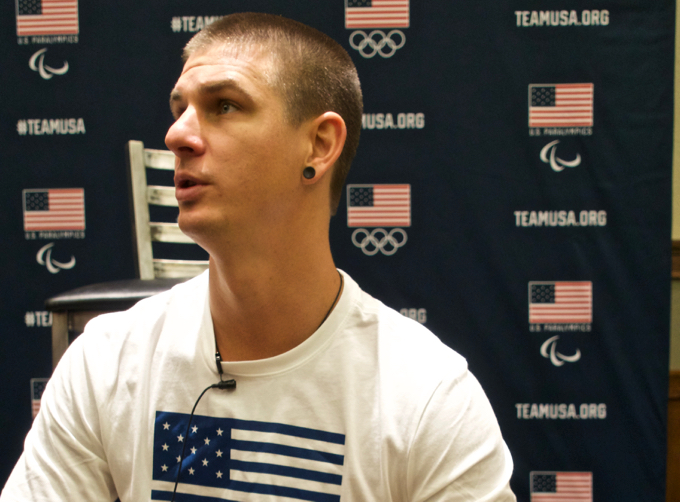
Paralympian with Tahoe ties set to defend gold

Evan Strong learned to snowboard at Northstar after losing part of his leg. Photo/Kathryn Reed

By Kathryn Reed

Evan Strong never had dreams of being a snowboarder. He was a beach guy, having grown up in Maui. Skateboarding was his sport of choice. He had sponsors at 13 and was on his way to being a professional skateboarder.

A drunken driver ended his career.

Part of Strong’s left leg had to be partially amputated after the motorcycle he was riding was struck head on. This was 10 days before he turned 18.

Today the 31-year-old hopes to defend his snowboard cross gold medal at the Paralympic Winter Games in PyeongChang, South Korea, next month. The Paralympics are March 9-18 where the able bodied Olympians just wrapped up their two-week stint.

“I’m in love with board sports and I want to play,” Strong told Lake Tahoe News. “I saw a snowboarding magazine and thought why I haven’t I done that.”

Living in a Hawaii was a main reason.

It was in 2007 that Strong arrived at Northstar to work and learn how to snowboard.

Strong describes Tahoe as “endless seasons of fun.” While living in the Truckee-North Shore area he also got into mountain biking.

He spends a great deal of time training in the Rockies, though he was out in the Tahoe area last season.

“Squaw Valley is as good as the Rockies,” Strong said.

He praised Boreal for its terrain park, Sugar Bowl for its terrain and Northstar for its glades.

In many ways he was a natural on the snow because of his affinity for board sports. Snowboard cross is what gives him the “biggest rush.” He has earned every title in the sport of para-snowboarding.

The sport was introduced at the 2014 Sochi Paralympic Winter Games.

In this Games he will compete in snowboard cross and banked slalom.


Some fear Calif. drought cuts could erase water rights

By Jonathan J. Cooper, AP

A proposal to make California’s drought-era water restrictions permanent could allow the state to chip away at long-held water rights in an unprecedented power grab, representatives from water districts and other users told regulators Tuesday.

Members of the state Water Resources Control Board delayed a decision about whether to bring back what had been temporary water bans from California’s drought, spanning 2013 to 2017. The plan is part of an effort to make water conservation a way of life, with climate change expected to lead to longer, more severe droughts.

It comes after U.S. officials declared that nearly half the state, all of it in the south, is back in drought just months after emerging from it.

Read the whole story


Why doesn’t anyone know who David Wise is?

By Justin Peters, Slate

Immediately after finishing his final run in the freestyle skiing halfpipe event, David Wise tossed his ski poles into the snow. “I’m sorry, I’m sorry,” Wise said, apologizing to no one in particular. “I got a little excited.”

Wise had good reason to celebrate. His first two runs of the three-run final had been busts, sabotaged by a broken binding on his skis. But the binding held together for his last run, a superlative, twist-and-flip laden jaunt that earned him a score of 97.20—5.20 points higher than the mark that won him the gold in Sochi. Wise’s superlative final run held up, earning his second consecutive Olympic title. As I watched him come through in the clutch and listened to NBC’s announcers read off his accolades, I wondered one simple thing: Why isn’t David Wise super famous?

He ought to be. Wise is the best freestyle halfpipe skier in the world, and the only man ever to win gold in the freestyle ski halfpipe event, which made its Olympic debut in Sochi.

Read the whole story


SLT pushing forward with recreational pot laws

By Kathryn Reed

The goal is for the initial draft of South Lake Tahoe’s recreational marijuana ordinance to be completed by the end of the month or early March so the Planning Commission could discuss it at a special meeting next month.

An attorney with Burke, Williams & Sorensen is writing the document. This is because interim City Attorney Nira Doherty, who works for that firm, is on vacation.

The goal is for the council to have an ordinance to discuss at the March 20 meeting.

After a nearly 3½ hour meeting on the topic on Feb. 20, it was decided that the recommendations of the community working group should form the foundation of the ordinance. From there the Planning Commission and City Council will fine tune things.

The main issues still to be debated are the number of shops (three were proposed by the group), where they would be located (anywhere as long they meet buffer requirements for schools and the like, the group says), and whether micro businesses should be allowed (no says the group).

The Tuesday meeting started out as a rehash of what was presented to the council earlier this month.

More than 70 people attended the workshop at Tahoe Beach Retreat. This was a joint session of the City Council and Planning Commission. As the presentation was in progress members could ask for a topic to be discussed in depth later. When “later” will be remains a mystery since it didn’t happen at that meeting.

What was a little different was the preferential treatment given to Lake Tahoe Unified School District and Barton Health. Both were asked to be part of the city’s working group, both chose not to. They were called up to the lectern first by Mayor Wendy David.

Reps from both spoke of how there is already a drug problem in town and how there aren’t enough resources – aka money – to cope.

Police Chief Brian Uhler was also given the opportunity to spend ample time on how he wants to curtail expansion of marijuana in the city limits.

Ironically, though, it was said there is no base line data from which to prove going forward with recreational pot shops would increase or decrease use or crime. It was not explained why the schools, police and Barton can’t collate their respective data to come up with solid information.

Many see pot shops as a cash cow in terms of tax revenue. The potential is there. Caution was urged, though, in terms of implementing too high of a tax so as not to drive the product underground where it would be less expensive for the consumer and possibly more dangerous an unregulated drug. Barton and LTUSD are hoping for a piece of the tax revenue.


Calif. weighs renewing drought-era water restrictions

By Jonathan J. Cooper, AP
 
SACRAMENTO — A proposal to make California’s drought-era water restrictions permanent could allow the state to chip away at long-held water rights in an unprecedented power grab, representatives from water districts and other users told regulators this week.

Members of the state Water Resources Control Board delayed a decision about whether to bring back what had been temporary water bans from California’s drought, spanning 2013 to 2017. The plan is part of an effort to make water conservation a way of life, with climate change expected to lead to longer, more severe droughts.

It comes after U.S. officials declared that nearly half the state, all of it in the south, is back in drought just months after emerging from it.

Read the whole story