S. Lake cemetery to honor military, public safety

An artist's rendering of what the memorial niches will be like at Happy Homestead Cemetery.

This is what the memorial niches will be like at Happy Homestead Cemetery. Rendering/Gabriel Hydrick

By Kathryn Reed

Plans are drawn, permits are being sought and the construction bid process is under way for what will be a memorial at Happy Homestead Cemetery for veterans and public safety.

“We are trying to make it as good as Arlington or better,” cemetery manager Mike Warren told Lake Tahoe News.

It will certainly be smaller. The entire area is about 30 feet by 40 feet.

The new feature will be in front of the office of the South Lake Tahoe cemetery where the annual Memorial Day ceremony is conducted.

The $120,000 project is expected to begin next building season, with completion in the summer.

It will be comprised of three niche banks, with a total of 178 niches. Each niche has enough room for two sets of ashes. There will also be an area for in-ground cremations.

Happy Homestead is already the final resting place for many veterans – about 1,000.

A black granite wall will have engraved badges from the public safety members.

While normally a requirement to be buried at Happy Homestead is to have been a resident of the district – which is roughly the same as the Lake Tahoe Unified School District boundary – Warren said any member of the military, police or fire services who dies in the line of duty will be able to be interred in the new area.

Warren said the district is looking at changing the residency rule for the whole cemetery, but added it is a complex process. It has to do with the state Health and Safety Code. The current rule means people who die on the Nevada side of the South Shore don’t have a local cemetery to use.

To help pay for the upcoming improvements the cemetery district is selling $100 memorial bricks that will be the paving stones at the site. They may be in honor of or in memory of a person in public safety or the military.

A new flagpole will also be erected.

People are already reserving a space in the memorial niche. They are also buying bricks.

For more information, call the cemetery at 530.541.7070.


Congress ends federal ban on medical marijuana

By Evan Halper, Los Angeles Times

Tucked deep inside the 1,603-page federal spending measure is a provision that effectively ends the federal government’s prohibition on medical marijuana and signals a major shift in drug policy.

The bill’s passage over the weekend marks the first time Congress has approved nationally significant legislation backed by legalization advocates. It brings almost to a close two decades of tension between the states and Washington over medical use of marijuana.

Under the provision, states where medical pot is legal would no longer need to worry about federal drug agents raiding retail operations. Agents would be prohibited from doing so.

The Obama administration has largely followed that rule since last year as a matter of policy. But the measure approved as part of the spending bill, which President Obama plans to sign this week, will codify it as a matter of law.

Pot advocates had lobbied Congress to embrace the administration’s policy, which they warned was vulnerable to revision under a less tolerant future administration.

Read the whole story


Caesars misses $225 million interest payment

By Associated Press

Caesars Entertainment Corp. on Monday missed a $225 million interest payment it owes some of its creditors, giving the company 30 days to pay it or default.

A company official said in a financial filing that the company wouldn’t pay the $225 million its debt-heavy operations division owes because it was still negotiating with senior creditors for a deal that would restructure the division’s debt.

The missed deadline didn’t come as a surprise. Analysts and those watching the company’s financial situation had predicted the likelihood Caesars wouldn’t pay.

Caesars is the parent company of Harrah’s Lake Tahoe and Harveys in Stateline.

Alex Bumazhny with Fitch Ratings said days before that it was likely the company would miss it since it’s a payment to the operating division’s junior creditors. The company’s decision was predicated on how much time it wanted to buy to keep negotiating a deal with its first-in-line creditors to restructure finances ahead of a potentially messy bankruptcy filing, he said.

This gives the company 30 days.

Caesars had been talking with senior creditors for months in hopes of resolving its dire financial situation outside of potentially messy bankruptcy court proceedings. Some of those creditors had stopped negotiating and revealed the company’s proposal to split its operations division into a real estate investment trust with one entity owning the casinos and hotels and another paying to lease and manage them.

Among the ideas, Caesars officials proposed turning its flagship casino-hotel Caesars Palace into its own real estate investment trust and essentially mortgaging the property for $2.6 billion to raise cash to pay off lenders and bondholders.

Caesars had $1.5 billion in cash and $22.8 billion in debt as of Sept. 30.


Birders flock to South Shore for annual count

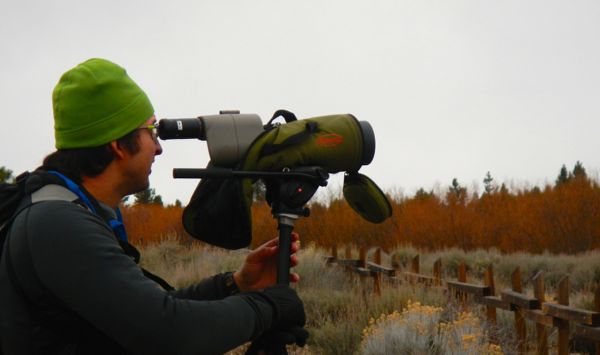
Scott Dietrich uses his scope Dec. 15 to better identify a bald eagle. Photos/Kathryn Reed

Scott Dietrich uses his scope Dec. 15 to better see a bald eagle. Photos/Kathryn Reed

By Kathryn Reed

With more than 300 bird species in the Lake Tahoe Basin, Scott Dietrich is on a quest to see as many as he can this year. Prior to the Dec. 15 Christmas bird count he was at 185.

Armed with binoculars to scan Cove East, Dietrich was quick to find the bald eagle perched atop a tree across the river and on the far side of the Upper Truckee Marsh. With a scope, there was no mistaking that white headed raptor.

The Incline Village resident has been birding for about seven years. While he does this mostly for fun, he has given birding tours and plans to again starting next May.

Dietrich’s most rare find was a short-eared owl that he saw in the Upper Truckee Marsh earlier in the fall. It’s unusual for this species to be at an elevation like Lake Tahoe’s.

His adventures take him to all parts of the lake, but it’s the South Shore he likes the most.

A red-shouldered hawk as  seen through a scope.

A red-shouldered hawk as seen through a scope.

“The Upper Truckee Marsh is probably the best area in Tahoe to look for rare birds,” Dietrich told Lake Tahoe News. “Lake Forest in Tahoe City is the other area for shorebirds.”

Dietrich was part of Monday’s annual bird count that takes place across the United States. This is the Audubon Society’s 115th annual bird count. Tahoe has been doing it since the early 1980s.

Data from the 2,300 counts will be tabulated by the national organization, which will document migration, breeding and other patterns.

Local numbers are still being calculated.

A 7½-mile radius, with the Upper Truckee Marsh being the center, is scoured for birds. Between 60 and 70 species have been documented the last few years. It’s the only bird count in the basin.

It didn’t matter that the temperature was in the 30s and snow was swirling in the air – this was the largest group to assemble for the annual count. They started at Cove East in South Lake Tahoe and then broke into groups stretching from Meyers to D.L. Bliss State Park to Cave Rock.

Before the group of 20 birders could get out of the roadway at Cove East the scopes were lined up looking at a red-shouldered hawk that was sitting on top of a pole at the Tahoe Keys Marina.

This bird used to be rare in Tahoe, but in the last few years it is common to find them at this higher elevation. Will Richardson, director of the Tahoe Institute for Natural Science, told Lake Tahoe News, “Bird populations are a dynamic thing. There are some natural contractions and expansions. Some is a result of climate change.”

But there is no disputing the avian population is changing.

“The Eurasian collared dove showed up a couple years ago. They came across the whole continent,” Richardson said.

A herring gull through a scope.

A herring gull through a scope.

Grace Mannell was probably the only one interested in seeing magpies. She recently moved here from the Bay Area, where this long-tailed bird is a rarity.

Some of the birders were on their first official count, others were veterans.

For Lynn and Don Harriman they have been counting birds every Wednesday for the last six years – either at Cove East or in the Upper Truckee Marsh.

“We wanted to see how the birds change through the years,” Don Harriman said of their avocation.

Almost everyone had binoculars, many had notepads to record what they saw, there were field books to help with identification and high-powered scopes — all tools of the trade.

Some of the birds were sitting still in trees, some flew overhead – like the two dozen robins, while others were on the water, and some were on the docks of the Keys – like the herring gull.

Three types of gulls call the Lake Tahoe Basin home – the herring, California, and ring billed. The herring is the most rare of the three. It’s here only in the winter. Those pink legs distinguish it from the others.

—–

Notes:

There will be a bald eagle count on Jan. 9. For more info, go online.


Congress to nutritionists: Don’t talk about environment

By Dan Charles, NPR

A government-appointed group of top nutrition experts, assigned to lay the scientific groundwork for a new version of the nation’s dietary guidelines, decided earlier this year to collect data on the environmental implication of different food choices.

Congress now has slapped them down.

Lawmakers attached a list of “congressional directives” to a massive spending bill that passed both the House and the Senate in recent days. One of those directives expresses “concern” that the Dietary Guidelines Advisory Committee “is showing an interest in incorporating agriculture production practices and environmental factors” into their recommendations, and directs the Obama administration to ignore such factors in the next revision of the guidelines, which is due out next year.

The directive is not legally binding, but ignoring it would provoke yet another political battle between the Obama administration and Congress.

The federal dietary guidelines have never explicitly considered the effects of food choices on the environment, but the idea of doing so is not new.

Read the whole story


Skiing as it was before chairlifts

By Kelly Dinardo, New York Times

Beads of sweat trickled down my back, forming an icy pool where my thermal top had ridden up. My heart, drumming a furious, hard-rock beat, accompanied the loud gasping of my breath. Reaching forward with one arm, I stabbed my pole into the snow-covered ground, slid the opposite leg forward and continued to ski up the mountain at La Fouly, a small, four-lift resort in the Valais region of Switzerland.

Known as ski mountaineering, Alpine touring or skinning, this is skiing much as it was before chairlifts: you propel yourself up the mountain before swooshing back down.

For years, skinning remained primarily the domain of backcountry skiers, those adventurous athletes who ventured off slope to ungroomed, unmarked, unpatrolled terrain. Today, people skin to reach isolated sections of a mountain, to search out fresh, deep powder or for the calorie-torching workout. And, it’s no longer limited to off-piste ground.

“It’s taking over at resorts,” said Tyler Cohen, managing editor of Backcountry Magazine. “It’s a good way to get in shape before the conditions are ready for backcountry skiing. It’s a great way to squeeze in a run and a workout before or after work. And, it’s a different way to experience skiing.”

An enthusiastic downhill skier, I spotted my first skinners battling uphill a year before my own huffing-and-puffing attempt. From the comfort of a gondola, I would pull up my neck warmer or yank on my mittens and study a man dripping with sweat or a woman in just short sleeves, working his or her way up the slopes of the Swiss Alps below.

Curious, I grilled all the people I met who mentioned they skinned until, in late January, my friend Greg Stewart said, “I’ll take you tomorrow.”

Read the whole story


Collaborative effort to monitor groundwater

By Kathryn Reed

Despite a multi-year drought, the amount of groundwater in the basin is still more than what is extracted every year — at least for now.

But overdrafting – the name for when more groundwater is used compared to what is replenished – is a problem in the Central Valley. When overdrafting occurs the groundwater level as measured by a monitoring well would get lower and farther from the ground surface.

California, until this year, did not regulate groundwater. Now a regional approach is being taken to better manage use, understand how much is being used as well as know the quality of that water. And if the regions don’t create a plan, the state will come in and do so.

“California was the Wild West of groundwater rules, where most other Western states manage groundwater on a state or regional basis,” explained Richard Solbrig, general manager of South Tahoe Public Utility District.

The entity with the longest straw was able to tap the groundwater, is how Solbrig described groundwater rules until this year.
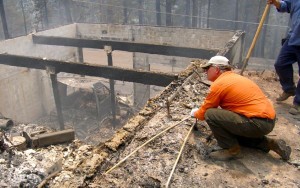
District crews crimping water supply lines in burn area. Photo/STPUD

South Tahoe PUD crews crip water supply lines in the Angora burn area. Photo/STPUD

The district was ahead of the state’s mandate and for the last year had been convening a stakeholders advisory group to come up with a plan. South Tahoe PUD’s board on Dec. 4 approved the Groundwater Basin Management Strategy Plan.

The district at the start of this century created a Groundwater Management Plan in the wake of the gasoline additive MTBE contaminating its wells. In many ways, the new plan is an extension, revision and update of the 14-year-old document.

Participants in the regional plan included Lukins Brothers Water Company, Tahoe Keys Water Company, Lahontan Regional Water Quality Control Board, South Lake Tahoe, El Dorado County, Tahoe Regional Planning Agency, Barton Health, Lake Tahoe Unified School District, a local gas station owner, and Harold Singer (former head of Lahontan) as the public member.

“(The goal was to) formulate a plan and a path forward in appropriately managing groundwater, including land use elements, monitoring, legacy contaminants such as PCE and MTBE, and pursuit of grant funding from Proposition 1 just passed, among other items,” Solbrig told Lake Tahoe News.
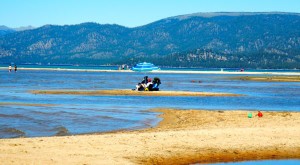
As Lake Tahoe's level drop, so goes the wells used by water companies. Photo/LTN file

As Lake Tahoe’s level drop, so goes the wells used by water companies. Photo/LTN file

The state is requiring a groundwater sustainability agency be created within two years. Having a plan is the first step to forming the agency.

The state is ranking regions on a low, medium and high priority for dealing with groundwater issues. The South Shore is rated medium because of ongoing contamination issues related to gas stations and dry cleaners.

The local group is hoping to receive Proposition 1 – the state water bond passed in November – money to deal with some of the issues as well as to help form the agency.

STPUD, Lukins and Tahoe Keys all use well water. The U.S. Forest Service has a well to service the Valhalla-Tallac area. Lakeside Water Company, near the state line, uses water directly from the lake. It has one well for emergency purposes.

Most water company wells are 300 to 500 feet deep. With the drought, the wells closer to the lake are seeing a change of water depth of about 5 feet and the wells farther way, say in Christmas Valley, have about a 10-foot difference. That, according to Solbrig, does not affect production.

“We still have 500 to 600 private wells in the basin,” Solbrig said. “They might be 50-years-old and 50- to 75-feet deep. A change of 5 to 10 feet could make the difference of producing no water.”

The plan is considering private and public wells.

There is a direct correlation in well level fluctuation with the level of Lake Tahoe.
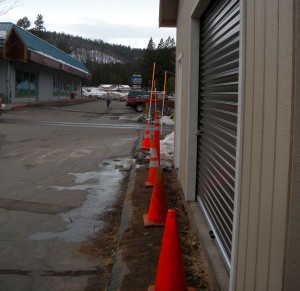
This structure will house remediation equipment to cleanup soil and groundwater contamination at the other end of the parking lot. Photo/Kathryn Reed.

This structure houses remediation equipment to cleanup soil and groundwater contamination in South Lake Tahoe. Photo/LTN file

STPUD will be the lead on the groundwater plan for the South Shore, in large part because it is the largest groundwater user in the basin. The group will meet once a year or more often if needed.

Various components are included in the plan, like paying attention to where any new wells would be drilled. The goal is to not influence the water table so it would have a negative environment impact by altering stream environmental zones or vegetation.

“One thing we will do is collect production data, and file regional based reports and estimates of the recharge,” Solbrig said.

Precipitation will be monitored and it will be compared to usage.

That type of data has long been required of surface water users. It’s a first for those tapping the groundwater.

It is better if moisture comes in the form of snow – even locally. Rain just means it all rushes to the lake faster. Snowpack means it gradually seeps back into the water table. Plus, then the water is distributed more uniformly underground and there won’t be dry pockets in outlying areas.

South Tahoe PUD supplies Heavenly Mountain Resort with water for snowmaking. Solbrig said about 85 percent of what is used returns to groundwater. The other 15 percent is lost in the process and to evaporation.

This compares to irrigation that is mostly consumed by the vegetation the water is being applied to.

“Why we do the turf buyback is because a majority of water property owners put on is gone. It goes into the grass or evaporates off into the environment,” Solbrig said.



Digital security a growing concern

By Nicole Perlroth, New York Times

Paul Kocher, one of the country’s leading cryptographers, says he thinks the explanation for the world’s dismal state of digital security may lie in two charts.

One shows the number of airplane deaths per miles flown, which decreased to one-thousandth of what it was in 1945 with the advent of the Federal Aviation Administration in 1958 and stricter security and maintenance protocols. The other, which details the number of new computer security threats, shows the opposite. There has been more than a 10,000-fold increase in the number of new digital threats over the last 12 years.

The problem, Kocher and security experts reason, is a lack of liability and urgency. The Internet is still largely held together with Band-Aid fixes. Computer security is not well regulated, even as enormous amounts of private, medical and financial data and the nation’s computerized critical infrastructure — oil pipelines, railroad tracks, water treatment facilities and the power grid — move online.

In a speech two years ago, Leon Panetta, the former defense secretary, predicted it would take a “cyber-Pearl Harbor” — a crippling attack that would cause physical destruction and loss of life — to wake up the nation to the vulnerabilities in its computer systems.

Read the whole story


How to make skiing fun for beginners

By New York Times

For first-time skiers, expectations and reality can often diverge on the slopes. They imagine gracefully swishing down an Alpine mountain, but then spend their first day falling. After that, most give up.

Indeed, according to the National Ski Areas Association, 83 percent of first-time skiers and snowboarders never return to the slopes for a second visit.

To combat this high attrition rate, Joe Hession, president and chief executive of Snow Operating, has worked with dozens of resorts, from Jiminy Peak in Massachusetts to Snowbasin in Utah, to redesign their ski areas and programs for beginners, making the learning process smoother and much less frustrating.

In lieu of bunny slopes, what you find at these resorts are hills with turns and banks shaped to let beginners really ski, even if they haven’t mastered turning or stopping. With the terrain guiding you, Hession explained, “you can make turns without a lot of skill, so it’s fun.”

Fun is the objective here, he added. “The perfect first day is someone has fun and learns something. The second best is they have fun and learn nothing.”

Read the whole story


Camelback Mountain provides sweeping views

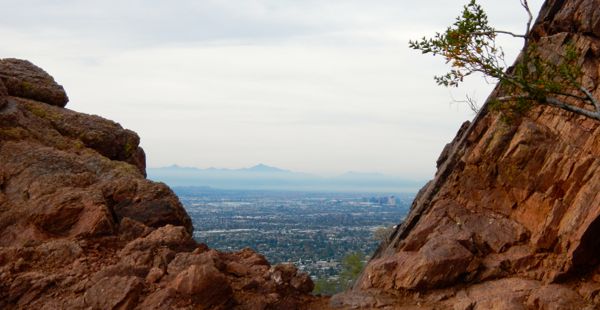
Downtown Phoenix is in the distance as seen from along the Camelback Mountain trail. Photos/Kathryn Reed

Downtown Phoenix is in the distance as seen from along the Camelback Mountain trail. Photos/Kathryn Reed

By Kathryn Reed

PHOENIX – Mileage is not always the determining factor in how sore one will be after a hike. Terrain has a lot to do with achy muscles, too.

Nine days ago I found out how true that statement is.

Camelback Mountain is considered by some to be the toughest hike in the city limits of Phoenix. (It’s on the border of Scottsdale.) There are two routes to the 2,704-foot summit – Echo Canyon and Cholla. Penny and I did the latter trail, which is longer. Echo is steeper.

We gained 1,300 feet in elevation over the course of 1.6 miles.

The layered sandstone was harder on my legs than Tahoe’s dirt and decomposed granite trails. It was even more pronounced coming down. I wish I had shock absorbers built into my shoes.

That night I could not climb or descend the stairs at the condo without pain and looking like there was something out of whack.

This is definitely not a trail for everyone, especially because of the scrambling that is involved. A backpack with water is recommended over carrying a bottle because many times both hands are needed to get up or down a pitch. There’s nothing technical about the climb, but it does require being in shape.

We just shook our heads at the people jogging up and down the trail.

But what got us to really turn our heads was when we saw members of the Scottsdale Adventure Club hauling up multiple Christmas trees to erect at the top. Last year the one 10-foot tree was a bit cumbersome, so this year they did a few smaller trees – all just to be festive.

The name of the mountain comes from its looking like a camel because of the two formations that are split by a saddle. From the top it’s a 360-degree view of the valley.

Fortunately, the area had been getting rain before I arrived, and was still overcast the morning of our hike. Even in the 70s it was a warm hike. You are completely exposed all the time – no big pines for shade.

While there are a few cacti growing, there did not seem to be much life on this massive rock. Luckily we didn’t see one of the more common critters – rattlesnakes.

Starting out we see the sprawling Phoenician resort below us. Civilization is everywhere below us and in the distance.

There was a time when Camelback was going to be an Indian reservation. Then development kept encroaching on the mountain. Finally, Preservation of Camelback Mountain Foundation led by Barry Goldwater was able to get the federal government involved in the 1960s to preserve the summit.

ngg_shortcode_0_placeholder (Click on photos to enlarge.)