Sierra snowpack at 33% of average

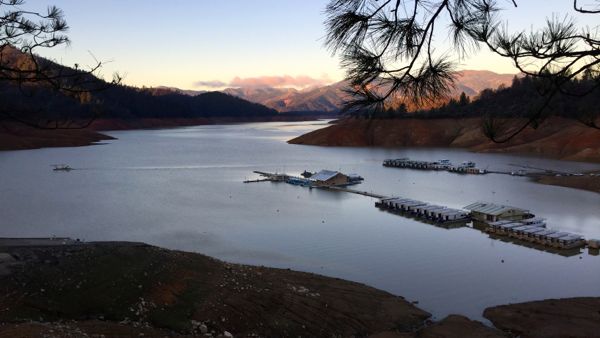
Shasta Lake is well below normal for this time of year. Photo/Kathryn Reed

Shasta Lake is well below normal for this time of year. Photo/Kathryn Reed

By Kathryn Reed

Even though the snowpack was increasing as it was being measured Tuesday morning near the entrance of Sierra-at-Tahoe, it will need to keep falling the rest of the winter to significantly ease the impact of California’s drought.

The Dec. 30 reading was the first manual measurement of the season. Frank Gehrke with the Department of Water Resources found 21.3 inches of snow at Phillips Station, with a water equivalency of 4 inches. This is 33 percent of average.

Even so, it’s an improvement over last year at this time when the measurement was at a record low of 20 percent of average, which was the same reading in 2012.

Water content at this location is normally 12 inches for this time of year.

Phillips had its lowest early-January water content reading of 0.1 inch in 2012, in a snow depth of 0.6 inches. On Jan. 3, 2014, Phillips had 2.3 inches of water content in 9.3 inches of snow. Besides that reading and the similar one in 2012, the driest January readings at Phillips were in 1987 (0.9 inches of snowpack water content), 1981 (2 inches), 1976 (2.7 inches) and 2000 (3 inches). Records at Phillips go back 50 years.

“Although this year’s survey shows a deeper snowpack than last year, California needs much more rain and snow than we’ve experienced over the past two years to end the drought in 2015,” Mark Cowin, director of the Department of Water Resources, said in a statement.

If the snow doesn’t come, this would be the fourth consecutive drought year.

While December rains in much of the state have been above normal, the snowfall has not kept pace. And on the South Shore there has been even less compared to the North Shore-Truckee region or even Kirkwood. Part of the problem is the storms, until now, have been relatively warm.

Without a large accumulation of snowpack, the reservoirs downstream are apt to remain low. The Sierra snowpack supplies about one-third of the water needed by residents, agriculture and industry.

Lake Oroville in Butte County, the State Water Project’s principal reservoir, is at 38 percent of its 3.5 million acre-foot capacity (61 percent of its historical average for the date), while Shasta Lake north of Redding, California’s and the federal Central Valley Project’s largest reservoir, is at 41 percent of its 4.5 million acre-feet capacity (66 percent of average for the date).


SnowGlobe vibrates with techno flare

By Kathryn Reed

Meghan Trainor’s song “All About that Bass” could be the anthem for SnowGlobe. It really is all about the bass. And that’s just what fans of this three-day music festival in South Lake Tahoe want.

It was a raucous eruption of DJ induced music by Disclosure that brought screams from the crowd at the main stage on Dec. 29. The throngs of people bounced to the beat as the techno sound reverberated across what is normally the community ball field next to Lake Tahoe Community College.

Dressed in all sorts of headware – from beaded masks to ski beanies to SpiritHoods to lighted get-ups – the rave is a place for self-expression.

With lights illuminating their jackets, friends Tori Kobayashi of Sacramento and Lina Kudinar of Fremont made the trek east for their first SnowGlobe experience. It was all about the lineup of artists that brought them to Tahoe. Disclosure and Porter Robinson topped Kobayashi’s list of people to hear. For Kudinar, the big draw on Monday night was Thomas Jack.

Emancipator Ensemble has people bouncing to the sound on Dec. 29 at SnowGlobe. Photo/Carolyn E. Wright/Copyright

Emancipator Ensemble has people bouncing to the sound on Dec. 29 at SnowGlobe. Photo Copyright 2014 Carolyn E. Wright

“The vibe here is better than other places. There’s more chill here,” Dylan Bivens, who graduated from Whittell High in 2008 and now lives in Reno, told Lake Tahoe News.

He has a three-day pass for his third SnowGlobe.

At the Sierra tent Bro Safari was a big draw as people spilled out into the walkway. Not being able to see the stage is no big deal – the sound is blasting forth.

Exaggerated icicles hang from the roof like something that could have been from “Alice in Wonderland”, changing color as the strobe lights lighted the three-sided tent.

SnowGlobe is considered a boutique festival, but is still able to bring in some of the biggest names in the business. Zedd won a Grammy this year for best dance recording. He will be on the main stage New Year’s Eve. He’s ringing in the New Year at a gig in Las Vegas, while Flume does the honors at SnowGlobe.

Now in its fourth year, SnowGlobe is a multi-million dollar event when it comes to the economic impact on the community.

“I heard from a number of lodging properties and the association that if it were not for SnowGlobe again this year, they would have few bookings due to the lack of snow,” City Manager Nancy Kerry told Lake Tahoe News.

Chad Donnelly, the promoter of the three-day event, is expecting crowds of 15,000 each night.

Traffic was a nightmare on both ends of town hours after the concert had started at 2pm Monday – with vehicles backed up on Echo Summit, and Highway 50 and Pioneer Trail near Stateline cluttered.

For those in the neighborhoods, it was a mixed night of disturbances because of the booming bass.

“About 8pm the SnowGlobe bass got extra strong for a few minutes and Charter cable went goofy. I had it on a TV cable music jazz station with my sound bar bass higher than usual, so we were co-existing pretty well but for the occasional thought that there was a semi-truck going down our street,” Diana Hamilton, who lives near LTCC, told Lake Tahoe News.

Another nearby resident told LTN, “This year’s first night at 6-ish is like last year’s last night at 10. At times it can be like living in a duplex with the world’s worst neighbor and other times not so bad.”

The city is monitoring complaints and ensuring the bass does not exceed the decibel level outlined in the three-year contract with Donnelly. (This is the first year of the contract.)

—

Notes:

• SnowGlobe is Dec. 30 2:30-11pm, and Dec. 31 2:30pm-Jan. 1 at 1:30am.

• The city’s complaint hot line is 530.542.6001.

• There will be fireworks each night.

ngg_shortcode_0_placeholder (Click on photos to enlarge.)


Nevada wants park users in Tahoe to pay

By Benjamin Spillman, Reno Gazette-Journal

It’s no surprise business is booming at Nevada’s Lake Tahoe State Park, Spooner Backcountry.

The park is home to stunning Lake Tahoe views, its own alpine lake and the Flume Trail which is probably the best mountain biking experience in Nevada.

The only problem is not everyone who visits pays the entrance fee, especially if they’re coming from the north via Tunnel Creek Road.

That’s the explanation behind a newly posted sign at Tunnel Creek Road reminding hikers about the $1 fee to walk in and mountain bikers about the $2 fee for riders. It’s one of a few projects State Parks has in the works to improve fee collection in the coming year, said Eric Johnson, Nevada State Parks administrator.

Read the whole story


Feinstein’s role as water referee complicated by drought

By Evan Halper, Los Angeles Times

The long-range weather forecast is the biggest wild card in the battle over every available bucket of water in drought-stricken California — but a close second may be Dianne Feinstein.

In a dispute in which positions have hardened after years of fighting, the state’s senior U.S. senator, who is expected to broker any deal that reallocates water supply, is one of the few remaining enigmas. The only thing consistent about Feinstein’s role as water referee is that the fights have left bruises on the exacting and thick-skinned senator over the years. The last few weeks have been particularly rough.

A year that started with Central Valley figures branding her a radical environmentalist and Bay Area dilettante ended with accusations from once-friendly colleagues and liberal editorial boards that the 22-year veteran of the Senate was shilling for Big Agriculture.

For months, Feinstein had tried to craft a compromise drought relief bill by negotiating a water deal behind closed doors with the state’s major agricultural interests. Late in Congress’ lame-duck session, those talks collapsed. No legislation got passed.

Yet Feinstein is eager to get back in the ring as soon as Congress picks up again in January.

Read the whole story


Couple duplicates good food, service at Ski Run

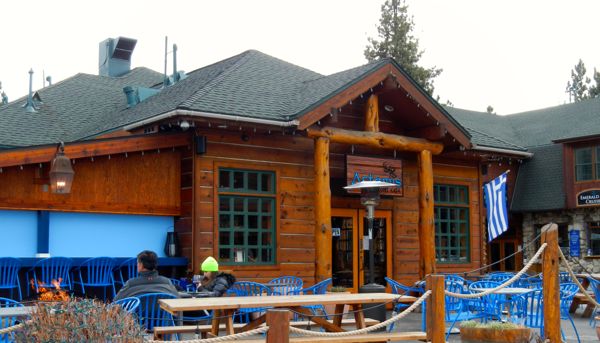
Artemis at Ski Run has fire pits out front and a view of Lake Tahoe. Photo/LTN

Artemis at Ski Run has fire pits out front and a view of Lake Tahoe. Photo/LTN

By Kathryn Reed

Owning and operating a restaurant is said to be a difficult endeavor – even more so in a place like Lake Tahoe because of the ebb and flow of customers as the seasons change or if the snow falls. Double that and people might question your sanity.

But that’s exactly what Brian and Angela Luke did this year when they opened a second Artemis restaurant in South Lake Tahoe.

“It’s been harder than we thought, definitely. But it seems to be working out,” Brian Luke told Lake Tahoe News. “We had some growing pains. We are getting it dialed in.”

Getting a day off – well, that never completely happens.

“Every day there is something,” Angela Luke said. “It hardly feels like work when we are both involved. It’s part of our everyday life. I can’t imagine it not being part of our life.”

But they will be even busier in January when their second child arrives. Still, the restaurants are their babies in a different way.

“Every location brings a different set of challenges. You have to jump in and immerse yourself before you are clear what those challenges are and how to go about tackling them,” she said.

Two restaurants weren’t in their plans when the first eatery in the Kings Trading Center near the Y opened in 2010.

“It was kind of out of necessity,” Brian Luke said. “We outgrew that place in the summer.”

Seating in the back patio was added, but the kitchen was still tiny. This created additional problems – the inability to get food to the table in a timely manner.

So, then the couple wrestled with whether it would be better to get a larger location or open a second restaurant. They looked at several locations, including the old Swiss Chalet.

Then Elie Alyeshmerni, owner of Ski Run Marina, approached the Lukes about taking over a soon to be vacant suite in his center. They jumped at the opportunity and opened that spot in May.

Aubrey, Brian and Angela Luke

Aubrey, Brian and Angela Luke

It’s not visible from Highway 50 like the Y location, but it has a lake view – something the strip mall can’t offer.

The menus are relatively the same, with lunch and dinner offered at both.

Two big differences at the Ski Run location are the full bar and breakfast. The former allows them to offer a comprehensive happy hour every day from 3-6pm. An espresso bar and mimosas are indicative of the variety of morning drinks that are available. Breakfast is a mix of American and Greek dishes.

What the Lukes have noticed at Ski Run is the extremes – super quiet or super busy. A rush comes in before the Tahoe Queen is set to sail. Tourists are finding the restaurant, while locals are more often found at the Y location.

“The first one is definitely very homey. It is very local clientele-based and very comfortable for people who have been coming there for four years,” Angela Luke told Lake Tahoe News. “This one is a lot more tourist driven. One of our main goals is to also make this a place where locals can enjoy. It’s such a great location.”

Next summer the outdoor bar will be operational. This time of year fire pits are keeping people warm outside. Getting into the catering side of the food industry is another goal.

Brian Luke has an extensive background in restaurants, having worked in the Caribbean as an executive chef and in other aspects of the industry before opening Artemis. He knew he was ready to open his own restaurant; he just thought it would be in the Bay Area. Prices, though, made that an unrealistic dream.

As a kid his family made regular treks to Tahoe. One Christmas he came snowboarding and started looking around at various vacancies where he might be able to open a restaurant.

The Greek theme came about by not wanting to duplicate what existed on the South Shore. Plus, he was familiar with Mediterranean food and it ties into the healthy Lake Tahoe lifestyle.

“I was trying to fill a niche that nobody was doing and trying to do it really well – good food at good prices and a great atmosphere, with great service,” Brian Luke said.

(Angela, who grew up in South Lake Tahoe, met Brian as he was opening the first restaurant.)

Beyond the food, the service is one thing that sets Artemis apart from other restaurants in South Lake Tahoe. The staff at both locations is attentive, friendly and knowledgeable.

“Service has been the hardest thing because of the transient nature of town. It’s hard to find good people in this town,” Luke said. “I’ve never had such hard time finding staff that was qualified and would show up and take things seriously and act like professionals.”

Training is critical – so are standards. Luke said if people don’t meet their standards, they are let go.

“We didn’t want to accept that this is just Tahoe,” he said. He isn’t lowering his standards.

His employees have been rewarded, with many who have been with them since Day 1 who have risen to management positions.

“Our goal is to be perfect. We try to get as close as we can on a daily basis,” Luke said.


Slew of California laws take effect Jan. 1

By Associated Press

SACRAMENTO — California’s historic drought prompted the Legislature into action in 2014, leading lawmakers to regulate groundwater for the first time and override homeowners associations that fine members for replacing lawns with more drought-tolerant landscaping.

The most populous state also becomes the first to set a “yes means yes” standard for sex between college students and the first to ban single-use plastic bags, a law the plastic bag industry is seeking to overturn through a voter referendum.

Those are among more than 900 bills passed in 2014 by the Legislature and signed by Gov. Jerry Brown, who also vetoed 143.

Most of the laws take effect Jan. 1. That includes a bill allowing driver’s licenses for people who are in the country illegally, another that will influence the 2016 ballot by modernizing California’s century-old initiative process and others addressing everything from teacher tenure to massage parlors.

Also taking effect with the new year is a ballot initiative approved by voters in 2008 that restricts the confinement of egg-laying hens, breeding sows and veal calves.

The state’s biggest ongoing story of the year led to a series of bills designed to have a lasting effect on California’s water supply.

In the midst of a third year of drought, the Legislature and governor closed a gap in the state’s water oversight that dated to the Gold Rush days, passing and signing bills to regulate groundwater use for the first time.

Although the drought is beginning to ease with early rain and snow, Brown’s signing of SB1168, SB1319 and AB1739 by Assemblyman Roger Dickinson, D-Sacramento, and Sen. Fran Pavley, D-Agoura Hills, ends the state’s pump-as-you-please policy. It also brings California’s groundwater rules in line with those of other Western states.

Specifically, the bills require water districts and other local entities to develop plans to manage their groundwater and allow the state to intervene if necessary.

Brown’s call on Californians to reduce water use by 20 percent led some residents to run afoul of their homeowner association rules. Lawmakers responded by approving bills that prevent associations from punishing residents who cut back on water use, allow plants to die or install drought-resistant landscaping.

“There are moments in legislative time when folks sort of rise to the occasion and we get something done on water,” said Felicia Marcus, chairwoman of the State Water Resources Control Board.

She also noted that lawmakers worked together to craft a bipartisan, $7.5 billion water bond measure that voters approved in November. It will let the state expand storage and develop water management plans.

With the new year also comes a first-in-the-nation standard for investigating sexual assaults on college campuses.

SB967, by Senate President Pro Tem Kevin de Leon, D-Los Angeles, requires “an affirmative, conscious and voluntary agreement to engage in sexual activity,” meaning silence or a lack of resistance can no longer be deemed consent.

The California State University and University of California systems already adopted similar consent standards, which will now apply to all public and private post-secondary schools that receive state money for student financial aid.

The statewide plastic bag ban, SB270 by former state Sen. Alex Padilla, D-Los Angeles, will be phased in starting in July at large grocery stores and supermarkets, unless opponents force a delay while voters consider repealing it. It could be May before the secretary of state’s office — headed by newly elected Padilla — determines whether the industry gathered enough valid signatures to place a referendum on the November 2016 ballot.

Proposition 2, the 2008 ballot initiative restricting the caging of certain farm animals, goes further than any other state when it is coupled with a law signed by former governor Arnold Schwarzenegger that extends the space requirements for egg-laying hens to out-of-state suppliers, said Wayne Pacelle, president and chief executive officer of The Humane Society of the United States. The measures helped trigger “a cascade of legislative and corporate reforms” nationwide, he said.

Other laws taking effect include:

  • AB215 by Assemblywoman Joan Buchanan, D-Alamo, which makes it easier for school districts to fire abusive teachers. The bill gained traction as a compromise between teachers unions and some education-reform groups after a headline-grabbing case of misconduct in Los Angeles highlighted how difficult it can be to remove problem teachers. The Los Angeles Unified School District paid elementary school teacher Mark Berndt $40,000 to drop the appeal of his dismissal after he was charged with spoon-feeding semen to his students and other lewd acts.
  • SB505 by Sen. Hannah-Beth Jackson, D-Santa Barbara, which requires law enforcement agencies to develop policies that encourage officers to search the state’s database of gun purchases as part of routine welfare checks. The bill was prompted by sheriff’s deputies failure to detect the danger posed by a man who weeks later embarked on a deadly rampage in May near the University of California, Santa Barbara.
  • AB1147, by three Democratic lawmakers, allows local governments to revoke the license of any massage parlor that violates the law. It is intended to make it harder for massage parlors to operate as fronts for prostitution.
  • AB2048 by Assemblyman Brian Dahle, R-Bieber, gives property owners in fire-prone areas a few breaks on paying the state’s annual $150 fire-prevention fee. It eliminates a requirement that the fee will increase each year based on inflation, lowers the 20 percent late payment penalty to 10 percent and permits exemptions for homes destroyed by natural disasters.
  • SB926 by Sen. Jim Beall, D-San Jose, gives sex-abuse victims more time to pursue criminal charges against offenders. It raises the age ceiling from 28 to 40 for childhood sexual abuse victims to file criminal complaints.


Nevada — the driest state — has no statewide water plan

By Jeff DeLong, Reno Gazette-Journal

Nevada is suffering from a debilitating drought, experiencing the impacts of a warming climate and, some say, is deficient when it comes to long-term water planning for the state as a whole.

Debate is mounting over the need to begin development of a comprehensive water plan taking into account available water supplies, drought, climate projections and development that will tap limited water resources across the nation’s most arid state.

Planners and elected officials have water resource plans in place across the state – in Reno-Sparks, Las Vegas, the Carson River Basin and elsewhere. But a number of experts are now pushing for a more holistic approach addressing water supply issues statewide, efforts similar to ones taken by neighbors of the Silver State including Utah, Arizona and California.

Read the whole story


Squaw Valley patroller tests her endurance in outdoor reality TV show based in Alaska

Lel Tone of Tahoe City is one of two women on this season's "Ultimate Survival Alaska" television show. Photos/National Geographic channel

Lel Tone of Tahoe City is one of two women on “Ultimate Survival Alaska” TV show. Photos/National Geographic channel

By Kathryn Reed

Lel Tone bounced like a ragdoll on the frozen tundra of Alaska as the dog sled team forged ahead; oblivious she was no longer in control. But she wasn’t about to let go. You never let go of the sled.

That is the lesson she learned as a ski patroller at Squaw Valley – and the mantra she maintains today when she is carrying someone downhill in a toboggan.

She is a force to be reckoned with, but that’s not obvious just by looking at her.

Don’t be fooled by the 44-year-old Tahoe City resident being barely 100 pounds. Her strength, tenacity and mental fortitude were put to the test this past summer when she spent three months participating in “Ultimate Survival Alaska”. The next season of the reality show airs Jan. 4 on the National Geographic channel.

“It was such an adventure … to have an opportunity to run around the wilderness in Alaska, to sleep under the stars (for 90 nights) in one of my favorite places on the planet,” Tone said. “It did feel really weird in mid-August to be under a roof again. I ended up sleeping on my porch to acclimate.”

Tone was picked for the show’s third season because of her heli ski guiding experience, mountaineering skills and avalanche forecasting abilities.
Talent_21_UltimateSurvivalAlaskaIII

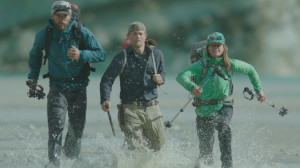
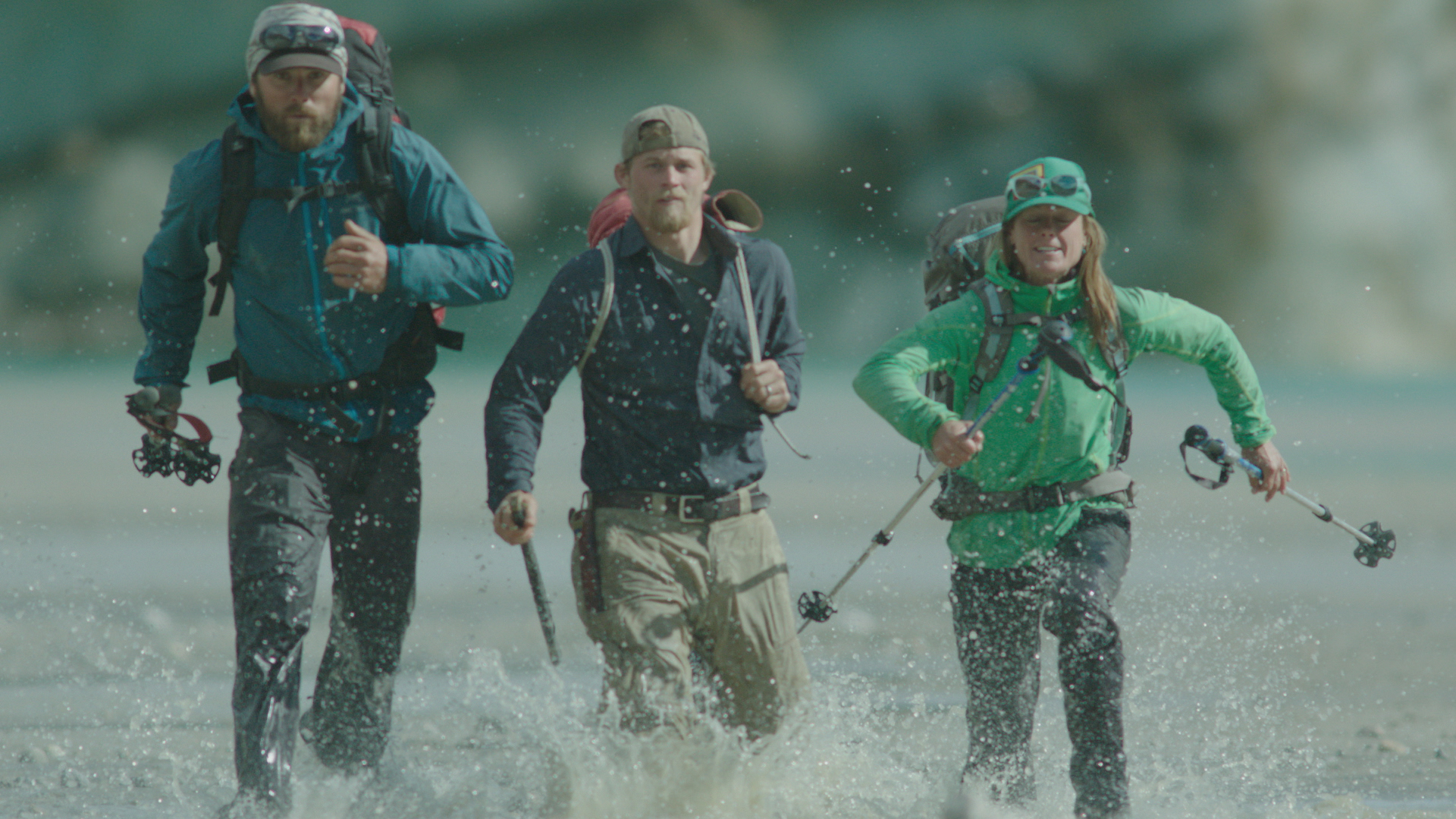
Lel Tone, right, holds her own with her male teammates.

She grew up in Switzerland, started skiing when she was a toddler, moved to the East Coast where she started ski racing while in college in Vermont and has been in Lake Tahoe for nearly two decades.

Tone was part of Team Endurance which consisted of two-time Iditarod champion Dallas Seavey, 27, of Alaska and mountain guide-rope access supervisor Ben Johns, 32, of Banff, Canada. But they didn’t know each other until they were thrown together in this adventure.

She is used to being on expeditions, like climbing Denali, where it’s a team, where you understand each other’s strengths and weaknesses.

A week before they met, Tone sent an email to the guys saying what gear she had and asking them what they had. Knowing they were about to entrust their lives to each other, the lack of coordination seemed a bit daunting.

Four teams of three participated in 13 challenges that required them to cross glaciers, raft whitewater, face predators, use means of travel – like dog sleds – they aren’t familiar with, scale mountains, bush whack and live off the land. They have the packs on the their back – Tone’s being about one-third her weight and equally as heavy as the guys’. No GPS, no phones.

At one point Tone whips out a .454 Casull, which makes one of her teammate’s weapons look like a child’s toy in comparison.

“My biggest concern was bear abatement and protection so I chose I gun that would do that job,” Tone told Lake Tahoe News as she took a break in the patrol shack at Siberia lift at Squaw. “I knew we could forage for food and fish for fish. The only thing in season for game was porcupine and ground squirrel.”

Large swaths of Alaska are bear country – and not the garbage variety black bears Tahoe is known for. She kept that .454 close by for quick, easy access.

“I have so much respect for big breasted women because I carried a chest harness. It weighed 7 pounds,” Tone said.

Her shoulders and neck were sore from carrying the gun and at times running with it strapped on.
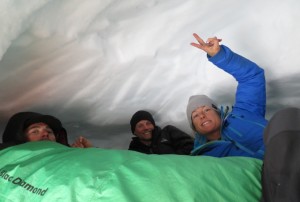
Lel Tone in a snow cave for night with her teammates.

Lel Tone in a snow cave for the night with her teammates.

It was the water, though, that truly tested her grit.

“We ran a class 5 river at the end of the summer. That was probably one of my most frightening moments,” Tone said. “I have respect for fast running water, a respectful fear. I had to confront my fear of crossing rivers.”

Trusting her instinct got her through those sketchy situations.

Her ski patroller and guide jobs have taught her how to make cuts, when to throw bombs and when to hold back. Listening to her intuition when things didn’t feel right served her well during the filming.

Each team had a cameraman and producer. But they were extracted at the end of the day, able to eat real food and sleep off the ground. The teams were left to their own. If it wasn’t raining, they staked out a spot a little farther from one another; otherwise they were all under a tarp for protection.

On one of the more solo sleeping nights Tone was tempted to pull our her monster gun to eliminate a squirrel that wouldn’t stop squawking, but she knew it would freak her teammates out.

With it staying light out for hours, the production crew made sure each team took a mandatory four-hour break.

One of the hardest parts for Tone was making sure she had enough to eat. As an athlete competing in mountain bike and paddleboard races, Tone knows the importance of nutrition. But she didn’t have the luxury of well-balanced meals with unlimited ingredients at her disposal.

Rice, beans and foraging – those were her staples.

She came back 10 to 15 pounds lighter, but said it wasn’t a problem to put it back on since returning home.

Tone is happy to be back in Tahoe, but said she would jump at the chance to do something like “Ultimate Survival Alaska” again. For now she is part of Squaw’s patrol team. She will also be teaching avalanche courses this winter.

“I’m really passionate about teaching people how to be safe in their environment,” Tone said.

In mid-February she is off to Alaska where she is a heli ski guide for Chugach Powder Guides and Trudillo Mountain Lodge.

Summers find Tone racing paddleboards, being a mountain bike guide, piecing together guide work that often takes her to the Southern Hemisphere.

This year Outside magazine nominated Tone as one of the world’s top 10 guides. She was featured in the 2011 Warren Miller film “Like There is No Tomorrow”.

—-

Notes:

• “Ultimate Survival Alaska” two-hour season premiere is Jan. 4 at 9pm on National Geographic channel.


Helped wanted signs signal economic growth

By Joyce M. Rosenberg, AP

NEW YORK — If you’re looking for signs that the U.S. economy is growing and that the job market is improving, just talk to small business owners.

After cutting back on spending for years, people are splurging again. That’s evident at Lady M Cake Boutiques.

Revenue is up 40 percent this year at the New York-based company with more customers paying $60 to $85 — three or four times what a supermarket cake costs — for confections made of paper-thin pastry dough and flavored with ingredients like green tea and chestnuts. Business is so good that owner Ken Romaniszyn, who has two locations in Manhattan and one in Los Angeles, plans three or four next year in New York, Boston and Charlotte, N.C. He’ll hire 60 new employees to staff the stores, adding to Lady M’s current staff of 145.

His cakes, which once appealed mostly to the wealthy, are now attracting a wider range of customers, Romaniszyn says.

“The middle class, they can afford to make a special occasion a little more special,” he says.

The U.S. economy is growing at a solid pace. This week, government figures showed that consumers and businesses drove growth to a sizzling 5 percent annual rate last quarter. Fewer Americans are applying for jobless benefits. In the first 11 months of this year, employers have added 2.65 million jobs. That already makes 2014 the best year for hiring since 1999.

A large chunk of the good news can be attributed to improvements at small companies. Reports from payroll company ADP and software maker Intuit show small business hiring has gained momentum since the summer. The trend looks to continue — surveys by Wells Fargo & Co. and the National Federation of Independent Business show more owners plan to bring in new employees in the coming months.

With revenue up 11 percent this year at her four Squeeze In restaurants in Reno and Truckee, owner Misty Young plans to add nine people to her staff of about 90 next year. She’ll also open a fifth restaurant next month in Redwood City, and hire 25 employees there.

Diners are spending an average 35 cents more per meal. When multiplied by the 270,000 people Young serves a year, it gives her an extra $94,500 in annual revenue, she says. Customers are ordering some of the most expensive items on the menu, like a $22 crab omelet. They’re willing to pay a few dollars more for a premium vodka like Grey Goose in their bloody Marys.

“People are in this ‘I deserve it’ mentality. They’ve worked hard and they want to play hard,” Young says.

The healthier economy is luring customers back to Spa Lamar for massages, facials and pedicures. Owner Heidi Lamar, who has 35 employees, is hiring to bring her staff back up to 50, the level before the recession.

Customers visit the Scottsdale spa more often, and they’re asking for more services. The average bill has soared this quarter to $122 from $98, Lamar says. She needs more staffers to handle the increased workload.

“The group we have is getting to the point where they’re maxed out,” she says.

The increase in business has encouraged Lamar to add new services such as massages for couples. She’s also renovating and painting the spa.

Some of the pickup in revenue comes from snowbirds, people who come to Arizona to escape the cold. But area residents are splurging on themselves again, she says.

“They say, ‘we’ve really missed you. It’s good to be coming back again,'” she says.


Gun violence: Suicide more likely than homicide

By Abbie VanSickle, Center for Investigative Reporting

Americans are nearly twice as likely to die from suicide by firearm as they are to be killed by someone else with a firearm, contributing to a rising suicide rate in this country, according to a new study published in the Annual Review of Public Health.

Suicides accounted for nearly two-thirds of deaths from firearms in 2012, according to the study, “The Epidemiology of Firearm Violence in the Twenty-First Century United States.” That year, 20,666 people died from suicide by firearm, compared with 11,622 who died from homicide by firearm.

That’s one firearm suicide every 25 minutes.

Mass shootings, such as the deadly school cafeteria shooting near Seattle in October, make headlines but account for a small percentage of firearms deaths each year, according to the study by Garen Wintemute, professor of emergency medicine and director of the Violence Prevention Research Program at the UC Davis. The four deadliest mass shootings in this century killed 84 people, the study says.

What makes guns such a common method of suicide? They are lethal and easy to obtain.

Easy access plays a role because suicide often is impulsive, according to research by Matthew Miller, a professor at Northeastern University and co-director of the Harvard Injury Control Research Center.

At a conference earlier this month near Boston on medical issues related to guns, Miller cited a Houston study of people who had survived a nearly fatal suicide attempt. For 70 percent of them, the time between deciding to kill themselves and attempting suicide was less than an hour. For 24 percent, it was less than five minutes.

One high-risk group: veterans. Wintemute reported that researchers have found suicide rates rising among both former and current members of the military. Veterans tend to have access to firearms and training in how to use them.

How does race fit into this picture?

For homicide by firearm, black men face a higher risk throughout most of their lives, researchers say, using data from the Centers for Disease Control and Prevention’s Web-based Injury Statistics Query and Reporting System. In 2012, for instance, the firearm homicide rate for black men between the ages of 20 and 29 was at least 20 times that for white men.

But suicide is another story. There, white men dominate, and the gap between them and black men widens with age. Among white men ages 35 to 64, there were 9,063 deaths from firearm violence in 2012. Nearly 90 percent were suicides.

Wintemute’s study also found that the U.S. is an outlier among industrialized countries in firearm deaths, with a substantially higher rate of both homicides and suicides.

Those deaths come at enormous cost. In 2010, researchers estimate, firearm suicides and homicides together cost society $164.6 billion, with suicides representing about 56 percent of that total. The costs include insurance claims, lost wages and lost tax revenue.