Scientist: Carbon fee will alter fossil fuel use

By Kathryn Reed

STATELINE – Government won’t solve climate change. And people won’t do anything to change the course of events without a monetary incentive. It is a global crisis. And the solution needs to be implemented worldwide.

Those are the thoughts and concerns of James Hansen, former director of the NASA Goddard Institute for Space Studies and adjunct professor at Columbia University’s Earth Institute.

He gave the keynote address Jan. 8 during the 17th annual Operation Sierra Storm at Harveys. Once a year meteorologists from around the country gather at Lake Tahoe to talk science, trends and news.

“The bottom line is science tells us we have to phase out fossil fuel emissions and leave what’s remaining in the ground,” Hansen said. “There is a tremendous amount of fossil fuel in the ground. We can’t afford to put it into the air without guaranteeing our children inherit a situation that is out of their control.”

He is dead-set against fracking.

Hansen has been working to stem the effects of climate change since the 1980s. In 2006, Time magazine called him one of the 100 most influential people on Earth.
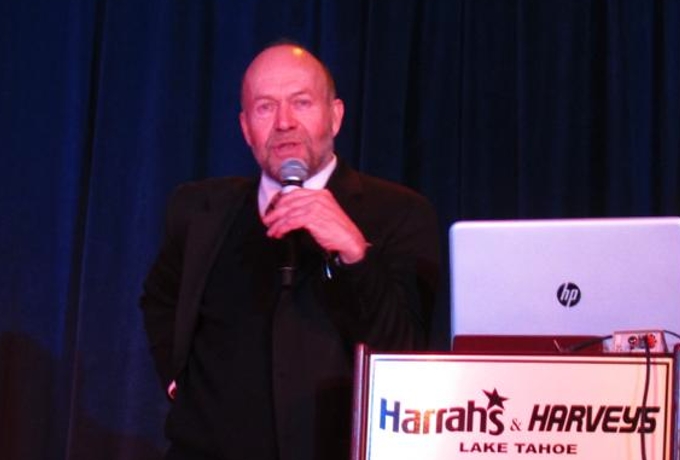
James Hansen talks about  climate change Jan. 8 in Stateline. Photo/Denise Haerr

James Hansen talks about climate change Jan. 8 in Stateline. Photo/Denise Haerr

Not one to mince words, Hansen told Gov. Jerry Brown in person that California’s cap and trade policy is nothing more than a tax that will do little to resolve the larger issue.

With word coming out this week that 2014 was the hottest year on record in the world, Hansen said 2015 is headed to be another record breaker. The U.S., by contrast, was one of the coolest places on Earth. But the United States only represents 1½ percent of the planet’s surface.

“If you add CO2 to the atmosphere, it’s like putting a blanket on the planet,” Hansen explained.

Instead of the heat radiating to space, most of the energy goes into the ocean. This then creates an energy imbalance on Earth. The energy into the ocean each year is the equivalent of the energy from 400,000 Hiroshima bombs a day. That energy contributes to the warming ocean, the loss of Artic ice and the rising seashore water that threatens cities.

Climate change is affecting plant and animal species – some of which are threatened with extinction – like the Eastern monarch butterfly. Some of the stressors on flora and fauna are also the result of herbicides. Agricultural practices – including how the soil is tilled – could be changed to help reduce carbons released into the air.

Getting China onboard to get away from coal will help, Hansen said, as he talked about that major polluter building nuclear plants.

“The only way to solve the problem is to put an across the board fee on carbon. The only way it will work is if the money goes to the public. That would stimulate people to avoid carbon emissions,” Hansen said.

He predicts 70 percent of people would get a dividend back, while 30 percent would have more out of pocket costs with a carbon fee. Hansen said this is a “golden opportunity” with the oil prices so low to implement such a fee.

“If we start adding a carbon fee, it will depress the use of fossil fuels,” Hansen said. “It would rapidly decrease the addiction to fossil fuels.”


Brown’s budget calls for record $113 bil. in spending

By Josh Richman and Jessica Calefati, San Jose Mercury News

SACRAMENTO — Gov. Jerry Brown rolled out a $113 billion budget Friday morning that boosts K-12 schools but doesn’t add more money for the University of California, which has threatened tuition hikes.

Although the proposed budget shows income and corporate taxes fueling the state’s second consecutive surplus after years of red ink, Brown said his plan signifies “self-discipline and real prudence” — even as advocacy groups say it’s high time to shore up the universities and mend the social safety net shredded by bone-deep cuts in past years.

“It’s a question of priorities,” Brown said. “There’s only so much money here.”

Still, the plan represents a 5 percent increase in general-fund spending over this current year. It would put another $1.2 billion into the state’s “rainy day” budget reserve fund, bringing its balance to about $2.8 billion, and would pay down about $1.2 billion in debt.

K-12 schools and community colleges get $65.7 billion in fiscal year 2015-16 under Brown’s plan — a 39 percent increase over four years ago — with much of the growth going to the Local Control Funding Formula that Brown and lawmakers enacted in 2013. Past K-12 budget deferrals will be all paid off.

Read the whole story


2014 hottest year on record in Calif., Nev.

By Paul Rogers, San Jose Mercury News

Driven by climate change and a persistent ridge of high pressure over the Pacific Ocean that caused California’s drought, 2014 was the state’s hottest year ever recorded.

Temperatures last year averaged 61.5 degrees Fahrenheit in California — 4.1 degrees hotter than the 20th century average, according to a report Thursday by federal scientists.

Three other Western states — Alaska, Arizona and Nevada — also experienced their hottest years since 1895, when modern instruments were first used. And Anchorage, Alaska, didn’t have a single day in 2014 in which the temperature dropped below zero, the first time in 101 years of record keeping.

“We do have a long-term warming trend across the globe, across the U.S. and in California,” said Jake Crouch, a climate scientist with the National Oceanic and Atmospheric Administration, which released the data. “This really warm year is just an exclamation point on top of a warming trend for that part of the country.”

Read the whole story


LTCC eager to spend $55 mil. on improvements

By Kathryn Reed

While it could take 18 to 24 months before Lake Tahoe Community College begins construction on a new building, that doesn’t mean there won’t be more immediate changes to the South Lake Tahoe campus.

The passage of the $55 million facilities bond in November means plenty of improvements are coming. Remodeling the commons area – the main building – could occur this summer and be ready when students arrive fall quarter.

Technology improvements will also be noticeable.

“The goal is from everyplace on campus you will be able to quickly get on the Internet without delay,” President Kindred Murillo told Lake Tahoe News.

Technology – or the lack thereof – has been a consternation at the college for years. Until recently people could not get cell service throughout most of the campus. It’s still sketchy. The same goes for connecting to the Internet.

This also means classrooms are lacking what is now a basic teaching tool – Internet.

“They should be able to connect to the Internet like that. It should be easy for them and not frustrating,” Murillo said.

A big piece of the tech improvements will come in the science labs, which are sorely outdated.

Students and staff also have to deal with rooms that are frigid or unbearably hot. While heating and air conditioning systems aren’t sexy, they are a necessity. A temperate room is also more conducive to learning.

The big-ticket items are going to require an environmental impact statement and an environmental impact report. The college expects by the end of the month to release the request for proposal for an environmental consultant.

While it’s likely to take 10 to 12 years for the college to complete the project list that the bond will fund, there is a facility’s master plan that encompasses 20 to 25 years. The desire is to have the EIS/EIR look at the bigger picture as much as possible. The environmental process could take 18 to 24 months.

The college is getting appointments on the book with Tahoe Regional Planning Agency officials as well. The Division of State Architect office will also play an integral role when it comes to the integrity of the facilities that are built.

“We are making sure everything we do is well thought out. We make up time by making sure we plan well,” Murillo said.

LTCC officials are in the process of prioritizing what gets done when. This in turn dictates how much the college will seek with each bond issuance. Murillo said likely there will be three issuances, four at the most. Financial advisors and attorneys help with those decisions.

Another consideration when deciding what to focus on is the fact the state has not issued a facilities bond and likely won’t in 2016. That means no shared costs as had been hoped.

“The governor’s budget will be critical. It will come out (today),” Murillo said.

She said what Gov. Jerry Brown proposes for community college funding will play a key role in how LTCC structures its priority list.

“We get the sense Gov. Brown will not do any statewide facilities bond. He has made it clear if communities want to make an investment in K-12 or a community college, it will be the responsibility of the local community,” Murillo said. “Part of the reason we did the bond is because we thought the facilities would continue to deteriorate while we waited for the state to do something.”

Not having the state matching dollars may mean some of the original plans are scaled back. But the college also has an additional $825,000 to spend that was going toward the university center. Lisa Maloff has agreed to donate the entire nearly $6 million needed for that facility. She wants to be at the ribbon cutting, so that project will be accelerated in any way possible.


Woodwind II unable to be salvaged

The Woodwind II on Jan. 8 was being cut into pieces before being hauled to a landfill. Photo/Kathryn Reed

The Woodwind II on Jan. 8 was being cut into pieces before being hauled to a landfill. Photo/Kathryn Reed

By Kathryn Reed

CAVE ROCK – Loud crunching sounds could be heard as a 50,000-pound excavator destroyed the Woodwind II. Grown men were somber witnessing the destruction of what was once a beautiful vessel that graced the waters of Lake Tahoe.

The catamaran broke from its mooring Dec. 11 during the windstorm at Lake Tahoe and became stuck on rocks near Zephyr Cove. While this is always a rocky area, it’s even shallower with the lake level being so low.

That Zephyr Cove mooring field a few years ago switched from the typical concrete block type anchors to screw auger type anchors. The new ones are not as secure, according to boat owners.

It was expected to take several hours Jan. 8 to breakdown the entire 55-foot-vessel.

Much of the damage was to the starboard side. Punctures in the hull and pontoon damage were extensive.

“The crane is utilized to pull some of the components out,” Dan Rikalo with Connolly Crane Service told Lake Tahoe News.

All the pieces will be taken to the Carson City Landfill.

Diesel from the vessel was taken off a while ago to prevent any spillage into Lake Tahoe.

It was towed to Cave Rock boat ramp on Jan. 7, then hauled out of the water with a large tow truck by its rudders.

Kevin McMullen of Keefe Kaplan Maritime in Richmond was at the dock Thursday morning to get the mast.

“We will cut it up. The insurance company wants it cut up. I hope they save it. It’s a beautiful mast,” McMullen told Lake Tahoe News.

Steve Dunham, who operates Tahoe Cruises, could not be reached for comment. He is down to one boat – the Safari Rose. She is currently at the Tahoe City Marina. The original Woodwind, which was a trimaran, also met its demise when it washed ashore. An operating permit for a tour boat at Lake Tahoe is a coveted item, so it’s possible there could be a Woodwind III.


Settlement talks in suit over busing Nev. mental patients

By Kyle Roerink, Las Vegas Sun

Settlement talks have emerged in a class action lawsuit accusing Nevada of misusing public funds for busing mentally ill patients to California.

The talks are the latest in a 16-month legal battle between Nevada and the city and county of San Francisco. A successful negotiation would end one of three busing-related lawsuits facing Nevada. Any money would compensate California for harboring indigent patients who were discharged from Nevada psychiatric facilities and given one-way bus tickets with directors to seek help in California. The settlement also would aim to outline new rules for transporting patients across state lines.

California officials say the busing cost San Francisco at least $4 million to treat 21 patients from Nevada, according to legal documents in a San Francisco district court. The San Francisco City Attorney’s Office said it has the names of 500 patients who traveled to California from Las Vegas’ Rawson-Neal Psychiatric Hospital between 2008 to 2013. It’s unclear how many of the 500 sought treatment once they arrived in California.

Officials from both states declined to comment on the details of the settlement negotiations — a standard practice during legal settlements.

Read the whole story


Factory Stores at Y sold — major changes coming

By Kathryn Reed

More than $1 million is about to be infused into the Y in South Lake Tahoe.

Sutter Capital Group based in Sacramento last month bought the Factory Stores at the Y.

But don’t expect discount stores to fill the empty spaces. Owners want to revamp this prime piece of real estate that has 51,811-square-feet of leasable space.

“Factory stores are outdated for that location,” Burke Fathy, general manager of the ownership group, told Lake Tahoe News.

The vision is for a mixed-use retail center that will include a restaurant that would be family friendly.

“Our business plan is to renovate, reposition, rebrand the property, to reinvigorate it and stabilize the assets,” Fathy said.

With 33,000 cars passing by the property each day, the location is one of the main things that attracted the real estate management firm.

The owners also want to capitalize on the area plan that is in the works for this section of town. A greenway is planned for behind the center where a revamped bike path exists.

Fathy said it’s possible to knock out the vacant section of the building where the L connects so people using the greenway would have access to the center. Then that square footage may be relocated elsewhere on the property.

Owners hope the more than $1 million worth of improvements will begin this summer.

Fathy would not divulge what the sale price was. For several years Wells Fargo Bank has owned the center because former owners Shannon Casteel and Nancy Irmer defaulted in 2012. At that time the sisters owed more than $8 million.

In 2004, they bought the center from their brother, Gary Casteel. He still runs Heavenly Village.

Fathy wouldn’t say if the few remaining stores will have a future in the revitalized center, but added, that they’ve managed to survive this long, so they might thrive going forward. (Izod and Van Heusen closed in December.)

When Big 5 opened in spring 2013 the company signed a five-year lease with an option for 20.


Calif. decreases water use, but falls short of goal

By Paul Rogers, San Jose Mercury News

After two months in a row of declining conservation, Californians are doing better at saving water, but they remain far short of a goal set by Gov. Jerry Brown last January.

Statewide, residents cut water use by 9.8 percent in November, compared with November 2013, according to new state figures released Tuesday. That’s an improvement from October, when the reduction was only 6.8 percent. And it compares with the 11.5 percent savings in August, and 10.2 percent in September .

Last January, in declaring a drought emergency, the governor asked Californians to voluntarily cut their water use by 20 percent.

Many parts of the state are at or near that goal now.

Read the whole story


USFS yanks $10 mil. contract to boost its image

By Associated Press 

GRANTS PASS, Ore. — The U.S. Forest Service has abruptly decided not to spend $10 million on a five-year nationwide public relations campaign to brand itself as a public agency that cares about people and nature.

The agency was planning on the campaign at a time when it’s struggling to pay for fighting wildfires, maintaining trails and offering timber for sale. It has also faced a major public backlash in the West over plans to close trails and roads to motorized vehicles due to a lack of money for maintenance, as well as to prevent erosion and protect fish and wildlife.

The Forest Service issued a statement Tuesday saying that it had not accepted any contract bids and would look for other ways to enhance the public’s access to national forests and understanding about what the agency does.

The agency wouldn’t say why it withdrew the contract.

Andy Stahl, director of the watchdog group Forest Service Employees for Environmental Ethics, said he thought the agency’s leaders “finally listened to Forest Service employees, and no one thought this was a good idea.”

Stahl said that after he learned of the contract, he sent an email to 25,000 Forest Service employees, and about half of them opened it. He got about 50 replies, all critical, suggesting the money could be put to better use on recreation programs, revising forest management plans, restoring ecosystems, hiring more employees, and lifting a three-year wage freeze.

Forest Service retirees also objected. Al Matecko, retired chief of public and legislative affairs for the northwest region and head of the Old Smokies, which represents about 950 retirees, said he received 50 emails from members who were strongly opposed. He passed on those objections to Forest Service leaders, Matecko said.

“Retirees were just amazed that at this time of shrinking budgets, the Forest Service could find $10 million,” he said.

Jim Golden, a retired deputy regional forester for the northwest region and chairman of the board of the National Association of Forest Service Retirees, said he warned Forest Service Chief Tom Tidwell in an email on Saturday of the “growing firestorm” among retirees unless the agency got out some information explaining the campaign. But Tidwell never came through with a promised briefing paper. Golden said.

“Our primary reaction was one of suspicion,” he said. “Not many retirees believe the Forest Service needs a new brand. Most of us believe the simple (motto), ‘Caring for the land and serving the people,’ is pretty effective.”

Last fall, the agency awarded a $526,799 no-bid contract to Metropolitan Group of Portland for a branding campaign titled “Valuing People and Place” in Forest Service regions covering Oregon, Washington, southern Idaho, Utah, Wyoming and Nevada, according to the federal website FedBizOpps.gov. It was the only no-bid contract issued by the U.S. Department of Agriculture out of more than 3,000.

Another federal website, USAspending.gov, shows the Forest Service has paid Metropolitan Group $3.6 million since 2011, much of it for the Valuing People and Place campaign.

The area covers national forests where the Forest Service has faced intense public backlash to plans to close roads and trails on national forest to motorized traffic.

Metropolitan Group’s Portland office did not immediately return a phone message asking for comment. Its website describes the company as a “full-service social change agency that crafts and integrates strategic and creative services. We help our clients with strategic communication, multicultural engagement, organizational development and resource development to build a just and sustainable world.”

The website describes the company’s work for the Forest Service as helping it reflect on its roots, discover its future, and “rediscover the meaning behind (Forest Service founder) Gifford Pinchot’s early direction to ‘find the greatest good.’ ”

The website adds that Metropolitan Group was helping train Forest Service employees to deal with the public on the agency’s so-called Travel Management plans, which refers to the road and trail closures.

The Forest Service filed notice Nov. 28, the day after Thanksgiving, that it was soliciting bids to expand the campaign nationwide at a cost of $10 million over five years. Bids were to close Dec. 26.

“It’s called the ‘Take out the trash season’,” Stahl said. “It’s when government does things it doesn’t want people to know about.”

Stahl sent out his email Dec. 26, and the Forest Service filed notice it was extending the bid period to Dec. 29. A week later, it announced it was not accepting any bids.

Established in 1905, the Forest Service manages 154 national forests, grasslands and other units covering 193 million acres in 40 states.


High-caliber performing arts center in the works

By Kathryn Reed

TAHOE CITY – A multi-theater indoor-outdoor performing arts center in the mountains has a growing audience of supporters. Now organizers need the funds to make the facility a reality.

The Tahoe Regional Arts Foundation is planning to build a center at Castle Peak. A 75-year lease has been signed with Vail Resorts-Northstar.

The 208 acres are near the entrance of the ski resort. The area is accessed by going to the right at the initial roundabout where the parking lots are. These lots would be used for the center.

“At this point the idea is conceptual, and Northstar is very supportive of the Tahoe Regional Arts Foundation’s current efforts to research feasibility, funding possibilities, and community interest levels for bringing a performing arts venue to the Truckee-Tahoe region,” Beth Howard, general manager of Northstar, told Lake Tahoe News.

Keith Vogt, president of the foundation, gave a presentation Jan. 6 to the North Lake Tahoe Resort Association’s Tuesday Morning Breakfast Club at Granlibakken Resort.

“Almost every other mountain community has a theater and we don’t,” Vogt told the group.

The Stages at Northstar is a multimillion performing arts center proposed for Truckee. Photos/Williams+Paddon Architects

The Stages at Northstar is a multimillion performing arts center proposed for Truckee. Photos/Williams+Paddon Architects

In doing research, the theaters in Jackson Hole, Wyo., Telluride, Colo., and Beaver Creek were looked at. All are successful, well designed and bring in diverse entertainment.

The Truckee center will be called The Stages at Northstar.

However, it’s likely the theaters and other aspects of the facility will have other names. Vogt told Lake Tahoe News there are opportunities for at least 20 areas to be named. This is where some of the larger checks are expected to come from.

It’s estimated that $50 million is needed to build the center and establish an endowment fund.

The goal is for it to be a year-round facility. There will be an outdoor amphitheater that will seat 3,500, with the potential for more on the mountainside. There will be two indoor theaters, with the main theater being 33,000-square-feet, with a capacity of 500 people.

It will be a visual and performing arts center. Vogt said the community theater groups need it, the youth deserve it and the public wants it.

The foundation, which received its nonprofit status last year, is run by a board of directors. They foresee offering summer drama programs where students will be part of a residence program.

Multiple studies have been done seeking the public’s input and such a facility keeps rising to the top.

Vogt assured people that while the goal is to be a state-of-the-art center that one day could garner international acclaim, area schools and nonprofits would be able to afford to use the space. He anticipates significant revenue being generated from renting out space for corporations for retreats. That classroom has multiple windows looking out onto the ski slopes of Northstar.

The annual fiscal impact to the area is estimated to be $4 million, Vogt said.

—–

Notes:

• For more info, email tahoestages@tahoearts.net.

• More info is also available online.