Skiing or boarding — which burns more calories?

By Amanda MacMillan, Outside

Q: My buddy and I have a bet going. He says snowboarding burns more calories, I say downhill skiing does. Who’s right?

A:You and your buddy should probably buy each other a Shotzski and call it even, because the most accurate answer to your question is a big fat, “It all depends.”

According to the nonprofit trade association Snowsports Industries America, alpine skiing burns approximately 500 calories an hour while snowboarding lags slightly behind at 450. Neither stat includes time spent on the lift. But those numbers are just estimates — there are no published comparison studies—and the experts we spoke with say that in reality, it’s likely more of a toss up.

“Your skill level, the difficulty of the slope, and your technique are all going to affect the muscle groups you’re working and how many calories you’re burning,” says Kevin Jordan, a ski and snowboard instructor at Aspen Snowmass in Colorado and ambassador for Learn to Ski and Snowboard Month. (That’s January, by the way!)

Read the whole story


LTCC board to vote on faculty raises

By Kathryn Reed

Faculty and some administrators at Lake Tahoe Community College are expected to see fatter paychecks.

The college board tonight is being asked to approve raises for full-time and adjunct faculty, as well as give one-time bonuses to three interim deans.

“Many employees on this campus work harder than they ever have because we have cut costs, reduced staffs, and combined job duties,” LTCC President Kindred Murillo told Lake Tahoe News. “They have done this repeatedly over the budget cuts, loss of (full-time equivalent students), and other issues, and we believe a 2 percent increase is reasonable and fair.”

The last raise for full-time instructors was in 2008. This salary increase is retroactive to July 1, 2014. The contract is for three years.

Scott Lukas, chair of the Faculty Academic Senate, told Lake Tahoe News, “We were interested in a raise that would get us to our comparable pay levels with the other schools in our small school list. The 2 percent that we agreed to was not at the level that we wanted, but I think that the district would not go anywhere above this 2 percent. So, in a sense, it was 2 percent or nothing.”

He said the union is not done with seeking salaries that are “fair compared to other schools”.

The salary boosts will cost LTCC about $100,000 a year. With adjunct instructor numbers not constant, the savings will fluctuate.

“LTCC, as typical of many small districts, has some of the lowest salaries in the state, so we have to be very thoughtful about recruitment of employees overall. While these are very good salaries for our local area, they are not attractive statewide,” Murillo said.

What remains to be seen is if this raise will do anything to improve morale at the South Lake Tahoe two-year school.

“I have heard that morale is low, but I would be wrong to comment on others and their perceptions. Probably, if I had to guess, this could relate to pay, increased workload, loss in benefits and the like,” Lukas said. “The bottom line is that the faculty at LTCC are really great faculty and they deserve a fair salary.”

One thing the faculty brought to the table is an early retirement incentive. For this to occur at least four people have to retire and there has to be a cost savings to the college.

Even though raises have not taken place for six years, negotiations have been ongoing, with changes to the faculty contract along the way.

“We moved our benefitted employees from 100 percent paid premier plan to a 100 percent standard plan that saved the district approximately $200,000 for FY 2014-15, and will save the district in the future as health benefit costs continue to increase,” Murillo said.

Because most employees are not full time they do not receive the health and welfare benefits.

In years past, the classified staff usually received what the faculty negotiated for. But a few years ago those workers formed a union. Negotiations with the Classified Employees Union have yet to begin.

In the next few months LTCC officials will be conducting meet and confer sessions with confidential classified, directors, and administrators. Those first two groups don’t have contracts, while administrator contracts are tailored to the individual.

Also on the Jan. 13 board agenda is an item to give Executive Dean of CTE & Instruction Virginia Boyar, interim Executive Dean of Student & Academic Support Services Suzanne Gochis, and interim Executive Dean of Instruction Michelle Risdon each an annual pay increase of $10,000 effective Jan. 1.

These are one-time salary spikes to compensate the three for the added workload because the positions of vice president of Academic Affairs and Student Services and executive director of Institutional Research, Planning, and Advancement remain vacant.

The college is saving $155,000, before bonuses for the deans, by not filling those jobs. But the plan is to eventually fill them.

“I plan on recruiting again (for the vice president job) once we finalize working on some issues around enrollment management, and the timing to recruit in the state system is right,” Murillo explained. “There is going to be a lot of movement in administrators this year because of retirements and president openings. This movement will trickle down and it will play into our strategy for recruitment.”

Job growth fails to help paychecks of workers

By Dionne Searcey, New York Times

The nation’s economy is entering 2015 in its best shape since the recession, but the improving job market has so far failed to help most Americans earn significantly more at work.

On Friday, the Labor Department reported that employers added another 252,000 workers to their payrolls in December, capping a year in which total employment rose by 2.95 million, the largest advance since 1999.

The unemployment rate also improved, edging down last month to 5.6 percent from 5.8 percent in November. The rate plunged just over a full percentage point between 2013 and 2014, the largest decline since 1984.

But a drop in average hourly earnings last month, after a healthy gain in November, sidetracked hopes that a tighter labor market was beginning to lead to broader wage gains.

Read the whole story


Annual Nev. casino revenues keep declining

By Richard N. Velotta, Las Vegas Review-Journal

The state’s largest casinos lost $743.7 million in the 2014 fiscal year, nearly cutting their losses in half from the previous year.

The state Gaming Control Board’s 2014 Nevada Gaming Abstract, published Friday, said the 270 Nevada casinos that generated $1 million or more in gaming revenue reported total revenue of $23.9 billion. In the 2013 fiscal year, 263 casinos that generated $1 million or more lost $1.3 billion on revenue of $23.1 billion.

“Total revenue” is the money spent by patrons on gaming, rooms, food, beverage and other attractions. “Net income” or “loss” is the money retained by casinos after expenses have been paid but prior to deducting federal income taxes and prior to accounting for extraordinary expenses.

It was the sixth straight year that casinos collectively showed a loss, but it was the smallest loss since 2009 when the recession began crushing casino finances.

Read the whole story


Fire cameras could prevent devastation in basin

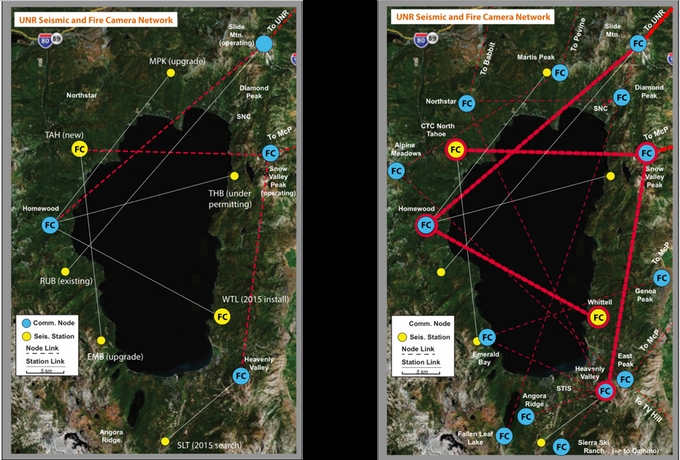
Left: Pilot program cameras; right: build out. Images/UNR

Left: Pilot program cameras; right: camera network when the system is built out. Images/UNR

By Kathryn Reed

INCLINE VILLAGE – If the fire alert system that is in its infancy in the Lake Tahoe Basin had been in place in 2007, the Angora Fire might not have wiped out 254 homes on the South Shore.

That is the prediction of Graham Kent, a South Tahoe High School graduate who is now the state seismologist for Nevada. He gave a talk Jan. 8 at the Tahoe Center for Environmental Sciences about AlertTahoe, the fire camera system that is being developed in Tahoe.

That same day the newest camera – at Homewood Mountain Resort – came online. Other cameras are at Snow Valley Peak, Angel’s Roost at Heavenly Mountain Resort, and on California Tahoe Conservancy property in North Lake Tahoe. A permit is secured to place a camera above Whittell High School, but there is no money to do so.

“Angora would be easy to control under a system like this,” Kent told the group.

The problem with Angora was dispatchers in Truckee believed it was a controlled burn and didn’t direct resources to the wildland fire in a timely manner. These cameras would have shown that smoke was no control burn. Plus, officials are working to put information on the website that identifies prescribed burns.

There was a time when people said a massive fire could not burn in the Sierra. The Rim and King fires prove that theory wrong. Had the winds changed, last September’s King Fire would have easily entered the basin at Tahoma.

Kent showed time lapsed images of the King Fire smoke that was captured on one of the cameras.

“You’re looking at stands of trees blowing up,” he said, as there would be a burst of smoke.

At one point flames are visible. (Video is in HD and 4K, with infrared capability.) The cameras can be moved to get a wider or zoomed in view.

On July 29 a camera picked up smoke on Mount Pluto at Northstar that neither CalFire nor the U.S. Forest Service was aware of. A storm came through to douse those flames. On Aug. 9 a tree was on fire north of Spooner. Officials knew about it because of a camera. The fire was kept to a half acre.

“That’s the point of the system. We find them, knock them down and make them small,” Kent said.

The Sept. 24 Cascade Fire allowed officials to see what a small fire looks like at night.

The U.S. Forest Service used to use fire lookouts to spot fires. These cameras are the modern day version of those lookouts – only much better. Fire agencies and the public may view them online.

The cameras are also used by UNR scientists to study earthquakes and floods. But as Kent pointed out, the cameras cannot change the size of those disasters. The cameras can help contain a fire.

An effort is under way to raise $2 million – in public and private dollars – in the next decade to be able to install more cameras, as well as to keep up with the maintenance and operation.

It cost $160 million to fight the Angora Fire, and at just more than 3,000 acres, that was a small fire. Angora was 1 to 3 percent of the size of the Rim and King fires.

With the snowpack diminishing in the Sierra and climate change taking hold, Kent said, “It is a very poor time to sit back and let fire happen.”

He said one fire could wipe out all of the $3 billion in environmental improvements that have been made in the basin since the 1990s.

The program continues to evolve. AlertTahoe is working with BLM to show two weeks worth of lightning strikes. If people think they see smoke from a fire, that location could be matched with where the lightning occurred. A Twitter feed, that will be activated this spring, will be geared toward spreading AlertTahoe info to the masses. The ability to show longitude and latitude identifiers for fires is in the works. And the website interface is being expanded.

—–

Notes:

• For more info or to help fund the project, go online.


Nev. to consider allowing betting on Olympics

By J.D. Morris, Las Vegas Sun

In recent years, gamblers expecting to place wagers on the Olympic Games at Nevada sports books were in for a letdown: Per state law, they were prohibited from doing so.

The South Point is trying to change that.

Next Thursday, the state Gaming Control Board will hold a workshop in Las Vegas to consider a regulation change proposed by the South Point that would allow for wagering on sporting events sanctioned by the International Olympic Committee.

South Point executives also are asking the board to loosen some regulatory language that would make it easier for sports books to accept wagers on other types of events, too.

Nevada gaming regulations ban wagering on any noncollegiate amateur sport or athletic event. The South Point wants to alter that language to expressly permit Olympics betting.

Read the whole story


Increase in police deaths isn’t what it seems

By Abbie VanSickle, Center for Investigative Reporting

In his remarks at the funeral of slain New York police Officer Wenjian Liu, FBI Director James Comey told those gathered that 2014 had been an unusually deadly year for law enforcement officers.

“We had 115 officers killed in the line of duty last year, a shocking increase from 2013,” he said.

Comey’s remarks suggest that officers are dying at the hands of criminals at a higher rate than in the past. But do the statistics support this “shocking increase?” Not really.

While newly available data show that law enforcement deaths did rise from 2013 to 2014, a closer analysis shows that 2013 may have been the aberration, with an unusually low number of police deaths, while 2014 marked a return to the recent norm.

“It was not far out of line from the other years,” said Steve Groeninger, spokesman for the National Law Enforcement Officers Memorial Fund. “I think it was troubling in that I think that we as a community had hoped that we were turning a corner on law enforcement safety, and, boy, they just jumped back up again.”

The memorial fund, a Washington-based nonprofit that tracks nationwide law enforcement deaths, compiles a database widely used by researchers. Its preliminary data for 2014 show that 126 law enforcement officers in the U.S. died in the line of duty, up 24 percent from 2013, when 102 officers were killed. In 2012, 122 officers died. But in 2011, 171 officers lost their lives, and in 2010, the figure was 161.

The biggest news in the 2014 statistics may be that firearms deaths surpassed traffic-related fatalities as the leading cause of death among law enforcement officers.

police_deaths


Firearms-related fatalities among law enforcement officers have decreased each decade since the 1970s, according to the memorial fund’s data. In the 1970s, an average of 127 officers were killed with guns annually. That dropped to an average of 87 officers a year in the 1980s. Last year, firearms deaths rose from 32 officers in 2013 to 50 in 2014 – a 56 percent increase, but still below this decade’s average of 53 officers a year.

This data is largely in line with related sources. The FBI tracks deaths of law enforcement officers each year and publishes an annual report, “Law Enforcement Officers Killed or Assaulted,” also known as LEOKA. This data differs slightly from the National Law Enforcement Officers Memorial Fund’s data because it does not include some types of law enforcement officers, such as prison guards, and relies on voluntary reporting by agencies.

While the 2014 FBI report is not yet available, prior data show that 2013 was an exceptionally safe year for police. According to the FBI, 26 officers were killed with firearms in 2013, a sharp decline from 2012, which saw 44 officers killed with firearms, and 2011, when 63 officers killed.

Interested in how many people were killed in 2014 by law enforcement? That’s much a harder question to answer. No national government database tracks deaths at the hands of law enforcement. Instead, local police departments can self-report information to the FBI on what it calls justifiable homicides, but that data is widely considered to be unreliable, according to recent media reports including Nate Silver’s ESPN website FiveThirtyEight and the Washington Post.


Skate skiing tests agility, balance, patience

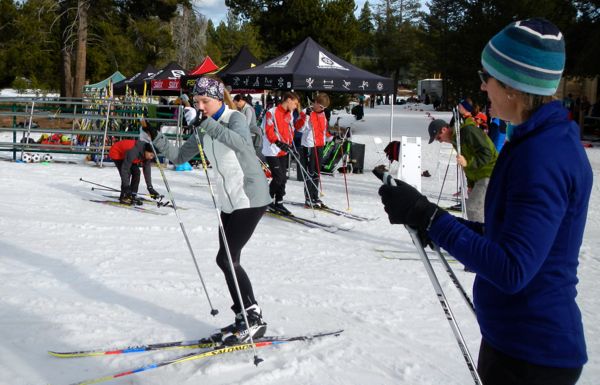
Truckee High School Nordic ski team member Grace Bronstone, left, gives skate skiing pointers Jan. 10 to Darla Sadler of Campbell. Photos/Kathryn Reed

Truckee High School Nordic ski team member Grace Bronstone, left, gives skate skiing pointers to Darla Sadler. Photos/Kathryn Reed

By Kathryn Reed

TRUCKEE – Push, glide, glide. Or was it glide, pole, pole, glide, glide?

Without the instruction of Grace Bronstone, we were a little unsure exactly what to do. Still, we kept at it to the point where we were fluid with our maneuvers, albeit a bit unsteady at times.

Skate skiing looks like ballet on snow when done correctly. We were not the models to emulate.

Bronstone, who is a member of the Truckee High School Nordic team, effortlessly slid across the snow at Tahoe Donner Cross Country Center on Jan. 10 during National Trails Day. She and teammates were helping out the rookies – and collecting donations for the team. Her patience with us was wonderful, as was her enthusiasm to teach us something she is clearly proficient at. A combination of grace and power.

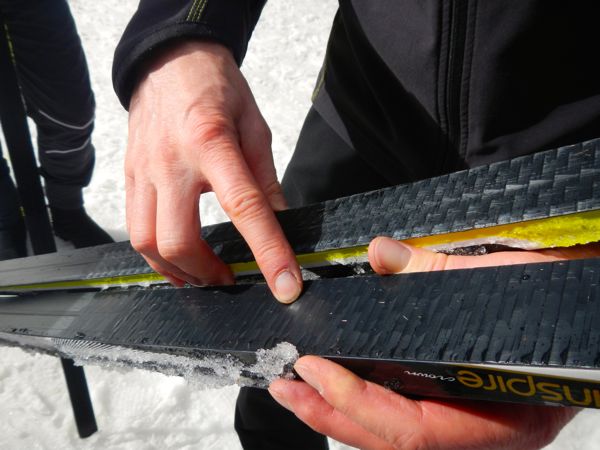
Dan Hill with Fischer skis explains how the base pattern affects performance.

Dan Hill with Fischer skis explains how the base pattern affects performance.

When Dan Hill, the Fischer-Swix rep, asked what our goals were for the day, I said, “To ski like Olympians.” Why not set the bar high?

While cross country Olympians tend to be in their 30s, the three of us are past the prime age for beginning such an endeavor. But Hill didn’t give up on us.

After Bronstone imparted her words of wisdom, Hill came to check on us. Darla and I needed to raise our poles up, use more force as we planted them, and engage our core for more oomph.

These poles that already seem super long – they come to our lower lip – are now to be raised in front of us to get that added power. I conjured images of past Olympics, remembering how those men and women seemed to be so aggressive. This isn’t just a sport that engages the leg muscles. I give Hill credit for helping me to achieve my goal in a little way. I was at least envisioning Olympians even though my technique was severely lacking.

Hill said to be an Olympian we would have to excel at classic cross country and skate skiing. We’ll keep working on just being proficient at both.

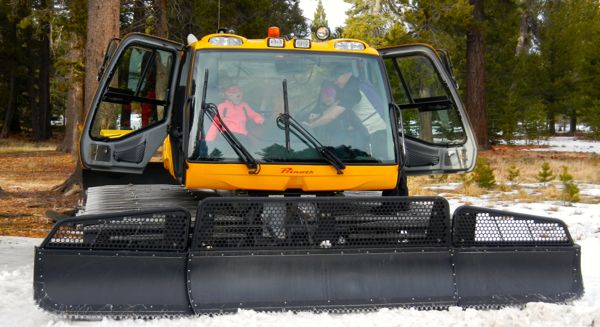
The groomer could use more snow move around.

The groomer could use more snow to move around.

“The goal of Winter Trails Day is to gain more lifetime skiers. For anyone who has been unsure about giving cross country skiing or snowshoeing a try, it’s a great way for participants to come out, ski and snowshoe for free, and get some free tips,” Ashley Quadros with Tahoe Donner told Lake Tahoe News.

Tahoe Donner and REI put on the Truckee event, with representation from the Tahoe Rim Trail, Sierra Avalanche Center and several equipment manufacturers.

While there were snowshoe demos and guided tours along some of the more than 100 kilometers of trails, Darla, Kim and I stuck to classic cross country and skate skis. We left having gained new skills, gathered a ton of information about Nordic ski equipment and an appreciation for the venue. A state-of-the-art center is under construction that should open this winter, which will complement the on-snow experience.


Colo. cannabis firm to help Calif. tribes

By Steve Raabe, Denver Post

Denver-based United Cannabis Corp. is proposing to team with Native American tribes in California to grow and manufacture medical marijuana products.

United Cannabis has signed a consulting and licensing deal with a company that will build up to three cultivation and processing facilities on tribal lands.

FoxBarry Cos. LLC, a firm that helps tribes with economic development projects such as farms and casinos, has pledged $30 million to develop the facilities. FoxBarry, in turn, will have exclusive distribution rights for United Cannabis products in California.

Read the whole story


Wandering wolf gets official pack status

his remote camera photo taken May 3, 2014, and provided by the Oregon Department of Fish and Wildlife shows the wolf OR-7 on the Rogue River-Siskiyou National Forest in southwest Oregon’s Cascade Mountains. State and federal wildlife agencies said Wednesday, Jan. 7, 2015, they have designated OR-7, his mate and their pups the Rogue Pack, for their location in the Rogue River drainage in the Cascades east of Medford. It's the first pack in western Oregon and the ninth in the state since wolves from Idaho started swimming the Snake River in the 1990s. (AP Photo/Oregon Department of Fish and Wildlife, File)

OR-7, which briefly called California home, is no longer a lone wolf. Photo/Oregon Department of Fish and Wildlife

By Jeff Barnard, AP

GRANTS PASS, Ore. — Oregon’s famous wandering wolf, OR-7, is now officially the leader of his own pack.

State and federal wildlife agencies said Wednesday they have designated OR-7, his mate and their pups the Rogue Pack, for their location in the Rogue River drainage in the Cascades east of Medford.

It’s the first pack in western Oregon and the ninth in the state since wolves from Idaho started swimming the Snake River in the 1990s.

As a youngster, OR-7 left his pack in northeastern Oregon in September 2011 in search of a mate. He traveled thousands of miles across Oregon and back and forth into Northern California before finding a mate last winter in the southern Cascades on the Rogue River-Siskiyou National Forest.

The GPS collar that tracked his travels is still working, but biologists hope to replace it this spring.

Efforts to trap OR-7, his mate or one of the pups to put a tracking collar on them were not successful last fall, said U.S. Fish and Wildlife Service biologist John Stephenson. They hope to have better luck this May, when the pack dens up for more pups.

Even if the GPS tracking collar fails, a separate unit on the collar that emits a radio signal that can be tracked by a directional antenna should continue working, Stephenson said.

Oregon could consider lifting state Endangered Species Act protections for wolves this year if biologists confirm that four or more packs produced pups that survived through the end of the year. The earliest a proposal could go before the Oregon Fish and Wildlife Commission is April, said spokeswoman Michelle Dennehy. Delisting would not mean an end to protections for wolves, but would give ranchers more options for dealing with wolves that attack livestock.

OR-7 has continued to stay out of trouble as far as livestock are concerned.

Oregon’s management plan calls for protections to continue for the Rogue Pack until there are four packs in western Oregon producing pups for three years running. Federal Endangered Species Act protection also remains in force in western Oregon and California.