Brine on Tahoe roads the new norm for storms

Brine leaves streaks on the road Jan. 1 at 3pm at the end of North Upper Truckee Road toward Highway 50. Photo/John Adamski

Brine leaves streaks on the road Jan. 1 at the end of North Upper Truckee Road on the South Shore. Photo/John Adamski

By Kathryn Reed

While there hasn’t been much snow to clear from roads this winter, crews in the Lake Tahoe Basin have been busy putting brine on streets when the threat of weather has been in the forecast.

This salt-water solution that is designed to prevent icing on the roads leaves a white film behind. It’s been more noticeable this season than in the past because more entities are using it.

Nevada Department of Transportation was one of the first agencies to go in this direction. They have more issues with snow storage so the less snow that sticks to the road, the less that has to be cleared.

“In the Tahoe basin we’ve done a lot of changes to winter maintenance,” NDOT spokeswoman Meg Ragonese told Lake Tahoe News. “We reduced the use of sand for winter road traction quite a bit since the 1990s. In the Tahoe basin specifically, NDOT has reduced winter road maintenance-related sand use from 4,300 cubic yards per year in 1990 to approximately 850 cubic yards, and reduced salt usage by 70 percent.”

Brine is a preventative treatment. If cars pack the snow down before a plow gets to it, the snow is released easier and doesn’t form a thick layer of ice.

Brine allows agencies to use less sand and salt, two substances that are deemed harmful for the environment.
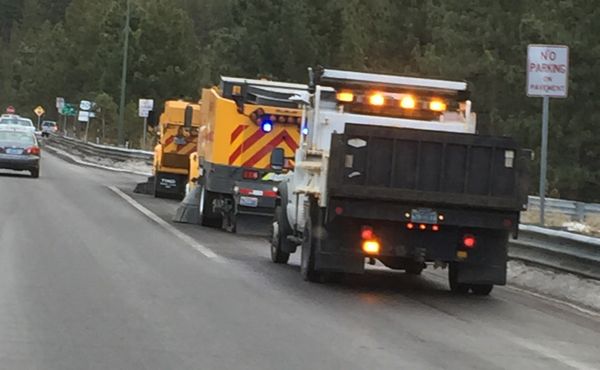
NDOT street sweepers remove salt and sand from roadways within four days of storm end in urban areas, dependent on weather. Photo/Kathryn Reed

NDOT street sweepers strive to remove salt and sand from roads within four days after a storm. Photo/Kathryn Reed

Through the years road crews have experimented with different products to keep the roads safe.

“When the snow begins, the brine is also mixed with a 75 percent sand and 25 percent salt combination to produce a wetter, heavier sand that will not as readily be thrown off roadway surfaces,” Ragonese said.

Agencies say improved equipment, mixture of products and weather forecasting allows for better application of all materials, and less need for the more harmful products.

“Brine would go on before a storm, sand during storm for traction, then salt or brine after to help melting process,” Steve Nelson with Caltrans told Lake Tahoe News. “Salt brine treated highways and bridges will resist frost for several days per application, reducing the time chain controls are in effect and the amount of traction sand used, significantly reducing chain control and sweeper employees’ exposure to moving traffic. Salt brine anti-icing techniques save time, are cost-effective and safer for workers and motorists, and they are more environmentally friendly than other methods.”

This report shows the increased use in brine for Caltrans’ Tahoe City and South Lake Tahoe maintenance yards. Brine is typically applied by tanker trucks at a rate of 50 gallons per lane mile.

When salt is applied, its rate is 200 to 500 pounds per lane mile, according to Caltrans. Caltrans went from averaging about 16,000 tons of sand in the basin each winter in the 1990s to 2,953 tons in 2012-13. Here is a chart of the amount of sand used from 1993-94 through 2012-13.

Tahoe Regional Planning Agency officials said they have no policy for what is applied to roads. Lahontan Regional Water Control Board takes a big interest on the California side. This is because they care about ends up in the lake.

Lauri Kemper with Lahontan said her agency supports the use of brine. Salt does not adversely affect lake clarity. But scientists don’t know what the affect on aquatic life is.

While road crews don’t want to hurt the lake or trees, the whole purpose of putting anything on the roadway is to help drivers.

“Public health and safety trumps everything,” Brendan Ferry, principal planner with El Dorado County, told Lake Tahoe News.

His people must balance safety with environmental concerns when it comes to deciding what goes on the roads.

Two years ago the county switched from using volcanic rock to decomposed granite. That switch has meant a 90 percent reduction – or 50,000 pounds – in fine particles reaching the lake, Ferry said.
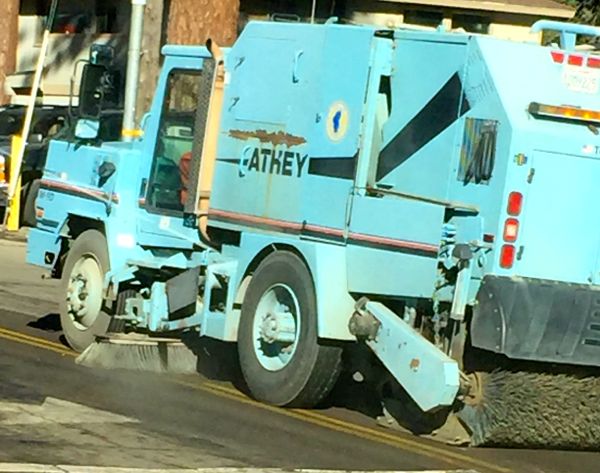
South Lake Tahoe aims to have sweepers out two days after a storm. Photo/Kathryn Reed

South Lake Tahoe aims to have sweepers out two days after a storm. Photo/Kathryn Reed

With granite being a native material, if it does reach the lake, it isn’t as detrimental as the coarser, foreign volcanic material.

“We focus a lot on roadway maintenance strategies. It’s one of the bigger things that is linked to Lake Tahoe’s clarity loss – ultra fine particles,” Ferry said. “Roadway abrasives are a primary source of those types of materials.”

The abrasives are used to help with traction. The county uses brine – which is usually a 27 percent salt, 73 percent water solution – on primary roads like Pioneer Trail and North Upper Truckee.

“We use that so we don’t need to use as many abrasives,” Ferry explained.

For years salt was applied to roads in and around the basin. But as the trees along the highways became tinged with a rust color it was determined the salt was the cause. It was distributed in hoppers, with much of the product ending up on the edge of the road and not having any affect on making the driving surface safer.

Then volcanic rock started to be used. Nearly everyone has followed El Dorado County’s lead and is using decomposed granite.

South Lake Tahoe doesn’t use brine because it has not seen the need nor does it have the equipment to do so. The city’s two sander trucks come out to drop Washoe sand at key intersections, routes to Barton Hospital and schools during storms.

The city is shopping for a sander truck that will likely cost about $350,000. It is a multiuse vehicle.

“The new one will have computerized distribution system. It will calculate how much sand to put down and where,” Jim Marino, assistant public works director, told Lake Tahoe News. “From the seat of the vehicle you will know how much you’ve put down. Two days later we’ll determine how much is picked up from an intersection.”

That’s the other environmental component. As part of Lahontan’s regulations, jurisdictions must report how much abrasive material is put down and then how much is collected either from sweeping or by cleaning storm drains. This way everyone knows how much was left in the environment or tracked into garages via tires.

6 invisible benefits of exercise

By Cassie Shortsleeve, Outdoor

Muscle tone and weight control. For the past decade, these benefits have topped the list of reasons why we exercise, according to the Sporting Goods Manufacturers Association’s annual report on the fitness industry. They consistently edge out others—like “feeling good after” and “increased energy”—we can’t see in a mirror.

That doesn’t mean we don’t care about the stuff we can’t see. We assume, for instance, that the effort to break a sweat leads to better cardiovascular health and a lower cancer risk. And extra energy and happiness are still key benefits.

But the breadth of invisible boons goes even further, affecting everything from our dating lives to our bowel movements. So the next time you’re stressing about a few stubborn pounds or a less-than-cut quad, focus on these six invisibly awesome effects of your efforts. We’ll start with your pain tolerance.

Read the whole story


Study: Helmets make a difference on the slopes

By Gretchen Reynolds, New York Times

Recently, researchers from the department of sport science at the University of Innsbruck in Austria stood on the slopes at a local ski resort and trained a radar gun on a group of about 500 skiers and snowboarders, each of whom had completed a lengthy personality questionnaire about whether he or she tended to be cautious or a risk taker.

The researchers had asked their volunteers to wear their normal ski gear and schuss or ride down the slopes at their preferred speed. Although they hadn’t informed the volunteers, their primary aim was to determine whether wearing a helmet increased people’s willingness to take risks, in which case helmets could actually decrease safety on the slopes.

What they found was reassuring.

To many of us who hit the slopes with, in my case, literal regularity — I’m an ungainly novice snowboarder — the value of wearing a helmet can seem self-evident. It protects your head from severe injury. During the Big Air finals at the Winter X Games in Aspen, Colo., this past weekend, for instance, Halldor Helgason, a 23-year-old Icelandic snowboarder, over-rotated on a triple back flip, landed headfirst on the snow and was briefly knocked unconscious. But like the other competitors he was wearing a helmet, and didn’t fracture his skull.

Indeed, studies have concluded that helmets reduce the risk of a serious head injury by as much as 60 percent. But a surprising number of safety experts and snowsport enthusiasts remain unconvinced that helmets reduce overall injury risk.

Read the whole story


Truckee-North Lake Tahoe trying to address socio-economic inequities of residents

By Kathryn Reed

TRUCKEE – Gated communities with manicured golf courses and spas – home to people who may have multiple addresses. A couple miles away much lower end housing inhabited with people living check-to-check.

While this dichotomy of the haves and barely hanging ons seems to becoming the norm throughout the Lake Tahoe Basin, the stark contrasts were pointed out in a presentation last week at the Truckee Donner Chamber of Commerce meeting.

“Living in Tahoe is the tale of two cities,” Alison Schwedner, director of the Community Collaborative of Tahoe-Truckee told the group gathered at Truckee Tahoe Airport. “It’s important to balance the two. We need to create an environment where families can live and thrive.”

Her group of 45 agencies is trying to address the needs of community members in the North Lake Tahoe-Truckee areas.

“Data shows a lot of families are struggling,” Schwedner said as she went over stats from the just released Community Report Card.

Kings Beach opened an affordable housing complex in 2014. Photo/LTN

Kings Beach opened an affordable housing complex in 2014. Photo/LTN

She talked of how people line up at the Family Resource Center because it’s warm and they may not have heat at home or be able to afford it. Project MANA provides food to half the people who live in Kings Beach. The waiting list for the more than 400 affordable housing units in the region is more than two years. Tahoe Truckee Unified School District provides 1,000 free breakfasts each day; 37 percent of the students receive a free or reduced lunch.

Getting help is a problem for many because of the state line and three counties – Nevada, Placer and El Dorado. Donner Creek Mobile Home Park is in Placer and Nevada counties. That means neighbors could be seeking help from different agencies. And sometimes that help is not right in town, and without a personal vehicle the aid may be out of reach.

Two contributing factors to what is keeping people down are low wages and the high cost of living. With most jobs being tourist oriented, they are minimum wage or about $11 an hour at most.

In 2011, the ACCRA Cost of Living Index put Truckee at ninth most expensive place to live in the United States.

Schwedner said it costs more to live in Truckee than the California and national averages. This means housing, food and everything combined costs more in Truckee.

“A lot of people technically live in poverty, but they don’t qualify for federal aid,” Schwedner said.

This in turn means people are turning to nonprofits for assistance.

Housing can be an issue. Schwedner showed a picture of affordable housing in Kings Beach that could be described as squalor. Then she showed the facility that opened last year – new, clean and a place people are proud to call home.

Tahoe Forest Hospital did a recent Community Needs Assessment that found while most people are healthy, with heart disease-obesity-tobacco use all being on the low side; there is an abnormally high use of alcohol in the area.

“We tend to be binge drinkers. We drink more than the state and country,” Schwedner said.

A question on the survey asked if people had a drink in the last 30 days. The hospital found that 81.1 percent of the people said yes. This compares to the state average of 55.5 percent and national average of 54.5 percent.

Mental illness is also something nonprofits are seeing as an issue and something the collaborative wants to address.


Sandoval puts focus on education

By Kyle Roerink, Las Vegas Sun

In his third and most ambitious State of the State speech, Gov. Brian Sandoval unveiled a litany of education initiatives and tax reforms he wants the Legislature to tackle in the upcoming session.

He set the stage for a session that will harbor intense debates about Nevada’s outdated revenue structure and bottom-tier education system.

Speaking for nearly an hour, he devoted more than 30 minutes to education reform, highlighting a plan to invest $882 million in education funding in the next two years. He outlined the plan as the beginning of a “new Nevada” and the foundation for education reform.

He didn’t hesitate to say that Nevada’s high school graduation rate and preschool enrollment were among the worst in the country.

Read the whole story


2 hikers enduring winter on the PCT

By Associated Press

RENO — After more than two months spent cold, wet, frostbit and blistered, Justin Lichter and Shawn Forry just wanted a few moments of comfort.

So, the first thing Lichter did before sitting down to talk about their attempt to become the first people to complete a wintertime through-hike of the 2,650-mile Pacific Crest Trail from Canada to Mexico was throw some logs in the fireplace at his Truckee-area home. Then, he and Forry joked about a planned side trip to Reno where they could watch movies and find an all-you-can-eat sushi restaurant.

With more than 1,500 miles of mud, slush and ice behind them and the heart of the Sierra Nevada ahead, the two men were determined to make the most of a 48-hour break from the trail.

“This is definitely a stop that we have been dreaming about for a long time, even before the trip started,” said Lichter, 34.

Although they’re still facing what will likely be the riskiest and most challenging terrain of the trip, the miles behind them have been no picnic.

Not long after they started in late October, the weather took a dreary turn which meant weeks of hiking, setting up camp, eating, sleeping and waking in cold and wet conditions.

Forry’s first blog post from the trail focused largely on the blisters that developed from hundreds of miles of walking with damp feet.

“The feet have been kind of a constant theme,” Forry, 33, said. “When you start in the wet and cold, it is a hard adjustment.”

Advertisement
In addition to contributing to blisters, week-after-week of wet, dreary weather was a challenge to the hikers’ psyches, said Lichter, who has more than 35,000 miles of ultralight hiking on his outdoors résumé.

“Every day, you are putting on all your wet and frozen clothes again and not seeing any of the views you worked so hard to climb up for.”

“Every day, you are putting on all your wet and frozen clothes again and not seeing any of the views you worked so hard to climb up for,” he said.

Toss in some high winds, snowstorms and extreme cold they’ve experienced and it starts to make sense there’s no record of anyone completing what Lichter and Forry are attempting.

Although both men are experienced adventurers with wilderness medical training and countless hours in the backcountry, the foreboding conditions already have resulted in some moments of doubt.

The greatest occurred not far from Bend, Ore., where they developed symptoms of frostbite on their feet. They’d been used to wet feet and cold mornings, but when they got to Oregon, the temperature dropped below freezing and it was too much for wet skin to endure.

“My journey into frostbite begins with jamming my feet into frozen boots in the morning,” Forry wrote in a Nov. 19 blog post. “I’ve seen a fair amount of frost nip and frostbite during my tenure in the winters of Minnesota, so when I saw the hardened, blanched white skin, I knew I was in for a long recovery ahead.”

At another point, the duo reached a rain-swollen Grider Creek in the Klamath National Forest only to find out the bridge they had been counting on to cross had been destroyed.

“We both ended up swimming across the creek at 7:30 in the morning and getting pretty wet in December,” Lichter said.

Given the difficulty of the journey, the obvious question for Lichter and Forry is, “Why?”

They say between the hardships, the trip has been punctuated with moments of ecstasy.

A big part of the enjoyment comes from knowing that even though thousands of people hike the Pacific Crest Trail in warmer months, very few get the chance to experience it during the winter when snowfall can make animal tracks easier to spot and lend a sense of quiet to the wilderness.

“There is just a real calm, surreal feeling in the wilderness,” Forry said. “You get a sense you are the only people out there, and in reality, we probably are.”

Lichter described waking up on Mt. Adams in Washington to a clear sky after weeks of storms and thick clouds and seeing Goat Rocks Wilderness and Mount Rainier in the distance.

“It was pretty much raining and snowing for over 40 days,” he said. “Then, you get a sunny day after that and, oh my God, I can see all these mountains. We just woke up to that.”

They’re even finding ways to power through the low moments by using them as reminders of why they decided to make the journey in the first place.

“You get frustrated, you get tired, that is part of the challenge,” Lichter said. “That is what makes the high parts even better.”

What’s next?

Lichter and Forry made it to Truckee late last week and even managed to get some miles in on Friday. They wanted to test the skis and boots they planned to use for the next part of the trip by traveling from Interstate 80 to a mountaintop at Sugar Bowl Resort, where Lichter works as a ski patroller.

Not only was it a chance to make sure the gear worked and fit comfortably, it allowed them to complete a difficult climb before resuming the trip. Getting to the top by their own power on Friday meant they could take the lift up the mountain Sunday morning to resume the journey from there.

At that point, they’ll be embarking on the portion of the trip that could be the most critical to success.

They’ll pass Lake Tahoe and experience the Sierra Nevada as it gets taller and more removed from towns and road access going south.

It’s also the time of year when storm cycles can stack up and dump snow by the foot, making travel treacherous.

“The mountains get bigger, so do the avalanche paths,” said Don Triplat, director of the Sierra Avalanche Center. “Right now, there are really good conditions that could change with the next storm.”

That means Lichter and Forry will need to stay mentally sharp throughout the physically demanding trek. Snow conditions can vary from one aspect to the next and throughout the day.

“If you are on a trail in the summertime, you can put your head down and walk,” Triplat said. “In the winter, you need to be evaluating constantly.”

In order to account for tougher conditions, Lichter and Forry adjusted their estimated daily mileage in the Sierra Nevada to about 10 per day, down from 20 or more on other parts of the trip.

If they successfully navigate the Sierra Nevada, the two hikers will be left with some desert miles, then the San Bernardino, San Jacinto and Santa Rosa ranges in Southern California.

Whether they make it to Mexico successfully or not, each man said the experience of the journey is more important than finishing.

“You don’t want to get started in that rabbit hole of ‘I’m only doing this to finish,'” Forry said. “It is cliché, but the journey is the biggest part of the trip.”


Docs dissect remedies for low back pain

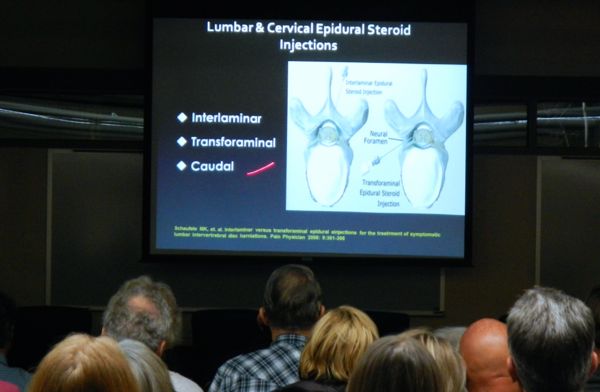
Barton doctors talk about different remedies for low back pain. Photos/LTN

Barton doctors talk about different low back pain treatment. Photos/LTN


By Kathryn Reed

Surgery isn’t going to always relieve back pain nor is surgery always the best option.

That is what doctors Mike Fry with Tahoe Fracture and Orthopedic Clinic and Alison Ganong with Tahoe Orthopedics and Sports Medicine told a group of more than 60 people last week.

Fry’s approach is more traditional – with drugs and surgery the main course of action.

Ganong takes a more holistic approach, where drugs might be a component, but the whole person and what their lifestyle is like is considered.

While most people at some point in their life will have low back pain, there are different types of lumbar diseases. Lumbar stenosis is what the doctors focused on.

Fry said people 50 and older are more often afflicted and can also have other issues going on like diabetes. Some people are born with it, while others acquire it over time.

Pain can be in the back, legs and glutes. Usually pain is most severe when sitting or lying down. More than half of back patients have numbness and less than half have weakness.

Fry explained that how people describe pain running down their leg could help narrow which of the five vertebrae is being affected.

Screw used during back surgery.

Screws used in back surgery.

“Surgery treats the symptoms of the disease, not the disease,” Fry said. “The degenerative process is still an ongoing problem with the spine after the operation.”

For Ganong, it’s a team approach to finding a remedy for the pain.

“It’s important to find out what causes the pain,” she said.

She likes physical therapy to be used early on because staying active is critical. Gone are the days when people with back pain are confined to bed.

Ganong is a proponent of the whole body being strong, especially deep muscles and the core. She pointed out how so much physical activity requires a strong core – like serving in tennis and pitching in baseball.

She works with patients on distinguishing between pain and function. When the pain limits ones ability to do something, that is much worse than being able to play-work through the pain.

When asked about the use of braces, both doctors said it is not a tool they favor except for possibly in post-operative situations. The no to braces is because the muscles become reliant on it.

As for whether a certain mattress can help people with back issues, a firm one is all they would say.

—–

Notes:

• The next Barton Wellness Lecture is Feb. 12 from 6-7m on Sleep Apnea & Cardiovascular Disease. David Young with Barton Cardiology will be giving the talk at Lake Tahoe Community College.


Feds limit asset seizures by local cops

By Robert O’Harrow Jr., Sari Horwitz and Steven Rich, Washington Post

Attorney General Eric H. Holder Jr. on Friday barred local and state police from using federal law to seize cash, cars and other property without evidence that a crime occurred.

Holder’s action represents the most sweeping check on police power to confiscate personal property since the seizures began three decades ago as part of the war on drugs.

Since 2008, thousands of local and state police agencies have made more than 55,000 seizures of cash and property worth $3 billion under a civil asset forfeiture program at the Justice Department called Equitable Sharing.

The program has enabled local and state police to make seizures and then have them “adopted” by federal agencies, which share in the proceeds. The program allowed police departments and drug task forces to keep up to 80 percent of the proceeds of the adopted seizures, with the rest going to federal agencies.

Read the whole story


Report: Requiring kindergartners to read may be harmful

By Valerie Strauss, Washington Post

The Common Core State Standards call for kindergartners to learn how to read, but a new report by early childhood experts says that forcing some kids to read before they are ready could be harmful.

Two organizations that advocate for early childhood education — Defending the Early Years and Alliance for Childhood — issued the report titled “Reading in Kindergarten: Little to Gain and Much to Lose.” It says there is no evidence to support a widespread belief in the United States that children must read in prekindergarten or kindergarten to become strong readers and achieve academic success.

The adoption of the Common Core State Standards falsely implies that having children achieve these standards will overcome the impact of poverty on development and learning, and will create equal educational opportunity for all children.

The report says that kindergarten has since the 1980s become increasingly academic — with big pushes from President George W. Bush’s No Child Left Behind and President Obama’s Race to the Top — and that today many children are being asked to do things they are not ready to do.

Read the whole story


Climate change to bring rain, floods to Tahoe

Local agencies are trying to address the affects of climate change to Lake Tahoe. Photos/LTN

Scientists are adamant climate change is already affecting Lake Tahoe. Photos/LTN

By Kathryn Reed

Tahoe’s isn’t likely to be barren anytime soon, but the type of moisture it receives in the future will be in the form of rain instead of snow, according to scientists.

That’s one outcome of climate change.

This in turn has consequences such as storage issues, flooding, more dry days than wet, and the increased threat of fire.

All of this was outlined during a climate change workshop hosted by the Lahontan Regional Water Quality Control Board at Lake Tahoe Community College on Jan. 15.

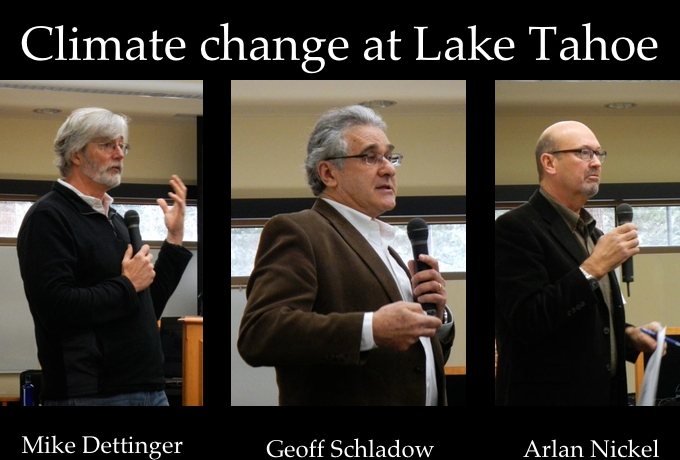
By 2050 the average snowpack for the Sierra is expected to be half of what it is now, according to Mike Dettinger, with the U.S. Geological Society and Scripps Institution of Oceanography at UC San Diego.

“With more rain, less snow, and larger storms it all comes together that the flood risk goes up in the Sierra,” Dettinger told the crowd of more than 60 people.

The meeting was one day before NOAA said 2014 was the 38th straight year with global annual temperatures above average.

Dettinger pointed out the last time California had colder than average years was from 1975-79.

Most models point to a trend of temperatures rising. This means the snow level will rise as well. That is why those living at lake level, and even many ski slopes in the Tahoe area, will see rain instead of white stuff.

Arlan Nickel with the U.S. Bureau of Reclamation said it may be time for agencies to look at when they release water so it better coincides with runoff and need. Peak runoff today is in May, but that date keeps moving up and is eventually expected to be in April.

With Lake Tahoe accounting for half of the Truckee basin’s water storage, he would like evaporation to be studied more.

While he didn’t mention it at this week’s talk, his agency along with scientists from the Desert Research Institute in Reno, and officials from the California Department of Water Resources this month placed a floating weather station at Folsom Lake with the intention of gathering data about evaporation.

DWR officials admit evaporation is a missing piece of information in the bigger water picture.

Geoff Schladow, director of the UC Davis Tahoe Environmental Research Center, is worried that dead zones are being created in Tahoe because the lake is not mixing like is used to. At 100 meters in 2014, that was the shallowest Lake Tahoe had mixed since records have been kept.

The mixing of water from the bottom of the lake to the top brings oxygen to all levels.

Without the mixing, ecosystems can be affected, heavy metals in the sediment become soluble, which can affect human health, fish die and other issues arise.

Lake Tahoe is not unique to these dead zones. Schladow said it is occurring throughout the world.

Schladow believes the models scientists have been using need to be updated because conditions are changing, and the data and assumptions from 10 years ago are outdated.

After the scientists spoke those attending were broken into groups to further discuss climate change and Lake Tahoe.

Lahontan is going to take the information from the workshop, compile a report and make recommendations to the regional board about potential policy changes or new policy.