Reducing food waste could ease climate change

By Roff Smith, National Geographic

More than a third of all of the food that’s produced on our planet never reaches a table. It’s either spoiled in transit or thrown out by consumers in wealthier countries, who typically buy too much and toss the excess. This works out to roughly 1.3 billion tons of food, worth nearly $1 trillion at retail prices.

Aside from the social, economic, and moral implications of that waste—in a world where an estimated 805 million people go to bed hungry each night—the environmental cost of producing all that food, for nothing, is staggering.

The water wastage alone would be the equivalent of the entire annual flow of the Volga—Europe’s largest river—according to a UN report. The energy that goes into the production, harvesting, transporting, and packaging of that wasted food, meanwhile, generates more than 3.3 billion metric tons of carbon dioxide. If food waste were a country, it would be the world’s third largest emitter of greenhouse gases, behind the U.S. and China.

John Mandyck, the chief sustainability officer of United Technologies, a U.S.-based engineering and refrigerated transport firm, says that food waste can be mitigated by improving the “cold chain,” which comprises refrigerated transport and storage facilities. His company hosted the first World Cold Chain Summit in London last November.

Read the whole story


Distrust keeps TPRID from moving forward

By Kathryn Reed

MEYERS – Dysfunction, distrust and plenty of dialogue filled a three-hour meeting of the Tahoe Paradise Resort Improvement District board Thursday night.

Whether or not to allow El Dorado County to have a larger role is one of the major items that still needs to be resolved. The board is contemplating a one-year agreement that would have the county parks staff help streamline some of the administrative duties.

It was reiterated multiple times that the county has no desire to take over the park. But distrust lingers because the first draft of the South Lake Tahoe-El Dorado County Recreation Master Plan stated just the opposite.

Even with the language being removed from the master plan, motives are still being questioned.

TPRID board members, from left: Lorraine Anderson, Judy Clot, Victor Babbitt, Sue Novasel and Peter Nelligan.

TPRID board members, from left: Lorraine Anderson, Judy Clot, Victor Babbitt, Sue Novasel and Peter Nelligan.

This board is responsible for operating the recreation facility that includes Lake Baron. Tahoe Paradise RID was created in 1965. It includes 2,200 residences, 4,400 parcels and is 10 square miles. The park gets its money from renting the facility – mostly for weddings, grants and $50,000 a year from Measure S/R. Steve Dunn, who is the park manager, lives on site; with the free rent being part of his compensation package.

Dysfunction was proved multiple times Jan. 22. Board members admitted they didn’t know which version of a resolution or memorandum of understanding they were supposed to be voting on. Several copies were in front of them. None was dated, so it was unclear which was the most current.

The public also was not privy to what was supposed to be voted on.

It was agreed that the accurate documents would be given to the board and then released to the media for distribution. The board will take the issue up in two weeks.

Not much of the more than 30-item agenda was discussed because the board members were anything but brief in their comments, were argumentative with one another and then allowed the public to join the dialogue.

It took 42 minutes to get through rearranging the agenda and for the first vote of the night – which was who should be the chair.

This was Sue Novasel’s first meeting as a board member. Her colleagues on the El Dorado County Board of Supervisors appointed her to it. On a 3-2 vote the TPRID board voted her in as chair for the next year. Members Judy Clot and Lorraine Anderson were the dissenters. They both wanted Clot to be chair. Victor Babbitt is the vice chair, voted in on the same 3-2 vote. Peter Nelligan on a 5-0 vote is secretary-treasurer.

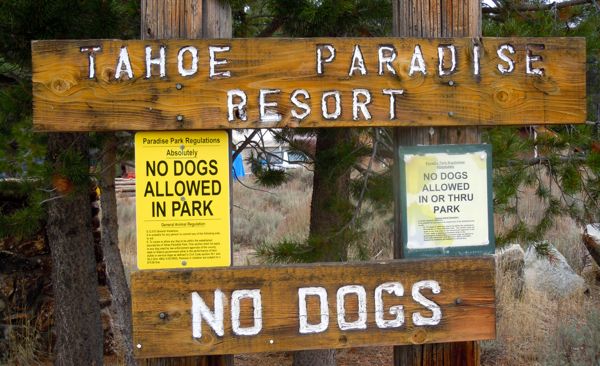
Many park users want dogs to be allowed at Tahoe Paradise. Photos/LTN

Many park users want dogs to be allowed at Tahoe Paradise. Photos/LTN

The five agreed to meet again in two weeks – Feb. 5 at 6pm at the Lake Valley fire station off Highway 89. The main purpose is to resolve the MOU issue with the county – whether to have one, and if so, what it should include.

Novasel is working on getting training for the board about the Brown Act – California’s opening meeting law, and wants meeting notices posted on the county website – and make it so people can sign up for email alerts about meetings. Some of this, though, may not be possible without the MOU.

The public asked the board in the future to consider allowing dogs in the park on a leash and for the board to be elected. As it stands now, current members vote a new board member in. Elections have been conducted in the past, but the expense has made it cost-prohibitive. It was suggested the MOU contain an item saying the county will pick up the costs of an election.


Measles cases intensifies vaccination debate

By Adam Nagourney and Abby Goodnough, New York Times

LOS ANGELES — A measles outbreak that began at Disneyland is spreading across California and beyond, prompting health officials to move aggressively to contain it — including by barring unvaccinated students from going to school in Orange County. The outbreak has increased concerns that a longstanding movement against childhood vaccinations has created a surge in a disease that was declared eliminated in the United States in 2000.

Health officials said 59 cases of measles had been diagnosed in California as of Wednesday, with an additional eight related cases spread through Utah, Washington, Oregon, Colorado and Mexico. Among those infected are five workers at Disneyland, where the outbreak was spotted in mid-December; 42 of the 59 California cases have been linked to the Disneyland outbreak.

The cases were a continuation of what health officials said was a worrisome increase in measles in Orange County and other places where parents had resisted the urging of health professionals to inoculate their children. The Centers for Disease Control and Prevention reported 644 cases of measles from 27 states last year, by far the largest number since 2000.

Before measles vaccines became commonplace in 1963, about three million to four million Americans a year contracted the disease, the agency said, and 400 to 500 died from it.

Read the whole story


Lack of water tests vineyard managers

By Ed Joyce, Capital Public Radio

More than three years of drought has reduced reservoir storage in California and groundwater supply. Some wine grape growers in Amador County are worried the limited resource could make this season more challenging.

The National Oceanic and Atmospheric Administration said that, barring “epic rain and snowfall,” the drought will continue through at least the spring and likely linger into the summer in California. That’s a worry for wine grape growers that rely on groundwater.

“There’s a lot of concern out there amongst growers that I work with in the four counties in the Central Sierra,” said Lynn Wunderlich, a Farm Advisor with UC Davis Cooperative Extension. She works with growers in El Dorado, Amador, Calaveras and Tuolumne counties.

Wunderlich said the rainfall in each of those counties varies significantly. Because of the drought, Wunderlich said some growers are extending their wells or digging new wells to increase groundwater supply.

Read the whole story


January on course to be record dry month

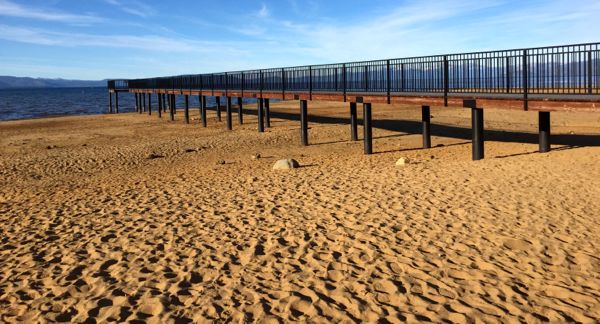
Two pilings of the Tahoe Keys pier remain in the water. Photo/Kathryn Reed

Two pilings of the Tahoe Keys pier remain in the water. Photo/Kathryn Reed

By Kathryn Reed

January is destined to be a record for the weather books. And it might be for some companies in the Lake Tahoe Basin, too.

No snow means no money for many businesses, which in turn means no paycheck or a smaller one because of reduced hours for employees. And with locals not making money, it then means less being spent throughout town.

For the first 20 days of the month the city has recorded a trace of moisture, according to the National Weather Service in Reno. The driest January was in 2003 when 0.03 inches fell.

Tahoe City hasn’t recorded any wet stuff this month. The record low precip for January was in 1991 with 0.08 inches.

It is the water equivalency that the Weather Service measures.

If the storm that is on the horizon for Jan. 27-28 materializes, this January may not be a record. But it will still likely be one of the worst on record.

Rain is what is being predicted for 8,500 feet and below. That means water on most of the already sketchy ski slopes.

For consecutive seasons Tahoe area resorts have been unable to open all of their terrain. This means not being fully staffed. And now hours are being cut. Tahoe Donner Cross Country, Dodge Ridge, Donner Ski Ranch, and Badger Pass have closed in the last week. That could change if Mother Nature comes through.

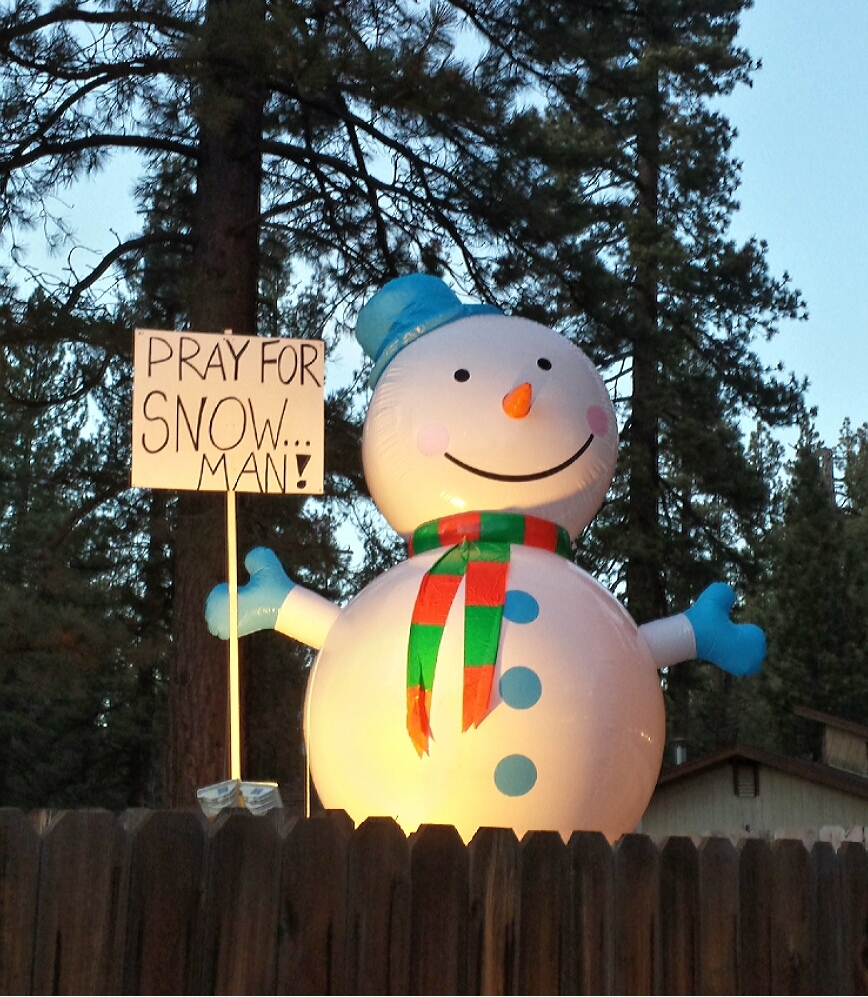
The only snowmen in Tahoe right now are inflatable, like this one at Tulare Avenue and Highway 50 in South Lake Tahoe. Photo/Toogee Sielsch

The only snowmen in Tahoe right now are inflatable, like this one at Tulare Avenue and Highway 50 in South Lake Tahoe. Photo/Toogee Sielsch

Tennis nets are back up in some places. Bikes were never put away for the season.

Vacancy signs were the norm last weekend – a three-day weekend that in the past often had lodging properties full.

While last summer was good for so many businesses in and around Tahoe, the same may not hold true for 2015. If snow, rain, and runoff don’t fill Lake Tahoe, the boating season could be over before it starts. It’s hard for most boats – except human powered – to access most of the marinas.

Tahoe Keys Marina owners have not taken out a dredging permit. It’s up to Aramark – operators of the Tahoe Queen – to dredge the Ski Run Marina. No permit has been sought and the Queen is not operating because of the low water level.

While there are plenty of things to do besides be on the lake in the summer, it is a big draw.

The only benefit of the low lake level may be larger beaches to accommodate more people. But one beach this month became off limits. Tahoe Keys Property Owners Association has put a fence up so only homeowners can access the sand and pier.

It’s going to be near beach-like weather this weekend.

Other records being set are for heat. It was 58 degrees in South Lake Tahoe on Jan. 18 – a record. The previous high was 57 in 1985. Another record may be set this Sunday where the forecasted high is for 62 degrees. The previous high was 57 in 1982.

Tahoe City on Jan. 25 may break the 1984 record of 51 degrees.

“It just continues to be mild and dry,” Jessica Kielhorn, meteorologist technician in Reno, told Lake Tahoe News.

Atmospheric rivers could end Calif.’s drought

By Tony Barboza, Los Angeles Times

California’s drought crept in slowly, but it could end with a torrent of winter storms that stream across the Pacific, dumping much of the year’s rain and snow in a few fast-moving and potentially catastrophic downpours.

Powerful storms known as atmospheric rivers, ribbons of water vapor that extend for thousands of miles, pulling moisture from the tropics and delivering it to the West Coast, have broken 40 percent of California droughts since 1950, recent research shows.

“These atmospheric rivers — their absence or their presence — really determine whether California is in drought or not and whether floods are going to occur,” said F. Martin Ralph, a research meteorologist who directs the Center for Western Weather and Water Extremes at the Scripps Institution of Oceanography at UC San Diego.

The storms, which flow like massive rivers in the sky, can carry 15 times as much water as the Mississippi and deliver up to half of the state’s annual precipitation between December and February, scientists say. Though atmospheric rivers are unlikely to end California’s drought this year, if they bring enough rain to erase the state’s huge precipitation deficit, they could wreak havoc by unleashing floods and landslides.

Scientists using a new type of satellite data discovered atmospheric rivers in the 1990s, and studies since then have revealed the phenomenon’s strong influence on California’s water supply and extreme weather.

Read the whole story


Mixed-use retail likely at Ski Run-Hwy. 50

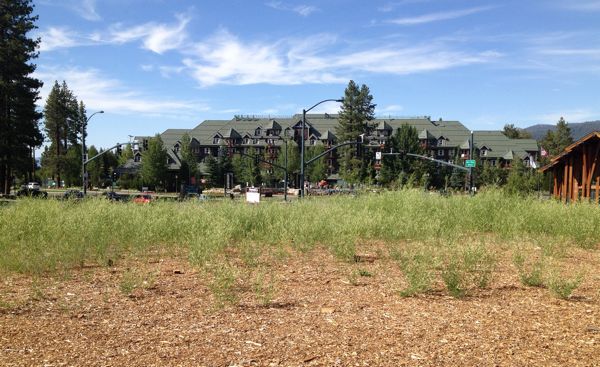
A developer bought this parcel from South Lake Tahoe for $1.1 million. Photo/LTN file

A developer bought this parcel from South Lake Tahoe for $1.1 million. Photo/LTN file

By Kathryn Reed

One of South Lake Tahoe’s prime pieces of real estate may be more than a plot of dirt 18 months from now.

Halferty Development Corporation out of Pasadena has until June 1, 2016, to obtain a building permit for the nearly 1.5 acres at the corner of Highway 50 and Ski Run Boulevard and still retain incentives from the city.

The City Council on Jan. 20 unanimously agreed to sell the parcel to the developer for $1.1 million. For that amount the city is also throwing in 12,000 square feet of commercial floor area (CFA) if the developer follows an agreed-upon timeline.

The property did not have any CFA or tourist accommodation units (TAU). It does have coverage and 88 parking spaces in the garage next door. How many more parking spaces it will have depends on the building and the design.

CFA and TAUs are commodities the Tahoe Regional Planning Agency came up with years ago to regulate growth, but instead have backfired a bit by creating a less than free market for development and value in items that don’t exist elsewhere in the world.

The city acquired this property from the South Lake Tahoe Redevelopment Agency for $800,000 after the state dissolved redevelopment agencies. At that time the council borrowed the money from reserves with the intent that it be returned to that pot. However, City Manager Nancy Kerry pointed out that this council may do what it likes with the $1.1 million. The council did not discuss where the proceeds would go.

A mixed-use retail center with the possibility of tourist units on the second floor is one concept. The city has been promised a drive-through drug store will not be going there. Other developers have wanted to build one, and Halferty has experience doing so.

James Halferty was not available for comment. He was one of three developers vying for the land.

Mayor Hal Cole told Lake Tahoe News the Southern California firm was chosen because it has the most experience, has the ability to start right away and came up with a price the city liked. Plus, Halferty was willing to give the city more control than the others.

“The most important thing is that it needs to look nice,” Cole said.

He knows tenants will change through the years, but he wants a building that will last 50 years, not look dated and rundown. During council member comments Cole expressed his frustration with the Auto Zone and BevMo buildings looking like they could be built in any town. He wants a more rigorous design standard so there is more of a mountain feel to what is built going forward. He is proposing the Planning Commission have more input into design.

How many millions of dollars Halferty will invest remains to be seen.

And if lodging is part of the project, he will have to obtain TAUs. Kerry said the city would work with smaller hotels and those wanting to buy them to help make that a reality.

A possible use is some sort of food court that would be attractive to the summer beach crowd and winter skiers. It could be grab and go, as well as have areas to sit around fire pits.

“He said to the negotiating committee, ‘What do you really want and I’ll build it’,” Kerry said. But with its being a small parcel, the options are somewhat limited.

There will be entrances off both streets. And pedestrians will get a crosswalk from this site to Ski Run Marina across Highway 50.


LTCC denied 4-year pilot school status

By Kathryn Reed

Lake Tahoe Community College is not one of the 15 two-year institutions that will be part of a pilot program to offer a four-year degree.

LTCC was one of 36 schools vying for this opportunity.

“The board, faculty, staff, students and administration are disappointed, although remain supportive of the California Community College baccalaureate pilot,” LTCC President Kindred Murillo told Lake Tahoe News.

The University of California and California State University systems need to find ways to accommodate more students. Allowing community colleges to offer four-year degrees would do that.

LTCC proposed a public safety administration degree.

The campuses and programs approved Jan. 20 are:

• Antelope Valley College — airframe manufacturing technology

• Bakersfield College — industrial automation

• Crafton Hills College — emergency services and allied health systems

• Cypress College — mortuary science

• Feather River College — equine industry

• Foothill College — dental hygiene

• Mira Costa College – biomanufacturing

• Modesto Junior College –respiratory care

• Rio Hondo College — automotive technology

• San Diego Mesa College — health information management

• Santa Ana College — occupational studies

• Santa Monica College — interaction design

• Shasta College — health information management

• Skyline College — respiratory therapy

• West Los Angeles College — dental hygiene.

The setback does not mean LTCC won’t offer four-year degrees at some point. This has been Murillo’s mission since arriving in South Lake Tahoe a handful of years ago.

“LTCC will continue our efforts to bring public undergraduate and graduate degree programs through the university center model,” she said.

Through a more than $5 million donation from Lisa Maloff the college within the next two years plans to begin construction on a standalone 5,500-square-foot university center. A university center is a location on a community college campus occupied by staff from four-year colleges who offer their programs locally.


Demand for backcountry-like terrain prompts resorts to up the ante inbounds

By Avery Stonich, Outdoor

When the new Kachina Peak lift opens at Taos Ski Valley this season, inbound skiers and riders will gain access to prime terrain once reserved only for those willing to hike to the top. The triple chair will whisk people up to 12,450 feet, just shy of the Kachina Peak summit, increasing Taos’ advanced and expert lift-serviced terrain by 50 percent.

“Kachina offers an adventure similar to backcountry skiing and riding, and we know many of our visitors are actively seeking more of that type of experience,” says Jesse Keaveny, chief marketing officer for Taos Ski Valley. “By adding the lift, we provide snowsports enthusiasts that thrill of untamed expert terrain, but in a more accessible — and controlled — way.”

Taos isn’t the only resort trying to bring backcountry-like experiences to its customers. According to National Ski Areas Association data, inbound snowsports visits dropped almost 10 percent from 2010-11 to 2013-14. While back-to-back dismal snow years in some regions (looking at you, California) take some of the blame, the improved performance of backcountry gear has allowed more skiers and riders to feed their stoke beyond resort boundaries. Backcountry gear sales have jumped nearly eight percent since 2011-12 and sales of hybrid alpine/AT boots have quintupled during the last four years, according to Snowsports Industries America.

Read the whole story


Study: Water stress takes toll on Calif.’s large trees

By Taylor Goldenstein, Los Angeles Times

Drought, fire-suppression techniques and changes in land use have made California forests denser with smaller trees and more susceptible to fast-moving wildfires, a study to be released Tuesday has found.

Researchers at UC Berkeley, UC Davis and the U.S. Geological Survey compared tree surveys conducted between 1929 and 1936 with surveys conducted between 2001 and 2010. They found that large tree density fell across California, with declines of as much as 50% in the Sierra Nevada highlands, the south and central Coast Ranges and Northern California. At the same time, the density of smaller trees increased dramatically.

The firemen are faced with this notion of when a fire is reported and started, do they go out and … put the fire out, or do they let it burn?
– Mark Schwartz, professor of environmental science and policy at UC Davis
Drier conditions caused by drought reduce water available for trees to grow while making it easier for fires to start and spread. Scientists say the changes raise crucial questions about how California manages its forest land to prevent and control wildfires as temperatures increase.

“The current drought in California highlights our need to understand the role of water balance in these systems and how it will be affected by global temperature rise,” said the study’s lead author, Patrick McIntyre. “Forests and woodlands cover a third of California, so this has important implications for our state.”

Read the whole story