Satellite to track drought from space

By Marcus Woo, Wired

The launch of a small satellite won’t fix the the drought in the American West—now entering its fourth year—and it won’t change the fact that January was the driest month in recorded California history. But the Soil Moisture Active Passive mission might at least tell scientists and farmers something new about that drought, and maybe how much worse it’ll get.

Winds and mechanical issues delayed the SMAP launch for two days, but on Saturday morning a Delta II rocketed it from Vandenberg Air Force Base to about 400 miles above the planet. After three months of “commissioning”—when ground control makes sure all the instruments are working—SMAP will spend three years taking the most accurate readings ever of soil moisture around the world. That’s right: It will measure how wet the dirt is. From space.

For understanding water on Earth getting a good handle on dampness is crucial. SMAP can see through atmospheric moisture, plants, and a couple of inches of dirt to measure wetness over an area of about 3.5 square miles.

Read the whole story


SLT eager to get pot grows into compliance

Special lights are required in the grow room. Photo/Steve Kubby

Special lights are required for marijuana plants to thrive in an indoor grow room. Photo/Steve Kubby

By Kathryn Reed

Plants are thriving even though it’s winter in Lake Tahoe.

That’s what happens when a garage is converted into a grow room.

Buds are sprouting from the 29 marijuana plants.

And this is all legal in South Lake Tahoe.

Ten permitted grows exist in the city. But what worries city officials is the hundreds of people who are illegally growing marijuana indoors. They pose a safety threat to themselves and their neighbors.

“With all the illegal grows I see there are a lot of hazards and it is a little spooky how close people are to burning the house down, or having damage with mold or water,” Dave Walker, South Lake Tahoe building official, told Lake Tahoe News. “I would love to see more people get permitted to make sure everybody is safe.”

Steve Kubby, who helped write Proposition 215 – the Compassionate Care Act, received his permit from the city last month.

“This was an amazingly effortless process for me,” Kubby told Lake Tahoe News. “The building department was so cooperative.”

Despite being legal, Kubby has reservations about having had to go through the process in the first place because the state law doesn’t say people need a municipality’s permission. Still, he said he complied to be a role model for others.

Kubby used Corey Barack, who is a plumber by trade, to ensure his place would meet all of the city’s rules and be as safe as possible. His business, Grow Safe, is a consulting firm for those seeking to grow marijuana legally in the city for medicinal reasons.

“The whole room is sealed,” Barack said as he gave a tour of Kubby’s room that is a walled-in section of the garage.

He hooked up a reservoir, which is really a sump pump, as a drip system. Kubby said the CO2 generator is like putting the plants on steroids.

“That generator increases the yield by about 30 percent,” Kubby said.

People may use 10 percent of their living area for a grow room, up to a maximum of 250-square-feet. Permits cost more than $300 and are good for one year. A 215 card is required to get the city permit. There is no limit on the number of plants allowed.

Outside Kubby’s house there is no stench of marijuana. That is another requirement of the city’s – to make sure everything is ventilated correctly. Many older homes cannot handle the amount of electricity required to keep a grow room going. That is why fire hazards are common. For Kubby, he changed his electric range and oven to gas to allow for more amps to be used for the grow room.

“We anticipated people might increase the grow area or add things that were not safe, but that has not been the case,” Walker said. “They have been very good about following the rules.”

—–

Notes:

• Building official Dave Walker and Police Chief Brian Uhler are giving a free informational talk Feb. 2 at 7pm at the Wellness Center in the Bijou Center in South Lake Tahoe. The purpose is to give information about the permit process for indoor grows and to answer questions.


Consumers eager to spend, economy improves

By Josh Boak, AP

WASHINGTON — There’s a good reason the U.S. economy is impressing the world right now despite a slowdown in the final three months of 2014: In a word, steadiness.

Companies have been hiring at healthy rates for the past year. Layoffs hover near historic lows. Auto sales are strong. Gas prices have sunk. Congressional budget fights have faded. Americans are increasingly confident.

All that fed a surge of consumer spending last quarter, offsetting weaker business spending caused in part by a pullback by oil drillers and a frail global economy.

The U.S. economy as a whole expanded at a 2.6 percent annual rate, the government said Friday, down from a sizzling 5 percent gain the previous quarter. Yet consumers signaled their optimism by spending at the fastest rate in nearly nine years.

“This hasn’t changed my picture on the strength and resilience of the U.S. economy,” said Scott Anderson, chief economist at the Bank of the West. “Almost all the drivers of consumer spending are pointing in the right direction.”

Nearly six years into the recovery from the Great Recession, the economy has finally gone from straining just to grow to posting consistently solid gains. The gains have come even though many households continue to struggle without much of a financial cushion. Nearly half say they spend all their income, go into debt or use savings to meet their expenses, a new analysis by the Pew Charitable Trusts has found.

In addition, a surging dollar is denting the earnings of U.S. companies that operate overseas. And energy firms have been hurt by plummeting oil prices, and as a result companies in the Standard & Poor’s 500 index are expected to report weak profit growth.

But collectively, consumers and investors are showing renewed faith in the economy.

On Friday, the University of Michigan said its sentiment index found that U.S. consumers are more confident than they’ve been since 2004. Also Friday, the government said wages and benefits are ticking up, a sign that steady job gains may be compelling employers to pay a bit more.

Most indicators suggest that the economy has surpassed a psychological threshold that has made businesses more comfortable with hiring and infused consumers with more enthusiasm.

“Psychology has been a big contributor to the improved level of performance in the United States,” said Carl Tannenbaum, chief economist at the bank Northern Trust.

At a time when Europe, Asia and South America face deep anxieties, the U.S. economy’s greatest strength might be its remarkable sturdiness.

The consensus expectation is that the U.S. economy will expand a solid 3 percent this year, well above the recovery’s 2.2 percent annual average. This has made U.S. stocks and Treasurys comparably attractive — havens from the risks from Europe’s prolonged slump, collapsing oil prices, China’s slowdown and Japan’s struggles to stave off recession.

Yet the U.S. economy still has additional room to continue expanding. In current dollars, the median household income of $54,417 remains about $1,800 below its late 2007 levels, according to Sentier Research. More than 5 million households owe more on their mortgages than their homes are worth, according to the real estate data firm CoreLogic.

Because the U.S. economy is rebuilding its core without relying heavily on mortgages, credit cards and other debt, it has avoided the sharp swings and shocks that can tip an economy into recession.

“You’re getting solid consistent growth,” said John Canally, chief economic strategist at LPL Financial. “If you have a slow recovery, you don’t build up the excesses that ultimately cause a recession.”

The gourmet hamburger chain BurgerFi plans to nearly double in size from its more than 60 restaurants this year. More consumers are upgrading from fast food, and the chain can choose from towns and cities “where the economic train has been rolling along at a pretty rapid pace,” said Corey Winograd, CEO of the Florida-based chain.

If all goes as planned, BurgerFi will account for 2,000 new jobs this year.

Investors are still trying to adjust for this newfound steadiness. The rush of foreign money into U.S. Treasurys has cut the yield on 10-year note to about 1.67 percent from 2.9 percent a year ago. A result is that it’s now cheaper for companies and homebuyers to borrow in ways that nurture growth.

During 2014, employers added an average of 246,000 jobs a month. That figure has remained above 200,000 for the past 11 months and has helped whittle the unemployment rate to 5.6 percent from 6.7 percent 12 months earlier. Given that applications for unemployment benefits have stayed consistently below a weekly average of 300,000, most economists think hiring should grow at a pace similar to the 2014 levels.

Wages have yet to grow significantly. But all those new jobs mean that the U.S. economy entered 2015 with an extra $126 billion in combined annual paychecks. That money has trickled into restaurant dinners, new cars and other goods and services.

Sales of new vehicles climbed 6 percent to 16.5 million last year, according to Autodata Corp. Car buying is poised to eclipse 17 million for the first time in a decade. Spending at restaurants and bars improved 5.8 percent last year, the government says.

Cheaper energy has been a gift for consumers, who account for nearly 70 percent of all U.S. economic activity. The Energy Information Administration projects that an average U.S. household will save about $750 this year on gasoline.

At the same time, Tannenbaum of Northern Trust cautions against becoming too complacent if consumers begin to fear that the economic woes abroad threaten the U.S. job market or financial markets.

“Psychology could also be the avenue through which some of the world’s uncertainties drag us back to growth that’s a bit less desirable,” he said.





Study: College isn’t always worth it

By Danielle Paquette, Washington Post 

Last month, after announcing his plan to make community college free, President Obama lauded a college degree as “the surest ticket to the middle class.”

New research in the prolific field of “Is College Worth It?” suggests it’s not that simple.

“‘Ticket’ implies a college degree is something you can just cash in,” said Alan Benson, assistant business professor at the University of Minnesota. “But it doesn’t work that way. A college degree is more of a stepping stone, one ingredient to consider when you’re cooking up your career. … It’s not always the best investment for everyone.”

Benson, along with M.I.T.’s Frank Levy and business analyst Raimundo Esteva, co-authored a paper, released last week, examining the value of public university options in California. Factors like how long it takes to complete a degree — often longer than four years — and whether students make it to graduation, he learned, can significantly diminish the value of pursuing higher education.

Read the whole story


Reno hotel proves gaming, smoking not needed

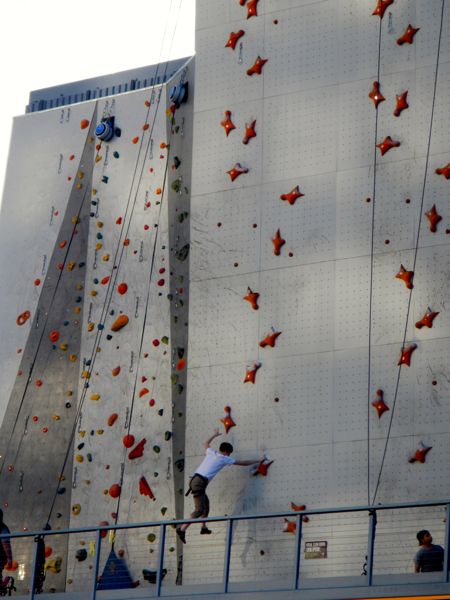
Brandy Mane tests her agility at the climbing gym inside Whitney Peak hotel. Photos/Kathryn Reed

Brandy Mane tests her agility at the climbing gym inside Whitney Peak hotel. Photos/Kathryn Reed

By Kathryn Reed

RENO – It’s hard to believe this is Reno. No stench of stale cigarettes. No casino. A restaurant that is a destination unto itself. A lobby like many boutique hotels; meaning modern, chic and upscale. And live music that rocks.

Whitney Peak Hotel isn’t what one would expect from any Nevada hotel.

It is the only non-gaming, non-smoking hotel in Reno.

But for those who want to partake in those activities, the hotel is steps from venues that allow those sorts of things. Whitney Peak is in the heart of downtown – right at the famous Reno arch and walking distance to the Truckee River area.

“It’s a hotel experience, not a casino experience,” Eli Gross, social media community manager, said. The goal, he said, is to provide a four star hotel.

Hotel rooms look nothing like when this was the Fitzgerald.

Hotel rooms look nothing like when this was the Fitzgerald.

The ownership group out of Chicago took over the Fitzgerald, which closed in November 2008, and spent $10 million transforming this property into something unique. It opened in June 2014. But before it became Whitney Peak it was CommRow from Oct. 1, 2011, to Jan. 1, 2013. This is when the exterior climbing wall was built.

Improvements are not complete. Gross told Lake Tahoe News it’s possible a pool will be added in the future. But it won’t be the party scene Las Vegas is known for or the Hard Rock at Stateline wants to become.

This has to do with the hotel catering to a demographic that isn’t all about partying, getting drunk and being half naked.

Food at Heritage is unique, fun and flavorful.

Food at Heritage is unique, fun and flavorful.

By April another $3 million will have been spent. This is to bring another 150 rooms online, upping the total to 300.

Most rooms average 300-square-feet, and are the same footprint of the old Fitzgerald that was built in 1976. Even so, it’s only the size of the bathroom – especially the tub – that indicates this is not a hotel built today from the ground floor up.

Whitney Peak, while it is chic upon entering, isn’t all about being high-end and sophisticated.

Rigorous Proof and Bryan Jones were playing in mid-January at Cargo, the nightclub on the first floor. It was a celebration of their album release “Moondog Matinee”.

Rigorous Proof and Bryan Jones at Cargo.

Rigorous Proof and Bryan Jones at Cargo.

There is an outside entrance to the 5,000-square-foot music venue that seats 400 or can accommodate more than 1,000 people if they are standing.

In some ways Whitney Peak is the antithesis of upscale luxury because there is no sense of pretentiousness. Employees at the front are in flannel shirts; at the bar workers are in jeans and grey button down shirts with their sleeves rolled up. It’s elegant without being over the top. Rooms are modern without being minimalist. Décor reflects the surroundings without being gaudy.

Service is at a level to be envied and emulated by others – except for at the climbing gym. Workers didn’t seem to care that a rookie was in the gym. It’s possible to take lessons to be more proficient at the indoor bouldering gym or to be Spiderman-like on the North America’s tallest outdoor climbing wall at 164 feet.

But the members, they were helpful to explain the pitches, the holds and how to swing a leg to stay anchored.

This rigorous play area is open to hotel guests for a small fee, and to the public for daily use or monthly membership. The owners invested $800,000 into the climbing facility.

Whitney Peak has the largest outdoor climbing wall in the United States.

Whitney Peak has the largest outdoor climbing wall in the United States.

Outside there are numerous routes that Tommy Caldwell and Kevin Jorgeson of Yosemite’s Dawn Wall fame could tackle in seconds because the holds are built-in and not a work of Mother Nature. Here climbers are roped in, then rappel down as downtown Reno is in view. People on the street gawk at the scene.

All that climbing can stimulate an appetite. Heritage is Mark Estee’s seventh restaurant. The James Beard semifinalist and veteran of the Ahwahnee Chef’s Holidays at Yosemite National Park is putting his culinary stamp on Reno.

Estee is all about using locally sourced food in all of his restaurants.

The open kitchen allows diners to see their food being prepared. Breakfast, lunch and dinner are served here, plus there is a bar. There is no confusing what one is ordering when the menu has categories like Animals and Plants. There are plenty of offerings to satisfy those who prefer one of those to the other.

—–

Notes:

For more info, go online.


Report: Nevadans’ personal finances not good

By Eli Segall, Las Vegas Sun

Nevadans may not be on the edge of financial disaster anymore, but their personal finances remain among the worst in the country, with many residents unable to “build a secure economic future,” a new report says.

The state is racked by some of the highest rates of lousy consumer credit, bankruptcies, foreclosures, underemployment, mortgage delinquencies and uninsured residents.

That’s on top of Nevada’s many education woes, including a near-bottom high-school graduation rate, one of lowest shares of residents with college degrees, and below-average rates of middle-school math and reading skills.

That’s all according to the nonprofit Corporation for Enterprise Development, a Washington, D.C., advocacy group for lower-income Americans.

Read the whole story


Report: 150 ski areas on verge of closing

By Ski Area Management

DENVER — There’s stoke, and then there is the opposite of stoke. When Bill Jensen, former CEO of Intrawest, told a crowd of nearly 400 ski industry executives that from his view, 150 ski areas were in “the sunset of their existence” and an additional 150 ski areas could also be out of business within the decade, it became an immediate water-cooler topic.

Jensen was speaking as part of the Assembly 2015, a one-day forum that took place on the first day of the SIA Snow Show at the Colorado Convention Center.

In his presentation, Jensen laid out a hierarchical pyramid of U.S. ski areas (left nameless), with the most viable ski areas at the top, that he labeled, “Ubers” and “Alphas”. He estimates that there are 45 ski areas in those categories, while 125 resorts are “status quo” and 150 more were breaking even. The remaining 150 he called “Sunsets”, and predicted they would eventually fade out of the business.

Jeff Harbaugh of Jeff Harbaugh & Associates, a consultant to the action sports, outdoor and youth culture attended the above presentation and noted that much of the discussion focused on the critical millennial group but wondered “why there were no Millennials on the panel.”

Harbaugh went on to say there was acknowledgement on the panel that “family incomes of $100,000 is sort of the floor below which we can’t hope to attract people.” But, he observed, that acknowledgement comes with a further acknowledgement that “we’re increasingly dependent on the millennials who don’t have anywhere near that income, and may not in the foreseeable future.”

Read the whole story


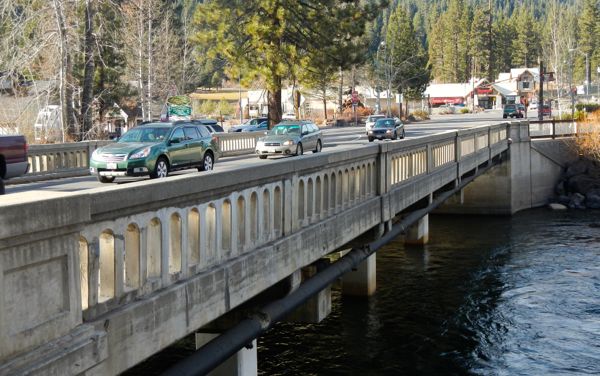
Fate of historic bridge in Tahoe City, choked up highway intersection coming down to wire

The future of Tahoe City's Fanny Bridge is still being decided. Photo/LTN file

The future of Tahoe City’s Fanny Bridge is still being decided. Photo/LTN file

By Kathryn Reed

INCLINE VILLAGE – Unclogging the congestion at Tahoe City’s Y, dealing with a seismically unfit bridge and providing more access points to the West Shore are the reasons the Tahoe Transportation District and others want to realign Highway 89.

Three public hearings this month, the last one on Jan. 28 before the Tahoe Regional Planning Agency Governing Board, were opportunities for the public to give input. It also gave those who will ultimately make the decision on the final project to get a preview of the alternatives.

Alfred Knotts with TTD said at this time there is no preferred alternative.

The four ideas TTD brought forward call for realigning the highway so it goes through the 64-acre parcel owned by the U.S. Forest Service near the transit center. The differences between them have to do with if there is a roundabout, if from where the bypass starts to the intersection of highways 89 and 28 becomes a city street, if that section would be pedestrian-bikes only, or if a cul-de-sac would be put in south of the bridge.

Now under consideration are two other alternatives that have come about from public input. They call for rehabbing, replacing or widening Fanny Bridge, and reconfiguring the intersection of highway 89 and 28 or putting in a roundabout at the Y.

The bridge is nearly 90 years old and no longer meets Caltrans’ roadway standards. The dam also needs improvements, but that is not part of this project.

Twelve people spoke at Wednesday’s meeting; many who are less than thrilled with the prospect of creating another road – mostly for environmental reasons. They don’t want businesses displaced or have cars no longer drive in front of their property, and some wondered why more of TRPA’s thresholds are not being addressed.

Representatives from the Chevron and Shell stations were in lockstep in opposition to the bypass, saying their businesses would suffer dramatically if people coming to and from the area no longer had to drive by their fuel tanks. They said it would mean less tax revenue for the area and employees would have to be let go. And they said the economic impact study that was done never looked at the businesses in what is called the “kill zone” – those located on Highway 89 that would be bypassed with a highway realignment.

Nancy McDermid, Douglas County commissioner and TRPA board member, said this bypass would not allow for development along the route, so there would not be competing businesses.

“If they need service, they still need to go into your area of Tahoe City,” McDermid said.

Two other board members foresee more people in the Tahoe City area using an improved intersection to get to the South Shore because it will speed up the drive. But they question where the traffic studies have taken into account how locals may change their habits.

Doing something with this intersection has been talked about since 1986. Safety is a large component of why people want to make improvements.

John Pang, retired Meeks Bay fire chief, said, “From a public safety standpoint we need multiple entry points. During the Washoe Fire (in 2007) we had access problems. Multiple escape routes are vital to community safety.”

—–

Notes:

• Comments on the environmental documents are being taken until Feb. 17. They may be sent to Brian Judge, TRPA, P.O. Box 5310, Stateline, NV 89449; faxed to 775.588.4527; or emailed to bjudge@trpa.org.

• The environmental documents are available online.

• The final document with the preferred alternative is expected to be before the TRPA Governing Board in March.


SLT fire captain arrested on child porn charges

Mark WyGant

Mark WyGant

By Lake Tahoe News and News 10

South Lake Tahoe fire Capt. Mark WyGant has been charged with receipt of child pornography.

The investigation began when a computer flash drive was found in an unassigned locker at a city fire station, according to the federal criminal complaint. A search warrant had been obtained by local police to view the contents of the flash drive.

The criminal complaint stated more than 5,000 images of children engaged in sexually explicit conduct were on the drive. Additionally, there were more than 50 video files depicting child pornography on the drive. Several of the videos showed a minor known to WyGant. WyGant admitted in an interview with law enforcement on Thursday to recording those videos, the complaint said.

WyGant has been placed on paid administrative leave.

“We will not make any further comment other than the press release which was just approved by the FBI,” City Manager Nancy Kerry told Lake Tahoe News.

WyGant was promoted to captain in 2010. He was instrumental with the mass casualty training drill at the airport in August.

Court documents show that the alleged crimes began in March 2011 and were ongoing until at least December 2014.

He did not enter a plea at his hearing Jan. 30 in federal court in Sacramento.

If convicted of possession of child pornography, WyGant faces five to 20 years in prison. He is being held without bail.

His preliminary hearing was scheduled for Feb. 13.


California vintners digging up vines

By Chris Macias, Sacramento Bee

Faced with stagnant sales of low-priced wine and a glut of overseas competitors, grape growers in the Central Valley are ripping out their vines and replacing them with more profitable crops such as almonds.

The attrition of vineyards was highlighted in Wednesday’s State of the Industry briefing at the Unified Wine & Grape Symposium, the annual trade show and convention for the state’s wine industry. The presentation by Bay Area wine consultant Jon Fredrikson drew a standing-room-only crowd of more than 1,500 to the ballroom of the Hyatt Regency hotel across from the state Capitol.

Farmers, vintners and other wine professionals who gathered for the event learned that the market for lower-priced wines declined in 2014, while bottles priced at $10 and above enjoyed growth as the economy improved

According to a survey by Gomberg, Fredrikson & Associates, the consulting and research firm co-owned by Fredrikson, wine shipments to the U.S. from all sources, including foreign countries, rose to 375 million cases in 2014, a 1 percent increase over the previous year. An estimated 224 million of those cases were produced in California.

Read the whole story