Inspiring LTUSD educator saying goodbye

By Kathryn Reed

Planting seeds. It’s what Beth Delacour does every day. But what sprouts is no ordinary specimen. Her finished product is a responsible, self-confident educated young person.

This is Delacour’s seventh and final year as principal of South Tahoe Middle School. She is retiring when the school year is over.

She has spent her entire 35-year career in education at Lake Tahoe Unified School District. This is rare. Usually to move up in the education world one has to switch districts.

Delacour started with kids and is ending with kids – which she thinks is perfect. She started as a regular classroom teacher, then taught special education, became the program specialist for 10 years, agreed to take on the human resources job for three months – it turned into eight years, and now she is at STMS.

The most difficult time in the district for her was in 2007 when she was HR director and the Angora Fire wiped out 257 houses. Houses that belonged to teachers, staff and students. The support was immediate, with school facilities opening up that summer to help, with assistance continuing for months to allow people to gain some semblance of their lives prior to that June.

Beth Delacour is retiring after 35 years in LTUSD. Photo/Kathryn Reed

Beth Delacour is retiring after 35 years in Lake Tahoe Unified School District. Photo/Kathryn Reed

“My favorite part of the job was anything with kids,” Delacour tells Lake Tahoe News as she sat in her office.

She has a view to the front walkway – seeing who is coming and going from her school. Her door is usually open. People pop in needing answers. Student artwork is in her office. One wall is the entire school schedule. Books are a prominent feature.

Delacour isn’t an ordinary educator. Her dedication, compassion and passion are extraordinary. Her job doesn’t end when the last bell rings. It’s not over when Friday comes. Some might say she cares too much, if such a trait is possible.

But it’s always been this way for the 58-year-old. When she started at Tahoe Valley Elementary School it was usual for her to be at the school until 6:30 at night. She was making $11,000 a year and thought it was great.

Her passion for kids has never wavered.

“Personally, it’s always a thrill to work with a professional who has a heart for all students. Her emotion always comes through with seeing them succeed. That is fun to watch,” Superintendent Jim Tarwater told Lake Tahoe News.

Tarwater has worked with Delacour in her current position as well as when she was director of human resources.

Karin Holmes has also worked with Delacour in two capacities – as a teacher at STMS and since last year as assistant principal.

“Beth is the most supportive person you could ever work with. I don’t think I would be here if it weren’t for her,” Holmes told Lake Tahoe News. “She has so much heart. It is just amazing. She is honest, she speaks the truth.”

Holmes tells stories of being various places around town and hearing people talk about the impact Delacour has had on their lives.

“Beth is a role model for kids and they respond,” Holmes said.

While Judy Klingler has liked all six of the principals she has worked for as their assistant, she said there is something special about Delacour.

“She has heart and compassion. Kids always are first and foremost. They are her passion,” Klingler told Lake Tahoe News. “She always puts the kids first, whatever they need, whatever the goals are they had. (She was there) whether for financial help or just being there as an inspiring adult.”

Delacour has no intention of leaving all of this behind. But what exactly the future holds, well, she isn’t sure. More time with her dad, kids and grandkids is the first priority. After about a six-month break from life as she knows it, Delacour said she would start the next chapter of her life. It’s likely to involve children and/or older people.

She knows she will miss her students, but she also knows it is time to move on.

“I have great hope for the kids and their future. Some of them are phenomenal,” Delacour said. “If they are going to run the world, it’s in good shape.”

Calif. considering new drought restrictions

By Fenit Nirappil, AP

As the California drought drags on, water officials are considering expanding mandatory outdoor water restrictions on homeowners and adding new limits on restaurants, hotels and decorative fountains.

At an informational meeting Tuesday, the State Water Resources Control Board also appeared ready to extend existing rules imposed last summer to boost water supplies.

That would mean Californians still won’t be able to wash cars with hoses that don’t shut off and must limit watering their lawns.

The emergency regulations also authorized agencies to fine water wasters up to $500 a day, though such stringent enforcement has been rare.

Possible new rules under consideration include a ban on running outdoor water fountains and prohibiting lawn watering during cold and rainy periods.

“The key is to get away from very light mandatory restrictions,” said Felicia Marcus, chairwoman of the board.

Other ideas presented Tuesday targeted businesses such as requiring restaurants to only serve water on request and telling hotels not to automatically provide guests with fresh towels and sheets every day. Some cities have similar rules already in place.

The board has considered making some water restrictions permanent with the prospect of future droughts looming.

“We definitely need permanent regulations,” said Frances Spivy-Weber, the board vice-chairwoman. “I just don’t see how we can enter the next 30 years with climate change without them.”

The board has the power to define unreasonable water use. That power can also be used to ban golf course and cemetery owners from using drinking water to maintain landscapes when recycled water is available, but Marcus said the board isn’t targeting those areas now.

The board could consider the extension of restrictions next month and take up other possible regulations later in the year.


UFOs were not always a laughing matter

By Matthias Gafni, Bay Area News Group

It was 1964. Late at night. The Northern California man had lost his hunting buddies in the woods near Lake Tahoe and climbed a tree to sleep.

Awakened by a glowing object landing on a nearby ridge, the man was soon fighting for his life against two neckless creatures and a robot before the beings emitted a noxious gas and knocked him out.

A tall tale? Drunken binge? Drug-induced hallucination (it was the ’60s, after all)? No matter. That Placer County UFO sighting and thousands more were studiously collected and meticulously researched as part of the Air Force’s strange, long-shuttered Project BLUE BOOK, a government program on the hunt for little green men — or perhaps Soviet spies; no one is saying for sure.

For 22 years, the military seemed to spare little expense in chronicling humans’ reported otherworldly encounters with glowing orbs, spinning spheres, flying ice cream cones, and more.

All of it had been hidden away in archive files until a UFO enthusiast posted 130,000 documents worth of BLUE BOOK material in a free online database for the first time last month. Dozens of Bay Area close encounters were included in the trove.

Read the whole story


Vacation rental rules changing in South Tahoe

By Kathryn Reed

Vacation rental owners are likely going to have to pay more money to get a permit in South Lake Tahoe as well as contend with other new regulations.

The South Lake Tahoe City Council on Feb. 17 spent the bulk of the meeting talking about how to revise the 2003 ordinance that was amended in 2011.

The council is going to have a public workshop soon to gather more input. After that, a revised ordinance is expected to come back to the council for adoption in April.

Noise is the No. 1 complaint about vacation renters. Some of the proposed ordinance changes are the result of those complaints.

Of the 1,574 permitted vacation rentals in the city, there were 158 calls to 911 complaining about a vacation rental. Not everyone who spoke Tuesday believes that is enough of a problem to warrant changes. But those also don’t account for all of the complainers.

“The city routinely receives complaints. The number of calls about general complaints are not tracked, as they come into various offices within the city,” City Manager Nancy Kerry told Lake Tahoe News.

A major issue still to be resolved is what to do with Airbnb like rentals where people are in their residence renting a room, a bed or even a mattress. There was no consensus among the council members as to whether those types of rentals should be subject to paying the transient occupancy tax.

What the council did agree to is to change the code so only two people may stay in a room unless the occupants are 10 years old or younger.

When it comes to occupancy limits, the word “overnight” will be removed. This means groups that rent multiple houses on a street cannot legally visit one another. If the house sleeps eight – then only eight people are allowed in the house no matter the time of day.

It was pointed out, though, that all enforcement regarding vacation rentals is complaint driven. Police officers aren’t going to be peeking in windows to see how many people are gathered around the dinner table.

Outdoor hot tubs will be off limits after 10pm. This came about because people were complaining of loud talkers after that hour. Part of the problem is people tend to raise their voices when the jets are on.

But, again, cops aren’t going to be looking over fences to see if people are soaking after hours unless neighbors complain.

While some members of the public suggested requiring rentals have a kill switch for the bubbles at 10pm, the council went with the more restrictive “no hot tubing after 10pm” mandate. And for those who want to violate that policy, the penalty starts at $250 and could escalate to the owner losing his or her vacation rental permit.

Amplified music after 10pm is going to be a no-no, too, with the same punishment for not following the rules.

The council opted to forego the staff recommendation to provide free parking permits to neighborhoods impacted by the vacation rentals.

Forcing renters to park immediately in front of the home will be removed from the code because it’s not enforceable.

Still to be decided is how many bear boxes a rental might need to install if and when there are trash violations.

The exact fee structure is also up in the air. Those who manage their own rentals will pay more than those that are locally managed. “Professionally managed” was changed to “locally managed” to accommodate owner-occupied Airbnb’ers as well as people who live in the area and have vacation rentals.

The issue is that out-of-town owners who don’t use a management firm tend to have more infractions. The higher fee is designed to be an incentive for them to turn control over to someone locally.

The city said increasing fees is necessary so more enforcement personnel may be hired. The part-time compliance auditor position is going to be full time, and a full-time enforcement officer will be hired. Those salaries will be paid with the fees.

While the council agreed to the above recommendations, the electeds can still change their minds before the vote. (Councilman Tom Davis recused himself from the discussion and direction to staff because of his affiliation with Tahoe Keys Resort.)


Echo Summit closure may be worse than ’11

By Kathryn Reed

When Caltrans closed Highway 50 over Echo Summit in 2011 to replace the dilapidated rock wall that was put in just after World War II, the powers that be came unglued. There were countless meetings, a media blitz let people know the South Shore was still in business and that the best route was not through the North Shore, state lawmakers got involved, the Amgen bike race was affected and ultimately everything worked out.

Caltrans is again going to close the same span – but not until 2019. But this next time could be much longer than 10 days.

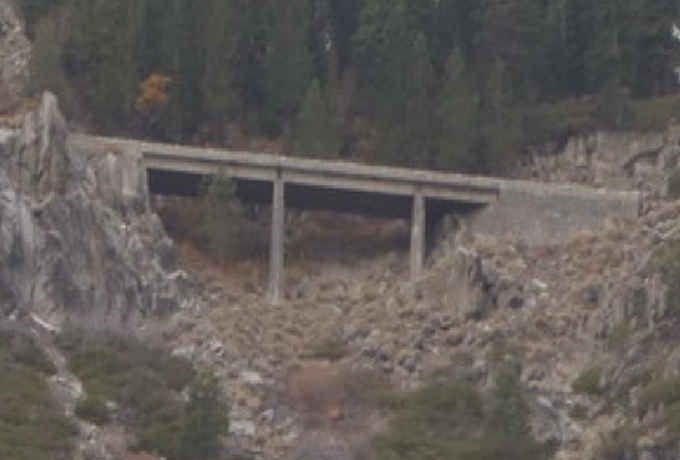
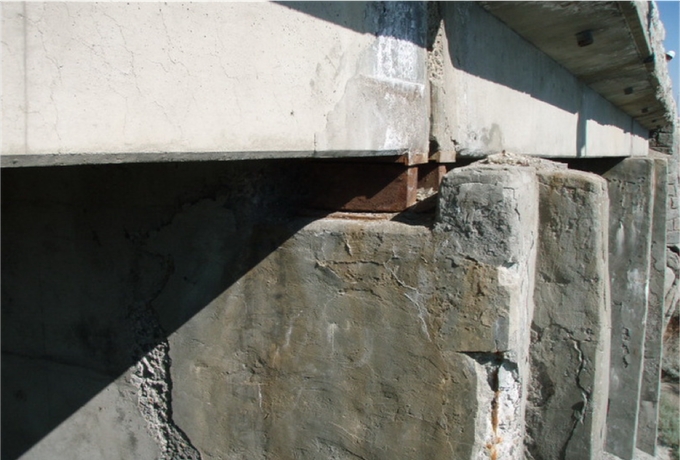
This time the state transportation agency will be replacing a bridge on top of Echo Summit that was built in 1939. The concrete is starting to crack and break off.

hwy 50 bridge

The Highway 50 bridge at Echo Summit is crumbling. Photos/Caltrans

“A lot of it is from the salt that is put down. It starts to corrode the surface and get inside the concrete,” Steve Nelson, spokesman for Caltrans, told Lake Tahoe News.

Caltrans is in the notice of preparation phase, which will last until early March. The environmental phase is expected to be finished in summer 2016, with design and right-of-way issues (U.S. Forest Service land may be needed depending on the width), with construction starting in 2019.

The current bridge is 24-feet wide.

Four alternatives are being considered:

1. Working 126 days in one season with 66 of those days a full closure of Highway 50 and the other days would be one-way traffic control.

2. Two seasons with 31 days of full closure, 55 days of one-way traffic control.

3. Two seasons with one-way traffic control.

4. Two seasons with one-way traffic control with workers doing 10-hour shifts instead of eight.

Nelson said the bridge work was not part of the wall project because the funding sources are different and that the bridge was not ready to go at the time the wall was rebuilt four years ago.

Concrete is failing so the Highway 50 bridge needs replacing.

Concrete is failing so the Highway 50 bridge needs replacing.

The entire project will cost $9 million, with $5 million for construction of the half-mile long bridge.

—–

Notes:

• For more info, go online.

• A meeting about the notice of preparation is on Feb. 26 from 6-8pm at Lake Tahoe Airport. An overview will be given and then it will be more like an open house format.

• Comments will be accepted until two weeks after the Feb. 26 meeting.


School construction bill passes Nev. Senate

By Ray Hagar, Reno Gazette-Journal

The Nevada Senate passed a bill that would pave the way for new school construction across the state Monday, while ending Nevada’s long-standing practice of paying prevailing wages on state-sponsored construction projects.

The bill, Senate Bill 119, would allow an extension of bond rollover funds from property taxes for school districts to keep pace with the need for new schools and major repairs on existing schools. Nevada’s two urban school districts — Clark and Washoe counties — are either in dire need of major renovation projects or new schools.

Although Democrats and Republicans both acknowledge the need for funding school construction, the passage of the bill was on strict party lines.

Read the whole story


Tahoe making case for federal transit dollars

By Kathryn Reed

Tahoe Transportation District officials are in Washington, D.C., this week on a mission to convince lawmakers to pass the federal transportation bill that would bring money to the Lake Tahoe Basin.

The Trans-Sierra Transportation Plan and Coalition is a loose coalition of six California jurisdictions and five from Nevada that have an economic interest in a functioning regional transit system.

“We will have more of a benefit working together instead of competing against each other,” Carl Hasty, executive director of TTD, told Lake Tahoe News.

With state and federal highways surrounding the basin and being the conduits to enter and exit the basin, local officials want a bigger piece of the financial pie.

But the region has long been shortchanged on its share of funding because it is considered a rural area. And while the permanent population fits the rural description, what isn’t part of the equation is the tourist population. With those added vehicles on the roads, it puts a strain on infrastructure that was not designed to sustain them. The local dollars plus what comes from the two states and feds are not enough to maintain the roads or create a transit system that functions for everyone.

The TTD board on Feb. 13 heard a presentation about the Trans-Sierra plan as well as an update on Lake Tahoe’s Highway Corridors and Inter-Regional Long-Range Transit Plan.

The staff report said, “Given the physical and environmental constraints of Lake Tahoe and the region, increased investments in transit will be key for getting a growing number of visitors and workers to and from their destinations with less congestion and fewer environmental impacts. Improved bus service, light rail transit, bus rapid transit, water taxis and ferries, and services for our senior and disabled friends and neighbors are all part of the Trans-Sierra Transportation Plan.”

It would take $35 billion to do all of the projects the jurisdictions have on the books. Hasty said $19 billion is realistic number for what could be funded. Included in that is the loop road on the South Shore and Fanny Bridge replacement in Tahoe City.

That sort of investment would increase the odds the region would be able to attract large events like the X Games or the Olympics. A coalition is still working on bringing the Winter Games to the area in 2026.

Information from staff said, “The wide open spaces and attractions of the Trans-Sierra Region straddle what has been dubbed the Northern California megapolitan, the fast growing urban area stretching from San Francisco, through Sacramento, to Reno. The Northern California megapolitan is home to some 15 million people today, and this number is expected to increase by an estimated 25-30 percent by the year 2035.”

Hasty and Alfred Knotts, TTD planner, will be talking with folks in the administration as well as congressional staff about Lake Tahoe’s needs.

“There is all kinds of talk going on in D.C. What there isn’t talk about is any growth in the program,” Hasty said.

The corridor concept is a layered approach to planning where transit, bike-pedestrian issues and roadways are all considered. It considers recreation, commuter, tourist and public transportation. And in doing so it means engaging a slew of stakeholders to make it all work.

Highway 28 in Incline Village is the corridor that received the most attention and work to date. Each corridor is different and will need different things.

All of this will be incorporated into the update of the Regional Transportation Plan that is due in 2016. It must be updated every four years. But instead of TTD or the Tahoe Regional Planning Agency doing so in a silo, components of the plan that are already being worked on by other entities will be compiled into the document so it is a collaborative, comprehensive document without redundancy.


Calif. population expected to outstrip water conservation

By Matt Weiser, Sacramento Bee

California water agencies are on track to satisfy a state mandate to reduce water consumption 20 percent by 2020. But according to their own projections, that savings won’t be enough to keep up with population growth just a decade later.

A 2009 state law requires urban water agencies to reduce per-capita water consumption 20 percent by 2020, compared with use at the start of the century. Most agencies are on track to reach that goal, and have made even more progress thanks to emergency cuts over the past year triggered by the ongoing drought.

However, by 2030, the data show, these savings will be more than erased by anticipated population growth. According to projections by the water agencies themselves, their total water deliveries will increase 16 percent by 2030 compared to their estimates for 2015.

California’s population, already larger than all other Western states combined, is expected to grow 14 percent during that same period, reaching an estimated 44 million people by 2030, according to the state Department of Finance.

Read the whole story


Calif. going after sugary drinks — again

By Lydia O’Connor, Huffington Post

If the soft drink industry thought its fight with health reformers ended in the San Francisco Bay Area last election season, a new bill in the California legislature may be a rude awakening, reviving the movement to cut the state’s sugary beverage consumption.

“I don’t think this issue is going to go away — not given the increasing concern with obesity, especially childhood obesity,” Larry Gerston, a political analyst and San Jose State University professor, told The Huffington Post.

Last fall’s soda battles focused on taxing the sweet drinks. The new challenge is warning labels. California Senate Majority Leader Bill Monning, D-Carmel, introduced a proposal Wednesday to put warnings on beverages containing added sweeteners with at least 75 calories per 12 ounces. The labels would read: “STATE OF CALIFORNIA SAFETY WARNING: Drinking beverages with added sugar(s) contributes to obesity, diabetes, and tooth decay.”

“Given the rock solid scientific evidence showing the dangers of sugary beverages, the State of California has a responsibility to inform consumers about products proven to be harmful to the public’s health,” Monning said in a press release. “This bill will give Californians the at-a-glance information they need to make more healthful choices every day.”

Read the whole story


Doctor: Sleep apnea needs more attention

By Kathryn Reed

Not getting a good night’s sleep is the least serious complication of sleep apnea.

Sleep apnea, a sleep disorder, is an often-overlooked condition that can contribute to more serious medical problems.

And for those living in Lake Tahoe or other high elevation communities, the threat is even greater. This is because there is two-thirds the amount of air in the basin compared to the Bay Area. The difference is the change in atmospheric pressure.

At higher elevations people tend to breath deeper and faster because they need air, but then they exhale carbon dioxide. But bodies need CO2. Without CO2 people can stop breathing, then they start hyperventilating. It becomes a vicious cycle.

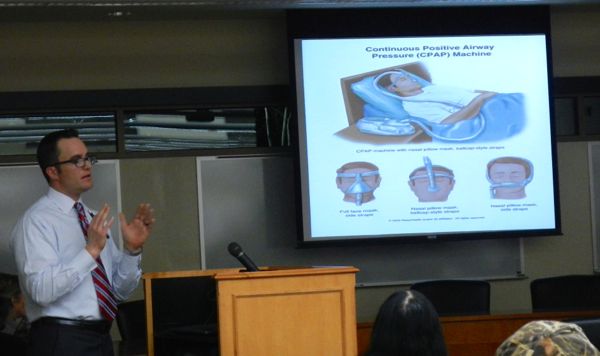
Dr. David Young talks about sleep apnea. Photo/LTN

Dr. David Young talks about sleep apnea. Photo/LTN

David Young with Barton Cardiology gave a lecture last week to about 80 people at Lake Tahoe Community about the dangers of sleep apnea.

“No one really knows a whole lot about sleep apnea. A lot more research is needed,” Young said. “I believe it is an under-diagnosed disorder, especially in Tahoe. Treatment can make huge changes in people’s lives.”

The best treatment today is a continuous positive airway pressure mask. The problem is people need to wear it every night about 50 percent stop doing so.

While snoring is the most common symptom of sleep apnea, not all snorers have sleep apnea.

Other symptoms include memory loss because of not having enough CO2 through the night, urinating at night, sexual dysfunction, depression and difficulty concentrating.

People are more apt to suffer from sleep apnea as they age, if they are male and are obese. Heavy drinkers and those who use opiates are also prone to sleep apnea.

The diagnosis, though, isn’t easy.

“It’s almost borderline torture,” Young said of diagnosing sleep apnea. Multiple electrodes are strapped to a patient.

Barton has a sleep lab where a more complete diagnosis can be established.

At Barton Memorial Hospital everyone who is going to have surgery will be screened for sleep apnea. This is because anesthesia and painkillers after the surgery can inflame sleep apnea.

Young would like to see Barton hire a sleep specialist. He said a pulmonologist might be hired soon who would be able to help with sleep apnea.