Ice climbing in Tahoe takes root

By Dave Zook, Moonshine Ink

Scaling a glistening slab of vertical blue ice with only a few centimeters of steel crampon points and ice tools pierced into the frozen water, the going is slow, demanding, and dangerous. Nevertheless, a small legion of Tahoe ice climbers is dedicated to finding the small window when ice climbing takes hold in Lake Tahoe.

“Ice climbing can be extremely challenging, frustrating, not to mention dangerous, especially when beginning, and Tahoe is not a world class destination by any means,” said Logan Talbott, an Alpine Skills International (ASI) guide and ice climber with 15 years of experience. “But it’s a unique medium and people get hooked by the experience of climbing up something like the bizarre formations on a frozen waterfall.”

Ice climbing may be overshadowed in Tahoe by skiing and snowboarding, but climbers relish in finding yet another way to celebrate Tahoe’s dynamic landscape. Plus ice climbing typically improves when the skiing deteriorates and vice versa, so the potential for a conflict of sporting interests is minimized.

“I’ll ice climb more when the skiing’s not good,” said Brennan Lagasse, a professor at Sierra Nevada College, ice climber, and skier. “These recent seasons where we’ve had a slow start I’ve certainly climbed a lot more, and it helps get your focus on something super fun rather than dwelling on when it’s going to snow.”

Read the whole story


Nevada lawmakers introduce competing equal pay bills

By Riley Snyder, AP

Nevada lawmakers are introducing competing bills aimed at closing the gender pay gap.

Assembly and Senate Democrats rallied with sign-toting supporters in front of the state legislative building earlier this week, calling on lawmakers to pass a bill requiring women and minority groups to be paid equally. State Sen. Pat Spearman introduced a bill that would incorporate parts of the Lily Ledbetter Fair Pay Act and the Paycheck Fairness Act.

“This is not something that I thought up last night,” the Las Vegas Democrat said. “This is really something that really has been in the works since before the session ended last time.”

Meanwhile, Republican Senate Majority Leader Michael Roberson is sponsoring SB167, which would empower the state Equal Rights Commission to administer fines and strengthen Nevada discrimination protection law. Roberson said his bill, which was introduced in the Senate last week, and he wasn’t aware of Spearman’s bill.

“I see a lot of press releases,” he said. “Where are the bills?”

Both proposals would allow employees who prove discrimination to collect up to two years of back pay and would allow the state’s administrative body to levy fines against employers. Spearman said her bill would create a penalty for repeat offenders and would also allow workers to collect attorney’s fees if legal action is taken.

Spearman said her bill goes further than Roberson’s and equal pay is an area that shouldn’t be compromised.

“In the words of Dr. King, there’s a fierce urgency of now,” she said.

The proposals are based on federal legislation that extend the statute of limitations on discrimination claims and seek to reduce the wage gap by making wages more transparent and fairly allocated.

Republicans and Democrats in the Senate have introduced similar legislation on a number of issues during the session, including bond rollovers for school construction and tightening laws that forbid stalking and domestic abuse convicts from owning firearms.

Truckee Meadows Community College political science professor Fred Lokken said the maneuvering is unusual, and it could hurt Democrats.

“It’s kind of like they’re hijacking legislation and modifying it,” he said of Republicans. “The intent could be for Republicans to derail the entirety of the Democrats’ agenda.”


Wilderness as therapist

By Ray Wiles, High Country News

One of the environmental movement’s most legendary characters was also a traumatized war vet. You might remember George Washington Hayduke for his inventive, destructive antics, but he was also a man who measured road miles by the number of six-packs it took him to drink while driving and whose mind often wandered back to Vietnam. “What’s more American,” Hayduke wonders in Edward Abbey’s novel The Monkey Wrench Gang, “than violence?”

The fictional Hayduke had a real-life model: a former Army medic named Doug Peacock. Peacock served in Vietnam during his 20s, and as he went through the violence of that war, the thing he carried was a map of the Northern Rockies. He brought it out during rare quiet moments and imagined himself in its contours, rolling over the sharp granite creases of the Wind River Mountains or the grassy meadows north of Yellowstone Lake. When he returned from the war, he returned to nature, studying grizzlies for several decades and fighting for their federal protection, as well as for that of other threatened species. These days, the 72-year-old activist and writer has become a new role model, not just for greens, but for a new generation of veterans.

“What they need to do is go out and immerse (themselves) in the wild,” he said recently. “Let it wrap around you. See what it does to you.”

The idea of wilderness as therapy for veterans is nothing new. In recent years, a growing number of such programs are springing up around it. But in order for it to work on the scale that’s needed, its supporters are going to have to get the military behind it. And that’s where the difficulty lies.

Read the whole story


Ballot measures: South Lake Tahoe voters make critical financial decisions for the city

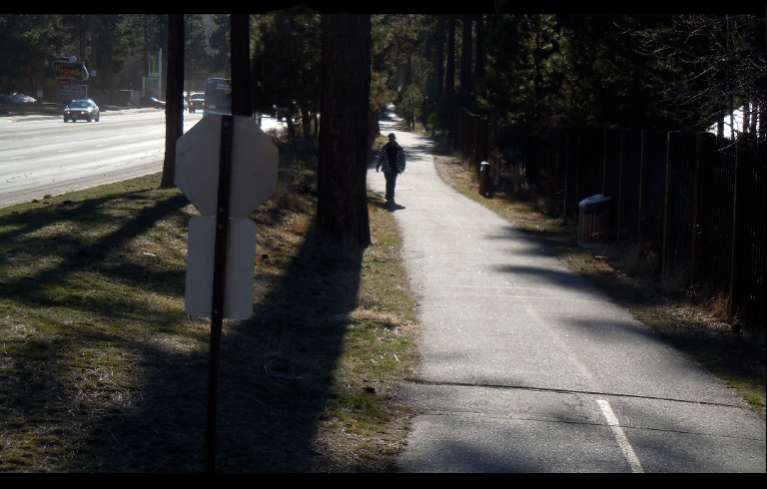
Linear Park in South Lake Tahoe receive a makeover with the help of Measure R funds. Photo/LTN file

Linear Park in South Lake Tahoe received a makeover with the help of Measure R funds. Photo/LTN file

Publisher’s note: This is one in a series of stories Lake Tahoe News will be running leading up to the 50th anniversary of South Lake Tahoe on Nov. 30.

City 50th Anniversary Logo v4By Kathryn Reed

One reason South Lake Tahoe incorporated 50 years ago was to have a greater say in how it was governed. Residents were a bit disgruntled with how the powers that be in Placerville were doing things at the lake.

It took a vote of the populace to make the city of South Lake Tahoe a reality. But that wasn’t the end of ballot initiatives in the city. Through the years voters have had an opportunity to decide on a number of issues.

All tax proposals, by law, must go to voters – whether it’s at the city, county or state level. But a city can bring other issues up for a vote – like parking. The June 3, 2014, Measure P was the last item a City Council put on the ballot.

Anti-paid parking advocates to their cause to voters in June 2014. Photo/LTN file

Anti-paid parking advocates took their cause to voters in June 2014. Photo/LTN file

This came about because of the controversial metered parking program the city had initiated in various parts of town. While the issue had been talked about for years, approved by various councils and included in budgets, after it became a reality a group of citizens called Tahoe for Tahoe wanted the meters and the program to be abolished. Because of legal reasons they could not get a measure on the ballot themselves. The city, knowing it could essentially be stabbing itself in the foot, agreed to take the issue to the people.

And the people said get rid of the program. It required a 50 percent plus 1 percent vote to pass. It did so with 66.96 percent.

The meters associated with the program were removed Aug. 31, 2014.

The first vote put to the people after incorporation came on Nov. 6, 1984. It was called Measure C. This would have created the county of Tahoe. It failed, with the naysayers casting 22,027 votes and proponents having 18,434 votes.

This idea, though, has not gone away. There are people today who believe the basin portion of El Dorado County would be better off being its own county.
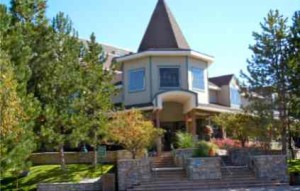
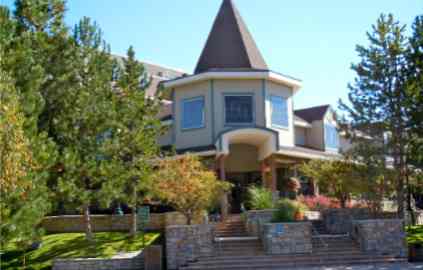
Lake Tahoe Resort Hotel, which was Embassy Suites when it opened, is a still a player in redevelopment.

Lake Tahoe Resort Hotel, which was Embassy Suites when it opened, is a still a player in redevelopment.

Next came another Measure C, but for a completely different reason. This was to increase the transient occupancy tax to 10 percent in most parts of the city and to 12 percent at specific hotels in the redevelopment area.

Voters on Nov. 8, 1988, said yes with 77.5 percent. It required a 66 percent yes vote to pass.

This was the start of redevelopment in the city. The purpose of the higher tax rate was and still is to help pay off the $110 million bond debt in case property taxes were ever insufficient. Every year at least some of those TOT dollars have gone to the debt. That debt won’t be paid off for more than 20 years. There was a time before the recession that only $100,000 from the TOT was needed to help with the debt. As property values rise, the property taxes increase, which in turn means less TOT required to pay the bills and more of it going to the general fund.

The city didn’t ask the voters for anything else until 12 years down the road. This time it was a joint measure with El Dorado County and the Tahoe Paradise Resort Improvement District. The three formed the Community Facilities District Recreation Joint Powers Authority.

Hockey is not popular at the city owned ice rink. Photo/ Jessie Marchesseau

Hockey keeps becoming more popular at the city owned ice rink. Photo/ Jessie Marchesseau

A special election was called on Sept. 19, 2000, where voters were asked to pay a 30-year $18/year tax to fund recreation. This was known as Measure S. The $6.5 million in bonds are to paid off in 2030. The money paid for the city ice rink that is now operated by a private company, the ball field next to Lake Tahoe Community College and $50,000 a year of TPRID, as well as bike trail improvements.

Sixty-nine percent of the voters said yes.

Hotel taxes were back before voters two years later.

Measure Z passed on Nov. 5, 2002, with 56.1 percent of the voters saying yes. It needed 50 percent plus 1 percent vote.

This measure added $1 to every hotel room night to add to the city’s transient occupancy tax revenue. TOT along with property and sales taxes are the three main revenue sources for South Lake Tahoe.

It was in place from Feb. 1, 2004, to Oct. 31, 2006. Measure Z brought in about $1.1 million a year when it existed, which at the time helped the city make ends meet.

This was the last time the city raised the TOT.

South Lake Tahoe lodging establishments are accessing a fee that goes toward marketing. Photo/Provided

South Lake Tahoe lodging establishments are assessing a fee that goes toward marketing. Photo/Provided

However, in 2006 the South Lake Tahoe Tourism Improvement District was formed. The group of lodging establishments agreed to assess guests $3 per night at hotels-motels and $4.50 night at time shares and agent-managed vacation home rentals. That money is then used for marketing purposes by the district. It is considered a fee and that is why it did not have to go to the voters.

They did this the day after Measure Z expired.

The sales tax in South Lake Tahoe went from 7.25 percent to 7.75 percent after voters gave the go-ahead on Nov. 2, 2004.

Measure Q passed with 58 percent of the vote. It needed 50 percent plus 1 percent for approval.

That extra half percent goes directly to South Lake Tahoe. This is unlike most sales tax that is set by the state, collected by the state, and spent by the state. Some is filtered back to the county and then the city, but not a ton compared to what is collected.

Voters on Nov. 8, 2005, said no to raising the snow removal fee. This was called Measure R – not to be confused with the later recreation measure by the same name.

This Measure R would have increased the snow removal tax from $20 to $40 per parcel. It required a two-thirds approval, but only 54.2 percent of the voters said yes so it failed.

Voters on Nov. 3, 2010, were asked to revise Measures S with Measure B, which stood for ball fields. It would have given more money to ball fields, but the bike community came together to help defeat the measure.

It needed 66 percent to pass; it received 60.54 percent.

Next up was the idea to increase the maximum amount on business license fees. It would have increased the not to exceed amount from $3,387 to $10,000 per calendar year.

But voters on Nov. 2, 2010, said no to Measure E – but barely. It required a 50 percent plus 1 percent vote. It received 50.81 percent.

Bike trails are improving with Measure S/R funds. Photo/LTN file

Bicycle trails are improving with Measure S/R funds. Photo/LTN file

Ball field and bicycle advocates came together in 2011 to successfully rewrite Measure S. What is now known as Measure R was approved by voters that Nov. 8. It rejiggered how money could be allocated, making it less restrictive. More existing ball fields and bike trails have received upgrades instead of the money mostly going to new facilities.

On the June 5, 2012, ballot the business license cap was revisited by the city.

The analysis from the city attorney at time regarding Measure B said, “Passage of Measure B will reduce the business license tax on 95 percent of businesses in the city of South Lake Tahoe by 5 percent. The measure increases the maximum any business pays from $3,448 to $20,000 based on the tax rate for each type of business. The current business license tax rates and maximum tax are increased annually for inflation, but if Measure B passes, the tax rate per $1,000 of gross receipts and the maximum tax of $20,000 shall not be increased for inflation.”

It passed with 55.61 percent of the votes.

The next ballot measure likely to be put forth by the city will come in 2016. It may be to raise the transient occupancy tax or create an amusement tax or both, all with the purpose of creating a funding source for recreation improvements.



Calif.-Nev. may drop out of state community college tuition fee for some Tahoe residents

By Kathryn Reed

California and Nevada state senators are working to revive the good neighbor policy so students in the Lake Tahoe Basin would not have to pay out of state tuition to attend nearby community colleges.

State Sen. Ted Gaines, R-Roseville, on Feb. 27 introduced the legislation — known as SB605. His counterpart in Nevada, state Sen. James Settelmeyer, R-Minden, will soon be doing the same.

“We want to make sure youth in our community have affordable options for affordable education and then the opportunity to build careers and find jobs in the basin as well,” Gaines told Lake Tahoe News. “We hope we’ll be successful in both legislatures and provide some relief in a basin that doesn’t know borders.”

No one in Settelmeyer’s office responded to LTN.

The bill would limit the number of students crossing the state line to 200.

One of the reasons the bill has failed twice before is that lawmakers were concerned about how many students would take advantage of the good neighbor policy and what fiscal impact that could have.

The bills mirror each other, which has not happened before. The laws would benefit Lake Tahoe Basin students in specific ZIP codes, and involve Lake Tahoe Community College and Western Nevada Community College.

This would be a six-year pilot program. Gaines said at the end of that time period officials would analyze whether the program was working, and if adjustments need to be made, including increasing or decreasing the number of students who may participate.

LTCC President Kindred Murillo has been at the forefront of trying to make this a reality. She credited the two lawmakers for being “champions” of the cause. The men represent Lake Tahoe in their respective legislatures.

The good neighbor policy has been in place before, but Nevada dropped it a few years ago. This means students going to Whittell High School cannot drive the three miles to LTCC, but instead must go over a mountain pass to the nearest community college in Nevada – at least if they don’t want to pay the exorbitant out of state tuition fee.

Gaines said his office has been speaking with the Association of California Community Colleges and has gotten support for the legislation.


Net neutrality vote didn’t end the debate

By Jim Puzzanghera, Los Angeles Times

In approving strong net neutrality regulations, the Federal Communications Commission fulfilled a decadelong desire by public interest advocates, technology firms and Democrats to tighten government oversight of the Internet to prevent abuses by broadband service providers.

ANALYSIS

But the agency’s closely watched decision on Thursday didn’t end the debate. Not even close.

The partisan divide over net neutrality — reflected in the FCC’s party-line 3-2 vote — highlighted the passions on both sides of the arcane technology policy concept and showed that final resolution of the issue still could be years away.

Here’s what’s coming next.

Only the five FCC commissioners and some agency staffers have seen the 317-page net neutrality order, which prohibits broadband providers from blocking, slowing or selling faster delivery of legal content flowing through its networks.

Read the whole story


LTCC-county working to bring UCD to area

By Kathryn Reed

The University of California, Davis at South Lake Tahoe? It’s being talked about.

El Dorado County wants a branch campus of UC Davis to possibly be located on the West Slope near the county line with Sacramento, or on Lake Tahoe Community College’s campus, or both.

The Board of Supervisors on March 10 will be asked to approve staff time to pursue the campus. On Feb. 24, the LTCC board of trustees gave consent for President Kindred Murillo to work on such an endeavor.

“The No. 1 reason is that I think it would be wonderful for our students to go to a four-year college close by … someplace where perhaps they could live at home,” C.L. (Cherie) Raffety, county treasurer-tax collector, told Lake Tahoe News. “I would just like it to be here in El Dorado County because in addition to being an outstanding education opportunity for our students, it also would contribute to the sustainable economic well being.”

The advantage to having the campus in South Lake Tahoe is that LTCC has the land, expects to complete the university center in 2018 and has been making in-roads to offering a four-year degree.

“It could be a couple extension programs; maybe start with a few staff members here. I don’t see it starting really big because you need to have students,” Murillo told Lake Tahoe News. “It is something I could see easing into gradually, especially if you create a pathway from the high school, to the college into Davis. That would be my dream.”

A branch campus could start at LTCC and evolve into a separate campus. UC Davis was once a branch campus of UC Berkeley. It started strictly as agriculture when Davis was a dot on a map, and then evolved into the institution that it is today.

That ag component, though, is something Raffety believes the county could tap into – especially viticulture.

UCD is also known for its veterinary program. And with Lake Tahoe Wildlife Care in the process of building a permanent facility practically across the street from LTCC, this could be natural tie-in.

Davis already has a huge presence at Sierra Nevada College in Incline Village, so the draw to Tahoe is already established. LTCC already has meetings with UCD scheduled for March to talk about being part of the university center.

With environmental studies being an important aspect of the curriculum at UCD and it being of utmost concern in Tahoe, Murillo foresees this being a natural fit.

Raffety said with this being the inaugural stage, it’s important to get feedback from the public about their opinions. She welcomes county residents reaching out to supervisors and calling her – 530. 621.5803. If the supes see value in pursing this idea, then UCD would convene a professor committee that would analyze the pros and cons. It’s likely to be a slow, methodical process.

“It would happen as fast as UC Davis wants it,” Raffety said. El Dorado came up with the idea through the economic development committee. Raffety, who is a former board member of the Los Rios Community College district, is a huge advocate of public education and of offering students as many options as possible.


Landmark Calif. plastic bag ban on hold

By Lydia O’Connor, Huffington Post

The nation’s first statewide ban on single-use plastic bags will not go into effect this summer after all. The California secretary of state’s office announced Tuesday that a referendum to overturn the measure has qualified for the November 2016 ballot.

The state confirmed that the trade group American Progressive Bag Alliance submitted at least 110 percent of the 504,760 verified signatures it needed to qualify its measure to overturn the plastic bag ban, the Los Angeles Times reported. As such, the landmark law is now on hold until California voters weigh in next year.

Approved by California Governor Jerry Brown last September and originally slated to go into effect this July, the ban would require grocers to charge at least 10 cents for each recycled paper bag or reusable bag given to consumers. The law also provides $2 million in competitive loans to help plastic bag manufacturers convert their businesses to manufacture reusable bags.

Read the whole story


Poll: More Californians want mandatory water rationing

By Christopher Cadelago, Sacramento Bee

Amid stubborn drought conditions, more Californians are warming to the prospect of government-imposed mandatory water rationing, but a majority still favor the state’s current approach of urging residents to voluntarily curtail their water use.

Support for rationing swelled to more than a third of voters in the latest statewide Field Poll, a rise of 7 percentage points since last spring. Support is greatest in the Bay Area and other parts of Northern California.

Meantime, an increasing number of voters think that the state is experiencing a severe water shortage. Ninety-four percent describe the situation as “serious,” with nearly seven in 10 characterizing it as “extremely serious.” To put that in perspective, when the state was in another long-term water shortage in 1977, far fewer voters (51 percent) described their feelings at the time as “extremely serious.”

“You can see that as the seriousness of the situation seems to be expanding in the public’s view, it’s willing to start making more trade-offs in certain areas than it was willing to do before,” said Mark DiCamillo, the director of the poll. “As the shortage continues, we’ll see how far voters are willing to go.”

Read the whole story


Adjunct faculty make case for equality

By Kathryn Reed

She wheels around what looks like an oversized briefcase. It’s heavy. People ask why she does it. Her answer – it’s her office.

This is Julie Ewing’s reality. For 12 years she has been an adjunct faculty member in Lake Tahoe Community College’s English Department. As such, she doesn’t have an office to store things. No adjunct faculty member does. That means taking everything with her every day she teaches. Taking it home. Taking it from room to room.

Adjunct faculty throughout the United States on Feb. 25 brought their issues to light in various ways. At some schools they walked out in protest. At LTCC there was an hourlong assembly where nearly 100 people – mostly students – heard the issues that face these part-time instructors.

Most of these instructors have the same education as full-time faculty. But being part time means they get paid less. On average they make $25,000 a year. They don’t have health benefits. They don’t have contracts and there is no job security. With no offices, they can’t have office hours for students.

At LTCC, the adjunct teaching non-credit ESL classes don’t get paid for holidays or snow days.

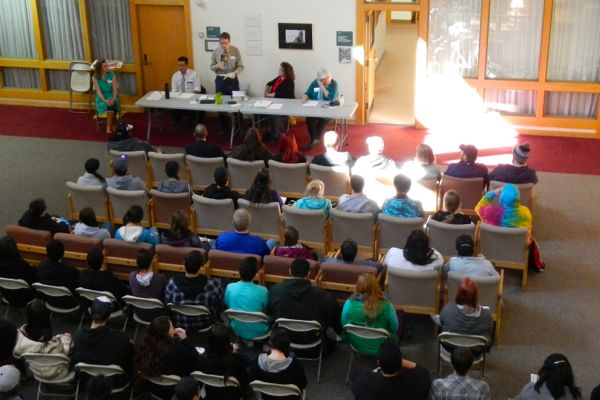
Nearly 100 people listen Fe.b 25 at LTCC about the plight of adjunct faculty. Photo/LTn

Nearly 100 people listen Feb. 25 at LTCC about the plight of adjunct faculty. Photo/LTn

These part-timers don’t get to take sabbaticals every seven years for enrichment opportunities like the LTCC full-timers do. They don’t get time to do research – at least not paid time. Ewing said she has never made $25,000 a year. She was close one year. But that was the year she spent on the road working at schools here, in Reno and Incline Village.

For Maxine Alper, who has been an adjunct faculty member at LTCC since 1997, she is wondering how her rent will be paid in the fall. On Friday a full-time faculty member bumped her. Full-timers have first rights to a class. The loss in pay is equivalent to two-thirds of Alper’s monthly rent.

It wasn’t a woe-is-me pity party, but instead an informative session about the disparity between those who work full time as instructors and those who work part time and how this may be impacting students and the community at large.

“It damages student learning, faculty governance, and academic freedom. Each of these is an educational cost that institutions incur when they choose not to invest adequately in their instructional missions,” Scott Lukas said. He teaches anthropology and sociology at LTCC – full time.

Lukas was one of four presenters Wednesday. Joining him were Albert Ponce – full time political science professor, Alper and Ewing. Alper said adjunct at LTCC make one-quarter to one-third what full-time faculty make.

Colleges use adjunct faculty because they can be paid less and benefits are not included.

At LTCC in fall 2014 and winter 2015 there were 158 contracts for adjunct faculty. Both quarters there were 39 full-time faculty members on the payroll.

Ponce called it a two-tiered system.

“We need to delink from this neo-liberal logic. We need to follow a model other than this one,” Ponce said.

It was acknowledged that much of the problem is at the state level where funding decisions are made and that people should be addressing lawmakers.

Jessica Sota, who is part of the LTCC student senate, said students need to be more involved and aware of who is teaching them.

LTCC students were in Sacramento on Feb. 25 voicing their concerns. They will be returning Monday for the annual March in March, at which time they will also be speaking with individual lawmakers about concerns at community colleges.