Nev. tries to capitalize on medical tourism

By Jennifer Rachel Baumer, Nevada Business

Until recently, the term “medical tourism” largely referred to Americans traveling out of the country looking for affordable healthcare.Until recently, the term “medical tourism” largely referred to Americans traveling out of the country looking for affordable healthcare in technologically advanced but less expensive venues, from Mexico to Thailand and parts in between.

Now the term is starting to come home, often referring to domestic travel of American citizens within U.S. borders, traveling to find the best healthcare available.

In addition, until recently the best healthcare in the country didn’t include Nevada. When ranked according to the number of hospital beds per 1,000 people, or physicians or nurses per 1,000, Nevada ranks 47th, which isn’t care worth leaving home for.

However, things are changing by building off a new quality of healthcare and one of Nevada’s core strengths: an incredibly business-friendly environment.

In Northern Nevada, medical tourism is still in the foundational stage.

Read the whole story


S. Tahoe to regulate long-term motel rentals

By Kathryn Reed

South Lake Tahoe wants to put motels that are being used as long-term housing under a microscope to ensure they comply with health and safety codes.

There are 120 hotel-motels in the city with about 5,000 rooms. Of those, 58 establishments have 1,300 rooms that are not being used for traditional tourist accommodations. That equates to 26 percent of the rooms in the city.

“They are not high-quality transitional housing,” Shawna Brekke-Read, Development Services director, told the City Council on March 3.

The draft Single Room Occupancy ordinance was before the council for discussion and input on Tuesday. The goal is to get these establishments to pay transient occupancy tax or be part of the new ordinance that is expected to be adopted this spring.

Using motels as housing is not regulated nor do the units face any inspections because there are no laws on the books that would allow this to happen. That is all about to change.

Problems at these dwellings are varied.

The staff report says, “Commonly, long-term hotels-motels lack a kitchen or safe cooking facilities, the electrical service is inadequate for the electrical demand, hot water heaters are broken or missing, sanitation is poor, smoke detectors are missing or faulty plumbing is problematic, and units are infested with pests.”

But not everyone believes all of these motels should be cast as squalor. Ted Long, a local attorney who used to be on the City Council, represents 60 units managed by Tahoe Rents.

“All the landlords I know want to do the right thing,” Long told Lake Tahoe News. “We don’t need a special ordinance for hotels. The people who are going to be hurt, despite the good intentions, are the people who live there.”

Long said the city is lumping all long-term rentals into the same category and adds that is not fair. He would prefer the motels fall under the multi-family dwelling ordinance that covers six units or more.

While the proposed ordinance would require the hotel rooms to be more like an apartment, Mayor Hal Cole stressed, “We are not turning hotels into apartments.” He said the ordinance creates hybrid-housing units that will be regulated.

Plus, if these hotels were to be apartment conversions, it would require the Tahoe Regional Planning Agency to be involved. It would also negate the city’s ability to collect the hotel tax.

It was agreed that requiring laundry facilities on each floor is not a good idea based on overflows being common when people cram two loads into one washer.

Another issue for Long and some of the landlords who attended the meeting is having to provide one off-site parking spot for every unit. Outside council chambers they talked about how many of their tenants don’t even own a vehicle.

The council (Tom Davis was out ill) agreed to soon conduct a workshop about the proposed ordinance with the goal of attracting more owners and tenants. It was proposed to do so somewhere other than the airport since buses don’t go there and transportation may be an issue for people living in these establishments.

Also needing clarification is whether sewer permits will be needed to accommodate possible required changes.

Richard Solbrig, general manager of South Tahoe Public Utility District, told Lake Tahoe News sewer permits are needed “when the plumbing facilities in a structure are expanded/added, not just rearranged or replaced with new fixtures. Typically in a private residence, it is the addition of a new bathroom. A new sewer unit costs $4,950. Any expansion of plumbing facilities in a structure does trigger a building department permit, and part of that permit process is a sign-off by the district.”

—–

In other action:

• Council meetings have not been available to Charter customers because the city and cable provider are squabbling over use of the building where the city’s equipment is stored. Meetings may be watched online via the city’s website.

• The city is revisiting its arts and crafts fair regulations for 2016. The council directed planning commissioners to refine what juried shows would look like as well to provide more specifics regarding uniform booths for vendors.

• The March 17 meeting will include an in-depth discussion about what to do with the city’s dilapidated streets.

• At the April 7 meeting as part of the midyear budget discussion the council will talk about how best to spend the nearly $1 million surplus from the 2013-14 budget.


Limited snowfall takes toll on water supply

By Kathryn Reed

While there is still lingering snow on some lawns in the Lake Tahoe Basin, the fact that it is barely measurable in most places is indicative of the winter that has barely existed in the Sierra.

The lack of snowfall continues to be illustrated with each snow survey. On Tuesday morning representatives of the state Department of Water Resources were at Echo Summit taking samples of snow to determine the water content. The 6.7 inches of snow contain 0.9 inches of water, representing 5 percent of average for this time of year.

The situation keeps getting worse. Statewide the water content was 50 percent of average in December and 25 percent in January.

On Tuesday, 103 electronic sensors found Tuesday’s snow water equivalent to be 5 inches or 19 percent of the March 3 multi-decade average. This is nearly a record. In 1991, the statewide water content was 18 percent of average. But that same year there was the Miracle March, which brought more precipitation than normal.

But there is no moisture in the forecast for Tahoe in the next week. And highs are expected to return to 60 degrees by Sunday.

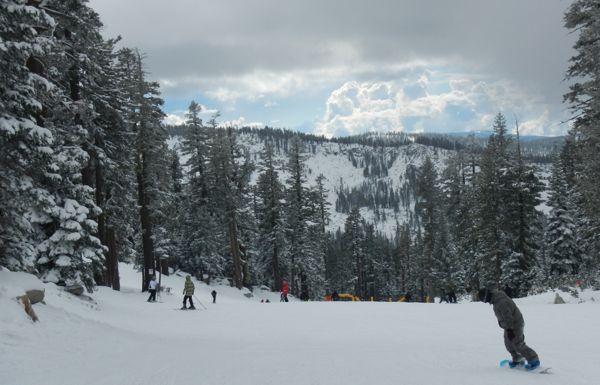
Skiers and snowboarders on March 1 welcome fresh snow at Sierra-at-Tahoe. Photo/Kathryn Reed

Skiers and snowboarders on March 1 welcome fresh snow at Sierra-at-Tahoe. Photo/Kathryn Reed

If there had not been a storm in the last week, today’s numbers have would be even worse. And while the storm brought a foot of snow or more to many Tahoe area resorts much to the delight of skiers who were in search of that rare powder day this winter, it will have little impact to the state’s fourth dry season.

While parts of Northern California are faring well when it comes to rain totals, this will not help them much in the summer. This is because it is the snowpack in the Sierra that sustains municipalities and farms downstream, supplying about 30 percent of California’s water needs. Without a snowpack to melt, it will be a trickle that flows into reservoirs. That in turn means less water to be doled out to users.

Already farmers and some Bay Area water districts have been told to count on little or no water allocations from the federal system. Those users will then be tapping into the groundwater, which is already severely depleted in some areas.

Adding to the concern is that users are not conserving as well as they had been earlier this winter. The state Water Resources Control Board on March 3 announced a steep decline in water conservation from 22 percent in December to approximately 8.8 percent in January in year-over-year water use comparisons.

The state Water Board on March 17 will consider renewing an emergency regulation supporting water conservation that was adopted last July. It restricts outdoor water use and authorizes penalties for water waste.


Restaurants replacing tips with service charge

By Chris Macias, Sacramento Bee

The rant from Mr. Pink in the 1992 flick “Reservoir Dogs” was delivered like a salvo against the service industry:

“… This tipping automatically, it’s for the birds,” said Mr. Pink (played by Steve Buscemi) before paying a breakfast tab with his gangster crew. “As far as I’m concerned, they’re just doing their job.”

Back then, Pink’s words seemed like a penny-pincher’s rationale. But fast-forward two decades, and a tipless restaurant world that Mr. Pink craved looks closer to becoming a reality.

A movement around Northern California, and the San Francisco Bay Area in particular, is shifting away from the time-honored practice of tipping servers to simply adding a service charge to the bill. Gratuity has long been included in the bill at Chez Panisse in Berkeley and Yountville’s The French Laundry, and recently become the norm at such Bay Area restaurants as Comal and Trou Normand. In Sacramento, The Kitchen has traditionally tacked on a service charge in lieu of tipping.

Read the whole story


Navy Reserve a way of life for SLT man

Publisher’s note: March 3, 2015, marks 100 years of the U.S. Navy Reserve.

By Dana Ayers

In addition to his dental practice and involvement with his local Catholic church, Lt. Tim Durkin of South Lake Tahoe also serves our nation as a member of the U.S. Navy Reserve attached to Navy Operational Support Center Reno.

Durkin, a Bay Area native, graduated from Woodside High School in 1971 and enlisted in the Navy one year later. He served as a radioman for four years before separating from service to attend dental school and start a family.

lt. durkin

Lt. Tim Durkin

“Looking back, it was a mistake to leave,” said Durkin, now 61. “When the opportunity was presented to apply for the Navy Reserves several years ago, I jumped at the chance. The Navy was good to me in my early years and I wanted to give something back. My skill as a dentist gives me that opportunity. I am hoping to deploy overseas to relieve a young officer with a family.”

The Navy provided numerous opportunities for Durkin, from his first ride in an airplane, to introducing him to his wife who was working for the Navy when they met 38 years ago. Durkin was also able to finance part of his dental education through the GI bill and purchase his first home using a VA loan, all due to his service. Durkin continues to gain opportunities as a reservist.

“The Navy Reserve has enriched my life with fellowship and a purpose beyond myself,” said Durkin. “I use the leadership training I am receiving daily with my employees, and hopefully they will tell you I’m becoming a better employer.”

Durkin also touted the Reserve’s commitment to physical and mental health, adding, “I am in better shape both physically and mentally than I have ever been, and I’m 61 years old.”

Vice Admiral Braun, chief of the Navy Reserve, is proud to lead such a talented and dedicated group of Sailors.

“The commitment of our talented Sailors to the Navy, their shipmates and their community is truly inspirational,” said Braun. “Their continued dedicated service in support of the Navy, Marine Corps and Joint Force lends credence to our motto: ‘Ready Now. Anytime, Anywhere’.”

Dana Ayers is an ensign in the Navy.

—–

Note: The Navy Reserve contributed 84 percent of the Navy manpower during World War II. Since 9/11, more than 70,000 Navy Reserve sailors have been mobilized and deployed to serve in Iraq and Afghanistan, including more than 8,000 who have done a second combat tour. Today, at least 20,000 Navy Reserve sailors, or about one-third of the Navy’s Reserve component, is providing fully integrated global operational support to the fleet and combatant commanders.


Is junk-food era drawing to a close?

By Tom Philpott, Mother Jones

Not long ago, the great processed-food companies like Kraft and Kellogg’s towered over the US food landscape like the high hat that adorned the head of Chef Boyardee, the iconic canned-spaghetti magnate whose empire is now owned by ConAgra.

But now, Big Food has fallen on hard times. Conagra, which owns Hunts, Reddi Whip, Ro-Tell, Swiss Miss, and Orville Redenbacher, along with Chef Boyardee, recently slashed its 2015 profit projections and sacked its CEO. Kraft — purveyor of Oscar Mayer deli meats, Jell-O, Maxwell House coffee, and Velveeta cheese — also recently shook up top management and reported sluggish sales in 2014. Cereal titan Kellogg’s has seen its sales plunge 5.4 percent over the past year, Advertising Age reports.

There’s a “mounting distrust of so-called Big Food, the large food companies and legacy brands on which millions of consumers have relied on for so long,” said Campbell Soup’s CEO.

What gives? Part of the problem is currency fluctuations. Having conquered the U.S. market, Big Food for years has looked overseas for growth. Recently, a strong U.S. dollar has cut into foreign profits, because a pricier dollar makes overseas sales worth less when they’re converted to the US currency, as the Wall Street Journal recently reported.

Read the whole story


Nev. medical marijuana industry shrouded in secrecy

By Eric Hartley, Las Vegas Review-Journal

After they applied with the state to open a medical marijuana dispensary, the owners of Euphoria Wellness faced an odd choice: Did they want to keep their name secret from the public?

For them, the answer was easy.

“I have nothing to hide,” co-owner Joe Lamarca said. “I’m going to have a sign out that says ‘Euphoria Wellness.’ I’m not trying to be secretive about it — I’m running a business.”

But others made a different choice, shielded by a state law that keeps much of the information about Nevada’s emerging marijuana industry hidden from the public.

In all, 199 of the 519 applicants for medical marijuana licenses — 38 percent — chose to keep their names confidential, including more than 40 percent of would-be dispensary operators.

Read the whole story


DCSD superintendent stepping down

By Kathryn Reed

After 32 years in public education, Lisa Noonan is ready for a change.

Now in her fifth year as superintendent of Douglas County School District, Noonan will not be at the helm next school year.

At least that is the plan. She has not given the board a hard retirement date, but instead is willing to work until a replacement if found. The board on March 3 is meeting to discuss how to go forward. Noonan said she hopes the board considers internal candidates.

“If Lisa wanted to stay longer, that would be wonderful,” Ross Chichester, president of the school board, told Lake Tahoe News. “We will look for someone as powerful as she is. She is collaborative and innovative. She has really, really turned the Douglas County School District around from times when it was not a popular place to be a board member. She has done a wonderful job through hard years of budgets.”

Lisa Noonan is retiring this summer as superintendent of Douglas County School District. Photo/Provided

Lisa Noonan is retiring this summer as superintendent of Douglas County School District. Photo/Provided

Noonan, 55, is looking forward to spending more time with family. She and her husband have six grandchildren – which is two more than when she started the job – who are spread out all over the country.

“I’ve missed out on things while serving other people’s children,” Noonan told Lake Tahoe News.

In her job, taking substantive time off isn’t always do-able. And a workweek, well, it’s much more than 40 hours.

“There are always projects. If you ever wake up and you are finished, something is wrong,” Noonan said.

She said it’s time to change her priorities and put family before work.

“I think probably what I will carry with me the longest is my tenure took place during very difficult economic times for the state and our profession. I tried to be caring and compassionate as possible with the tough choices that had to be made,” Noonan said. “Gently we got through those difficult times budget wise. There was no handbook on how to do that.”

Bringing full-day kindergarten to all schools and increasing the rigor at the high schools are other accomplishments she is proud of.

She was 23 when she took her first full-time teaching job at an elementary school. She has a bachelor’s from Humboldt State University, master’s from San Diego State University and doctorate from UNR. She was working for Washoe County School District in administration before being hired by DCSD in 2010. Noonan plans to continue living in Nevada.

“Our kids are just awesome. Our future is bright for all of us. We have great kids. That is nice and reassuring,” Noonan said.

—–

Notes:

• The special board meeting to discuss how to go forward with finding the next superintendent is March 3 at 4:30pm at the district office in Minden.

• Douglas County’s front office in Minden has already seen changes in the last year. Rich Alexander and Lyn Gorrindo, both assistant superintendents, retired last summer. Teri White was hired as assistant superintendent, doing much of the human resources work.


Cracks appearing in public pensions’ armor

By Mary Williams Walsh, New York Times

First in Detroit, then in Stockton, and now in New Jersey, judges and other top officials are challenging the widespread belief that public pensions are untouchable.

Gov. Chris Christie of New Jersey delivered the latest blow on Tuesday, when he proposed to freeze that state’s public pension plans and move workers into new ones intended not to overwhelm future budgets or impose open-ended demands on taxpayers.

The first crack came in Detroit, where a judge ruled that public pensions could, in fact, be reduced, at least in bankruptcy. Then, just a few weeks ago, an opinion by the bankruptcy judge for Stockton, which emerged from Chapter 9 on Wednesday, called California’s mighty public pension system, CalPERS, a bully for insisting in court that pension cuts were wholly out of the question.

Such dogma “encourages dysfunctional strategies,” wrote the judge, Christopher Klein, chief judge of the U.S. Bankruptcy Court for the Eastern District of California. He said CalPERS’s legal arguments were invalid, and he concluded that it lacked standing to dominate the courtroom discussion the way it had. Stockton did not even seek permission to freeze its pension plans, but the judge nevertheless wrote that it was entitled to do so and went on to cite steps that struggling cities in general should take to trim their pension costs legally.

Read the whole story


Calif. lawmakers seek national monument designations

By Associated Press

WASHINGTON – California lawmakers and advocacy groups are ramping up efforts to win national monument designation for four scenic vistas in the state, from vast stretches of the Mojave Desert to redwood stands along the Pacific Coast Highway to canyons and mountains near the state’s famous wine country.

The designation typically takes lands already owned by the government and walls them off from new mining, roads and power lines. Recreational activities such as hunting, fishing, hiking and horseback riding are commonly allowed, though each national monument has its own dos and don’ts.

Supporters of the proposed monuments in California are pursuing two paths. The first is through legislation. Many Republicans are wary, though. So, supporters are also placing greater emphasis on Plan B: Executive action from President Barack Obama. The narrowing window for that option is adding urgency to their efforts.

Presidents have the authority to designate new national monuments through the Antiquities Act, and Obama has approved 16 so far, including three more last week. California groups took notice.

“We think that’s exciting, and we merit the same consideration in the near term,” said Bob Schneider, senior policy director for Tuleyome, a conservation group that seeks to preserve 360,000 acres in northern California as a national monument.

The group has worked with Democratic Rep. Mike Thompson, who has filed bills in three consecutive congressional sessions calling for what would be named the Berryessa Snow Mountain National Monument. In December, he brought in Interior Secretary Sally Jewell for a tour and to hear from local residents.

“The majority party is not willing to participate in the debate,” Thompson said. “If the president is willing, I’m all for him protecting the land through an executive order.”

Many of the communities in Thompson’s district support his efforts. One local chamber of commerce projected that a national monument designation would generate an additional $50 million in economic activity in the subsequent five years though increased visitors. But another local chamber has fretted that a national monument designation could impose additional requirements on already overburdened agencies with no guarantee of additional resources.

Any national monuments legislation moving through the House would likely have to go first through a subcommittee chaired by Republican Rep. Tom McClintock of California. He’s clearly skeptical.

“The Republicans want to preserve and enhance the public’s right to enjoy the public’s land. Democrats are seeking to further restrict public access,” McClintock said. “That’s the fundamental, core issue.”

Like Thompson, Sen. Dianne Feinstein also is getting restless. She first proposed legislation in 2009 calling for two new national monuments in the Mojave and Sonoran deserts and reintroduced a version of the bill in early February. Feinstein favors legislative action, but she said in an emailed statement that executive action may be necessary if the bill stalls.

Feinstein, a Democrat, said she would prefer the legislative route because an executive order would simply create two new national monuments while her legislation includes more land for national parks, wilderness and off-highway recreation. Numerous compromises crafted over the years would be lost.

The Wildlands Conservancy helped the federal government acquire large segments of both proposed monuments in Feinstein’s bill through donations of money and land. The group was delighted when Jewell visited the proposed Sand to Snow National Monument last year and a vehicle in her security detail had to stop to let a bighorn sheep cross the road.

“You can’t beat that,” said David Myers, the organization’s executive director.

Interior Department spokeswoman Jessica Kershaw declined to directly answer whether Jewell has recommended that the president use his executive authority on any of the four California projects. But she said Jewell regularly briefs the president on her travels and has talked to him about “the local vision for conservation around the Berryessa Snow Mountain Region.”

Kershaw also noted that the Obama administration has testified in favor of Feinstein’s legislation back in 2010 and Thompson’s legislation in 2013.

McClintock says an executive order creating any monuments in California would be “a complete overreach” by the president and an abuse of the Antiquities Act, which was designed to protect small archaeological sites from looting.

The newest and smallest of the proposed national monuments is in Silicon Valley’s backyard, near Santa Cruz. The 5,800 acres were acquired by various foundations and donated to the U.S. Bureau of Land Management just last year.

At a public rally two weeks ago, nearly 1,500 people showed up, stunning organizers who called the event the launch of their campaign, not the conclusion.

Bruce Babbitt, the former Interior secretary under President Bill Clinton, was the guest speaker.

“Half the town was there,” Babbitt said. “It seemed to me an excellent statement to President Obama of community support. Congress has a chance to act. If it doesn’t, all the more reason for President Obama to step in.”