Transit for South Shore seniors in slow motion

By Kathryn Reed

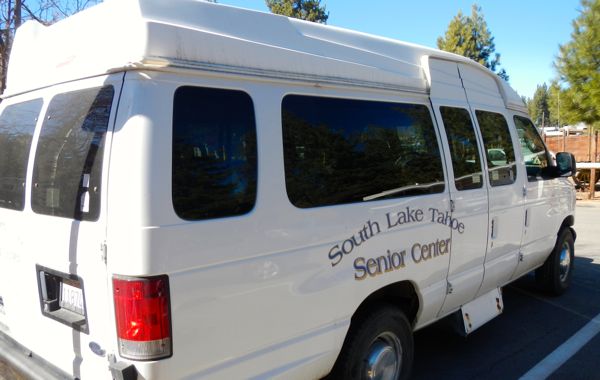
A van in front of the South Lake Tahoe Senior Center rarely leaves the premise. However, that doesn’t mean seniors don’t have any place to go.

“I don’t care who owns it and I don’t care who provides it, they just need the service,” City Manager Nancy Kerry told Lake Tahoe News.

The city and El Dorado County officials are trying to resolve who owns the van and therefore who is responsible for it. A certified driver and liability insurance are other issues to be addressed.

The van seats eight, has room for one wheelchair and meets Americans with Disability Act requirements.

Tahoe Transportation District officials are also in on the discussions because they would like to use it for specialized transportation services for seniors and disabled on the South Shore much like what the pilot program on the North Shore is doing.

South Shore seniors have a van, but limited use. Photo/LTN

South Shore seniors have a van, but limited use. Photo/LTN

“Tahoe Transportation District is in the process of making a formal request for the vehicle,” Tara Styer, TTD mobility manager, said at the March 9 Lake Tahoe Collaborative meeting. She said the vehicle is being used two hours a week now, but that is not nearly enough.

Mobility management is the latest buzz phrase in the transportation world. It’s about concentrating on the individual needs of riders. In this case, the population is primarily seniors and disabled. Others would be able to use the vehicle if there is space.

“The unmet needs are out-of-area transportation,” Styer said.

In particular, getting people to specialized medical appointments. And with the expansion of Medi-Cal, there are few local dentists who will see those patients.

Veterans in the area in 2014 lost their transportation to the hospital in Reno.

Styer envisions each week the van being used for local trips. Then out-of-town trips to Reno, Placerville, Roseville, Sacramento, Carson City, and North Shore-Truckee would be scheduled.

Grants have been applied for to help pay for the vehicle. Passengers would pay a limited amount.

Tahoe Senior Plaza has a vehicle it shares with Kelly Ridge residents. However, off the hill trips are not frequent, according to Styer. The other option for people is the on demand service provided by TTD, but at $3 one-way it can be cost-prohibitive. These are reasons why other alternatives are being investigated.


New partnership seeks to restore Sierra forests

By Matt Weiser, Sacramento Bee

The Sierra Nevada is many things to California: a mountain playground in winter and summer, a swath of public land stretching nearly the length of the state, and vital habitat for a broad variety of wildlife. It also provides the majority of California’s freshwater supply.

With a fourth year of drought looming, state and federal agencies have launched an ambitious partnership to improve the Sierra’s ability to store and filter water, as well as reduce fire risks, by restoring its forests.

Called the Sierra Nevada Watershed Improvement Program, it aims to coordinate the diverse activities of government agencies, property owners and nonprofit groups to focus on the Sierra’s most serious problems. Goals include restoring streams and meadows, improving habitat and thinning overgrown forests, while also protecting economic uses of the land, such as logging and grazing.

The effort is being led by the Sierra Nevada Conservancy, a state agency, in partnership with the U.S. Forest Service, the primary landowner in the Sierra.

Read the whole story


Health benefits boost board compensation

By Brad Branan, Sacramento Bee

Most people elected to special district boards receive no compensation to oversee the agencies that provide services such as water or local park maintenance.

But some district directors receive annual salaries approaching $20,000 and health benefits for a position that has few requirements besides preparing for and attending meetings.

Of the nearly 1,000 special district board members in the capital region, about 70 percent received no compensation, the Sacramento Bee found in an analysis of 2013 salary data recently released by the California State Controller’s Office.

The other 30 percent, however, received an average of $4,300 in total compensation. All of the two dozen directors who received the most compensation – $15,000 or more – served districts in the Sierra foothills or around Lake Tahoe, in particular water districts with a long history of providing health coverage to board members and their immediate family members.

The South Tahoe Public Utility District had four of the five highest-paid board members in the region in 2013. They each received $4,800 in wages, but the biggest expense came from health care costs, an average of $21,585 each.

Read the whole story


Soroptimist honor those making a difference

By Kathryn Reed

STATELINE – “This is the time to uphold women’s achievements, recognize challenges, and focus greater attention on women’s rights and gender equality to mobilize all people to do their part.”

These are the words of Pat Papp, a district director for Soroptimist and member of Soroptimist International Tahoe Sierra.

While March 8 was International Women’s Day, on March 5 the two Soroptimist clubs on the South Shore came together to recognize women and high school students who are making a difference in the community.

“International Women’s Day is a time to reflect on progress made, to call for change and to celebrate acts of courage and determination by ordinary women who have played an extraordinary role in the history of their countries and communities,” Papp said.

The Live Your Dream award is about recognizing women who have overcome obstacles, but are still pursuing their education to make life better for themselves and their families. The two honorees, who both work for Barton Health, were given $2,000 to further their education.

Since the award was first given in 1972, nearly $30 million has been bestowed upon recipients worldwide.

Kathleen Dewing of Soroptimist International of South Lake Tahoe presented this year’s South Shore honorees. She said the people chosen this year are women who will set an example for their children, who will give back to their communities and who have already overcome so much.

Many who receive this award have endured some form of abuse, been challenged in ways that go beyond what would be considered normal and still find the good in what lies ahead.

Latosha Sanchez and Keyla Trejo were honored last week. Both are working toward their nursing degree. Sanchez has kids who are 6, 2 and 11 months. She a full-time mom and a full-time student.

“I had a troubled childhood. My mom had many men in and out of our lives,” Sanchez said. “I was the shoulder for her to cry on.” Sanchez’s husband is a rock for her to rely on – something she wasn’t used to.

For Trejo, she is a single mom with a 6- and 8-year-old.

“My parents never had the opportunity to purse their goals career-wise,” Trejo said. “The biggest hardship after becoming a single mom was deciding what to do with my life and for my kids.”

The Ruby award recognizes women who are helping to improve the lives of other women and children. Janey Roeser and Tere Tibbets are this year’s honorees.

Roeser is the club advisor for the S Club at South Tahoe High School. She’s paid to teach English at the school. She is described as having the spirit of volunteerism and the soul of someone who wants to make a difference.

“Selfishly, it has enriched my life,” Roeser said, “I don’t know if they know how much they’ve given to me.”

Tibbetts immigrated from Cuba with her family when she was 13. With her parents being educated, it helped the family survive. This helped Tibbetts learn early on that education makes a difference.

“The more educated your are, the freer you are,” Tibbetts said.

She worked for Lake Tahoe Unified School District for 20 years and then went to Lake Tahoe Community College as a counselor.

Today, her big emphasis is on her book club that she created for women whose first language is Spanish. It’s getting them to read, to meet others and become educated.

Honored with the Violet Richardson award were five South Tahoe High students and one Whittell High student. The award is in honor of the first president of the first Soroptimist award.

Each of the young women received $100. The involvement in school ranges from having grade point averages higher than a 4.0, to sports to extensive volunteer work to being involved in and starting clubs at their respective schools. And all are planning to go to college to enable them to pursue careers of their choice.

This year’s winners are Haley Chamarro, Kylee Lyons, Emma Sower, Sarah Novak and Joemae Santos from STHS and Kate Krolicki from WHS.


Sports betting turns a corner

By J.D. Morris, Las Vegas Sun

Sports betting is having a big moment in the United States.

Prominent voices from professional sports and politics have indicated they’re willing to discuss expanding sports gambling, which is legal only in a handful of states. Meanwhile, Nevada has broadened the types of wagers it offers, and people appear to be betting on sports more than ever before.

The Professional and Amateur Sports Protection Act, passed by Congress in 1992, made sports betting illegal in almost every state. Nevada, Oregon, Montana and Delaware are exempt from the law, but beyond Nevada, wagering is allowed only on a limited basis.

So for now, Nevada is the only state with full-fledged legal sports betting, but that could change in the not-too-distant future.

Adam Silver, commissioner of the NBA, has said he supports legal sports betting. He told ESPN he spoke with commissioners of other sports leagues, and “all of them are interested in having a better understanding of the issue.”

Read the whole story


Truckee men complete historic PCT winter trek

By Associated Press

CAMPO — Moments after finishing a historic wintertime trek of the Pacific Crest Trail, Justin Lichter reassured bystanders the pale, desquamated look of his rain-soaked hands was “totally normal.”

The difference between what looks like a serious problem to the average backpacker and what Lichter and hiking partner Shawn Forry were able to laugh off as an afterthought demonstrates the significance of their most recent accomplishment – a 2,650-mle trek from Canada to the Mexican border.

By completing what’s thought to be the first wintertime through-hike of the iconic trail Lichter and Forry broke a huge American hiking barrier and raised the bar for what’s possible when it comes to adventure.

Lichter is a professional ski patroller at Sugar Bowl Resort and Forry is an Outward Bound instructor based in Truckee.

“It is like anything else, if you watch a champion ice skater they make it look easy,” said Pea “Girl Scout” Hicks, who was among the hiking fanatics who waited in the rain to meet Lichter and Forry at the southern terminus of the trail. “These guys make it look easy. It is not.”

Among the many reasons the accomplishment is impressive is the fact Lichter, who has the trail name “Trauma” and Forry, whose trail name is “Pepper,” broke a barrier so many have thought about and discussed but very few have even attempted. While the Pacific Crest Trail runs within a relatively easy drive of several major cities, has been the subject of an Oscar-nominated film as recently as last year, and sees several hundred through-hikers annually, completing the trail in winter has long been considered a near impossibility.

“Before they did this doing the PCT in winter was kind of the great unknown,” said Elizabeth “Snorkel” Thomas, who in 2011 set a women’s, unsupported speed record for through-hiking the Appalachian Trail. “It was one of the last things on the hiking frontier.”

The barrier remained in place for so long in part because of the notoriety of winter conditions in the regions through which the trail passes. From north-to-south, the direction Lichter and Forry hiked, the trail passes through the Cascade and Sierra Nevada ranges before descending into the Mojave desert then heading back up into the San Gabriel, San Bernardino and San Jacinto ranges. The most treacherous stretches for winter travel are the Cascade and Sierra sections because those ranges are known for having remote terrain that’s subjected to harsh winter conditions with massive snowstorms.

Not only would whoever broke the winter barrier need to be a proficient hiker, they would need to be able to travel on snowshoes and skis if they were going to get through the imposing ranges.

Forry’s dad, Randy Forry, summed up the thoughts of many who have pondered and dismissed the notion of completing the trail during winter.

“When he told me it has never been done before I kind of said ‘you know there is probably a reason’,” he said.

The risk associated with the winter trek was such that before Lichter and Forry decided to attempt it, many within the hiking community would have considered it foolhardy. The credentials Lichter and Forry brought to the trek, however, made people take notice of their attempt. Lichter has hiked more than 35,000 miles, done an unsupported swim around Lake Tahoe and developed a hiking route between Durango, Colorado and Las Vegas. Forry has hiked more than 20,000 miles in seven countries, including New Zealand where he and Lichter completed a precursor route to the Te Araroa trail.

“In most cases if someone said they were going to through-hike the PCT during winter you would try to talk them down from the cliff,” Hicks said. “But these guys got a lot of encouragement.”

During the summer, a hiker in trouble on or near the trail could expect dozens of people to be in the vicinity, improving the likelihood of finding help, but that’s not the case in winter. Lichter and Forry traveled 1,700 miles from Snoqualmie Pass in Washington to Walker Pass in California without seeing anyone along the trail. Their only human contact was when they left the trail for resupply or went through towns.

“Once you are in the High Sierra it is not an easy out,” Forry said. “There is always that looming cloud of anything could happen at any moment.”

They were almost derailed before Christmas when they both suffered frostbite on their feet near Bend, Ore. At another point they forced to swim across swollen Grider Creek in the Klamath National Forest early one morning in December after discovering a bridge they had planned to use was washed out.

The intellectual challenge began long before the duo set foot on the trail. They had discussed the idea for about five years, Lichter said, but it took more than talk to make it a reality. A tuneup trip on skis through the Sierra Nevada a couple seasons ago helped to jump start the process of deciding what gear they would need and how it might perform on the trek. They also spent a lot of time studying resupply options because many of the standard summertime access points are closed in the winter.

The biggest deviation from plan came shortly before the trip started. That’s when they decided to scrap the original idea of going south-to-north and instead go north-to-south.

“This seemed like a smart thing to do so we could get through Washington before they built up a lot of snowpack and higher avalanche risk and then get into the Sierras, an area that we are most familiar with, in the heart of the winter,” Lichter said.

Lichter and Forry needed more than their outdoors skills to complete the trek. They also needed to stay sane. It was a challenge because the harsh environment meant any given day could be an emotional roller coaster for either or both of the men, meaning each had to not only manage his own emotions but be attentive to how the other was feeling. Communication got to the point each hiker could anticipate what the other was about to say or do, they said.

“You know when to back off and when to pry,” Forry said. “Trauma knows if he sees me snapping trekking poles over my knees not to ask any questions.”

The mental aspect, according to Thomas, might have been the most difficult part of the accomplishment.

“There is sort of a mental stamina that I think is what really makes what they did impressive,” she said. “If you don’t have the mental stamina you are just going to quit.”

Lichter confirmed as much during an interview with the Pacific Crest Trail Association when responding to a question about the skills needed for a winter through-hike. In addition to knowing about winter camping and avalanche safety he added one more item to the list, “Short term memory failure.”
Evolution of food not necessarily healthy

By Kathryn Reed

While humans have evolved for the better in so many ways, when it comes to what they eat – especially in the United States – it’s more like people have devolved.

“There weren’t many overweight or obese ancestors,” Lynn Norton, a registered dietician with Barton Health, told a group of nearly 60 people last week at Lake Tahoe Community College.

She reached back to the days of hunters and gathers to talk about how diets have changed through time. They were eating seeds, nuts, animals and had different protein sources. People ate what the land provided. In addition to this, they were active. Their quest to find food necessitated a certain nomadic lifestyle.

Today people hunt for food in grocery store aisles, gather items that are easy to prepare and have sedentary lives.

This has led to 75 percent of the people in the United States between the ages of 20 and 77 being obese or overweight.

“Today we are screening kids for fatty liver disease,” Norton said.

Farming took hold about 600 generations ago, with nearly all parts of the world having some sort of farming at least 300 generations. This led people to migrate less, but it also meant less diversity in diets.

Eventually, people were becoming deficient in certain vitamins because of the lack of varied foods. Lifestyle changes led to infectious diseases and epidemics becoming more prolific.

The Industrial Revolution of the 1800s began food processing on a massive scale. Additives became the norm – like sugar, fat and salt. Instant food was common. Convenience became more important and little attention was paid to how manufacturers made that happen.

“The meats of our ancestors was wild game and it was much leaner. Today we are fattening up cattle,” Norton said.

It was in 1970 that corn syrup, aka fructose, was introduced. Fructose can come from corn, sugar cane or sugar beets. Norton explained how the latest trend is for food companies to list fructose as beet sugar so it sounds healthier. She called it “a game” and that the consumer is unaware.

She went through a litany of ailments that are prevalent and common today that can be traced back to food choices. These are health issues that people didn’t have to contend with hundreds of years ago. Heart issues, clogged arteries, hypertension, some orthopedic injuries and others are what she calls “diseases of excess.”

“We need to balance the abundance from all the food choices,” Norton said.

She said the way to better health is to be active, minimize added sugars, avoid high calorie meals, eat slowly, ingest more plant foods, lose weight, reduce stress, get enough sleep and drink water.


Health benefit promises hurt school districts

By Zahira Torres, Los Angeles Times

Clifornia school districts once viewed lifetime healthcare coverage for employees as a cheap alternative to pay raises. That decision is coming back to haunt school leaders, and districts are scrambling to limit the lucrative benefit promised decades ago.

The price tag for retiree healthcare obligations has reached about $20 billion statewide — an amount systems are not prepared to absorb.

Many districts failed to set aside money to pay for those increasingly expensive benefits for thousands of employees. Now, the financial burden threatens to drag down credit ratings and crowd out other budget priorities.

Read the whole story


Detter had lasting influence on Nevada’s history

By John L. Smith, Las Vegas Review-Journal

Black History Month came and went with the usual fitting tributes to iconic African-American leaders.

From Frederick Douglass and Harriet Tubman to Medgar Evers and Martin Luther King Jr., the black experience in America has no shortage of historical figures. Their stories and struggles are well known, and rightly so.

But what is rarely discussed, and to my mind far less appreciated, are the contributions African- Americans made to early Nevada as the territory and young state struggled — often against the march of progress — to become a civilized place to live for all races.

Thomas Detter’s name should be better known.

Read the whole story


Hiking adventure proves it’s a dog’s life

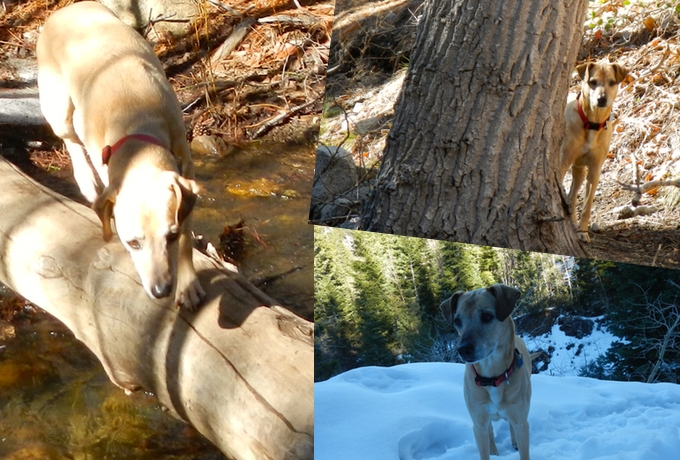
Aj spends her 12th birthday exploring the Mount Rose Wilderness. Photos/Kathryn Reed

Aj spends her 12th birthday exploring the Mount Rose Wilderness. Photos/Kathryn Reed

By Kathryn Reed

RENO – AJ’s birthday hike was no piece of cake.

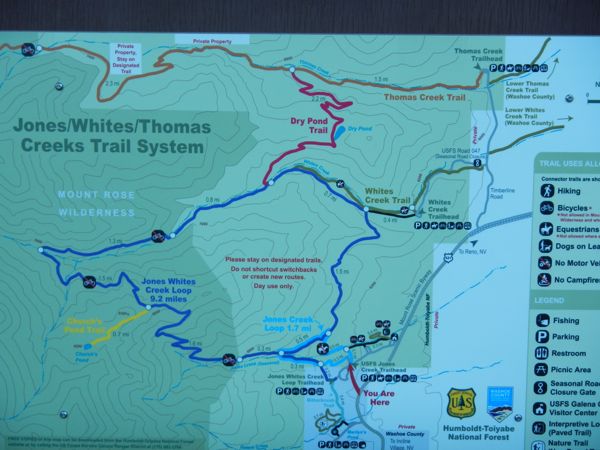
This 12-year-old – that’s 84 in human years – is much sprier than her much younger mommies. As if we needed a reminder. What was a 9.2-mile loop for us had to have been at least 1½ times that amount for the dog. She can be like the Energizer Bunny – she just keeps going and going and going.

This is what she lives for – being in the outdoors, romping in new terrain, sniffing all those delicious scents that never cross my olfactory senses and quenching her thirst from pristine water flowing from higher elevations.

When we first planned this for Feb. 14, snow had not fallen in a while and the U.S. Forest Service said the trail was free of any white stuff. Naturally, it snowed the week we were going. But because it is much lower in elevation we figured we would be OK in just hiking boots. And we were, despite going down on the slick snow a few times. Poles would have been a tremendous help, but they were in the garage.

The Jones-Whites-Thomas creeks trail system could keep us entertained for days.

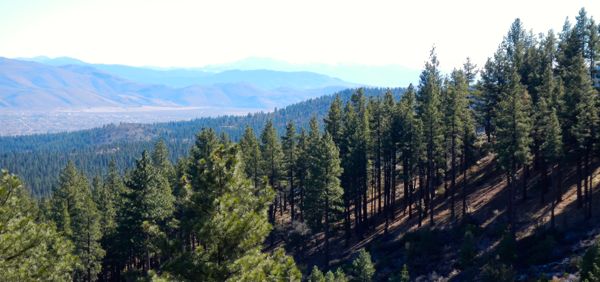
It doesn't take long for pretty views to unfold.

It doesn’t take long for pretty views to unfold.

This loop has a little bit of everything. We went in a counter clockwise rotation based on the advice of visitor center staff. From the parking lot it is 0.6 miles to the start of the loop.

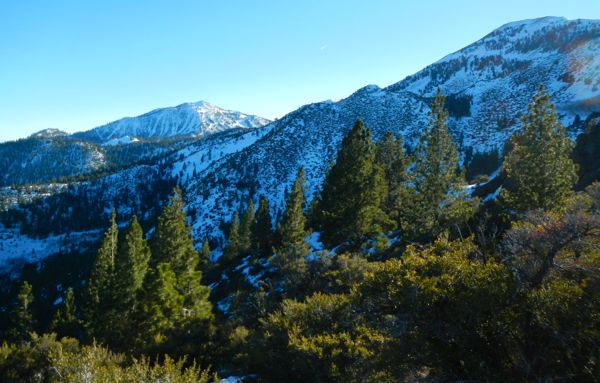
From there the terrain is similar to being in the Lake Tahoe Basin, but more barren. Plenty of pines loom overhead, but it’s not dense. It doesn’t take long before we are climbing. This provides spectacular views of far off mountains as well as parts of Reno. Behind us the slopes of Mount Rose are all covered in white.

A segment of this trail is open to mountain bikers. All were courteous to let us know they were approaching.

Farther along we come across some downed trees that require scrambling to get over. AJ, showing off her part Greyhound agility skills, leaps across the debris as though it’s a fun obstacle course.

Plenty of water is running in the creeks so AJ didn’t need any bottled water. She even trotted across logs to get to the other side. Her people were a little less confident in their ability to balance.

While we made it across the water without getting wet, there are four stream crossings that in a more typical winter or heavy spring runoff might prove to be a bit more challenging.

As we start a long trek west we know at some point we need to head south to get back to our starting point. But we’re in a canyon and the terrain to our left looks steep. We didn’t really descend that much, did we? Won’t there be some sort of cutoff to get us back without going up?

Mount Rose Ski Area, in the distance, is visible at different points.

Mount Rose Ski Area, in the distance, is visible at different points.

Up we go. And that’s when the snow goes from spotty to consistent. Luckily, others had gone before us. While there had been good trail markers, in the snow we would have had no clue where to go without others first “paving” the way.

At times we punch through to thigh-high snow. It becomes slow going. But it is still so incredibly beautiful that our whining is short-lived.

We make it to the top – again. More views, more picture taking. It’s an easy descent, but by this time we are getting chilled and fatigued. (At one point I was in shirtsleeves.) AJ on the other hand looks like she could keep going, right until she curls up on the blanket in the back of the Jeep.

—–

aj bday hike-3

Getting there: The scenic route from South Lake Tahoe – go east on Highway 50. Turn left on Highway 28 at the top of Spooner Summit. Turn right onto the Mount Rose Highway in Incline Village. There is a sign for the Jones Creek trail system on the left. This is well beyond Mount Rose Ski Resort. The visitor center is on the right; drive a little farther to the trailhead.

The less scenic route from South Lake Tahoe would be to drive to Carson City and then come up Mount Rose Highway from the other side.