Oversight of bottled water firms lacking

By Ian James, Desert Sun 

Some lawmakers are raising questions about the impacts of bottled water companies on water supplies in California after a Desert Sun investigation found little government oversight of the amounts of water being tapped or the effects on the environment.

Despite the drought, no state agency has been tracking exactly how much water is used by industries such as the state’s 108 bottled water plants. The Desert Sun also found that the U.S. Forest Service has been allowing Nestle Waters North America to keep using a pipeline to transport spring water out of the San Bernardino National Forest even though its permit expired in 1988.

Sen. Barbara Boxer, D-Calif., said the Desert Sun’s report raised important issues that should be addressed.

Read the whole story


Pollen in Tahoe triggering allergic reactions

By Kathryn Reed

That runny nose and cough may not be a lingering cold. It could be allergies.

There is no “allergy season” per se, just peak times for certain allergies. With plants beginning to bloom sooner than normal in the basin, people are experiencing allergic reactions to them. How this affects an individual all depends on what one is allergic to.

The pollen count in the Lake Tahoe Basin has been on the rise with the arrival of an early spring. According to Pollen.com, South Lake Tahoe is expected to have a pollen count of 8.8 today, which puts it in the medium-high zone. Sunday it could hit 10 and Monday 11.3 – both in the high category.

The Centers for Disease Control and Prevention says 8 percent of the people in the United States suffer from seasonal allergies – that is about 40 million people.

“The most common plant allergy in South Lake Tahoe is pine pollen. Other common allergies are dust and pet dander,” Ronald Roth, a board-certified otolaryngologist at Barton Ear, Nose, & Throat, told Lake Tahoe News.

Plants, flowers and trees are blossoming and blooming in Lake Tahoe. Photo/LTN

Plants, flowers and trees are blossoming and blooming in Lake Tahoe. Photo/LTN

Pollen is the main allergen of hay fever.

One way to help curb the problem is to stay inside and try not to bring pollen indoors. But this can make people feel like a shut-in. It also means not opening windows to have a fresh breeze.

While plant allergies are seasonal, dust allergies can be a year-round problem. However, dust and fungus allergies are more common in winter, according to Roth.

“If you experience allergies, try an over the counter medication. Decongestants such as Claritin or Zyrtec, or nasal spray, including Nasacort, can relieve allergy symptoms for some people,” Roth said.

He offered these tips:

• Wash your pets.

• Change your air filters.

• Buy down-proof pillowcases and protectors.

• A HEPA air filter can also make it easier to breathe.

• If you’re seeing persistent symptoms, contact your primary care provider for a prescription medication or for other treatment options.

Symptoms include:

• Runny nose

• Congestion

• Headaches

• Cough

•Throat irritation

• Post nasal drip

• Ear itching

• Ear fullness or congestion.

Allergies treat everyone equally. Men and women of all ages are susceptible to being allergic to something.


The art – and science – of forecasting wildfires

By Kate Schimel, High Country News

In the midst of fighting a wildfire, predicting the future is a matter of tracking invisible forces: gust fronts, storms, air columns. While firefighters battle the flames on the ground, fire experts look for signs that the weather or the wildfire might shift. They follow storm tracks, watch weather models and study the fire’s path.

Their attempts at prediction begin even before the first plume of smoke rises. In regional centers around the West, forecasters determine the risk of wildfire and brief fire managers on where they should have teams ready to go.

For the Rocky Mountains, that task falls to Tim Mathewson, a 20-year veteran of weather forecasting. “It’s a tough science,” Mathewson said. “There’s a lot of ingredients that help determine whether there’s a big fire today.”

For example, in 2012, much of the Rocky Mountain region was dry. Figuring out where a chance ignition might blow up into a large-scale fire was tricky. At one point, teams were staged and ready to go in four of the five states Mathewson watches.

Read the whole story


Calif. pumping water that fell to Earth 20,000 years ago

By Tom Knudson, Reveal

By now, the impacts of California’s unchecked groundwater pumping are well-known: the dropping water levels, dried-up wells and slowly sinking farmland in parts of the Central Valley.

But another consequence gets less attention, one measured not by acre-feet or gallons-per-minute but the long march of time.

As California farms and cities drill deeper for groundwater in an era of drought and climate change, they no longer are tapping reserves that percolated into the soil over recent centuries. They are pumping water that fell to Earth during a much wetter climatic regime – the ice age.

Such water is not just old. It’s prehistoric. It is older than the earliest pyramids on the Nile, older than the world’s oldest tree, the bristlecone pine. It was swirling down rivers and streams 15,000 to 20,000 years ago when humans were crossing the Bering Strait from Asia.

Tapping such water is more than a scientific curiosity. It is one more sign that some parts of California are living beyond nature’s means, with implications that could ripple into the next century and beyond as climate change turns the region warmer and robs moisture from the sky.

“What I see going on is a future disaster. You are removing water that’s been there a long, long time. And it will probably take a long time to replace it. We are mining water that cannot be readily replaced,” said Vance Kennedy, a 91-year-old retired research hydrologist in the Central Valley.

Despite such concern, the antiquity of the state’s groundwater isn’t a well-known phenomenon. It has been discovered in recent years by scientists working on water quality studies and revealed quietly in technical reports.

Groundwater is crucial to California. In an average year, nearly 40 percent of the state’s water comes from underground sources. In the current extended drought, it’s more than half. Eighty percent of California residents rely to some degree on groundwater. Some towns, cities and farming operations depend entirely on it.

Groundwater is like a bank account. You want to balance the debits and credits, not draw down the principal. But California has been depleting its groundwater principal for generations, pumping more than nature can replenish. So, too, has the United States as a whole. The biggest overall user is agriculture.

“If we continue irrigating at the increasing rates that we are in the U.S., the bottom line is that can’t be sustained,” said Leonard Konikow, a retired U.S. Geological Survey hydrogeologist in Virginia. “That can’t go on forever.”

A new article by Konikow in the journal Groundwater estimates that nearly 1,000 cubic kilometers – about twice the volume of Lake Erie – was depleted across the United States from 1900 to 2008. That’s enough to contribute to rising sea levels, along with melting glaciers and polar ice.

“That really surprised a lot of people,” Konikow said.

The pace of depletion has jumped dramatically since 2000. And Konikow identified one area that appears to have the most serious depletion problem in the nation – California’s agricultural powerhouse, the Central Valley, especially its more arid southern portion.

How long the bounty can last is anyone’s guess. As wells are drilled deeper, pumping costs soar. Water quality can suffer. In some areas, the earth itself is starting to sink as deep aquifers are pumped to historic low levels.

That problem is known as subsidence, and it’s a big deal. As the land sags, it is harming water delivery canals, damaging wells and buckling pavement.

“The rates of subsidence we are seeing are about a foot per year in some areas. They are just phenomenal,” said John Izbicki, a research hydrologist with the U.S. Geological Survey.

The last time this happened, during a binge of overpumping in the 20th century, one part of the valley sank 28 feet and damages topped $1.3 billion (in 2013 dollars), according to the California Water Foundation.

But that’s not all: As those deep aquifers are pumped, they suffer structural damage and no longer hold as much water as before. To visualize what happens, imagine a kitchen sponge.

“You take it out of the package and it’s all nice and fluffy,” said Bryant Jurgens, a research hydrologist with the U.S. Geological Survey. “After a month of use, it starts to shrink. When you wet it again, it doesn’t ever quite get as big as it originally was. That’s exactly what happens to the aquifer.”

And some of that water, as it turns out, is quite ancient. If you bottled it, you could label it the provenance of the Pleistocene – a geological epoch that lasted from about 2.5 million to 12,000 years ago.

The landscape was much different back then. Yosemite Valley was a river of ice. Mastodons and other now-extinct creatures roamed the West Coast. To the east and south, lakes stretched for miles across terrain we now call desert.

All water, in a sense, is ancient. It’s been cycling through clouds, rivers, forests and oceans for millions of years. But in recent decades, scientists have found ways to determine roughly when precipitation fell to earth and percolated into the surface, becoming groundwater.

They do it by testing water for the presence of certain compounds that decay slowly over time, such as carbon-14, a radioactive isotope that also is used to estimate the age of ancient civilizations and human ancestors.

There is no point-and-click website that reveals the age of groundwater in the state. To access the information, you must wade through a tangle of studies compiled by the U.S. Geological Survey as part of a state-funded public drinking water-quality monitoring program.

The jargon in those studies is so thick it is nearly incomprehensible. But deep in the scientific sediment are nuggets worth sharing with friends – a sentence here, a table there. They show water pumped from some deep public supply wells in the valley is 10,000 to more than 30,000 years old. Similar ages also have been reported in many desert basins, including Coachella Valley and Owens Valley, a major source of drinking water for Los Angeles.

What that means for the future is uncertain. Even though many areas pump more water than is recharged naturally, there is still more groundwater to be pumped.

“We are withdrawing from a fairly large bank account,” said Tom Myers, a hydrogeologic consultant in Reno, Nevada, who has worked in Southern California. “But we are withdrawing from it a lot faster than we are putting back in. The problem is we don’t know how close it is to empty.”

And many areas also recharge aquifers with surface water imported from elsewhere.

“There are places where you could be pumping very old groundwater and there is sufficient recharge to the system – so it’s not necessarily a problem,” said Miranda Fram, a research chemist with the U.S. Geological Survey. “But in many cases, it is. It’s mining old groundwater that’s not being replenished.”


Reducing fine sediment helping Lake Tahoe

By Kathryn Reed

Abrasives put on roadways in the Lake Tahoe Basin are a huge contributor to the loss of lake clarity.

That was one of the messages delivered to the Lahontan board on Thursday when staff gave an update about the total maximum daily load program. The TMDL is designed to keep fine sediment from reaching the lake. Those tiny particles are degrading the lake’s clarity, along with phosphorus and nitrates.

“Caltrans is leading the way with El Dorado County with traction abrasives. They were shooting themselves in the foot by putting fine sediment on the ground,” Bob Larsen, senior environmental scientist with Lahontan Regional Water Quality Control Board, said March 12.

Brine is now being used more often than salt or decomposed granite to handle slick roadways. Sweeping after a storm to collect the leftover matter is also helping to keep material from the lake. Changing abrasives and vigilant street sweeping has proved to be a cost-effective route.

Larsen said it has also been proven that sweeping streets with cracks is not effective.

“That is why it is important to maintain the infrastructure,” he said.

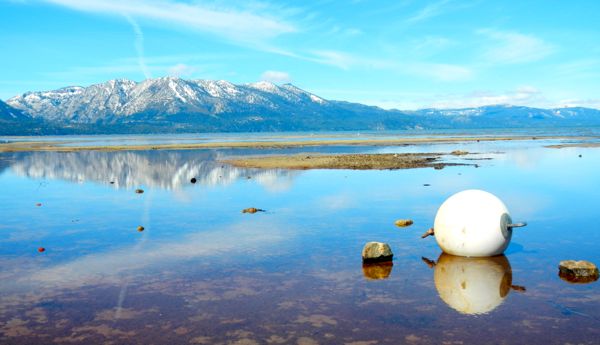
Lake Tahoe clarity is an ongoing issue. Photo/Kathryn Reed

Lake Tahoe clarity is an ongoing issue. Photo/Kathryn Reed

One of the early complaints from the jurisdictions having to comply with the unfunded TMDL mandate was the cost. Larsen told the board it’s important for Lahontan to be an advocate for the stakeholders when it comes to securing funding for projects.

Another tactic is to crack down on lax maintenance of erosion control measures – or best management practices.

Larsen said he is cautiously optimistic that the decline of Lake Tahoe’s clarity is stabilizing.

The Lake Tahoe TMDL is a 65-year program, with this being year four. The goal after all that time is to be able to see what amounts to a white dinner plate being visible 100 feet below the surface of Lake Tahoe. Larsen said the 2016 goal of 71 feet of clarity is on target to be met.

Because the urban runoff is responsible for 70 percent of the fine particles reaching the lake, that is where the emphasis is.

Non-urban areas are also a concern, with unpaved roads in the forest being the biggest problem. Since 2004, the U.S. Forest Service has decommissioned more than 200 miles of roads.

All of the initiatives are likely to help improve the near shore as well, Larsen said. This is the beach area that has turned murkier as the water temperature increases. This area is also being studied by other agencies to determine other reasons why the water is more brown than clear.

While Lahontan only has jurisdiction in California, the TMDL is a joint policy with Nevada. A universal website has been established to encompass what is going on lakewide.

TMDL is not unique to Lake Tahoe. Lahontan also has jurisdiction over the TMDL program for Heavenly Valley Creek, Indian Creek Reservoir, Squaw Creek, Blackwood Creek, and Truckee River.

Rich Booth with Lahontan gave a summary to the board about those water bodies. He said the four main pollutants are metals, nutrients, total dissolved solids, and other things, with bacteria being part of the other.

All but Squaw Creek are on target to meet the 20-year compliance goal, Booth said. He called the increase in fine sediment “disturbing”.

The agency is also going to take a harder look at the Truckee River because by the current standards it is in compliance. However, last year the Truckee River Watershed Council presented information to the board saying it is still an impaired waterway. It’s likely the goals will be reconfigured.


Gender gap in education cuts both ways

By Eduardo Porter, New York Times

Why do the best-educated girls do worse at math than top-educated boys?

Concern about this deficit exploded into public consciousness 35 years ago, when researchers in the department of psychology at Johns Hopkins University published an article suggesting the gap might be caused by a “superior male mathematical ability.”

The debate that ensued was furious. It was so hot that a quarter of a century later, a similar controversy contributed to the ouster of Lawrence Summers from his post as the president of Harvard.

Was there anything “natural” about the performance gap? Or was it the product of gender bias working its way through schools? As the debate raged, ending the underrepresentation of women in science, technology, engineering and math became a critical policy priority.

Amid the din over top girls’ mathematical abilities, something important was forgotten: What is happening that so many boys are falling behind in pretty much everything else?

Last week the Organization for Economic Cooperation and Development — a collective think tank of the world’s industrialized nations — published a report about gender inequality in education, based on the latest edition of its PISA standardized tests taken by 15-year-olds around the world.

Read the whole story


Nev. entertains body-camera law for cops

By Ana Ley, Las Vegas Sun

Nevada lawmakers are pushing a bill that would require uniformed law enforcement officers to wear body cameras, mirroring the nation’s intensifying efforts to improve relationships between police and the communities they serve.

Introduced Monday by Assemblyman Harvey Munford, D-Las Vegas, Assembly Bill 162 is one of 87 pieces of body camera legislation being considered in 29 states, according to the Denver-based National Conference of State Legislatures.

Even supporters of AB 162 say the feasibility of the unfunded mandate is questionable, and it will likely be watered down significantly by a series of amendments proposed by law enforcement groups and civil rights advocates. At most, the bill will likely end up requiring police agencies to consider the new technology (which many are already doing).

Read the whole story


Paying for ambulance service a conundrum

By Kathryn Reed

A shared resource or a subsidy? Being able to answer that question is what the financial disagreement over ambulance service on the South Shore is coming down to.

The Cal-Tahoe JPA, which has two board members from the South Lake Tahoe City Council and two from the Lake Valley Fire Protection District board, has a little more than one year left in a five-year contract with El Dorado County to run the ambulance service in their jurisdictions. There is then the possibility to renew the contract for five years in one-year increments. The county pays the JPA $2.06 million a year to do so. That money comes from a parcel tax assessed to property owners ($500,000) and fees paid by patients or their insurance companies (the remainder).

The contract deals with response time and says there will be five available ambulances, with access to a sixth.

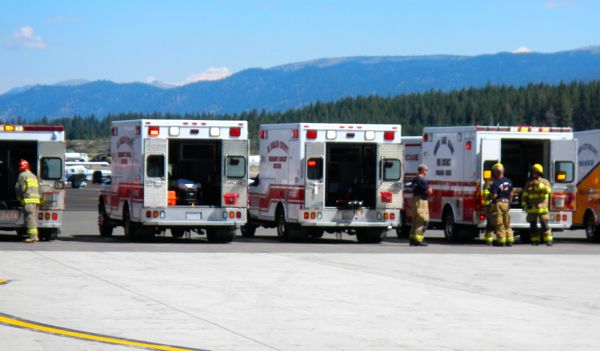
Who pays for the cost of ambulance service is being debated. Photo/LTN file

Who pays for the cost of ambulance service is being debated. Photo/LTN file

The problem is the fire departments believe three ambulances are needed at all times to meet the response times. But the amount paid by the county never covered that level of coverage. The city and Lake Valley at the time agreed to share that expense.

This contract also calls for a flat fee for taking patients to out of area hospitals, which is often a loss for the JPA.

The city is also absorbing dispatch expenses that went from $65,000 to $95,000 to $150,000 per year. The city calls this a subsidy to the JPA and wants reimbursement from the county.

But the contract says otherwise. The county pays a flat fee for X amount of service whether that is medical care or dispatch.

On the flip side, the county only has to pay for ambulance service – not when a fire truck rolls with the medic unit. That is where the shared resource aspect comes into play.

Most of this was brought up at the monthly JPA board meeting on March 11. The four board members spent the bulk of the meeting in closed session to discuss how to respond to a Feb. 12 letter from Don Ashton, director of the county’s Health and Human Services Department. There was no reportable action.

Board attorney Dave Hale claimed the way to go into closed session was to call it potential litigation. The board agreed this was logical and not a violation of the Brown Act.

The departments are going to look at what all the real expenses are to run the ambulance service. This means looking at what it costs to store ambulances at the fire stations, the use of phones and other office related expenses. Those numbers will then be presented to the county.

Per the contract it’s possible to revisit issues. This first was talked about last summer, with the initial formal meeting between the JPA and county in October. JPA Executive Director Ryan Wagoner and Ashton with the county met Wednesday after the JPA meeting.

In the past it was disclosed that not all residences are paying the ambulance fee, but Wagoner said that is not true. He told Lake Tahoe News condos and mobile homes are in a different category, but still contribute to the cause.

El Dorado County was a bit put off by last month’s presentation by South Lake Tahoe Fire Chief Jeff Meston to the City Council regarding ambulance service.  Ashton said as much in his to letter Wagoner last month.

Wagoner insists discussions are going the way the contract states that they can, everyone is playing nice and that talks are progressing. But he underlined how the county and the West Slope ambulance agency have been negotiating for 1½ years, so these things take time.

The next JPA meeting is April 13 at 9am at Lake Tahoe Airport.


Barton Health fires CFO after 7 months

By Kathryn Reed

Steve Neff, chief financial officer of Barton Health, was fired today.

Neff had been on the job since August.

Steve Neff

Steve Neff

“He got fired today. I’m not at liberty to give all the reasons behind that,” Kirk Ledbetter, chairman of the board, told Lake Tahoe News. “It was something the leaders at Barton felt was appropriate.” Ledbetter sent a memo Wednesday letting the rest of the board know what was going on.

The CFO reports to the chief executive officer. Only the CEO reports to the board.

CEO John Williams was not available Wednesday afternoon. However, the morning of March 11 he sent an email to staff saying Neff had been terminated.

Mindi Befu, spokeswoman for the South Lake Tahoe-based healthcare organization, told Lake Tahoe News because it’s a personnel issue the reasons for Neff’s firing could not be disclosed, but added that the terms of his contract were followed.

Befu would not say what Neff’s salary was. His predecessor was making about $400,000 a year.

Neff joined Barton after Dick Derby, who had the position for 14 years, retired last summer. Before coming to Tahoe Neff had been a partner with Renaissance Healthcare Partners in Massachusetts for 17 months. He has been in health care for more than 30 years, with 14 of them in leadership positions.

At the time he was hired, Williams in a statement said, “We look forward to his experience and leadership in the coming years.”

Recruiting for another CFO will begin in the next month. Ledbetter expects the board to be updated on matters at the March 26 meeting.


Study: Calif nearly guaranteed major temblor soon

By CBS and Associated Press

LOS ANGELES — The probability California will experience a magnitude 8 or larger earthquake in the next couple of decades has increased, according to the U.S. Geological Survey.

“The new likelihoods are due to the inclusion of possible multi-fault ruptures, where earthquakes are no longer confined to separate, individual faults, but can occasionally rupture multiple faults simultaneously,” said lead author and USGS scientist Ned Field. “This is a significant advancement in terms of representing a broader range of earthquakes throughout California’s complex fault system.”

Compared to the 2008 assessment, earthquakes around magnitude 6.7 — the size of the destructive 1994 Northridge quake — has gone down by 30 percent with a frequency from an average of one per 4.8 years to about one per 6.3 years.

The study also says the likelihood that California will experience a magnitude 8 or larger earthquake in the next 30 years has gone up from about 4.7 percent to about 7 percent.

Read the whole story