Study: SBA loans going to luxury retailers, resorts

By Bruce Parker, Fox News

The Small Business Administration is the federal agency that helps “little guy” businesses get loans they couldn’t get through traditional lenders. Or so the story goes.

According to a 2014 federal oversight report from public research group American Transparency, taxpayer-backed SBA loans are popular with businesses serving “wealthy lifestyles.”

Found among the list of borrowers were Rolex and Lamborghini dealers, Napa Valley wineries, Sears and State Farm affiliates, Jackson Hole and Lake Tahoe resorts, and Levine Leichtman Capital Partners in Beverly Hills — not your typical mom-and-pop shops.

Read the whole story


Businesses dissecting Sandoval’s revenue plan

By Kyle Roerink, Las Vegas Sun

Talk of tax season is ripe in the Nevada Legislature, but the chatter has nothing to do with April 15.

Gov. Brian Sandoval will lobby for his business license fee on Wednesday in the Senate’s revenue committee. The fee, an existing tax the Sandoval administration has reconfigured, would levy the key fiscal component of his $1.1 billion tax plan aiming to bolster the state’s public education system.

Sandoval is breaking with traditional conservative ideologies in the name of offering $438 million to boost new programs and opportunities for the state’s students, teachers and parents in the next two years. He is one of at least 10 Republican governors calling for tax hikes across the country and says he is determined to cement the 2015 session as the foundation for revamping Nevada’s bottom-rung education system.

Sandoval’s education-driven gusto has politicians and special interests singing his praises and willing to write checks.

Read the whole story


Future of Lake Tahoe Airport being solidified

By Kathryn Reed

Keep the airfield as it is while providing flexibility for other uses at the airport was the consensus Monday night of the nearly 60 people who attended a meeting about the Lake Tahoe Airport master plan.

This was the third and final meeting before preferred alternatives are defined. Those will then be studied in environmental documents. Comments on all alternatives will be solicited for another month.

It’s possible the whole process could be completed in summer 2016.

It has been about 23 years since the city did a master plan for the airport. The goal is to define what it will look like for the next 20 years.

Last year the City Council said the airport will be a general aviation facility and commercial air service will be a thing of the past. However, it’s possible those priorities could change in the future. And the City Council at its last meeting approved an economic study be done for the airport. This will be incorporated into the business plan for the facility.

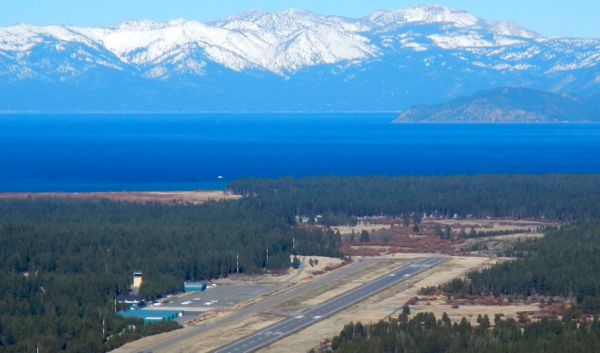
Lake Tahoe Airport's future is being decided by  the public and South Lake Tahoe officials. Photo/LTN file

Lake Tahoe Airport’s future is being decided by the public and South Lake Tahoe officials. Photo/LTN file

Michael Hotaling, the consultant preparing the master plan, on March 16 said the FAA – which is picking up 90 percent of the costs to prepare the plan – focuses on safety, security, sustainability and capacity. The city may have other priorities, but the feds’ desires by virtue of being the banker, so to speak, carry more weight.

With this being Lake Tahoe, environmental factors also play a role. So, while it might be a good idea to cut down trees for safety reasons, the Tahoe Regional Planning Agency gets to weigh in if they should be removed or some other mitigation done.

Air quality, compatible land use and stream environmental zones are potential constraints for any future development at the airport.

Some of the 14 people who spoke Monday night brought up:

• How the airport has virtually no services; that it requires flying somewhere else to get the bugs off the plane because they cannot be washed at this airport.

• The need to lower the rent on hangars.

• The desire for new instrument approaches.

• The idea to create an airport district like what Truckee has.

• The savings of giving up the FAA certificate that allows commercial service. (The 139 certificate is on today’s City Council agenda.)

The city’s subsidy to operate the airport has dropped 43 percent from 2010-11 to 2013-14, with the cost at $352,000. That could drop about another $120,000 by giving up the 139 certificate. Most of the certificate’s expenses are related to training firefighters to deal with a commercial airliner crash.

At this week’s meeting everyone had the opportunity to vote on the plans they liked best. Most want to keep the runway, tarmac and apron as they are.

Hotaling brought up reasons the city might want to consider lengthening or widening the runway – mostly to keep up with changing airplanes and specifications. But it was also noted that even though the Gulfstream V and planes like it are likely to be more common in coming years, pilots could land and take off at their own discretion.

The current 8,541-foot runway is not optimal for a Gulfstream in the heat of summer. Optimal conditions are for an 11,000-foot runway.

But no one has come forward advocating to lengthen the runway, nor do they want to shorten it.

Based on the alternatives being voted on Monday people are behind improving other amenities like adding a self-fueling station – which could lower the price per gallon of jet fuel, creating hangars to accommodate larger aircraft, and designating a swath of land east of the airport as non-aeronautical (this would allow for a potential concert venue).

More information about the master plan may be found online.


Nevada a hotbed for geothermal activity

By Jackie Valley, Las Vegas Sun

Humans have been using geothermal energy for more than 10,000 years, since American Paleo-Indians used hot springs for cooking, bathing and cleaning. But it wasn’t until 1904 that the first geothermal electric power plant was invented to generate electricity, when Italian scientist Piero Ginori Conti figured out how to turn steam into power.

The amount of heat in the top 33,000 feet of the Earth’s surface contains 50,000 times more energy than all of the oil and natural gas resources in the world.

Worldwide, geothermal power plants produced more than 11,700 megawatts of electricity, enough to meet the annual needs of more than 6 million typical U.S. households. The first geothermal plant in the United States debuted in 1992, and now, two decades later, 69 geothermal plants operate nationally. Several are in Nevada, and more are coming.

Read the whole story


Seasons dramatically changing at Tahoe

By Julia Prodis Sulek, San Jose Mercury News

TAHOE CITY — There’s something disconcerting about life at Lake Tahoe these days.

It’s still winter, but visitors are renting bikes instead of snowshoes and kayaks instead of skis. Come summer — without last-ditch torrential rains — the lake level is expected to be at such a historic low that some marinas will have to dredge for boats to launch. Jumping off the end of a pier could result in a rock-hard landing.

California’s epic drought, entering its perilous fourth year, has combined with a pattern of warming temperatures to cast a “Twilight Zone” quality on one of the state’s most popular winter destinations and iconic landmarks.

“It’s bizarre what people are doing now. It’s so out of season,” said Geoffrey Schladow, director of the Tahoe Environmental Research Center and a UC Davis professor. “Years like this are going to become more common.”

In many ways, Lake Tahoe is California’s canary in the coal mine — at 6,200 feet. While our weather can quickly swing from one extreme to the other, the twin realities of the current relentless drought and steady warming over the past century are converging to create a remarkably different experience at the venerable — and vulnerable — lake. Everyone, from environmental agencies to businesses to tourists, is scrambling to adapt.

Long-term predictions by Lake Tahoe scientists warn that by the end of the century, summers could be two months longer and temperatures 8 degrees hotter than when Squaw Valley hosted the 1960 Winter Olympics. The dire effects of climate change present daunting challenges to local government officials, who have been patting themselves on the back for their efforts to Keep Tahoe Blue and reverse some of the damage caused by rampant lakeside development in the 1960s and ’70s.

But there’s nothing they can do to guarantee winter.

Read the whole story


S. Tahoe identifies 12 acres for concert venue

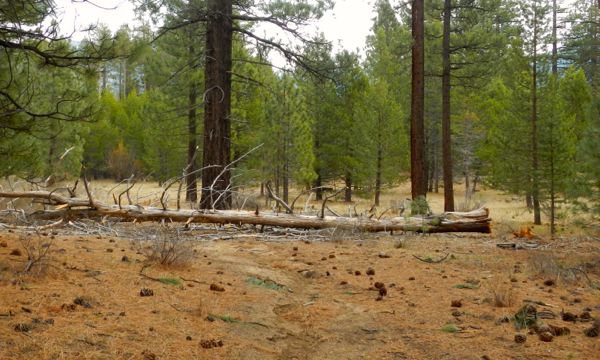
The clearing in the distance could be an area for a stage. Photos/Kathryn Reed

The clearing in the distance could be an area for a stage. Photos/Kathryn Reed

By Kathryn Reed

An outdoor concert venue that isn’t a parking lot. A setting that embraces the natural environment. A site that could be used year-round. A place that would have limited impact to residents.

It does exist in South Lake Tahoe.

City officials are looking at the possibility of turning 12 acres at Lake Tahoe Airport into an event center.

The Federal Aviation Administration has already given the OK to have special events there on a case-by-case basis. Through the airport master plan process the city is seeking to designate this area non-aviation. If that goes through, then the city can do what it wants with the land without permission from the FAA.

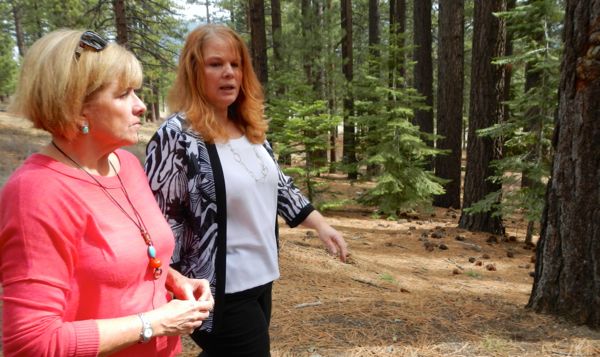
“It’s common sense this is non-aviation,” City Manager Nancy Kerry said while walking the property with Councilwoman Wendy David.

The City Council has approved a cost benefit study to be done. Engineers will be brought out to assess the site.

Much of the property sits a few hundred feet below Highway 50, paralleling Kyburz Avenue. This means little road noise for attendees and less chance of concert sounds drifting to residences.

Plus, the density of trees will help absorb the sound.

South Lake Tahoe City Manager Nancy Kerry, right, gives Councilwoman Wendy David a tour March 14 of the proposed event center site.

South Lake Tahoe City Manager Nancy Kerry, right, gives Councilwoman Wendy David a tour March 14 of the proposed event center site.

Walking farther into the space the quieter it gets. It’s like being in the wilderness even though civilization is so close.

Kerry said people are looking for an experience beyond listening to music. This setting would be designed to provide just that.

“They don’t want to bother your environment, they want to be in your environment,” she said.

South Lake Tahoe has been looking for a site to stage music festivals ever since SnowGlobe came to town in 2011. It brings more than 10,000 people each night to what is a three-day music festival at the ball field at Lake Tahoe Community College, and millions of dollars to the local economy. But it also brings wear-and-tear to the synthetic field, and noise complaints from neighbors.

The airport parcel is larger than the area used at the college for SnowGlobe.

The idea is not to build large structures or lots of permanent seating. Limited terraced seating would be created. At most multi-day outdoor festivals everyone is standing – often dancing.

Some infrastructure is in place – like a concrete slab from when this site was a summer boys and girls camp, and sewer capacity. A segment of a paved road from the corner of Kyburz Avenue and Melba Road remains and could be the route where vendors would access the facility.

Electricity would need to be brought to the area, fencing installed, some trees removed and one storm drain would need to be put underground.

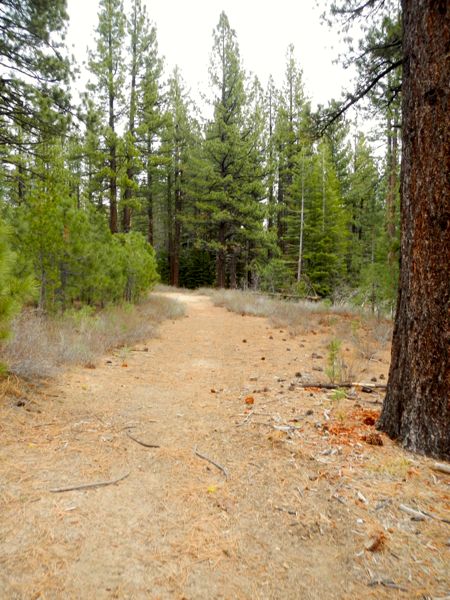
Part of the trail that exists is wide enough for vehicles.

Part of the existing trail is wide enough for vehicles.

A future bike trail through this area is already on the books. That is the route that would likely be developed for attendees to use. It’s already a distinct path that is well used by cyclists. Interpretive signs could be erected to educate the public about the forest, what being a steward of the land is about and other Tahoe-centric things.

Kerry said she envisions the entrance being at the defunct airport control tower. Parking would be at the airport, along with shuttles from other parts of town to the venue. People would then walk into the forest, a bridge going over the creek would be built and then multiple tents might be erected – like SnowGlobe – so various acts could be playing at the same time.

It’s also possible this site would be used for more than music events.

Originally, this parcel was slated to be commercial development to complement airport needs. With the city deciding to forgo trying to establish this as a commercial airport again, the need for ancillary businesses is a moot point.


Sierra, Northstar ski resorts may be sold

By David Sharp, AP

A real estate investment trust that’s considering getting out of the snow business could sell more than a dozen ski resorts from Maine to California that are worth hundreds of millions of dollars.

CNL Lifestyle Properties owns 16 resorts including Northstar, Sierra-at-Tahoe, Sunday River and Sugarloaf in Maine, Bretton Woods, Loon Mountain and Mount Sunapee in New Hampshire, Okemo Mountain in Vermont, Crested Butte in Colorado, and Brighton in Utah.

If CNL sells them all to one buyer, industry officials say it would be the largest single ski resort transaction in the history of the sport — though skiers might not notice the sale at all.

“CNL Lifestyle Properties bought Sierra and Northstar a few years ago. Booth Creek Resort Properties manages the resort — the assets and special use permit are property of CNL. I work for Booth Creek, we pay rent to CNL,” Sierra General Manager John Rice told Lake Tahoe News.

In October 2010, Vail Resorts acquired the stock of the companies that operate Northstar from Booth Creek and other sellers for $63 million. Vail also runs Northstar Village, which is owned by CNL. No one from Northstar or Vail Resorts was available for comment.

Rice said change in ownership would have no affect on Sierra.

“Whoever owns the permit would still need a tenant. Sierra is the tenant. A new owner of the assets would be our new landlord, if you will,” Rice explained.

CNL will evaluate options for its remaining properties including ski resorts, theme parks and marinas “in the near future,” said Steve Rice, senior managing director of CNL Financial Group, and no relation to John Rice. Besides selling them, alternatives include a private buyout or listing on a publicly traded exchange.

“We’re taking a studied and careful approach,” Rice said.

REITs are an investment vehicle for a variety of properties including hotels, office buildings and malls, but they are new to the ski industry in the last 15 or so years.

There’s only one other REIT that’s a big player in the ski industry, Missouri-based EPR, said Michael Berry, president of the National Ski Areas Association.

CNL Lifestyle Properties was valued at as much as $3 billion in 2012 with ownership of more than 100 water parks, ski resorts, marinas and senior housing developments before the value dropped in the aftermath of a real estate downturn. The REIT is nearing the end of its projected lifespan and anticipates having an “exit strategy” in place by Dec. 31.

In June, CNL agreed to sell 48 golf properties for $320 million. In December, it announced an agreement to sell its senior housing for $790 million.

Ideally, the remaining ski properties, theme parks and marinas would be sold, and the company enlisted Jefferies LLC, an investment bank, to evaluate options.

Any sale wouldn’t have any significant impact on skiers because the resort operators’ long-term leases will remain in place even if the properties change hands.

“At the end of the day, from a customer standpoint, it’s not going to alter reality that much,” Berry said.

Ski resorts, which are at the mercy of weather and the economy, can be good investments as long the owners have a long investment horizon, said Michael Krongel from Mirus Resort Capital in Burlington, Mass., who’s been involved in buying, selling and developing ski resorts for 45 years. REITs like Florida-based CNL bring in revenue through rent paid by ski resort operators.

Lake Tahoe News contributed to this story.


Cost, confusion plague Nevada public records

By Ken Ritter, AP

Cost and confusion can be obstacles to obtaining public records in Nevada, where reporters are sometimes quoted high fees for research, redaction and copying.

Sure, the Silver State has open record and open meeting laws. But it might be unique in the U.S. for not defining what a public record actually is, officials said.

“There is no single definition that can be found within Nevada Revised Statutes,” said Colby Williams, a Las Vegas attorney who has handled access-to-records cases for the Associated Press, the Las Vegas Review-Journal and National Review.

State law section 239 lets agencies at all levels charge 50 cents per printed page for “extraordinary use of personnel or technological resources.” But Barry Smith, executive director of the Nevada Press Association, said he thinks some entities use the rule as a moneymaker — or a barrier.

“The trouble comes when some agencies see it as an opportunity to discourage people from obtaining public documents by jacking up fees as much as possible,” Smith said. “I hear from newspapers and reporters that they want to charge for redaction by an attorney at $100 an hour. That can easily run into thousands of dollars.”

The Nevada System of Higher Education told the Las Vegas Sun that agency staff members spent 54 hours, at a cost of $5,579, to compile 844 pages of documents sought for a story, said Ric Anderson, managing editor of the newspaper.

University administrators eventually agreed to limit the overall cost to 50 cents per page, or $422. Anderson said the Sun arranged to have a reporter review the documents at the system office in Las Vegas to avoid the cost.

Clark County charged $150 — tallying three hours of work at $50 per hour — to produce 125 emails by seven Clark County commissioners after a reporter asked last May for communications relating to medical marijuana licensing, Anderson said.

“We believe documents should be readily obtainable and available at minimum cost,” Anderson said. “We understand there are instances where frivolous requests tie up peoples’ time. Our requests are reasonable. We’re working on behalf of the public.”

Sparks police charged AP in Reno $67 for 1,300 pages of records relating to an October 2013 school shooting, or a little less than 20 cents a page. Reno police charged $50.95 for a compact disc with 1,168 pages of documents about a December 2013 shooting at Renown Regional Medical Center, just less than 23 cents per page.

Wes Henderson, executive director of the Nevada Association of Cities and Municipalities, denied that government officials try to gouge people who make freedom of information requests.

“The argument that the intent is to limit public access or to make money is a red herring,” Henderson told a state Legislature panel taking up a bill to let public agencies begin charging 50 cents per page for electronic documents. The association supports the bill.

“Most requests for copies or records, people ask for it; they get it. No charge,” Henderson said in an interview. “We want to be able to recoup some of the cost for the requests that take more time and effort.”

The measure, Senate Bill 28, would let agencies collect an additional fee for a record requiring more than 30 minutes of staff time, or totaling more than 25 pages.

Henderson said the intent was to clarify confusion about the “extraordinary use” clause.

He acknowledged the proposal is unpopular with the media. He pointed to a Las Vegas Review-Journal editorial calling it the worst bill of the 2015 state Legislature.

Stanton Tang, news director at KOLO-TV, the ABC affiliate in Reno, said reporters and editors understand that it takes time for staff members to make physical printouts.

“But to drag-and-drop a file takes moments,” Tang said. “What’s the need for them to increase expenses for these files other than to discourage people from asking?”

Agencies that field open-record requests counter that turning over email records is nothing like pulling a piece of paper from a file and making a copy.

Police employees have to review the entire record to remove birthdates, Social Security numbers and other personal identifiers, said Charlotte Bible, a Las Vegas Metropolitan Police Department lawyer.

“We always have to be concerned that the records that are produced … may be posted on the Internet,” Bible told the state Senate Committee on Government Affairs.

Smith said another impediment to openness and transparency is the lack of any entity with authority to enforce open-record laws.

“In Nevada, the only recourse we have when someone denies a record or tries to charge us is to go to court,” the press association chief said. “That, in itself, can be a barrier.”

But Williams said that once a civil complaint is filed, state judges and the Nevada Supreme Court usually order a record to be released.

“I’d give the courts an ‘A’ in the way they interpret the statute,” he said.


Tahoe first responders heat up Rotary event

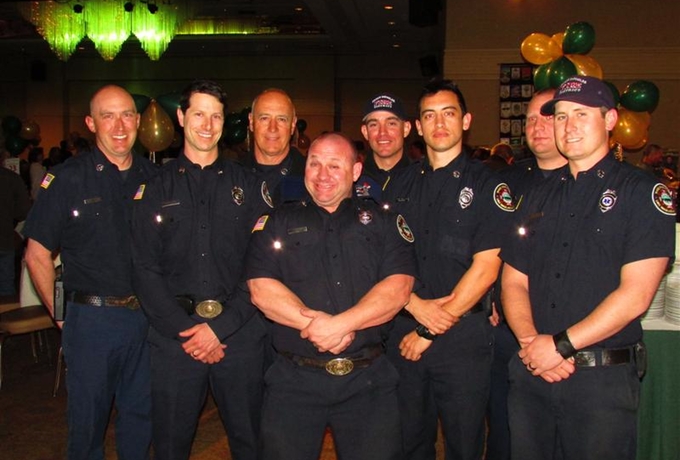
Tahoe Douglas firefighters were out in force March 13 supporting their colleague; form left, Nathan Johnson, Chris Lucas Bill Romanowitz, Ben Pratt, Nick Robidart, Juan Serrano, Scott Vandover and Chad Baker.

Tahoe Douglas firefighters were out in force March 13 supporting their colleague; from left are, Nathan Johnson, Chris Lucas, Bill Romanowitz, Ben Pratt, Nick Robidart, Juan Serrano, Scott Vandover and Chad Baker.                Photos/Denise Haerr

By Kathryn Reed

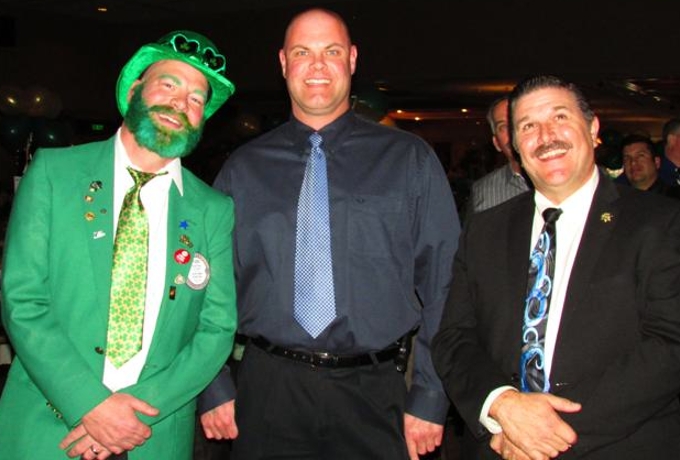
STATELINE – Service above self is the philosophy of Rotarians worldwide. Tahoe Douglas Rotary took that mantra a step further on March 13 by honoring those who embody that philosophy on a daily basis.

This was the first year the South Shore Rotary club honored first responders during the annual St. Patrick’s Day fundraiser in what was called the Community Hero Awards.

“We wanted to add more meaning to the night,” Rotarian Erik Watada told Lake Tahoe News. “A lot of people are familiar with Rotary, but are not sure what they do. We wanted to draw a better connection to what we do.”

In doing so, the club was able to sell out the event at Harrah’s Lake Tahoe for the first time in its 47-year history.

Leaders within the Tahoe Douglas Fire Protection District, Douglas County Sheriff’s Department, South Lake Tahoe Fire Department, Lake Valley Fire Protection District, South Lake Tahoe Police Department, and El Dorado County Sheriff’s Department selected one person from their department to honor. Videos of each of the recipients and their bosses were shown to the crowd during the dinner. The only disappointing aspect of the night was the disrespect shown by some attendees who talked during the entire presentation. Each honoree had $1,000 donated to a charity.

Rotarian Todd Poth, from left, with honoree Sgt. Greg Almos and El Dorado County Sheriff John D'Agostini.

Rotarian Todd Poth, from left, with honoree Sgt. Greg Almos and El Dorado County Sheriff John D’Agostini.

The outstanding honorees are:

• “Capt. Ralph Jones was selected because he has proven to be a highly professional, dedicated, and devoted firefighter and bomb technician. Throughout his career he has focused on serving the residents and visitors of our community.” – Tahoe Douglas Fire Chief Ben Sharit.

Charity recipient: Northern Nevada Children’s Cancer Foundation.

• “Our community is safer thanks to the hard work and leadership of Sgt. Ron Elges.” – Douglas County Sheriff Ron Pierini.

Charity: Douglas County Sheriff’s Advisory.

• “Al (Martinez) was selected by his peers based upon his outstanding efforts with public education. He is a caring employee who wants to educate the public in all facets of fire and life safety.” – South Lake Tahoe Fire Chief Jeff Meston.

Charity: H.E.R.O. Scholarship.

• “Michael (Anderson) exemplifies the fire district’s mission, vision and values in his performance as a firefighter/paramedic. He is well known for his positive, can-do attitude.” – Lake Valley Fire Chief Gareth Harris.

Charity: Live Violence Free.

• “Officer Ross Molesworth’s commitment to this community as a police officer, volunteer, and kids’ coach is commendable. He has demonstrated the ability to take actions that are beneficial to all in our community.” – South Lake Tahoe Police Chief Brian Uhler.

Charities: South Tahoe National Little League and South Lake Tahoe SWAT.

• “Deputy Greg Almos demonstrates a sincere commitment to serving the residents of our community. He devotes great attention to how to make the South Lake Tahoe Basin safer and more enjoyable.” – El Dorado County Sheriff John D’Agostini.

Charity: El Dorado Search and Rescue Council.

Besides adding the first responder honoree component to the night, the Rotary club also became the first nonprofit on the South Shore to have its silent auction be paperless. To participate people had to use their smart phone or a computer to bid on items. This allowed people who didn’t attend to bid on items and for bids to be made before the event.

It also meant not having to hover over a table and elbowing one’s competitor to get to the sheet. When someone was outbid on an item that person received a text and could then enter a higher bid.

Before the festivities began the Rotary club had more than $30,000 pledged in the silent auction.

This format also sped up the process for checking out at the end of the evening.

The total proceeds are still being calculated. Money raised is then returned to the community through various projects and scholarships.

Watada also said rotary is looking at possibly expanding first responder recipients in future years.


Group predicts $9 bil. in March Madness wagers

By J.D. Morris, Las Vegas Sun

The American Gaming Association is again using a major athletic event to draw attention to sports betting, this time estimating that Americans will wager upwards of $2 billion through more than 70 million brackets on this year’s March Madness college basketball tournament.

The Washington, D.C.-based trade group for the casino industry announced its predictions in research released today.

Beyond just the amount bet through brackets, the association expects the total amount wagered will reach $9 billion, including $240 million bet at sports books in Nevada.

Read the whole story