High cuisine may become an après ski tradition

By AC Shilton, Outside

Chefs are infusing more than just sweets into cannabis. High-end cannabis dining is coming to a ski town near you.

Your cannabis-related food associations probably aren’t great. There were the terrible weed brownies you made in college, with bits of plant fiber in every bite. Then there’s all the garbage food you’ve eaten while stoned. High cuisine, for many of us, has never really been anything close to haute cuisine.

But in places where cannabis is legal, chefs are working to change weed’s junk food reputation. Fine dining pop-ups and cooking classes, where marijuana is either cooked into dishes or served in some sort of complementary pairing with each course, are selling out, with everyone from first-time boomer users to veteran stoners wanting a seat at the table.

The movement is a personal one for many chefs.

Read the whole story


Today’s ski bum works for Silicon Valley, lives in Tahoe

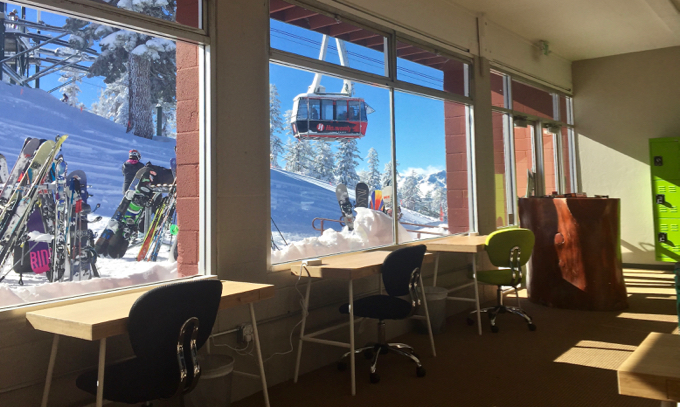
Tahoe Mountain Lab has a satellite facility at Heavenly Mountain Resort. Photo/Jamie Orr

By Michelle Robertson, San Francisco Chronicle
 
Aaron Rothschild starts most of his days about 6am. That way, he can finish up work in time to catch a few runs on the ski slopes. Some afternoons, he conducts meetings in the Squaw Valley Ski Resort parking lot with a “laptop between me and my steering wheel.”

The recent advent of telecommuting – a Gallup poll found at least 43 percent of Americans spent at least some time working remotely in 2016 – has enabled the rise of a new breed of ski bum. Unassuming in his beanie and laid-back demeanor, this individual blends into the ragtag fabric of a mountain town. He lives in his chosen domain year-round, but unlike other full-time residents, he does not depend on the unpredictable fall of snowflakes to stay afloat.

With its proximity to Silicon Valley, the greater Tahoe region has become an obvious weekend escape for the tech jetset. These “weekend warriors” are known to flood the ski resorts and snap up second homes along the lake, and their high incomes (and willingness to spend them) is most welcome to locals.

Read the whole story


SnowGlobe promises to suppress noise

By Kathryn Reed

Chad Donnelly is committed to South Lake Tahoe even if some residents wish he would take SnowGlobe, his three-day music festival, elsewhere.

“I really believe in what we do,” Donnelly told Lake Tahoe News.

Since 2011 he has brought the electronic music festival to the ball fields on Al Tahoe Boulevard. It’s grown in that time – in terms of the number of attendees, the ability to attract Grammy-winning artists, the amount of money in his pocket, donations to nonprofits, and overall impact to the local economy.
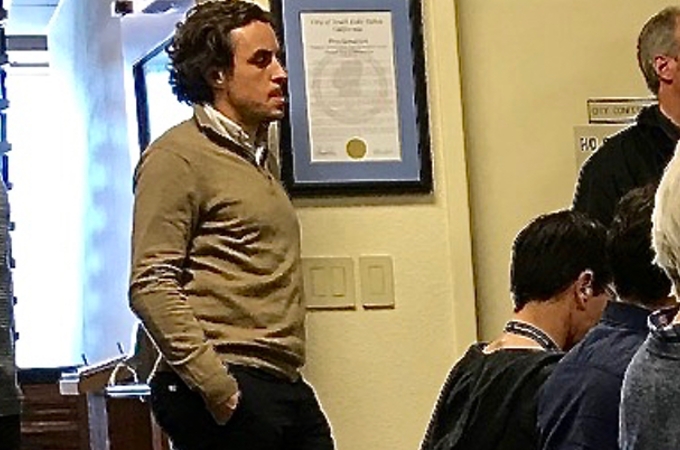
Chad Donnelly, SnowGlobe producer, listens to deliberations on March 6. Photo/LTN

It’s also grown in the number of complaints, or least the effort to have the venue changed or concerts banned is more cohesive. A petition with 175 signatures supporting modifying or canceling SnowGlobe has been given to city officials.

Asked why he stays when there is a backlash against him – at least by a small vocal group – Donnelly gets a bit melancholy. SnowGlobe is his baby. He loves the mountains. And for the most part, the South Shore has welcomed him no matter the noise. He’s built something he is proud of.

Noise and the condition of the fields are sticking points for many people, even electeds. Those issues were brought up again March 6 at the City Council meeting during a presentation about SnowGlobe.

Of the 34 people who spoke, the majority were in favor of the festival – saying it’s good for the economy – especially in lean snow years, that it is putting South Lake Tahoe on the map in a positive way, it is upping the number of lodging nights, and it is diffusing the chaos at Stateline.

The contract goes through 2018. What Donnelly wants is a long-term agreement. The council isn’t ready to say yes or no to that request just yet. And there is no set date when that will be back before the council.

At the end of the lengthy discussion on Tuesday it was decided that city staff would meet with Donnelly and those who have concerns. The goal is to have a resolution in the next couple of weeks.

Part of the urgency to get things resolved quickly is that the producers are already signing contracts and the NoGlobe people want the hours curtailed. If the times change, it means fewer acts to book.

Donnelly and his reps have promised to do more to control the sound – starting this year. This in part includes covering the entire field. Technology via computer modeling will be implemented on every speaker, the subwoofers will be lifted off the ground, and delay towers will be used.

Snow is a natural absorber of sound. But Mother Nature has not always come through. Lake Tahoe News asked Donnelly if blowing snow would be an option. Possibly, he said; he needs to know the costs, logistics and figure out the depth that would be required to make a difference.

Even so, Mother Nature would still be a variable. The overnight temperature has to be at a certain level for consecutive days for snowmaking to be viable.

The ball field after the 2017 event was in sad shape. Donnelly is paying up to $250,000 for the field to be replaced.

He paid $50,000 to rent the field.

The Community Playfield Consortium, made up of the city and Lake Tahoe Community College, manage the fields. The city this week received two bids to fix the damaged field. Work will begin as soon as possible, though the normal date to be able to move dirt in the basin is May 1.

The council is worried that the public who paid for that field is being denied access because it won’t be ready for use until mid-June most likely. On the one hand that isn’t a huge issue because the field has never been in the rotation for use because the sod was just laid last fall. Still, fields are in short supply – which was the reason to build it, and means a delay is getting people to use them for their intended purpose.



Study: Snowpack drops over decades

By Gillian Flaccus, AP

PORTLAND — Scientists have found dramatically declining snowpack across the American West over the past six decades that will likely cause water shortages in the region that cannot be managed by building new reservoirs, according to a study published last week.

The study led by scientists from Oregon State University and the UCLA found drops in snow measurements at more than 90 percent of regional snow monitoring sites that have consistently tracked snow levels since 1955, said Philip Mote, director of the Oregon Climate Change Research Institute at Oregon State University.

Study authors also used modeling to show the average snowpack in the region dropped between 15 and 30 percent in a little more than a century, he said, and that modeling paralleled the actual findings based on existing measurements.

Read the whole story


New Calif. drought regulations cause an uproar

By Tara Lohan, Water Deeply

Last month, California’s State Water Resources Control Board postponed a decision on the adoption of new statewide regulations meant to curb wasteful water practices. The regulations would make permanent some rules California enacted temporarily during the recent drought, which ended last year.

After several public comment periods this winter, water board staff tweaked the regulations to address concerns and recommendations from water users and other groups, but the postponement came after a large number of water agencies claimed the regulations are a violation of water rights.

“We believe using waste and unreasonable use as the tool to reach these conservation objectives is problematic and inconsistent with the law,” read a comment letter to the board signed by dozens of water agencies. “The regulation is defective because it has the effect – if not the purpose – of diminishing water rights by legislative means, without any process whatsoever.”

Read the whole story


Kerry resigns as S. Lake Tahoe city manager

By Kathryn Reed

It’s official – Nancy Kerry is no longer city manager of South Lake Tahoe.

“We’ve accepted the resignation of Nancy Kerry effective immediately,” Mayor Wendy David said after emerging from about a 30-minute closed session meeting on March 6 at 6:05pm.

Nancy Kerry

Kerry told Lake Tahoe News, “I’ve really enjoyed the 10 gratifying years in the city tackling unique and complex issues. I’m really proud of what we accomplished as a team.”

Asked why she resigned, Kerry would only say, “With all due respect, I am committed to leaving the city on the highest road possible. The city and I came to a respectful agreement.”

It was a somber mood in council chambers when it was opened to the public. Council members Tom Davis and Jason Collin ducked out of the meeting via the side door, not staying for the announcement.

No one would talk to Lake Tahoe News, the only media outlet who was there for the announcement, so it is not known what the vote was – unanimous or divided.

David and acting City Manager Jeff Meston retired to his office at City Hall. He retains that title. It will be up to the council to decide how to go forward with replacing Kerry on a permanent basis.

Kerry’s departure has been clouded in speculation for more than a month. It started with the illegal hiring last fall of someone to study the culture of the city, which turned into an illegal review of Kerry.

Then she was placed on leave a month ago. On Tuesday it all came to an end. Still, though, the public is left wondering what really happened.

The settlement calls for Kerry to receive her nine month’s severance ($176,321) which her contract stipulated if she were let go without cause. She is also owed 339 hours of vacation leave and 520 hours of sick leave.

Had Kerry truly left on her own volition, this payment would never have occurred. Had there been actual cause for the separation in employment, Kerry would not have received any of this money either.

In some ways, the taxpayers are getting off cheap because Kerry could have sued the city on several allegations. Just the protracted litigation would have been costly.

The settlement states that Kerry cannot file “any claim against [the] city based on, or related to acts or events taking place on or before the effective date of this agreement. Employee understand that by making the above waivers and releases she has forever surrendered every claim, complaint, allegation of misconduct or cause of action of any kind or nature, whether known or unknown, suspected or unsuspected, at the time of the effective date of this agreement.”

The council as a whole and individually are the city manager’s boss. That means the city manager is covered by labor laws like any other employee. So if one of the councilmen called a city manager “mommy” or made comments about clothes, weight or other appearance issues, the city manager would be able to sue for harassment or hostile work environment at a minimum.

Those accusations told to this reporter by community members/city staff will now not see the light of day and the people responsible not held accountable.


Avalanches a reminder of danger lurking in the snow

By Andrea Castillo, Benjamin Oreskes and Tony Barboza, Los Angeles Times

MAMMOTH LAKES — One day after an avalanche roared down Mammoth Mountain, danger was hardly on the mind of snowboarder Caleb Hill as he carved through fresh powder under clear skies Sunday.

Like hordes of other visitors to the Sierra Nevada resort, Hill, 24, was undeterred by avalanches at two of California’s largest ski resorts that closed runs and triggered rescue operations in recent days. The Colorado native was more frustrated by the long lines and lift closures keeping him from the slopes as Mammoth reopened Sunday, saying the risk of an avalanche was a fact of life.

“It’s a reminder that just because you’re at a resort doesn’t mean you’re safe,” Hill said. “Powder is forgiving but it’s also dangerous.”

Read the whole story


Sports betting’s big wager — younger bettors

By Davide Porter, AP

NEWARK, N.J. — As the push to legalize sports gambling in the U.S. nears a crucial Supreme Court decision, states hoping to reap a financial windfall could face another hurdle: Attracting younger players used to online fantasy sports.

The explosion in popularity of daily fantasy sports over the last decade has created a generation of sports fans more attuned to gauging individual player statistics than how two teams may fare against each other, the challenge at the heart of traditional sports wagering.

Even more important, experts say, is whether states will be able to offer online sports wagering to a demographic raised on smartphones and laptops. That will depend heavily on how the Supreme Court decides New Jersey’s case, expected this spring.

Read the whole story


Calif. spent nearly $1.8B fighting major 2017 wildfires

By Jonathan J. Cooper, AP
 
California state agencies spent nearly $1.8 billion fighting fierce wildfires that killed dozens of people and destroyed thousands of homes and businesses last year, legislative budget experts reported.

The federal government will reimburse most of the costs, but the state will still need to come up with about $371 million on top of the state’s existing wildfire budget, the Legislative Analyst’s Office told the Senate Budget committee. That shouldn’t be a problem because state revenue has far exceeded expectations so far this fiscal year and the general fund is flush with cash.

Read the whole story


Tahoe resorts adjusting to wild swings in snowfall

By Ed Fletcher, Sacramento Bee

Despite last week’s heavy snowfall, Tahoe ski resorts know they can’t predict how strong each winter will be.

They suffered through drought years earlier this decade. Out of nowhere last year, Tahoe was deluged with so much precipitation that avalanches were a regular concern.

This season has been subpar, save for the occasional big storm system, including one last week that forced Squaw Valley to close due to an afternoon avalanche that seriously injured one person.

Read the whole story