Calif. considering automatic voter registration

By Patrick McGreevey, Los Angeles Times

Every eligible Californian with a driver’s license would be automatically registered to vote under a proposal Thursday by Secretary of State Alex Padilla, who estimated it would add millions of people to the voter rolls.

Padilla and Assemblywoman Lorena Gonzalez, D-San Diego, are modeling their legislation on a “motor voter” law signed last week by the governor of Oregon in an attempt to boost voter turnout.

The California proposal is partly in response to the 42 percent record low turnout in California’s November election, as well as this month’s Los Angeles election, which saw about 10 percent of eligible voters go to the polls.

Read the whole story


Reid says he won’t seek re-election

By Carl Hulse, New York Times

WASHINGTON — Senator Harry Reid, the tough tactician who has led Senate Democrats since 2005, will not seek re-election next year, bringing an end to a three-decade congressional career that culminated with his push of President Obama’s ambitious agenda against fierce Republican resistance.

Reid, 75, who suffered serious eye and facial injuries in a Jan. 1 exercise accident at his Las Vegas home, said he had been contemplating retiring from the Senate for months. He said his decision was not attributable either to the accident or to his demotion to minority leader after Democrats lost the majority in November’s midterm elections.

“I understand this place,” Reid said. “I have quite a bit of power as minority leader.”

He has already confounded the new Republican majority this year by holding Democrats united against a proposal to gut the Obama administration’s immigration policies as well as a human-trafficking measure Democrats objected to over an anti-abortion provision.

“I want to be able to go out at the top of my game,” said Reid, who used a sports metaphor about athletes who try to hang on too long. “I don’t want to be a 42-year-old trying to become a designated hitter.”

Read the whole story


Debate over banning online gaming moves forward

By Amber Phillips, Las Vegas Sun

WASHINGTON — In a choose-your-own-facts debate, a Sheldon Adelson-backed bill to ban online gaming got its first airing in Congress with a controversial hearing Wednesday.

Ban proponents, led by powerful members of Congress, argued that allowing online gaming to continue would degrade America’s morality by proliferating gaming.

“Every home in America is potentially a casino,” said Rep. Sheila Jackson Lee, a Texas Democrat.

Opponents of the ban, which include several state lottery officials and representatives for almost every major casino except Adelson’s Las Vegas Sands, say a ban would push online gambling further underground and contribute to a $3 billion illegal offshore online gaming industry.

Read the whole story


Heavenly eyes epic construction season to begin evolution into year-round resort

By Kathryn Reed

STATELINE – Going forward, Heavenly Mountain Resort will no longer be known as a just a ski resort. Its Epic Discovery project received unanimous approval from the Tahoe Regional Planning Agency Governing board on Thursday.

“It’s conceivable if all the pieces fall into place, we could break ground on a handful of projects this summer,” Heavenly General Manager Pete Sonntag told Lake Tahoe News moments after the vote.

Still needing to be secured are approval from Lahontan Regional Water Quality Control Board and the final record of decision from the U.S. Forest Service.

Sonntag would not put a price tag on what will ultimately be a multi-million dollar endeavor.

Epic Discovery is Vail Resorts answer to creating year-round resorts. It is developing these adventure parks at Heavenly, and in Colorado at Vail and Breckenridge.

Heavenly's summer offerings are about to explode with Epic Discovery's approval. Photo/Carolyn Wright/Copyright

Heavenly’s summer offerings are about to explode with Epic Discovery’s approval. Photo Copyright 2015 Carolyn E. Wright

It’s possible some of the activities will be accessible in the winter. It will allow Heavenly to be more of a year-round destination, though there will still be times when it will have to close. Annual maintenance to the gondola starts every September, which is why scenic rides are limited to weekends and then it is offline the entire month of October.

With the Forest Service in 2011 allowing ski resorts to expand recreation opportunities into the summer, ski areas started to turn their attention to things like ropes and canopy courses, alpine coasters and mountain biking. But the Forest Service is keeping a close eye on this transformation.

“We’ve required a phased construction to make sure we consider the effects on the natural environment,” Lake Tahoe Basin Management Unit Forest Supervisor Jeff Marsolais told the board. The USFS also wants to see designs when they are 30 and 60 percent complete to ensure they meet all the regulations.

Because these types of projects on national lands are new and some of the components are not standard protocol, Marsolais’ bosses in Washington weighed in on some items.

An issue that was raised through comments was how the proposed Panorama Trail would impact Van Sickle Bi-state Park.

The Forest Service, Heavenly, Tahoe Rim Trail Association and Tahoe Area Mountain Biking Association created an agreement to monitor the effects over time.

“This is a different way of doing business,” Marsolais said of the adaptive management plan.

One thing he put the kibosh on was the proposed coaster in Sky Meadows because of the stream environmental zone, pine marten habitat and potential effects on skiing.

Andrew Strain, govern affairs guru for Heavenly, said the hub of the non-skiing fun will remain at Adventure Peak near the top of the gondola.

“We will be using developed areas of the ski resort,” he said.

Heavenly will greatly expand beyond the ropes courses it opened last summer. Much of what will be constructed will continue to be off the ground fun.

The mountain bike park will be outside the basin on the Nevada side.

“Heavenly today is essentially the black hole of mountain biking,” Strain said. Trails will connect to already established routes are that mostly known by locals.

For those who are a little less adventuresome or may have physical limits there will be tours of the mountain on existing roads via Heavenly vehicles.

Twenty people spoke at the March 26 meeting; all were in favor of the project.

(El Dorado County Supervisor Sue Novasel recused herself because her daughter works for Vail Resorts in Colorado. This was her choosing even though legally she did not have to.)

Many of the comments underscored how this will allow Heavenly to hire people year-round. The economic impact has not been quantified, but many business owners see Epic Discovery as a potential boon to their bottom line by people extending their visits because there will be more to do on the South Shore.

Plus, it’s in alignment with the desire of turning the region into a recreation destination.

Several people praised the educational component of the project; with the hope people will be better stewards of the land.

It was also pointed out that for many tourists this would be their first encounter with national forest land. It’s an opportunity to educate them about what grows and lives in the forest, as well as the threat of fire.

Heavenly sees about 110,000 people on the mountain now during the summer and expects to increase that by about 50 percent. Traffic and parking are not expected to be an issue because the thinking is people who are already in town will be the users and this will not be destination unto itself.


U.S. home prices surge 13 times faster than wages

By Victoria Stilwell, BloombergBusiness

For most people, buying a home is no cheap venture. That’s especially the case when the growth in U.S. home prices is beating wage increases 13 to 1.

Wages climbed by 1.3 percent from the second quarter of 2012 to the second quarter of 2014, compared to a 17 percent increase in home prices around that time, according to a new report from RealtyTrac. The real-estate data provider used the Labor Department’s weekly earnings data to measure wage growth, while home prices were derived from sales-deed data in December 2014 and compared to December 2012 on the hypothesis that a change in average wages would take at least six months to affect home prices.

Using localized earnings data, RealtyTrac also found that 76 percent of housing markets posted increases in home prices that exceeded the wage growth there during that time frame, led by the regions of Merced; Memphis; Santa Cruz; and Augusta, Ga. Others include the Detroit, Houston and Miami regions. (To be fair, some of these areas are still considered affordable and experienced massive price drops during the housing bust and recession.)

Read the whole story


Pine tree-killing beetles thrive in drought

By Lewis Griswold, Fresno Bee

PINEHURST — A massive die-off of pine trees in the southern Sierra Nevada caused by beetles attacking drought-stressed trees is turning forests brown and creating a fire tinderbox.

From El Portal in Mariposa County to Kernville in Kern County and beyond, stands of dead trees are striking fear in the hearts of mountain residents.

“You drive around and it’s all around us,” said Lee Duncan, who lives in Miramonte in Fresno County near Pinehurst. “It’s like a gasoline can everywhere.”

About the only hope in halting the die-off is for the drought to end, an unlikely occurrence this year as winter ended with perhaps the lowest Sierra snowpack on record.

As a fourth year of drought looms, mountain residents are stuck with the cost of removing dead trees next to their homes and loggers fault the U.S. Forest Service for not allowing them to thin forests. But forest managers say the tree die-off might help Mother Nature.

Read the whole story


Feds need $11.5 billion to fix public lands

By Jenna McLaughlin, Mother Jones

In 2014, the 300 million visitors to U.S. national parks may have noticed the potholes in the roads, the magnificent vistas obscured by dense brush, dirty visitors’ centers in need of basic repairs, trails that were not maintained, and overgrown campgrounds. Why? Blame Congress, which has routinely purchased new federal lands over the last 20 years while neglecting to fund the maintenance of existing national parks. National parks and historic sites need almost $12 billion in upkeep — or about four times the National Parks Service’s annual budget. Meanwhile, congressional Republicans proposed a budget that would slash spending by $5.5 trillion in 10 years.

So why the backlog? The NPS claims that stingy funding from Congress has forced park employees to make tough decisions about which repairs to perform and which to put off. But Sen. Lisa Murkowski, R-Alaska, and many conservationists place most of the blame on the government, which has bought up new land instead of spending money maintaining the sites it already administers.

“We spend hundreds of millions of dollars each year to acquire additional federal lands, but none of that funding is applied to the maintenance backlog,” she wrote in a 2013 op-ed in the Hill.

With an annual budget of $3 billion, the NPS is responsible for managing and maintaining 75,780 sites across the country — including such tourist destinations as the Grand Canyon, San Francisco’s Golden Gate National Recreation Area, Ellis Island, Mt. Rushmore, Yellowstone — and many of the nation’s most iconic NPS-administered landmarks are fast falling into disrepair.

Read the whole story


Sides being drawn over SLT vacation rentals

By Jessie Marchesseau

Residential neighborhoods in South Lake Tahoe being used for tourist lodging are beginning to divide the town.

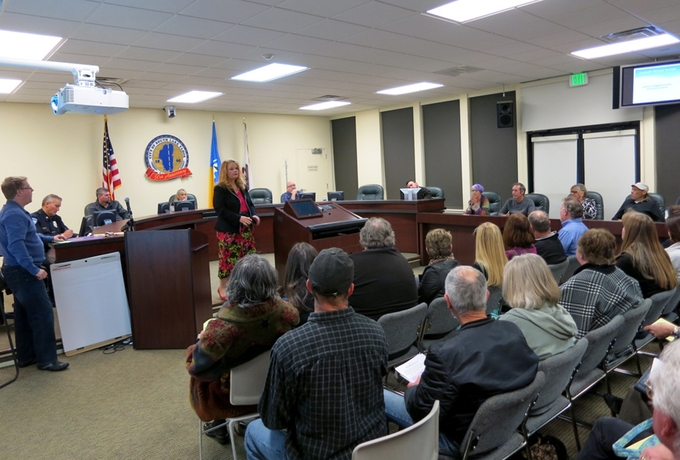
More than 100 people packed the City Council chambers for Tuesday’s vacation home rental workshop, while still more looked and listened in from outside the door. The meeting, originally scheduled for 1½ hours, lasted twice that long, with more than two hours taken up exclusively by public comment.

Dozens of people voiced their opinions on the subject, including residents who do not own vacation rentals, and residents who do, property managers, contractors, real estate agents and business owners.

While there did not appear to be a unanimous opinion on any of the topics, it was generally agreed upon that stricter enforcement was needed. However, there was a divide when it came to who should be fined, the owner or the renter.

City Manager Nancy Kerry   outlines proposed changes to South Lake Tahoe's vacation home rental ordinance. Photo/Jessie Marchesseau

City Manager Nancy Kerry outlines proposed changes to South Lake Tahoe’s vacation home rental ordinance. Photo/Jessie Marchesseau

People weighed in on the proposed amendments and some proposed their own. Many shared experiences as neighbors, owners, renters and managers.

Non-VHR-owning residents voiced the most concerns and complaints with some going so far as to request a moratorium on VHRs altogether. This is not likely to happen though, as City Attorney Tom Watson said such a move would almost guarantee a lawsuit.

In the end, no final decisions were made at the March 24 meeting; however, the City Council received myriad comments and feedback with which to move forward.

“This is to have all sides heard,” Watson said. “Both opinions are important to the community.”

City Manager Nancy Kerry reiterated how residents as well as VHR owners have property rights that must be respected and taken into consideration when creating new ordinances. She said the city is aiming to balance the needs of everyone, not just serve one group. They are considering how any changes will affect real estate values, the tourist economy, the environment, the community, and the quality of life for residents and business owners. Taking all those things into account, Kerry presented the city’s proposed amendments.

According to the city’s research, there are four main issues with VHRs causing a negative impact on the quality of life for local residents: noise, trash, parking and the commercialization of neighborhoods.

Increased enforcement of regulations would include possibly hiring an additional enforcement officer for one year and conducting on-site visits to check for compliance. Increased fines, citations to renters and owners, and the elimination of the first time violation warning in lieu of a fine are all on the table.

Another proposed amendment is to provide incentives for owners to use local property management firms as opposed to doing it themselves through services such as VRBO. This incentive would be in the form of lower permit fees for locally managed properties. The proposed fees for properties not having a local manager would be double those of locally managed properties.

The new fee structure would also be based on occupancy, meaning larger homes would have higher permit fees. The council suggested changing the occupancy limit from two people per bedroom plus four, to just two per bedroom, exempting children under 10. The hope is this will help to reduce both the noise and parking issues often plaguing vacation rentals.

Also addressing the noise issue was the proposal to restrict hot tub use after 10pm as well as any use of outdoor speakers or other noisy equipment or activities. When it comes to parking, the possibility of neighborhood permits was mentioned, but Police Chief Brian Uhler pointed out that it is not possible to limit public parking on public streets. Any enforcement must be limited to illegally parked vehicles.

To help remedy the issue of vacationers leaving trash on the curb for days, the city could require VHRs to have bear boxes. However, there was some concern that this could become unsightly.

The Council will discuss the topic further at the April 7 meeting. The first reading of the new ordinance will likely be April 21.


LTUSD-LTCC seek seamless transition

LTUSD and LTCC board members meet March 24 for the second consecutive year. Photo/LTN

LTUSD and LTCC board members meet March 24 for the second consecutive year. Photo/LTN

By Kathryn Reed

Education and life post high school graduation are becoming less distinct transitions in South Lake Tahoe.

Instead of the solid lines between grade levels and physical entities, the powers that be are on a quest to make it a seamless transition. Lake Tahoe Unified and Lake Tahoe Community College are trying to blur the lines between the academic institutions.

This will be accomplished in several ways. Part is through a dual enrollment program that was unveiled Tuesday night to LTUSD and LTCC board members. This was the second joint meeting of the two elected boards.

The goal is to develop a memorandum of understanding that would have a South Tahoe High School teacher teaching a college-level course. The dual enrollment concept has been around since 1974. Today 60 high schools in California participate in dual enrollment.

LTUSD Assistant Superintendent Ivone Larson and LTCC Dean of CTE & Instruction Virginia Boyar jointly presented the idea to the elected officials March 24.

Dual enrollment allows high school students to get a head start on college credits.

Still to be determined is what the cost, if any, of these classes will be for STHS students. No matter what, LTCC will be able to count them as students, which allows the college to get financial reimbursement from the state.

“Dual enrollment offers high school students the opportunity to complete college level courses while still attending high school,” the staff report said. “These college courses can occur at the college, on the high school campus, or online. Courses that are completed through dual enrollment appear on both the students’ high school and college transcripts.”

Up to 30 semester units may be obtained.

Complementing this will be the Get Focused Stay Focused Initiative. This two-year pilot program that ends in December 2016 involves seven community colleges in the greater Sacramento area, including LTCC.

It will start this fall with the incoming freshmen class, with the pilot program ending after the first semester of their sophomore year.

The goal is to get students to think about their future and not just be in the moment. Flexibility is built in so teens can change their minds about what they want to do in the future. It’s not all about having a college degree be the end goal, but instead about having a plan for their lives.

The semester-long class is designed to get students to have realistic discussions regarding the realities of life. It means if their goal is to live in Glenbrook and they want a job in retail, then one of those goals needs to change. They will be taught about economic realities, what to do to achieve dreams, and know that college does not have to be the answer.

“There is a pathway for everyone,” Boyar said.

Students will develop a 10-year education and career plan.

An advisory committee will be put together between LTUSD and LTCC officials to solidify the plan.

What high schools that have the Get Focused Stay Focused Initiative have found is that students are more engaged, not as many kids drop out, and graduation rates increase. Colleges like that students arrive with a plan of study, need fewer remedial courses and are focused on a goal.


Calif. lawmakers seek access to confidential well logs

By Tom Knudson, Reveal

It’s not a secret that California is facing a groundwater crisis.

But something else is: a vast repository of state records that scientists and water policy specialists say could dramatically improve our understanding of California’s groundwater resources if they were made public.

The records are called well completion reports, or well logs for short. For decades, the California Department of Water Resources has gathered the documents from well drillers and archived them in cardboard boxes in West Sacramento and other locations around the state.

In all other western states, such reports are public and often searchable online. But in California, they are considered confidential under a 64-year-old state law. Many think that should change.

Access to logs could help improve water quality and reveal which parts of California are being pumped the most, experts believe. Laurel Firestone, co-executive director of the Community Water Center, a Visalia-based nonprofit, called the secrecy a huge impediment to understanding the state’s groundwater system.

“It’s almost like when they black out classified information,” Firestone said. “We have no maps of where people are using water, and what people are using water for. It’s hugely important. We work with families that have lost their entire water supply, whose wells are going dry.”

Opening the state’s well log vault is under consideration this spring at the state Capitol, where lawmakers, the governor and state officials are scrambling to find ways to help California cope with a four-year drought that is straining surface and groundwater supplies. Earlier this month, NASA senior water scientist Jay Famiglietti warned that “the state has only about one year of water supply left in its reservoirs, and our strategic backup supply, groundwater, is rapidly disappearing.”

State Sen. Fran Pavley, D-Calabasas – author of two of three historic groundwater laws passed by the Legislature last year – has introduced a new bill to make well logs public. A hearing is scheduled for today.

“After four years of a continuous drought, it is about time we get this information … to better protect California’s precious groundwater,” said Pavley in a statement.

To a nonspecialist, well logs can appear as dry as the drought-parched California earth. To groundwater scientists, they are a treasure trove of information that can help chart the size, shape and thickness of aquifers and determine how water cycles through and between them. That, in turn, can help predict how much pumping aquifers can withstand without being depleted.

The state’s stockpile of well logs has grown to about 800,000 documents over the past six decades. Laid end to end, that is enough paper to circle Lake Tahoe twice.

While the public can’t view those records, the Legislature did create a loophole in 1951 allowing access “to government agencies for use in making studies,” making them accessible to some professionals but not others. The passage has been so narrowly interpreted by the Department of Water Resources that even scientists who work for public universities sometimes can’t gain access.

This is the third time since 2011 that Pavley – chair of the Senate Natural Resources and Water Committee – has sought to make well logs open to the public. Whether she will succeed this year is anyone’s guess. But it is certain the debate will be lively.

A glimpse of the coming drama can be gleaned from letters that have arrived in her office in recent weeks.

East Bay Municipal Utility District, which provides water to more than a million people, wrote to support the bill, saying data in well logs “is central to developing and implementing groundwater management plans.”

But in a state where groundwater is tied to private property rights and farmers pump with no restrictions, opposition remains strong in the agricultural community.

“We believe the well log data is available to those entities that have a genuine need to evaluate and utilize it,” wrote representatives of three agricultural organizations and the California Chamber of Commerce, in a letter opposing the Pavley bill.

“No beneficial purpose could be gained by making this confidential data available to the public,” they added. “We believe this measure will only assist those trolling for lawsuits.”

Several environmental and community action groups wrote in support. “As the physical effects of the drought worsen, from loss of water supplies to increased concentrations of groundwater contaminants, the need for reliable and transparent data … grows,” they said. “The information contained within well completion reports would allow communities to identify new well locations that might yield safe drinking water, a concern affecting thousands across the state.”

The governor’s view is already well known. “California is the only western state that does not provide ready access to well reports,” he wrote in a statement vetoing a 2011 well log access bill he felt was too restrictive. “That should be changed.”