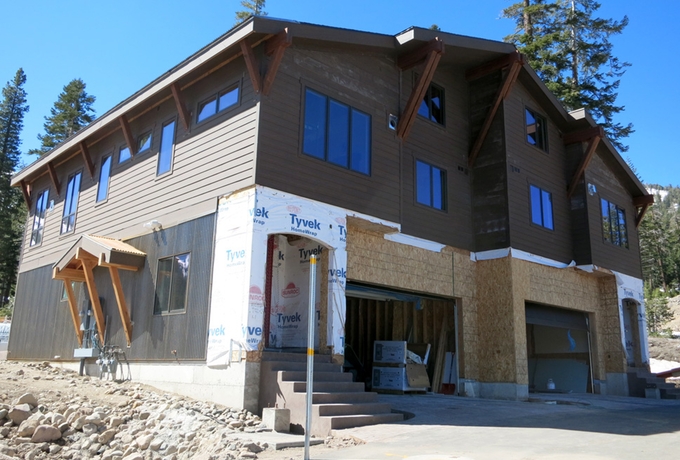
Kirkwood real estate officials are confident the market has turned and are beginning to build. Photo/Jessie Marchesseau
By Jessie Marchesseau
KIRKWOOD – By the time Kirkwood closes its lifts for the season, the new townhome building under construction near the Timber Creek Village should be completed. This building, the first in the development, houses two townhomes in what is slated to become a 21-unit complex.
Situated right at the base of Timber Creek, the Timber Creek Townhomes will be eight buildings of ski-in, ski-out residences. The development will eventually take over what is currently the Timber Creek parking lot, with parking spaces being relocated to across the street.
The Timber Creek Townhomes are the first multi-family residential development at Kirkwood in more than five years and the first one by Kirkwood Resort Development in more than 15. Sentinels West, directly across the street from the TC Townhomes, was built by a private developer between 2006 and 2009. Though Kirkwood Resort Development did a series of single-family projects in the early 2000s, the group hasn’t taken on a large multi-family project since the Mountain Club in 1999.
So why did KRD decide now was the time to get back into the residential real estate game? According to Peter Forsch, chief executive officer of Kirkwood Resort Development, now is the ideal part of the market cycle for them to step in. Real estate prices have been climbing in the Bay Area for the last few years. Historically, Kirkwood and Lake Tahoe real estate lags behind the Bay Area market by a couple years. So Kirkwood is experiencing what Forsch predicts is just the beginning of a market upswing.
Though relatively new to Kirkwood, having joined KRD in January 2014, Forsch has been in resort development for decades working in areas such as Aspen, Jackson Hole and Big Sky. In his experience, the developments that position themselves at the beginning of the market cycle have more successful outcomes than those that wait until the market peaks. With this in mind, KRD started this project last summer in anticipation of market improvements.
Real estate at Kirkwood has been holding steady for the last year or so, but Kathy Walters who has been selling real estate at Kirkwood Mountain Realty for 18 years said she expected to see the rebound a little sooner. The majority of Kirkwood homebuyers come from the Bay Area, and as the economy there improved, she expected to see that affect Kirkwood as well. But this year’s drought and below average snowfall kept a lot of skiers and would-be buyers away. The real estate market at a winter resort like Kirkwood is directly related to the amount of snowfall. Walters told Lake Tahoe News she believes the market is stronger overall than it has been in past years, but could be a lot better if there were more snow.
This is what the townhouse will look like when completed. Rendering/Provided
However, market conditions were not the only aspect driving KRD’s decision to break ground on the TC Townhomes. Nate Whaley, chief financial officer for KRD, explained they believed this particular project was perfect for what consumers want right now. The townhomes are moderately sized with three and four bedrooms between 2,000- and 2,400-square-feet. This represents a downsizing from the huge houses of the boom and is more manageable for families.
“People are still willing to pay for what they want,” Whaley told Lake Tahoe News, “just not willing to pay for more than what they want.”
KRD is also taking cues about what consumers want from other nearby resort developments such as Northstar and Martis Camp, and considering where the majority of buyers are coming from right now, specifically the South Bay and Silicon Valley, and what is important to residents of those locales. The result is a residential project which boasts energy efficiency, sustainability, advanced technology, low maintenance materials, ski-in ski-out amenities and an overall mountain contemporary design. And they’re doing it for a fraction of the price their contemporaries on the North Shore are.
But Forsch acknowledges that the people buying at Kirkwood are not necessarily the same ones wanting to buy at Northstar or Lake Tahoe. Kirkwood does not offer world-class shopping or five-star dining. There is little night life and no bright city lights to speak of. People who buy here are looking for a more authentic, outdoor, away-from-it-all experience.
Until recently Kirkwood was not even connected to the electrical grid, but generated power for the entire community with diesel generators. It may seem that being connected to a reliable and consistent power supply might be a big deal to potential buyers, but Walters said she has not seen that to be the case. In her experience, Kirkwood buyers never seemed to be concerned about electricity issues in the past, and that hasn’t changed.
Vail Resorts moving in and taking over ski area operations has not had much of an affect on Kirkwood’s real estate sales either. Walters said she believes knowing Vail’s positive track record gives people added confidence in the resort on the long-term and has brought in new potential buyers who were passholders at Heavenly or Northstar, but has by no means caused a buying frenzy. The Kirkwood buyer is still someone who is in it for what the mountain itself has to offer, which is some of the most challenging terrain and deepest snow in the Sierra.
“The Kirkwood buyer is a really special person,” Walters told Lake Tahoe News. “They know a good thing when they see it.”
—–
Notes:
The Timber Creek Townhomes will be open for viewing on April 4 and April 11 from noon to 5pm.
Contact Kirkwood Realty at 888.593.7767 or info@kirkwoodrealestate.com for more information.
Tourists spending billions on wellness travel
By Jeri Clausing, Travel Weekly
At Blackberry Farm, a resort in Tennessee’s Smoky Mountains, a new “Wellhouse” offers Japanese forest bathing and other “deep healing woods” activities, including in-forest yoga, meditation and endurance hikes. At the Fairmont Princess in Scottsdale, Ariz., guests can do a whole lot more than keep up with their usual workout routines at the hotel gym: They can also get state-of-the art body-fat assessments and take the latest in fitness and wellness classes.
And in suburban New York and Washington, D.C., travelers now have the choice of a new, wellness-focused midscale hotel brand that has cork floors and in-room fitness equipment, healthy organic foods and bedding and amenities focused on relaxation and better sleep.
Over the past few years, wellness has moved way beyond the niche market of yoga retreats and fitness camps, informing and redefining virtually every aspect of the travel industry, from luxury hotels and spas to business hotels, even airports.
Several recent studies show wellness tourism is growing twice as fast as any other sector, and there are no signs that it will be letting up as everyone from aging baby boomers to millennials focus on adopting healthier lifestyles.
Triple gold-medalist Alpine skier Jean-Claude Killy of France, O.J. Simpson, and Chevrolet executive John Z. DeLorean sit at a table, while Hunter S. Thompson takes notes from the side of the stage. This might read as the tortuous setup to a particularly hackneyed joke, but it’s the punchline. Such was the scene at the 1969 Chicago Auto Show, where this trio touted the virtues of the all-American Chevy Camaro.
But one of these things was not like the other. Simpson, fresh off his Heisman Trophy-winning campaign at the University of Southern California, was known for his charm and affability, making him an ideal pitchman. DeLorean, widely regarded as a brilliant engineer, had a non-conformist, counter-cultural public persona that positioned him as the future of Chevrolet. So what was a 25-year-old from the French Alps doing with these two American icons, hawking a special edition “Killy Z-28 Camaro”?
The answer lies in the changing role of downhill skiing in the postwar decades, which transformed Killy from a relative unknown into a celebrity with lucrative global endorsements for Chevy, Schwinn Bicycles, and Head Skis, among others. To Thompson, Killy was emblematic of the changing fortunes of the global middle class.
Concerted efforts by public officials and private businessmen intersected with broad economic trends in the decades after World War II to transform skiing into a mark of middle-class status and a motor of economic development — first in the European Alps, and then in mountain ranges around the world.
Read the whole story
The Beekley Family Foundation
This transformation proved shocking to those who popularized the sport of skiing at the turn of the century. Archaeological evidence of skiing dates back to 6,000 B.C., and for the vast majority of their history, skis were a utilitarian means of locomotion in snowy environments. Norwegians pioneered leisure skiing in the mid-19th century, and the sport rapidly became a marker of national identity that distinguished them from their Swedish overlords. Socially elite skiers first took to the Alps in the last decades of the 19th century, seeking diversion during prolonged winter stays at Alpine resorts. Skiing was one winter leisure option among many, and early skiers were mocked as “plank-hoppers” by their fellow tourists, who favored activities such as ice skating and tobogganing. Many preferred to ski at night to escape the derision of Alpine inhabitants. And yet, by the dawn of the 20th century, skiing had emerged as a popular leisure option, marked by its unique blend of speed and appreciation of nature.
Not all dreams of South Lake Tahoe founders realized 50 years after incorporation
One of the first things to change in the city was signs. This is Highway 50 near Park Avenue in 1964. Photo/Bill Kingman
Publisher’s note: This is one in a series of stories Lake Tahoe News will be running leading up to the 50th anniversary of South Lake Tahoe on Nov. 30.
By Laurel Ames
Despite the grumbling by South Tahoe residents about the county seat located in Placerville, 60 miles away, and the difficulty of getting to El Dorado Board of Supervisors meetings, emotions did not coalesce about various irritations until it was revealed that El Dorado County was largely financing the West Slope county government with funds they collected in the Tahoe basin.
Those funds were primarily the locals’ property taxes, and the taxes and fees paid by the developers of new subdivisions that were exploding around the communities. The new subdivision projects were clear-cutting trees, gouging out flat home sites, and installing sub-par roads, with only a thin layer of asphalt. Because the decisions about how large, how many and where the subdivisions would be built and what level of engineering they needed were made in Placerville, they received only a very cursory review.
In addition, developers were throwing up poorly-designed shoddily-built buildings on Highway 50, damaging or filling wetlands and shoving streams into ditches, plus building on the beaches and had already dredged the Upper Truckee Marsh for the Tahoe Keys – all of it approved by the county Board of Supervisors.
But the worst evidence of our powerlessness was the indefensible proliferation of ugly signs along the highway, each competing to be larger and more gaudy in color, with a fast increase in every kind of lighting, moving lights blinking, flashing and bursting across the signs.
“We’ve become incorporated five years too late.” — Brad Murphy, first mayor of South Lake Tahoe, the Tahoe Daily Tribune reported Dec. 1, 1965. But he proclaimed the city would now take leadership in protecting the lake’s beauty.
After incorporation, everyone agreed that the sight down the highway at the state line was a horrible vision of our new city. The San Francisco Chronicle described it as “The Market Street of the Sierra.”
With the feeling that we were being ripped off, being surrounded by poor standards of building, by the county’s failure to recognize the special Tahoe environment and the shoddy level of county-provided public services, including poor snowplowing service, slow sheriff response times, and little road repair, plus the failure to even acknowledge the need for a community vision for the South Shore area that recognized the importance of the lake for our community, people began to talk about creating their own local government.
A small core group came together to build a strong organization of dissatisfied residents to figure out how to get ourselves our own locally elected officials, keep our taxes in the basin and under our control, and assure that the former charm of our mountain town was restored, while our lake was protected. Creating a new city was the solution, and incorporation was the legal process. Volunteers soon joined in for the numerous tasks – from typing stencils for the mimeograph machine to organizing fundraisers and everything else in between.
That group was made up of Betty and Tom Mitchell, the Bijou Elementary School principal; Mary and Vaughn Burlingham, a developer; and myself and Wink Ames, an insurance broker and my husband at the time.
“The people of Lake Tahoe’s South Shore formally have taken steps to control and preserve the natural beauty of this area. The overwhelming vote for incorporation proves the people do care what happens to the lake. We now have local government control and do not have to rely on those from other areas to take care of our needs.” –– Wink Ames
With the help of many others, we researched local government law and faced the problems of attaining property owner signatures when 67 percent of the lot and cabin owners were not residents, all in an era when there were no computers, no faxes and no copy machines. It was plain hard work after buying the property owner rolls from the county assessor to sort the thousands of names and addresses by hand (first, we cut the county records into individual strips by name and address and then laid them out, one by one, in a very primitive sorting system) until we could write (again by hand) addresses on envelopes, paste on stamps and mail requests for a signature to residents and out-of-town property owners so we could form our own town.
Betty Mitchell remembered the numerous “addressing parties” that locals came to in order to help the effort. And then the county, which was watching us attack their golden egg, threw up a big hurdle – they interpreted the state law on signatures required for incorporation to be every signature on a property deed. We were dumbfounded, as the county required only one signature for many actions, including paying property taxes. We were looking at properties that individually were owned by up to 18 people. The decree by the county set us back, until a local lawyer volunteered to help. We sued the County (Ames vs. Board of Supervisors) and a judge agreed with us – only one signature per parcel.
Following two years of work by volunteers, our efforts paid off in a wildly successful election, and the city of South Lake Tahoe was born on Nov. 16, 1965 — the date of the vote.
El Dorado County approved development on the South Shore without regard to the environment. Photo/LTN file
How the city has shifted
This past few weeks Betty Mitchell, Wink Ames and I have looked back, reminisced, and thought about what the city was in the beginning, and what it is now. Fifty years is a long time, but our memories came together over highlights and details.
By far the most significant and we hope long-lasting change was from the challenge to the city from the myriad ugly, ugly signs and billboards. It wasn’t easy, and Mitchell remembers her husband, who had been appointed to the first Planning Commission, was irate about a large Harrah’s sign stuck in the ground on property in California next to the highway. That sign, among others of the most gross, was targeted for removal in the first phase of cleaning up the signs. But Harrah’s put pressure on a city councilman, the city manager put pressure on Tom Mitchell, who stood his ground, but the other planning commissioners caved and gave Harrah’s 14 years to remove the sign.
Today, all those signs are gone, much of the gaudiness has gone away, and, except on the Nevada side, signs are now classier, muted from the wild abandonment of the 1960s, but still subject to the whims and senses of the city Planning Commission, as those who read the city agendas can see. The city’s early vision of signs that were not obtrusive was on the road to attainment until this past summer when the city got two new very large very bright-colored lighted signs – Auto Zone orange and BevMo red. Oops. Is this the vision for the city’s future?
The other great success we remembered was the city action to kill the proposed freeway from Meyers to Harrah’s parking lot at Stateline. The route of the four-lane freeway was through every meadow in town, as it further rerouted the Upper Truckee River along the airport, and curved toward Stateline across the river and ran parallel to Barbara Street. Just past the north end of the airport, in the middle of that meadow, a large freeway flyover, with off ramps and on ramps to the flyover to connect to another freeway that would replace Highway 89 up the West Shore. That 89 freeway right-of-way can still be seen in the form of the large lagoon on the town side of Venice Drive in the Tahoe Keys. The roadways would cover up all of the meadow at the intersection of 50 and 89. Another place to see the old proposed freeway is the snow storage yard for Caltrans at the end of Sierra Boulevard.
The freeway then headed toward Stateline across Trout Creek meadow, Bijou Creek meadow, across the drainage above Pioneer Trail, across Ski Run, up the hill, through the houses and down to the Harrah’s parking lot. Caltrans had spent years buying up right-of-way, businesses and houses, as they advanced their plans.
The new City Council got wind of the enormity of the road and how it would affect the town, and called Caltrans (at that time the Department of Highways) to meet with the community at a meeting in the new high school auditorium – and the city turned out. The Caltrans engineers were there with their presentation, and the freeway opponents brought in experts and organized local speakers. South Tahoe was passionately opposed to the freeway.
The highlight of the event was when the head Caltrans engineer was asked if they had prepared mock-ups (models) of the freeway, and he said “no”. But Bill Ledbetter, CEO of Harveys, had managed to obtain a full-color picture of the mock-up of the exit into Harrah’s parking lot, had made 400 8 x 10 color glossies and had them handed out to the audience as the question was being asked. The Caltrans rep slunk back to his seat and the City Council took up the issue of signing an agreement with Caltrans to proceed with the project. The vote was 4-1 against.
When the city went off the rails
Several years later, a different group was formed by Ed McCarthy (later the founder of the Council for Logic and mentor of Terry Trupp, later the mayor of the city who was arrested for drug dealing) that announced that the freeway was desperately needed and campaigned for a vote of the people to approve the freeway. His ads said, in full caps, “THE STATE OF CALIF WILL BUILD AND PAY FOR ANY KIND OF ROAD WE WANT.” By that time the time-share developers were building time-shares and they signed up their new owners to support a new parkway. People voted for it, even though “parkway” was just a nice name for a freeway. But it was too late, and a combination of Caltrans harboring a grudge against the city, and the later advent of CEQA and new environmental rules that would have prevented the super-sized road in the wet meadows, ended the idea of splitting the city into two sides and destroying parts of large wetlands of the largest river in the Tahoe basin.
While later the city hungered for the two loop roads at the state line, one above and one to connect to the road near the Edgewood golf course, and even today wants a larger loop road above the existing loop road, it has not attempted to reignite any effort to build a freeway through the city’s meadows. The early city had its head on straight, and the town held a vision of protecting the meadows. Wink Ames noted that he ran for the second City Council on a platform to protect the environment and the communities, and that local control would be brought to us by thoughtful and responsible representatives. Ames got the most votes.
At the beginning, the new city quickly hired a land use planner, and citizens got to work in a yearlong process called 14,000 Planners. As Ames remembers, the planner told the groups that they could have any kind of community it wanted, provided they could articulate and agree on a picture of what that vision was. They met for a year and turned out the city’s first General Plan, which was aimed at creating a true mountain village style community, protecting the remaining open spaces, limiting sizes of building to be compatible with the small communities of Stateline in California, Bijou, Al Tahoe and Tahoe Valley. And protecting the large pine trees for their significant role along the highway for the scenic values of the communities was important to the residents.
“I really believed it would work,” Ames said of the 14,000 Planners plan. “But the vision is gone. It doesn’t look any better now.”
Mitchell noted that the community wanted local control and they thought that, in addition to snowplowing that was better than the hit-or-miss of the county, road repairs and a city police department, they would see their town start to look better. But it never happened.
BevMo’s sign lacks a mountain feel. Photo/LTN
My thought is the city lost its vision of being a series of mountain villages and has not replaced that with a cohesive new vision, as demonstrated by the new BevMo and Auto Zone. The Chateau at Stateline is seen as an improvement over the Hole in the Ground (brought to us by city approval) but lacking an architecturally pleasing exterior reminding us all that when the beautiful Outdoorsman building was remodeled into a drug store, the best building South Shore ever had was lost forever.
And worst of all, the water at the lake’s edge in the summer, which was astoundingly clear in 1965, is now lost to streaming algae, milfoil mats and a shoreline that is no longer the “pristine purity and crystal clarity” that the politicians used to brag about in 1965. Instead, the city, when faced with state and federal rules to protect the lake, took umbrage at the concept that the locals would be stewards, and led the fight against a regional agency, fought the legislation that required new development rules, and did not accept fiscal responsibility for protecting the lake – garnering the city its moniker in out-of basin government offices as “welfare queens” in that the city wanted the state and feds to pay for protecting the lake, but to reap the benefits from living at Tahoe.
Today, as you drive down Highway 50, try to imagine the highway lined with tall pine trees, with the Y a real Y with a hundred old Ponderosa pines in the center – an area that is now all pavement. Fifty years from now, will the remnants of tall pine trees still exist, or will the highway run past a solid wall of 42-foot tall buildings, side by side?
The city of South Lake Tahoe can try again for a new vision for the town and embrace protecting the meadows, the lake, and the big trees, emphasizing the natural values of the surroundings in their decisions.
Based on the last 50 years, it looks like a long shot.
Laurel Ames was one of the key players in getting South Lake Tahoe to incorporate. She still lives in the city.
Plastic bag lobby not going down without a fight
By Lance Williams, Reveal
In the final months of 2014, the nation’s plastic bag manufacturers spent $3.1 million to sidetrack a California law that sought to ban throwaway bags.
But that political spending spree may be a small down payment on what could be a hugely expensive environmental fight on the state ballot in 2016 – and one with profound national implications as well.
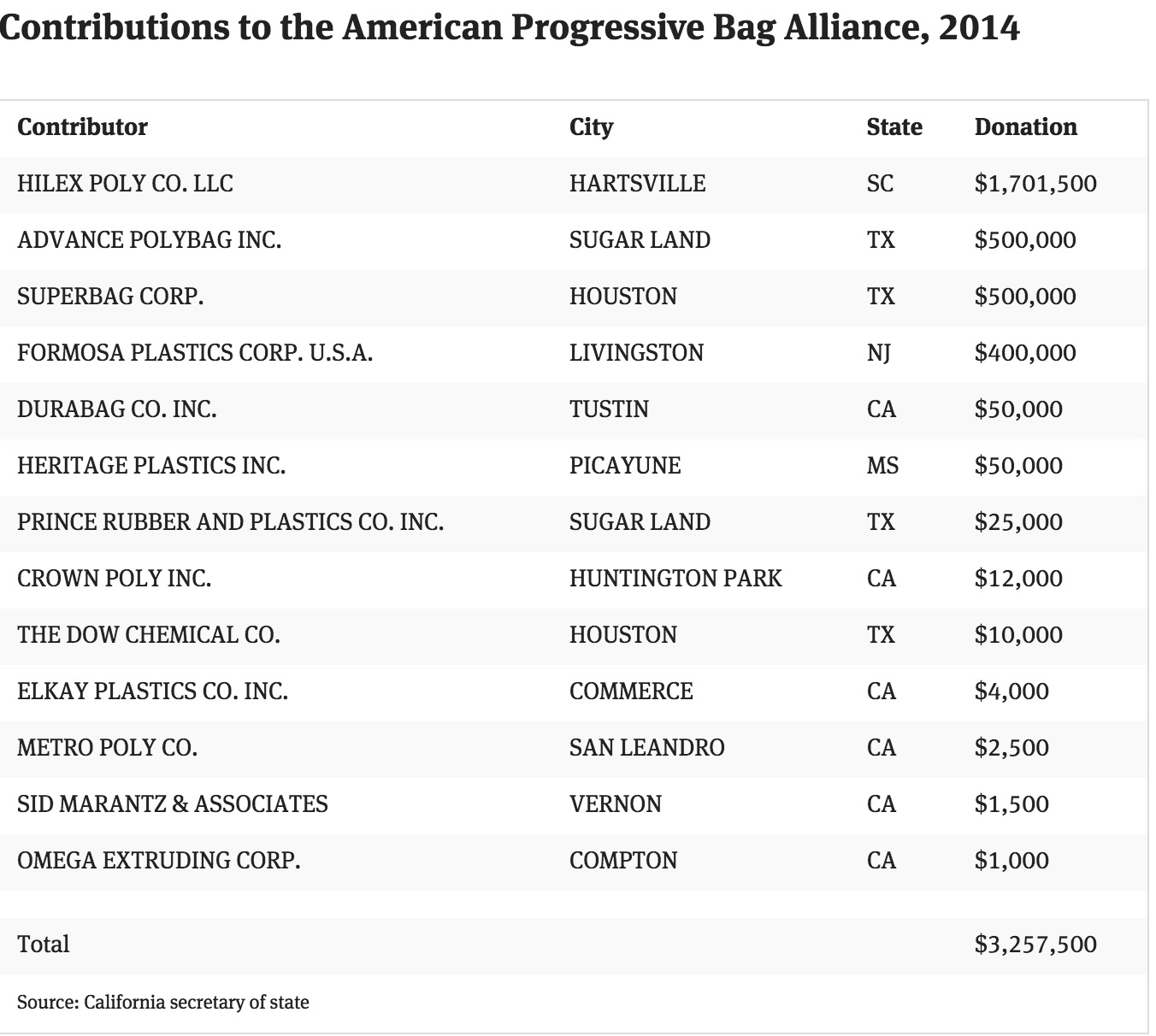
Last year, the California Legislature barred retailers from giving plastic shopping bags to consumers. A dozen bag manufacturers – most from outside the state – banded together to finance a quick-strike petition challenging the law before it had gone into effect.
The bag companies gathered some 800,000 signatures – enough to put the issue of whether California should ban the bags to a statewide vote. Until the November 2016 election, the new law remains in limbo.
The biggest bag manufacturers are based in South Carolina, Texas and New Jersey. But starting in 2010, the industry emerged as a free-spending political player in California’s Capitol, pumping about $6 million into donations and lobbying since then.
That’s a measure of how eager the industry is to stop California from enacting what would be the first statewide ban in the country.
With the referendum looming, the price could get quite a bit steeper.
The cost of running a statewide ballot measure spirals upward every election. Four winning campaigns spent an average of $34 million in 2014, according to a recent analysis by Forward Observer, a Sacramento political consulting firm.
Meanwhile, a Los Angeles Times poll showed that 60 percent of Californians support the bag ban.
Given those numbers, overturning the ban will be a “heavy lift” for the industry, said Renee Van Vechten, a professor of political science at the University of Redlands and an expert on state initiatives. Even extraordinarily heavy spending might not make a difference, she said.
“Is it winnable? The easy answer would be no,” she said. “But they obviously think they have a chance and a lot to lose if it goes forward.”
The campaign’s cost likely will be shouldered by the same companies that financed the petition drive. Here, from state records, are the petition donors:
Throwaway bags are a staple of America’s convenience lifestyle, but environmentalists complain that they are a huge source of litter and pollution.
Californians throw away 14 billion bags per year, the state Legislative Analyst’s Office said. Estimates of cleanup and disposal costs range from $25 million to $500 million, and a huge number of bags don’t make it to the landfill.
But the industry contends that the rationale for banning plastic bags is based on “emotional imagery, junk science, and exaggeration, rather than facts and good data,” as Phil Rozenski, policy chair for the American Progressive Bag Alliance, wrote in an email.
Bag bans threaten the livelihood of 30,000 American workers, he wrote. Instead of a job-killing ban, California should pursue “comprehensive recycling education and in-store take back programs,” he wrote. He also called California’s law “a scam” and said the industry believes voters will vote to repeal it.
For years, environmentalists concentrated on backing local ordinances to ban throwaway plastic bags. San Francisco was the first to enact a ban, in 2007. Today, advocates say more than 100 California communities and dozens more around the country have such laws on the books.
The push for a statewide ban began in 2010, recalled Los Angeles activist Hans Johnson, but it ran into a furious and well-financed lobbying campaign. From 2010 through 2014, South Carolina-based Hilex Poly Co. spent $1.8 million lobbying the California Legislature, records show, far more than it spent in any other state. The American Progressive Bag Alliance, the industry’s Washington, D.C.-based political arm, spent an additional $1 million.
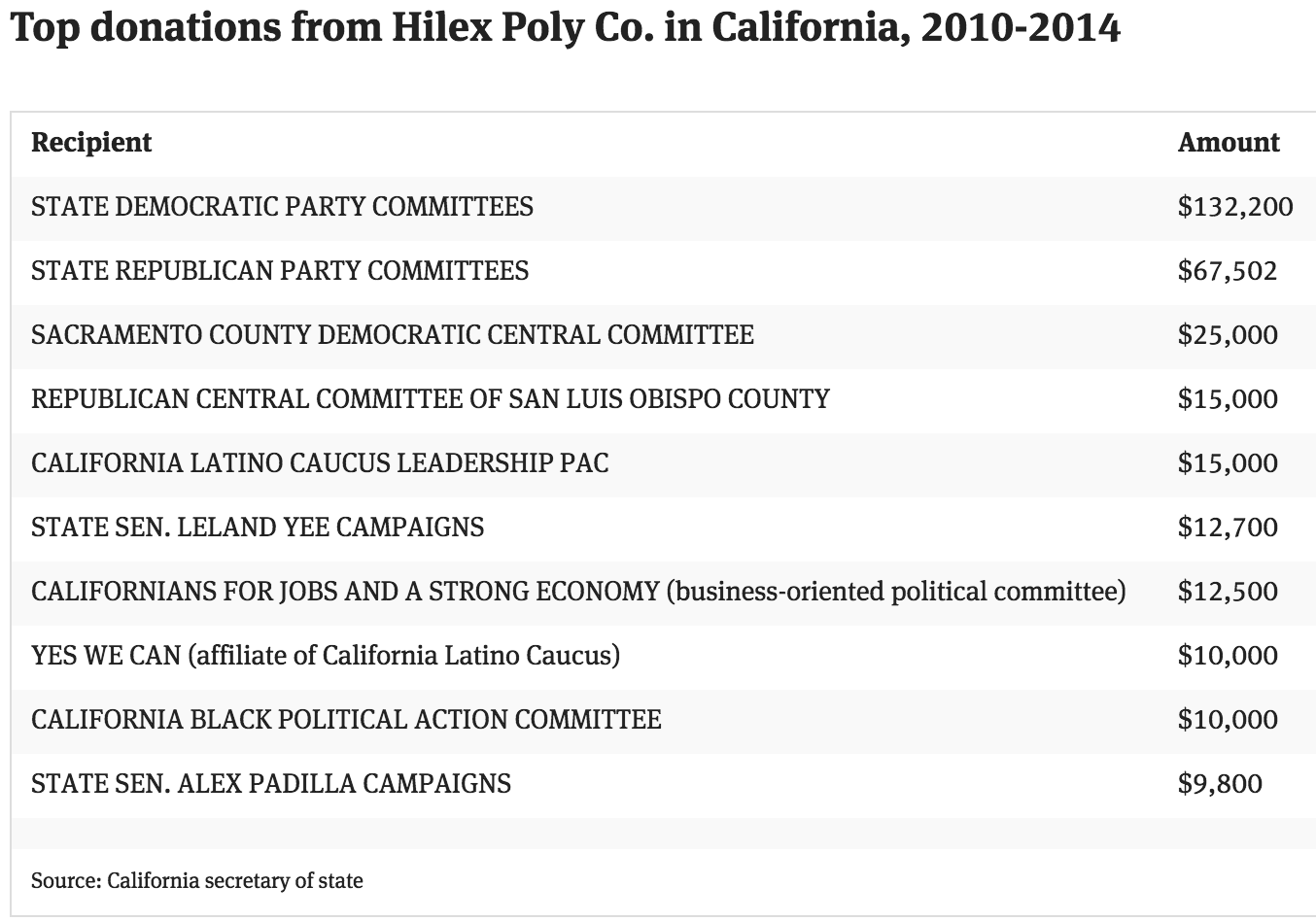
Hilex also donated more than $500,000 to about 70 state lawmakers and political committees in California, favoring Democrats, who controlled the Legislature, by about 2 to 1. The top recipient lawmaker was state Sen. Leland Yee, D-San Francisco, who was indicted last year in an FBI bribery sting. Hilex gave $9,800 to then-state Sen. Alex Padilla, D-Van Nuys, now the secretary of state and the author of the bag ban measure that was enacted in 2014.
While the bill was pending – and Padilla was in a tight race for secretary of state – the bag alliance paid for a flurry of television and radio ads criticizing what it called “Padilla’s misguided bag ban.” A lobbying report indicates that the alliance spent $266,000 on the ad campaign.
Top donations from Hilex Poly Co. in California, 2010-2014:
Shift toward renewables a conundrum for Calif.
By Kim Smuga-Ottoksmugaotto, San Jose Mercury News
FOLSOM — California’s electrical grid has a problem — a nice problem, but a problem nonetheless: The state often has too much power.
Nearly 23 percent of California’s energy now comes from renewable sources such as wind and solar, and the state is on track to reach its goal of generating one-third of its energy from renewables by 2020. But feeding all that green energy into the Golden State’s grid — without overloading it — has become a major challenge.
That’s because the state’s aging natural gas plants aren’t nimble enough to turn off when the sun starts shining and then quickly switch back on when it gets dark. And while the technology to generate clean energy is growing by leaps and bounds, efforts to store the power haven’t kept up.
Power grid operators work in the grid operation center at the California Independent System Operator in Folsom, Calif., on Monday, March 9, 2015.
The dilemma has forced the energy industry to rethink the way we make and use electricity. And utilities are having to recalculate how much they should charge for electricity at certain times of the day.
KIRKWOOD – Destination – unknown. Trail – none. Wow factor – off the charts.
Some of my most memorable moments have been when I had no idea where I was going. The journey, the discovery, the not knowing what lies ahead – it can be adrenaline pumping, mesmerizing and almost always comes with a story to tell.
This sense of adventure enveloped us as we forged through the woods on virgin snow earlier this month.
Craig broke trail for the four of us. A view – that’s his big thing. And he delivered.
The day started with Plan A having to be scrapped because the south-facing ascent was all dirt. We wanted a snowshoe. Back in the truck and up the road a bit we went before we pulled over on the other side of Highway 88 to be on a north-facing route.
It’s not supposed to be this difficult to go on a snowshoe in early March, especially near the Carson Pass.
Snowshoeing into the wilderness near Carson Pass brings dynamic views. Photos/Kathryn Reed
Early on we had to cross a stream. I don’t trust my balance, especially with wearing a small pack that has snowshoes dangling off the back. Donna was gracious enough to get a picture of my back side as I crawled across. Fortunately, the other 12 crossings were not a big deal and allowed me to remain upright.
It didn’t take long before we came across a mini waterfall that in some ways seemed out place on this trek.
We kept seeing this tall black peak that none of us had noticed before in all the times we had been in this area. The map told us it was Black Butte, elevation 9,031 feet. We headed in that general direction.
Snow consistency varied throughout the route – from powdery to heavy to crunchy to deep.
Not only did we not see anyone on our way up, there were no other tracks. It was as though we had been transported to the middle of this perfect oasis. It was one of those days that will be hard to top.
We kept going up. It was not a difficult ascent. The views were always picturesque. Red Peak seemed to be constantly behind us. Eventually Caples Lake, too, was visible when we turned around.
The rocks gave the area personality. They should have been under snow, especially the ones we passed on our way up.
Lunch was on an outcropping of rocks at 8,740 feet. Black Butte was directly to our right.
It was like a tease just sitting there – so close and yet so far. Another day, perhaps without snow, we’ll reach the top of Black Butte. It was only 2.5 miles to get to our lunch spot. In all, we went 5.7 miles.
Instead of retracing our steps, we went over the other side of the rocks toward Woods Lake where we saw tracks from cross country skiers. The lone person we saw that Sunday was on skis by the lake.
A little glissading was in order, but it wasn’t necessary. It just added to the fun.
We gingerly scampered across a small section of Woods Lake. At the time it was frozen, with just a little melting around the edges. I’m sure now three weeks later based on the warm weather we’ve had the conditions are much different.
Then it was time to follow the creek back to where we came from. More beauty.
It was just one of those magical days in the greater Lake Tahoe area when you can’t imagine living anywhere else.
—–
Getting there:
From South Lake Tahoe, go west on Highway 50. Turn left onto Highway 89 toward Hope Valley, turn right onto Highway 88 at Picketts Junction. Park on the left where it says Woods Creek Fishing Access. Then start walking. We were not on the road long. Good luck.
ngg_shortcode_0_placeholder (Click on photos to enlarge.)
Sierra Nevada snowpack hits historic low
By Peter Fimrite, San Francisco Chronicle
The abominable snowpack in the Sierra Nevada reached an unprecedented low this week, dipping below the historic lows in 1977 and 2014 for the driest winter in 65 years of record-keeping.
Electronic surveys show the water content of the snow throughout the Sierra is a shocking 8 percent of the historical average for this time of year, by far the driest it has been since 1950, the year record-keeping began, because of the lack of rain and snowfall and the exceedingly high temperatures. It is a troubling milestone that water resources officials say is bound to get even lower as the skies remain stubbornly blue.
“It’s certainly sobering when you consider that the snowpack in a normal year provides about 30 percent of what California needs in the summer and fall,” said Doug Carlson, the spokesman for the California Department of Water Resources. “What this suggests is that we will have very little water running off. It accentuates the severity of the drought and emphasizes the importance of people cutting back on their water use.”
Senate Minority Leader Harry Reid’s decision to retire next year leaves no clear successor in his home state of Nevada, where a popular Republican governor appears reluctant to change jobs and the pending loss of Reid’s clout in Washington is causing anxiety over who might replace him.
As of Friday, the list of potential candidates came down to Gov. Brian Sandoval and everyone else. The political centrist who was easily re-elected last year is likely to face intense pressure from national Republicans and business interests to pick up where Reid leaves off on Capitol Hill.
Sandoval didn’t deliver an unequivocal “no” Friday but he made clear the 2016 contest wasn’t on his current agenda.
“My focus is in on Nevada, period. Politics can take care of itself, but right now I am absolutely laser-focused on getting my budget through and improving education in Nevada,” he said.
Beyond the governor, the race would be wide open.
Reid, the longtime Senate Democratic leader, quickly blessed former Nevada Attorney General Catherine Cortez Masto to run for his seat, while Rep. Dina Titus, another Democrat, said she would consider a bid. Among Republicans, other possibilities are Rep. Joe Heck, Nevada Attorney General Adam Laxalt and former Lt. Gov. Brian Krolicki.
“The major decision will be made by Brian Sandoval,” said political scientist Eric Herzik, who teaches at the University of Nevada, Reno. “If he jumps in, this race tips overwhelmingly to the Republicans.”
The Nevada campaign will inevitably figure in the fight for control of the Senate. In a video statement Friday, Reid said Democrats must retake the majority and “it is inappropriate for me to soak up all those resources” to defend his seat.
Awkward in public, clumsy with words, the 75-year-old Reid never was a beloved figure at home. He survived a brutal re-election campaign in 2010, when angry voters turned on him in the aftermath of the recession. He’s been in the Senate since the Reagan era.
But he helped deliver victories for President Barack Obama, including on national health care reform, and his name is affiliated with a long string of wins in Nevada, from development on the Las Vegas Strip to Yucca Mountain, which he helped stop after it was approved by Congress as a nuclear dump in 2002.
Reid lost his role as Senate majority leader when last fall’s elections swept Republicans into power. He suffered serious eye and facial injuries on New Year’s Day while exercising at his Nevada home.
Las Vegas native Daniel Bastardo, smoking a cigarette during a break from his casino security job, said it was going to be hard to replace the man who proved Sin City was worthy of political respect.
“You gotta hang up your hat at some point,” said the 28-year-old Democrat, understanding Reid’s desire to retire. “I’m worried who’s going to represent us now.”
The sense of looming loss was felt around the state. With Reid’s pending departure, Nevada will be without its most experienced hand on Capitol Hill. Sen. Dean Heller, R-Nev., has been in Washington for several years in a chamber where seniority equals influence, and the state’s House members are relative newcomers in a body where members sometimes serve decades.
Sig Rogich, an influential Nevada Republican who helped Reid defend his seat in 2010, said “you don’t lose him and not expect to feel the void.” The Nevada Mining Association said the state would “miss having this native son in its corner.”
The contest will play out in a state in which Democrats hold an edge in registration but voters have long displayed an independent streak. Obama was a two-time winner, but the state also helped send Republican George W. Bush to the White House twice.
Democrats are anchored in the Las Vegas region, while Republicans have an edge in rural parts of the state. A fast-growing Hispanic population is gradually reshaping the electorate, similar to other states in the West, including California.
A major factor in the coming election will be the casino industry, which has a long history ignoring party labels and picking winners in Nevada politics.
Jan Jones Blackhurst, an executive vice president at Caesars Entertainment, called Reid “irreplaceable.” Reid won broad support from the industry in his 2010 victory over tea party favorite Sharron Angle, a Republican.
Finding the right successor, she said, is “a big issue and big concern.”
With Reid’s influence, “all of the sudden Nevada mattered,” she added. With his exit, “that’s going to be a challenge for the state.”
The 2016 presidential race will also intertwine with the Senate contest, potentially driving up turnout among key voter groups, including Latinos. Part of Reid’s victory in 2010 was credited to a Democratic political apparatus that ferreted out supporters, but it’s unclear if another candidate can duplicate those efforts.
Betty Post, a Republican retiree in Las Vegas, said she was thrilled to see Reid stepping down. “We need new blood in there,” she said, adding that she considered the long-serving senator a “bully.”
To Las Vegas attorney Elizabeth Stephens, a Democrat, Reid’s exit could be summed up succinctly. “It’s scary,” she said.
Tahoe homeless facility not progressing
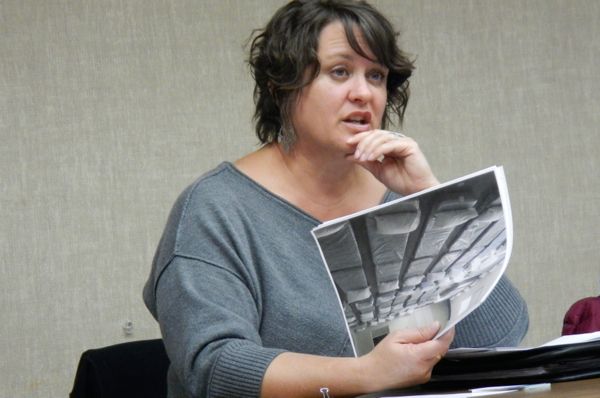
Anne Schiller with Catholic Charities in Reno talks about what her agency offers homeless people. Photo/Kathryn Reed
By Kathryn Reed
Another winter has gone by and still there is no place for the homeless in South Lake Tahoe to seek shelter.
Frustration is beginning to show among those who keep meeting to talk about establishing a warming room in South Lake Tahoe. Without nonprofit status, it is impossible to apply for grants that would help fund such an endeavor. The group doesn’t want to form its own nonprofit and no entity has come forward to volunteer to be the umbrella under which the warming room proponents could function.
“We need to get buy-in from the people we want to serve. We need a vision of what we want to create,” Marissa Muscat with Barton Hospital and Live Violence Free said.
Representatives from Catholic Charities in Reno spoke to the group March 24 about what they offer and some of the realities of such an endeavor.
They were quick to say that the talking can go on forever and encouraged the Tahoe folks to jump in, start small and go from there.
Thirty-seven families with kids going to school in Lake Tahoe Unified School District are living in non-traditional housing. Thirty-eight homeless people were identified in the January count; a nationwide effort by the federal government to document this class of people. Throughout El Dorado County there were 247 homeless people counted that day. In the Truckee-Tahoe City area there were 51 people.
It was pointed out that not everyone wants out of this way of life. The Reno women shared how one veteran was given a studio apartment. When he was shown it he turned it down, instead preferring to be at the shelter.
Mental illness is one of the largest barriers to get people to change their habits.
“It’s surprising how many of these people have income who are staying in a combination of these shelters,” Anne Schiller, chief clinical officer for Catholic Charities, said.
Their overflow shelter, which operates during the cold weather months, costs $24,000 a month to operate. It is equally split between Catholic Charities, the city of Reno and Washoe County.
Men and women are allowed – no kids, no pets. A mattress is provided for a few, but mostly they sleep on mats that resemble insulate pads for backpacking. One is lined up after the other. There is no privacy. But they are out of the cold. Most nights the 100 mattresses are spoken for.
This is more than most warm rooms provide. Typically they are just a building out of the cold where homeless must sleep on the floor or stay up all night.
Linens are changed twice a week, a deep cleaning occurs once a week and spraying for things like lice and bed bugs happens once a week.
The hours are from 7pm to 7am. Bed checks and perimeter checks are done regularly.
Once a week case management is provided to help these people get services they need and to apply for aid they qualify for.
This facility is in addition to the regular shelter Catholic Charities runs.
“We’ve tried different things and they have not worked that well,” Schiller said. “Before this facility we tried local hotels.”
The problem was it was not in a great location, no staff was on-site to deal with issues and there was a lot of property damage.
For now, the Tahoe group is going to keep meeting, brainstorm and try to find a nonprofit to essentially be the fiscal agent.