Tiered water rates hinge on court decision

By Carolyn Lochhead, San Francisco Chronicle

California cities could lose a big tool to encourage water conservation in an intently watched court case from San Juan Capistrano, a picturesque mission town in Orange County where a taxpayer group has challenged the city’s authority to charge homeowners more money for using more water.

The Capistrano Taxpayers Association won in lower court, and a state appeals court is expected to rule any day. If the taxpayer group prevails, water districts say, it could make it harder for them to achieve the deep reductions in water usage Gov. Jerry Brown ordered last week.

With the Sierra snowpack at a record low of 5 percent of normal, water officials argue that pricing incentives for residential consumers are vital to encourage conservation. Since a severe drought in the 1980s, about two-thirds of urban water utilities have used tiered rates, which charge higher prices for higher volumes of water used.

But the taxpayers group won at trial court in 2013, arguing that Proposition 218, approved by California voters in 1996, bars any local government agency, including water utilities, from raising rates above cost. The city appealed and a decision is due this month.

Proposition 218 is a follow-up to Proposition 13, the landmark 1978 law that prevents local governments from raising property taxes without approval by two-thirds of voters. Looking to make up for that loss of revenue, local governments quickly began turning to various fees and assessments. Taxpayer groups responded with Proposition 218, which requires fees for essential services be based solely on the cost of providing them.

Read the whole story


Calif. drought tests history of endless growth

By Adam Nagourney, Jack Healy and Nelson D. Schwartz, New York Times

LOS ANGELES — For more than a century, California has been the state where people flocked for a better life — 164,000 square miles of mountains, farmland and coastline, shimmering with ambition and dreams, money and beauty. It was the cutting-edge symbol of possibility: Hollywood, Silicon Valley, aerospace, agriculture and vineyards.

But now a punishing drought — and the unprecedented measures the state announced last week to compel people to reduce water consumption — is forcing a reconsideration of whether the aspiration of untrammeled growth that has for so long been this state’s driving engine has run against the limits of nature.

The 25 percent cut in water consumption ordered by Gov. Jerry Brown raises fundamental questions about what life in California will be like in the years ahead, and even whether this state faces the prospect of people leaving for wetter climates — assuming, as Mr. Brown and other state leaders do, that this marks a permanent change in the climate, rather than a particularly severe cyclical drought.

This state has survived many a catastrophe before — and defied the doomsayers who have regularly proclaimed the death of the California dream — as it emerged, often stronger, from the challenges of earthquakes, an energy crisis and, most recently, a budgetary collapse that forced years of devastating cuts in spending. These days, the economy is thriving, the population is growing, the state budget is in surplus, and development is exploding from Silicon Valley to San Diego; the evidence of it can be seen in the construction cranes dotting the skylines of Los Angeles and San Francisco.

But even California’s biggest advocates are wondering if the severity of this drought, now in its fourth year, is going to force a change in the way the state does business.

Read the whole story


Tahoe area OHV riders seek more access

By Kathryn Reed

Look outside – that’s why the U.S. Forest Service doesn’t open all trails in April – especially ones that allow motorized vehicles.

Last week a group of off-highway vehicle enthusiasts gathered at the South Lake Tahoe Forest Service office to talk about how best to maintain the roads, suggest ways for user groups to work together and offer ideas to the Forest Service. Users included four-wheelers, all terrain vehicle riders and dirt bikers.

One thing many advocated for was access when spring arrives even if the calendar says winter. But it was pointed out that the storm that arrived Sunday, which was in the forecast days in advance, was reason alone to limit access.

“Gates are closed for resource reasons,” Jacob Quinn with the Lake Tahoe Basin Management Unit told Lake Tahoe News. This includes critters nesting, and other fauna and flora considerations that go beyond looking at whether the ground is dry.

Users said if the sand pits and Twin Peaks on the outskirts of South Lake Tahoe were open now, it might curtail the illegal activity that is going in places like Upper Kingsbury Grade. People are going around the gate off Andria Drive.

“They are running it like crazy right now,” Frank Machler, USFS law enforcement officer, said. “They are there illegally. We are trying to get a handle on it.”

One person suggested a few boulders and better signage. Signs may come later in the summer.

Those in the room want to be stewards of the land, including helping with trail maintenance. Much like the mountain bike community in the past few years has partnered with the USFS, the same goes for the motorized recreation community.

The Forest Service has actively been applying for grants from California and Nevada entities with the goal of helping make improvements for off-roaders.

With the Forest Service unable to be on every trail, the feds welcome input from users about what they see so improvements or enforcement can be more immediate.

The users spoke about how they often take apart illegal campfire rings. Fire is a concern for them, whether it’s from illegal fires or their vehicles. Most who belong to organized riding groups have spark arresters on their vehicles and carry fire extinguishers.

Vegetation will be abnormally dry this summer because of the lack of snow. Safety is an issue especially when it comes to those in the backcountry knowing about dangerous conditions – something like last fall’s King Fire. Cell phone service is usually non-existent so the use of ham radios is often used.

Later this year the LTBMU will be revising the motor use map. Public comments will be solicited in the fall.

“That’s our legal document for when we can open and close gates,” Quinn said. “The idea is to improve accuracy. That is the point of the revision.”

Forest Service employees suggested users pay attention this season to what improvements they would like so they can be brought up in the form of a comment down the road, with the goal of its being addressed with the revised document. This would be the time to ask for more regulated fire pits with the goal of fewer illegal ones being built.


Vacation-home sales set record as economy improves

By Prashant Gopal, Bloomberg

Even before the remnants of eastern Massachusetts’ snowiest winter have melted, second-home buyers flocking to Cape Cod’s beach towns have helped Steve Clay’s team of agents break their sales record.

Clay, an agent with Keller Williams Realty, said he and his four agents have 17 properties under contract, more than at any one time since the team formed in 2009.

“Buyers know they missed the bottom of the market, and now they don’t want to miss the bottom of interest rates,” he said.

Second-home buyers from Cape Cod and New York’s Hamptons to Miami and Lake Tahoe are returning to the housing market as surging stock prices, job growth and low interest rates boost purchasing power and consumer confidence. U.S. vacation-property sales jumped 57 percent last year to an estimated 1.13 million, a record in data going back to 2003, the National Association of Realtors said in a report Wednesday.

Read the whole story


Feds blasted for Lake Tahoe logging

By Nick Cahill, Courthouse News Service

SACRAMENTO — A federal judge refused to dismiss a professor’s claim that the U.S. Forest Service is damaging the Lake Tahoe watershed by clearing timber and brush and depositing the slash in streams and wetlands.

U.S. District Judge Garland Burrell Jr. ruled Tuesday that the Forest Service’s argument was based upon faulty evidence and that plaintiff Dennis Murphy did not waive his legal challenge to the Upper Echo Lakes Hazardous Fuels Reduction Projection by failing to comment during a public comment period.

Burrell denied all three of the Forest Service’s claims for dismissal.

Murphy, a former consultant for the Forest Service, claims the agency violated the National Environmental Protection Act when it invoked a categorical exclusion for an environmental assessment, and falsely claimed that the project “does not individually or cumulatively have a significant effect on the human environment.”

The Forest Service also implemented the project contrary to the description in a memo sent to the public, Murphy said.

Read the whole story


Sierra Club wants coal out of Liberty’s portfolio

By Kathryn Reed

The Sierra Club is on a mission to get Liberty Utilities to stop using coal.

The national environmental group is behind a campaign to prevent the electric company from renewing its contract with North Valmy when it expires at the end of the year.

Liberty supplies power to the California side of the Lake Tahoe Basin, Truckee, Alpine County and other areas.

“We are the last Californians using coal to heat our hot tubs,” Grace Anderson with the Tahoe Area Sierra Club chapter said at last week’s meeting.

According to the California Energy Commission, “Electricity supplies from existing coal and petroleum coke plants represented about 8 percent of the total energy requirements to serve loads in California during 2012. A little over 93 percent of this coal-based energy came from power plants located outside California.”

Valmy is in Humboldt County in Nevada.

Liberty gets 5.2 percent of its power from coal.

The problem with coal, according to the Sierra Club, is how dirty it is.

“Coal is the absolute dirtiest of all energy sources and the greatest contributor to global warming: coal-fired power plants are responsible for over 83 percent of the CO2 pollution since 1990, and have the highest ratio of CO2 output per unit of electricity out of all the fossil fuels,” according to Green America.

On Nov. 17, 2008, then Gov. Arnold Schwarzenegger signed Executive Order S-14-08 requiring that “…[a]ll retail sellers of electricity shall serve 33 percent of their load with renewable energy by 2020.”

Based on the graphic below from Liberty’s website, the company is nowhere close to meeting that mandate.

Screen Shot 2015-04-04 at 10.23.26 PM

Liberty buys much of its power from NV Energy. NV in 2013 said it would begin eliminating coal immediately. However, the Valmy plant is expected to be online through 2025.

While the local Sierra Club chapter has not taken a stance on the issue, Anderson is working with the national Sierra Club to get the Canada-based power company to rethink how it does business.

There will be hearings about the Valmy plant before the state Public Utilities Commission later this year. The Sierra Club is on a letter writing campaign to the CPUC to stop Liberty from using coals.


Pesticide linked to cancer has boomed in Calif.

By Rachael Bale, Reveal

Monsanto Co.’s Roundup has been having a bad couple of weeks. Last week, the World Health Organization declared that its active ingredient, glyphosate, and two other pesticides probably cause cancer in humans.

Another study out this week suggests glyphosate use also may contribute to antibiotic resistance, a mounting problem that’s begun to be compared to climate change.

Glyphosate is one of the most widely used pesticides in the world. Using our California pesticide database, we wanted to see where it is used, on which crops and just how much gets applied.

In California, glyphosate use for commercial agriculture has increased by nearly two-thirds over the past decade. About 20 percent of it went to almonds alone. It is most heavily applied in the Central Valley counties of Fresno and Kern.

While it’s popular in the United States, glyphosate is banned, or about to be banned, in several countries because of health risks that may range from infertility and birth defects to kidney disease. The WHO report now says it could cause non-Hodgkin lymphoma.

Malathion, WHO found, could cause non-Hodgkin lymphoma and prostate cancer. In California, malathion use has decreased by more than 40 percent from 2003 to 2012. Much of the malathion applied in California goes to strawberry and alfalfa crops.

Use of diazinon, the third pesticide newly identified as probably carcinogenic, has dropped 85 percent in California during the past decade. It’s used most heavily on lettuces. More than one-third of all diazinon applied in California was used in Monterey County. The WHO says there is some evidence diazinon could cause non-Hodgkin lymphoma and lung cancer.

The U.S. Environmental Protection Agency, which regulates pesticides, does not consider glyphosate, malathion or diazinon to be carcinogenic. In 1985, the EPA classified glyphosate as possibly causing cancer, but six years later, changed its designation after new studies suggested it does not cause cancer.

Malathion and diazinon are part of a class of pesticides known as organophosphates, which previously have been the source of health concerns because of what they can do to the brain and nervous system. They work by blocking an enzyme called acetylcholinesterase, which breaks down a certain neurotransmitter. When there isn’t enough acetylcholinesterase, the neurotransmitter builds up, causing nerve overstimulation. That causes pest insects to die, but in high enough doses, it can make humans really sick, too.

When your nervous system doesn’t work right, your muscles – including your heart and those involved with breathing – don’t work right either. Effects of organophosphate exposure range from eye and skin irritation to muscle twitching, trouble breathing and a fast heartbeat, to seizures and death. Some organophosphates, including malathion and diazinon, also are considered by some agencies to be endocrine disruptors – meaning they mess with humans’ hormones.

These new cancer designations are controversial, especially in the case of glyphosate. Some scientists, along with Monsanto, say the evidence that WHO cites appears thin. The Science Media Centre in London has a valuable roundup of scientists’ reactions to WHO’s announcement.

Another thing to keep in mind is the difference between hazard (pesticides can cause cancer) and risk (how likely a person is to get cancer from those pesticides).

“The IARC (World Health Organization’s International Agency for Research on Cancer) process is not a risk assessment. It determines the potential for a compound to cause cancer, but not the likelihood,” Alan Boobis, a biochemical pharmacology professor at Imperial College London, told the Science Media Centre.

That means the next step is more studies looking at the health of farmworkers and nearby residents who are exposed to these pesticides to determine if they are likely to cause cancer in real-world situations.



Placer County considers fire cuts

By Richard Chang, Sacramento Bee

Despite drought conditions that have elevated wildfire risks this year, Placer County officials are considering whether to shutter one rural fire station and eliminate several positions to save money as it faces higher state firefighting costs.

Placer County contracts with the CalFire to staff its engines and stations in a vast fire protection area that spans from the Sacramento County line to Emigrant Gap in the Sierra Nevada. Other parts of the county are governed separately by independent fire districts and municipal agencies.

The 66 CalFire firefighters that serve Placer County are projected to cost $8.89 million in the current fiscal year. CalFire has raised its rate by 21 percent to $10.74 million for the fiscal year that starts July 1, a hike Placer officials have criticized as “unsustainable.”

Read the whole story


Arrest made in death of SLT couple’s daughter

reno caseBy Marcella Corona, Reno Gazette-Journal

It’s been 10 years since 28-year-old preschool teacher Kyla Annan was found strangled to death at her home in Reno.

“It’s a pretty hard time,” Kyla’s father, Steven Annan, said Friday afternoon. “In 10 years you can bury a lot.”

Annan and his wife, Cheryl, of South Lake Tahoe, sat unmoving at a press conference Friday, with their hands clasped on their laps and solemn expressions on their faces in a corner of a briefing room at the Reno Police Department.

They had recently learned police arrested the man believed to have slain their daughter.

Read the whole story


Settlement in Alpine County toxic mine case

Even though over the course of decades more than $100 million has been spent on cleanup activities at an old sulfur mine in Alpine County, a settlement agreement between disagreeing parties was just reached.

In July, at the Lahontan Regional Water Quality Control Board meeting officials said the settlement could happen any day. It took another eight months.

The Leviathan Mine is considered a superfund site, making it one of the most toxic areas based on Environmental Protection Agency standards. As a CERCLA site, there are certain parameters that must be followed. And there is also a certain amount of risk that is allowed. This site will presumably always be toxic, just not to the degree that it is today.

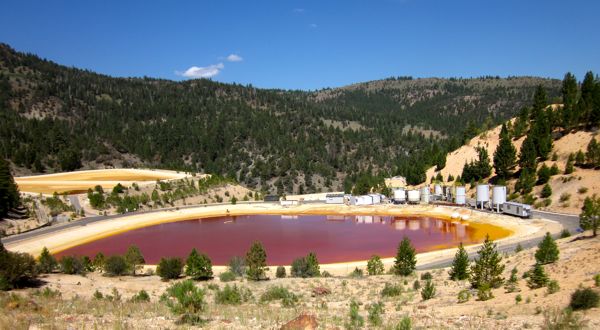
Leviathan holding ponds and treatment system used by Lahontan. Photo/Lahontan Water Board

Leviathan holding ponds and treatment system used by Lahontan. Photo/Lahontan Water Board

It is better than what it was. In 1999, there were no rainbow, brook or brown trout in Lower Leviathan Creek, according to the U.S. Fish & Wildlife Service. In 2013, there were 72 rainbows, 521 brooks and zero browns.

Anaconda Copper Mining Company used the mine from 1951-62. It was sold in 1963 to William Mann, who was Alpine County’s clerk, for $100. Eventually officials discovered acid mine drainage was contaminating Leviathan Creek. There was no way Mann was going to be able to write the checks for the cleanup. California stepped in in 1983 and bought the land.

A lawsuit was filed against Atlantic Richfield Co., which had bought Anaconda. A settlement of just more than $2 million allowed clean up to start. But then the Washoe tribe asked the EPA to get involved because the pollutants were creating a thick layer of orange precipitate along the streambed that ended up in the East Fork of the Carson River. The EPA went after ARCO, and in turn ARCO filed a suit against Lahontan.

It is that second lawsuit that was just settled.

The settlement details what work ARCO and Lahontan will conduct at the site going forward, and lays out the cost-sharing formulas. The settlement also secures long-term funding for a cleanup project that could take decades, if not centuries to complete, according to officials. Lahontan will design and construct the remedy, and ARCO will pay 75 percent of the cost to complete it. ARCO will also pay 70 percent of Lahontan’s expense to operate and maintain the remedy over the long term.

Today, Lahontan and ARCO have separate treatment systems. The settlement allows for just one.

— Lake Tahoe News staff report