Tourism expert: People have the money to travel

By Kathryn Reed

MINDEN – People are employed, they are willing to spend and they are saving. Saving for a vacation is what travel industry officials are hoping.

These economic trends are good for tourism, according to Brian London.

London was the keynote speaker April 16 at the Nevada Commission on Tourism’s Rural Roundup at the Carson Valley Inn.

“What is something they are saving for? Vacation. That means there is no wrong time to start promoting your destination. Start now to inspire them,” London told the crowd of a couple hundred tourism officials.

London is a travel industry analyst who used to work for the agency responsible for marketing Florida.

Tourism reps from rural Nevada -- which includes the Carson Valley and Lake Tahoe -- are participating in the annual multi-day tourism conference. Photo/LTN

Tourism reps from rural Nevada — which includes the Carson Valley and Lake Tahoe — are participating in the annual multi-day travel conference. Photo/LTN

Tourism is Nevada’s No. 1 industry. The state agency is focusing its pitch on Millennials, the 79 million people between the ages of 20 and 34.

London spoke to the need for destinations to know their demographic and what those people want. It doesn’t mean neglecting one segment over another, but it does require knowing not all sectors have the same wants and needs.

“You have to change or you won’t be speaking the language of your customer,” London said.

He believes Boomers will be the driving force in the travel industry for the next two decades. They have the time and money for travel, and control more than half of the discretionary spending by people in the United States.

They are mostly interested in touring, resorts, casinos and golf – all things Nevada can offer in abundance. They are also less into active sports and recreation, and more into sightseeing and fine dining.

Millennials are attracted to locations with events and to cities. They want to be part of something and then to share it with others.

“Photos are their favorite information currency,” London said. “They grew up with technology. They want instant access. They don’t ask if there is WiFi, they assume you have Internet available.”

If lodging properties, restaurants and the destination itself is not using photos and video as teasers, Millennials are likely to look elsewhere.

Gen X’ers, the group in between, are into the outdoors and theme parks. They want bonding and a connection with family.

Millennials represent 28 percent of the travel market, Boomers 26 percent, Gen X 20 percent, Gen Z and Older 13 percent each, according to London.

London is a strong proponent of businesses paying attention to online reviews. He said average daily rates increase at hotels that respond to complaints. It shows the property cares. It’s called reputation management.

Keeping track of trends is critical, too. London suggested businesses – even the larger destinations – look at reports publicly traded companies file with the Securities and Exchange Commission. This is because they have to tell investors how they are going to spend their money. A tidbit – Hilton is building 245,000 new rooms this year. This is a clear indication they are bullish on the lodging sector – aka travel market.



Judge: Pot stays on most-dangerous drug list

By Maura Dolan, Los Angeles Times

Efforts to legalize marijuana suffered a defeat in court Wednesday when a judge upheld the constitutionality of a 1970 federal law that classifies cannabis as a dangerous drug akin to LSD and heroin.

U.S. District Judge Kimberly J. Mueller, announcing her decision at a hearing in Sacramento, said she could not lightly overturn a law passed by Congress.

Mueller agreed last year to hold an extensive fact-finding hearing on the issue, raising the hopes of activists seeking to legalize marijuana and worrying opponents who consider the drug a threat to health and public safety. The hearing marked the first time in decades that a judge was willing to examine the classification of marijuana under the 1970 Controlled Substances Act.

Read the whole story


WHS, DCSD remain at odds about priorities

By Kathryn Reed

Whittell High School parents, teachers and staff spent months coming up with ideas about how the district could improve the 7-12 school. The top priority was to keep the integrity of the middle school and high school concepts despite the grade levels being under one roof.

This was the promise several years ago when the three lake schools were consolidated into two.

This week that promise was officially dissolved. The Douglas County School District board on April 14 agreed with the recommendations presented by Superintendent Lisa Noonan. (Board member Tom Moore was absent.)

No additional staff will be hired for WHS. To deal with an incoming seventh-grade class of more than 40 students, the committee recommended hiring another teacher. This large class will necessitate another section of classes at this grade level. That in turn will take a teacher or teachers out of high school sections.

WHS has 14 full-time instructors and four part-time. A dozen of them teach at the middle and high school levels.

Currently the enrollment at WHS is:

• 7th grade: 35

• 8th: 32

• 9th: 45

• 10th: 31

• 11th: 30

• 12th: 26.

Stacy Noyes, a parent on the committee, told the board the decision is not equitable, that the electeds are not doing their job and that the students deserve better than what they are getting.

Principal Crespin Esquivel is caught in the middle of trying to please his boss, the board, staff, parents and students.

Even before Tuesday’s meeting he knew he was not going to have the luxury of more staff. He created the 2015-16 master schedule with that in mind. But what will be new is that all students will be on the same bell schedule. This means little kids changing classes at the same times the big kids are. They’ve always done so separately.

Esquivel was able to keep the lunch periods separate between the middle and high schoolers.

“My obligation is to do what’s best for the kids,” Esquivel told Lake Tahoe News.

He said he is open to new ideas, to being creative. To do so, though, takes the blessing of the district and possibly the state. Esquivel would like the board and district personnel to come to his Zephyr Cove school next year to see how difficult it is to put a master schedule together. He’s made the offer, but doubts he’ll have any takers.

To make things work, economics and speech will no longer be offered as standalone classes. And grade levels will have to be combined for some sections with teachers asked to essentially teach two classes in one period.

With Whittell being so small, it is hard at times to offer electives beyond graduation requirements, let alone what colleges are looking for. Parents often plot a student’s four-year trek starting freshman year to ensure the proper credits are attained because not everything is offered every year.

Noonan said she is doing the best she can. With the Legislature still in session, funding for the next school year has not been solidified. This is why she won’t advocate for more staff at Whittell.

“We have a lot of needs and they have price tags and I don’t have additional recourses coming in at this time,” Noonan told Lake Tahoe News. “It’s hard to see people sad and frustrated.”

But it’s not like the district has suspended all additional spending. The board this week approved the use of short-term substitutes to be used when the gifted and talented teacher is out. (Board member Robbe Lehmann’s child is in this program.)

Other action taken in response to the committee include:

• Creating a memorandum of understanding with Lake Tahoe Unified School District so students in each district could cross the state line. Noonan said a draft has been created, but she has yet to meet with LTUSD officials. The goal is to finalize it by August, with implementation for the 2016-17 school year.

• An online AP computer science course will be offered in the fall. A teacher spearheaded this.

• Duel credits between high school and community colleges are an issue being contemplated by the Legislature.

Noonan said there is a possibility for more changes down the road if funding becomes available. She said the document serves as a blueprint for WHS and will be used like a strategic plan.


CalPERS contributions to rise more than 9%

By Dale Kasler, Sacramento Bee

CalPERS is about to raise pension contribution rates again, this time by more than 9 percent, a move that will cost state government and local school districts nearly $600 million.

The increases are the latest step by CalPERS to gradually shore up its finances. In early 2014, CalPERS said it would embark on a series of significant rate hikes, and on Tuesday the pension fund’s finance and administration committee recommended higher rates for the upcoming fiscal year.

While CalPERS is continuing to deal with the lingering effects of the 2008 crash in the financial markets, it pinned the latest rate hike primarily on growth in government payrolls and recent demographic assumptions that show retirees living longer.

Read the whole story


Drought ‘devastating’ for Tahoe ski industry

By Kathryn Reed

Adapting to change is the only way ski resorts are going to survive.

That was the message John Rice, general manager of Sierra-at-Tahoe, delivered to more than 40 people on Wednesday afternoon at Lake Tahoe Community College.

He refused to engage in the debate of why things are changing, but he said there is no denying things are changing.

Sierra averages 480 inches of snow a season. It received 140 inches this season – a record. The resort near Echo Summit was open for 94 days. Another record. It closed March 16 – the earliest on record. These aren’t the kinds of records any resort wants.

Sierra had 1,200 people from Intel booked in March. The resort had to cancel because of conditions.

John Rice with Sierra-at-Tahoe on April 15 talks about the impact of drought on ski resorts. Photo/LTN

John Rice with Sierra-at-Tahoe on April 15 talks about the impact of drought on ski resorts. Photo/LTN

Rice said the drought is having a “devastating” affect on the industry. Less money being generated means fewer people to hire, which ultimately affects so many businesses in town.

It used to be people would book ski trips months, even years in advance. Now it’s more spontaneous. With weather data at people’s fingertips and more accurate ski reports from resorts, the guesswork has been eliminated. People can go to where the snow is or stay away from the sparsely covered slopes.

For the resorts without snow this is not a good thing for the bottom line. And with the greater Lake Tahoe area suffering from its fourth winter of lousy conditions, Rice said, all resorts are dealing with a slump in season pass sales and group sales. Skiers aren’t willing to take a gamble on Tahoe right now even though in winter 2010-11 Sierra had 869 inches of snow.

Snow totals at Donner Summit have been kept since the late 1800s. Multi-winter low snow years are not unusual, Rice pointed out. But there is no crystal ball to know when Mother Nature will change her ways.

To cope with dry cycles resorts are going to have to be creative with what they offer. Sierra was bringing in people to its 30,000-square-foot plaza with music and events. People who often avoid Tahoe in the winter because of the roads could come experience snow. It’s about providing an experience they can’t get at home.

Sitting by a fire pit surrounded by pine trees, roasting s’mores, wine tasting, tubing, ice skating are all things various Tahoe resorts offer. It’s not just about the skiing and snowboarding.

A resort in Vermont has an indoor water park. Camp Woodward, the nearest being at Boreal, is extreme sports indoors.

While many resorts boast about their snowmaking capabilities, Sierra can only cover 4 percent of its slopes with man-made snow. Industry numbers are that between 17 and 25 percent of the water used for snowmaking is lost, the rest returns to the aquifer.

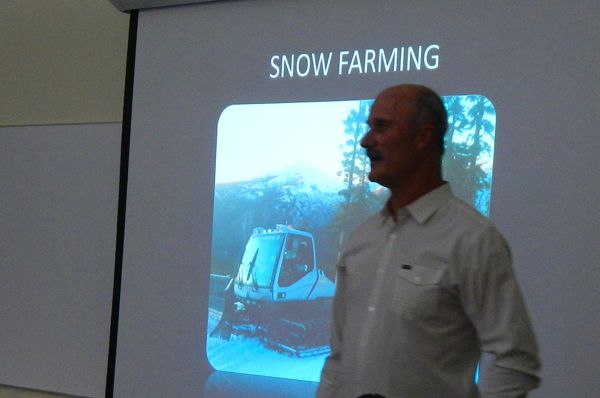
Sierra is more known for snow farming – taking the white stuff off parking lots and areas of the mountain and repurposing it on skiable terrain. Last winter an employee used a 5-gallon bucket from home and a resort shovel to start filling in bare spots.

Rice praised his initiative that turned into a 100-person bucket brigade. It was about employees trying to be resourceful, stay employed and doing their part.

Summer grooming helps Sierra open with a decent layer of snow. Take a look at a run like Lower Main. It’s pretty smooth. Without boulders and uneven terrain, it means it will be covered faster and sooner than some other runs.

Places like Northstar and Heavenly are turning to active summer activities like ropes courses and mountain biking. Rice said without a closer bed base Sierra does not see this as a viable option. It will, though, be expanding into the wedding business in the summer.

Resorts are also putting together season pass programs that involve multiple resorts. This is good when the home resort’s conditions are sketchy. While it means free skiing, the resorts benefit because people buy food, souvenirs and may extend their stay. Plus, people see this as added value.

—–

Notes:

• The next Tahoe Talks Brown Bag lunch is May 20, noon-1:30pm in LTCC’s board room. It will be a panel discussion about cycling’s impact on Tahoe’s economy


Bills renew California’s anti-smoking effort

By Patrick McGreevey, Los Angeles Times

California has become a battleground between the tobacco industry and health groups as lawmakers push proposals that include increasing cigarette taxes by $2 a pack and raising the legal smoking age from 18 to 21.

The state once led the nation in snuffing out smoking, but health activists say a strong tobacco lobby and a lack of political will have blocked new efforts in recent years.

“We used to be leaders, and we are not anymore,” said Stanton A. Glantz, a professor of medicine at UC San Francisco.

California lawmakers have responded to such criticism with a flood of legislation on the issue.

In addition to making California the first state to raise the smoking age, the measures would bar electronic cigarettes from public places where smoking is prohibited, ban single-use filters on cigarettes and prohibit the use of chewing tobacco in pro baseball stadiums and recreational league games.

Read the whole story


Planners plotting Tahoe’s cycling future

By Kathryn Reed

Cycling in the Lake Tahoe Basin can be compared to driving in rush hour traffic. It’s a lot of stop and go, along with frustration.

With the lack of connectivity, routes abruptly stopping and harrowing experiences when having to interact with vehicles, two-wheelers in Tahoe are often relegated to second-class citizens – at least on the roads. Planners, with the help of the public, want to change that reality.

“We are transitioning into an active transportation plan,” Nick Haven, transit planner with Tahoe Regional Planning Agency, told Lake Tahoe News. “Historically, we’ve been focused on circulation and transportation.” Now health and other modes of transit like skateboarding are part of the bigger picture.

The bi-state agency is updating its bike and pedestrian plan – something that is done every four years.

On April 14 more than 20 people gathered at the South Lake Tahoe Library to offer input about what planners should focus on when designing trails, what overall goals should be, where missing links in the trail system exist, and where bike racks should be installed.

Greg Kendall of Marla Bay voted for buffered or protected bike lanes, as did many others. While he prefers a separated bike path, he told Lake Tahoe News he knows that isn’t realistic for his part of the South Shore where the roads are narrow. Kendall also believes it’s necessary to accommodate the different types of cyclists – those out for a leisurely ride, and those who are more serious, going faster and would be encumbered by a multi-use path.

Morgan Beryl, who is TRPA’s project manager for what is now called an active transportation plan, told Lake Tahoe News the document would prioritize projects for funding, be a guide for what should be implemented and be a source for designers.

TRPA has found that people are sticking to their vehicles because they don’t feel safe on the roads or in intersections – whether on a bike or foot. Working to make intersections safer is a goal. Caltrans recently added a class 4 designation to bike trails. This allows for two-way travel on the same side of the street along the road. Bike boxes are being tested in Sacramento and Davis. These put cyclists in front of vehicles at an intersection. Removable signs in the roadway and flashing lights to alert motorists of the presence of cyclist are other innovations.

—–

Notes:

• Feedback on the bike-pedestrian plan is also being sought via an online survey that will be up through June.

• A draft plan – which will seek more public comment – should be ready by October, with the final document completed by the end of the year.

• There is a meeting at Kings Beach Elementary on April 16 from 5:30 to 7:30pm about the plan.


Lincoln well-remembered in Nevada

By Guy Clifton, Reno Gazette-Journal

Abraham Lincoln never set foot in Nevada, but the histories of the state and the nation’s 16th president are forever intertwined.

“It’s hard to think of a president who had a bigger impact on Nevada,” Michael Green, a history professor at UNLV, said about the president who was shot by assassin John Wilkes Booth 150 years ago today.

“Without Lincoln, we don’t have a Civil War, we don’t have statehood, we don’t have laws that were passed during the Civil War that affected Nevada.”

We might not even have Mark Twain — the pen name Samuel Langhorne Clemens picked up while working for the Territorial Enterprise in Virginia City. If Lincoln hadn’t appointed Clemens’ brother, Orion, to be the first secretary of the Nevada Territory, Sam might have never followed his brother West. No “Roughing It,” no “Fairest picture the whole earth affords” musings about Lake Tahoe, no tall tales from the Comstock.

Lincoln wanted Nevada to become a state, in part to help ensure his re-election in 1864, but ultimately to help him secure the needed votes in Congress for the 13th Amendment to end slavery.

Read the whole story


As population ages, hospice care grows

By Sammy Caiola, Sacramento Bee

Mary Miller is full of opinions. During her weekly visits with hospice volunteer Joe Lenihan, the 88-year-old doesn’t hesitate to speak her mind – solicited or not. She’ll talk the ear off of a wrong-number caller, and she’s known affectionately around the neighborhood as “Mean Old Mom.”

“There are days when Mary is a little cantankerous – it’s not all sunshine and lollipops,” Lenihan said. “It can be a difficult time for some folks, and to share that with people is a real joy.”

Miller has been in hospice, an at-home care service provided to patients in their final days, since her congestive heart failure was deemed terminal in January. She chose the option because she wanted to remain in the McKinley Park house where she’s lived for 37 years, the past 15 without the company of her late husband, Henry.

Over the past decade, the hospice industry has seen substantial growth with the aging baby boomer population. Adults over 50 are expected to make up 20 percent of the population by 2030, and 90 percent of Americans want to grow older at home, according to a recent report by AARP, formerly the American Association of Retired Persons.

Read the whole story


S. Lake Tahoe’s midyear budget shows promise

Unfunded liabilities are not unique to South Lake Tahoe. Graphic/California Common Sense

Unfunded health care liabilities are not unique to South Lake Tahoe. Graphic/California Common Sense

By Kathryn Reed

Two budgets in one year. That is essentially what South Lake Tahoe will have.

While the City Council will go over the midyear budget a week from today, the reality is that what will be presented by staff is more like a brand new budget. This is because timing of events did not allow inclusion of the employee contracts when the 2014-15 budget was adopted last fall.

The contracts with the six employee groups include a complete overhaul of health care benefits and raises.

Those changes along with adjustments to the expense and revenue columns have created a midyear surplus of approximately $890,000. The council on April 21 will be tasked with allocating that pot of cash.

Staff is recommending $600,000 be set aside for year three of the employee contracts to pay for the raises. About $50,000 will be used for the city’s 50th birthday bash. The remainder is expected to be set aside to see how the fiscal year ends. This in part has to do with the drought and not knowing if projected revenues will be forthcoming if tourists don’t make Tahoe their vacation spot of choice.

However, hotel taxes through January, the last numbers available, are up 5 percent for the fiscal year.

“Last year the drought brought people up (here),” City Manager Nancy Kerry said. “This year could be different. It may be hard to get a boat in the water.”

Another concern of the city is property values because they are declining. Property taxes, along with transient occupancy tax and sales tax are the three main revenue sources for South Lake Tahoe.

The county tax collector has advised the city to expect $1 million less in property taxes from the redevelopment area, Kerry said. This is because values have been adjusted. Numbers for the rest of town remain unknown. The city will cover that shortfall with money that has been set aside in the TOT trust fund for redevelopment.

Refinancing redevelopment bonds is a way the city is cutting its expenses. That should occur later this spring.

A sign the economy is doing better is the robust number of building permits being issued; with revenues up $250,000 beyond what was forecasted.

With three key changes, Kerry practically revolutionized how the budget is done and the council’s role. One change is to only put in the budget what the true needs are, second is to bring more one-time expenses to the council, and the biggest change was to tackle the unfunded health care liability. One-time expenses include buying defibrillators for most public buildings, additional containers for marijuana evidence, and money to invest in economic development. When Kerry took the helm less than three years ago, the employee unfunded liability expense in the city was about $45 million. Had changes not taken place last fall, that number would now be $53 million. An actuarial last month found that the liability has been reduced by 73 percent and that in 11 years the liability will be nearly non-existent.

By changing the health care plan, eliminating retiree health benefits for employees not yet retired, and modifying coverage the city will see a cost savings of $1.5 million a year for three fiscal years starting with the current one.

“Now resources will be able to be spent on residents’ needs,” Kerry told Lake Tahoe News.

—–

Notes:

• South Lake Tahoe City Council meets April 21 at 9am at Lake Tahoe Airport.