LTCC students getting help beyond the classroom

By Lake Tahoe News

Lake Tahoe Community College has set up a pantry of nonperishable foods and hygiene products for students in need.

“It’s meant to address the very real problem of community college students struggling with learning due to hunger. There’s all kinds of evidence that shows that when college students don’t have their basic needs met like food, shelter, stable living environment, child care, they struggle in their studies and are much more prone to fail and drop out,” LTCC spokeswoman Diane Lewis told Lake Tahoe News. “About 73 percent of community college students are nontraditional, meaning that they fit one of these six criteria: they’re part time rather than full, they’re employed full time while in college, they’re financially independent, they have dependents to provide for, they’re a single parent, or they don’t have a high school diploma or a combination of these. That is a high percentage of vulnerability, and insufficient nutrition is often a consequence.”

The college hopes to get a refrigerator so perishable goods could be available as well.

Students may receive two bags of food twice a month.

Criteria to receive the bags include:

·      Being a registered LTCC student, either full time or part time.

·      Either eligible for the Board of Governors fee waiver, or able to demonstrate financial need through a pay stub or other income verification.

“We aren’t aware that the need is growing – only that hunger and food insecurity are a constant and very real issue on any community college campus, nationwide. We have found that many of our students are unaware of resources available in town for nutrition,” Lewis said. “The food pantry is meant to serve mostly in emergency situations when students need immediate help and don’t know where else to turn for it. In addition to food and supplies, the pantry will also provide information about local resources that students can tap into.”

The pantry will be stocked through a mix of grant money, donations from community partners, and donations from LTCC staff, faculty, and students. To donate, contact Laura Salinas at 530.541.4660, ext. 549 or lrsalinas@ltcc.edu
States mull ‘sanctuary’ status for marijuana businesses

By Becky Bohrer, AP

Taking a cue from the fight over immigration, some states that have legalized marijuana are considering providing so-called sanctuary status for licensed pot businesses, hoping to protect the fledgling industry from a shift in federal enforcement policy.

Just hours after U.S. Attorney General Jeff Sessions announced on Jan. 4 that federal prosecutors would be free to crack down on marijuana operations as they see fit, Jesse Arreguin, the mayor in Berkeley, summoned city councilman Ben Bartlett to his office with a novel idea.

Berkeley was already the first city in the nation to formally declare itself a sanctuary city on immigration, barring city officials from cooperating with federal authorities. Why not do the same thing with marijuana? Last month, it did.

Read the whole story


Transparency is lacking in Nevada government

By Michael Scott Davidson, Las Vegas Review-Journal

Former state Sen. Mark Manendo sexually harassed more than a dozen women over his years in the Nevada Legislature, leading to his resignation. The transgressions were documented in a $67,000 taxpayer-funded investigation, but the public can’t see the report.

Former Henderson Police Chief Patrick Moers retired with full severance benefits after a law firm hired by the city found he repeatedly sexually harassed at least one employee. The city has declared that report, paid for by city taxpayers, confidential and unavailable for public scrutiny.

Time and time again the Las Vegas Review-Journal has sought public records, asked questions and demanded openness from local and state government workers whose salaries are paid with taxpayer dollars.

Read the whole story


Escaping Tahoe for hike on Prison Hill

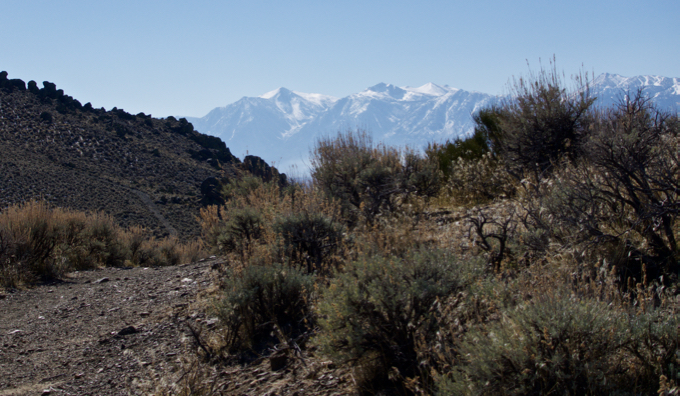
Walking among the sagebrush the Sierra seem to loom large. Photo/Kathryn Reed

By Kathryn Reed

CARSON CITY – We were held captive on our hike at Prison Hill. Captive by the beauty and number of trails we could explore.

It was a first for the three of us to experience this section of Carson City. There are so many trails in the Prison Hill Recreation Area and Silver Saddle Ranch that we will be back.

It was mid-February when we ventured off the hill. The openness – as in no trees – makes this area ideal to venture to any time of year but summer. It would be blistering hot then. When we went there wasn’t snow at the lake, so hiking outside the basin seemed like our best option for playing outside.

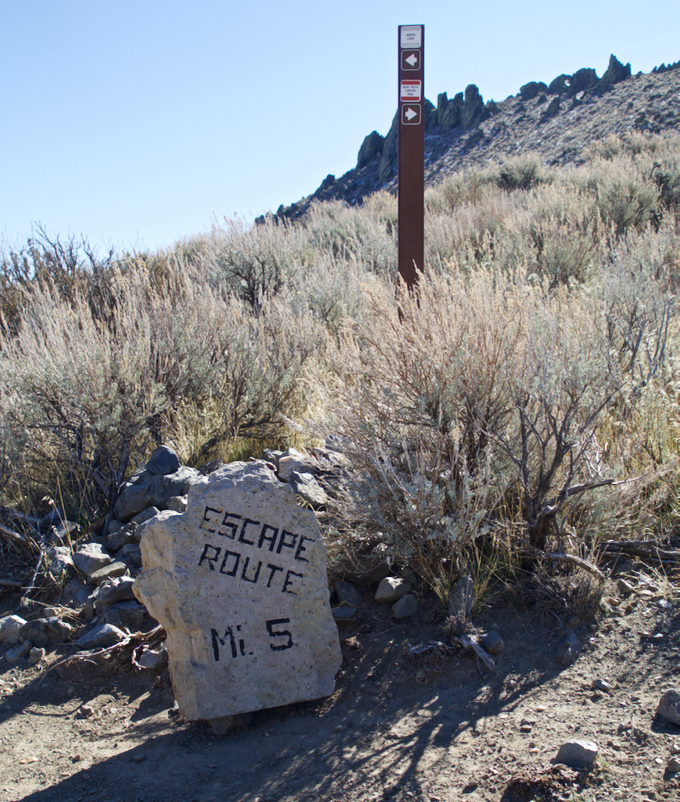
For the most part signage is good. Photo/Kathryn Reed

Even though we were in the capital city, at times it felt like we were in a remote location of the Silver State. The terrain is rugged and beautiful. Sage is the predominate plant protruding from the otherwise barren landscape.

At times the Sierra are in view, providing a snowcapped magic and complete contrast to where our hiking boots were leaving tracks.

Looking east it was more desolate. Trails – not sure if they were hiking, 4-wheeling, equestrian or biking – could be seen in the distance. Just another place to put on the to-do list.

Where we were a lone horsewoman passed us. People were scarce. That was one of the nice things about the hike – so few people on a weekend. Dogs being permitted was an added bonus.

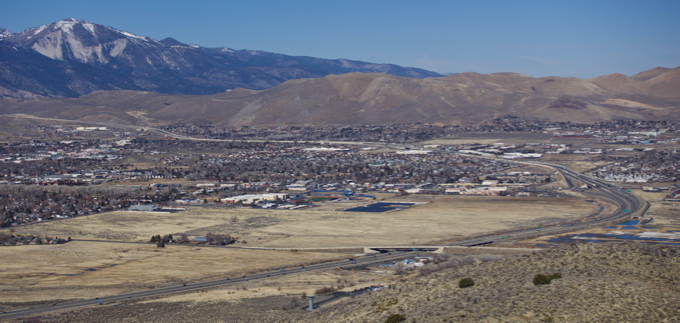
Carson City seems to go on and on from Prison Hill. Photo/Kathryn Reed

Yes, ample views showed the sprawl of Carson City, but there is so much beauty around that the development was not a distraction. On the north side the prison for which the hill is named finally came into view.

This is where the annual Escape from Prison Hill Trail Race is staged. This year’s event is April 21. There is a 5K, 10K and half marathon.

Tombstone looking rocks have “Escape Route” etched on them. Not knowing where we’d be escaping too, we kept on our preplanned route.

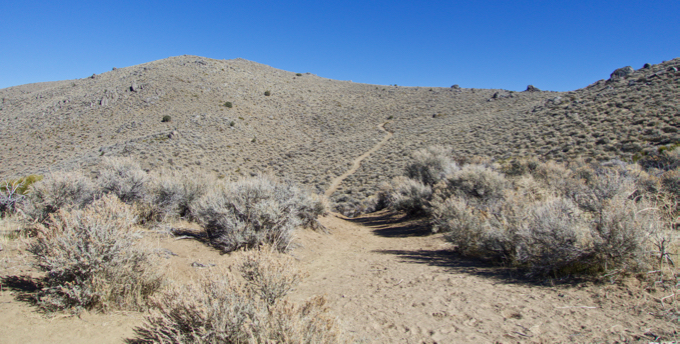
We started on the north side of the West Loop, then hooked up with the North Loop. In all it was just less than 5 miles. The start is nearly straight up – no switchbacks. It gets easier from there. Poles would have been welcome coming down.

Bring water — this trail doesn’t have any. Photo/Kathryn Reed

—–

Getting there from South Lake Tahoe:

Take Highway 50 east to Carson City.

Turn left at the bottom of the hill onto Carson Street. Turn right on Clearview Drive. Go to the end. Signage is good.


Nev. heroin overdose deaths nearly tripled since 2010

By Jessie Bekker, Las Vegas Review-Journal

Opioid-related deaths in Nevada have decreased slightly since 2010, but the number of fatal heroin overdoses has nearly tripled since then, according to state data presented Thursday.

But that pattern appears to be changing as well, as heroin-related deaths remained unchanged between 2015 and 2016 while deaths from synthetic opioids, including the super-potent painkiller fentanyl, rose by 56 percent.

“I think the data is definitely evidence that there’s a shift,” Kyra Morgan, chief biostatistician of the Nevada Department of Health and Human Services, said Thursday in a presentation to roughly 45 state and local officials gathered in Reno and Las Vegas.

Read the whole story


Technology helps measure snowpack with accuracy

By Ezra David Romero, Capital Public Radio

Frank Gehrke trudges through snow and ice, as he’s done for nearly four decades in the Sierra Nevada. He’s one of many state workers who takes monthly snow surveys, in the same spots, to figure out how much water is in the snowpack. And this old-fashioned way of measuring the snowpack is quite laborsome.

The data from surveys and a system of around 150 sensors informs local and state officials how much water is stored in the Sierra. But there’s a flaw: Measurements can be up to 40 percent off.

In dry, warm years like 2018, snow sensors often don’t work because they’re covered in thick layers of ice as snow melts and freezes.

That’s why Gehrke is stoked about a new way to measure the snowpack from the sky.

Read the whole story


Tahoe doc: Diet plays major role in people’s health

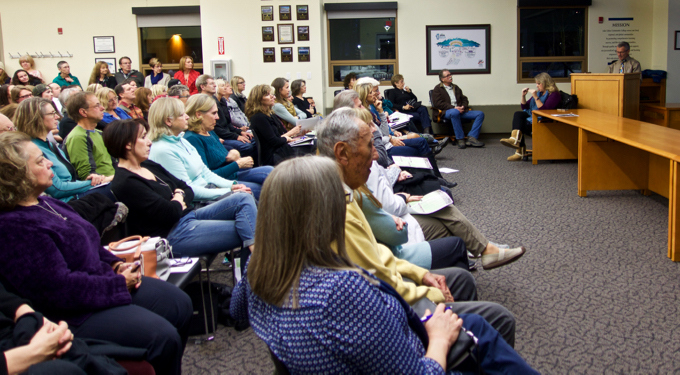
Greg Bergner talks about the importance in diet in relation to health. Photo/Kathryn Reed

By Kathryn Reed

It was a new take on “you are what you eat.” Eat healthy food and you will be healthy, don’t do that and you are bound to suffer from myriad maladies.

This was the message Greg Bergner delivered March 8 to an overflowing crowd at Lake Tahoe Community College. Bergner is the director of lifestyle and wellness for Barton’s Center for Orthopedics & Wellness.

“Our bodies have a remarkable capacity to heal themselves even after we screw them up,” Bergner said.

That means it’s not too late to change your habits.

He explained how the top seven causes of death in the United States account for more than 80 percent of the deaths. Six of them are medical related. They are:

·      No. 1 – heart disease

·      No. 2 – cancer

·      No. 3 – COPD (lung disease)

·      Nos. 4-6 – accidents, stroke, Alzheimer’s

·      No. 7 – Type 2 diabetes.

Bergner said the only way to reverse heart disease is through a whole food plant based diet.

The difference between plant based and veganism is the latter is more of a lifestyle based on animal rights. Whole food would not allow something like olive oil because it’s processed, nor are French fries acceptable.

Bergner spoke of studies starting in the 1990s that illustrated how diet impacts a person’s health, most notably heart disease.

Studies are continually being done, with one from 2014 from the World Health Organization saying processed meats are a carcinogen. Bergner said it’s not a fact the U.S. government is paying much attention to.

The Mediterranean diet also shows dramatic health benefits. It allows for fish, other meats, olive oil and wine. The portions of meat are small, which could be problematic for some people.

Bergner acknowledged not everyone is going to embrace a plant based diet. But he added – we all have choices. Start with eliminating processed meats, he said.

At the end of the talk he showed a video from Canada of an older gentleman and the outcome based on choices. In one scenario he had made poor choices and was basically an invalid, the other made smarter decisions and was living an active life. The question was – What will your last 10 years be like?

The food one consumes will likely be a driving force in answering that question.


Calif. threatens Weedmaps over promotion of illegal shops

By Brooke Staggs, Orange County Register

California’s cannabis czar issued a cease and desist order to Weedmaps, directing the Irvine internet company that maps marijuana dispensaries to immediately stop promoting businesses that don’t have state licenses.

“You are aiding and abetting in violation of state cannabis laws,” states the letter from Lori Ajax, chief of the Bureau of Cannabis Control.

If the company doesn’t immediately drop advertisements for unlicensed businesses, Ajax said Weedmaps could face criminal and civil penalties, including civil fines for each illegal ad.

Read the whole story


It’s the U.S. vs. Calif. – who’s got the winning case?

By Stephen Magagnini and Anita Chabria, Sacramento Bee

In the case of the United States versus California, who will win?

The fight over how undocumented immigrants in California are treated is now a matter for federal courts to decide after the Trump administration this week sued the state to invalidate a trio of “sanctuary” laws.

The state argues it can’t be forced to act as a federal immigration enforcer and that its laws are necessary to protect its estimated 2.6 million undocumented residents, maintain community trust and shield its economy.

Read the whole story


Tahoe-Truckee region tilts toward 100% clean energy

By Sage Sauerbrey, Moonshine Ink

Commitments to 100 percent clean and renewable electricity are a growing trend across the country, and with good reason. The prices of many renewable resources are dropping to or below those of natural gas and weaning ourselves off the fossil fuel teat has become a matter of global resilience and necessity. The wonderful thing is, today it’s an achievable goal; many different approaches can be taken to reach it based on the state of the market, technological advances, and political definitions.

With the help of hydropower (not technically renewable under California code), Aspen, Colo., went 100 percent in 2015. In Truckee/North Lake Tahoe, roughly one-quarter to more than one-half of local providers’ power mixes are already renewable sources such as wind and solar. To reach 100 percent clean energy, private entities are looking to a solar/battery storage combo to make the jump, while Truckee’s public utility district sees nuclear as a potential means to achieve a carbon-free grid. Residents may also be given the chance to get some skin in the game with an optional “renewable rate,” which is hoped to further increase demand for clean energy. The potential is there, and with smart action the region is in position to make state and country-wide progress timelines for renewable energy look like gross overestimations.

Read the whole story