Calif. tribal gaming market regains momentum

By Howard Stutz, Las Vegas Review Journal

Eight years ago, California’s Indian casino market was approaching $8 billion in annual gaming revenue. By comparison, Nevada casinos in 2007 brought in a single-year record $12.8 billion, of which $6.8 billion came from the Strip.

The recession knocked the California casino market down a few notches, as it did in Nevada.

But the Golden State’s tribal gaming industry is firing up again.

California’s 69 Indian casinos produced slightly less than $7 billion in gaming revenue in 2013 — $6.994 billion to be exact — according to the recently released Indian Gaming Industry Report for Casino City, authored by California economist Alan Meister.

The state’s casinos accounted for a fourth of the nation’s $28.3 billion in total Indian gaming revenue in 2013.

Read the whole story


Protecting the lake, benefiting the community

The Upper Truckee Marsh in the 1950s would have have been developed today. Photos/League to Save Lake Tahoe

The Upper Truckee Marsh, as seen in the 1950s, would have have been developed today. Photos/League to Save Lake Tahoe

Publisher’s note: This is one in a series of stories Lake Tahoe News will be running leading up to the 50th anniversary of South Lake Tahoe on Nov. 30.

City 50th Anniversary Logo v4By Darcie Goodman Collins

As the city of South Lake Tahoe turns 50 this year, I have been contemplating the League to Save Lake Tahoe’s relationship with the city. As many people are aware, we have not always had the strongest partnership.

To understand the legacy between the city and the League, we should consider the environmental challenges we inherited as our organizations grew during the 1960s. Unbridled development without any urban planning had already begun to impact the lake. The Tahoe Keys had destroyed hundreds of acres of valuable wetland. The region lacked any long-term vision. By the 1990s, however, the idea of redevelopment gave hope for revitalization on the South Shore. The League, the city and other interested parties ironed out a plan for Tahoe’s first redevelopment project, the Heavenly Village. The League worked to get as many old motels torn down as possible, and sought to gain as much wetland and shoreline restoration as possible from the project. The Heavenly Village now serves as a model for redevelopment around the lake.

Finding a redevelopment model to help Tahoe’s communities revitalize while also benefitting the lake is a bright spot from the past 50 years. In reflecting on my three-year tenure as the League’s executive director, I also found many positive points.

For example, the Tourist Core Area Plan passed in 2013 with relatively little controversy. We supported it after the city addressed our concerns on new zoning identified in the draft plan. Also in 2013, we were thrilled when the city passed a landmark plastic bag ban, the first community at the lake to do so. The ban will substantially reduce the amount of plastic waste in our streams and lake. And this past year, the League was very pleased to see the commercial service option dropped from the Airport Master Plan process. This will help keep airport noise in check, to the benefit of wildlife and community members, as well as eliminate any need to expand the airport’s footprint. The city is also making step-by-step progress toward achieving pollution-reduction targets set by the TMDL, an EPA program to reduce sediment flowing into the lake.

These encouraging examples remind us that we can protect the lake while also benefitting the community.

Next up, the League will be keeping a close watch on the Tahoe Valley Area Plan and the Loop Road project to ensure they maximize benefits for the lake. The League supports the Tahoe Valley Area Plan, which will be brought forward for adoption within the next few months, for its open space and environmental benefits.

In the 1960s when the Tahoe Keys was built environmental concerns were not a major concern for most people.

In the 1960s when the Tahoe Keys was built environmental concerns were not a major concern for most people.

The second phase of the TMDL will be more challenging, and the city will have to identify several new water quality improvement projects to meet pollution reduction requirements. We are also encouraging the city to improve public transportation and winter road sanding operations, a huge source of sediment flowing into the lake. As the city moves forward with more redevelopment, we’re hoping to see the city create targets for coverage reduction and restoration on sensitive lands. We are committed to productive dialogue with city staff and policy makers to identify solutions to these current challenges.

The League’s purpose has always been to act as a strong watchdog for the lake. However, we can’t Keep Tahoe Blue without community involvement. I was born and raised in South Lake Tahoe and care deeply about its future. Since coming on board, I’ve built a robust community engagement program because I believe the more residents gain hands-on experience tackling the lake’s environmental challenges, the more they’ll understand what solutions are needed and stand up for them.

For example, in addition to our two new volunteer programs, Eyes on the Lake and Pipe Keepers, which call on community members to help with scientific monitoring, we are now partnering with Lake Tahoe Unified School District to develop a Tahoe-based environmental curriculum. Students will use the lake itself as a laboratory to study geography, biology, public policy and other subjects.

The environmental movement is evolving, and finding more productive ways of achieving results. We are encouraged that the city is also growing and responding more to the concerns of its citizens.

Environmental progress is slow without true partnerships. With the League, the city and the community working together, we can achieve so much, for much less money and in a quicker, more efficient way. We wish the city a very happy 50th anniversary and look forward to collaborating to improve our environment and benefit our community.

Darcie Goodman Collins is a native of South Lake Tahoe and serves as executive director for the League to Save Lake Tahoe.


Drought may bring summer brownouts

By Timothy Gardner, Reuters

The West Coast could see power brownouts in coming months as hydro power stations struggle with the four-year drought, and in the longer term climate change could cause additional problems for power plants, the U.S. energy secretary said on Monday.

“That is certainly a risk,” Energy Secretary Ernest Moniz told reporters at a Christian Science Monitor breakfast on Monday, when asked whether the region could see a summer of power brownouts, or reductions in availability of electricity supply.

“Hydro power is a renewable (form of energy) but if you look historically there is actually quite a bit of fluctuation from year to year, depending upon what happens over the winter,” he said.

Read the whole story


Graffiti artists marring national parks

By Louis Sahagun, Los Angeles Times

Andre Saraiva is an internationally known graffiti artist. He owns nightclubs in Paris and New York, works as a top editor of the men’s fashion magazine L’Officiel Hommes and has appeared in countless glossy magazines as a tastemaker and bon vivant.

Two months ago he showed up on the decidedly un-fashionista website Modern Hiker, along with a photo of a boulder he tagged in Joshua Tree National Park. Since then, Saraiva, who lives in France and is known by his fans as Mr. Andre and Mr. A., has been scorned by American nature lovers and thrust into a highly charged debate.

Saraiva is of a new generation of graffiti artists who regard nature — not just the built environment — as their canvas. They tag national parks, then post photos of their work on the Internet.

Those acts infuriate outdoor enthusiasts, many of whom are otherwise fans of graffiti art.

Read the whole story


Farmers’ markets about to open in Tahoe

By Kathryn Reed

It’s time to abandon the produce section of the grocery store. Farmers’ market season in Lake Tahoe starts a week from today.

Lake Tahoe Markets, which runs three markets in the basin, is returning to Kahle Community Park on Wednesdays from 4-7pm. Last year this market moved across the highway to accommodate construction on Kingsbury Grade. Incline Village’s market at Tunnel Creek continues on Thursdays from 4-7pm and in Crystal Bay at the Tahoe Biltmore the market is Fridays from 10am-2pm. All open next week.

Produce from Steve Rozier's farm will be featured at his Tahoe markets. Photo/Provided

Produce from Steve Rozier’s farm will be featured at his Tahoe markets. Photo/Provided

Steve Rozier, who runs Lake Tahoe Markets, expects a ton of strawberries, some stone fruit and residual winter citrus to dominate the early markets.

“I believe consumers like to come out and touch the produce,” Rozier said.

Each of his markets is a little different. There is some overlap in vendors as well as site-specific purveyors of produce and other goods. Most of the farmers are from Nevada.

“All of the markets have their own personalities,” Rozier told Lake Tahoe News.

Rozier, for the first time, will also be bringing his own produce from the Carson Valley. Dani Bug Organics, at 2½ acres, is considered boutique farm.

Through the winter he has been delivering produce boxes to consumers. That ends when the markets open.
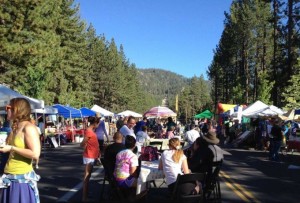
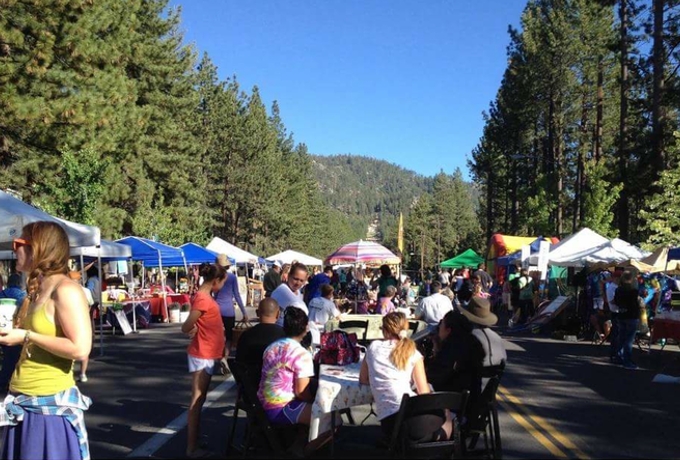
The Ski Run market has produce and entertainment. Photo/Provided

The Ski Run market has produce and entertainment. Photo/Provided

The two South Lake Tahoe markets kick off their seasons the first week of June. The El Dorado County Certified Farmers Market begins June 2 and will go through mid-October. It returns to the American Legion parking lot from 8am-1pm on Tuesdays. The Ski Run market in front of Blue Angel Café begins June 5. It is Fridays from 3-8pm.

“Some of the vegetables will be quite a bit earlier,” Jim Coalwell, who runs the Tuesday market, told Lake Tahoe News. This is because of the drought.

The pear crop in El Dorado County has been hit hard by fire blight.

“There’s been quite a bit of damage to pears and apples. Fire blight attacks and kills the blossoms,” Coalwell said.

He also runs the Placerville market, which starts this weekend.

Coalwell said the local farmers are doing OK with their water supply, and therefore what they can grow. The same is not true for the Fresno and Watsonville farmers who attend the South Tahoe market. For some of those farmers their water supply has been drastically reduced. Like last year, some fields will be fallow.

With most of the goods coming from small markets, Coalwell does not anticipate the supply of produce to be less than years past.

Some of the bigger changes Coalwell is contending with are rules coming out of Sacramento.

“The state used to take a 60-cent assessment per stall, now they want $2,” Coalwell said. “Theoretically it is used for inspectors to keep the markets honest.”

Processed food is being more tightly regulated by the state, as are some of the rules for farmers. These are all things Coalwell is still getting a handle on.

This marks the fifth year of the Friends of Ski Run market, which is run by a nonprofit. More than 20 vendors will be offering organic farm fresh produce, honey, locally raised meats, hot food for dinner, handmade ice cream, handmade chocolates and other treats.

There is also a bounce house and face painting for kids, live art performances-demos and local live music.

“We strive to support local entrepreneurs with more then 85 percent of our vendors being South Lake locals. With drought conditions and new regulations for farms, it is a crucial time to help support our local farmers and food supply,” Michaela Dickson, one of the organizers, told Lake Tahoe News.


Living with devastating reality of year-round fire season

By Julia Prodis Sulek, San Jose Mercury News

BISHOP — The fire came up quickly here in the eastern Sierra Nevada, destroying 35 homes and taking the mountainside community of Swall Meadows by surprise. Who would expect a roiling wildfire — throwing fireballs and whipping up flame whirls through 7,000 acres of sagebrush, piñon and Jeffrey pine — in the dead of winter?

“Three years before, I had 12 feet of snow at my house on that exact date in February,” said volunteer Fire Chief Dale Schmidt, whose Wheeler Crest station in the remote Swall Meadows neighborhood is surrounded by carcasses of burned homes. “Four years ago, they would have had a couple to 3 feet of snow where the fire started. That’s the mental state people were in: Winter is not the season for fire danger.”

As California enters its fourth year of drought, communities across the West are confronting a new reality — a year-round fire season. Perhaps nowhere are the consequences as obvious as in Swall Meadows, where the 300 residents are now shoveling ash instead of snow.

Read the whole story


Van Sickle provides beauty steps from casinos

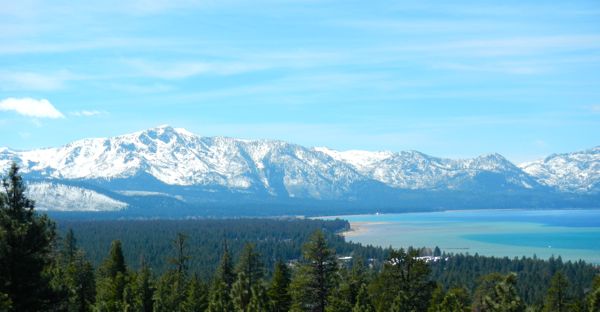
Mount Tallac from the vista point at Van Sickle Bi-State Park. Photos/Kathryn Reed

Mount Tallac from the vista point at Van Sickle Bi-State Park. Photos/Kathryn Reed

By Kathryn Reed

STATELINE – Immersed in a kaleidoscope of blues and greens, the landscape is mesmerizing. Perched on a slab of granite, its an unobstructed view of the hues of Lake Tahoe that complement the pale blue sky. Wispy clouds dance in the sky. Pines hover overhead, with branches dangling down as though to hug all those who enter the forest.

While Van Sickle Bi-state Park is always beautiful, it is even more so without many people accessing it. A few people were out Sunday – mostly walkers, plus a dude on a fat mountain bike.

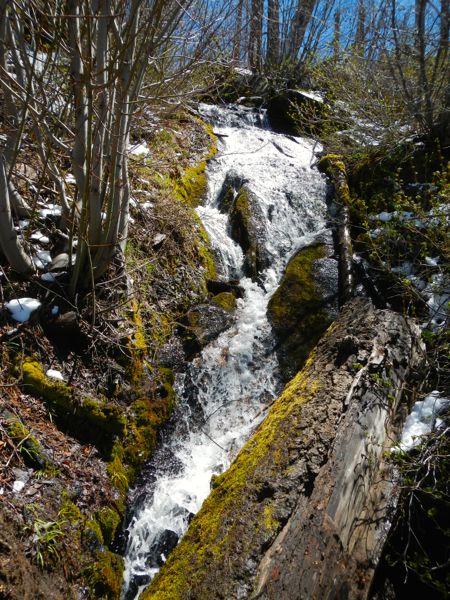
The waterfall at Van Sickle.

The waterfall at Van Sickle.

Signs of winter and spring dotted the trail April 26 with remnants of the previous day’s snowstorm and wildflowers starting to bloom.

It was the long dream of rancher Jack Van Sickle, who donated more than two-thirds of the land for the 725-acre park to the state of Nevada, to have his property be enjoyed by the masses. His old barn still sits on the land underneath the Heavenly Mountain Resort gondola line.

The park opened in summer 2011.

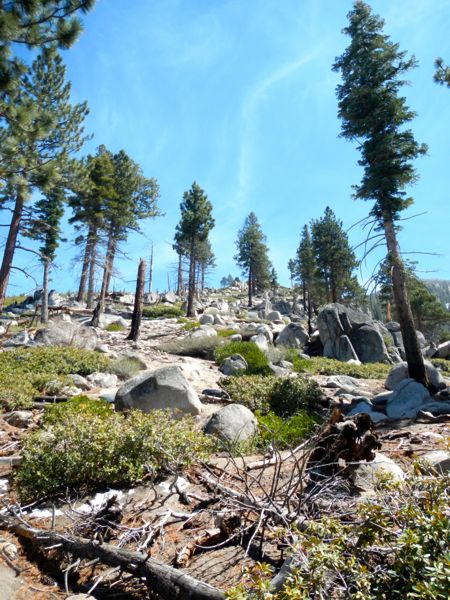
The path hooks up with the Tahoe Rim Trail.

The path hooks up with the Tahoe Rim Trail.

With how fast the waterfall if flowing, it would be hard to know this is year four of a drought. Now there are symbols on the signposts directing people to the falls, which are about 1.5 miles from the trailhead.

The gates open today. Vehicle access is from California near the intersection of Montreal Avenue and Heavenly Village Way. A footpath is accessible from there or it’s possible to park at Harrah’s and walk out the back entrance and get onto a trail on the other side of the road.


Linking ag-food-nutrition on global-local levels

By Kathryn Reed

INCLINE VILLAGE – The average person now lives farther from where her food is produced than at any other time in history. And, yet, without food, people won’t survive.

Feeding a world of nearly 9 billion people is not easy. And while there are 100 million fewer people classified as hungry today compared to 10 years ago, there are still approximately 800 million hungry people in the world. In California, 16 percent of the households suffer from hunger. One percent of youth in the United State have chronic nutrient deficiencies.

Josette Lewis

Josette Lewis

Hunger, malnutrition, poor diets and associated diseases were the topic of a lecture at Sierra Nevada College last week. Josette Lewis, associate director of the World Food Center at UC Davis, talked about the link between agriculture, food and health.

She said if diet is not addressed on a global scale, then the next burden would be chronic disease. It’s already evident. South Asia, Lewis said, is the No. 2 area in the world for the highest number of people with diabetes and it has some of the highest areas of malnourishment.

Worldwide women and children are more likely to be undernourished.

Lewis pointed out how obesity and malnourishment go hand-in-hand. Many high caloric, high fat foods are cheap.

Next month the World Food Center and Brookings Institution are having a conference to look at the cost of obesity on low-income families in the United States.

“If we want a healthy diet, it needs to be available,” Lewis said.

That is one of the problems – especially in Third World countries – the access to a well-balanced, nutrient rich diet is not available.

Water will increasingly be part of the discussion with food production, especially with California in its fourth year of drought. Lewis said 70 percent of the fresh water in the world is applied to agriculture.

“The majority goes off into the environment; into the soil or into surface water,” Lewis said.

With drip irrigation and other applications, the water is going where it’s intended to go instead of carrying soil nutrients and chemicals into other locations.

Lewis said the ag industry has made great strides in reducing water consumption. From the 1960s to the early 2000s there has been a decrease of 14 percent of applied water in California, while at the same time crops per acre have increased 85 percent.

“We need to be more efficient with the use of water. We are working on technology for irrigation and food processing technology,” Lewis said. “We are working to help faculty develop larger scale research programs.”

Climate change is also being incorporated into the equation because it is affecting what can be grown where.

“Nut crops are particularly sensitive to temperatures. They need a certain number of near freezing temperatures at night to hibernate so they produce in the spring,” Lewis said.

Nighttime temps are increasing, which is worrisome for those growing nuts.

There may be a geographic shift, Lewis said, in where things are grown. There has already been a shift north when it comes to growing wine grapes.

However, moving an entire industry is expensive and may not even be physically possible.

Lewis said the goal of the World Food Center is to “create transformational solutions to feed and nourish the world for decades to come.”


Liberty Utilities to ax coal from power supply

By Kathryn Reed

Liberty Utilities is removing coal from its power portfolio.

On April 24 it filed a request with the California Public Utilities Commission to change its allocation from NV Energy. This came one week after it filed paperwork to add solar.

“… as of Jan. 1, 2016, the resource portfolio available to serve Liberty Utilities’ California customers will be exclusively from hydroelectric, natural gas, or geothermal facilities and, importantly, no longer include any coal-fired generation,” the document says.

Today, Liberty buys all of its power from NV Energy.

In 2011, Liberty bought NV Energy’s service area that includes about 49,000 customers on the California side of the Lake Tahoe Basin, in Truckee, Alpine County and other areas of Northern California. The service agreement expires at the end of the year.

Liberty and NV on April 21 reached an agreement on another contract that calls for the elimination of the coal plant. This will mean Liberty will be paying NV Energy about $2.34 million less per year. That contract is good through 2022. It is up to the California Public Utilities Commission to approve the service agreement.

“Given NV Energy’s pursuit of non-coal fired energy sources as well as Liberty’s, we believe we will be able to meet our customers’ future demands in an economic fashion without the dependence on coal-fired energy,” Rich Salgo, vice president of operations for Liberty, told Lake Tahoe News.

Liberty is also asking for the CPUC to approve the solar projects. It plans to buy and operate two solar plants that combined are 65 megawatt facilities. These facilities will more than replace the coal.

If the solar plants have a glitch, NV will supply the requisite amount of power to Liberty. The contract says Liberty could purchase up to 30.5 percent of its renewable energy from NV if the solar plants are not available.

With all the changes, Liberty expects to save $200,000 per year.

California law mandates that sellers of electricity must have 33 percent of their load be serviced with renewable energy by 2020. This will help Liberty reach that mandate. As of September 2014, the latest data available, the mix NV supplied Liberty was 52.44 percent natural gas, 21.7 percent renewable, 20 percent coal, 4.45 percent hydro, 1.4 percent nuclear and 0.01 percent oil.

“We will continue to pursue energy sources that will enable us to meet California’s increasing renewable energy requirements through 2020,” Salgo said.

NV in 2013 said it would begin eliminating coal immediately. However, the Valmy plant in Humboldt County, Nev., is expected to be online through 2025. That plant as of next year will not be supplying Liberty customers, assuming the CPUC approves the proposals.

Earlier this month the Tahoe Area Sierra Club had a talk focused on Liberty’s use of coal and the desire to have the power company change its practices.

“We are impressed with the groundswell of local support we have seen for this initiative to go coal free. Liberty was cooperative throughout our discussions and we congratulate them for coming to a good decision – good for Tahoe, Liberty and the warming planet,” Grace Anderson, lead volunteer for the Sierra Club Beyond Coal Campaign Tahoe Basin, told Lake Tahoe News.

The national conservation organization had been putting pressure on the utility to discontinue using Valmy. Sharing the Sierra Club’s point-of-view were the local chapter as well as the Mother Lode and Toiyabe chapters, South Tahoe Citizens Climate Lobby, and Sierra Nevada Alliance.


Calif. drought tests strength of water rights

By David Siders and Jim Miller, Sacramento Bee

High above a landscape parched by unremitting drought, Meadow Valley Creek courses through the northern Sierra Nevada and pools in a stand of alders behind a tiny, concrete dam.

Robert Forbes draws water from the reservoir through an overturned smokestack and into a ditch that has run west of Quincy for more than 100 years.

He adjusted a piece of plywood at its mouth to restrict the flow one recent morning. In dry years, Forbes said, “I start rationing people along the line.”

Forbes’ family’s access to this water derives from an 1870s claim in Plumas County; and his antiquated management of the ditch – breaking ice with a shovel in the winter, negotiating irrigation schedules among neighbors when the weather warms – has persisted for decades with little intervention.

Earlier this year, the state Water Resources Control Board ordered more than 1,000 property owners to prove their water rights. This month, the board warned claim-holders to expect curtailments of their ability to divert water from rivers and streams.

The actions are significant because they include the state’s most senior water rights holders – those claimed before California established its permitting process in 1914.

Read the whole story