Reclaiming federal land has strong allure in West

By Nigel Duara, Los Angeles Times

American Lands Council promises cash-strapped Western communities a chance to win back federal acreage
Utah has passed legislation demanding return of all federal land; experts say it will never happen
Proponent sums up Western land transfer movement: ‘It’s the principle’
Spread over 6,500 miles of sparse scrub and alkaline soil, Millard County is one of Utah’s poorest. But for five years, the cash-strapped county so remote it was the site of a Japanese American internment camp in World War II still found $1,000 to send to the American Lands Council.

The Lands Council’s goal is grand but simple: to wrest control of vast swaths of land from the federal government and turn them over to the states.

At stake are hundreds of millions of dollars, even billions, that could be made off land administered by the federal government. The big-dollar opportunities include oil leases in Utah grassland, all-terrain vehicle tourism in Arizona and rare-earth mineral mining in Nevada.

Read the whole story


Animals in drought-stricken West dying for water

By Darryl Fears, Washington Post

For the giant kangaroo rat, death by nature is normally swift and dramatic: a hopeless dash for safety followed by a blood-curdling squeak as their bellies are torn open by eagles, foxes, bobcats and owls.

They’re not supposed to die the way they are today — emaciated and starved, their once abundant population dwindling to near nothing on California’s sprawling Carrizo Plain, about 100 miles northwest of Los Angeles, where the drought is turning hundreds of thousands of acres of grassland into desert.

Without grass, long-legged kangaroo rats cannot eat. And as they go, so go a variety of threatened animals that depend on the keystone species to live. “That whole ecosystem changes without the giant kangaroo rat,” said Justin Bra­shares, an associate professor of wildlife ecology and conservation at UC Berkeley.

Endangered kangaroo rats are just one falling tile in the drought’s domino effect on wildlife in the lower Western states. Large fish kills are happening in several states as waters heated by higher temperatures drain and lose oxygen. In Northern California, salmon eggs have virtually disappeared as water levels fall. Thousands of migrating birds are crowding into wetlands shrunk by drought, risking the spread of disease that can cause huge die-offs.

As the baking Western landscape becomes hotter and drier, land animals are being forced to seek water and food far outside their normal range. Herbivores such as deer and rabbits searching for a meal in urban gardens in Reno are sometimes pursued by hawks, bobcats and mountain lions. In Arizona, rattlesnakes have come to Flagstaff, joining bears and other animals in search of food that no longer exists in their habitat.

“You think about it. In our urban environments, we have artificial water. We’re not relying on creeks,” said David Catalano, a supervisory biologist for the Nevada Department of Wildlife.

A Tahoe coyote. Photo/LTN file

A Tahoe coyote. Photo/LTN file


Enthusiasm surrounds pro cycling in Tahoe

By Susan Wood

With cowbells clanking and a Kentucky-Derbyish announcer yelling in the background, history was made Saturday in South Lake Tahoe with the Women’s Amgen Tour of California wrapping up its second day.

Leah Kirchmann of Canada, riding for Optum Pro Cycling, won the stage of the largest and first tour in the United States – inspiring hundreds of little girls and cycling enthusiasts in her path. Coming in second was U.S. rider Lauren Komanski, who also holds the distinction of being the yellow jersey winner for overall best time after two days. Trixi Worrack of Germany placed third.

They race in Sacramento on Sunday.

Front and center of the commotion at the finish line on May 9 was Joanna Lilly, a recreational rider who brought her two daughters, Alice, 7, and Zella, 5, to watch the spectacle.

“I encourage them to do every sport we have to offer. They ride. They ski. They play soccer,” Lilly told Lake Tahoe News. The enthusiasm was marked by spectators banging on the barricades.

It was a day of encouragement all around. It was also a day to propel women’s cycling a step closer to being on an even playing field with the men and a day to place Lake Tahoe on the proverbial publicity map.
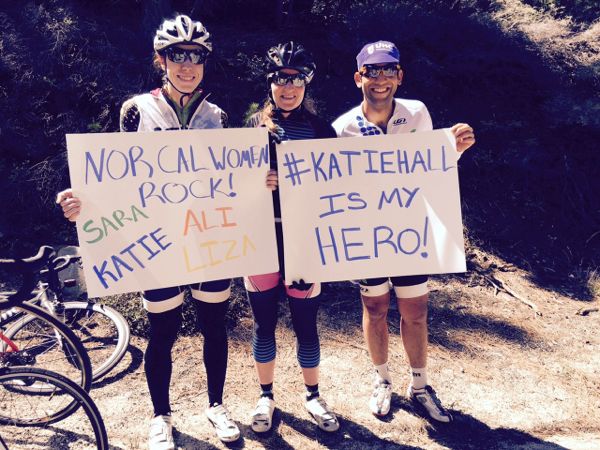
South Lake Tahoe resident Tina Hughes, from left, Amanda Siegel of Sacramento and Stephen Katana --  fiancé of Stage 1 winner Katie Hall -- on Apache Drive in Meyers on May 9. Photo/Trish McGraw

South Lake Tahoe resident Tina Hughes, from left, Amanda Siegel of Sacramento and Stephen Katana — fiancé of Stage 1 winner Katie Hall — on Apache Drive in Meyers on May 9. Photo/Trish McGraw

The South Shore loop was marked by a blink-and-you-miss-it blur of 70 riders who whizzed by for two laps between Heavenly Mountain Resort’s California Base Lodge, down Pioneer Trail to Meyers and back.

About a dozen people had gathered on Highway 50 in the heart of Meyers with many others up Apache Road to see the riders snake through town.

Kyle Anton of Meyers brought his two young daughters on a walk to perch themselves on a rock near Steve’s Transmission.

“It’s important for them to see women athletes to give them encouragement and to show them they can do whatever they want to do,” he said.

When asked if Dylan, 6, had ever seen a professional, competitive race like this, she blurted out: “On TV.”
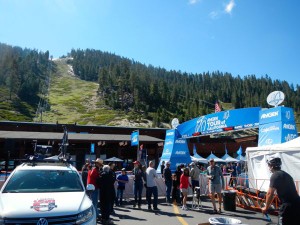
Amgen 2015:

A day earlier snow covered the slopes at Heavenly Mountain Resort. Photo/Kathryn Reed

Dickson Brown of Stateline, who makes a point of catching the Tour de France on television, was not going to miss the up-close-and-personal view of a large-scale cycling event in his backyard.

“To have something like this, people should come out to support it. A lot of people thought: ‘Oh, this is only the girls,’ but women’s sports need to be supported as much as men’s sports because they don’t get the money or the limelight the men do. They’re dedicated and give up a lot of their time,” he preached.

Brown was so eager to see the race he parked along the route early, an hour before the ride started at 10:30am and waited for friends. They were headed up Apache to get a view of the women climbing.

“You can get a good idea of who’s riding well and who’s not riding well,” he said based on the riders’ ascent.

Graeme Holdsworth wanted to get a clear view of how his friend, rider Jo Hogan, was doing by preparing to also ride his bike up Apache.

“It’s a good route. It’s picturesque, but since it’s snow country, the road surface is in not that good of shape,” said the Australian. He rode the route earlier this week.

When asked if he could keep up with his professional rider friend, he declared a resounding: “No.”

Across the highway, John Hoefer felt right at home with his lone lawn chair – living the nostalgia of days gone by trying to keep up with his boys.

“My sons were all bike racers,” he said.

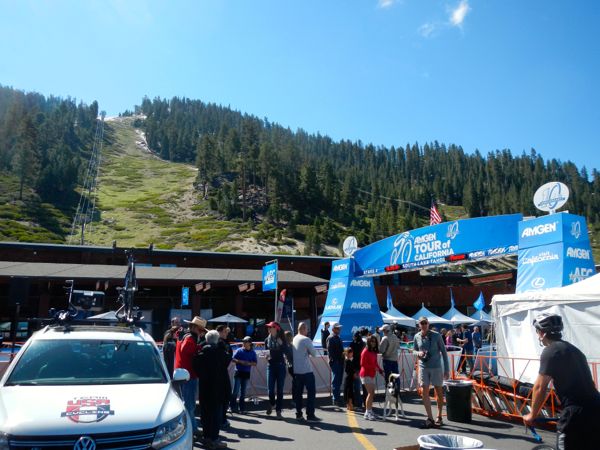
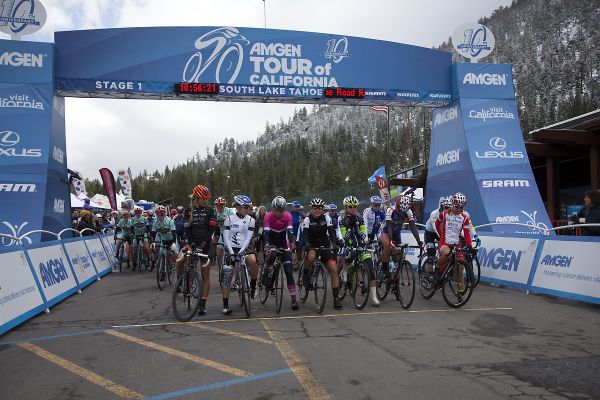
Teams line up for the second stage that had riders race a loop on the South Shore.

Teams line up for the second stage that had riders race a loop on the South Shore. Photo/Kathryn Reed

Over at Ski Run Boulevard leading up to the end of the first lap, Wendy Mains of Roseville expected a larger crowd. She showed up at Pioneer Trail and Ski Run with her Sacramento-area friends.

“I had no idea this was going on (before we got to Tahoe). This is great. We walked everywhere expecting to see more people,” she said.

Her friend, Dana Eagen of Loomis, agreed, wondering if it’s just a late-bloomer thing for Americans to appreciate a sport that is so big overseas.

“This is typical of Americans trying to learn a European sport. It’s like trying to teach football to a Spaniard,” he said. “This sport is all about Europe.”

That trend is something the Women’s Cycling Association would like to do something about.

“History is being made, and we’re making a powerful statement – that women belong in big time stage racing. When you look at this, it’s a huge step in the right direction. There’s still work to be done, but we’re encouraged Amgen stepped up to the plate and expanded the women’s race,” Jill Gass, a coach from Revolution Coaching, told Lake Tahoe News.

She was especially enthusiastic about a slim margin between the leaders.

“I thought the finish would be more spread out. The women’s race should be super exciting (by the end of Sunday),” she said.
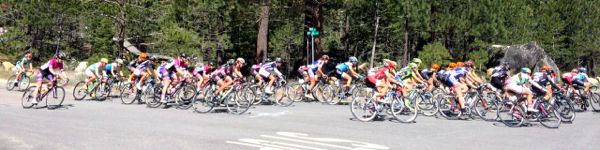
The peloton at Portal Drive and Highway 89. Photo/Kim Wyatt

The peloton at Portal Drive and Highway 89. Photo/Kim Wyatt

Gass was joined by Inga Thompson, a three-time Olympic women’s cyclist, Tour de France winner and 10-time U.S. national champion. Thompson expected more advancement from the sport in the last few decades, but she’s happy with any progress. She retired from racing in 1993.

“Women’s racing has gone downhill through the years, so it’s big to see Amgen bring back the three-day race. We’re rebuilding from 30 years ago. I applaud it,” Thompson told

Riders a bit younger were at least encouraged to see people.

“This is one of the best supported races I’ve ever been in,” Alison Tetrick of Petaluma said, while resting after the race with her winning teammates. Optum had just won the stage for Day 2.

“The crowd was large and boisterous,” she said.

Perhaps support is relative.

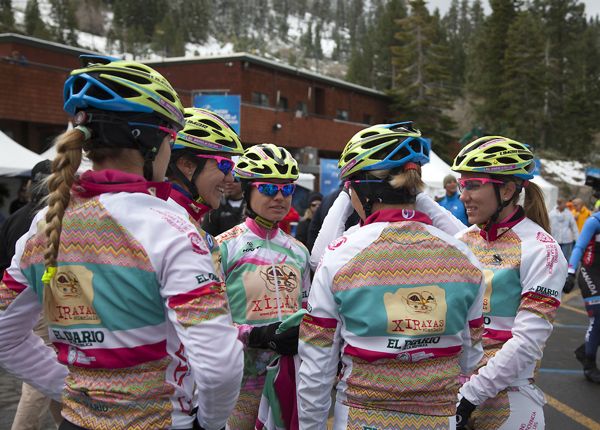
“I feel like not many people knew about it,” Sacramento rider Amanda Seigle said after the race. Her friend and fellow rider, Tina Hughes, shared how a few of her South Lake Tahoe friends and neighbors didn’t know the race was going on.

The duo would like to see the women’s race staged in conjunction with the men to ensure a larger turnout.

“But this was a nice boost to women’s racing,” said Seigle, who rides for Jakroo Racing.

ngg_shortcode_0_placeholder (Click on photos to enlarge.)



Blame warm winter for spike in food prices

By Russ Parsons, Los Angeles Times

The display at the Weiser Family Farms’ stand at the Santa Monica farmers market last weekend was sparse, even by early spring standards — potatoes, some green shallots and garlic, a little sprouting broccoli. The lilacs that signal the start of spring for many Southern Californians came and went weeks ago.

But a couple of stalls down, a shopper could find cherries, apricots, and even peaches and nectarines that tasted like midsummer.

That, in a nutshell, is the state of California’s nearly $30-billion produce industry, which accounts for more than half of the fresh fruits and vegetables grown in America.

Fruit has been ripening and ready to pick at almost shockingly early dates. At the same time, some vegetables have been in extremely short supply, resulting in much higher than normal prices. Lettuces are selling at wholesale for twice what they were at this time last year. Cauliflower has doubled just since February.

Read the whole story


USFS chief: Expect ‘above average’ fire season

By Kevin Freking, AP

WASHINGTON — The head of the U.S. Forest Service warned Tuesday of an “above average” fire season that could cost the agency more than $1 billion and require shifting funds from programs designed to prevent wildfires.

Tom Tidwell testified before the Senate Energy and Natural Resource Committee that the fire season is 60 to 80 days longer than it was just 15 years ago, and he didn’t expect any falloff. “These are the fire seasons we’re going to continue to have,” he said.

California and several other Western states are battling severe drought, increasing the risk of wildfires.

Tidwell estimated that the agency’s cost of fighting wildfires this year would be in the range of $800 million to $1.7 billion.

The Forest Service and the Department of Interior can transfer money from other programs once their fire suppressions accounts have been depleted. But Tidwell called that process self-defeating because it requires the agencies to delay work designed to limit the threat of wildfires.

Lawmakers agreed that changes are needed, but they differ on key details that could make consensus difficult. There’s some bipartisan support for the administration’s efforts to make the biggest forest fires eligible for disaster funding. Two Republican members of the committee, Jeff Flake of Arizona and John Barrasso of Wyoming favor an approach that places more emphasis on forest management projects to prevent wildfires, including a speedier environmental review process for those projects.

Republican Sen. Lisa Murkowski of Alaska, the committee’s chairman, said residents in her state are worried about the coming fire season. She said she visited Fairbanks recently and couldn’t remember another beginning of May with no snow on the ground.

The ranking Democrat on the committee, Sen. Maria Cantwell of Washington, called for Tidwell to work with other agencies to improve communications services during a forest fire. Last year’s Carlton Complex fire in her home state left many residents without power and the ability to communicate for weeks due to downed power lines. Police had to drive from town to town and use megaphones to spread word of the threat, she said.


Women fight to win Lake Tahoe cycling race

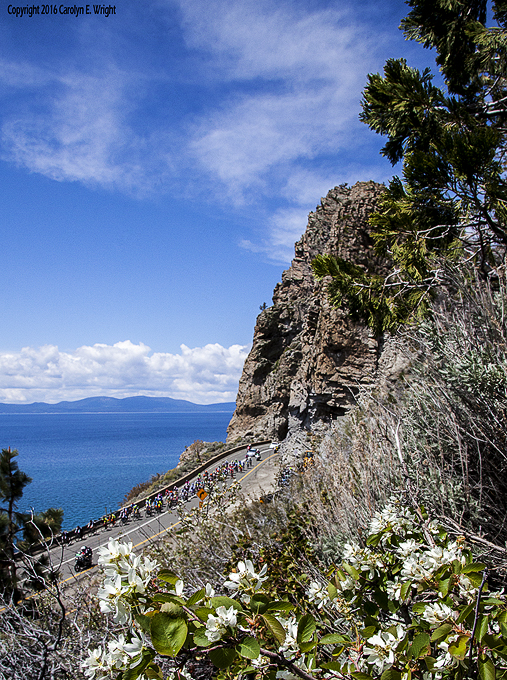
The peloton makes its way through Cave Rock on May 8. Photo Copyright 2015 Carolyn E. Wright

The peloton makes its way through Cave Rock on May 8. Photo Copyright 2015 Carolyn E. Wright

By Kathryn Reed

Mother Nature teased Amgen Tour of California race officials Friday morning as temps hovered just above freezing and snow danced in the air. As the 11am start time got closer, the clouds parted to show blue sky and the requisite 45-degree mark had been reached.

Eighty-two elite women racers left Heavenly Mountain Resort’s California Lodge on May 8 on a 74.5-mile trek around Lake Tahoe, with an elevation gain of 5,300 feet. They rode through South Lake Tahoe, turned right onto Highway 89 to ride around the lake (72 miles) and then up Keller Road with its 15 percent grade, to finish at the California Lodge. (Cycling events go clockwise because it’s safer to make right turns.)

Elite racing bikes easily cost five figures. Photo/Carolyn E. Wright/Copyright

Elite racing bikes easily cost five figures. Photo Copyright 2015 Carolyn E. Wright

This is the first time a women’s cycling event of this caliber has been staged in the United States.

As the teams each signed in and were introduced before the start, Ali Tetrick of the Optum team said, “I think at the finish you will see a small group. You will see who wants to sprint after climbing that hill.”

She was correct in her prediction.

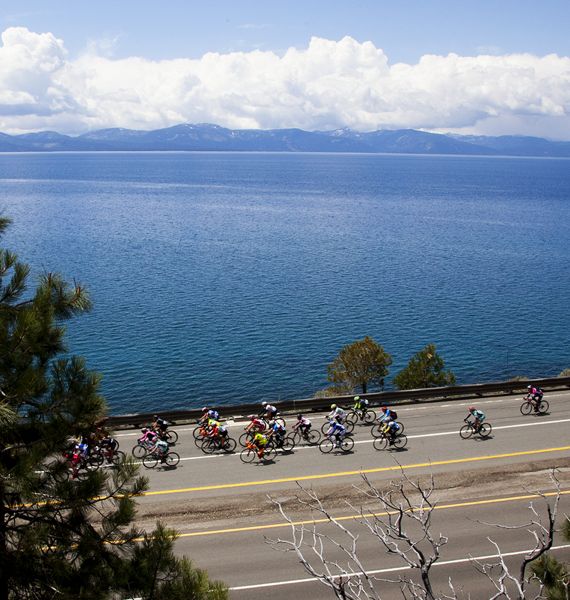
Riders enjoy views of Lake Tahoe for much of the competition. Photo/Carolyn E. Wright/Copyright

Riders enjoy views of Lake Tahoe for much of the competition. Photo Copyright 2015 Carolyn E. Wright

“That last hill will turn riders inside out,” the announcer boomed as the pack thinned out in the last few miles. “They are all hoping they have enough gas in the tank to make it to the finish. You thought the Donner Party was bad; this is ridiculous.”

Katie Hall of team United Health Care crossed the line first with a time of 3:10.49. Rounding out the podium were Alena Amialiusik of Velocio-SRAM and Lauren Komanski with Twenty 16, both with a time of 3:10.51.

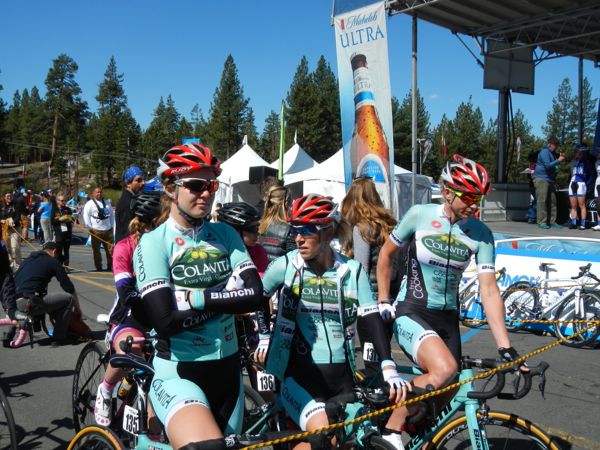
Top riders from each team on the start line. Photo/Carolyn E. Wright/Copyright

Top riders from each team on the start line. Photo Copyright 2015 Carolyn E. Wright

Sarah Storey (Pearl Izumi) started a breakaway and was followed by Allison Beveridge (Canadian national team). They pulled 1:25 minutes ahead of the peloton until they were caught at the top of Spooner Summit.

With 7 kilometers to go, all the major teams had a rider in the breakaway. One by one they started to fall back.

Earning the best young rider jersey was Hannah Barnes (UHC); Queen of the Mountain went to Storey; and the sprint leader was Beveridge.

The gear, the bike and the rider are lightweight. Photo/Carolyn E. Wright/Copyright

The gear, the bike and the rider are lightweight. Photo Copyright 2015 Carolyn E. Wright

Dealing with the elements

The elevation and temperature are not issues most of these cyclists have to deal with on a regular basis.

Lauren Stephens with team Tibco said, “I’m used to riding in 100-degree heat, and 100 percent humidity.” The topped ranked rider in the United States in 2014 calls Texas home.

Storey said, “We had a lot of preparation with the altitude.”

The British athlete is already well decorated with Olympic cycling and swimming medals from the 1996 Paralympic Games in Atlanta. (When she was born her left arm was entangled with the umbilical cord in the womb, which left her left hand unable to function.)

Rhae Shaw her BMW team scouted the course in March. Photo/Carolyn E. Wright/Copyright

Rhae Shaw and her BMW team scouted the course in March. Photo Copyright 2015 Carolyn E. Wright

The BMW team came to Tahoe in March to check out the courses. It was beautiful weather for their weeklong training – nothing like this week’s weather.

While May is always iffy weather in Lake Tahoe, it felt more like winter than spring on Friday. More snow covered Gunbarrel than has been on that ski slope in the last month. All morning clouds shrouded Mount Tallac.

Cycling is a team and individual sport. Photo/Carolyn E. Wright

Cycling is a team and individual sport. Photo Copyright 2015 Carolyn E. Wright

The cold had most of the riders covered head to toe, with only a few braving shorts.

“We know mountain weather. Anything can happen,” Rhae Shaw of the BMW team told Lake Tahoe News before the start.

“It’s very difficult to ride at this elevation,” Shaw added. She said Colorado is the other area that gives cyclists a bit of a challenge when it comes to altitude.

Saturday’s forecast is a high of 61 degrees in South Lake Tahoe.

Cyclists pause for the national anthem. Photo/Kathryn Reed

Cyclists pause for the national anthem. Photo/Kathryn Reed

Local impact

The South Shore in 2011 tried to host the men’s first stage. Mother Nature wasn’t as forgiving then and the race was canceled because of snow.

Carol Chaplin, executive director of Lake Tahoe Visitors Authority, was hesitant to put a dollar figure on the economic impact a race of this magnitude has on the region.

“More for us it’s about the awareness of the destination,” Chaplin told Lake Tahoe News. “We have great cycling. Elite athletes like to train here.”

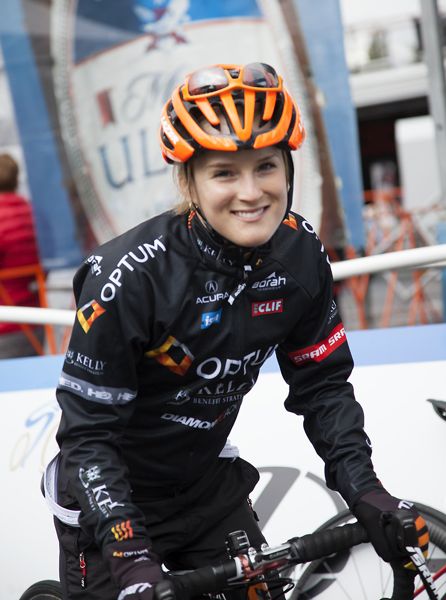
A team Optum rider prepares for the start of the first phase. Photo/Carolyn E. Wrigth

A team Optum rider prepares for the start of the first phase. Photo Copyright 2015 Carolyn E. Wright

While the North Shore does not have a start or finish like when the men’s race was here and Northstar and Squaw Valley were part of the itinerary, it is still involved.

Sandy Evans Hall, executive director of the North Lake Tahoe Resort Association, was on hand for the start of Friday’s race.

“They will get to see the entire lake. It showcases what we have,” Hall told Lake Tahoe News. “We are really focused on human powered sports.”

Katie Hall, center, celebrates her win May 8 with Alena Amialiusik, left, and Lauren Komanski

Katie Hall, center, celebrates her win May 8 with Alena Amialiusik, left, and Lauren Komanski. Photo/Kathryn Reed

Even though there isn’t live television coverage of the women’s races in Lake Tahoe, it is possible to stream the events. And footage from these events will be used during the men’s race this coming week.

Plus, it gives locals a chance to see a professional sporting event for free. More than 100 people gathered near the Y on Friday as the cyclists made the turn onto Highway 89. Cheering crowds were in groups throughout the race as well as many more who gathered at the finish line.

—–

     Notes:

·  Stage 2 for the women begins May 9 at 10:30am at Heavenly Mountain Resort’s California Lodge.

·  The 49.7-mile course goes into Meyers, will be two circles, with an elevation gain of 3,300 feet.

·  Pioneer Trail will be closed from Ski Run Boulevard to Highway 50 in Meyers from 9:30am-1pm.

·  The finish at the Cal Lodge is expected to be at 12:30pm.

·  For more info, go online.

·  There are two sites where people may stream the event live. Here is the first and the second.


Calif. government not planning for retirements

By Jon Ortiz, Sacramento Bee

California state government continues to struggle with plans for replenishing its aging workforce, according to a new report released Monday, chiefly because departments talk a good game but largely fail to follow through.

Nearly 41 percent of state employees are age 50 or older, State Auditor Elaine Howle noted in her assessment, yet the Department of Human Resources has been slow to assess what departments are doing to plan for the next generation of employees.

And three departments first reviewed in 2009 – the Office of Emergency Services, Caltrans and the Department of Social Services – have made some progress but need to do much more.

Read the whole story


EDC leader has history of costing taxpayers

By Kathryn Reed

Pamela Knorr is proving to be a financial liability for her employers — aka the taxpayers. First it was Alpine County, now it is El Dorado County.

On July 3, 2012, Knorr signed a five-year contract to be CAO of Alpine County at a rate of pay of $11,757 per month. She also received a $400 a month car allowance and access to the county credit card presumably for county business. The contract said Knorr would be entitled to 18 months severance pay if she were terminated.

Pamela Knorr

Pamela Knorr

She and the board agreed to this even though months earlier she believed the sheriff and county auditor were harassing her.

Knorr on April 11, 2013, filed a claim against the county alleging harassment that dated to April 2012 – three months prior to signing the long-term contract.

Knorr’s claim states the Alpine County sheriff initiated a criminal investigation of Knorr in an effort to harass, retaliate and intimidate her. The claim also states that the auditor harassed and retaliated against her and that Knorr “was subjected to unwanted harassing conduct by men who harassed, attempted to coerce, threatened, intimidated, and discriminated against (her) for being a women in a leadership position.”

The claim says county counsel and the Board of Supervisors in April 2012 were notified of the alleged harassment.

Alpine County and Knorr settled that dispute for $10,000.

Her last day with Alpine was Aug. 2, 2013. She was paid $80,145.50 on Aug. 7, 2013, and another $80,145.50, on July 1, 2014, as severance per the contract.

Janet Dutcher, Alpine County assistant CAO, told Lake Tahoe News that Knorr agreed to take less than what the contract called for and to have it split in two payments.

Knorr did not return Lake Tahoe News’ phone call.

Knorr is not done with Alpine County. A former Alpine County employee who worked for her when she was CAO has sued her. Robert Levy, former undersheriff of Alpine County, in the 19-page lawsuit alleges Knorr along with three supervisors at the time and a private citizen violated his civil rights, conspired to do so, discriminated against him based on age, failed to prevent discrimination and retaliation, violated the Public Safety Officers’ Procedural Bill of Rights Act, and defamed him.

“Her theory was a younger, cheaper workforce was better,” Jeanette Viduay, investigator with the Watts Law Office, told Lake Tahoe News.

Knorr is 44 years old.

She was not unemployed for long. El Dorado County hired her in September 2013 as Human Resources director.

El Dorado County’s recruitment for Knorr’s position was for the shortest amount of time allowed by county policy, which is unusual for such an important job. Terri Daly was CAO at the time. Daly and Knorr share a close friend and mentor, Yolo County CAO Patrick Blacklock. Blacklock is the former CAO of Amador County. Daly and Knorr are former Amador County employees.

Daly’s employment as El Dorado County CAO was terminated in November 2014. She received a $150,000 settlement. Knorr replaced Daly as CAO at that time.

As the top official in El Dorado County, Knorr as chief administrative officer is not taking actions to remedy the budget debacle her predecessor, Daly, created. Daly went on a hiring spree, which is the same as a spending spree. Each month the county is spending $1.3 million more than it is taking in. A $10 million surplus has been exhausted.

The five members of the Board of Supervisors, who are Knorr’s bosses and who earlier this year gave her the one-year contract, have not mandated the spending be stopped. While it is the board’s responsibility to set policy and then for Knorr and other staff to carry out the policy, there is a bit of tug-of-war over who has responsibility over the budget. Ultimately, though, it will be the electeds who vote on the budget, so it is their responsibility to OK how much is spent on what.

Brian Veerkamp, chair of the Board of Supervisors, did not return a call.

While Knorr’s contract for CAO is for one year, she is also still head of the Human Resources Department. This means that anyone who has an issue with Knorr or others in her department have no recourse. This is the same HR Department that was lambasted this spring by the county grand jury.


Visits to U.S. ski areas fall 5% in 2014-15

By Jason Blevins, Denver Post

The snowless winter in California overwhelmed the snowy East to yield the ski resort industry’s second worst season in 16 years. Resorts across the U.S. saw visits fall to 53.6 million, according to a preliminary count by the National Ski Areas Association.

While it wasn’t as bad as the 2011-12 season, when visits plummeted 16 percent from the previous season to 51 million, visits for the 2014-15 season fell 5 percent. The season finished 3.8 percent below the five-year average of 55.7 million.

Snowfall was down 28 percent across the country, according to early results from the the NSAA’s annual Kottke Survey.

Read the whole story


4 on sailboat barely survive Lake Tahoe storm; South Shore marina loses rental boat

A rental boat at Camp Richardson capsizes May 7. Photo/Bob Sweatt

A rental boat at Camp Richardson capsizes May 7. Photo/Bob Sweatt

By Kathryn Reed

A skipper with 30 years of experience on Lake Tahoe was barely able to make it to shore safely on Wednesday because of the 4 to 8 foot waves.

Mike Young of Incline Village left Obexer’s in Homewood about 2pm May 6 destined for Incline Village, but wound up at Camp Richardson about 7pm. By that time all four on board the vessel had their lifejackets on, the Coast Guard had been called and uncertainty was setting in.

“We were pretty close to the East Shore. We saw one little squall coming across the west to Incline and thought it would blow by and we would be good,” Young told Lake Tahoe News. “But it filled up fast.”

Someone on shore alerted Young that the waves were high and the wind was howling so it would best to try to land elsewhere.

Young wasn’t worried about whether the boat could handle the storm; he just needed a place to dock.

He called the U.S. Coast Guard when he was off Zephyr Cove.

“They said when you are in trouble, call us and we will send a helicopter,” Young said.

The Coast Guard, which is stationed in Tahoe City, said the boat was not in distress. Uncertainty, alert and distress are the three levels of search and rescue, according to the USCG. Because the boat was able to sail, it did not need rescuing, according to USCG protocols.

“We are not allowed to give navigational advice,” Thomas Hussey, USCG boatswain’s mate second class, told Lake Tahoe News. This is because if the vessel does not make it, the Coast Guard does not want to be held liable.

Hussey said it was from Camp Richardson personnel that they heard the boat was going to moor there.

Young said the decision was made to head south because that was the direction the wind was coming from.

He turned the sailboat around. At first shelter was found at a cove near D.L. Bliss State Park. Waves were 3 to 4 feet going across the lake. Then he tried to find a nearby buoy, but was unsuccessful so he headed toward the mouth of Emerald Bay.

A call to Camp Rich was made and people there said it was not windy. But that didn’t last.

Bob Hassett, who runs Camp Rich Marina, said in a one-hour period the wind at Lake Tahoe Airport measured 5 mph from the southwest and then it was variable before having gusts of 30 mph out of the northeast.

“That is abnormal,” Hassett told Lake Tahoe News of the 180-degree change. “Then it churned the lake. The waves were from one direction, wind from another and that is where you have troubles.”

By the time Young, who was under motor power for this stretch, made his way to the South Shore resort the wind had done the 180 and he said waves reached 8 feet at times.

Camp Rich employees went out in a skiff to retrieve the four from the sailboat. While Hassett said he doesn’t like to put employees in harms way, not helping wasn’t an option. Young was appreciative of all the assistance the Camp Rich guys provided.

For now the sailboat is on a buoy; waiting for the weather to clear so it can be sailed to its home part in Incline.

In addition to Hassett’s employees assisting with rescuing the four sailboaters, Hassett lost one of his rental motorboats and another was damaged, but is salvageable. New, the boat costs between $30,000 and $50,000.

Still, the marina operator said he would open for business May 15.