LTCC instructors tackle racial inequality

LTCC instructors, from left, Yasmin Sayyed, Scott Lukas and Albert Ponce, on May 19 discuss racial issues. Photo/Kathryn Reed

LTCC instructors, from left, Yasmin Sayyed, Scott Lukas and Albert Ponce, on May 19 discuss racial issues. Photo/Kathryn Reed

By Kathryn Reed

White privilege. It’s a concept that 50 years removed from the heyday of the Civil Rights movement is still hard for some people to grasp.

This was obvious by the questions being asked during a 90-minute seminar at Lake Tahoe Community College on May 19 on what would have been Malcolm X’s 90th birthday. The civil rights activist was gunned down in 1965 at the age of 39.

“When you watch the coverage of what went down in Waco it’s a system of privilege,” LTCC sociology instructor Scott Lukas told the nearly 70 people in attendance.

Had the deadly biker gang fight on Sunday in Texas been between blacks instead of whites, Lukas believes the response by police and the media would have been much different.

Albert Ponce, political science instructor, said, “Relationship today exist vertically. It needs to be horizontally. We need intercultural dialogue – and not be told what we should become. That is assimilation.”

He believes interculturality is the answer to people understanding and respecting one another, not multiculturality.

Yasmin Sayyed, LTCC sociology instructor, stressed the need for people to not lose themselves as they blend in with the majority. It’s about never losing your own story and not taking on someone else’s.

“If education means you lose your mother tongue, then it is a hollow victory,” Sayyed said.

Sayyed grew up in New York, where she knew Malcolm X. She met him in 1964 after she returned from Mississippi where she was getting people to register to vote. It was the summer before her 18th birthday. She said she returned to Harlem broken – having been beaten and sexually assaulted in the South.

She embraced much of what Malcolm had to say.

“Who are we to let our oppressors define how we fight our oppression against them. His words started having a different implication for me especially after my experience in Mississippi,” Sayyed said.

“We stapled our picket signs to baseball bats. It was amazing we never got spat on again,” she said. She never took a swing at anyone, but the gesture made people take notice.

From there the discussion in the Malcolm X camp became less about what drinking fountain blacks could drink out of, and more about moving away from protests and seeking political power.

Sayyed said the fight then and today is not against white people, but it’s against whiteness.


SLT making it easier to access Connolly Beach

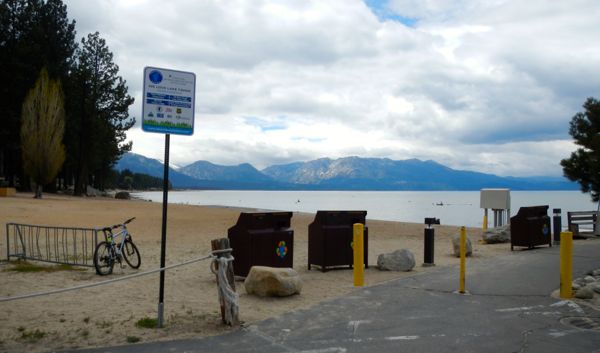
South Lake Tahoe officials want to ensure the public has access to Connolly Beach. Photos/Kathryn Reed

South Lake Tahoe officials want to ensure the public has access to Connolly Beach. Photos/Kathryn Reed

By Kathryn Reed

Three bear boxes, boulders and a beat up bike rack are what welcome the public to Connolly Beach from the parking lot. The pavement is in disrepair. Vehicle access is through the hotel maze.

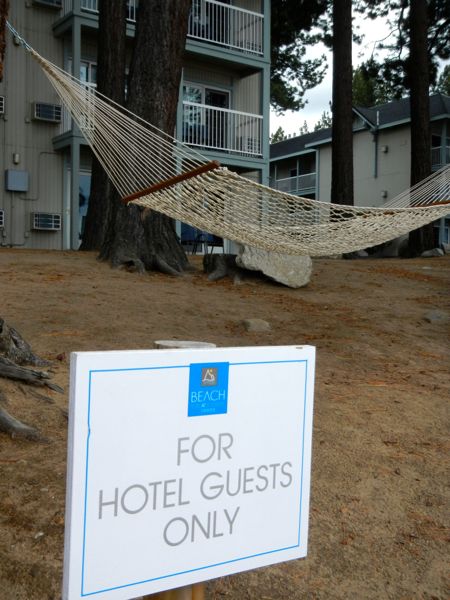
A sign says no alcohol is allowed on the beach, but the owners of the Beach Retreat Hotel have set up a bar. Farther down are four hammocks with signs saying they are only for hotel guests.

This stretch of sand in the middle of South Lake Tahoe has been contentious for years. And even though the state Supreme Court has weighed in on the topic, the city and current owner – Urbana Realty Advisors – are still not on the same page.

“I feel excluded even though I know my feet treaded there as a kid,” Sue Hoy told the City Council on Tuesday. She said the beach is now “totally unwelcoming.”

Hotel owners have strung private hammocks on the public beach.

Hotel owners have strung private hammocks on the public beach.

As with all beaches in California, the public has a right to access the sand below the high-water mark at any hour of the day, every day of year.

The court, though, ruled the public also has access from the high-water mark – 6,229.1 feet – to 100 feet toward the hotel. No one bothered to survey this at the time of the 1985 decision. The city recently did. That 100 feet goes into the buildings.

This is why the city wants all of the beach to be accessible to the public. The courts said so. However, access to the 100 feet from the high-water mark is only available June 1-Sept. 30, sunrise to sunset.

The South Lake Tahoe City Council on May 19 was updated on where things stand regarding what is better known as Timber Cove Beach and gave staff direction on how to proceed.

No one from the property attended the meeting.

“They can’t ask the public to leave unless they are disruptive,” City Manager Nancy Kerry explained.

The gate at Bal Bijou is coming down by the end of May.

The gate at Bal Bijou is coming down by the end of May.

The gate at Bal Bijou will be removed before June 1 so the public has access to the beach parking area without having to drive through the hotel property. A tree needs to come down and paving in some areas will occur.

Eighteen of the parking spots are public.

Signage will be placed on the beach to help explain ownership and usage issues.

The California Tahoe Conservancy is also interested in ensuring the public has access. It owns a tiny lot to the west of the Beach Retreat property. With the lake so low, it’s possible to walk from the CTC lot to Connolly Beach without any obstruction.

Chris Mertens, an environmental planner with CTC, said his agency wants to provide another access point to Connolly Beach. To make that happen talks need to be initiated with the hotel owners as well as Tahoe Shores, which is on the other side of the CTC lot.

Another issue the city is working on is how to actually spell Connolly.

—–

In other action:

  • The council accepted a $98,000 donation from Lisa Maloff for the purchase of a K-9. The money will also pay for the four-legged officer’s training and equipment.
  • Pump Trax was awarded the $60,550 bid to design and oversee the construction of the Bijou Bike Park.


Drought tests California tourism

By Elizabeth Zach, New York Times

Disneyland is anything but underwhelming. Its deluxe fountains constantly spout, water rides regularly douse patrons, and plush gardens all lead children, and sometimes adults, to both squeal with delight and break down in tears.

So you may suspect that a Southern California theme park that relies on evoking a fantastical world of grandeur would view the water restrictions in the wake of the state’s drought as onerous. That would be wrong.

The drought has already changed the habits of a tourism industry that includes the state’s signature theme parks, world-renowned golf courses, extensively manicured hotel and spa grounds and the abundance of natural wonders that make up a $57 billion tourism industry and employ nearly 5 percent of the state’s workers.

But new limitations calling for people, governments and businesses to reduce water use by as much as 36 percent compared with 2013 mean different things to different attractions. The large-scale destinations say that they’ll continue to cut use, so the restrictions will in some ways mean business as usual.

At Pebble Beach golf resort in Northern California, the 454 guest rooms are also equipped with low-flow shower heads and guests can choose to have linens changed less often. The links are watered with reclaimed waste water, a $67 million project that the Pebble Beach Company says has also reduced discharge into Carmel Bay.

At another popular tourist destination, away from the coast and into the Sierra Nevada, ski operators around Lake Tahoe are seeking to boost their warm weather attractions on the heels of a weak winter season. Seven resorts in the Lake Tahoe area closed early this season because of limited snow.

Andy Wirth, president and chief executive of Squaw Valley Ski Holdings, said that although the number of winter visitors the last four years has been between 20 and 25 percent fewer than before the drought, he is cautiously hopeful that other area attractions will draw them.

Read the whole story


Calif. wells keep drying up

By Matt Stevens, Los Angeles Times

Just a few months ago, the state’s top water officials said they had reason for optimism. Rain was cascading down on California in December and water conservation passed 20%.

“I, for one, had high hopes,” Mark Cowin, director of the state Department of Water Resources, told a California Senate joint oversight hearing on the drought last week.

Cowin and his colleagues sat before lawmakers and took turns delivering a series of sobering facts and figures about the state’s persistent drought: The mountain snowpack was dismal; conservation is falling far short of Gov. Jerry Brown’s 25 percent mandate; officials are curtailing water rights.

One fact in particular caught senators’ attention, though. About 1,900 wells have gone dry, Cowin said.

Read the whole story


SLT dentist creates program for kids in need

By Kathryn Reed

Dental care can be a luxury. Often it’s not covered on health plans or it’s cost prohibitive to add it. And most doctors don’t accept Affordable Care Act or Medi-Cal patients.

One South Lake Tahoe dentist is bucking the trend. Mireya Ortega through her Young Tahoe Smiles program is providing extremely low cost care for ages 0-16. Until this year the youngest children she saw were 5 year olds.

She started the program in 2010; and it has grown each year. Partly this has to do with the First 5 dental van no longer making visits here, part has to do with the casinos not offering dental care to most employees and part of it has to do with the economy not turning around for everyone in the area.

Mireya Ortega through Tahoe Young Smiles is ensuring youngsters have quality dental care. Photo/Kathryn Reed

Mireya Ortega through Tahoe Young Smiles ensures youth have quality dental care. Photo/Kathryn Reed

Through 2014 she saw 196 patients. This equated to more than 600 visits and more than 2,100 procedures. The care is worth hundreds of thousands of dollars.

It’s not just a cleaning. Ortega takes X-rays, provides fluoride, sealants, basic fillings, baby teeth root canals and extractions.

Having the young patients come back at six-month intervals has made a dramatic difference in reducing the care they need and getting them to do the basics. Hygiene has improved, and she can provide preventative care and less restorative care.

Ortega does all of this because she knows that catching dental issues early can lead to better overall health. Plus, getting kids to understand the importance of oral hygiene is easier than teaching adults.

According to the American Dental Association, the first dental visit should be by age 1 or as soon as the first tooth appears. By kindergarten more than 40 percent of kids in the U.S. have tooth decay, according to the Centers for Disease Control and Prevention.

Ortega’s literature about the program says, “Young Tahoe Smiles is a dental program whose mission is to provide basic dental care to children in the age group of 0 to16 years, who are dentally ill, financially challenged, underserved, and without dental insurance or any other assistance program to help them. The goal is to restore children’s oral health to a stable, infection free, pain free and functional state.”

Also new this year, Ortega changed the income requirements to allow more patients. She verifies financial eligibility and sets fees accordingly. The minimum charge is $5.

For Ortega, Young Tahoe Smiles is a better way to care for kids than Medi-Cal. (No dentists in South Lake Tahoe accept Medi-Cal.)

“(Medi-Cal) is a time consuming process. It’s not worth it,” Ortega told Lake Tahoe News. “It’s assembly line dentistry. It’s not the type of care I like to provide.”

It’s not just kids she addresses. Educating the parents about dental care is part of the deal, too.

She also has dental plans for adults who don’t have medical insurance.

—–

Notes:

·       High Sierra Dental Care is at 1060 Ski Run Blvd., South Lake Tahoe.

·       For more info, call 530.541.7040.


Federal water bill mired in secrecy

By Michael Doyle, McClatchy News Service

WASHINGTON — Five months into a new Congress, and deep into a lasting drought, California water legislation still stymies and splits the state’s lawmakers.

Draft copies are tightly held, as if stamped Top Secret. Myriad details are in flux. The legislative timing, though a June 2 Senate hearing could yet happen, remains unsettled. Democrats are divided; some are distinctly unhappy.

It all sounds so familiar, and yet there’s still no telling how this movie ends.

“Right now, I don’t know,” a gloomy sounding California Democratic Sen. Dianne Feinstein said Thursday, when asked about the prospects for a bill. “It’s very difficult to put something together. Obviously change is controversial, so to propose something and then not to be able to do it makes no sense.”

Read the whole story


Right dose of exercise for a longer life

By Gretchen Reynolds, New York Times

Exercise has had a Goldilocks problem, with experts debating just how much exercise is too little, too much or just the right amount to improve health and longevity. Two new, impressively large-scale studies provide some clarity, suggesting that the ideal dose of exercise for a long life is a bit more than many of us currently believe we should get, but less than many of us might expect. The studies also found that prolonged or intense exercise is unlikely to be harmful and could add years to people’s lives.

No one doubts, of course, that any amount of exercise is better than none. Like medicine, exercise is known to reduce risks for many diseases and premature death.

But unlike medicine, exercise does not come with dosing instructions. The current broad guidelines from governmental and health organizations call for 150 minutes of moderate exercise per week to build and maintain health and fitness.

Read the whole story


Transportation officials interested in KMS site

By Kathryn Reed

Kingsbury Middle School may be turned into a transportation hub of sorts.

“For that location to work definitely the buildings would have to be modified,” Carl Hasty, executive director of Tahoe Transportation District, told Lake Tahoe News. “One thing we are getting into is some facilities planning for the bus yard. We want to know what options are out there.”

The fleet of 40 BlueGo buses that are all owned by TTD are stored on property that is rented from South Lake Tahoe in the industrial area. This location is too small to keep all the vehicles inside and it requires some upgrades, according to Hasty. The ventilation system needs to be revamped to handle the compressed natural gas vehicles (CMG), plus buses are getting taller. There is no fueling station at the city yard nor is there a bus washing facility.

TTD owns the CMG fueling station at Lake Tahoe Airport and then contracts for diesel service.

Talks are at the initial stages between TTD and Douglas County School District for a potential 30-year lease.

Douglas County School District in January 2012 voted to put the 10-acre school on the market with an asking price is $4 million. To date no one has made a formal offer, though there have been multiple inquiries. The buildings encompass 36,000-square-feet.

The district consolidated its three lake schools into two starting with the 2008-09 school year because of declining enrollment. It has sat empty since then.

At the board’s April meeting it was determined that renting the site could be an option instead of only selling it. For what price remains a huge unknown. Tenant improvements would be part of the equation.

TTD is hoping to have its facilities plan done by the end of the year. What is likely to be a document that looks at needs for the next 20 years will be designed to address at short- and long-term issues. Until that time, Hasty said it would be premature to enter an agreement with DCSD.

Hasty said facilities dollars are hard to find, but it’s easier to do so with a plan in hand.

Part of the equation is if the basin goes to a regional transportation system, what would that look like. The East Shore Express based in Incline Village is growing in popularity and may become permanent. That would make having a transportation site there be logical as well. TART is the North Shore transit agency. That entire fleet is CMG. The facility is at Cabin Creek on Highway 89 outside of the Lake Tahoe Basin.

Another component is that TTD offices are currently inside of the Tahoe Regional Planning Agency offices in Stateline. If the bus garage were to move down the road to the KMS site, so could the employees.


The other Audubon: The one that allows golf courses to kill birds

By Rachael Bale and Tom Knudson, Reveal

The long, emerald-green fairways of the Dairy Creek Golf Course double as a serene nature haven where birds are celebrated and protected. The course, in the California coastal town of San Luis Obispo, even has the credentials to prove it: Audubon International has certified it as a sanctuary.

But golfers and bird-watchers beware: It’s not what you think. When American coots do the things American coots do, like pull up grass and poop, they get shot and killed.

Data from the U.S. Fish and Wildlife Service show that Dairy Creek Golf Course has intentionally killed more than 1,000 of the small, black duck-like birds over the past three years, making it one of the most deadly golf courses for birds in the country.

And Audubon International, as it turns out, is not affiliated with the venerable, bird-friendly National Audubon Society. It is something else entirely – a third-party certification organization funded by the entities it certifies: golf courses.

U.S. Fish and Wildlife Service data show that Dairy Creek Golf Course in San Luis Obispo has intentionally killed hundreds of migratory birds over the past three years.Credit: Stuart Palley for Reveal
Audubon International has certified as environmentally friendly more than a dozen golf courses that have killed nuisance birds. Those golf courses, mostly in California, have killed nearly 4,000 birds from 2011 through 2013, according to data from the Fish and Wildlife Service.

In all, more than 30,000 birds – most of them coots and Canada geese, but a handful of double-crested cormorants, too – were killed on golf courses during that time.

While that’s no threat to coot, goose or cormorant populations, killing birds is only supposed to be a short-term, last-ditch option for golf courses under an international treaty designed to protect migratory birds.

But the data show that many golf courses rely on lethal methods year after year. In addition, some biologists say the killing doesn’t accomplish anything because more birds will rush in to occupy real estate – full of big open spaces and ponds – that’s perfect for birds.

“You’re not reducing the population. You’re just moving them temporarily,” said Brooke Maslo, a wildlife specialist at Rutgers University’s Cooperative Extension program.

More than a dozen golf courses – certified as environmentally friendly by Audubon International – killed nearly 4,000 nuisance birds, including American coots, from 2011 through 2013.Credit: Tom Knudson/Reveal
For years, the National Audubon Society and its local chapters have been fighting against the confusion the Audubon International name causes. Often, they say, they oppose the very developments that the golf course group blesses.

“Audubon International is one of the worst examples of somebody trading on a name that is disingenuous,” said Bob Sallinger of the Audubon Society of Portland. “From my perspective, it’s a golf course industry front organization to some degree.”

Much of Audubon International’s financial support does come from the golf industry. Funders include the U.S. Golf Association as well as turf, irrigation and landscaping companies, according to their online list of sponsors. But most of the funding comes from the golf courses themselves – they pay anywhere from a few hundred dollars for an annual membership to upwards of $7,000 to get certified.

Audubon International was founded in 1987 by Ronald Dodson, a former regional vice president of the National Audubon Society in the 1980s. After he was laid off at the National Audubon Society, he launched Audubon International and its programs for golf courses.

In 1991, the National Audubon Society sued Audubon International over the name. Audubon International often certifies golf developments the National Audubon Society opposes, and the similar names cause confusion. The National Audubon Society’s suit was not successful.

Audubon International’s stated mission is promoting good stewardship of the environment. It requires golf courses to implement plans for water and chemical use as well as for biodiversity. This includes encouraging courses not to irrigate in the middle of the day when water can be lost to evaporation, limiting pesticide use and landscaping low-traffic areas with native plants to create wildlife habitat.

To award the highest level of certification, known as a Signature Sanctuary, the organization sends a representative to survey the golf course. For the Cooperative Sanctuary level, it relies on the course’s word.

One of the main elements of its certification process is helping golf courses create good habitats for wildlife. But when those habitats attract wildlife the golf courses don’t want, Audubon International doesn’t require them to have a plan.

In fact, asking about nuisance wildlife management isn’t part of the certification or recertification process at all, said Audubon International’s Tara Pepperman, who runs the Cooperative Sanctuaries program for golf courses.

“We don’t really touch that topic,” Pepperman said.

Audubon International’s executive director, Doug Bechtel, said the organization does have educational materials on how to deal with nuisance wildlife but that the final decision on how to handle problem birds to protect their property is up to the golf courses.

“If they need to protect that investment,” Bechtel said, “it’s not our best interest as a third-party independent organization to deny them their private property decisions.”

The killings are sanctioned by the federal government. The 96-year-old Migratory Bird Treaty Act, a landmark international agreement that prohibited killing many species of native migratory birds, allows birds to be intentionally killed under certain circumstances. If those birds are damaging property or pose a threat to human safety, anyone from a golf course to a vineyard to an airport can get a depredation permit to kill the birds.

More than a dozen golf courses – certified as environmentally friendly by Audubon International – killed nearly 4,000 nuisance birds, including Canadian geese, from 2011 through 2013.Credit: Tom Knudson/Reveal
More than 1.6 million native migratory birds have been killed under depredation permits from 2011 through 2013, a Reveal analysis of Fish and Wildlife Service permit data found. Conservationists and some biologists have criticized the permit system for allowing needless killing of migratory birds and weak enforcement of Fish and Wildlife Service’s own policies to ensure lethal methods aren’t overused.

Dairy Creek Golf Course’s superintendent, Josh Heptig, said shooting the birds is a last resort. His course has tried remote-controlled boats, laser pointers, dogs and fences. But the course is on a migration path. And there are ponds next to the course that it doesn’t own, so there are always coots around.

Heptig said the coots do up to $10,000 in damage to the grass and expose more than 50,000 golfers to feces annually. Bird feces can carry certain infectious diseases, but public health experts say the risk to golfers isn’t great.

“The hypothetical risk is there, but we’ve never documented that it’s a major problem,” said Dr. Kirk Smith, a public health expert and veterinarian who co-chaired a 2013 project about preventing human-transmittable diseases from animals in public places.

Still, the economic damage and health concerns have allowed Dairy Creek to continue renewing their permit to shoot coots.

Heptig acknowledged that the lethal method doesn’t solve the problem, either. When the shots ring out, Heptig said, many of the coots temporarily relocate to other ponds. Once it quiets down, they return.

The coot killings at Dairy Creek Golf Course came as a surprise to Michael Stiles, the outgoing president of the nearby Morro Coast Audubon Society. Stiles said the golf course attracts them.

“They put ponds in. They have green open space,” he said. “They attract the birds and then (kill) them. It’s not good.”

Collette Adkins, a biologist and lawyer with the Center for Biological Diversity, said it’s great that the golf courses set up an environment that attracts wildlife, but that doesn’t mean they’re environmentally friendly.

“Use of nonlethal methods of controlling nuisance birds – and showing some tolerance – would reflect a true commitment to the environment,” she said.



Building El Nino could soak parched Calif.

By Christopher Weber, AP

These latest wet storms aren’t expected to provide much, if any, relief from California’s historic drought. But there is hope for a serious drenching next year in the form of El Nino, a tropical weather pattern over the Pacific Ocean that typically brings rain to the West Coast.

Climatologists say the system forming near the equator looks like a big one that has the potential to provide relief from the yearslong dry spell.

Here are some things to know about El Nino:

What is it?

An ocean-warming phenomenon that builds in the Pacific during springtime. Moderate-to-strong events typically bring winter rain and snow to California and the rest of the southwest.

Wasn’t there one this year?

Yes, but it arrived too late to help the drought. There’s a 90 percent chance the current El Nino will last through the summer and a greater than 80 percent chance it will stick around through the end of the year, according to the National Oceanic and Atmospheric Administration. While NOAA says it’s too soon to determine the strength, other scientists say it’s turning out to be quite strong.

Is next year’s El Nino a sure thing?

Definitely not, says climatologist Bill Patzert of NASA’s Jet Propulsion Laboratory. But he says the increasingly warm temperatures in the Pacific along the equator recall conditions back in the spring of 1997, the prelude to a record El Nino year that brought heavy rains to California. “It’s definitely a couple of notches above where we’ve been. Right now it looks like there might be some potential, but there are no guarantees,” he said.

What’s the deal with La Nina?

El Nino’s flip side, La Nina, is a cooling of the central Pacific. It’s been much more common for the past decade or so. From 2005 to 2014, there have been twice as many months with a La Nina than with El Nino, weather records show.