
Lawmaker: Calif. needs laws to boost earthquake safety

By Rong-Gong Lin II, Los Angeles Times
 
A Los Angeles lawmaker says California needs new statewide laws that boost earthquake safety, and wants to toughen rules on how strong new buildings should be and require cities to identify buildings at risk of collapse.

Assemblyman Adrin Nazarian, D-North Hollywood, said the bills are important for keeping California functioning after a major earthquake.

California’s construction requirements are so minimal that even a new building can be legally built to a weakness that would leave it severely damaged in an earthquake — so much that it would have to be torn down, Nazarian said.

Read the whole story


Last Calif. drought one of the worst since 1600s

By Dale Kasler, Sacramento Bee

Just how bad was California’s last drought?

For most of Southern California, it was either the worst or second worst since the century Columbus landed in the New World, the Ottoman empire was started and Joan of Arc was burned at the stake.

In other words, it was one of the worst since the 1400s, according to a study released Monday by the California Department of Water Resources.

Read the whole story


Calif.’s reliance on solar becoming a problem

By Sammy Roth, Desert Sun

Less than 2 percent of U.S. electricity comes from the sun. But last week, on a cool Sunday afternoon when there was plenty of sunlight and no need for air conditioning, the bulk of California briefly got 50 percent of its electricity from solar power.

It was a record for the Golden State, and it wasn’t the only one. The next day, more than 10,400 megawatts of solar power hummed along simultaneously on California’s main power grid — 500 megawatts above the previous record, which was set last summer.

The world’s sixth-largest economy kept building sprawling solar farms and installing rooftop panels during the first year of the Trump administration, despite the president’s efforts to support dirtier energy sources like coal. But the people responsible for keeping the lights on say California’s growing reliance on solar is starting to become a problem.

Read the whole story


STHS kids make a statement in nationwide march

South Tahoe High students express why they were marching March 14. Photo/Kathryn Reed

By Kathryn Reed

We march because …

·      Things need to change.

·      Too many lives have been lost.

·      I march for those who are afraid to.

·      Mental health matters.

·      We march because this is happening to us. We are the ones who have to go to school and be scared.

That’s what South Tahoe High Schools had to say about why they left their classrooms at 10am on March 14. They marched to the front of the school where three students and a teacher shared their thoughts about guns, safety, mental health and the need for adults to do more. Then everyone assembled in the gym where they could write why they were there, offer condolences to the family and friends of the Florida school shooting, register to vote, express how they want their campus to be safer, or meet with a counselor.

Student marches were happening through the country on Wednesday as a way to mark the one-month anniversary of the Marjory Stoneman Douglas High School shooting in Parkland, Fla. It was to show solidarity, a chance for students to say enough, to point fingers at the adults who are not protecting them, and say gun violence matters.

For 17 seconds the hundreds who gathered at STHS stood in silence to remember the 17 people who were gun downed in February.
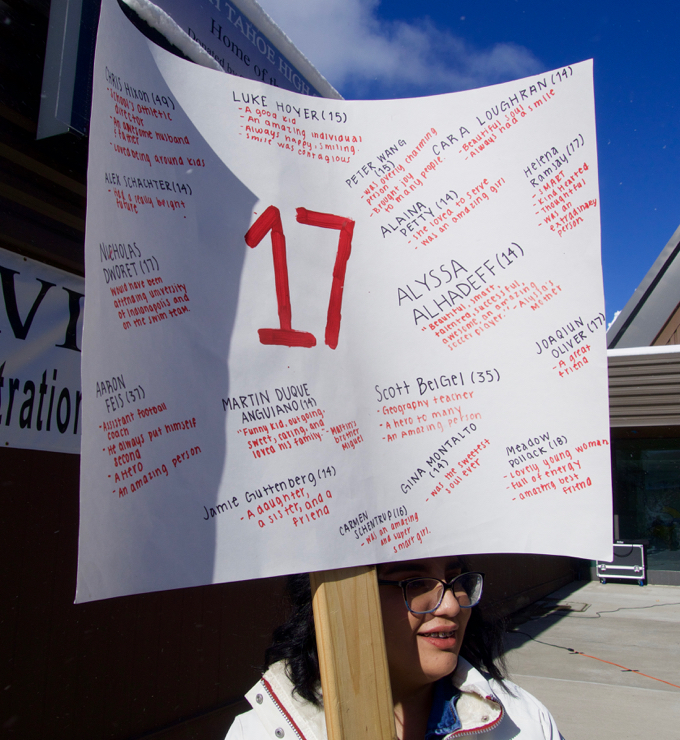
STHS student Daniella Valdivia honors the 17 who died at a Florida school in February. Photo/Kathryn Reed

While some say this won’t happen in Tahoe, that is being naïve. Bad things happen everywhere.

It was in Columbine, Colo., that the country first seemed to be truly awakened to gun violence at school. That was April 19, 1999, when 15 people were killed.

But years before Columbine there was the Cleveland Elementary School shooting in Stockton. On Jan. 17, 1989, Patrick Edward Purdy took three minutes to kill five children, wounding one teacher and 19 students. He had once lived in South Lake Tahoe. So, the South Shore already has a connection to a deadly school shooting.

“I’m not against guns; I’m against gun violence,” Daniella Valdivia told her peers. She advocated for students to be kinder, to talk to those who are “wall flowers.” She said saying hello can change the world in so many ways.

Student Cole Proctor said, “We have so little regard for mental health. Instead of trying to solve that problem, we want to box them in. We see them as killers instead of kids who have problems.”

He would like better mental health programs on camps.

For Tevan Martorana he believes this is his generation’s moment to make a difference. He is going to fight until every student feels safe at school.

“If we want to make change, we need to recognize the humanity in all of the other people around you,” teacher Barbara Bedwell said.
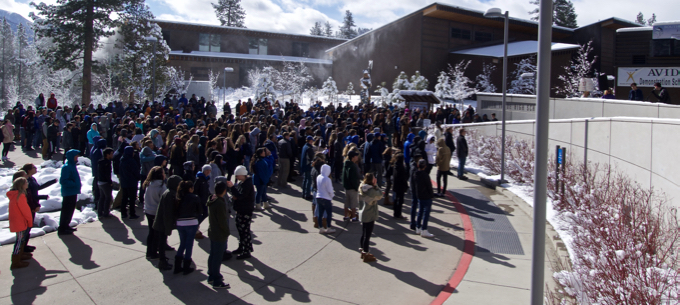
Hundreds of South Tahoe High students march in unison on March 14. Photo/Kathryn Reed

For senior Jessie Brown what she has noticed in the last month since the Florida massacre is teachers at STHS are talking more – about security, what can be done.

She carried a sign promoting building bridges, not fences. This was in reference to the school district’s proposal to put a fence around STHS.

That, Brown said, would only isolate people more and create a sense of fear, not protection.

It wasn’t just students who were at the march. Kelly Shanahan showed up with doughnuts for the kids and a sign that said, “Thank you students for leading the way. #Enough.”

“We have failed them as adults. I’m here with them 100 percent,” Shanahan said.


Fire chief worries about safety of S. Lake Tahoe

Publisher’s note: This is the second of two stories about the South Lake Tahoe Fire Department.

By Kathryn Reed

Fire – it’s going to happen. Where? When? How destructive? Those are unknowns. But the reality is the resources are lacking in the city, the basin, California, Nevada and throughout the west.

“Mutual aid” has been talked about at all levels of the fire service for eons, but it wasn’t until the deadly Wine Country fires last fall that the issue started making headlines.

Locally, the need for outside resources has been played out over and over again. Look at all the different fire trucks that often arrive at an event of any consequence. It’s not just an event like the Angora Fire that demonstrates the cooperative nature and need of fire resources, it’s much smaller blazes as well.

South Lake Tahoe Fire Chief Jeff Meston was in Sacramento last month testifying before a legislative committee about the need to improve the state’s mutual aid system. He is the president-elect of the California Fire Chief’s Association.

Outside help didn’t come to Santa Rosa last fall until six hours after it was requested. Help would take even longer to get to Tahoe.

Fire officials are lobbying the state to mobilize resources when there are red flag days or other threats like flooding and mudslides. This way the people and equipment are already deployed, so the destruction and loss of life would be less.

Meston’s attention is also focused on local issues.

He is in the process of putting together a study called the Standards of Cover. It is an in depth look at all the safety issues in the city. Every dwelling in the city is being recorded – including the type of siding, construction materials and vegetation.

He had hoped to have it ready to be presented to the City Council in May, but that could be delayed since he now has the added role of being acting city manager. Still, he wants it before the council before budget discussions. It is more than three-quarters completed.

Meston believes the Standards of Cover, which the city has never had, should be the guiding document for decision-making for the fire department.

In the past the ISO (Insurance Service Organization) rating was something fire departments coveted.

“They don’t verify any information. They say whatever the chief says is good enough for us,” Meston said of the ISO process.

The city’s last ISO rating from a couple years ago was a 4 (scale is 1-10, with 1 the best). Meston commented how that is the same score as the previous rating and that the on-duty resources have been cut significantly in that time.

Today SLTFD has eight people on duty at any given time. There are two three-person engines, one person in a squad and a battalion chief.

“Two issues really affect fire loss – how quickly you get there, and how many people you get there with to do the job,” Meston told Lake Tahoe News. “The national standard is 17 and we send eight.”

He said the document he is creating will not sugar coat the “terrible” response times, staffing issues and the consequences — both real and potential.

“What has happened is our homes are far more combustible than the 1960s because of plastics, coverings,” Meston said. “We reach flash-over, when a fire consumes a great majority of oxygen and people in the house no longer survive; we reach it quicker than in the 1960s. So it matters how fast we get there to minimize the loss of life and property.”

The purpose of the document is to give elected officials facts to use when it comes to making decisions about the fire department. Meston will also include recommendations in the document.

“We need to have a discussion about priorities; about priorities citywide. We are trying to be everything to everybody and we can’t be,” Meston said.


Most of $10B bet on March Madness will be illegal

By Richard N. Velotta, Las Vegas Review-Journal

The American Gaming Association believes $10 billion will be bet on the NCAA men’s basketball tournament, and only 3 percent of that will be wagered legally.

Most of the betting money that will change hands as 68 teams vie for a national championship beginning Tuesday night will occur in office pools and bracket contests that are illegal in most states.

But the association representing the $240 billion casino industry used the kickoff of March Madness to highlight its fight to repeal the federal Professional and Amateur Sports Protection Act and legalize sports wagering nationwide.

Read the whole story


Fire and ice: PCT in the era of climate change

By Alex Brown, Sierra

I’m climbing the western flank of Mt. Washington, a jutting outpost of volcanic rock in the Oregon Cascades, when I hear the all-too-familiar thrum of helicopter blades. Nearly four months into my through-hike of the Pacific Crest Trail, I’ve come to associate the sound with bad news. In Southern California, rotors had garbled the loudspeaker-blared instructions of the rescue team hovering over our camp, dispatched to pick up a hiker suffering from altitude sickness. More than 1,000 trail miles later, just shy of the Oregon border, I’d spent days watching choppers go back and forth overhead, refilling on water to fight the blazes that were filling the valleys below with hazy smoke.

This time, the helicopter buzzes close, past the skeletal burned-out trees I’m hiking through, and hovers over a slope east of the trail. I hear it just behind the trees as I finish my climb, but it’s gone by the time I top the ridge and follow the trail to the right. There, in the spot vacated by the chopper, I see tendrils of smoke rising from the trees, just 100 or so yards off the trail. My hiking buddies and I gawk at the sight, scarcely believing the fire is so close. We quickly hike on, not saying much. A couple miles later, we cross paths with a fire crew, 15 or more strong, hiking toward the blaze as we make tracks in the opposite direction.

“Last year was the most challenging year we’ve had in terms of dealing with closures on the PCT,” said Beth Boyst, who for the last 11 years has been the trail’s chief administrator with the U.S. Forest Service (the PCT passes through all different designations of federal and state land, but USFS holds the lead oversight role).

Read the whole story


SLT fire chief wants money for his department

Publisher’s note: This is the first of two stories about the South Lake Tahoe Fire Department.

By Kathryn Reed

South Lake Tahoe’s fire safety is lacking. That’s what the fire chief says.

“The city had set a goal of a response for 90 percent of all calls in four minutes or less. We meet that goal about 20 percent of the time. It is a really, really terrible number,” Fire Chief Jeff Meston told Lake Tahoe News.

It’s a staffing and money issue. In 2014, the city closed station No. 2 near South Tahoe Middle School. Ambulances are still there, but no firefighters.

When Meston took over as chief in fall 2013 the department had been reorganized so it had shift commanders instead of battalion chiefs. This was something the rank and file members lobbied for, and in turn they got better raises.

Meston saw that this command structure wasn’t working and urged the return of battalion chiefs, as most fire departments have. Station two had to close to make the budget work with the personnel changes.

“Guess where the fire activity is and where response time is the longest?” Meston said, with the Al Tahoe area by station No. 2 being the answer. “That was a conscious decision that occurred that the council didn’t have much to say about. I believe the elected officials are the ones who should determine fire (budgets).”

Ultimately it is the council that approves the budget, so the responsibility does stop there. It is also the city manager’s job to balance the needs of the various departments based on the revenues available.

No department ever gets everything it wants.

Meston, who is now acting city manager, has a chance to bring his concerns to the council’s attention in a more direct manner. On the April 3 agenda the mid-year budget is expected to be up for discussion.

When there are excess revenues they often get reallocated at this meeting. Staff, with heavy influence by the city manager, makes recommendations, with the council being the ones with the final say.

“The reality is when you compare us to every other like city in the state of California, we are second from the bottom in terms of general fund budget,” Meston said. “Usually a city spends half of its budget on police and fire. Ours is under 50 percent.”

The current fiscal year’s General Fund budget is $38.8 million, with fire getting 15 percent of that, and police 24 percent.

When it comes to what the budget allocates to personnel, 64 percent of the General Fund goes to salaries and benefits for all employees. Of the $24.73 million, police top out at 35 percent of that figure with $8,714,744 and fire is second at 22 percent with $5,403,998.

Those numbers are before contract negotiations are even settled. It’s possible any “extra” money that is talked about next month will be spent on raises for workers. Talks have been going on for months, with a resolution having been expected earlier this year, but then the city manager debacle ensued and changes were made to who was negotiating on the city’s behalf.


Calif. water use back to pre-drought levels

By Paul Rogers, San Jose Mercury News

California’s water conservation habits, refined and improved over five years of drought, are quickly evaporating.

For the seventh time in the last eight months, the amount of water saved by urban Californians has declined, according to new data from the State Water Resources Control Board. In other words, lawn sprinklers are back on, showers are getting longer and overall, California’s water use, after five years of conserving, is now back to where it was before the drought began.

“You don’t want to jump to a conclusion and say the sky is falling, everybody has forgotten how to conserve,” said Felicia Marcus, chairwoman of the water board. “But having been through what we’ve been through, we obviously want people to stay aware and redouble our efforts.”

Read the whole story


1 in 3 Nev. motorists may see rise in auto insurance

By Ken Ritter, AP

About one in three Nevada motorists, or as many as 600,000 people, could face a 9 percent jump in auto insurance rates this summer when the state raises the basic required minimum levels of bodily injury and property damage coverage, officials said.

The increase, effective July 1, could amount to about $10 more a month for average policyholders who have minimum bodily injury coverage of $15,000 per person and $30,000 per accident, plus basic $10,000 per accident in property damage coverage, according to figures provided to state lawmakers when they approved the increase last year.

Read the whole story