Top court overturns online threats case conviction

By Adam Liptak, New York Times

WASHINGTON — The Supreme Court on Monday made it harder to prosecute people for threats made on Facebook and other social media, reversing the conviction of a Pennsylvania man who directed brutally violent language against his estranged wife.

Chief Justice John G. Roberts Jr., writing for the majority, said prosecutors must do more than prove that reasonable people would view statements as threats. The defendant’s state of mind matters, the chief justice wrote, though he declined to say just where the legal line is drawn.

Chief Justice Roberts wrote for seven justices, grounding his opinion in criminal-law principles concerning intent rather than the First Amendment’s protection of free speech. The majority opinion was modest, even cryptic.

Read the whole story


Nevada Legislature OKs record budget, adjourns

By Sandra Chereb and Sean Whaley, Las Vegas Review-Journal

CARSON CITY — The Nevada Legislature came to a halt at midnight Monday, capping a day that saw approval of a record $1.1 billion general fund tax package to fund Gov. Brian Sandoval’s aggressive education package and a dizzying day of dealmaking.

When combined with $336 million directed to the state school fund, the total tax measure stretches to $1.4 billion. With two hours left in the session, the Assembly gave final approval to the last of five budget bills authorizing Sandoval’s $7.3 billion two-year general fund spending plan.

Committees met on short notice and on the chamber floors throughout the day. Lobbyists and lawmakers pitched amendments to bills. And the Senate and Assembly processed bills until the very end.

Once the clock struck midnight, anything twisting in the wind died. The Senate adjourned for a final time, sine die, about 12:18am.

Read the whole story


Muir’s heir keeping naturalist’s legacy alive

By Linda Fine Conaboy

Many who live near or play in the Sierra are familiar with John Muir, but his great-great-grandson, not so much. However, Robert Hanna is a name to know for those with an interest in the outdoors.

Hanna, who works for California’s Assembly Republican Caucus, knows the woods and the mountains and the flowers and the trees. And he knows all about his great-great-granddad, although, of course, the two never met.

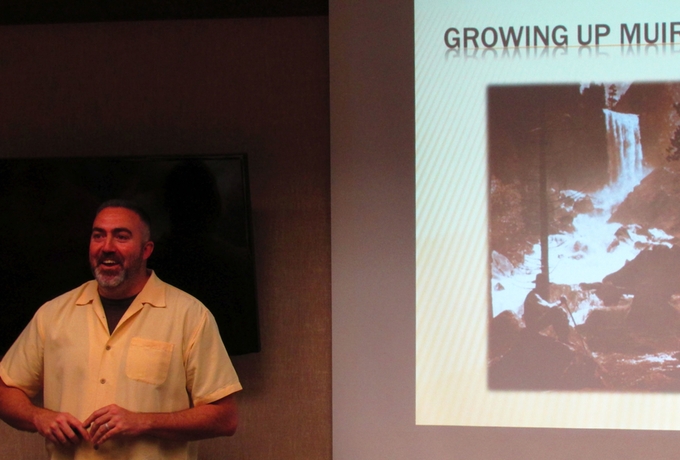
During a May 30 talk presented by the Friends of the Library to a full house at the South Lake Tahoe Library, Hanna gave an overview of all things Muir. Hanna offered more than what is usually presented about the famous Scottish naturalist. He painted an in-depth view of his family from Muir’s birth in 1838 in Dunbar, Scotland, to the present.

Robert Hanna has become an expert on all things John Muir. Photo/Denise Haerr

Robert Hanna has become an expert on all things John Muir. Photo/Denise Haerr

“I grew up learning about John Muir in a different way, from a family perspective,” he said. “I wanted to create a story of John and his legacy in-depth. I wanted to look at family history in a way that has not been seen before.”

And that’s what he did in his slide show, consisting of more than 100 images, displaying Muir’s sundry sides and personalities and introducing the audience to a no-nonsense, seemingly tough and resilient man and the large family, who throughout the years, have always supported him and his ideals. Hanna tossed out many vignettes and lots of narrative describing a large and boisterous group that he came to know through many family reunions staged mainly at the family’s large ranch holdings in Martinez.

“A lot of people think John Muir was born old,” Hanna laughed, referring to the often stern demeanor he presented in photographs.

However, when you learn about his early life in Scotland and later, in Wisconsin, perhaps there’s a reason for his unsmiling face. Muir was raised by a stern and religious father who mandated that he memorize and repeat nearly three-quarters of the Bible by the time he was 14. He also was required to perform myriad chores on the family farm; in fact, farming was, in his father’s mind, to be young John’s lot in life.

Little did he realize that his son was not destined to become a farmer. Turns out what young John loved most of all was books and machines — especially those machines he invented himself. Like the self-settling table saw and the barometer he constructed from a water clock powered by a stream on the family farm.

Then there was the clock desk, a contraption that not only rousted a student out of bed at a pre-set hour, but then automatically opened and closed various school books at designated times. He designed what he called a “loafer chair”, a device abhorred by any who might wish to slack off during the day. It soon became apparent that Muir was fascinated by clocks and incorporated them into many of his “timely” inventions.

He created some of these at the University of Wisconsin where they were discovered by Ezra Carr and his wife, Jeanne, who became his friend and encouraged him to put his ideas into print and were to play a pivotal role in his later life. The Carrs also introduced young John to Ralph Waldo Emerson, who also became his life-long friend.

The early adventures of John Muir were always interesting and always tempered with a distracting need to make enough money to feed himself. He left the university in 1863 for a foot tour of Wisconsin, Iowa, Illinois and Canada; a pivotal trek that Hanna said led to Muir’s devotion to and love of nature.

The loss of sight in both eyes and the eventual regaining of his vision led him to become extremely introspective. During this episode, he made a pact with God that if his sight returned, he would dedicate himself to nature, according to Hanna. He kept his word to God.

A 1,000-mile trek to Florida gained him a renewed closeness to Mother Nature and also, unfortunately, a raging bout of malaria. His recovery found him journeying to San Francisco — followed by a walking trip to Yosemite. The rest might be colloquially termed as history.

It is Hanna’s belief that time in nature can heal many ills and time spent with others in nature can bring about closeness and a bonding not to be gained elsewhere. For example, Muir cemented his relationship with Emerson during the poet’s brief visit to Yosemite; he was able to convince President Theodore Roosevelt to designate Yosemite a national park in 1890 after a rewarding trip throughout Yosemite’s vast wildness.

It is said that Roosevelt called his excursion with Muir, “some of the best three days in my life.”

Lest he become too much a hermit in the wilds, the Carr family lured Muir out of the woods and introduced him to Louie Strentzel, whom he married. He moved to the family farm in Martinez, made its orchard extremely profitable, thereby, finally becoming a man of money, and raised his two daughters there.

He was on his way back to Martinez, via train, when he developed pneumonia and died in Los Angeles in 1914 at age 76.

One issue Muir fought hardest for was the battle to save the glacial Hetch Hetchy Valley, which lies in the northeastern part of Yosemite National Park. Muir lost his fight and the O’Shaughnessy Dam was constructed 20 years after his death, in 1934, on the Tuolumne River, flooding the entire valley. The water stored there, to this day, travels 167 miles to San Francisco and remains The City’s main water source.

At the end of the fight Hetch Hetchy fight it is said that Muir weighed only 85 pounds. But in the end, he lost; however, now, his great-great-grandson is in the trenches, following his famous relative’s path, doing what he can to convince powerful lobbyists and anyone else who will listen, to drain the Hetch Hetchy Valley and store the water downstream.

“It’s political and it’s a big fight,” Hanna said. “It was wrong to destroy an icon within a national park. I’m going to keep fighting the good fight for as long as it takes.”

Hanna said that besides fighting some good fights, he’s happy now to be telling Muir stories and sharing Muir’s legacy. He closed his presentation with one of his favorite Muir quotes, said to be uttered after the defeat of the Hetch Hetchy project: “No matter, for I’ve had a grand life in these divine mountains and I may yet do something for those coming after me.”


Not all processed foods are unhealthy

By Erin Schumaker, Huffington Post

Pop quiz. Which of the following is considered a processed food: Kellogg’s Corn Flakes, homemade greek yogurt, bagged baby spinach? (Answer: All of them.)

The point here, is that “processed foods” includes a much wider variety of products than most consumers typically associate with the term. Secondly, not all processed foods are evil. Processed foods can provide convenience, like in the case of bagged baby spinach, or safety, as in the case of pasteurized eggs, and can even — gasp — be healthy.

“The idea of saying just avoid processed foods is crazy,” Dawn Jackson Blatner, RD, CSSD, LDN, told The Huffington Post. “Yogurt is a processed food. It’s actually been cultured and packaged. Canned beans, with no other ingredient besides beans, is processed because [the beans] have been cooked and they have been canned.” Where Blatner draws the line with her endorsement is with extremely processed foods, which logically enough, is also where things start to get murky for consumers.

Read the whole story


Pesticides used at levels that defy warnings

By Andrew Donohue and Bernice Yeung, Reveal

California continues to allow one of agriculture’s most popular and potent chemicals to be used under rules its own toxicologists have said aren’t scientifically sound.

As a result, residents in farming counties such as Kern, Fresno and San Joaquin are being put at a higher risk of cancer than state scientists believe to be acceptable, internal documents and interviews show.

A Reveal investigation last year showed how the state’s Department of Pesticide Regulation gutted regulation of 1,3-Dichloropropene at the request of its manufacturer, Dow AgroSciences. In the past year, state officials have begun to rein in the use of the pesticide, a gas injected into the soil before planting crops such as strawberries and almonds.

This has limited the most excessive use in Ventura, Monterey and Merced counties, which went beyond what even Dow had envisioned. But the recent changes don’t mean the department closed the loophole that allowed the excess use.

It simply has gone back to enforcing the original outlines of the Dow loophole, meaning growers in communities across the state still legally can use the pesticide at levels that state scientists have said are unacceptable, newly released data for 2014 shows.

Last year, growers went past the original safety limits in 20 communities in Fresno County and in communities in Monterey, Santa Barbara and Kern counties, among others.

In total, growers in 54 townships went over the cap in 2014, according to department documents. That’s an increase from 2013, when 47 did. In the areas that went over the cap, the most common crops were almonds, grapes and strawberries.

Joseph Frank, a retired state toxicologist who oversaw the department’s review of 1,3-D, said top state officials chose Dow’s analysis over their own scientists’ analysis.

“It is playing games with numbers, and we’ve told management this,” he said.
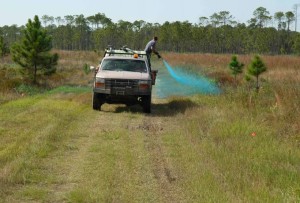
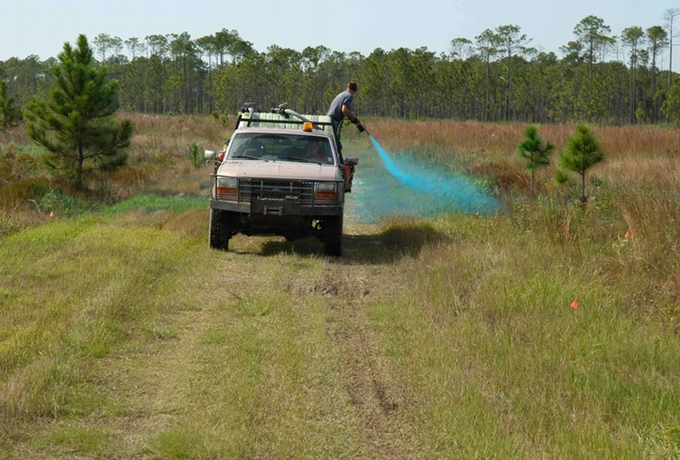
Pesticides are regularly being used despite health concerns. Photo/USFWS

Pesticides are regularly being used despite health concerns. Photo/USFWS

The department said it’s doing a new analysis of the health impacts of 1,3-D, an exercise known as a risk assessment. Staff toxicologists are reviewing the science around 1,3-D and will issue safety guidelines to top managers. From there, managers will balance that science with a pesticide’s benefits to design rules about how it can be used.

“The risk assessment will provide the scientific basis for a new plan to manage the use of this pesticide,” said department spokeswoman Charlotte Fadipe.

Dow said the original state limits are based on conservative estimates and outdated science. Recent real-world air monitoring and studies on how long people live in one place show that the loophole doesn’t cause public health concerns, the company said.

That 1,3-D is considered a cancer-causer in California doesn’t on its face have to be alarming. We’re constantly surrounded by things that could cause cancer, like the sun or arsenic in rice.

As the saying goes, the dose makes the poison.

The 1,3-D loophole highlights a core tension in how the government handles these doses.

While the pesticide regulation department’s mission is to protect human health and the environment, its regulations often reflect a compromise between scientists’ recommendations and the benefits a pesticide gives to the powerful agricultural industry.

This is generally how governments handle industrial chemicals. The name of the process manages to be at once bureaucratic and straightforward: risk management.

However, in the case of 1,3-D, there was little compromise. In the early 2000s, growers needed something to fill the gap left by an international ban on what was once their go-to pesticide, methyl bromide.

1,3-D fit the bill. It’s a byproduct of plastic manufacturing that Dow has turned into an effective pesticide. But the state says it can cause cancer. Some 1,3-D eventually escapes into the air and can be breathed in by neighbors and workers.

Because of concerns over how much 1,3-D lingered in the air, the pesticide faced tight restrictions. The state had gone through a rigorous process to decide how much 1,3-D could be used. That limit already was stretching the boundaries of what state scientists thought was acceptable, Frank said.

But those limits didn’t last long. Despite warnings from his own scientists, the department director at the time, Paul Helliker, signed off on Dow’s request to loosen the rules. He and his successors then stopped enforcing the rules altogether, allowing excess 1,3-D use in agricultural communities across the state.

Because of all the different factors that can cause cancer, there’s little way of knowing definitively whether anyone has gotten or will get cancer because of 1-3,D. But the excess use does increase the probability, the state scientists say.


The state already had a complicated history with 1,3-D.

In the early 1990s, it pulled 1,3-D from the market after learning how much lingered in the air after it had been applied. Air monitors at a Merced middle school picked up levels that were 800 times what the state said was acceptable on one day.

After five years of research, Dow persuaded state officials to put it back on the market. The state, though, needed a way to limit the amount of 1,3-D that could be used in each community. So regulators divided the state into small grids, 6-by-6-mile squares known as townships, and capped the amount of 1,3-D that could be used by growers in each township at 90,250 pounds a year.

At this level of use, scientists projected it could cause one extra cancer case per 100,000 people. The rules management put into place, Frank said, already were pushing the boundaries of what scientists thought was appropriate. State scientists previously had suggested that the department try to limit that risk to one cancer case per 1 million people. But state officials said Dow had argued that those restrictions would make it impossible to use 1,3-D.

A couple of years later, Dow and growers began pressuring the state to loosen those restrictions.

The proposed Dow plan worked like cellphone rollover minutes: If growers in a township didn’t use all of their annual 1,3-D allotment in previous years, they could save it in a bank and use that much more in future years.

Each year, growers could use up to double the amount of 1,3-D that the original rules allowed – 180,500 pounds, so long as they had that amount saved up in the bank.

Dow and the department directors said that because cancer risk is averaged over 70 years, allowing a few years of increased use was fine as long as it all averaged out over time.

Scientists objected, saying anything over the annual limit violated the science underpinning the regulations. They said the concept of banking didn’t hold water. Just one year of high exposure, Frank said, could provide the catalyst that may eventually give someone cancer.

Here’s how one outside expert described it in our November story:

Chensheng Lu, an associate professor at Harvard University’s School of Public Health, likened the averaging idea to drinking and driving. If you get pulled over once and you are sober, but you are pulled over a second time and your blood alcohol level is twice as high as the legal limit, you can’t average the two incidents and say everything is fine. “This is a very dangerous approach,” Lu said.

In 2002, Helliker, the department director at the time, agreed with Dow, adopting the heart of its plan.

Once the Dow loophole was in place, top department officials essentially stopped regulating 1,3-D. In 2004, they began allowing growers to exceed the limits they had set – to the point that the exception became the rule. Agricultural businesses essentially had unfettered access to the chemical.

Over 12 years, growers in one Merced community used 1 million pounds more 1,3-D than they were supposed to even under the Dow plan.

Growers near Oxnard’s Rio Mesa High School, which is surrounded on all four sides by strawberry fields, far surpassed the 180,500-pound limit under the Dow plan. In 2006, they used 267,000 pounds. Over 12 years, they used 317,000 more pounds 1,3-D than they had in the bank.

1,3-D use increased by more than 200 percent across the state. As it became a hit with strawberry growers, it increasingly was used near schools, homes and businesses in more populated areas like Ventura County.

Between 2002 and 2012, 1,3-D use in Ventura jumped 1,174 percent.

All told, people in more than 100 California communities have been at greater cancer risk, interviews with former state scientists and internal documents show.

Scientists with the Department of Pesticide Regulation have analyzed this system twice since Dow began floating the concept. Both times, state documents show, they objected to the basic plan put forth by Dow and top officials.

“We are unaware of a defensible scientific rationale justifying such a practice,” staff toxicologist Linda Hall concluded in a 2009 study.

Frank, who was Hall’s boss at the time, said his team consulted experts at Harvard and the Massachusetts Institute of Technology. “We could not find anyone in the field who disagreed with us,” he said. “It wasn’t even debatable.”

Department leaders have been unable to provide a competing scientific analysis, outside of Dow’s, that justifies the loophole.

Early last year, following inquiries from Reveal, Department of Pesticide Regulation Director Brian Leahy said the department would stop issuing 1,3-D exemptions.

The new state data reveals the limits of that decree.

Growers still may go above the 90,250-pound annual limit if they have 1,3-D in the bank. And the growers who accrued negative balances won’t be monitored to ensure that they pay back their debt.

The department appears to be hoping that things eventually average out.

Fadipe, the department’s spokeswoman, said simply holding the most prolific 1,3-D users to under 90,250 pounds “will not increase the average concentration.” She continued: “You are either reducing the average air concentration (over 70 years) or not increasing it.”

But that doesn’t mean it will all add up.

Take the Merced community where growers used 1 million more pounds than they were supposed to under Dow’s plan. In 2014, they used 80,377 pounds of 1,3-D.

If growers there used that amount each year for the next 50 years, the township’s 70-year average since 1995 still would be more than the 90,250-pound cap – 97,841 pounds. But there’s no fixed year that the 70-year average starts and stops, so choosing a timeframe for averaging becomes arbitrary.

Still, Leahy has trumpeted his decree as if it were a get-tough regulation, rather than a return to following the rules of the loophole.

In Leahy’s response to pointed questions from school officials in charge of Rio Mesa, here’s how a department fact sheet described the regulatory history of 1,3-D and other pesticides:

“Based on its scientific analysis of monitoring data and computer modeling, DPR (the Department of Pesticide Regulation) implemented a series of requirements beginning in the mid-1990s, including restrictions on application methods, buffer zones, limits on use, and other protection measures for metam (sodium), methyl bromide, and 1-3,D. In February 2014, DPR implemented additional restrictions to further reduce long-term exposure to 1-3,D. DPR will implement restrictions for chloropicrin in 2015. DPR is likely to further update its restrictions for 1-3,D in 2016.”

The fact sheet skips straight from the 1990s to Leahy’s February 2014 decree, leaving out the loosened regulations and broken rules in between.
Drought doesn’t prevent Tahoe development

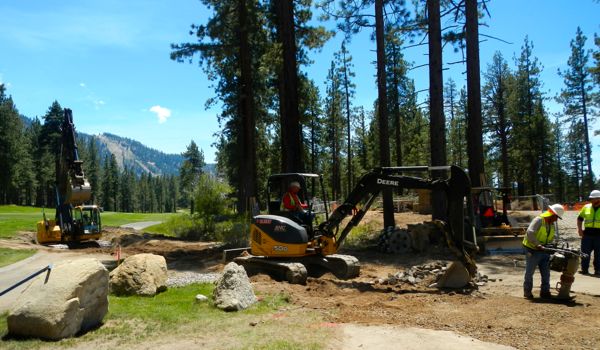
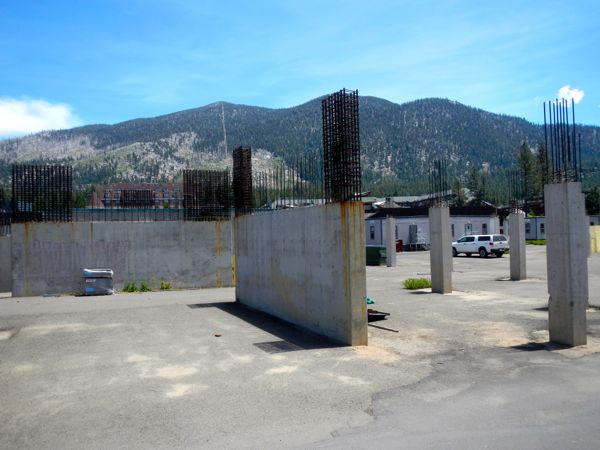
Crews work on the golf holes that will be rerouted to accommodate Edgewood Lodge. Photos/Kathryn Reed

Crews work on the golf holes that will be rerouted to accommodate Edgewood Lodge. Photos/Kathryn Reed

By Anne Knowles

Large commercial development projects around Lake Tahoe are moving along unchanged in the midst of a historic drought.

Squaw Valley’s proposed 94-acre hotel, condo, timeshare and recreation area, Edgewood Tahoe’s 154-room lodge, and the Chateau’s multiphase retail and hotel project at Stateline are all on track.

A fourth project, Homewood Mountain Resort’s redevelopment, is mired in litigation but owner JMA Ventures expects to begin construction on the $500 million project a year from now.

Placer County has requested an update to the water supply assessment for the Squaw Valley Specific Plan environmental impact report, according to Alex Fisch, senior planner for Placer County.

That EIR became available in mid-May and public comment on the project is being accepted through July 17.

The update to the water supply assessment, provided by the Squaw Valley Public Service District, will include data on precipitation and aquifer pumping through 2014.

Fisch said the county requested a 25-year assessment of water availability. By law, a 20-year assessment is required for all projects constructing 500 or more dwelling units.

The controversial Squaw Valley plan on 85 acres includes up to 1,493 bedrooms in 850 units; 297,733 square feet of commercial space, including conference rooms, retail and restaurants; 90,000 square feet of recreational features such as movie theater, indoor rock climbing and pool and water slides; and parking. Housing for up to 300 employees and 20,000 square feet of additional commercial space is planned on another 8.8-acre parcel.

The development is expected to take 25 years to build and, according to the EIR, will need 234 acre-feet of water annually by 2040.

“It’s difficult to say how much water it will need in the intervening years,” Mike Geary, SVPSD general manager, told Lake Tahoe News.

“The county, to its credit, is allowing a flexible phasing plan. So many projects are affected by market forces so the county just said build it how you want.”

SVPSD plans to drill four wells on the property to deliver the water.

SVPSD is also developing an 8-mile pipeline to the Martis Valley to import water into Olympic Valley as a redundant, emergency source of water for existing customers, says Geary.

Water purveyors are still working out the details for future phases of the Chateau project in South Lake Tahoe.

Water purveyors are still working out the details for future phases of the Chateau project in South Lake Tahoe.

Also in Placer County is Homewood’s controversial redevelopment project, which includes hotel, retail and new base area. That project’s EIR outlines two alternatives for water. One alternative calls for Tahoe City Public Utility District to be the sole water provider. A second alternative says TCPUD would supply water to the south base area while Madden Creek Water Co. would supply the north base.

It estimates water demand at 385 acre-feet per year for the south base, 134 acre-feet per year for the north base and 43.6 acre-feet a year for snowmaking.

Calls to JMA Ventures to clarify the project’s plans were not returned.

Water for the long-delayed build out of the Chateau project is still being ironed out. When the project was initially permitted, South Tahoe Public Utility District was going to deliver service to the bigger portion of the development, the convention center and a 400-unit hotel, while Lakeside Park Association was set to supply so-called project B, 125 time-share units.

Now, the two purveyors are in negotiations about who and how to deliver service to the significantly altered project. STPUD provides service to the retail that has already gone in. The storefronts currently use 1,480 gallons per day, according to Richard Solbrig, STPUD general manager.

(The permit on STPUD’s portion of the original plan, for a convention center and hotel, called for 77,700 gallons per day, Solbrig said.)

Solbrig told Lake Tahoe News it’s unclear where the overall project is going next, although a 32-room hotel with pool big enough to accommodate two planned hotels and 19,000-square-feet of retail space is being designed now for the next phase that could break ground this summer.

STPUD and Lakeside agreed on a revenue sharing deal, since Lakeside lost most of its customer base when the project went belly up, and are working out the details now, according to Solbrig and Jack McLaughlin, president of Lakeside Park Association.

The Edgewood Lodge project is moving along, with corollary work being done now and construction on the hotel itself starting later this summer. But it’s unclear how much water the project will consume. Douglas County’s EIR on the project only mentions water quality, like what is required for the Tahoe Regional Planning Agency.

Patrick Rhamey, vice president of real estate, said an analysis of water demand exists, but he didn’t have the time to provide it to Lake Tahoe News.

The water purveyor is Edgewood Water Co., a small company that delivers water to properties totaling about 2,000 rooms, said Rhamey.

“Edgewood Lodge’s 154 rooms, excuse the pun, are a drop in the bucket,” he said.


Feds propose land controls to preserve Nev. sage grouse

By Steve Tetreult, Las Vegas Review-Journal

WASHINGTON — The Department of Interior on Thursday proposed added controls across 17 million acres in rural Nevada and northeastern California to preserve habitat and avoid an endangered species listing for the imperiled sage grouse.

Solar and wind energy development would be excluded or subject to added scrutiny across Northern Nevada, according to a new environmental impact report. Controls would be put in place for geothermal and oil and gas exploration over 15 million acres and restricted outright in 1.5 million acres of the most sensitive areas where the range birds flock.

There would be potential effects on mining and grazing in the best remaining areas for the grouse, whose population has dropped from the millions to about 200,000 to 500,000 across the West.

Read the whole story


Nevada OKs paying for private school

By Trevon Milliard, Reno Gazette-Journal

Nevada parents will almost certainly have an unprecedented choice starting next school year, following the Legislature’s final approval of Senate Bill 302 on Friday.

The choice: Parents can either keep their children in public school or pull them out and the state will hand them about $5,000 per child to attend the private school of their choosing — including religious institutions — and pay for tutoring.

They could even opt for homeschooling.

Read the whole story


Turf buyback sprouts endless possibilities

Publisher’s note: This is one in a random series of stories about what it’s like to go through the South Tahoe Public Utility District turf buyback program.

By Kathryn Reed

I’m exhausted and overwhelmed, and I haven’t turned over one blade of grass. It’s going to be a long summer, or two.

My front yard – the only place where there is grass – has never been much to look at. It became less functional years ago when a tree removal company parked a crane on it. It made croquet balls hop instead of roll. Then there was the summer I spread fertilizer, but didn’t water it immediately.

Why would I want to keep watering a lawn I didn’t like?

And with South Tahoe Public Utility District installing a water meter last summer, how much I pay to water that grass is about to change. Something had to be done.

I got myself on the waiting list for the turf buyback program last year and this year I am part of the program.

Donielle Morse, left, and Leanette Rangle with South Tahoe PUD take turf measurements. Photos/Kathryn Reed

Donielle Morse, left, and Lannette Rangel with South Tahoe PUD take turf measurements. Photos/Kathryn Reed

Last week Donielle Morse and Lannette Rangel with STPUD came out to measure the turf – 804-square-feet; and have me sign a contract – I must keep the new stuff in for five years, plant native or low water consuming plants over 35 percent of the area, and use a better, low water use irrigation system. They told me other particulars to ensure I will qualify for the $1,206 rebate check.

The buyback program is open to all South Tahoe PUD water customers. The most anyone will get is $3,000. The equation is $1.50 per square foot.

They took pictures and will do the same when I call for the final inspection.

I’m supposed to keep a list of all the plants I use, create a sketch of where things go and have stats about the irrigation system. (Hand watering is also an option.) I have a sprinkler system so it seems logical to convert it.

I ask about transplanting things from the back to the front. That’s OK, but they suggest I ask the TRCD about how well specific vegetation does when moved.

That afternoon Jennifer Cressy with the Tahoe Resource Conservation District came out. The free consultation is part of the program. She gives me ideas about how to relocate some of the established plants I have and says others aren’t transplantable.

“Talk nice to it the whole time,” she says of the bushes I’m eyeing to move. She also says to make sure my shovel is sharpened. (I didn’t bother to tell her I’ve never thought about sharpening a shovel before.)

She peruses the other things growing in the back and points out how the roses would be easy to transplant. Hmmm. I hadn’t thought about that and suddenly see potential.

I already knew all sides of the house were going to be disturbed in this remake. It might get messier and more complicated, though, than I anticipated. It’s a good thing I have two seasons to get the turf out and have the area revegetated.

Jennifer Cressy with Tahoe Resource Conservation District talks about thinning a bush before replanting it.

Jennifer Cressy with Tahoe Resource Conservation District shows where to thin a bush before replanting it.

“One of the easier techniques is composting the lawn in place if you are doing it yourself,” Cressy tells me.

Cressy introduced me to the term sheet mulching. I have since read more about it. It seems like an easier alternative than what I thought I was going to have to do, which was haul away all of my grass. Some of the literature even says I won’t have to take all the grass out, but instead I could kill it by blocking out the sun.

With a sod cutter I’d need to be wary of tree roots.

Cressy offers simple tips – like when ordering soil amendment, get extra for future projects; have any deliveries be dumped onto a tarp so it’s easier to scoop it up at the end; plant shallow rooted vegetation near trees because the trees absorb so much water; pay attention to where snow is shoveled or dumped by the city so flexible bushes go there.

When it comes to what to plant that is determined on a site-by-site case. I’m on an extremely high water table so that will make a difference in what I can plant compared to someone who is on a slope.

“Climate and native appropriate plants” are what we all should be shopping for.

Cressy throws out the idea of a raised vegetable bed near the door. She adds that edibles and plants that smell good should be near the walkways.

I’m on information overload. But she gets me thinking. Next step – put a design onto paper.

—–

Notes:

· Tahoe Resource Conservation District has a wealth of landscaping information online – not just for those taking out turf.

· More information about South Tahoe PUD’s turf buyback program is online. The website also has information about the current water restrictions.

· The Evans’ Family Garden in the Angora burn area has examples of appropriate vegetation for the Lake Tahoe Basin.

· Here is a list of landscaping workshops for the do-it-yourself gardeners, landscapers and landscape managers.


Calif. has no idea how much water it has

By Leighton Woodhouse, New Republic

Tucked in the foothills of the San Gabriel Mountains in Pasadena, NASA’s Jet Propulsion Laboratory (JPL) looks and feels like a high-security college campus for engineering nerds. From the streetlight banners celebrating the latest satellite launch to the bungee rocket toys in the gift shop, the facility — which is formally a part of the California Institute of Technology — leaves no doubt about its mission: “It is really an aerospace company,” is how Jay Famiglietti, NASA’s senior water scientist who runs a project called the Western States Water Mission, puts it.

The vast majority of JPL’s thousands of employees are engineers and technicians who build robots and rockets to ship into space. Scientists like Famiglietti are there to make sure that all that hardware serves some sort of greater purpose benefitting humanity.  Right now, for his research team, that purpose is mapping the dwindling water supply of the drought-gripped Western United States.

Famiglietti is a hydrologist — a specialist in the world’s water systems. Before he arrived at JPL, he was accustomed to looking at rivers, oceans, and aquifers from ground level. Now, as a NASA researcher, he looks at them from space. His project seeks to create a computer model that will track and predict the movement of every concentration of water in the western part of the country: how much snow is in the mountains, how much moisture is in the soil, how much groundwater the aquifers contain, how much water is in the rivers and how quickly it’s flowing, where floods will occur, and what’s the water volume of the reservoirs. Once his team shows it can be done regionally, they will expand the project to a global scale.

Read the whole story