Jeffrey pine beetles taking toll on Tahoe trees

By Kathryn Reed

Jeffrey pine beetles love drought. It means trees are weaker and unable to fend off this species that is native to the Lake Tahoe Basin. It means they get to proliferate.

What it means for the trees is more will die. This in turn creates more fuel for wildfires.

Officials throughout the Western United States are concerned about the proliferation of beetles as the wildfire season gets under way in what is now the fourth year of one of the worst droughts on record.

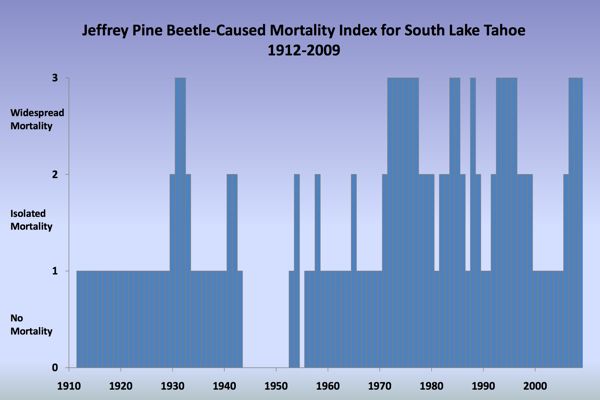
The Jeffrey pine beetles are black and are no more than one-quarter-inch long. They have a history of wreaking havoc in Tahoe. There was a huge outbreak in the basin from 1991 to 1996 that wiped out nearly 40 percent of the Jeffrey pines in the basin.

“We need to react to the outbreak quicker than we did in the 1990s,” Kit Bailey, fire chief for the Lake Tahoe Basin Management Unit, told Lake Tahoe News. “We won’t stop it, but we may moderate the negative affects.”
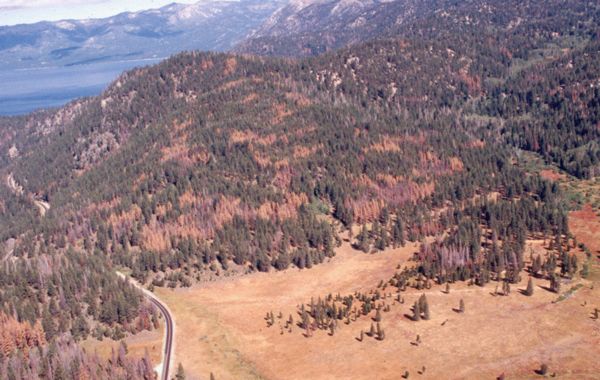
Aerial photograph of Spooner study site and surrounding area in 1995 following extensive Jeffrey pine beetle-caused tree mortality exhibited by discolored Jeffrey pine crowns

Orange trees at the Spooner Lake area in 1995 show the devastation of the Jeffrey pine beetle. Photo/U.S. Forest Service

Not leaving the tinder dry wood is one way to deal with the carnage.

Dave Fournier, vegetation specialist with the LTBMU, said removing the infested trees in the fall would be key to keeping the infestation in check and reducing the mortality rate of trees. Felling the trees and hauling them out of the basin removes the beetles that continue to lay their eggs in the dead or dying tree. This kills off the next generation of beetles before they can hatch in the spring.

During the drought in the early 1980s a beetle outbreak affected mostly fir trees. Because there were osprey nests no trees were removed, Fournier said. This was in Slaughterhouse Canyon on the East Shore.

Two decades later the powers that be finally realized trees needed to be removed because they were so thick. Trees were so close together and others were scattered about the ground that it took an hour to walk 100 feet, Fournier said.

No trees were removed in the ’90s during the Jeffrey beetle outbreak. This, too, created an overabundance of fuel for a fire.

Policies and philosophies have changed in the intervening years. Now thinning projects are seen as a way to combat the beetle problem.

The denser the tree stand, the less water there is to go around. Less water means a tree is not completely healthy and is therefore more susceptible to being overtaken by a beetle.

About 60 percent of the wildland urban interface in the basin has been thinned. The Forest Service has the funds to complete about half of what is left. The problem is these areas are heavy fuel loaded stands that are 100 years old.

“My prediction is that these stands that have been thinned using current standards should not see a sea of red providing the thinning was sufficient,” Fournier told Lake Tahoe News.

Another issue the Forest Service is contending with is that until about 10 years ago large diameter trees were not removed. This is a problem because their roots are deep and they need more water than smaller trees.

The U.S. Forest Service annually surveys its land by air. In 2014, 800,000 acres of tree mortality were found in California. This compares to 2013 when there were 350,000 acres.

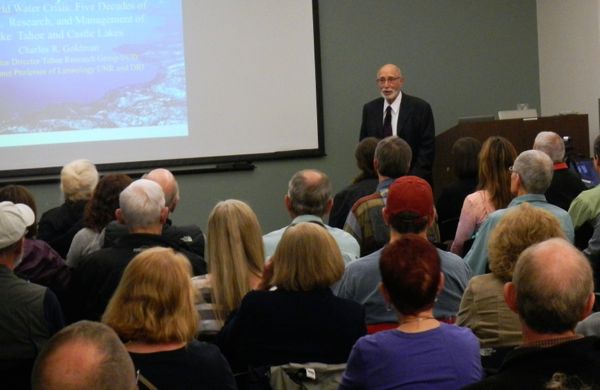
Charles Goldman at a talk June 4 in Incline Village touched on forest health, saying, “Up to 70 percent of the trees in some areas are dead or dying” from bark beetles.

Fournier is already documenting evidence of the resurgence of these beetles. They are ravaging trees at Kiva Beach on the South Shore.
Source: U.S. Forest Service

                                                                                                                                                   Source: U.S. Forest Service

A sea of red trees is the telltale sign of beetle infestation. By fall it will be easier to see the devastation. However, with so little moisture for the past few winters, the dead needles are likely to first be evident this summer to the average person.

The Jeffrey pine beetle is one of 220 species of beetles. Of those, 12 like to burrow into the various pine trees. Usually the different beetles are confined to a select area of the state.

A good winter normally kills off many of the beetles – keeping their populations in check. But that hasn’t happened for a few years. This has given the beetle population an opportunity to grow.

They bore into the trees in the late fall. A healthy tree can use its pitch to extract the beetle so it never takes hold. But the drought has weakened trees’ ability to fend for themselves and therefore the beetles are winning.

“Once they lay eggs the tree is girdled,” Fornier explained. “Then it’s just a matter of time for how long it takes for that tree to shutdown.”

While the Jeffrey pine beetles are native to the basin, in a normal winter about one tree in every 3 acres dies – not groves, as is happening today.



Calif. pension overhaul advocates try new strategy

By Jon Ortiz, Sacramento Bee

For the third time in four years, advocates for altering public pensions have a plan they want to put to a statewide vote.

But this time the proposal by pension-change advocates Chuck Reed and Carl DeMaio has a new twist: Pensions and other retirement benefits would automatically become a matter of ballot-box politics by requiring voter approval any time government officials sought to upgrade benefits.

It also would make “defined-contribution” plans the default retirement program for state and local employees hired Jan. 1, 2019, and later. Employers who wanted to add new employees to “defined-benefit” plans now common in government – but rare in the private sector – would have to get voter approval after that date.

Reed said that the measure is necessary to rein soaring retiree benefit costs that are “crowding out funding for important services such as police, fire, schools and road repairs.”

As news about the plan spread Thursday morning, union reaction was swift and predictable.

“Chuck Reed is a hypocrite,” said Bruce Blanning, executive director of the state engineers’ union. “He’s not interested in protecting taxpayers. His real target is working men and women who dedicated themselves to public service and then retire. He wants their money to be controlled by the same Wall Street bankers who gave us the Great Recession.”

Read the whole story


Calif. Senate votes to raise smoking age to 21

By Patrick McGreevy and Phil Wilson, Los Angeles Times

The state Senate on Tuesday approved a bill that would raise the minimum legal age for buying cigarettes and other tobacco products from 18 to 21 as part of an effort to reduce smoking by young people.

Sen. Ed Hernandez, D-West Covina, said he introduced the bill, SB151, out of concern that an estimated 90% of tobacco users start before age 21. Raising the minimum age will mean that fewer teenagers pick up the habit, said Hernandez, an optometrist.

He cited a study done by the Institute of Medicine for the federal Food and Drug Administration that concluded that raising the smoking age to 21 would cut smoking by 12 percent more than existing control policies.

Read the whole story


Revered scientist continues Tahoe clarity quest

By Kathryn Reed

INCLINE VILLAGE – Without the work of Charles Goldman, the scientific debate about issues concerning Lake Tahoe might be much different.

The limnologist started studying this area in 1958 when he began teaching at UC Davis. His research is the basis for much of the work that is being done today to improve the clarity of the lake. While the methods to achieve various goals will continue to be debated, the decades’ worth of data are indisputable and provide a basis from which to keep going forward.

In a career spanning more than 50 years, Goldman could point to multiple achievements to hang his hat. Sewage, though, is what he is most proud of. Specifically, keeping treated sewage from Lake Tahoe.

Charles Goldman talks about the changes at Lake Tahoe on June 4 in Incline Village. Photo/LTN

Charles Goldman talks about the changes at Lake Tahoe on June 4 in Incline Village. Photo/LTN

Years ago he took local wastewater and mixed it with samples from the lake. Tahoe’s clear water turned green in three days. It was all the nitrogen that remained in the treated water that was the problem.

“Now we are seeing attacks on science. We are almost back to where the Earth is flat,” Goldman told the more than 80 people attending the June 4 talk at the Tahoe Environmental Research Center on the campus of Sierra Nevada College. He alluded to those who have recently broached the subject of reworking the federal law that mandates wastewater be hauled out of the basin.

The 4-year-old drought has people contemplating ways to deal with water.

Goldman called climate change “the greatest threat to humanity since the development of the atomic bomb.”

He remembers fighting against uncontrolled growth in the basin because of the negative environmental impacts it would have. Threatening phone calls from those wanting to develop the basin were routine. A California Highway Patrol car would follow him from Tahoe to Davis; he never knew if was for protection or some sinister reason.

While he is no longer teaching, Goldman refuses to completely retire. He is advocating the U.S. Forest Service prevent cattle grazing above 5,000 feet. Goldman will present a paper this summer from a 10-year study about the bacteriology of lakes and streams in the High Sierra because of the grazing.

“It’s bad for water quality,” he said.

And on top of that, Goldman added, the program costs more to run than the feds are generating in income.


Drought saps $2.7 bil. from Calif. economy

By Geoffrey Mohan, Los Angeles Times

The drought is on track to dry up $2.7 billion in revenue and erase more than 18,600 jobs from the California economy this year, according to a preliminary report.

But that blow has been hard to detect because the agriculture sector is just 2% of the overall state economy and because farm employment has grown steadily in the last decade, a panel of experts told the state Board of Food and Agriculture.

Despite the drought, in fact, statewide agricultural employment grew by 3,100 jobs last year, with “stronger than expected” gains in the coastal and northern farming regions overtaking losses centered largely in the San Joaquin Valley, according to the UC Davis report.

Read the whole story


Report: Number of hungry people in world drops

By Rick Gladstone, New York Times

The number of hungry people globally has declined from about 1 billion 25 years ago to about 795 million today, or about one person out of every nine, despite a surge in population growth, the United Nations reported Wednesday.

In developing regions, the number of hungry people has fallen to 780 million today, or 12.9 percent of the population, from 991 million 25 years ago, or 23.3 percent of the population at the time, according to the United Nations’ annual hunger report, published by the Food and Agriculture Organization, the International Fund for Agricultural Development and theWorld Food Program.

Despite the finding that nearly 800 million people in the world remain hungry, the report described the progress made as a significant achievement.

Read the whole story


Abundance of LTUSD employees calling it quits

By Kathryn Reed

When classes start Aug. 31 for the next school year, many familiar faces will no longer be roaming the halls of Lake Tahoe Unified School District. Many longtime employees are retiring.

More than 600 years worth of educational experience are walking out the door as the school year comes to an end next week. The changes are coming in the classroom, administration and elsewhere.

Steve Morales, facilities director, is one person whose presence in the district for the last 33 years has touched all the campuses and most components of the district.

He had worked in construction since he was 18, and then got an electrician’s job with LTUSD when he was 29. By 30 he was in his current role. The difference is the job description has changed quite a bit in the intervening years.

“As the district continued to mature and grow, this position did the same,” Morales told Lake Tahoe News. “It’ been continuously growing and challenging so it never became a stagnant position. There was never a time when I was bored with the work.”

Steve Morales is retiring after 33 years working for Lake Tahoe Unified School District. Photo/LTN file

Steve Morales is retiring after 33 years working for Lake Tahoe Unified School District. Photo/LTN file

When he started in the early 1980s the buildings had been neglected, landscaping near non-existent, the ball fields were not irrigated, and the schools looked run down with peeling paint. The superintendent at the time and board decided to turn things around.

The basic maintenance needs were addressed, including getting the mechanical and electrical systems working properly.

The state made some money available and local voters approved a bond in the early 1990s for facilities. This is when South Tahoe Middle School’s multipurpose room was built as well as the science-technology building at South Tahoe High School.

This was the first major construction in LTUSD since Sierra House Elementary School was built in the mid-1970s.

Hiring skilled laborers like electricians and plumbers has helped to keep the facilities in better shape. Depending on the season 30 to 40 people work for Morales.

Each year the financial responsibility he has changes. It’s fluctuated from a few million dollars to about $40 million.

“What I’m most proud of in the facility improvement and expansion side of the coin is the fact that within months of passage of local bonds for school facility improvement the district was spending that money and the projects were started,” Morales said. “By the time people saw these taxes on their tax bills typically we were already in construction. We were putting their money to work almost immediately.”

Morales is also proud in all this time with well more than $100 million of construction occurring under his watch that a project has never been stopped nor has there been the claim of a bid going awry.

He was essentially the project manager overseeing the work accomplished from the latest bond — $64.5 million in local money, plus more than $30 million in state matching dollars. The bulk of that work was at South Tahoe High School.

Superintendent Jim Tarwater calls the oversight of the 2009 bond and getting the work done by 2014 Morales’ “legacy.”

But all of Morales’ work is not done. He will be overseeing the bleacher project at STHS, which starts next week.

“For a person who moved up through the ranks and has been part of all the construction and maintenance for a district in the mountains, that has a lot more challenges just because of the weather, and transportation, he has done an outstanding job,” Tarwater told Lake Tahoe News.

Also part of Morales’ job is to oversee transportation. The fact there was never a major accident on his watch, is another thing Morales is proud of.

Initially, IT fell under Morales’ purview.

“The original backbones of the computer and software systems came out of this department. We provided the infrastructure, the cabling,” he said.

Morales, who turns 62 at the end of the month, will be back on a limited basis. Retirees are allowed to work for benefits.

What else he does in retirement remains to be seen. He has three kids and seven grandkids to help fill the time.

As for a replacement, Darryl Quandt who is a supervisor in the department will be interim director of facilities.

—-

Here are the others who are leaving LTUSD:

Classified retirees, with their last job listed:

·       Eleanor Heckendorn – hired October 1984, instructional assistant

·       Wilma Hoppe – hired April 1992, executive services specialist

·       Angie Keil – hired May 1992, secretary

·       Paul Mitchell – hired February 1998, custodian

·       Darlene Morris – hired August 1987, accounting assistant

·       Michael Kezer  — hired December 2011, campus security assistant

·       Nancy Tesh – hired September 1988, human resources analyst

·       Debra Yates  — hired July 2006, chief financial officer.

Certificated retirees:

·       Betsy Benavides, teacher, 24 years in education

·       Karen Boyer, speech therapist, 20 years in education

·       Howard Coleman, teacher, 32 years in education

·       Beth Delacour, principal, 32 years in education

·       Madeline Fernald, teacher, 16 years in education

·       Joann Hernandez, counselor, 15 years in education

·       Deborah Kushner, teacher, 31 years in education

·       Ivone Larson, assistant superintendent, 26 years in education

·       Marie Meagher, director of special services, 36 years in education

·       Carol Murdock, teacher, 36 years in education

·       Elizabeth Roeser, teacher, 37 years in education

·       Lauretta Ross, teacher, 36 years in education

·       Dennis Sarosik, assistant principal, 34 years in education

·       Louise Ann Simon, teacher, 27 years in education

·       Pamela Taylor, teacher, 30 years in education

·       Susan Willmett, teacher, 19 years in education.


Calif. won’t ID who’s draining the groundwater

By Lance Williams and Katharine Mieszkowski, Reveal

A new law that attempts to preserve California’s precious groundwater comes with a catch: The state will hide the names of people draining this vast underground water source, Reveal has learned.

The secrecy provision could make it impossible for the public to identify water wasters and learn whether conservation efforts are taking hold, according to documents and interviews.

One of the law’s authors, former Assemblyman Roger Dickinson, said farmers and private pumpers wanted confidentiality.

“In essence, this was a battle we didn’t think we could take on,” Dickinson said. “So we agreed to keep the confidentiality.”

At issue is little-noticed language in the Sustainable Groundwater Management Act, a package of laws that for the first time sets rules on farmers’ use of groundwater, a vital but rapidly disappearing subterranean water supply for the Golden State.

California growers provide the country with almost half of its fruits, vegetables and nuts. In a normal year, they rely on groundwater for about one-third of their entire water supply. Years into a historic drought, it can account for more than half.

Meanwhile, groundwater management has been a free-for-all, with farmers drilling ever-deeper wells and pumping as much water as they want with little regulation or scrutiny.

The result: Some rural aquifers have been subject to such intense pumping that they are in danger of drying up. Some rural residents’ taps have gone dry, and growers have chopped down orchards fields and fallowed fields. In parts of the Central Valley, the earth has sunk as much as one foot per year as the water has been drained beneath it.

The Legislature tried for years to address the issues. The package of bills that finally passed – hailed as historic by Gov. Jerry Brown when he signed them in September – has a long lead time but ambitious goals.

The new laws require officials to identify regions in California where aquifers are in danger of drying up. It gives water officials the power to limit overdrafts.

And, for the first time, the laws require farmers and other well operators in affected regions to account for how much water they are drawing from the ground. The most-stressed aquifers must be recharged and brought to sustainability by 2040.

For decades, water use data was a matter of public record in California – at least for residential and commercial customers of public utilities.

During the last drought, in 1991, news stories naming and shaming water wasters led to important reforms. But in 1997, in response to privacy concerns about Silicon Valley tech executives, the Legislature weakened the state Public Records Act to make water consumption information confidential.

In discussing the groundwater measures, water agencies wanted that same confidentiality provision applied to groundwater users.

Environmental groups, including Sierra Club California and Clean Water Action California, argued that the confidentiality language was too broad. They feared it could be used to hide not just the names of the pumpers, but also how much water was being pumped. They didn’t get much traction.

James Wheaton, legal director of the Oakland-based Environmental Law Foundation, called the secrecy provision “jaw dropping.” He said lawmakers are saying, “We’re going to finally regulate and monitor groundwater, and we’re going to keep it all secret.”

The foundation is suing to open confidential records about groundwater contamination on the Central Coast, arguing that state secrecy violates a fundamental principle of democratic governance.

A cloak of secrecy already shrouds other important information about California’s groundwater. Well logs, documents filed by well operators that could provide scientists with important information about the condition of aquifers, are secret in California, though they are public records in other Western states.

Dickinson, a former Assembly Democrat from Sacramento and co-author of the groundwater legislation, said confidentiality became “a very sensitive subject” as the bills were being written.

Over the years, some agencies have made water-extraction data public, and others have refused, said Dickinson, now a lawyer in Sacramento. Farmers and private pumpers opposed making the information public, and in the end, proponents feared that a debate over confidentiality might kill the entire effort to regulate groundwater, he said.

He said he believes additional legislation likely will be necessary “somewhere down the road” to make more information about pumping public.

Dickinson’s co-author, Sen. Fran Pavley, D-Calabasas, has trumpeted the groundwater bills as a major legislative achievement. But she wasn’t interested in talking about the secrecy issue.

Through an aide, Pavley declined requests for an interview. At one point, the aide said Pavley was unavailable for a phone interview because she was on a plane to her district in Los Angeles County. Asked whether she could be interviewed after the plane landed, the aide said that wouldn’t be possible, either.

“We’re not going on the record on this,” the aide said.


EDC supes say yes to seniors, table raises

By Kathryn Reed

In the same week El Dorado County interim CAO Pamela Knorr wanted to cut senior programs she asked the Board of Supervisors to give key employees, including herself, a 15 percent raise.

The raise was tucked into the June 2 consent agenda. This is usually where items that don’t need discussion from the electeds are placed. The item was to amend the salaries resolution to include longevity pay. None of the supporting documents mentioned that Knorr and County Counsel Robyn Drivon would be eligible for the spike in salary.

The proposal came from the Human Resources Department, of which Knorr is still head of. It was to change longevity to be based on total years in government service, not just at El Dorado County. Knorr, according to a February county press release, has more than 28 years of government service. She is 44 years old; making her 16 when she started her career.

The new rule would have only affected those employees not covered by a union; so not the rank and file workers.

The issue was first broached in mid-May at which time the Auditor-Controllers Office found errors with the proposal and got the item delayed. More errors were found in the latest proposal.

The multi-page document was released to the supervisors after 5pm May 29.

On June 1 at 9pm, Auditor-Controller Joe Harn emailed the supervisors and Knorr asking for the item to be delayed at least two weeks. The letter in part says, “This draft resolution has not been reviewed and vetted in accordance with our normal process. … I still note significant changes in the resolution that are not explained, noted, or disclosed in any way in HR’s board letter. Most significantly, the resolution proposes to change Section 901 and grant longevity pay to department heads that have prior service at other cities and counties. This could mean a 15 percent raise for some department heads. This is a major change in the Salary and Benefits Resolution. This change should either be eliminated or clearly disclosed in the board letter and discussed and justified in public.”

County Assessor Karl Weiland also sent an email to the board: “I support the auditor’s request. Subsequent to the last continuance, I sent an email to the CAO and county counsel expressing my concerns regarding process. The reinstatement of the longevity for prior service clause into §901 (a) whether accidental or intentional, needs to be thoroughly vetted before adoption.”

At this week’s meeting the supervisors removed the item from the agenda.

As for the seniors, Knorr recommended the supervisors shut down the senior lunch programs in Diamond Springs, El Dorado Hills, Greenwood, Pioneer Park and Pollock Pines. She also wanted the county’s senior daycare program to be eliminated.

The board said no way to both proposals. A large contingent of seniors was in the audience at Monday’s budget workshop meeting advocating for their programs.

Another matter on the June 2 agenda was discussion about hiring a permanent chief administrative officer. Knorr this spring told the board she would start the recruitment process. This is instead of relying on a consultant and subcommittee of the board, even though Knorr wants to have the job on a permanent basis. There was no reportable action taken.

Knorr was not available for comment.


SLT council passes plan for Y, residential hotels

A greenbelt is planned for the Y as part of the Tahoe Valley Area Plan. Rendering/Design Workshop

A greenbelt is planned for the Y as part of the Tahoe Valley Area Plan. Rendering/Design Workshop

By Kathryn Reed

With the approval of two items Tuesday, the South Lake Tahoe City Council took significant steps to mapping out the city’s future.

One issue was the Tahoe Valley Area Plan and the other was single room occupancy hotels. The council members individually said how important these two votes were on June 2.

It has taken more than 20 years for the city to approve a development plan for the Y. A previous city manager hijacked one plan that had been created by a citizens’ committee. Then the powers that be decided to wait for the TRPA to finish its Regional Plan update.

Steve Leman, who was on the committee years ago, had high praise for this iteration of the plan, calling it balanced, creative, comprehensive and professional. He also alluded to wanting to possibly go forward with a small project in the area on the land he owns on Emerald Bay Road.

But Leman also wondered if the city missed its golden opportunity to renovate this area now that the state has done away with redevelopment.

John Hitchcock, planner for the city, highlighted some of the changes that evolved through public meetings that started 16 months ago as well as staff input from the last time the city went through the process. They include creating a greenbelt. How to go forward with this proposal will be on the council’s next agenda.

“The storm water facility becomes multi-use space instead of single,” Hitchcock explained. It will also have scenic, recreation and open space components.

Another change is updating the stream environmental zone map through the use of consultants, which included digging in the dirt to determine if the area originally mapped was SEZ. Hitchcock said planning for a 20-year, one-hour storm is sufficient, and that it is most important to capture the first flush of a storm when it comes to dirty water reaching the lake.

But Laurel Ames questioned why the city was reducing the stream environmental zone area from what has been on the books for decades and wondered why the flood plain was not greater. She pointed out how many people in Texas weren’t in a flood plain either, but still were flooded.

Ames wanted to show the council and audience a map of what the zoning changes looked like but the city would not accommodate her by loading her thumb drive. (She was allowed to do so at the Tahoe Regional Planning Agency meeting last week.)

Shannon Eckmeyer, representing the League to Save Lake Tahoe, had high praise for the plan. She is also on the city’s Planning Commission, which approved the plan at its last meeting.

Tahoe Regional Planning Agency Governing Board is expected to vote July 22 on the Tahoe Valley Area Plan.

As for the hotel issue, health and safety are the driving forces to mandate property owners upgrade their establishments. Single room occupancy (SRO) hotels are essentially long-term housing in a hotel room with a hot plate or microwave and a fridge. Owners are able to retain the hotel designation and therefore the tourist accommodation units. These TAUs then add value to the structure with this unique commodity attached to it.

Tuesday was the first reading of the ordinance, with the second set for June 16. The ordinance would become effective 30 days later. Property owners will have one year to meet the rules. Having enough electrical power is a main worry because it could lead to a fire. (Fire Chief Jeff Meston said recent hotel fires were not an electrical issue.)

An on-site laundry facility is no longer required.

For places that might install a communal kitchen, it will be up to the owners to set the rules. Some people want to install a tiny sink, but that would trigger a hook up fee for each sink. South Tahoe Public Utility District counts kitchens as a sewer unit. Hook up fees are $3,600.

The city is working with STPUD to get that lowered for the low-income housing.

—–

In other action:

·      The council approved the Chateau project’s acquisition of 6,307 square feet of commercial floor area for the next phase, which is slated to break ground in August and take 18 months to complete. It includes a condo-retail mix, with the condos potentially used as tourist rentals.

·      The vacation home rental ordinance will be on the June 16 agenda.

·      There may be fewer bear boxes at Connolly Beach. Info about the beach’s history will be on a future sign. Councilman Tom Davis brought up needing to provide access to public restrooms.