Calif. Legislature approves $117.5 bil. budget

By Chris Megerian, Los Angeles Times

California lawmakers passed a new budget Monday, but the debate over state spending is far from over in the Capitol.

Shortly after the approval of a $117.5-billion general fund, legislative leaders returned to negotiations with Gov. Jerry Brown in an attempt to reach a final deal.

“We’re close,” said Assembly Speaker Toni Atkins, D-San Diego.

Lawmakers’ pay would have been docked had they not passed a budget by midnight. But the plan they approved is $2.2 billion larger than what Brown proposed, and the governor has repeatedly expressed concern that the Legislature’s ruling Democrats want to spend too much.

Read the whole story


S. Tahoe officer fatally shoots suspect at hotel

A South Lake Tahoe police officer fatally shot a suspect June 15. Photo/LTN

A South Lake Tahoe police officer fatally shot a man June 15. Photo/LTN

A South Lake Tahoe police officer this morning fatally shot a man at the Tahoe Hacienda Inn.

Officers were called to the hotel on Lake Tahoe Boulevard at 2:40am June 15 because of reports of a woman who was screaming and crying.

Ten minutes later an officer fired a single shot at a man in his early 20s who was trying to escape out of a hotel window. The man died a few hours later at Barton Memorial Hospital.

The victim’s name is not being released until next of kin is notified.

The officer’s name has also not been released. The officer has been put on paid administrative leave.

This is the first officer-involved shooting for the department since November 2004.

“This afternoon we are securing a search warrant so we can investigate the interior of the hotel room where the incident took place,” Police Chief Brian Uhler told Lake Tahoe News.

El Dorado County sheriff’s and district attorney’s detectives will be investigating the shooting aspect of the case.

A hotel employee about 8:30 Monday morning told Lake Tahoe News that officers had not told her what was going on. Yellow crime tape surrounded the entire hotel this morning, with part of the driveway open by the afternoon.

— Lake Tahoe News staff report


Squaw spends half million to derail incorporation

By Brad Branan, Sacramento Bee

An effort by some residents of Olympic Valley to turn the small Sierra Nevada community into a town has attracted notable opposition from Squaw Valley, the ski resort that would provide most of the new municipality’s income.

The movement to create a town was born of opposition to Squaw Valley’s plans to build new hotels, condos, commercial properties and a large recreation center over a 25-year period. Incorporation proponents, however, are downplaying that as a motivating factor, saying they need Squaw Valley’s expansion to sustain the town and that they are driven instead by a desire to have “greater self-determination.”

Executives of the ski resort said they’re skeptical of the group’s intentions and believe they can get a fairer review of their expansion from Placer County officials.

In a 12-month period ending in April, a Squaw-backed political action committee spent about $570,000 in its effort to derail the incorporation bid, according to records filed with the Placer County elections office. The money has paid for attorneys and consultants.

Read the whole story


Placer County working on massive area plan

By Kathryn Reed

STATELINE —  Placer County is putting a twist on its area plan that other jurisdictions have not done. That is to tie an actual project to environmental documents.

“An additional benefit is we will see what regulations do on the ground,” Arlo Stockholm, consultant for the county, last week told the Tahoe Regional Planning Agency’s Advisory Planning Commission.

The Tahoe City Lodge is a 120-unit hotel on 3.1 acres that is being proposed to be built across from Commons Beach on Highway 28.

Comments are being taken until Aug. 3 regarding the notice of preparation for scoping the environmental impact documents.

A rendering by Design Workshop of what Tahoe City could look like.

A rendering by Design Workshop of what Tahoe City could look like.

The county wants to change how commodities are traded in the Lake Tahoe Basin so commercial floor area could be converted to tourist accommodation units. The Regional Plan does not currently allow for that. This is one reason why Placer has bought a hotel in South Lake Tahoe and desires to do so again – it needs to acquire TAUs so people can build lodging establishments.

Samir Tuma with Kila Properties in Palo Alto is the developer of the Tahoe City Lodge. He said they are in talks with the Tahoe City Golf Course to try to integrate their businesses.

Ellie Waller, who lives on the North Shore, isn’t against a good project. However, at the meeting she questioned why taxpayer dollars were being used to pay for the environmental documents of a private developer.

Jennifer Quashnick with Friends of the West Shore is concerned the lodge will preclude other projects from being considered. She also hopes the cumulative impacts of growth in the region will be looked at, in particular the proposed expansion at the Squaw Valley Village.

Stockholm said the recently approved Fanny Bridge project will be taken into consideration with the area plan docs.

Waller also questioned why Placer is doing one area plan that encompasses the entire Lake Tahoe portion of the county instead of breaking it up into smaller chunks like what South Lake Tahoe and Douglas County have done.

The county should save a considerable amount of money with the consolidated format even though there are four designated geographic segments in the area plan. The Tahoe Basin Area Plan encompasses about 72 square miles.

“There will be separate design standards for the four plan areas,” Stockholm told the commission.

—–

Notes:

·      Future meetings:

1.     Placer County – June 16, 12:30pm, North Lake Tahoe Event Center, Kings Beach.

2.     Placer County – June 16, 5:30pm, Tahoe City Public Utility District board room.

3.     Placer County – workshop, June 22, 5:30pm, North Tahoe Event Center, Kings Beach.

4.     TRPA Regional Plan Implementation Committee, June 24, 8:30am, Stateline office.

5.     TRPA Governing Board, June 24, 9:30am, Stateline.

6.     Placer County – workshop, June 29, 5:30pm, Tahoe City Public Utility District board room.

·      More information is available online.


Sandoval signs final bills of legislative session

By Sean Whaley, Las Vegas Review-Journal

CARSON CITY — Gov. Brian Sandoval signed the final bills of the 2015 legislative session into law Friday, including a measure creating the “Breakfast After the Bell” program for schoolchildren and another providing $14 million for the construction of a Northern Nevada Veterans Home.

In all, Sandoval signed 549 bills and issued six vetoes from the session that ended June 1.

The bills signed into law Friday, the deadline for Sandoval to sign or veto measures, include those that are part of a comprehensive effort to create and expand resources for Nevada veterans and their families through enhanced educational, employment and health care services.

Read the whole story


Calif. auditing school mental health services

By Jocelyn Wiener, CHCF Center for Health Reporting

California’s state auditor has launched an investigation of school districts and other local educational agencies to determine whether they are delivering enough treatment to children with serious mental illnesses.

In 2011, a change in law shifted responsibility for decisions about the mental health care of students with disabilities from counties to the schools.

Since then, families, advocates and child psychiatrists have charged that some of the state’s sickest children are struggling to get help. A story in The Sacramento Bee last year focused on these complaints, and on data showing significant drops in placements in residential treatment facilities since the law changed.

State Sen. Jim Beall, D-San Jose, chairman of the Senate’s mental health committee, requested the audit. He said nearly 80,000 children with disabilities had been receiving mental health services through the counties before the change in law. Now, due to a lack of data, it is no longer clear how many are being served, he said.

“Right now, we literally don’t have any results or information,” he said. “My job is to make sure these services are available to all the kids who need them.”

He said he expects to see results in December and may pursue legislation after that.

The state auditor will examine how well school districts and Special Education Local Plan Areas are fulfilling their responsibilities to treat children with mental illnesses, how they are spending the money designated for these services, and whether the state Department of Education is fulfilling its oversight role.

Critics of the change in law say there have been significant disparities in how well schools have followed through on their new obligations.

“If you really look under the hood, what you see is enormous variance,” said Ken Berrick, CEO of the Seneca Family of Agencies, which serves children with emotional disturbances in a dozen counties.

Randall Hagar, director of government relations for the California Psychiatric Association, said the audit is a first step toward creating a more accountable, transparent system.

“We’ve needed information to clarify how the state is doing and whether it’s doing right by its kids,” he said. “Once we get that data, we’ll be able to figure out what the next steps are and how to improve care where it needs to be improved.”

Wiener writes for the California HealthCare Foundation Center for Health Reporting at USC’s Annenberg School for Communication and Journalism.


Nev. fails to create rules to deal with drought

By Anne Knowles

CARSON CITY — Nevada could pay a price for not making any substantive changes to its water laws during the 2015 legislative session.

The possibility of a special session for the Legislature was discussed at the first meeting of the Nevada Drought Forum, a panel created in April by executive order of Gov. Brian Sandoval and consisting of several state agency heads and other water authorities.

Lynn Hettrick, deputy director of the Nevada Department of Agriculture and a former Nevada assemblyman, said a special session should not be ruled out if the forum determines new statutes are needed immediately to address the ongoing drought.

“We don’t know if we need to do something on an emergency basis,” Hettrick told Lake Tahoe News. “It’s a long time to wait for the next session and we have to at least be open to that possibility.”

The Carson River on The Nature Conservancy's River Fork Ranch near Genoa. Photos/Anne Knowles

The Carson River supplies water to farms and ranches in Nevada. Photos/Anne Knowles

The forum participants are conducting several meetings, including a three-day summit in September, and are tasked with delivering a report to the governor by Nov. 1 outlining actions the state should consider in order to deal with what is now a four-year drought.

“The bar would have to be really high for a special session, but never say never,” Leo Drozdoff, director of Nevada Department of Conservation and Natural Resources, who chairs the forum, told Lake Tahoe News.

The 2015 legislative session ended June 1 with neither bill requested by the Nevada Department of Water Resources becoming law. Even a separate bill sponsored by state Sen. Pete Goicoechea, R-Eureka, chair of the Senate Government Affairs Committee and the Legislature’s respected water expert, failed to pass.

Jason King, state engineer, told Lake Tahoe News he was “blindsided” by the opposition to the bills.

King said the water department spent the two years between sessions meeting with all the stakeholders who would be most affected by any changes to existing law, trying to craft acceptable legislation.

That included domestic well owners in Pahrump, a town about 65 miles west of Las Vegas, and farmers in Eureka County’s Diamond Valley, where basins are drying up due to overappropriation and overpumping. Both were the targets of Senate Bill 81, a bill making changes to critical management areas.

Critical management areas are a designation created by law in 2011 in which either by order of the state engineer or petition of the majority of the water rights holders a water management plan is mandated for a distressed basin.

SB81 proposed to give the state engineer the authority to limit the quantity of water that may be withdrawn from domestic wells in a designated basin. Currently, domestic well owners do not need water rights or a permit but they are limited to pumping 2 acre-feet of water annually. During one of several workshops on the bill, it was suggested that under the new law the state engineer might temporarily reduce that to half an acre-foot because that is what the average household consumes.

That drew immediate opposition from the domestic well owners as well as water rights holders, who also could by restricted by SB81.

“Since SB81 was made public, water users, particularly in one basin we have been working in, have accused our office of using this bill as a ‘power grab’,” said King, during his testimony to the Senate Government Affairs Committee. “I strongly disagree. This bill is directly in response to their concerns.”

The office’s goal, King said, is to have a more flexible way to limit water users where water is being overpumped. Right now, the state engineer can issue curtailment orders, but the orders are all or nothing.
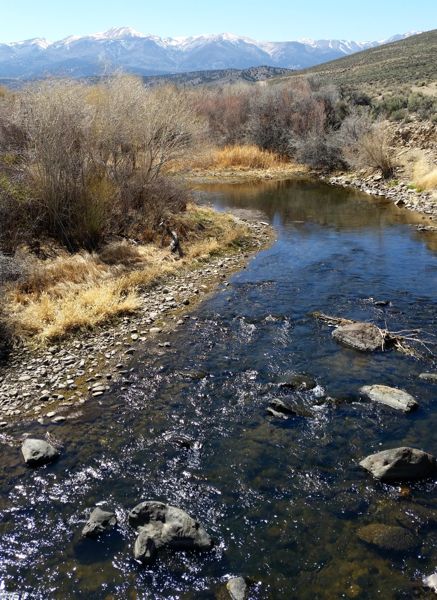
The Walker River that farmers in Mason and Smith valleys rely on. Photo/Anne Knowles

The Walker River that farmers in Mason and Smith valleys rely on. Photo/Anne Knowles

In February, in its first-ever curtailment of groundwater, the state engineer ordered farmers in Smith and Mason valleys to cut groundwater pumping by half. (Their groundwater rights are a supplemental right used in conjunction with surface water rights on the Walker River.) The farmers formed Farmers Against Curtailment Order LLC and sued the state engineer. District Court Judge Leon Aberasturi granted a temporary injunction.

“The judge might have been OK if we had cut off by priority,” said King, rather than try to reduce usage by a percentage.

By priority means that water is allocated by seniority. Those with the oldest or most senior rights receive their full amount of water, those with newer or junior rights are cut off.

All or nothing.

That could be the next step in Pahrump or Diamond Valley. Indeed, on April 28, Sadler Ranch in Diamond Valley sued the state engineer, saying the office’s failure for decades to curtail groundwater pumping by junior water rights holders in the valley has impinged on his senior water rights. The 3,000-acre ranch has rights dating from 1870.

The petition for curtailment, filed in the 7th Judicial District Court in Nevada, says pumping by junior appropriators has reduced the ranch’s water by 90 percent.

The suit, citing the state engineer’s data, says Diamond Valley has a perennial yield of 30,000 acre feet, which is the maximum amount of groundwater that can be pumped annually over the long term without depleting the aquifer.

But more than 130,000 acre feet of groundwater rights have been issued and in 2011, more than 96,000 acre feet of water was pumped, says the suit.

King said his office is examining what existing tools it has to use in Pahrump and Diamond Valley, which could including making the first designation of a critical management area.

“The biggest hammer we have that we never want to use is to manage by priority,” said King. “The biggest trigger is if senior rights holders can’t get their water.”

Domestic wells, too, can be regulated by priority. Even though the wells don’t need water rights, they do need permits to be drilled so each has a date that sets priority.

SB81 was the more disputed of the two bills. Senate Bill 65, a lengthy bill that primarily updated antiquated language in the state’s century-old water law, went through workshops too and was eventually stripped of its most controversial sections, including a definition of perennial yield and restrictions on where domestic wells can be drilled. Even then the bill failed.

“There was a fear factor,” said former Assemblyman Hettrick. “People looked at the bills and said what door is this going to open? Once you do this, what’s next?”

Next for the Nevada Drought Forum are two meetings to get the perspective of water users. A meeting with tourism, mining and other business interests is set for July 14 in Las Vegas and a meeting with the state’s two biggest water users, agriculture and municipalities, is scheduled for Aug. 19 in Carson City or Sparks.

The forum summit, likely somewhere in the state capital, is now planned for Sept. 21-23.



Homebuyer down payments more affordable

By Nick Ramsey, Columbus Business First

It’s getting easier to afford to buy a home.

Down payments on home purchases across the nation are getting smaller again after years of increases following the burst of the housing bubble, according to a new report from RealtyTrac.

According to the real estate analytics site, the average down payment in the first quarter represented 14.8 percent of the purchase price, compared with 15.5 percent early in 2014.


“The dangers of interest-only, negative-amortization, and low, low credit score loans are not a part of today’s low down payment programs,” Craig King, COO at Chase International brokerage, covering the Lake Tahoe and Reno housing markets, said in the RealtyTrac release. “Without those types of high-risk components, low down payment loans are a sound strategy.”

Read the whole story


Science seeks to unlock marijuana’s secrets

By Hampton Sides, National Geographic

There’s nothing new about cannabis, of course. It’s been around humankind pretty much forever.

In Siberia charred seeds have been found inside burial mounds dating back to 3000 B.C. The Chinese were using cannabis as a medicine thousands of years ago. Marijuana is deeply American too—as American as George Washington, who grew hemp at Mount Vernon. For most of the country’s history, cannabis was legal, commonly found in tinctures and extracts.

Then came Reefer Madness. Marijuana, the Assassin of Youth. The Killer Weed. The Gateway Drug. For nearly 70 years the plant went into hiding, and medical research largely stopped. In 1970 the federal government made it even harder to study marijuana, classifying it as a Schedule I drug—a dangerous substance with no valid medical purpose and a high potential for abuse, in the same category as heroin. In America most people expanding knowledge about cannabis were by definition criminals.

But now, as more and more people are turning to the drug to treat ailments, the science of cannabis is experiencing a rebirth. We’re finding surprises, and possibly miracles, concealed inside this once forbidden plant. Although marijuana is still classified as a Schedule I drug, Vivek Murthy, the U.S. surgeon general, recently expressed interest in what science will learn about marijuana, noting that preliminary data show that “for certain medical conditions and symptoms” it can be “helpful.”

Read the whole story


Douglas County projects uptick in revenues

By Anne Knowles

MINDEN — Douglas County is back in balance.

Three years ago, the Nevada county had a $3 million structural budget deficit that was projected out for several years. Since then, the county has moved to priority-based budgeting and made a few other changes, such as contracting out some services to Carson City and Storey and Lyon counties, that cut costs.

Now revenues are growing again. In 2016, its general fund revenue, consisting mainly of money from property taxes and the state’s consolidated tax, is projected to grow 2.4 percent, in line with a 2.4 percent uptick in expenses, made up primarily of personnel and services, and supplies.

For fiscal year 2015-16, the county has about 500 full-time positions and a budget of $136 million.

“In January, the board (of commissioners) held a workshop to update our goals and they added organization sustainability,” Jim Nichols, county manager, told about 100 people gathered June 11 in the ballroom of the Carson Valley Inn to get an update on the county’s financial health. “That includes retention and recruitment of staff.”

Other good news included increases in home sales and home prices and a slight but welcome jump in property assessed values.

Assessed values are expected to increase 1.7 percent in 2016, to about $2.6 billion, after a precipitous decline of 29 percent between 2010 and 2014.

“Twenty-nine percent is significant,” said Christine Vuletich, assistant county manager and chief financial officer. “I know everyone knows that.”

Nichols said the county still faces some challenges, including investments in infrastructure, particularly the county’s 171 miles of paved roads that for years have had a backlog of needed maintenance.

Nichols said he was also concerned that big business projects in the Reno area, specifically Tesla Motors’ battery plant and the Switch data center, which are expected to create about 52,000 jobs both directly and indirectly, could drain the local workforce.

Nichols also pointed to some achievements from the past year, including the opening of the 83,000-square-foot community and senior center, upgrades to the Zephyr Cove water facility, completion of the Elks Point Road to Round Hills Pine Beach stretch of the Stateline-to-Stateline bike trail and the adoption by the county commissioners of the Tahoe Douglas Area Plan, which goes next to the Tahoe Regional Planning Agency for approval.

Nichols praised private investment that is helping to revitalize the area, including Lake Tahoe Hard Rock Lake, Epic Discovery at Heavenly Mountain Resort, and Sharkey’s.

The county’s presentation concluded with its second annual Spotlight Awards honoring area businesses. The awards, in seven industry categories, went to Minden Meat & Grill, Minden; Ace Hardware, Gardnerville; Zephyr Photonics, Zephyr Cove and Minden; Heavenly Mountain Resort, Stateline; Park Heritage, owner of the recently opened Overland Restaurant & Pub in Gardnerville; Carson Valley Golf Course, Gardnerville; and Design Workshop, Stateline.

The county also recognized six employees for exemplary service: Marcie Schurke, finance; Anita Macgillivray, human resources; Ron Roman, public works; Don Gerard, public safety and maintenance; Kathy Munson, library services; and Melissa Blosser, public information.