Cameras designed to be fire containment tool

By Ann Harmon

Drought? Never mind, the Tahoe basin hasn’t a problem. People who live here, people who visit, they’ll have plenty of water with Lake Tahoe nearby. But doesn’t a drought mean its forests are drying out, that many trees will die? Well, sure, but fire fighters and equipment are great these days. Tahoe will be fine.

Have we forgotten the 2007 Angora Fire? Dismissed the $160 million it cost, the 254 homes burned? Do we remember last year’s 97,000-acre King Fire fought for more than a month, costing $5 million per day? That came close to Tahoe, too close.

If Tahoe burns, a national treasure will be gone. Maybe we should pay attention after all. We have not been this dry for 1,200 years.

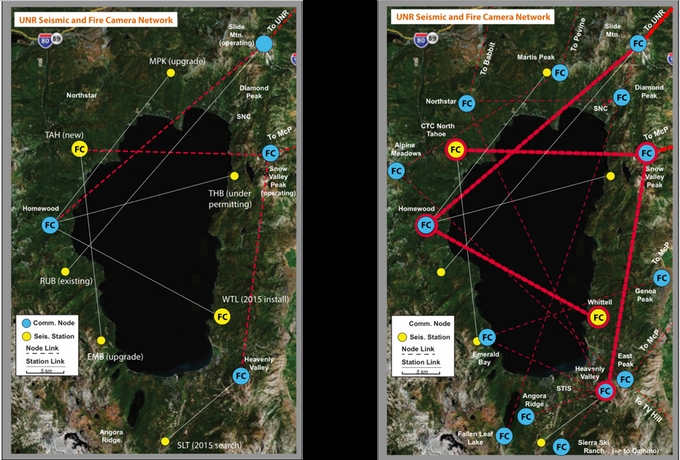
Left: Pilot program cameras; right: build out. Images/UNR

Left: Pilot program cameras; right: build out. Images/UNR

The UNR Seismological Laboratory, under Director Graham Kent, recognizes exactly what the drought means: possible basin fires. When the Lab learned of Forest Guard, an international 2009 award winning project of young students in Meadow Vista, it worked with them and with Sony Europe to develop a Tahoe plan. The ALERT Tahoe project is now under way to place 15 cameras around Tahoe to film any basin fire within seconds of its start using on-demand time lapse imagery. Four units are now in place.

The first aha was last August when Mac Heller with the U.S. Forest Service on a fire near Fresno logged onto the camera at Snow Valley Peak. He spotted a small lightning strike fire north of Spooner Summit. Firefighters put it out at less than half an acre.

The USFS-CalFire interagency joint command center in Camino now watches cameras 24/7. Pictures also go to the USFS, CalFire, BLM and local fire districts around the basin.

Axis HD cameras with 32x pan-tilt-zoom capability provide panoramic views from towers built on solid rock, also carrying early warning earthquake detectors. Notably, the BLM has funded these same cameras for Central and Northeast Nevada to catch sagebrush and forest fires. At $3,500 each, cameras have a three-year guarantee. Each station’s complete system of independent microwave communications, power systems, and other expenses is a $15,000 to $30,000 investment.

Towers withstand snow, high winds and earthquakes, so durable that inspections can be limited to two visits a year. This is a good thing. Access can be very difficult. Cameras, when funded, will ultimately provide coverage from Peavine to McClellan Peaks and possibly from Sierra-at-Tahoe and the western slope of the Sierra.

The ALERT Tahoe program is being funded by public grants and private donations. New donations are critical to roll the system out as rapidly as possible. Tahoe can’t wait. This summer, if $50,000 is raised quickly through private donations, installations will be placed above Zephyr Cove and, hopefully, on Martis Peak. If additional donations and site approvals are secured early this summer, possibly two other stations would be built, one on Diamond Peak, one above Cal Neva.

Two million dollars would provide the system and operating funds for a decade. Remarkably, that is only 1.25 percent of the cost of the Angora Fire. Kent notes that, were $2 million immediately available, camera eyes could be placed within two years on 15 towers. Delayed funding would take three to four years more.

System maps, cameras and donation information are on ALERT Tahoe’s website.

Also under way, with financing by the National Science Foundation and the Nevada Governor’s Knowledge Fund, is UNR lab’s research into using drones for quickly communicating real-time imagery during fires. Plans are to team with UC San Diego to share ideas and save possible costs, including crowd sourcing fire watching.

Ann Harmon is a retired research chemist who lives in Stateline.


CEQA exemptions for water projects inserted into budget bill

By David Siders and Jeremy B. White, Sacramento Bee

Some drought-related groundwater and water recycling projects would gain exemptions from the California Environmental Quality Act under late-emerging legislation at the Capitol.

The exemption, contained in a budget-related trailer bill, offers a narrower exemption than a broader one Gov. Jerry Brown originally proposed. Lawmakers appeared to be nearing a deal Thursday, after pushing back on Brown’s initial proposal.

The language would exempt certain groundwater replenishment projects and the development of building standards by state agencies for recycled water systems. It would also exempt from CEQA the adoption of stricter conditions in the issuance of permits for wells.

Read the whole story


EDC Fair can be a dizzying, thrilling experience

The Midway at the El Dorado County Fair has a new operator this year. Photos/Kathryn Reed

The Midway at the El Dorado County Fair has a new operator. Photos/Kathryn Reed

By Kathryn Reed

PLACERVILLE – With at least 2,000 carnival wristbands sold before the El Dorado County Fair even opens, it’s obvious the Midway is a huge draw.

New this year at the Placerville fair is the company operating the rides and games – Carnival California.

With the number of joyful screams and big smiles during Wednesday’s preview, it looks like there will plenty of fun to be had at the four-day fair that opens today.

Father and son -- both Michael Burks -- on the bumper cars.

Father and son — both Michael Burks — on the bumper cars.

Seven-year-old Michael Burks has been coming to the fair since he was a baby, but June 17 was the first time he had been in a bumper car. His dad, also Michael Burks, had to do the driving because he has longer legs.

A couple head-on collisions bounced them around, but the younger Burks eagerly asked if they could go again.

“We are very excited to have six ‘spectacular’ rides, including the Pharaohs Fury, the Typhoon and of course the ever popular Zipper and classic Century Ferris Wheel,” Jody Gray, fair director, told Lake Tahoe News. “These rides have LED lights, (bringing a) very impressive look to the carnival.”

This is the third carnival provider in the last 14 years. The previous firm stopped doing shows in Northern California.

Gray believes one reason the Midway is so popular at the Placerville fair is that rides like this are rare in the area.

The fair receives a flat fee from the carnival and the games.

A mini roller coaster delights fair-goers.

A mini roller coaster delights fair-goers.

The Mega Slide is great for all ages. The smallest of children seemed to fly the fastest down this slick rolly slide.

Be prepared to be squished if sitting on the right side of the Sizzler car. Three arms, each with four cars holding two people zoom in and out made the world seem like it is still spinning even after the ride had come to a stop.

The Typhoon is a good starter ride for those unaccustomed to the world of such spinning devices. The person on the left gets the brunt of the crushing.

The main carnival is in its usual spot near the entrance, however other rides are now staged on the far side of the fairgrounds.

—–

The baby pigs live up the the fair's theme -- HOgs

The baby pigs live up to the the fair’s theme — Hog Days of Summer.

Notes:

·      The fair runs June 18-21.

·      Carnival tickets may be purchased in advance online, which includes discount prices.

·      Hog Days of Summer is this year’s theme. More info about the fair and all events are online.


EDC Grand Jury blasts 2 elected officials

By Kathryn Reed

The El Dorado County Grand Jury raked Auditor-Controller Joe Harn and Supervisor Ron Mikulaco over the coals in separate reports that were released this week.

Neither of the elected officials believes there is much truth to the reports, with Mikulaco saying it is politically motivated.

Harn said it’s hard to defend accusations when no examples of wrongdoing were presented.

Mikulaco, who is in his first term, represents the first district on the western edge of the county. He said he was never interviewed by the grand jury regarding the allegations made against him, which is a Penal Code violation.

“I’m not a good ol’ boy. There is a cost to not towing the line,” Mikulaco told Lake Tahoe News.

In the future he believes there needs to be better screening of the grand jury members so no one with blatant political connections and therefore perceived biases serves.

Brian Veerkamp, chair of the board, did not return a call. His secretary told LTN, “I doubt he will be able to comment, but I will give him your message.”

In addition to the reports on the two elected officials, the grand jury also believes the El Dorado County Charter should be repealed and county government structured as a general law county.

This civil grand jury claims Harn cost the county more than $1 million because he allegedly did not send a complete cost allocation plan to the state.

“The bottom line is they don’t understand the cost allocation plan. It didn’t cost us anything,” Harn told Lake Tahoe News.

In a prepared statement he further stated, “The state controller found no fault with the plan prepared by my office. The state controller found that the IT billings prepared by IT were not supported. IT didn’t maintain the records needed to substantiate the billings. My office is not responsible for the IT billings. The IT billings were done correctly for a decade prior to the former CAO’s reorganization of the management of IT.”

Since that time CAO Terri Daly was shown the door and the person who had always done IT’s billings for the cost allocation plan left the county.

Joe Harn

Joe Harn

The findings against Harn include:

·       Report: Harn delayed or refused to make payments for reasons of personal and political motivation.

Harn’s response: He has to pay the bills, so this isn’t possible

·       Report: The Board of Supervisors has not ensured the independence of the outside audit of the county’s financial statements.

Harn’s response: An outside audit is done every year. It’s likely a new auditor will be hired this year because the same CPA firm has been used for the last seven years. He welcomes the board to have an audit committee.

·       Report: He is not complying with two ordinances – sections 3.16.130 and 3.16.140.

Harn’s response: The 1958 ordinance saying the Board of Supervisors approves bills for payment has been replaced by a 1978 resolution saying this is the auditor-controller’s responsibility. (There is likely to be an agenda item June 23 repealing the 1958 ordinance so there is no confusion.)

·       Report: He allows personal relationships to interfere with his management of his staff.

Harn’s response: “I like and respect my staff, and they like and respect me.”

·       Report: The auditor-controller is guilty of harassment and disrespectful conduct toward employees of both the county and other entities.

Harn’s response: “If they brought up specific examples, I might be able to say I should have been nicer. Earlier they say I’m a bully, but don’t say who I bullied.”

Ron Mikulaco

Ron Mikulaco

As for Mikulaco, the report says, “District One Supervisor Ron Mikulaco lacks comprehensive awareness of his position as a county supervisor and fails to follow basic and generally accepted principles of good governance. Equally alarming, he is abrasive, combative and insulting to others, and refuses to follow the protocols and processes expected of any elected official, especially an El Dorado County supervisor.”

The supervisor told Lake Tahoe News, “It was pretty brutal. I was a little caught off guard. They never talked to me about any of the items in there. They never interviewed me.”

The report accuses him of using taxpayer money for a satellite office in El Dorado Hills that the jury says is not necessary. (The district five supe has an office in South Lake Tahoe and Placerville.) Mikulaco said he furnished the office and pays for it out of the allowance he is given each year.

Each supervisor has $250,000 to spend – this includes the salary for their assistant and then other items related to their job. Mikulaco said he has given money back to the county because he has not spent it all.

He said the training he received that the jury took issue with is no different than what others are offered.

As for his personality, Mikulaco said, “I agree I can be abrasive when people lie to me.”


Marijuana growers’ pesticide use a concern

By Luke Runyun, NPR

The marijuana industry has a pesticide problem. Many commercial cannabis growers use chemicals to control bugs and mold. But the plant’s legal status is unresolved.

The grow room at Medical MJ Supply in Fort Collins, Colo., has all the trappings of a modern marijuana cultivation facility: glowing yellow lights, plastic irrigation tubes, and rows of knee-high cannabis plants.

“We’re seeing a crop that’s probably in it third or fourth week,” says Nick Dice, the owner.

The plants are vibrantly green, happy and healthy. And Dice says that’s because the company’s taken a hard line on cleanliness.

Read the whole story


FDA mandates elimination of trans fats

By Sabrina Tavernise, New York Times

WASHINGTON — The Food and Drug Administration on Tuesday gave the food industry three years to eliminate artery-clogging, artificial trans fats from the food supply, a step that health experts said would save thousands of lives a year.

Trans fats — a major contributor to heart disease in the United States — have already been substantially reduced in foods, but they still lurk in many popular products, including frostings, microwave popcorn, packaged pies, frozen pizzas, margarines and coffee creamers.

The FDA first announced its plans to ban the substance in 2013, and its announcement on Tuesday was its final ruling. Companies will have three years to comply. The agency has estimated that banning trans fats completely could prevent 20,000 heart attacks and 7,000 deaths from heart disease each year.

Read the whole story


No resolution to SLT vacation rental policy

Real estate agent Stan Freeman let's people know his view on vacation homes. Photos/Kathryn Reed

Real estate agent Stan Freeman let’s people know his view on vacation homes. Photos/Kathryn Reed

By Kathryn Reed

With two-thirds of the vacation rentals in South Lake Tahoe being in residential neighborhoods, it is big business. It also means non-traditional neighborhoods are being created.

Those are the overriding issues when it comes to vacation home rentals – economics vs. locals not wanting residences used as a business.

Since the City Council has been toying with tweaking the VHR ordinance the number of VHR permits has gone from about 1,600 to 1,800.

Before Tuesday’s City Council meeting the real estate community mailed material from its viewpoint in regards to property values and private property rights if the proposed ordinance became law. Then they and other advocates filled council chambers and the lobby June 16 to make their case.

City staff at the meeting stressed that private property rights don’t allow people to essentially run a business from their home without oversight. The city’s perspective is that vacation home rentals are a land use issue.

Those in support of the city’s proposed ordinance were in the minority by a long shot. But if they don’t ultimately get their way, there is talk of asking the voters to be the ultimate decision makers. This is much like when people didn’t want parking meters; a ballot measure ended that practice. This means VHRs could also be cast aside by voters.

Police Chief Brian Uhler escorts Jim Morris away from the podium.

Police Chief Brian Uhler escorts Jim Morris away from the podium.

Advocates for this type of lodging point to how this is the way of the future and that VHRs are growing. They also say even the threat of drastic changes is getting home buyers to rethink purchasing in the city limits.

Repeatedly most of the 27 people who spoke Tuesday said enforce the rules on the books so it can be determined if a problem really exists, then address problems at that point.

The city is also doing a “holistic evaluation of VHRs from quality of life issues to zoning, real estate values, residential impacts” and more. This should be finished in spring 2016. There were multiple requests to wait to see what that study produces before changing anything.

Ultimately, after three hours of testimony and deliberations by the four council members it was decided that Wendy David and Austin Sass would form a subcommittee to further look at the issue. (Tom Davis recused himself because of his interest in Tahoe Keys Resort.) David is a supporter of VHRs, saying she lives among them and uses them when she travels. Sass is the most vocally opposed councilmember, repeatedly asking that there be a maximum number of VHRs. However, the only types of businesses the council has restricted are medical marijuana, and the sale of puppies and kittens.

The duo will decide if workshops will be conducted or if stakeholders will be part of the committee or some other scenario is created with the ultimate goal of reaching consensus so the entire council then votes on something.

The electeds did agree the subcommittee is to work on a permit procedure that goes beyond today’s administrative process, to not mandate ADA requirements beyond state and federal rules, to allow residential input but not allow neighbors to have veto power, and to not force those with hot tubs to meet the same guidelines as hotels.

The meeting was conducted in a civil manner except for when Jim Morris with Lake Tahoe Accommodations verbally attacked the council, the city manager and city attorney, wouldn’t leave the podium and had to be escorted away by the police chief. He also nearly got in a fight at a previous meeting with someone who had an opposing view. And he has filed a lawsuit against the city.

—-

 In other action:

·  The council passed the single residency hotel ordinance on a 4-1 vote. Councilman Tom Davis wanted more time to discuss the issue with those who will be affected.


Man killed by SLT officer didn’t have weapon

Updated June 16, 4:30pm:

A man with a history of drug arrests was the victim of Monday’s shooting in South Lake Tahoe.

Kris Jackson

Kris Jackson

A single bullet fired by a South Lake Tahoe police officer in the early morning hours of June 15 killed Kris Jackson, 22, of Sacramento. Jackson was trying to flee out of a window at the Tahoe Hacienda Inn when fired upon. Jackson died at Barton Memorial Hospital a few hours after being shot.

“The involved officer’s statement explains he perceived a deadly threat from Kris Jackson. After interviews and a search of the crime scene, no firearm or other weapon was located,” the police department said in a statement Tuesday afternoon.

This is the time line of events as released by the department from dispatch records:

  •  2:40:21am — Call into dispatch received and the caller reports a female crying and screaming.
  • 2:41:27am —  Two officers were dispatched.
  • 2:47:28am — Officers arrive on scene.
  • 2:49:39am — The involved officer reports on the radio that someone is going out the back window.
  • 2:49:57am — The involved officer reports the shooting to dispatch.
  • 2:50:13am — An ambulance is requested.
  • 2:56:46am — The ambulance arrived on scene.

The officer’s name still has not been released.This is the first officer involved shooting in the city in more than 10 years.

Jackson was on criminal probation. He goes by Jaez BenSlidin on Facebook.

On June 1, Jackson was arrested by South Lake Tahoe police officers for allegedly possessing several baggies of cocaine, scales and packaging materials. On May 21 he had been arrested by local officers on a Sacramento failure to appear warrant related to a drug possession charge.

Officers were called the hotel on Highway 50 because of screams and a woman crying. The woman was not the victim of physical abuse, according to authorities.

— Lake Tahoe News staff report


South Shore economy bouncing back

By Bill O’Driscoll, Reno Gazette-Journal

Tourism on the south end of Lake Tahoe has taken hits in recent times, from ski season-sapping drought to tribal casinos in the California foothills.

Now the region is fighting back. More than a dozen businesses, from high-rise hotel-casinos at Stateline to the small retailers in South Lake Tahoe, have finished or are proceeding with a collective $150 million in renovations, according to industry figures.

And the timing couldn’t be better, officials say, with the summer season unfolding and broad economic recovery underway.

“It’s all kind of coming together at a time when people feel better about traveling and spending more money,” said Carol Chaplin, executive director of the Lake Tahoe Visitors Authority. “We’re kind of threading the needle.”

She also cites the timing of JetBlue Airways’ new nonstop flights from New York City to Reno-Tahoe International Airport, the main gateway to Tahoe.

Read the whole story


Music festivals a boon for cities, musicians

Small touches like a wine barrel as a table add local flair at BottleRock in Napa. Photos/Susan Wood

Small touches like a wine barrel as a table add local flair at BottleRock in Napa. Photo/Susan Wood

By Susan Wood

As South Lake Tahoe ponders showing off its own outdoor concert venue near the Lake Tahoe Airport, the city will have plenty of examples of communities to look to that have set the stage for the growing industry – the latest being the three-day extravaganza at BottleRock Napa.

The South Shore is no newcomer to outdoor concerts. Consider the highly successful version at the Harveys Stateline parking lot bringing big, one-night acts such as Elton John, Kenny Chesney and Imagine Dragons this summer. Then in winter, resilient crowds of more than 40,000 techno music lovers flock to SnowGlobe’s multi-stage grounds near Lake Tahoe Community College over three nights on New Year’s week.

In addition, the North Shore contributes with Wanderlust at Squaw Valley. Beyond in the Sierra Nevada, the Strawberry Music Festival in Grass Valley hosts many acts, along with other, numerous, pop-up, smaller venues.

BottleRock founder Dave Graham believes locals can put on a better festival.

BottleRock founder Dave Graham believes locals can put on a better festival. Photo/Susan Wood

Bands need festivals for revenue

Fun and frolic aside, these festivals and concerts represent a serious business trend for concert promoters and musicians, according to Pollstar. The trade publication covering the global concert scene has seen a growing business model for artists. While the public’s consumption of music has never been greater, the ability of artists to financially monopolize on that demand has declined, Pollstar says. Digital sales and streaming revenues have lagged in replacing the reduced income from recording and publishing. So artists must hit the road to make money.

The North American concert industry mushroomed to $6.2 billion last year, with the explosion attributable to one single, large factor – the increasing proliferation of large multi-day music festivals. This year’s global calendar confirmed 1,500 events in 70 countries, according to Pollstar.

Moreover, the growth is led by average ticket prices jumping 2.8 percent to a record $71.44.

“The only way touring artists can make money is touring. They need to if they want to make a living now. A lot of the old revenue streams have dried up,” Pollstar music media representative Gary Bongiovanni told Lake Tahoe News.

So, here’s more power to the cities that provide a place to perform, he indicated.

“Whether it’s public or private money financing it, we’re seeing growth from the 20,000-seaters to the much smaller jazz- and family-oriented places for 5,000 (people),” said Bongiovanni, who has covered the music scene for 33 years.
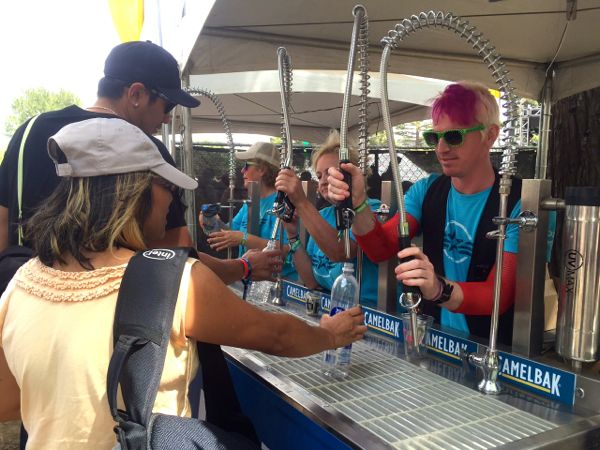
CamelBak's hydration station is as busy as the alcohol booths at BottleRock.

CamelBak’s hydration station is as busy as the alcohol booths at BottleRock. Photo/Susan Wood

A sense of place

Bongiovanni believes if South Lake Tahoe can pull off hosting such an event tucked in the trees on a now deemed 30-acre site proposed at Melba Road and Kyburz Avenue below Highway 50, it would be a win-win for artists and the community.

“Lake Tahoe is ideal for these concerts. It’s picturesque; an idyllic place to see outdoor music shows. My first question is whether the population of South Lake Tahoe is large enough to support the facilities for an event like that,” he said, further stressing how the event needs locals and tourists to turn out to make it successful year after year.

Some infrastructure is already there on the property. There’s a concrete slab where one stage could go. Evidence of a sewer hookup is also there. The airport tower would make an ideal landmark.

For the natural environment, leaving most of the trees should provide a sound buffer and perhaps even a mystique to this proposed concert venue.

SnowGlobe in South Lake Tahoe caters to the techno crowd. Photo/Carolyn E. Wright/Copyright

SnowGlobe in South Lake Tahoe is more like a rave catering to the techno crowd.Photo Copyright 2015 Carolyn E. Wright

South Lake Tahoe ready to expand festival experience

South Lake Tahoe City Manager Nancy Kerry is batting around the idea, with the help of a strategic team. A cost-benefit study will be conducted.

“The idea is for the property to remain as it is,” she said, listing the planned thinning of trees and space for a proposed bike path as means to an end.

Kerry realizes events have been mounting in town, and they’re popular. Supporters believe each event has its own special market, venue and vibe.

“SnowGlobe demonstrated 15- to 40,000 people would come to a concert in the forest if we have it,” she said. The city has also tapped into the Electric Forest website that illustrates a laid-back vibe where those who appreciate good music expand their own creativity in attendance. Picture hula hoops, and peace, love and harmony without Woodstockish drugs as the focus. It’s a good-to-be-alive feeling.

Imagine. This is all from Tahoe’s own natural beauty.

“A lot of these event venues capture the natural surroundings,” Kerry said.

Artificial turf was laid at the Napa County Fairgrounds just for BottleRock. Photo/Susan Wood

Artificial turf was laid at the Napa County Fairgrounds just for BottleRock. Photo/Susan Wood

Learning from others

The key to making it a success is maintaining Lake Tahoe’s unique charm and character.

This theory was even expressed by a Napa resident attending last month’s three-day BottleRock giant outdoor concert in her hometown.

“Tahoe can do this, but it needs to keep its own identity. The Nevada side has money. The California side is where the people really appreciate recreation. Don’t lose yourselves trying to be some place like Napa,” Erin Crain said, while standing in BottleRock’s concessionaire square on the Friday night of the festival.

Crain stood in front of the wine bar serving varietals like a Rombauer Merlot. Other wineries such as Butter, Napa Cellars and Del Dotto had their own tents, some like the latter, with extravagant seating areas to provide an elegant wine experience.

“We wanted to create a staging area to reflect the elegance of Del Dotto,” winery worker Kristina Ambra told Lake Tahoe News while buffing the chandelier the day before the concert weekend began during a media tour.

This may not be a Tahoe experience, but the South Shore may embrace brewmasters, climbing walls or stand up paddleboarding as symbols of this unique area. Ideas abound relating to tents and stations that capture Tahoe’s outdoor nature and pristine environment. One of BottleRock’s nice touches Tahoe lovers could relate to – CamelBak’s watering hole, a station where a line of the Petaluma-based workers consistently dispense water in concert goers bottles.

Concert-goers were using turned-up wine barrels as waist-high tabletops. (In Tahoe, picture sawed off tree trunks serving as tabletops.) Off to the side, tents camouflaged trash and recycling cans.

Besides drinking, foodies also relished the BottleRock experience with a variety of Napa tents designed to tempt the taste buds. It seemed the Whole Foods Market food truck was one of the busiest, situated next to Kara’s Cupcakes. That Napa dessert mainstay served a steady line until it ran out of cupcakes about 9pm, an hour before concert-goers cleared out Friday night.

There was even a culinary stage where concert attendees watched renowned Chef Masaharu Morimoto teach rapper Snoop Dog how to roll sushi. The crowd gathered for that event had people backed up 50 feet away.

But above all, it was BottleRock’s music that was a hit and plentiful – with bands appealing to all age groups with the variety of genres. The contemporary hit band, Imagine Dragons – which will appear at the Harveys Summer Outdoor Concert series next month, cranked out its assortment of chart toppers such as “I Bet My Life,” “It’s Time” and “Demons.” (The bass player is from Forestville in neighboring Sonoma County.)

The crowd – about a football field long took it all in – some swaying and dancing, while others played corn hole and chatted in the back. Laura Palmer enjoyed standing way back in the open space by the winery tents to watch the youngsters play in the grass. Even though the band members on stage looked like figurines, the acoustics were off-the-charts precise.

“People would go crazy in Tahoe for something like this. This is something all ages can do. Make it inclusive,” the Alameda resident said. Palmer added she liked BottleRock’s set up because of the open space where she feels she can breathe and watch the entertainment and be entertained by the kids.

Laurie Smith, a 20-year resident of Napa, admitted she attended BottleRock two years ago to watch her son for a different reason.

“I came to make sure my son didn’t get high,” she said, laughing next to the Whole Foods food truck. “I like it this year. I would call it a success. Good wine, good food, the best weather.”

Concert promoters take note: these parents may be onto something – appeal to varying members of the household.

Sunday’s BottleRock performances catered to Snoop Dog’s rap crowd, new band American Authors with the “Best Day of My Life” anthem, a noticeably pregnant Tristan Prettyman’s soulful, sentimental baby boomers and EchoSmith’s “Cool Kids” Billboard soundtrack enthusiasts. (Note: the band consisted of all teenagers, with a stage presence of seasoned performers.)

In its third year, BottleRock has been deemed a massive success – especially compared to the first two years when vendors were late getting paid and crowds clogged the 26-acre site. Easy traffic flow was critical for the three local men putting on the event – Jason Scoggins, Justin Dragoo and Dave Graham.

Graham’s advice to South Lake Tahoe wanting to put on a successful multi-day concert was simple – have a local organizer do it.

“It’s difficult to be an outside entity and putting this on. There are a lot of things you have to weigh, constituents to deal with,” he told Lake Tahoe News in a flurry of busy work the day before the concert started. “You definitely have to have a thick skin.”

And above all: “Start early,” he added, reporting a two-year runway for putting on BottleRock. He laughed at the thought others told him he was “crazy” for trying to conduct such a feat attracting more than 100,000 people over three days. “But it’s as good and better as it was planned.”

Many commented about the planning and design of BottleRock.

“There’s only a five-minute walk between stages,” longtime Napa public relations guru Tom Fuller said during a media tour.

And even though BottleRock’s quest was to attract varying concert-goers with different musical tastes, it helps if some of them have money to splurge. While single-day tickets went for $109 and three-day passes sold for $275, the VIP passes cost $595 for the weekender. This means special service, a more pleasurable lounge place and an elevated seating area.

“If you’re going to spend money on a VIP ticket, you’re going to have a VIP experience,” Fuller said.

The city of Napa had no immediate report on tax revenue figures from the festival, but the Napa Downtown Association appeared initially happy about the outcome.

“It brings a different cache to Napa and builds our brand. It’s positive from that standpoint,” association member Craig Smith told Lake Tahoe News.

Although retailers show little sign of any burst in business because concert-goers “don’t come to shop,” Smith referenced the restaurants, which get “slammed” through lunch and up to the evening.

But there is a bit of a catch.

“If it’s held on a normal weekend, it’s a boon for business. But if it’s held on a strong weekend, it’s not a plus,” he said, mentioning July 4.

This may be a topic of conversation next year. BottleRock organizers have already announced the 2016 dates. They fall on Memorial Day weekend.