Police, bike advocates work to make roads safer

By Kathryn Reed

Most fatalities involving a vehicle in South Lake Tahoe are the result of a bicyclist or pedestrian being hit, not cars crashing into each other.

The police department is in the preliminary stages of building a campaign to make people more aware of others who are on the road. The Lake Tahoe Bicycle Coalition wants to be part of that message.

At a meeting in late June police Sgts. Shannon Laney and Shannon Norrgard spoke to a group of residents – mostly cycling advocates – about options, funding and solutions.

In the city limits in 2012 there were three deaths, one in 2013 and three in 2014 involving a vehicle hitting either a cyclist or pedestrian.

The No. 1 factor in the deaths is drivers under the influence, then failing to yield, and third is pedestrians not in a sidewalk, according to Laney.

Sgt. Shannon Laney listens to ideas about how the public could help with bike safety in South Lake Tahoe. Photo/Kathryn Reed

Sgt. Shannon Laney listens to ideas about how the public could help with bike safety in South Lake Tahoe. Photo/Kathryn Reed

It was pointed out how there is blame on all sides for accidents and fatalities. No matter the mode of transit – including walking – people are not always following the rules. Bicyclists are under the same laws as motor vehicles.

Laney said it could be difficult to catch up to cyclists who are violating the laws, especially riding on the wrong side of the street. It has to do with traffic and being able to flip a U-turn, and then whether that infraction rises to a level of importance to be worth chasing down.

South Lake Tahoe has an ordinance that makes it illegal to cross Highway 50 outside of a crosswalk. With crosswalks at times being quite a distance, many pedestrians opt to jaywalk. It is up to Caltrans to add crosswalks.

A new law in California says motorists must give cyclists 3 feet of space. Laney said that’s pretty hard to enforce until there has been a collision. That’s when citations get written. He said it would take a sting operation or dedicated personnel to actively enforce that law. Manpower is an issue.

That is where the Bicycle Coalition might be able to play a role. It could work on securing grants that would pay for increased patrols for bike related enforcement as well as education material.

Education, all sides agreed, is one component that has been missing. This would be for cyclists and drivers.

Norrgard mentioned how it would be great to blast a message about the 3-foot law so more people would know about it. Eventually it would be engrained in people’s heads and then behavior would change without having to think about it. It might be similar to when 10 years ago the “click it or ticket” campaign was foreign, but now most people know it is about buckling up.

Cycling activist Curtis Fong said handing out literature at key intersections could be the first step to start educating people about the rules of the road – whether one is on two wheels or behind a wheel.

Both sides agreed to work more closely with one another.


Calif. water rights lawsuits a century in the making

Houseboats at Lake Oroville sit well below the high water mark. Photo/Kathryn Reed

Houseboats at Lake Oroville sit well below the high water mark. Photo/Kathryn Reed

By Bettina Boxall, Los Angeles Times

The lawsuits hit the courts within days of the state mailing notices to some Central Valley irrigation districts: They were to stop diverting from rivers and streams because there wasn’t enough water to go around.

Unsurprising as the move may be in this fourth year of drought, to the districts, the notices amounted to an assault on water rights they have held for more than a century.

“This is an attempted water grab,” said Steve Knell, general manager of the Oakdale Irrigation District, one of several San Joaquin Valley agencies suing the state to block the curtailments. “It is a power move and we will fight tooth and nail to make sure that this doesn’t happen.”

The drought has highlighted the arcane workings of California’s water rights system, one that rewards those who got here first and underpins agriculture’s position as the state’s dominant water user.

Read the whole story


Future of Lake Tahoe Airport in council’s hands

By Kathryn Reed

Before summer is over, a preferred alternative for the Lake Tahoe Airport Master Plan should be selected.

The South Lake Tahoe City Council is expected to discuss the matter July 21 or Aug. 4.

It was in 1992 that a settlement agreement regarding the master plan was reached. This involved the city, state Attorney General’s Office, League to Save Lake Tahoe and Tahoe Regional Planning Agency. That document expired in 2012 so the city has been operating the airport without a valid master plan.

The June 30 meeting attended by about a dozen people was the final public workshop before the council takes over. The public will have two more opportunities at council meetings to offer input.

Michael Hotaling, the consultant preparing the master plan, said it’s likely the preferred alternative will be a combination of the various proposals that have been whittled down based on public comments, research and staff input. The alternatives separately address the airfield, and land area with buildings and open space.

Under consideration is whether to keep the airport as it is or do something else.

The FAA will have the ultimate say over the Aviation Demand Forecast and the Airport Layout Plan. The feds are paying 90 percent of the cost to create the master plan.

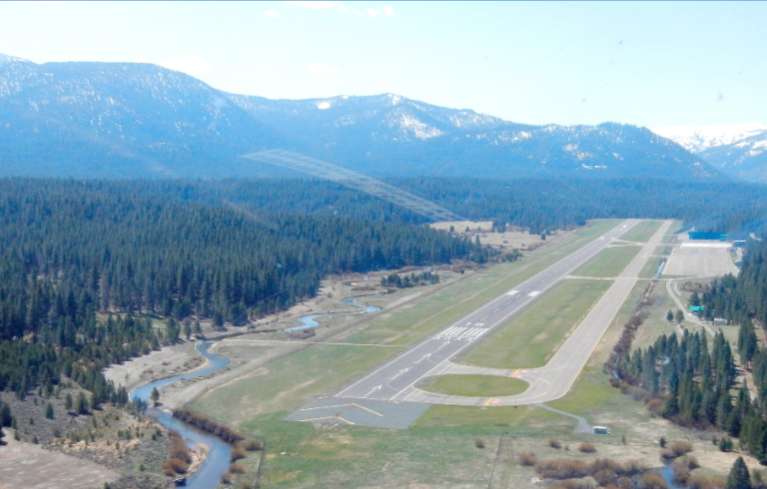
Lake Tahoe Airport's airfield could be altered. Photo/LTN file

Lake Tahoe Airport’s airfield could be altered depending on what the master plan calls for. Photo/LTN file

Closing the airport, while considered early on, is no longer an option. This is because the FAA deems the airport an important element in its greater transportation plan. Plus, it is a resource in emergencies and could provide the only way out of the basin in a catastrophe.

To accommodate a large number of planes like what will be arriving for this month’s celebrity golf tournament a temporary tower will be in place. Personnel from Reno will operate it. This is the second year for the portable tower. The permanent one cannot be used because it does not have equipment and the line of sight is blocked by trees.

Bringing back commercial air service is also off the table. The 139 certificate, which would allow commercial service, no longer is in effect. The council in the last year voted to give up that FAA designation.

Based on input from a meeting earlier this year the public is divided over what should be done at the airport. Some want to alter the airfield to allow a larger class of plane that is forecast to be the aircraft of choice going forward, others want to leave things as they are.

The consultants predict air traffic at Lake Tahoe Airport to increase 1.7 percent in the next 20 years. This means going from 2.7 flights per hour to 3.1.

When it comes to the land segment, some want to get keep the aviation designations for the property in case things change, others want to allow different uses. The city is looking at creating an outdoor events area east of the tower.

In the 2013-14 budget, $351,972 of the general fund was used to keep the airport afloat. That is a decrease of 43 percent from 2010-11. Hotaling said projections are for that number to continue to decline.


NY firm takes over South Shore fireworks; app allows music synchronization without radio

By Kathryn Reed

Three barges loaded with an array of canisters will make their way this morning from Tahoe Keys Marina to a secure holding area near Stateline. Then a small vessel will deliver a slew of pyrotechnics to the barges in anticipation of Saturday’s fireworks display on the South Shore.

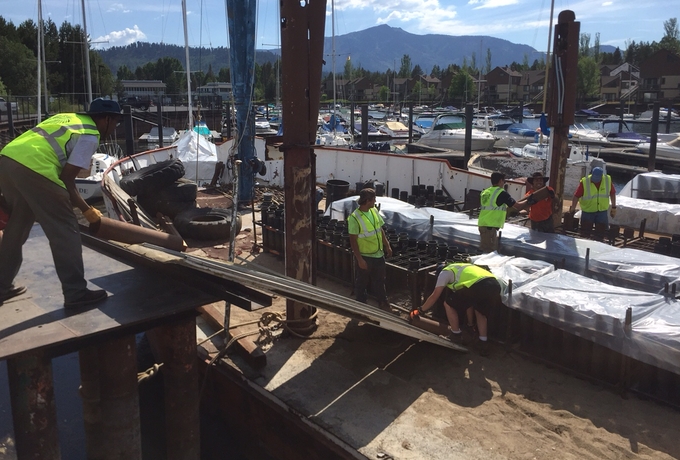
An 18-wheeler carrying empty canisters of varying sizes was being unloaded June 30, with the materials transferred to the barges.

“With three barges, what we look for is the ability to have movement, some animation to the show,” Joseph Mercante, project manager for Fireworks by Grucci, told Lake Tahoe News. “Instead of lifting three of the same or red, white and blue we can move from one side to the other or all at once with a lift so the audience sees the relationship of the three barges.”

Employees of Grucci load the barges June 30 at Tahoe Keys Marina with canisters that will be filled with pyrotechnics. Photos/Kathryn Reed

Employees of Grucci load the barges June 30 at Tahoe Keys Marina with canisters that will be filled with pyrotechnics. Photos/Kathryn Reed

His company is well versed in creating displays with a water setting. This allows for more creativity. Red strobing dahlias are a flower shape, with the deep red reflecting off the water like a strobe. Mercante said at some angles the reflection on the water has a triple effect.

The kamuro shell from Japan is one Mercante only uses on water.

“This willow shell is just like the tree. It will break out wide and will dip almost to the ground,” Mercante explained. “It’s something we would not want to do in a land-based area where that might touch the ground.”

Grucci was one of the first companies to sync its display with music. They did in 1976 for the country’s bicentennial. Arthur Fiedler was conducting the Boston Pops. Since that time technology has evolved so it’s not just music playing during a fireworks show.

Grucci created the score for Saturday’s show, with the blessing of the Tahoe Douglas Visitors Authority – the entity paying for the event. Mercante said it is patriotic in nature, with other music selections.

What will be new for Tahoe is the ability to hear the music without radio access. Grucci has an app for 99 cents that allows people to access the music on their iPhone or Android.

Grucci manufacturers its fireworks, so there is more control over the material used. This means less superfluous material – which is a boon for when it comes time to clean up the mess that night and in subsequent days.

This is Grucci’s first time to work in Tahoe. And it’s the first time in decades that there is a new operator of the annual show. Fireworks by Grucci – which is based out of New York – was awarded a contract to put on the July 4 and Labor Day weekend shows by the Tahoe Douglas Visitors Authority. The more than $100,000 July 4 show is costing about what it was with the other vendor.

The company has been around since 1850.

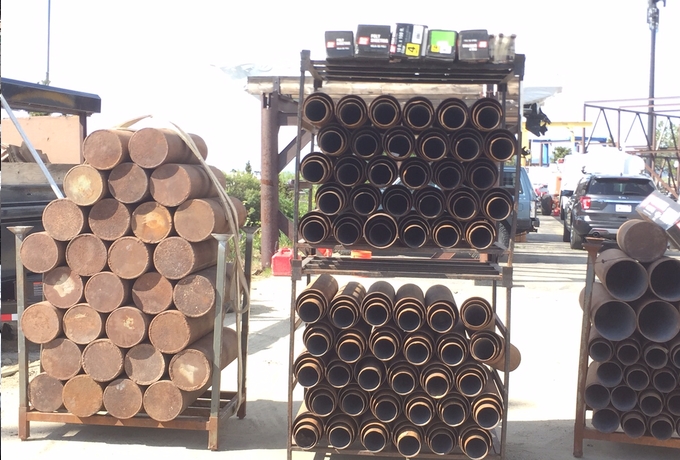
Various sized canisters are needed to accommodate the multitude of fireworks.

Various sized canisters are needed to accommodate the multitude of fireworks.

“At the end of the process the TDVA board decided that Fireworks by Grucci was a better overall value, and as one of America’s oldest and largest companies the experience of shooting top tier shows globally was an important factor,” Mike Frye, who handles events for Lake Tahoe Visitors Authority, told Lake Tahoe News.

Grucci has two Guinness World Records – one for the largest fireworks display. The company has worked seven consecutive presidential inaugurations; and the Olympic Games in Beijing, Salt Lake City, Los Angeles and Lake Placid.

“This is a world renowned company that has set world records. They have a good safety record and are environmentally responsible. We anticipate a safe clean firework show that will please the audience,” Eric Guevin, Tahoe Douglas fire marshal, told Lake Tahoe News.

In addition to being permitted by the Tahoe Douglas Fire Protection District, the company has permits from the U.S. Coast Guard and Nevada Division of Wildlife.

—-

Other info:

There are other sanctioned fireworks shows in the basin. However, all personal fireworks are illegal – even the ones that are labeled “safe and sane.”

As of today fire restrictions are in affect. The U.S. Forest Service is only allowing propane or gas-type grills on beaches. Fires are only allowed in established campgrounds with permanent fire pits

July 4 display details:

·       Number of days to install – five

·       Number of hours to choreograph – 25

·       Number of pyrotechnicians – 12

·       Number of man hours to set up – 720

·       Largest firing aerial shell – 10 inches

·       Show starts at 9:45pm and lasts 25 minutes.

·       The barges are in Stateline, near the California border.


Nev. working on skill-based slot games

By J.D. Morris, Las Vegas Sun

Nevada’s effort to make casino floors feel more like arcades advanced last week as gaming regulators started crafting the rules that will govern the introduction of skill into the state’s slot machines.

The Gaming Control Board had its first workshop to receive input on regulations that will implement Senate Bill 9, which Gov. Brian Sandoval signed in May. The bill directs regulators to encourage “innovative, alternative and advanced technology” in casino games — now the board is making rules to figure out exactly how that will work.

Once in place, the regulations should let slots play more like arcade and video games by allowing for an element of skill, hopefully making the games more appealing to customers who aren’t attracted to the traditional, chance-controlled slots.

Board Chairman A.G. Burnett said he expects the skill-based regulations will bring a “sea change” to the casino industry.

Read the whole story


Drought conditions make bad air worse


Smoke from the Washington Fire filled the Lake Tahoe Basin last week. Photo/Kathryn Reed

Smoke from the Washington Fire filled the Lake Tahoe Basin last week. Photo/Kathryn Reed

By Sammy Caiola, Sacramento Bee

A longtime asthma sufferer, Shirley Bittante tries to stay inside when the air district rates conditions outside her Fair Oaks house as “unhealthy.” She may have to spend more time indoors this summer as heat and drought degrade air quality across the state.

Bittante, 60, said she’s noticed more dust and fumes in the air in recent years. More fallow farmland, more forest fires, stagnant air and other factors aggravated by the state’s record four-year drought have spiked annual particle concentrations in Sacramento and other cities, creating an especially difficult environment for people with respiratory illnesses.

“I don’t have to physically see the smog. I just know it’s bad,” she said. “When you live with it every day, you get so used to it – the congestion and the coughing … I don’t see any end in sight.”

Particle pollution has increased in 25 California counties, where the number of unhealthy particle days has nearly tripled since 2014, according to the American Lung Association’s 2015 State of the Air report released in April. Statewide, 28 million people live in counties that received a failing grade for air quality, making up 73 percent of the state’s population.

Read the whole story


Women play significant role in SLT’s 50 years

Publisher’s note: This is one in a series of stories Lake Tahoe News will be running leading up to the 50th anniversary of South Lake Tahoe on Nov. 30.

slt 50th logoThey buried Norma Thayer on a Saturday afternoon in May. She died in November 2014. She was interred with 17 friends and relatives remembering her and her 64 years at South Shore.

They gathered to lay her in the ground next to her daughter, no fuss, sharing memories of the extraordinary woman she was, but they left out one groundbreaking mention. Thayer was the first woman to run for the South Lake Tahoe City Council.

Norma Thayer

Norma Thayer

In the initial election in 1965 19 men ran for office, the top five each serving six-month terms as mayor. In 1967 the election was conducted for the first full four-year terms. Fifteen men and Thayer were on the ballot. Thayer didn’t succeed in her effort, but she didn’t come in last.

Nine years passed without a woman candidate. In 1974 Pat Lowe was elected. Lowe displayed a very practical turn of mind. It was her idea to set out left turn lanes in the neighborhoods and to place dry wells throughout the city to drain the annual floods. She went on to election as supervisor of El Dorado County, unfortunately succumbing to cancer before she could complete her second term.

As her colleague Laurie Ames recalls, “Pat spoke truth to power.” Today a portion of the bike trail is dedicated to her memory.

Del Laine as mayor of South Lake Tahoe. Photo/City of South Lake Tahoe

Del Laine as mayor of South Lake Tahoe. Photo/City of South Lake Tahoe

Del Laine was elected in 1976, serving two terms. Other women serving two terms were Neva Roberts (1982-1990), Margo Osti (1990-1998), Judy Brown (1996-2004), and Kathay Lovell (2002-2010).

Brooke Laine was elected to one term in 1998 and appointed to fulfill the two years remaining (2013-2015) on Claire Fortier’s term (2010-2012).

Lovell served three terms as mayor. Del Laine, Roberts and Brown all served two terms as mayor. Osti, Brooke Laine and Fortier served one-year terms as mayor.

Angela Swanson was elected to a term, retiring in 2015. JoAnn Conner (2012-2016) and Wendy David (2014-2018) currently serve.

Several other women stepped up to run, including Joan Currie, Gail Sanders, Linda Mendizabal, Joy Curry, Adrian Gooch, Elizabeth Hallen and Alice Jones. And Norma Thayer.

If you add those candidates up, 19 women have been willing to serve, of which 11 were elected, while 103 men ran the race, of which 33 were elected.

But it isn’t just numbers that matter, it’s what contributions were brought about. Neva Roberts initiated the competition that gave us the city flag, but what she more reveres are the people who came to her when they felt unheard by others. Her strong advocacy gave a handicapped woman a variance from CTRPA strictures and put a stop sign in Al Tahoe to provide a sense of safety for a neighborhood.

Margo Osti is proud of getting the Clean Tahoe program established, as well as working on affordable housing issues.

Standing fast for the gondola redevelopment plan and the vacation rental ordinance are tops on Judy Brown’s list of “yes!” Now after her council terms she continues to offer strong guidance as a member of the city’s Planning Commission.

Brooke Laine is proud the ice rink is an asset for the city, something she fought for, and she values her commitment to the public ownership of the city parking garage, which will be a financial asset for the city within a decade.

K

Kathay Lovell, then mayor of South Lake Tahoe, speaks during an Angora Fire meeting while state and federal officials look on. Photo/Kevin Chandler

Kathay Lovell, the only woman to serve three terms as mayor, worked hard to bring about Lakeview Commons, standing tall every hour to push for its completion. She was also the voice of calm during the tragic Angora Fire in 2007.

Claire Fortier delayed retirement until she could cast a strong vote for the revised Regional Plan update – a plan long in negotiation and diligently guided to fruition with her support as chair of the Tahoe Regional Planning Agency Governing Board.

JoAnn Conner takes pride on helping to revise city regulations to be friendlier in maintaining and attracting businesses, and to helping improve recreational facilities regionwide.

Wasting no time carving out an area of strong interest is Wendy David who has stressed mental health and community well being as her focus.

— Compiled by Del Laine


TRPA grants Barton Ranch demolition permit

By Kathryn Reed

A segment of South Lake Tahoe’s past is about to visually disappear from the landscape.

A hearings officer with the Tahoe Regional Planning Agency today approved the demolition of all of the buildings at the old Barton Ranch at the Y. Slated for the wrecking ball are the barn, ranch house, guesthouses, cabin, cottage and shed.

Gary Midkiff, a land use and permitting consultant representing the Ledbetter and Mosher families who own the property and are descendants of the Bartons, spoke at Monday’s meeting. Despite a full room, Kirk Ledbetter was the only other person to talk June 29. He could not be reached after the meeting.

The family takes issue with people putting up signs that say “History vs. Greed”. The family’s contention is the usefulness of these buildings is long gone. Now vagrants are using them. Vandals are ruining what is still standing. Squatters are living there.

The family has been going through this process for more than four years.

Boarded up Barton Ranch building in South Lake Tahoe. Photo/Bill Kingman

The boarded up Barton Ranch buildings in South Lake Tahoe are likely to be demolished this summer. Photo/Bill Kingman

The landowners are open to people repurposing the buildings – whether turning them into historical museum-like structures or something else. No one has come forward with the money to make that a reality.

Part of the problem is these once iconic white and green buildings are full of graffiti, mold, mildew and lead-based paint.

TRPA is involved in the process and not just South Lake Tahoe officials because it is identified as a historical resource by the bi-state regulatory agency. This triggered a more involved process than a routine demolition permit.

The Bartons were pioneers in this area. In 1915, they moved to the South Shore, establishing a dairy ranch at what is now the Lake Tahoe Airport. Across the Upper Truckee River it is still known as the Barton Meadow.

They ran a milk route to Echo Lakes, Camp Sacramento, Twin Bridges, Tahoe Meadow and Beecher’s Country Club, where Harrah’s is now located.

Then they developed the acreage near the Y. At that time it was wide open – not full of commercial enterprises like today.

What becomes of this 4-acre site next to Raley’s remains to be seen. The demolition permit is good for three years. If the structures don’t come down in that time the property owners lose their rights to the commodities associated with the parcel. This includes 39,007-square-feet of coverage, two residential units and 5,631-square-feet of residential floor area. Those items will be banked and the owners able to use them on another site.

Conditions of the permit include revegetating the site and trying to obtain a recorded history of the one family member still alive who lived at the property.

If anyone appeals the demolition permit before the July 20 deadline, the Governing Board would then have the final say.


Next water fight — companies bottling water

By Tony Dokoupil, MSNBC

MOUNT SHASTA — Throughout parched California, a punishing drought has forced communities to cut back on their water use. Just outside the town of Mount Shasta, however, a private bottling company is about to do the opposite, opening a tap on millions of gallons of the state’s dwindling public resource.

The pumping is set to start later this summer, when Crystal Geyser – a subsidiary of Otsuka Holdings, a massive Japanese health care conglomerate – will drop its straw into a famous spring here, sucking in and selling the run-off from ancient glaciers. Some of it will be shipped overseas, while the rest will be sold in-state, according to the company.

No matter where it’s sold, many residents of Mount Shasta are angry and confused by the move. They fear dry wells and an overdrawn aquifer. Some also believe that the mountain spring should be shared by all, not sold off for individual gain. They’ve decided to fight, hiring a lawyer and pledging to picket the plant when it opens.

For the moment, the cold, clean glacier-melt of Big Springs flows into the wells and jugs of locals, and feeds the pipes and faucets of millions of thirsty state residents. It pools in a shrine-like park in the city of Mount Shasta, beneath a dome of blue sky at the roof of the state, a short hike from the base of the 14,179-foot peak.


Read the whole story


Idea overload stalls sod replacement project

Publisher’s note: This is one in a random series of stories about what it’s like to go through the South Tahoe Public Utility District turf buyback program.

By Kathryn Reed

Brittle. That’s my front yard. It’s a yard, but definitely not grass.

Friends have come by to offer advice about how to transform it, others have emailed, called or told me in person what I should do. All of this has been welcome. The problem is I’m overloaded with information and ideas. Thank goodness I have two years to finish this endeavor.

The best advice I’ve received is just start – and start it in small sections. I still need to take that advice.

One friend suggested having a girls’ turf removal party to get it all done quickly. I’m worried I wouldn’t have any friends to enjoy the finished product with. Others said look into using a sod remover device. Why aren’t home improvement-machine rental stores open seven days a week in Tahoe?

Grass has some serious roots that I took for granted when all I did in the past was set the automatic sprinklers and mow. My yard is uneven, so that will take some leveling. I still need to mark the sprinklers – sort of like the call before you dig campaign used for utility line identification.

While no turf has been removed as I write this, I have bought plants. The master gardeners’ sale at Lake Tahoe Community College earlier this month was fantastic. All of these experts were milling about, suggesting what works well where. And the plants were so cheap.

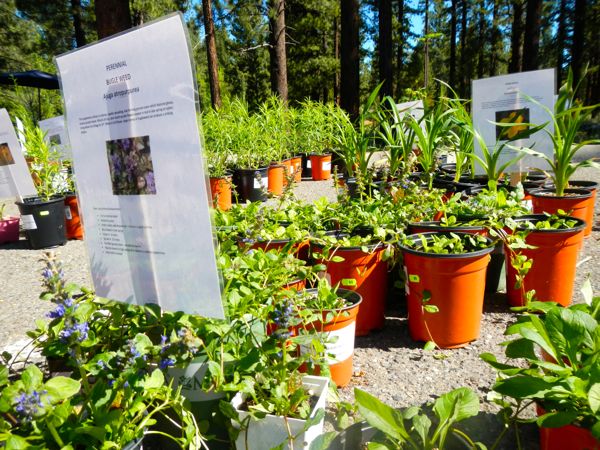
The local master gardeners group has an annual plant sale in South Lake Tahoe in June. Photo/LTN

The local master gardeners group has an annual plant sale in South Lake Tahoe in June. Photo/LTN

I was told to get there early for the best selection. Those in the know were not kidding. I thought it meant “Tahoe time” early. Wrong. I missed out on the trees.

The $50 worth of plants I have are mostly sitting along the edge of the house in shade. One looks dead. The edibles are out back in more permanent containers. I’m pretty sure those containers will find their way to the front in the final design.

Design. More procrastination. While Coleen sketched out what the front could look like, I have yet to do a final version.

I’m likely going to take Lisa’s advice and put in gutters. I have someone coming out in July to give me an estimate. This will render the current TRPA-designed (rather ugly) drip line a moot point. I want to add a rain barrel. (Who knew there were so many types – this just added to my sense of being overwhelmed.) The irony of tweaking the drip line is that it plays no role in the turf buy back; it just has a lot to do with the yard design.

I’ve figured out the work involved isn’t just the grass area. Yes, it’s my choice – but it’s part of the whole scheme. If money and coverage were not issues, the driveway, walkway and kitchen expansion would be occurring. This is because the front yard ties into all of that. Oh well, another day for those improvements.

I have split the wood that was in the way. I’ve been taking dog walks on streets I don’t normally travel on so I can get more ideas. I’m sure people think I’m nutty taking picture of their plants, color, design and yard art. I’m going to steal one idea of having two rounds of wood and making them into a bench. This will be much easier than splitting a couple of these monsters that I can’t even move.

I need to create an area for wood splitting that is completely on my property. One friend suggested having the path come from the street. I think it will look better from the driveway, with a little S curve that isn’t too decorative to make using a wheelbarrow full of rounds impossible to navigate. But part of me wants to make the path wide enough to drive on to make it easier to unload the rounds. This would necessitate a straight path. It would also mean less area to have to vegetate.

And so, I keep procrastinating. But I do know I can start getting rid of the drip line. That involves moving rocks and probably making the garage inaccessible as I make the driveway a staging area. That should annoy me enough to really start going – and get things accomplished before the snow starts to fly.

What the state is doing

California is considering a statewide initiative, in partnership with local agencies, to collectively replace 50 million square feet of lawns and ornamental turf with drought tolerant landscapes. There will be a meeting about this on July 2 from 1-3pm in Sacramento. Go online to register for the webinar. Comments on the program are being taken until July 10.

The state Department of Water Resources is also devising a model landscape ordinance at the direction of Gov. Jerry Brown.

The updated draft rules would prohibit installation of turf unless it is used for a specific function such as sports fields or gathering areas, require the installation of efficient sprinkler nozzles, ban turf in street medians and parkways with few exceptions and require use of compost to improve the water-holding capacity of soil.

Officials say the law would reduce water use at a new home by 16,000 gallons a year, or 30 percent. Water use on new commercial landscapes would be cut by approximately 40 percent. California is expected to add 472,000 single- and multi-family housing units with an associated 20,000 acres of new landscape over the next three years. The state’s population is expected to grow by more than 11 million, reaching nearly 50 million people by 2050.

State law requires all land-use agencies, such as cities and counties, to adopt a water-efficient landscape ordinance that is at least as efficient as the model ordinance prepared by DWR.