El Niño growing into monster

By Mike Moffitt, San Francisco Chronicle

New computer models suggest that the current El Niño formation brewing in the Pacific could become the strongest in recorded history.

The broad swath of warmer-than-usual seawater is spreading and deepening. The two largest concentrations are off the coast of Peru, where water is 4 degrees Centigrade warmer than usual, and just west of Vancouver and Seattle — 3 degrees warmer.

If this El Niño continues to grow, it could surpass the modern record-setting 1997-98 El Niño event, which inundated the Bay Area and the rest of California for months, causing flooding, mudslides and subsidences, and heavy snowfalls in the Sierra.

Read the whole story


Ex-supervisor wants back pay from EDC

briggsBy Kathryn Reed

Former El Dorado County Supervisor Ron Briggs believes he is owed nearly $93,000 in back wages.

The claim he filed against the county has been rejected. He expects the formal lawsuit to be processed in the coming months.

Briggs served on the board for eight years, having left in January when the incoming electeds were seated.

He claims that starting in 2000 the Board of Supervisors adopted four resolutions tying the supervisors’ rate of pay to what the unions and other electeds received. It wasn’t until 2013 that Briggs said he became aware of this.

However, there is an ordinance on the books that says supervisors set their own wages, that it must be heard twice in public – as is the norm for all ordinances.

Supervisors receive about $76,000 a year, plus benefits. Briggs contends had the raises occurred, he would have been making – as would the current board – closer to $93,000 annually.

“Ron Briggs was paid the same as every other county supervisor and in accordance with the rules and direction established by the Board of Supervisors before Ron took office,” Joe Harn, county auditor-controller, told Lake Tahoe News. “Ron never complained to my office about his salary while he was in office for eight years.”

The county has hired outside legal counsel to deal with the threat of litigation. Through May, about $12,000 has been spent. That number could skyrocket if a prolonged court case ensues.

“Ron’s threatened litigation against the county is another waste of the public’s money,” Harn said.

State law allows Briggs to seek three year’s worth of wages. That is how the $92,346.84 was derived.

“To tell the county counsel and CAO I need a pay increase … it was uncomfortable. I waited until I got out,” Briggs told Lake Tahoe News.

Briggs said in 2013 he was in favor of reducing how other electeds were paid. So much so that he and other supes cut the pay of the sheriff, auditor and others.

(However, none of the supervisors broached the subject of reducing their own pay.)

In November 2014, after the election, supervisors voted 3-2 to restore the pay. Briggs and Supervisor Shiva Frentzen were it the minority. The majority believed the electeds should make more than the subordinates. Without restoring the pay, this would not have been the case.

Briggs said, “It’s an out of hand pay system the county has for its electeds. The reason why salaries and benefits keep rising and rising is because we keep firing all our department heads. Every time you raise department heads’ pay it affects the entire organizational chart. Every time an elected gets a pay raise, then the second and third (in charge) wants a raise and it gets out of control.”

The potential litigation, he said, is his way to make the point that the pay structure as it relates to elected officials in the county needs revamping.


Brown wants to keep oil in the ground

By David R. Baker, San Francisco Chronicle

Even the greenest, most eco-friendly politicians rarely utter the words Gov. Jerry Brown spoke at the Vatican’s climate change symposium last week.

To prevent the worst effects of global warming, one-third of the world’s known oil reserves must remain in the ground, Brown told the gathering of government officials from around the world. The same goes for 50 percent of natural gas reserves and 90 percent of coal.

“Now that is a revolution,” Brown said. “That is going to take a call to arms.”

It’s an idea widely embraced among environmentalists and climate scientists.

Read the whole story


UNLV researchers open new front in HIV battle

By May Ortega, Las Vegas Review-Journal

A collection of biological codes sits in a library at UNLV. Much of the focus is learning how the codes can help cells fight off HIV. Researchers hope this work can be used to develop drugs much faster.

A library of biological codes sits inside the Schiller Laboratory of Applied Informatics in UNLV’s Juanita Greer White Life Sciences building.

Like any special collection, this is a place where research takes place.

And like any scientist looking for a discovery, UNLV students and teachers want their work to be known.

Read the whole story


Gatsby Festival revives 1920’s-era Lake Tahoe

By Terra Breeden

Tahoe and tourists are almost synonymous. This isn’t anything new. It was even in the case in the 1920s, though at that time it was mostly the upper echelon of society who summered here.

To capture what life was like here in the 1920s, a group of history buffs started the Great Gatsby Festival in 1985 as a tribute to the South Shore’s heritage.

“The reason we started this festival 30 years ago is for living history,” Tallac Historic Site Director Jackie Dumin told Lake Tahoe News. “We wanted to have a living history festival here at the Tallac Site, which is a 1920s era site, and what makes you think of the roaring ’20s more than the Great Gatsby?”
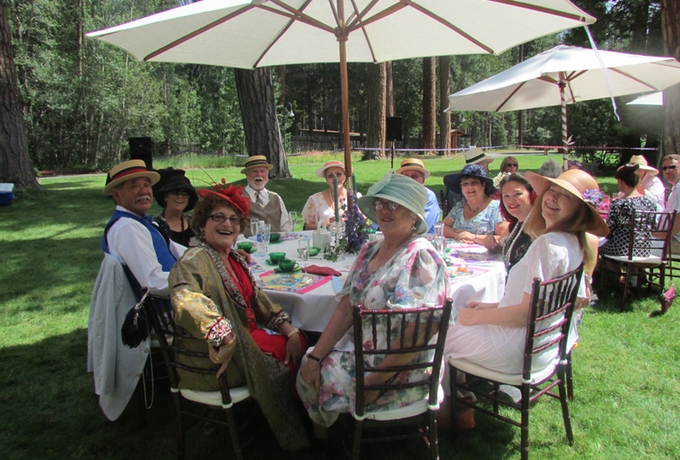
The tea is one of the highlights of the Great Gatsby Festival. Photo/Provided

The tea is one of the highlights of the Great Gatsby Festival. Photo/Provided

Many of the buildings at the Tallac Historic Site were built in the 1920s. During this era, South Lake Tahoe was an elite vacation destination only available to those who came from privileged families, namely the Bay Area’s upper-crust society. In the 1920s roads had not yet been built around the lake and the only way to reach South Lake Tahoe was by boat. Those who could afford the expensive journey often stayed at the Tallac Historic Site buildings where they experienced pristine beaches and mountain serenity at these luxury estates.

“The Baldwin property was built in 1921 by Dextra, the daughter of the infamous South Lake Tahoe forefather Lucky’Baldwin, when she was only 19 years old,” Dumin said. “The Pope Estate next door was established in the 1920s, and the Heller family built Valhalla in 1923, so all of our buildings at Tallac Historic Site are 1920s era.”

Now celebrating its 30th year, the Gatsby festival is a longstanding Tahoe tradition that has become a highlight of the summer for many attendees and volunteers alike.

“The volunteer support is what has made this event so successful,” Dumin said. “It a lot of work, but it’s even more fun.”

Grab a feather boa and snap on those suspenders because the Great Gatsby Festival is free to attend. And people are encouraged to show up in period costume. The festival runs from 10am-5pm on Aug. 8 and 10am-4pm on Aug. 9.

For those who want to fully experience the lifestyle of the South Shore in the 1920s, a high-class tea party is at Valhalla on the Sunday afternoon of the festival. Guests are served tea and gourmet snacks on vintage China by “maids and butlers” in period costume. Afterward, there is a fashion show with this year’s theme being the “grit and glamour” of the 1930s.

“We have living history tours of the Pope House every 20 minutes,”  Tahoe Heritage Foundation Director of Operations Mikan Gosuico said. “We have volunteers in character and in costume so guests are able to go through the house and meet a lot of characters from the Pope family.”

Outside of the Pope House, a jazz band will play on the lawn where people are welcome to dance and enjoy a beverage from the nearby speakeasy.

“Well, we are in the 1920s of course when alcohol is illegal,” Dumin said. “And the speakeasy really provides that immersive historical experience.”

Silent, black and white movies will be shown in one of the cabins and lots of pre-World War II vintage cars will be placed for viewing around the property. There will also be vendors selling vintage clothing, and food and drink.

Don’t forget to bring the kids. Games and crafts that are 1920s era appropriate like a watermelon seed spitting contest are part of the festivities.

Besides the high tea on Sunday there will also be a silent auction throughout the weekend to help raise money for the Tallac Historic Site. Profits from the Great Gatsby Festival are used to benefit this historic area.

—–

Notes:

·       Parking is limited at the Tallac Historic Site. Parking is also available at the Taylor Creek Visitors Center, which is a 5-10 minute walk. Or park at the Y and take the Nifty 50 Trolley. Here is the trolley schedule.

·       Tickets for the tea party and fashion show are $65.

·       For more information about the festival or to buy tea tickets, go online.



Calif. water — vanishing and widely contaminated

By Tom Philpott, Mother Jones

In normal years, California residents get about 30 percent of their drinking water from underground aquifers. And in droughts like the current one — with sources like snowmelt from the Sierra Nevada mountains virtually non-existent — groundwatersupplies two-thirds of our most populous state’s water needs.

So it’s sobering news that about 20 percent of the groundwater that Californians rely on to keep their taps flowing carries high concentrations of contaminants like arsenic, uranium, and nitrate.

When farms sprouted up, they mobilized the once-stable uranium naturally present in the soil, and the toxic element leached into groundwater.

That’s the conclusion of a 10-year US Geological Survey study of 11,000 public-water wells across the state.

Read the whole story


U.S. still leaves the disabled behind

By Ananya Bhattacharya and Heather Long, CNNMoney

Jordan Gallacher hasn’t had a job in three years. Many employers reject him with a form letter or email, but one said outright: “We don’t hire blind people.”

Gallacher, 28, is a computer expert. He has a bachelor’s degree in management and entrepreneurship from Louisiana Tech University. Yet most employers don’t give him a second glance when they learn he’s blind, even though he is able to operate a computer just fine with a screen reader.

Gallacher is one of nearly 57 million disabled people in America.

Today marks the 25th anniversary of the Americans with Disability Act (ADA), a civil rights act passed in 1990 to fight discrimination against the disabled.

Read the whole story


Sod removal experience not pleasant

Kathryn Reed attempts to cut the sod at her house in South Lake Tahoe. Photo/Susan Wood

Kathryn Reed attempts to cut the sod at her house in South Lake Tahoe. Photo/Susan Wood

Publisher’s note: This is one in a random series of stories about what it’s like to go through the South Tahoe Public Utility District turf buyback program.

By Kathryn Reed

It took three tiny shovel indentations into the yard to be convinced this was not the route to remove dead grass. I needed a sod cutter.

Before this summer I didn’t know what a sod cutter was let alone that they exist. I’ll be fine if I never cross paths with one again. For anyone who has operated a rototiller or aerator, it’s along those lines. The difference is the job isn’t done once the sod is cut.

The sod has to be removed. It rolls up. But the rolls were too dang heavy for me to move so I got the shovel out and chopped them into sections. Each segment was about as big as a baseball base.

I managed to cut 3½ lines last Saturday. Then a part fell off. Ahern’s sent a guy up from Gardnerville to fix it. But by this time several hours had passed and I needed to move on to other things. Saturday was supposed to be my day for yard work. After all, the massage was scheduled for the next day in anticipation of not knowing if I’d be able to lift my arms. Dead grass and dirt are not light.

 (Side note: If renting from Ahern’s, do so late afternoon on Friday to get it for two days for the price of one. This is because they aren’t open on the weekend. And when calling other places, be wary of them saying they have the device and they really don’t.)

Note: If renting from Ahern’s, do so late afternoon on a Friday to get the equipment for two days for the price of one. This is because the store isn’t open on the weekend. And when calling other places, be wary of them saying they have the device because they may not.

While waiting for the repairman to arrive, I took out the sod and put it in the area where the garbage company picks up trash. I was wishing I had borrowed my friend’s Fit-Bit so I’d know how many steps this entailed.

Suffice it to say it was not a good day; it was not a productive day. I was hot, sweaty and barely made a dent into the project. Suddenly, 804-square-feet felt like it might as well have been AT&T ballpark. I was striking out.

I already had about the most ugly front yard on the street. I didn’t realize splotchy lines of dirt could make it look even worse.

Stakes mark where the sprinklers are. Spray paint outlined where I wanted the path.

I had tried sketching what I wanted. That didn’t go so well either. I can’t even draw stick figures so there was no way this part was going to resemble something comprehensible. I’ll need to try again because of the requirements with the South Tahoe Public Utility District turf buyback program is to provide a drawing.

The best part of this endeavor was meeting Brian Hirdman on Friday afternoon at the rental place. (We’d actually met before for a story but at the time I couldn’t recall how I knew him.) He was there renting a sod cutter, too. He asked what I was doing, and said he did sod removal and landscaping for a living. I gave him my card and said if he was serious about helping, to call.

He called ….


Food consumption in U.S. on the decline

By Margot Sanger-Katz, New York Times

After decades of worsening diets and sharp increases in obesity, Americans’ eating habits have begun changing for the better.

Calories consumed daily by the typical American adult, which peaked around 2003, are in the midst of their first sustained decline since federal statistics began to track the subject, more than 40 years ago. The number of calories that the average American child takes in daily has fallen even more — by at least 9 percent.

The declines cut across most major demographic groups — including higher- and lower-income families, and blacks and whites — though they vary somewhat by group.

As calorie consumption has declined, obesity rates appear to have stopped rising for adults and school-aged children and have come down for the youngest children, suggesting the calorie reductions are making a difference.

Read the whole story


Number of U.S. mass shootings on the rise

By Melissa Healy, Los Angeles Times

If it seems like mass shootings are becoming more common, researchers say there’s a good reason: They are.

Between a 2011 shooting at an IHOP restaurant in Carson City that left four people dead and the 2013 attack on the Washington Navy Yard where 12 people were killed, a mass shooting occurred somewhere in America once every 64 days, on average.

In the preceding 29 years, such shootings occurred on average every 200 days, according to an analysis by researchers from Harvard University’s School of Public Health and Northeastern University.

The study defined a mass shooting as an outbreak of firearms violence in which four or more victims were killed and the shooter was unknown to most of his victims.

Read the whole story