Fires lead Brown to call state of emergency

By Jeremy B. White, Sacramento Bee

Gov. Jerry Brown has called a state of emergency across the state in response to wildfires engulfing much of drought-stricken California.

This summer fire season has been particularly intense, with a series of blazes such as the Rocky Fire in Lake County and the Wragg Fire near Lake Berryessa consuming thousands of acres and leaving firefighters scrambling.

In declaring a state of emergency, Brown mobilized the California National Guard and relaxes some regulations like environmental rules or those governing trespassing on private property.

Read the whole story


Feinstein’s drought package splits from GOP strategy

By Carolyn Lochhead, San Francisco Chronicle

WASHINGTON — California Sen. Dianne Feinstein introduced a sweeping drought bill Wednesday that takes a much broader approach to the state’s water shortages than her failed effort last year to work almost exclusively with House Republicans to deliver more water to San Joaquin Valley farmers.

Feinstein’s new measure is important for one big reason: Feinstein introduced it. The state’s senior senator has made herself an authority on California water policy, and no bill dealing with the state’s drought has much chance of passage without her approval.

In contrast to a recently passed House measure that focuses mainly on getting water to valley farms — and rolling back environmental protections to do it — Feinstein included something for almost everyone.

Read the whole story


Study: Sierra wildfires worse with climate change

By Henry Gass, Christian Science Monitor

Wildfires in California are burning at increasingly higher elevations, according to a study, with scientists saying the phenomenon is another signal of approaching climate change that could also have implications for how forests are restored after fires.

The Washington Fire for several days threatened the town of Markleeville. Photo/Carolyn E. Wright/Copyright

The Washington Fire this summer for several days threatened the town of Markleeville. Photo Copyright 2015 Carolyn E. Wright

The study, which analyzed 105 years of data, found that forest fires in the Sierra Nevada mountains rarely burned above the 8,000-foot elevation early in the 20th century. Fuel for fires were typically dryer and more abundant at lower elevations, but over the past three decades several fires each year have burned at or above the 8,000-foot elevation.

Mark Schwartz – lead author of the study and also director of the John Muir Institute of the Environment at the UC  Davis – described the increase of higher-elevation forest fires as “yet another harbinger of climate change” in a statement released with the study.

Read the whole story


Calif. landscapers making a mint off drought

By Steve Hargreaves, CNN Money

The drought’s been rough for a lot of people in California. Farmers, gardeners, restaurant diners who just want a glass of water.

But there’s one subset that’s doing quite well: landscapers who specialize in ripping out water-guzzling lawns and replacing them with lush, native plants that require a fraction of the moisture.

“I’m falling behind on my design work because I’m fielding so many calls and emails,” said Rob Moore, owner of California Native Landscape Design in Orange County.

Moore said he’s on track to make over $100,000 this year — double what he made last year — as people adopt native landscapes.

Read the whole story


Regan Beach options narrowed to 3

By Terra Breeden

Expand the beach, build a jetty, put in adult swing sets; these were a few of the options presented to the public by the Regan Beach Committee on Tuesday night during a meeting at the South Lake Tahoe’s recreation center.

After months of considering possibilities and listening to public opinion, conceptual plans that included many drastic changes to the popular beach were shown to the nearly 50 who gathered July 28.

“What we don’t want to do is recreate Lakeview Commons,” Parks and Recreation Commissioner Steve Noll said. “This is a restoration project.”

Three options were presented, each containing many of the changes discussed at previous meetings. All three options included a new concession stand and restroom facility, improved play area for children, and focused on shoreline stabilization and rebuilding the decrepit retaining wall.

Although all of the plans presented at the meeting included these changes, each had a different focus on what the future of Regan Beach should be.

Attendees were directed to choose their three favorite features from each option. The park features that are favored the most by the community will be included in a completed plan of Regan Beach due to be presented at a meeting later this summer.

Homeowners from the Al Tahoe neighborhood and other South Lake Tahoe residents who frequent the beach examined the plans, trying to visualize what this “new” park would actually look like. Contrasting opinions circulated wildly as each option was presented to the audience.

Option 1 was called “The Hub” and was geared toward creating a more park-like setting at the beach. Changes to the beach that “The Hub” include creating a larger lakefront plaza and picnic space, building separated parking lots with two-way traffic, and placing a gazebo with terraced seating on the event lawn. “The Hub” plan was also drawn to include a non-motorized boat launch for water sport enthusiasts and separated the dog beach area from the main park.

Option 2 was called “Play” and as the title suggests, this option concentrated on providing more outdoor activities at Regan Beach. Option 2 extended the beach area and implemented a large adventure play area with terraces that extended from the lawn to the beach. This conceptual plan also contained a direct walkway connection to the dog beach from Lakeview Avenue and a handicap-friendly ramp that extended from the parking lot to the beach.

Option 3 was named “Restoration” and this plan focused on renovating the park to be in tune with the Lake Tahoe environment. This option aggressively tackled shoreline restoration and concentrated on wildlife habitat creation. With this plan, a jetty would be built to the east of the park. This structure would be a physical barrier between the park and dog area and would also create an aquatic habitat for fish. The “Restoration” plan also included a large promenade walkway with a picnic area and moved the restrooms and concession stand closer to the beach with views directed toward the west for watching sunsets.

“These are not finalized plans,” Noll stressed. “We want to know what the community thinks about these ideas.”

The beach and recreation area are in need of a serious makeover after decades of neglect. The concession stand is not up to health code standards, the retaining wall around the park is collapsing, and the steep stairs that descend to the beach are not handicap or kayak and paddleboard friendly. The latter is a feature that has become increasingly problematic as the watersports grow in popularity.

Separating the dog beach area from the main park is a big concern as well.

“These days the whole beach is a dog park,” one man said at the meeting.

The preferred alternative will be decided based on input gathered at the community meetings and survey. It will be presented to the public in late August. The survey is online. The three options are also online.


Collaboration keeps beaver habitat intact

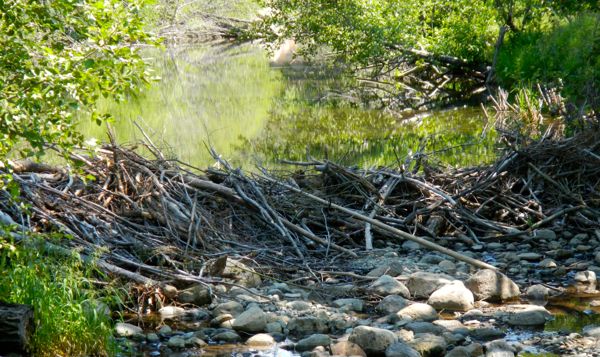
Beaver dams at Taylor Creek are no longer being destroyed by the U.S. Forest Service. Photos/Kathryn Reed

Beaver dams at Taylor Creek are no longer being destroyed by the U.S. Forest Service. Photos/Kathryn Reed

By Kathryn Reed

CAMP RICHARDSON – It depends on who one talks to whether beavers are destructive or one of nature’s best engineers.

At 40 to 50 pounds, these mammals are no slouches in the animal kingdom. Being nocturnal, they are not often seen. However, their “work” is very evident. Usually it’s in the form of dams or felling of trees.

This “work” that is done near civilization is what has the Sierra Wildlife Coalition and U.S. Forest Service partnering to maintain the animal’s habitat and protect manmade structures.

Pipes carry water through the dam and wire mesh keeps them from plugging up.

Pipes carry water through the beaver dam and wire keeps them from plugging up.

Beaver dams were causing the $1 million stream profile center at Taylor Creek on the South Shore to flood. Removing the dams was futile. Killing this native species wasn’t an ideal option.

Sierra Wildlife Coalition proposed painting some of the aspen trees in the area with a sand-latex mixture that would prevent the beavers from gnawing at them. It’s worked. And unless one looks closely it is difficult to know the tree has been treated with anything.

The painting goes 5 feet up from the ground because beavers will cross the snow in the winter. It is winter when most trees are chewed.

Beavers leave behind evidence of their work.

Beavers leave behind evidence of their work.

Levelers have been placed in the dams to allow water to keep flowing down stream while keeping the beaver structure in place. It almost looks like a rudimentary science project with the plastic pipes and wire-mesh cages.

Advocates are working to prevent the kokanee salmon from getting caught up in the diversion devices. However, with the fish not being native to the Tahoe, their survival is less of a concern to the federal agency.

While the devices are not working perfectly, it is a better scenario than repeatedly removing the dams – which is a costly and time consuming endeavor. It would cost about $40,000 to raise the trail, so the leveler method is the economically cheaper route.

Trees are painted to deter beavers from chewing them.

Trees are painted to deter beavers from chewing them.

Beavers are good for the environment. The problem is people are living or recreating so close to their habitat so the good aspects get overshadowed.

According to the Sierra Wildlife Coalition, beaver ponds create wetlands, reduce erosion, decrease flood damage downstream, control soil erosion and help filter out sediment before it reaches Lake Tahoe.

The nonprofit, which is based in Tahoe City, has about seven volunteers who help with the installations and tree protection. Another 200 people are on the group’s email list and keep the core group informed about beaver activity in the basin and Truckee area.

Beavers are in almost every creek in the region. This is why the Sierra Wildlife Coalition is working with agencies, homeowners and others wherever possible to have beavers and people coexist.

—–

Notes:

·      Sherry Guzzi with the Sierra Wildlife Coalition will give a presentation about beavers July 31 at 8:30pm at Taylor Creek, Lake of the Sky Amphitheater on the South Shore. Cost is $5.


How water scarcity shaped the U.S.

By Stephen Grace

Water, when scarce, has split the nation into warring factions. But it has also united fractured regions. Water can both release the demons of war and stir the better angels of our nature.

We hear so much about California and the drought. But consider the whole West — and the Continental Divide, also known as the Great Divide. This spine of the continent splits North America — and the state of Colorado, where I live — into hydrological halves.

The snowy West Slope of the Great Divide boasts abundant rivers that flow to the Pacific Ocean. The East Slope, which drains to the Atlantic, is decidedly drier but is home to a thirsty agricultural sector and Front Range cities (including Denver and Colorado Springs) that support the vast majority of the state’s population. To address this imbalance, Colorado diverts water from the West Slope of the Great Divide to the East Slope by means of a Rube Goldberg assemblage of dikes, dams, and pipes, including a tunnel that runs beneath the Rocky Mountains the exact length of a half marathon, 13.1 miles. The economic and ecological consequences of this water transfer from one side of the Divide to the other have provoked disputes throughout the state’s history.

Droughts and disconnects between water sources and water needs are by no means exclusive to the western United States. Even in the water-rich Southeast, imbalances between population centers and water supplies have led to conflicts. In the 1980s, severe drought triggered a water dispute between Georgia, Alabama, and Florida when drought-depleted rivers couldn’t satisfy competing needs for agricultural production, municipal use, hydroelectric generation, and environmental health. This tri-state dispute clogged courtrooms and triggered the involvement of the federal government.

Florida also faces water wars within its borders. According to a study by the Natural Resources Defense Council, Florida is one of 14 states at high risk of water shortages by midcentury. The Sunshine State is blessed with an abundance of freshwater in its rural north, but cities desperate for more supply crowd the south. This disparity has exposed chasms between competing economic and environmental interests. Transferring water over long distances in Florida could allow golf courses to remain green in the south while upsetting the balance of ecosystems in the north.

Along with diverting rivers, pumping water from beneath the ground has supported the growth of cities in many parts of the country. It has also revolutionized agriculture, perhaps most notably on the High Plains. This rain-scarce region was transformed into one of the world’s most bountiful breadbaskets by pumping from the Ogallala Aquifer, which stretches from Texas to South Dakota. The Ogallala, which accumulated over millennia as melting Ice Age glaciers soaked into the ground, is now being spent far faster than rain can replenish it. This liquid inheritance is in danger of running dry — and creating skirmishes both within states and across state borders.

Conflict, of course, commands attention. Some of the West’s most iconic stories—from the novel “The Virginian” to the movie “Shane” to the Broadway musical “Oklahoma!” — center on conflicts over scarce water. In my first water book, “Dam Nation”, I spun tense tales of water wars to keep readers, and myself, awake while unpacking complex issues. For instance, one of the West’s most memorable water battles broke out in 1934 when Arizona’s governor, vowing to stop California from completing a dam that was being built to divert water to Los Angeles, dispatched National Guard troops with machine guns to the Colorado River.

To say that water is a perennial cause of conflict is to state the obvious, but as I learned while researching “The Great Divide,” a forthcoming film and book about Colorado’s water issues, that’s not the whole story. What is less apparent, but arguably more significant, is that water scarcity has spurred far-reaching compromises throughout history. When fierce debate over the use of the Colorado River headwaters threatened to fracture the state of Colorado in 1937, a pact was forged to maintain peace across the Great Divide. While negotiating this historic agreement, neither the West Slope nor the East Slope got all the water it wanted. Each side achieved a modest victory, and compromise prevented conflict from escalating into chaos.

Prior to that momentous accord within Colorado, the 1922 Colorado River Compact united seven western states in a far-reaching agreement that negated the need for courtroom brawls. Some argue that the Colorado River Compact should be discarded and replaced with a new interstate agreement that reflects the economic, demographic, and environmental realities of the 21st-century American West. Regardless, over nine decades later, that compact continues to balance water use between states. This is not as exciting a story as the narrative of “Chinatown”, the film noir classic that shows ruthless power brokers in Los Angeles robbing a river from a rural valley. But as California’s epic drought exposes stark divides between north and south, between cities and agriculture, and between economic development and environmental sustainability, the proven ability of water agreements to bond fractured regions must not be forgotten.

In 2013, after six years of persistent effort to find common ground among competing parties in the state of Colorado, the Colorado River Cooperative Agreement was finalized. This pact created a framework for resolving disputes over the use of West Slope rivers by Denver Water, which supplies 1.3 million people in the city of Denver and its surrounding suburbs. Furthering this cooperative process, Trout Unlimited, a nonprofit conservation organization, and the West Slope’s Grand County joined with Denver Water to craft a plan to heal the ecologically damaged Colorado River headwaters. Former adversaries will work together to improve the health of the watershed while allowing Denver Water to increase the amount of its diversions across the Great Divide during periods of high flow.

Water compromises are not the stuff of scintillating drama. But as we face a future of cities surging with growth in some of the continent’s driest regions, a food supply strained by drought, and ecosystems degraded by depleted aquifers and drained rivers, we must remember that cooperation, not conflict, is the best way to bridge our nation’s many water divides.

Stephen Grace is the author of “The Great Divide”, a companion book to “The Great Divide” film by Havey Productions, which will be published in August. He wrote this for Thinking L.A., a partnership of UCLA and Zócalo Public Square.


High rollers: Dealers describe special treatment, abuse

By Michael Melia, AP

UNCASVILLE, Conn. — One high roller requests a refrigerator full of bananas that he squeezes and throws as he gambles. Another urinates against a wall. Other high-stakes players described by a pit manager at Mohegan Sun, one of the world’s largest casinos, throw chairs, scream at dealers and expect rules to be bent at the tables.

In the increasing competition for the biggest spenders, casinos are known to pull out all the stops with comped hotel rooms, meals and rebates for a percentage of their losses. But some dealers say efforts to satisfy and retain the players — known as “whales” — go much further, with casinos tolerating abuse and extending courtesies that test the integrity of the games.

“All men are created equal except in the casino,” Glen Costales, the pit manager, said at a hearing before a tribal gaming commission in May. Transcripts of the hearing were obtained by the Associated Press. “If it’s a premium player, he gets away with a lot more than the five-dollar player would get away with.”

Costales was testifying in support of a pit boss, Maria DeGiacomo, who was fired this year after the casino accused her of colluding with a high roller by allowing late bets at a blackjack table. DeGiacomo and other employees say dealers frequently grant similar requests from top players.

The player, Matthew Menchetti, was a regular who lost as much as $50,000 on visits to Mohegan Sun, and a lifetime total of more than $1 million. Casino security flagged his play as suspicious in February and asked state police to arrest him and two dealers, but the detective concluded DeGiacomo and another dealer apparently took it upon themselves to keep Menchetti happy and playing, according to a police report, and no charges were filed.

His attorney, John Strafaci, said Menchetti is seeking to have his name cleared by the gaming commission since state police cleared him of wrongdoing. He said what his client was doing was normal for players of his caliber.

Mohegan Sun’s president, Raymond Pineault, said its termination of the dealers involved and its ejection of the player demonstrate it does not tolerate any bending of the rules.

Shane Kaufmann, a vice president for a branch of the Transport Workers Union in Las Vegas, which represents several thousand casino dealers, said rules are frequently ignored at high-stakes tables.

“The casinos pretend they have rules that are set in stone, like going into a bank or dealing with a police station. Are they supposed to allow late bets? Absolutely not. Do they do it all the time? All the time,” said Kaufmann, a dealer who sees plenty of crude behavior himself. “The abuse, the screaming, the cheating, the sexual harassment. Throwing things around. It’s worse all the time.”

Gaming commissions enforce the rules at casinos across the country, but the level of scrutiny can vary by jurisdiction. Dealers say state inspectors in Atlantic City, N.J., for one, have a reputation for toughness. In Connecticut, the state does not have any oversight of table games at Mohegan Sun and Foxwoods, where the tribes that own the casinos also control their own gaming commissions.

Costales, who described the banana squeezer and public urinator without revealing their names in his testimony, said such outrageous behavior is tolerated more these days because of growing competition than when he joined the business three decades ago.

Menchetti, who also was testifying in support of DeGiacomo, told the gaming commission that when he said he’d forgotten to post a bet, DeGiacomo and others generally made accommodations. He said the intention was never to steal — at most, it prolonged his stay at the table — but he expected special treatment, given his level of play, according to the transcript of the hearing.

“It’s no different in my mind than me calling my host and asking him for an extra 2,500 points on my account so I can go purchase something at a Lux, Bond & Green,” he said, referring to a jewelry store.

DeGiacomo said Menchetti did not do anything close to cheating and the two of them became victims of selective enforcement because certain bosses did not like either of them.

DeGiacomo, who is still fighting her dismissal, said rules shifted depending on the player and pit bosses were encouraged to keep high rollers happy. She testified during her hearing: “I have to make sure that we get our money, which we did, every time he played. There’s maybe two times he won.”

As part of the state police investigation, the detective interviewed several dealers who said Menchetti would hit the table, curse and yell at them. They told the detective that in cases where he or other high rollers asked to post a late bet or for other considerations, they would defer to a superior.


Redevelopment keeps redefining S. Lake Tahoe

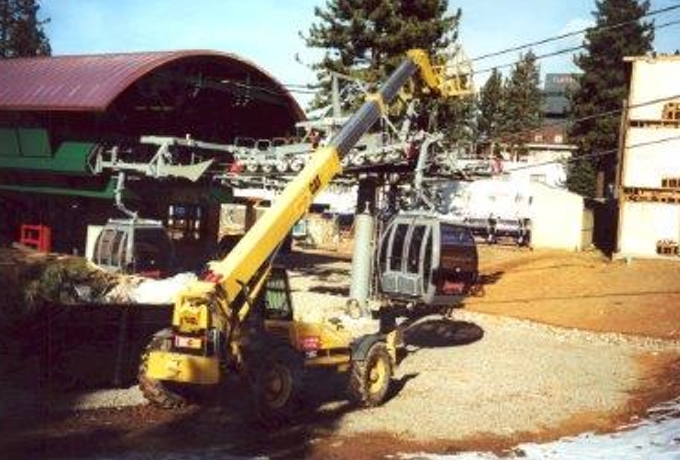
Having the gondola Heavenly go from the village to the mountain transformed the skiing experience on the South Shore. Photo/Heavenly Mountain Resort

Having the gondola at Heavenly go from the village to the mountain transformed the skiing and tourist experience on the South Shore. Photo/Heavenly Mountain Resort

Publisher’s note: This is one in a series of stories Lake Tahoe News will be running leading up to the 50th anniversary of South Lake Tahoe on Nov. 30.

slt 50th logoBy Susan Wood

Resilience, humility, irony. This describes the state of redevelopment in South Lake Tahoe from the early days of Virginia Slims commercials to the mid-1980’s burst of tourism to today’s absence of California government in sanctioning the way to finance change.

As the city this year celebrates its 50 years in business, the look and feel of this mountain town next to the largest alpine lake in North America reflects a state of flux in the last half century.

A hint of early, unofficial redevelopment came about in the 1960s upon Squaw Valley bringing the Winter Olympics to Lake Tahoe. The South Shore city accommodated the perceived influx of visitors by building rows of motels along the major thoroughfare, Highway 50. Right or wrong, the infrastructure in many respects stayed planted for decades.

Before ceasing to exist three years ago as a result of the 2011 Budget Act, state redevelopment agencies had been around since 1943 as a mechanism for growth for cities. But most at that time relied on federal funding. It wasn’t until 1952 that cities got into the swing of using the state’s money to fund such ventures – eight years before the Games arrived in the Tahoe area. Talks were even under way in July 1966 of building a convention center on Happy Homestead property, a proposal that never materialized, albeit how easy it seemed to build back then.

In the early ’60s, building required an 8½ x 11 site plan and power permit. Now, reams of paper and a bankroll are necessary for construction on most projects.

Then in the mid-1980s, a group of moving and shaking city officials realized that to compete, ironically with places like Vail for tourism dollars, South Lake Tahoe would need to reinvent itself. When the city’s planning department saw “what was coming” as community matriarch and former city Councilwoman Del Laine pointed out, efforts were under way by officials to get on the improvement track.

“We realized we could improve on what we had,” Laine told Lake Tahoe News.

There were meetings and more meetings in 1987, some as far away as the League to Save Lake Tahoe’s home base in San Francisco. Along with the lake’s regulatory watchdog Tahoe Regional Planning Agency, the League’s environmental advocacy leaders were at least curious about what redevelopment could do for the city on both sides of the town from north to south.

Today, current projects are still in the works from the Y’s just approved Tahoe Valley Area Plan to the Stateline area’s constantly evolving condominium hotel-retail project where a convention center was once planned on 11 acres bordering Cedar, Stateline and Friday avenues, and Highway 50.

At this time, the notion of the environment and economy working in harmony was what kept the redevelopment wheel in motion.

“South Tahoe would have been in the same shape as other failed tourism communities,” former City Attorney Dennis Crabb said, while also listing Seaside near Monterey and Jackson in the Gold Country as other examples.

A pretty lake wouldn’t have been enough to maintain a pristine environment and an economy full of potential. With McDonald’s on Lake Tahoe Boulevard flooding every year because of a lack of storm drainage infrastructure and motel owners seeking more business to sustain them, citizens appeared eager for something to change.

“Motel owners were going to get bailed out, and that was salvation,” Crabb said, while also building a case for nearby retailers tacking onto the gravy train.
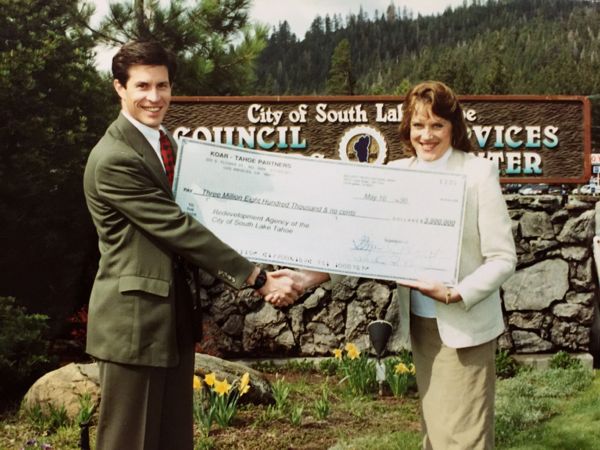
SLT 50th project: Steve Kenninger with KOAR, developers of Embassy Suites, and Mayor Nera Roberts in 1990.

Steve Kenninger with KOAR, developers of Embassy Suites and what is now called Lake Tahoe Resort Hotel, and then South Lake Tahoe Mayor Neva Roberts in 1990. Photo/South Lake Tahoe

Nothing worth doing comes easy

After the city incorporated in 1965 and the lake was legally divvied up by jurisdiction in 1970, the town was in desperate need of reinvention.

Kerry Miller, the city manager who arrived in June 1987, remembers redevelopment’s humble beginnings like they were yesterday.

“The Tahoe basin came off a three-year building moratorium, with the League’s legal challenge of TRPA, and we realized that as a result, the economy suffered and tourism suffered,” Miller said from his home in Folsom.

In days long before its flagship ski resort owned anything here, Vail continued to develop during the lake’s moratorium. The Colorado town’s achievements cut into ski area tourism, and Tahoe faced a visitation drought down the road that would make the recession from a few years ago look like happy days.

“It became likely Tahoe as a tourist destination would not be able to compete,” Miller told Lake Tahoe News.

City staff prepped some plans. An agreement was struck with the state Attorney General’s Office. Measure C, which passed in November 1988, put transient occupancy tax in city coffers – 10 percent across the town, 12 percent in project areas. And what a project area South Lake had, resembling an oversized barbell from one side of town to another. The South Tahoe Redevelopment Agency zone spans 173 acres from Herbert Avenue to Stateline Avenue. Later on, the zone leapfrogged to Harrison Avenue at midtown near El Dorado Beach and at the Y.

In the late-1980s, all approvals were reached, movement was made to secure bond financing and the land assembly came together starting with Lake Tahoe Vacation Resort at Ski Run Boulevard.

“The citizens were involved during the entire planning process,” Miller said.

Sure, there were naysayers but “surprisingly not a lot,” the former city official added in a tone that seemed to almost surprise him.

“People had objections. There were people bemoaning the idea of change. But it was overwhelmingly positive. The town looked dated. Tahoe’s beauty ‘no matter what’ had a dated quality to attracting visitors,” he said.

Eminent domain – the government-sanctioned taking of property for improvements to alleviate blight, in its truest sense – represents the all-encompassing main objection to redevelopment. But bringing fair market value and a relocation plan to the table for the displaced seemed to ease the pain somewhat, and citizens were ready for a change, Miller recounted.

Improvements were being made, but then “a funny thing happened” as the city endorsed the KOAR company’s plans for what was Embassy Suites bordering Stateline. The Gulf War in 1990 literally dried up the financial markets. The post-war recession “fatally affected” redevelopment for three years, Miller went on to say.

After the economy started to recover and Embassy Vacation Resort opened at Ski Run in 1995, the movement paved the way for a concentrated effort to go into the Park Avenue Project on the other side of the street bordering Stateline.
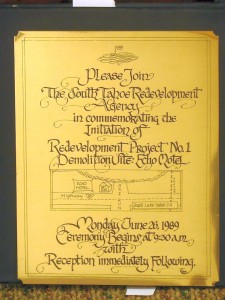
Redevelopment in South Lake Tahoe began in earnest in the last 1980s.

Redevelopment in South Lake Tahoe began in earnest in the late 1980s.

The birth of Heavenly Village

The major redevelopment undertaking resulted in Heavenly Village with its two Marriott timeshare condominium properties, 120,000 square feet of retail run by Gary Casteel who at the time owned the Factory Stores at the Y, a city transit station and parking garage, and a $25 million gondola built by Heavenly Mountain Resort in 2002.

Project 1 didn’t come without hitches and glitches. It demonstrated a sign of ultimate, stubborn resilience from the private and public sectors – almost to a fault.

First, the city Redevelopment Agency siphoned off $7 million from the general fund to finish the 110,000-square-foot project – a watershed moment announced at a meeting in May 2003 when the council got a wakeup call on monitoring its accounting department. The tab was financed and refinanced, thus raising the debt service in 2006 to $112 million to be paid over three decades. The city even paid out $12 million in legal fees associated with the $250 million project flanked by the Grand Summit and Timber Lodge.

Redevelopment was a lot like gambling – one, which paid off ultimately when considering, delayed tax-revenue benefits. The property once assessed at $15 million when the plan was adopted in 1988 had increased more than 20 times on the El Dorado County tax rolls according to statistics from a decade ago. Its value mushroomed then at $346 million, up $100 million from when the complex was completed.

Moreover, Heavenly’s parent company at the time – American Skiing Co. experienced a dive in its value on the stock market to the point shares sold for less than $1. The plummet resulted in a delisting from the New York Stock Exchange. It was the beginning of the end. At one point, it was doubtful the gondola would even get built.

To the rescue, Vail Resorts ended up buying the town ski resort a few years later – and has since poured millions of dollars into capital improvement projects.

Yet another hurdle to overcome, parking turned out to be an albatross of an issue. The money-losing $6 million garage turned into $9 million for the city. Parking at the gondola turned into a debate and debacle for years. Visitors either clogged the side streets until the city implemented a two-hour limit in the surrounding area to urge motorists to park in the garage or parked at Harrah’s back lot or at what was the Crescent V shopping center next door. The latter resulted in aggressive parking monitors ticketing visitors or in some cases grabbing their arms.

Something needed to give. City officials got creative, offering deals for parking in the garage, validation agreements with retailers and a turning of the cheek from the major casino in what was happening in its back lot.
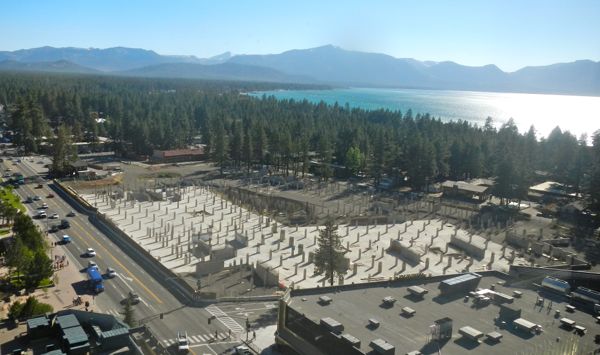
Concrete rebar constituted "the hole" for years until Owens Financial consolidated the properties and has incrementally begun to develop the site. Photo/LTN file

Concrete and rebar constituted “the hole” for years until Owens Financial consolidated the properties and began incrementally developing the site. Photo/LTN file

The other side of the coin

Parking could still be an issue as one looks at the current Project 3 across the highway. Talk about evolution. The changing of management hands alone resembles a cross between a card game and a chess tournament. Harveys casino, then Marriott, then Lake Tahoe Development Co. – the latter run by a small, local development duo – was once in line to build the city’s largest proposed project once estimated at $410 million.

Upon breaking ground in 2007, the triangular-shaped project area on the lake side now called the Chateau Project where McP’s Tap Room serves as an anchor was supposed to house a major hotel and 200,000-square-foot convention center. The city was due to own the monstrous facility according to the ever-changing Owner Participation Agreement between the city and Tahoe Regional Planning Agency.

One challenge after another ensued.

Displaced and bought-out business operators kept the city in and out of court through the years. Legal fees mounted, with some business owners having better results than others.

At least Jim Hickey, owner of the former Union 76 gas station, came out ahead of the game.

“I thought everything was fair in the long run. I wished it would’ve happened a little faster, but I know the project was big. It took several months to close the deal,” Hickey, now an Internet marketer, told Lake Tahoe News.

All in all, there was the harsh reality that convention centers went out of style, a warning Charlie McDermid from Holiday Inn Express warned the city about when he waved a hotel-trend magazine at a heated City Council meeting years ago. Financing for the evolving hotel-condominium idea dried up.

With no performance bond in place for the city, L.T. Development Co. led by Randy Lane and John Sherpa consequently filed for bankruptcy. Rebar and concrete marked what was affectionately referred to in town by locals as “the hole in the ground” — much to the embarrassing dismay of the city.
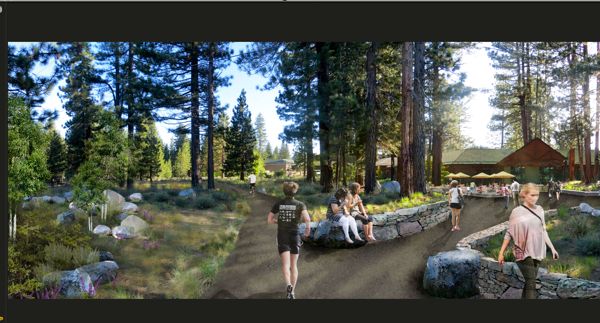
The Tahoe Valley Area Plan has passed the regulatory hurdles and now awaits investors to transform the area along with the city creating a green belt.

The Tahoe Valley Area Plan has passed the regulatory hurdles and now awaits investors to transform the area along with the city which intends to create a green belt.

It’s a new game in town

But current City Manager Nancy Kerry, an idea activator, was not going to let this blemish lie unattended on her watch.

Even as the state pulled its support for redevelopment a few years ago, staff and L.T. Development Co. negotiated with Tahoe Stateline Ventures, a subsidiary of Owens Financial, for it to buy the parcels in the project area and with tweaked plans go forth with a scaled down version of what was to happen across from Harveys.

The 32-unit condominium project, absent a traditional hotel now, is now proposed with a pool, 19,477-square-feet of retail space (a third of its original size), streetscape improvements and public fire pits.

A little modesty never hurt anyone.

Owens Financial chief Bill Owens describes his undaunted dedication in three words: “Location, location, location.”

What keeps him interested sounds almost in line with what the founding fathers and mothers of redevelopment had in mind.

“I believe South Lake Tahoe has been maligned in public perception because of the older properties not being redeveloped. A lot of (business operators) don’t want to bother. We need this. You can walk to gaming, walk to the lake, walk to a ski resort. There are very few places on Earth you could do that,” he told Lake Tahoe News, adding working with the city has been “a pleasure.”

One could say he’s a visionary like Kerry.

He doesn’t wince at challenges. And between planning staff’s early caution led by Jim Marino about parking and sometimes dangerous pedestrian movement across the highway, there could be more issues. A Heavenly employee was hit by a motorist crossing the street in that area about a decade ago, severely injuring her.

There are the other considerations.

Owens would prefer not to have to deal with the slopes of the roofs as dictated by TRPA guidelines issued in 2007 for the project now estimated to cost almost half as much.

“(The roof slope) makes it more expensive to build, but it’s not something I can’t live with,” he told Lake Tahoe News.

But that’s all in a day’s work to people on his side like Joe Stewart of SMC Contracting. The contractor is a tour de force for building in the redevelopment area, namely the Park Avenue project, so he knows the drill.

It’s a good thing. Between a changing proposal, shrinking competitive market, nagging recession and no redevelopment agencies in 400 communities up and down the state, this isn’t easy.

“Heavenly Village was built with redevelopment funds. This one has zero public funds. In some cases, it makes the project go slower. I think the redevelopment agency was a huge benefit across the street. We should be lucky it’s built,” Stewart told Lake Tahoe News. “I feel like Bill Owens certainly stepped up and did something no one else would do.”

In August, Stewart expects the groundbreaking of the second phase.

All this is music to the ears when it comes to the last of the “redevelopment” oriented projects for civic-minded Paul Bruso, who has owned and operated Ernie’s Coffee Shop for decades.

Bruso was one of the early pioneering citizens to spearhead a plan for a remodeling of the Y where his restaurant he’s retiring from sits.

The Tahoe Valley Area Plan has undergone its own jerks and grinds as it makes its way into the future. It’s come to the forefront with issues over building height, project area and former Councilman Ted Long’s apparent push to spearhead taking over the plan from the citizen’s group years ago, elevating the debate.

But when all was said and done minus Long’s sarcastic “thank-you-very-much, we’ll-take-it-from-here” attitude, Bruso said he’s pleased with how the plan is materializing.

One thing he would like to see is better lighting.

“People who visit want to get out of their cars and walk. We want them to feel safe,” he said.

Overall, it’s “a good plan,” according to the restaurateur.

“It’s like (the city has) been thorough in what people want. They took all the necessary steps,” he said. “The whole idea is this town is going through a beautification process. Unfortunately, the Y is the tail of the dog.”



Wyoming wind could save California water

By Mead Gruver, AP

CHEYENNE — California regulators could achieve savings in water use, electricity rates and greenhouse emissions by turning to Wyoming wind power to help offset the natural ups and downs of wind and solar power in their state, according to a University of Wyoming report released Monday.

The reason: Wyoming’s wind patterns tend to be opposite of those in California.

The wind in Wyoming tends to blow more during the winter and afternoon. California tends to be windier during the summer and at night, according to the report for the Wyoming Infrastructure Authority by Jonathan Naughton of the university’s Wind Energy Research Center.

That the wind doesn’t blow all the time and the sun doesn’t shine at night or on cloudy days are two of the biggest shortcomings of those renewable energy sources. But spreading renewable power out across the grid can make renewable energy generally more viable.

Chances are, if the wind isn’t blowing in one region, it’s gusty somewhere else.

The study compared wind patterns at California wind farms to those at sites with wind potential in Wyoming, including an approximately 1,000-turbine wind farm in south-central Wyoming that the Denver-based Anschutz Corp. plans to build to export electricity to California.

Naughton said using Wyoming wind could help California save water: as much as 1.2 billion gallons a year as California relied less on power plants fueled by nuclear energy and fossil fuels.