Touching goodbye to fallen firefighter

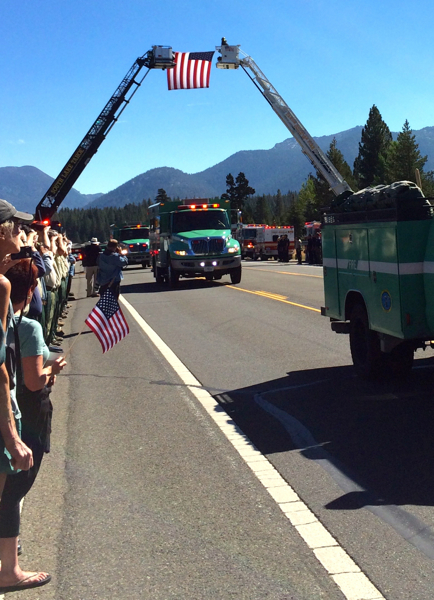
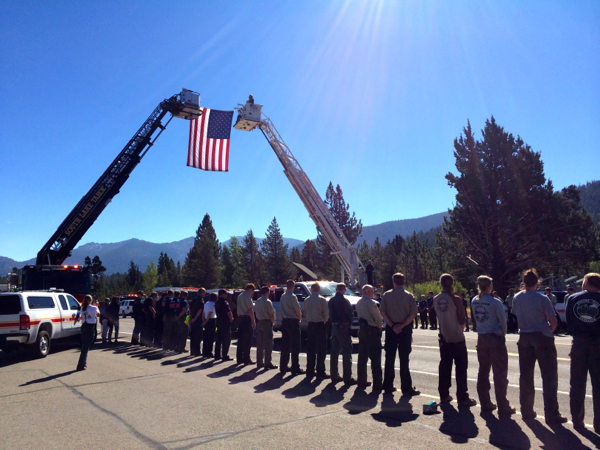
People line Highway 50 in Meyers to honor firefighter Michael Hallenbeck. Photos/Kim Wyatt

People line Highway 50 in Meyers on Aug. 13 to honor firefighter Michael Hallenbeck. Photos/LTN

First responders and the South Shore community pay their respects to Michael  Hallenbeck. Photos/Kim Wyatt

First responders and South Shore residents pay their respects.

It was a somber occasion that brought people on the South Shore to the curbside Thursday morning.

It was an opportunity to pay tribute to fallen U.S. Forest Service wildland firefighter Michael Hallenbeck. Hallenbeck died Aug. 8 after being struck by a tree while fighting the Sierra Fire that was burning outside the boundary line of Sierra-at-Tahoe.

The procession started in South Lake Tahoe and ended at Green Valley Mortuary in Rescue. U.S. flags were suspended from two ladder trucks in Meyers, under which the procession passed.

Private services for the 21-year-old will be Saturday.

“This tragedy reminds us of the dangers firefighters face every time they suit up. Anne and I are grateful for U.S. Forest Service Firefighter Mike Hallenbeck’s service and on behalf of all Californians, we extend our deepest condolences to his family, friends and colleagues,” Gov. Jerry Brown said in a statement.

Hallenbeck was stationed with the Lake Tahoe Basin Management Unit. This was his first fire. For the past couple winters the Shingle Springs man had worked at Sierra-at-Tahoe. The resort had a candlelight vigil for him on Aug. 12 and will have an event in his honor this winter.

— Lake Tahoe News staff report


How Americans fell in love with the open road

By Peter J. Blodgett  

Tens of millions of Americans have hit the road this summer. The all-American road trip has long been a signature adventure, but once upon a time the notion of your own motorized excursion of any length would have seemed impossible.

In 1900, Americans were hampered by wretched roads and limited by the speed and endurance of the horses that powered buckboards, coaches, and wagons. If they had an urge to travel far distances, they had to rely upon the steam locomotive.

As fantastic as it might have seemed at the turn of the 20th century, the idea of supplanting the iron horse with the horseless carriage did catch the fancy of some intrepid men and women. Eager to test the technological limits of their new contraptions, a few hardy souls set off upon far-reaching expeditions between 1900 and 1910.

Colorado attorney Philip Delany, recounting his 1903 excursion from Colorado Springs to Santa Fe observed: “and so the machine is conquering the old frontier, carrying the thudding of modern mechanics into the land of romance. . . .”  Such travel meant seeing “the wildest and most natural places on the continent,” encountering more than a few hints of danger on steep and rocky mountain roads, and reliving the exploits of American pioneers. “The trails of Kit Carson and Boone and Crockett, and the rest of the early frontiersmen,” he declared, “stretch out before the adventurous automobilist.”
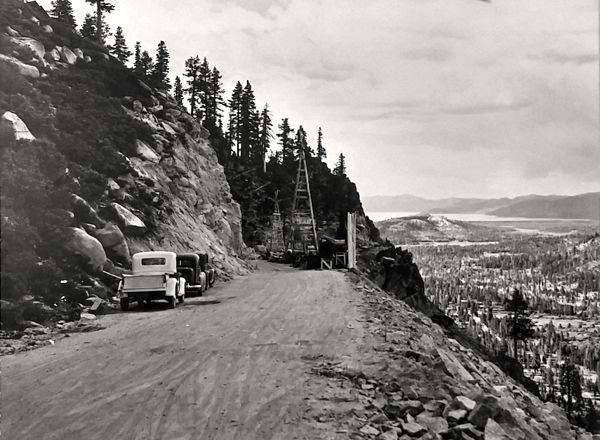
Four-wheel drive was not an options in the 1930s. Photo/Lake Tahoe Historical Society

Four-wheel drive was not an options in the 1930s. Photo/Lake Tahoe Historical Society

At the same time, some city dwellers simply sought an escape. Early 20th century urban environments had their drawbacks: sidewalks overflowing with scurrying pedestrians; streets crowded with unending waves of trolleys, delivery wagons, carriages, and pushcarts; the persistent stench rising from mounds of horse manure; raw sewage emptying into open gutters; rotting piles of uncollected garbage and dense clouds belching from factory smokestacks.

Upper-middle-class tourists motored through the countryside and then camped by the side of the road, finding the sentimentalized image of the gypsy or the tramp quite a compelling identity to assume. They reveled in their sense of independence from stodgy summer resorts and the tyranny of inflexible timetables set by railroads or steamship lines. They delighted in the beauty and serenity of unspoiled countryside. In the same article quoted above, Philip Delany observed that “when [the automobilist] is tired of the old, there are new paths to be made. He has no beaten track to follow, no schedule to meet, no other train to consider; but he can go with the speed of an express straight into the heart of an unknown land.”

In its infancy, however, an automobile could not deliver most Americans from their urban frustrations — for most Americans could not afford to own and operate one. At a time when average annual salaries might not reach $500, many automobiles might cost between $650 and $1,300, securely beyond the grasp of all but the wealthiest. Moreover, with few garages, filling stations, and dealerships outside of city limits, even the infrastructure required for the care and feeding of the automobile could be difficult to locate and could drain the motorist’s wallet. During their earliest years, neither automobiles nor auto touring could be considered within the reach of the masses. Automobility would only become pervasive over time, thanks to rising wages, falling prices for used cars, expanding opportunities to buy these machines on credit, and, especially, the introduction of Henry Ford’s revolutionary Model T in 1908.


Even for those Americans who could afford the first horseless carriages, to go off the few familiar paths in most parts of the country, especially in the great distances of the trans-Mississippi West, required a large measure of self-reliance. One motor traveler characterized the roads of his native Wyoming in 1909 as “deep ruts, high centers, rocks, loose and solid; steep grades, washouts, or gullies . . . ” He went on to note that, “unbridged streams; sand, alkali dust; gumbo; and plain mud, were some of the more common abominations.” Between the obstacles presented by such abysmal road conditions, the likelihood of frequent mechanical breakdowns, and the rarity of supplies to sustain driver and vehicle, these early outings always required an audacious spirit.

Aspiring long-distance auto tourists back then were counseled by self-proclaimed experts to carry abundant quantities of supplies. Those who made the first transcontinental drives between 1901 and 1908 hauled along ropes, blocks and tackle, axes, sleeping bags, water bags, spades, camps stoves, compasses, barometers, thermometers, cyclometers, first aid kits, rubber ponchos, tire chains, pith helmets, assorted spare parts, and sufficient firearms to launch a small insurrection. Mary C. Bedell’s impressive list of gear, published in her entertaining 1924 account of auto touring, “Modern Gypsies”, typifies what was carried by the most dedicated motor campers both in scale and variety: “tent, duffle bags, gasoline stove, Adirondack grate and a kit of aluminum kettles, with coffee pot and enamel cups and saucers inside” — an array of equipment that added “four or five hundred pounds” alone to the weight of the fully loaded automobile. A car so laden, puffing along western trails, bears a striking resemblance in the mind’s eye to a hermit crab staggering across the ocean floor burdened with its house on its back.

Even as motoring Americans loaded up their cars with the contents of their local hardware stores, however, the growth in their numbers year by year provided alluring prospects to entrepreneurs in small towns and great cities throughout the West. Garages, gas stations, roadside cafés, and diners began to pop up along more frequently traveled routes while hotels, restaurants, and general stores started to advertise in the earliest guidebooks produced by organizations such as AAA and the Automobile Club of America. Following the lead of Gulf Oil in 1914, gasoline retailers commissioned maps branded liberally with their logos for free distribution at their service stations. Motorists once left entirely to their own devices now encountered a rapidly evolving infrastructure of goods and services.

Meanwhile, governments at the local, state, and federal levels began to invest increased engineering skill, construction efforts, and tax dollars in road improvements. While motor tourists by the end of the World War I might still encounter 10,000 miles of battered gravel trails littered with potholes for every 10 miles of carefully surfaced and maintained roads throughout the country, the increasing pace of improvements made it far easier to drive through the West than it had been for those who had attempted such a journey only a decade before.

Although still new to the American scene by 1920, the road trip thus had begun to take on a shape familiar to modern eyes. Above all, the automobile was assuming a dominant role in popular recreation as more and more Americans incorporated it into their visions of recreation and leisure. As costs fell and reliability increased, as the successful outings of the few began to inspire the many, and as the thrill of this new technology spread through an ever-wider range of the populace, motoring for pleasure insinuated itself as a notion in the minds of many Americans. Indeed, less than a decade after the turn of the 20th century, author William F. Dix could assert that the automobile had become nothing less than a “vacation agent” for motor-savvy Americans as it “opens up the countryside to the city dweller, [and held out the promise of] great national highways stretching from ocean to ocean and from North to South.” Over those highways, he continued, “would sweep endless processions of light, graceful, and inexpensive vehicles . . . carrying rich and poor alike into a better understanding of nature and teaching them the pure and refreshing beauties of the country.”

While Dix fell far short as a prophet of social or technological developments, his sense of how inextricably linked the automobile would become in the leisure pursuits of Americans has been thoroughly borne out by the evolution of the American road trip.

Peter J. Blodgett is H. Russell Smith Foundation curator of western historical manuscripts at the Huntington Library and editor of “Motoring West Volume 1: Automobile Pioneers, 1900-1909”. He wrote this for What It Means to Be American, a national conversation hosted by the Smithsonian and Zócalo Public Square.


Zephyr Cove disc golf in state of flux

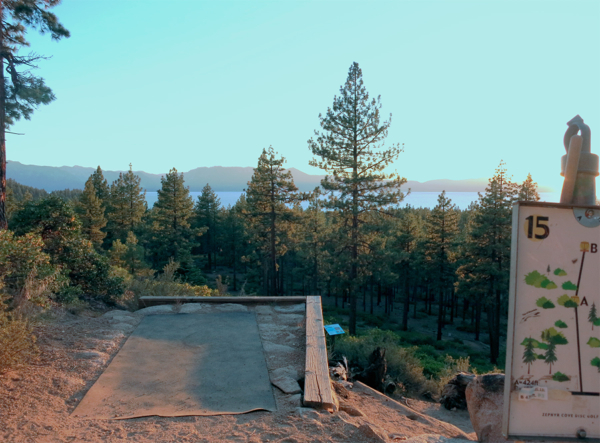
Zephyr Cove's disc golf course is known for its views. Photos/Jessie Marchesseau

Zephyr Cove’s disc golf course is known for its views. Photos/Jessie Marchesseau

By Jessie Marchesseau

Douglas County Parks and Recreation has no immediate plans for any major changes to the Zephyr Cove disc golf course.

This may come as a surprise to those who have heard the rumors swirling through the local disc golf community alleging that Douglas County had accepted a proposal to make significant changes to the existing course. Hundreds of people even signed a petition trying to stop this work that was never agreed to. The idea of changing a beloved course which is considered one of the top courses in the country by the Professional Disc Golf Association had people up in arms.

It began after Tahoe residents and disc golf enthusiasts Mike Plansky, Will McKissock and Dan Deegan presented a plan for changes and improvements to the Zephyr Cove disc golf course at the Douglas County Parks and Recreation Commission meeting on June 2. The plan proposed adding a three-hole pitch and putt area near the picnic tables, a six- to nine-hole kids course adjacent to the parking lot, a nine-hole “lakeview loop” and reconfiguring several of the existing 18 holes.

The commission listened to the presentation, but did not approve or move forward with the plan.

“We listen to all ideas, we don’t restrict,” Scott Morgan, parks and recreation director for Douglas County, told Lake Tahoe News. “We can’t restrict.”

The official meeting minutes state that the commission was already aware at that time there were some parties in the community who were not in agreement with some aspects of the plan being presented.

One of those parties not in agreement is original course designer Craig Getty. Getty also had a plan to add an additional nine holes to the Zephyr Cove disc golf course and to reconfigure a number of the existing holes. He claimed to have already had a verbal agreement with the acting park ranger to move forward with his plan. However, Morgan said such an agreement is not possible as rangers cannot give consent for park improvements. Douglas County Parks would have to give approval and conduct a public review to make such changes to the course.

Last fall, Plansky had been working with Getty on Getty’s plan for alterations to the course, but when the two couldn’t come to an agreement on certain aspects, Plansky began working on a different plan with a number of colleagues. This is the plan which was presented at the June 2 meeting. Getty, who has designed eight courses in the Tahoe area, said it was the first time someone other than himself had submitted plans to make changes to one of the courses he designed.

Since it was built in 1998, most of the changes to the Zephyr Cove course have been pretty minor and completed under the direction of Getty. Morgan described it has having evolved “organically” over the years and said most of the maintenance and enhancements were done rather informally as a result.

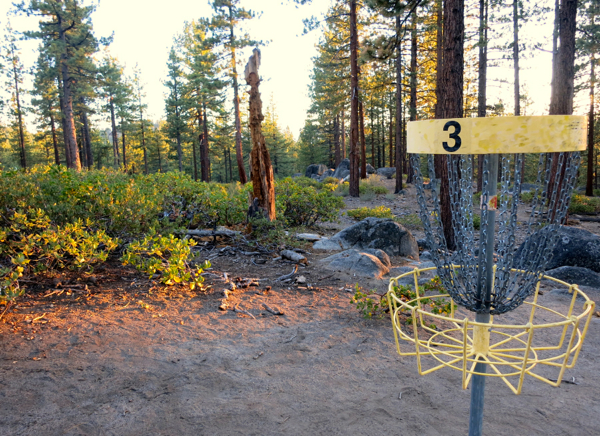
The course meanders through the forest above the tennis courts at Zephyr Cove Park.

The course meanders through the forest above the tennis courts at Zephyr Cove Park.

This is the first time there has been dissent expressed within the community in response to any maintenance or alterations. As a result, the county has decided to move slowly with respect to changes or improvements to the course and require that all parties come to a consensus before any work is done. Until that happens, parks and recreation has put a halt on any work to the course beyond standard safety issues and routine maintenance.

The minutes from the June 2 meeting state that Plansky, McKissock and Deegan were encouraged to “form a nonprofit open to the public organization that would not deny membership to anyone who has an interest in serving in the nonprofit.” In short, they must form a nonprofit group where any and all interested parties come together and agree on things before they are done. Consensus required.

The commission also stated that in order to be granted an MOU for the development, operation and maintenance of the Zephyr Cove disc golf course, a Douglas County staff member must be on the board of the nonprofit. In a subsequent meeting with Getty and his associates, Morgan reiterated these requirements.

“We want to recognize an organization that is there to support and preserve the disc golf course,” Morgan said.

Such organizations are not uncommon for the development and maintenance of county facilities such as tennis courts and the Dangberg Ranch. It’s also not uncommon for disc golf courses. For example, the Reno Disc Golf Association recently finished a large disc golf project in Reno, something RDGA President Skot Meyer said would never have been possible without the existence of their nonprofit group. He said that in Reno, it has worked extremely efficiently and been a great benefit to the community. But noted that most of the people in the RDGA have similar ideas; it may take such an organization in Douglas County a while to come to an agreement on things.

Getty is not optimistic: “not much will get done,” he said of having a group overseeing course work as opposed to an individual. He likened it to having an architect and a bunch of carpenters all build a house and giving them all equal authority. “They all want it done a different way,” he said. “The history of how the course was designed should take precedence.”

But Morgan insists this is the only way, and the county will not approve anything that is not agreed upon by all parties.

“Sounds like we’re all supposed to work together, and that’s what we’re trying to do,” said Plansky, who is moving forward with the development of the nonprofit organization.

While all parties seem to agree that the course needs some work, exactly what that work will be and any progress toward it is unlikely to happen during this disc golf season.


Cost-benefit analysis of aerial firefighting

By Kelsey Ray, High Country News

When large wildfires blaze, the public counts on airplanes to put them out. Pilots fly air tankers over mountainous terrain and drop fire retardant — up to nearly 12,000 gallons per trip — onto the dense forests below.

The bursts of red slurry bring hope to those whose homes are imperiled. Politicians and the media thrill at the sight and clamor for more.

But is it safe? And is it effective enough to justify the high costs?

The U.S. Forest Service, which saw its large air tanker fleet shrink to just nine planes in 2012, has 20 air tankers on exclusive-use and call-when-needed contracts for the 2015 season, plus one under Forest Service operation. Spokeswoman Jennifer Jones said the agency is working to bring up to 28 air tankers into service.

Read the whole story


Calif. law bars grand juries in police deadly force cases

By Melanie Mason, Los Angeles Times

Gov. Jerry Brown signed into law Tuesday a measure that prohibits secret grand juries to weigh in on cases involving excessive or deadly force by law enforcement, and another affirming the public’s right to take audio or video recordings of police officers.

Both measures were part of a spate of proposals introduced by lawmakers earlier this year on police accountability; some of the more controversial bills dealing with body-worn cameras or reporting on use-of-force incidents have stalled in the Legislature.

Sen. Holly Mitchell, D-Los Angeles, offered the grand juries measure in response to high-profile incidents in Ferguson, Mo., and New York City, where grand juries declined to indict police officers for the deaths of Michael Brown and Eric Garner, respectively.

Read the whole story


Tahoe Keys answer to invasive weeds — herbicide

Milfoil is is choking the canals of the Tahoe Keys. Photo/LTN file

Milfoil is is choking the canals of the Tahoe Keys and spreading to Lake Tahoe. Photo/LTN file

By Kathryn Reed

It’s time to do something different.

That was the overriding message delivered Tuesday night regarding invasive weeds that are taking over of the Tahoe Keys canals in South Lake Tahoe. Twenty-five years of various methods – most notably harvesting – have not solved the problem.

The Tahoe Keys Property Owners Association has spent about $250,000 developing a multi-year plan to control Eurasian milfoil, curlyleaf pondweed and coontail – the three primary invasive weeds. Estimates are that treatment could cost as much as $1 million.

Today the association spends about $400,000 a year on the harvester, which essentially is mowing the milfoil. It also upends particles that drift into Lake Tahoe proper – 4,000 per acre. Boat propellers are another way the weed gets into the bigger body of water.

The plan is to use herbicides over the course of five years to get rid of the bulk of the invasive weeds. It would be applied in conjunction with continued harvesting and placing barrier mats in locations to suffocate plants.

The draft plan was released Aug. 11, with comments on it being taken until Sept. 15. The plan has been vetted by a panel of five scientists, three who were at the meeting in person, with the other two participating remotely.

Joe DiTomaso, Joel Trumbo, Sudeep Chandra

Joe DiTomaso, Joel Trumbo, Sudeep Chandra

They are:

·      Joe DiTomaso, non-crop weed specialist at UC Davis.

·      Joel Trumbo, senior environmental scientist for the Lands Program for California Department of Fish and Wildlife.

·      Kurt Getsinger, chairman of the Technical Advisory Committee of the Aquatic Ecosystem Restoration Foundation, member of the USDA’s IR-4 Project Aquatics Committee, and expert to the EPA Office of Pesticide Programs.

·      Sudeep Chandra, at UNR does limnological studies related to the restoration or conservation of aquatic ecosystems.

·      Pat Akers.

Collectively, they agree the plan is solid, especially liking that it is science based, there will be monitoring, and adaptive management will be used. That latter means if things aren’t going as planned, changes will be made mid-course. Using herbicides in the spring and not everywhere were also praised.

“The plan is well-thought out and researched. We feel the problems in the Keys are significant and some action has to be taken, and quickly,” DiTomaso said.

It was noted that these plants are invading waterways throughout the United States and that chemical applications have been used elsewhere. While each body of water is different, the Keys is not starting from scratch in terms of finding solutions.

Ultimately it will be up to the Lahontan Water Quality Control Board to issue a permit for the use of any herbicides, so it is not definitive this will happen. However, TKPOA would like to implement the plan in 2017. Environmental analysis would take place between now and then.

Many questions came up from the more than 80 people who attended Tuesday’s meeting regarding the safety of applying chemicals to the lagoons in terms of drinking water, and other plant and aquatic life.

John Larson, president of the TKPOA board, said if contaminants are found in the drinking water, one of the three wells the self-contained water company uses could be taken off-line. In a worst-case scenario, the Keys water system could get its water from South Tahoe Public Utility District.

As for killing native plants, it was noted the more than a dozen EPA approved herbicides that could possibly be used have particular attributes. It would be like applying a chemical to kill dandelions on a yard, but not killing the grass at the same time.

“Herbicides are toxic to plants. The converse is they are less risky to things that aren’t plants,” Trumbo said.

Killing the non-natives should also allow the natives to be healthier. These invasives are habitat for warm water fish, so eliminating their food source could help curtail their population.

No one expects the plants to be eradicated, but instead reduced to a level they can be controlled.

Still needing to be worked out is getting all the property owners on the same page. Within the Keys, besides the TKPOA, the Tahoe Keys Beach and Harbor Association, Tahoe Keys Marina, California Tahoe Conservancy, Tahoe Keys Village and lawyers who own the lagoon all have a say. And not all back the TKPOA plan.

—–

Notes:

·      The plan is online, as is the ability to comment.


Strapped states farm out upkeep of parks

By Jim Carlton, Wall Street Journal

California’s cash-strapped parks system has a $1.2 billion maintenance backlog. But many of its 279 parks are getting spruced up anyway thanks to a secret weapon: conservation groups that have stepped in to rebuild trails, renovate restrooms and even buy more land.

Park Champions, a program run by the California State Parks Foundation, a nonprofit umbrella group, has had 3,202 volunteers work 23,790 hours cleaning up tarnished facilities around the state during the past four years. In Mendocino County north of San Francisco, two nonprofits recently picked up half the $160,000 tab to rebuild a dilapidated day-use area at Hendy Woods State Park that features a picturesque strand of towering, old-growth redwoods.

Similar public-private partnerships have formed in Florida, Pennsylvania and elsewhere. In Florida, the number of volunteer hours contributed to state parks by nonprofit workers in 2014 was up 33 percent from before the recession in 2008. Over the same period, full-time park staffing remained at about 1,060, according to the Friends of Florida State Parks nonprofit group.

Read the whole story


Megafires are remaking U.S. forests

By Laura Parker, National Geographic

TWISP, Wash. — The largest fire in state history swept through the eastern slopes of the Cascade Range with explosive force last summer. The Carlton Complex Fire burned more than 250,000 acres, devouring everything in its path at the hypersonic pace of 3.8 acres per second.

Until then, the top slot in the state’s fire rankings belonged to the Tripod Fire, which burned up 175,000 beetle-infested acres in two months on the same slopes in 2006.

Carlton and Tripod are “megafires,” part of a wave of extreme fires that are transforming the great forests of the American West. By the end of the century, scientists say, megafires—conflagrations that chew up at least 100,000 acres of land—will become the norm. Which makes them of critical interest to researchers.

These infernos, once rare, are growing to sizes that U.S. Forest Service Chief Tom Tidwell describes as “unimaginable” two decades ago. Five alone have consumed more than 5 million acres in central Alaska since June. Washington, Oregon, California, Arizona, New Mexico and Colorado also experienced their worst wildfires in the past seven years.

So far in the Lower 48, none of the thousands of fires that have burned across the 11 Western states have grown into megafire size. But the most perilous weeks of fire season are still ahead.

Read the whole story


Landscaper transforms sod into garden

Raised mounds planted with perennials will look dramatically different in a year. Photos/Kathryn Reed

Raised mounds planted with perennials will look dramatically different in a year. Photos/Kathryn Reed

Publisher’s note: This is one in a random series of stories about what it’s like to go through the South Tahoe Public Utility District turf buyback program.

By Kathryn Reed

A spiral herb garden, raised mounds with endless plants and a dry riverbed. Those were not part of my plans when I decided to remove my turf. Those were Brian Hirdman’s ideas when he was hired to take over my landscaping project.

Hirdman’s passion, creativity and desire to reuse products attracted me to him. Plus, he shops locally. He had a vision that never would have crossed my mind no matter how many magazines I looked at or friends I spoke to. With his iPad he showed me other yards he had transformed. I was inspired knowing I could have something unique and well beyond my ability.

His brand of landscaping expanded my vocabulary to include permaculture and hugelkultur.

He was able to combine my need to use the yard for wood splitting, wanting relatively low maintenance and his sense of style.

Dead grass has been replaced with the prowess of Brian Hirdman's landscaping .

Dead grass has been replaced with the prowess of Brian Hirdman’s landscaping .

Enlisting help

I knew I was in over my head I when rented the sod cutter last month and started to pick up the pieces. Dirt is heavy.

That aspect of the project alone could have taken me all summer to finish. And the grassy area was only 804 square feet.

I initially met Hirdman in May 2014 when he was putting in a garden at the Family Resource Center.  We reconnected when I ran into him last month at Ahern’s where we were both renting sod cutters.

Fortunately, he called that weekend. I turned the machinery over to Hirdman and his helper Garrett Murphy. With two cutters they had the yard sliced and diced in no time.

The two took the sod and made them into mounds, then covered it with newspaper, followed by horse poop and soil with some repeating – like making lasagna. No need for the black gardening cloth. The newspapers will breakdown. The horse poop from Camp Richardson stables is weed free based on what the animals are fed.

The beds will compact a bit, but for the most part will remain raised.

Newspapers, which will decompose, are part of the process to create the mounds.

Newspapers, which will decompose, are part of the process to create the mounds.

Beyond the basics

Naturally, all of this comes with a price. Hirdman is adept at knowing what South Tahoe Public Utility District requires so I will get my rebate check. His base price is three times the square footage of the sod being removed. This includes removing the sod, planting the plants, irrigation, manure and wood chips.

Initially I had hoped to stay close to my rebate of $1,200. That was pre-Hirdman.

An unexpected infusion of cash into my bank account that had nothing to do with work didn’t stay there long. I wanted to do more than the basic turf removal. Hirdman became the financial beneficiary and I no longer have the worst front yard on the street.

Brian Hirdman, left, and Garett Murphy work on the main raised area.

Brian Hirdman, left, and Garett Murphy work on the main raised area.

I love that everything in the spiral herb garden is edible or has medicinal purposes. It’s one of Hirdman’s signature designs – creating these out of rock from Tahoe Sand and Gravel. The choice of where plants go is based on the microclimates that are formed from the tiered garden.

This along with the dry riverbed that will catch the excess water from the rain barrel were extras.

Before hiring Hirdman I was most worried about figuring out the irrigation system. Based on the number of hours he was digging in the dirt to deal with a busted line and needing to adjust the pressure, I’m glad all but the extra parts were part of the bid price.

I also didn’t skimp on the number of plants. Oddly, today it looks like more could be planted because there is so much openness between greenery. In a year, though, the yard will look dramatically different, full of color, and taller foliage.

One of the mounds the guys created is designed to attract butterflies, insects and humming birds – my own little ecosystem that goes beyond the squirrels and bunnies (and occasional bear and coyote) that exist today.

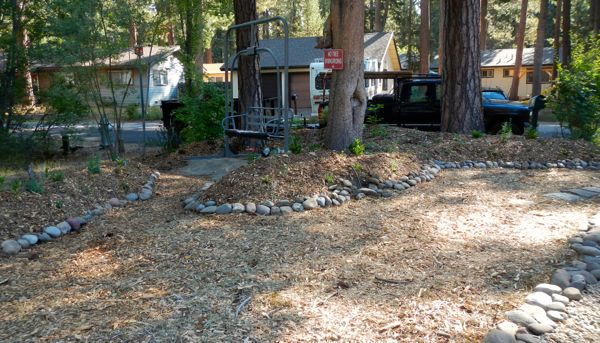
Hirdman and Murphy also moved the chairlift swing, which in itself was monumental. I remember how hard it was to get it to where it had been. It’s now in a spot between two large pines that look out onto a California Tahoe Conservancy lot. The plants to the side and behind make a sanctuary of sorts, which in the coming years will be more pronounced as things grow.

Brian Hirdman and Garrett Murphy create the spiral herb garden

Brian Hirdman and Garrett Murphy create the spiral herb garden

More to do

The whole yard is not completely done. I’ll be getting gutters this fall that will drain into a rain barrel that still needs to be purchased.

I have rounds picked out to create a bench, but still need to find a couple snowboards or some skis to turn that into a reality.

I’ll probably move more sand around from the badminton court to put under the swing.

Next spring I’ll bring the wine barrel from the back, which today has thriving tomato plants in it, and place it in a preselected spot. Most likely annuals will go in it.

Oh, and I need to get my South Tahoe PUD inspection so I can get my rebate.


El Nino meets ‘the blob’ — but will it help?

By Jeff DeLong, Reno Gazette-Journal

There’s El Nino, and then there’s “the blob.”

Both are phenomena associated with warm water in the Pacific. Both could have some impact on the weather, including building hopes for a big winter that might help pull the West out of protracted drought.

No one really knows.

“This is a little bit of an unprecedented situation,” said Kelly Redmond, deputy director of the Western Regional Climate Center in Reno. “It’s like two sets of dice that influence the atmosphere. But do these sets of dice have a string connecting them?”

El Nino is characterized by warmer-than-normal surface water temperatures in the equatorial Pacific stretching from the coast of Peru to west of the international dateline. After a year of anticipation, conditions came together last March for an El Nino to be officially declared, with scientists now saying there’s a better than 90 percent chance the condition will stick around into next winter.

Read the whole story