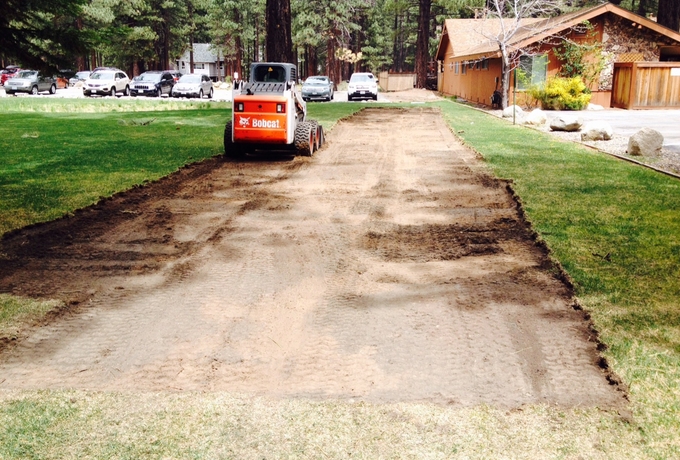
Barton Heath in May started removing sod from many areas, including near the Alpine Building. Photo/Provided
By Kathryn Reed
Hospitals use huge quantities of water – from old sterilizers operating 24 hours a day to non-aerated faucets to old toilets. And then there is landscaping.
According to the EPA, the median hospital uses 315 gallons of water per bed per day. Hospitals have historically been near the top for water consumption based on square footage at 55 gallons per square foot. Only senior care facilities and hotels ranked higher, according to the EPA.
The Centers for Disease Control and Prevention, Environmental Protection Agency, National Oceanic and Atmospheric Agency, and American Water Works Association put out a report titled “When Every Drop Counts: Protecting Public Health During Drought Conditions”. It says, “Hospitals, clinics, and other health care facilities oftentimes rely heavily on water to ensure the well-being of their patients. Water is used for drinking, sanitation, patient care, equipment sterilization, HVAC systems, and other essential functions throughout these facilities.”
Barton Memorial Hospital is no different than other entities when it comes to needing to use water for all of the above-mentioned reasons. However, the South Lake Tahoe medical facility it trying to curtail its usage as California deals with being in year four of a drought.
“Water plays an intricate part in our wellbeing which is why we, the staff and physicians at Barton Health, are doing our part to reduce our water usage and protect Tahoe’s natural beauty. We value our residents, visitors, and wildlife, and want to be part of the solution to help alleviate our state’s water crisis,” Rich Belli, director of facilities, told Lake Tahoe News.
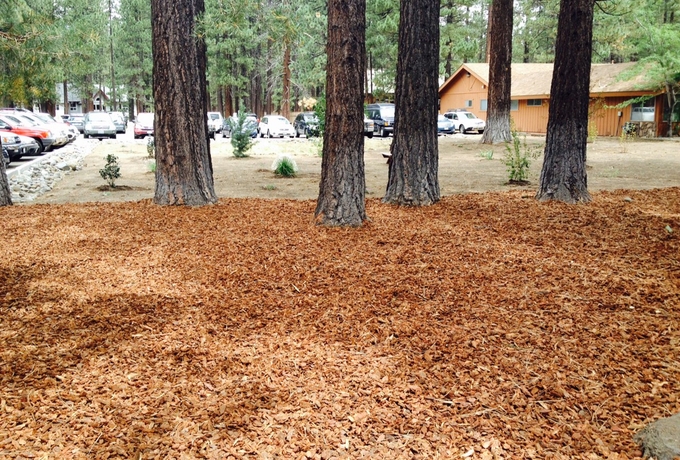
Mulch was put down and native plants are growing where sod once was. Photo/Provided
In 2014, Barton cut its water usage by more than 28 percent compared to the previous year.
Actions taken this year include:
· Replacing remaining standard toilets with low flow toilets at all Barton Health facilities.
· Decreasing sprinkler usage and working with South Tahoe Public Utility District’s turf buyback program to remove 8,000 square feet of lawn in various areas throughout the hospital campus and replace it with drought tolerant landscape.
· Turning off outside water features.
· Minimizing use of bottled water by serving pitchers of water at catering events and to patients unless medically necessary.
Salinas man finds meteorites in Nevada
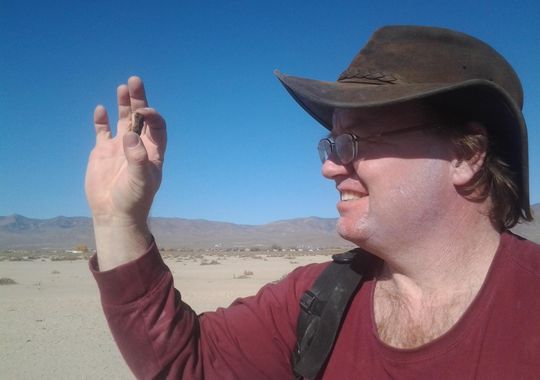
Scott Harlan found this meteorite at Misfit Flats. Photo/Provided
By Scott Harlan, Salinas Californian
My interest in geology probably started with my father who was a petroleum geologist. We would go to gem and mineral shows together and look at all of the spectacular specimens.
There is a sense of discovery when you find something that no man has ever seen before.
Then in 2013, there was a fireball over Lake Tahoe that possibly could have resulted in meteorites on the ground. My brother in law, Richard Medalen, and I went up to look, but the hike was going to be difficult and it started raining the day we planned to search.
So, we decided to head to the nearest dry lake bed, which was Misfit Flats in Nevada.
We searched for a few hours and brought home a few rocks that could possibly be meteorites. Almost all meteorites have metallic iron and nickel inside, so the most definitive test for a novice is to cut the stone, polish the cut surface, and look for silver colored metal.
It’s been more than a year since the Federal Aviation Administration designated the state of Nevada as a drone test site. Since then, the state has largely been quiet about what the sites are being used for.
One reason for the relative quiet: confidentiality agreements.
Much of the research going on at the test sites at about 35 locations across the state is proprietary, said Tom Wilczek, who works closely with the test sites as the aerospace industry specialist in the Governor’s Office of Economic Development.
The state has signed non-disclosure agreements with various organizations that have made use of the sites. Those using the sites include private companies, universities and public agencies.
A stand of live trees defines the Angora Fire boundary. Photos/Kathryn Reed
By Kathryn Reed
The dictionary definition of a forest is “a large area covered chiefly with trees and undergrowth.” It’s hard to know what to call a former forest that is covered with undergrowth and what looks like poles.
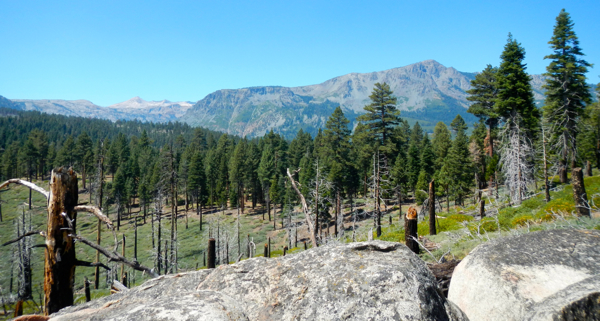
This is Tahoe Mountain eight years after the Angora Fire.
The trees – such as they are – create a salt and pepper affect. It burned so hot through here in June 2007 that what was once brown and green trees are no more. “Stumps” are taller than people. The life of these trees was taken too soon all because people were negligent when it came to putting out an illegal campfire at Seneca Pond.
When it comes to forest devastation, Angora’s 3,000-plus acres is a blip on the map – especially when compared to the fires burning throughout California right now. It was the loss of the 254 houses that was the most impactful.
Bull thistle, while pretty and attractive to bees, is not a native species to the basin.
Among the standing dead trees is an understory of life. However, much of it is invasive and flammable like white thorn and bull thistle. Grass is a couple feet tall.
This is U.S. Forest Service land. They say it’s normal for this type of flora to grow after a fire because these species like disturbed soils. The agency is treating some areas to kill the invasives.
Late spring and early summer rains have helped the vegetation grow taller than would be normal for this time of year.
Tall grass is thriving on Tahoe Mountain.
Dave Fournier, vegetation specialist with the Lake Tahoe Basin Management Unit, said this flashy fuel would burn quickly, but at a low intensity if a fire were to come through this area again. Even in windy conditions this type of fuel is easy to suppress, he said.
Some of this vegetation is along the trails off Tahoe Mountain Road and some is near houses. The Forest Service offers a homeowner stewardship program that allows residents who have property that abuts the federal land to treat it. For more info on the program, call 530.543.2600, then wait for the “urban lots” prompt.
South Lake Tahoe looking toward Stateline is visible from the ridge.
A map at the third gate on the right on Tahoe Mountain Road shows a variety of trails that are mostly used by mountain bikers. They are also good for dog walks, and evidence showed equestrians use them as well.
The views are fabulous – the South Shore peaks (Tallac, Jobs, Freel), Lake Tahoe from the ridge, and even the developed area is interesting from this perspective.
—–
Notes:
From South Lake Tahoe continue on Lake Tahoe Boulevard at the Y. Turn right on Tahoe Mountain Road. Park at the third green gate.
Not all the trails are marked. We took the first two distinct left turns and then the first right. Then we guessed and just kept going up.
‘Godzilla El Niño’ would not end drought
By Rong-Gong Lin II, Los Angeles Times
The strengthening El Niño in the Pacific Ocean has the potential to become one of the most powerful on record, as warming ocean waters surge toward the Americas, setting up a pattern that could bring once-in-a-generation storms this winter to drought-parched California.
The National Weather Service’s Climate Prediction Center said Thursday that all computer models are predicting a strong El Niño to peak in the late fall or early winter. A host of observations have led scientists to conclude that “collectively, these atmospheric and oceanic features reflect a significant and strengthening El Niño.”
“This definitely has the potential of being the Godzilla El Niño,” said Bill Patzert, a climatologist with NASA’s Jet Propulsion Laboratory in La Cañada Flintridge.
In California, officials have cautioned the public against imagining that El Niño will suddenly end the state’s chronic water challenges.
In fact, it would take an astonishing 2.5 to three times the average annual precipitation to make up for the rain and snow lost in the central Sierra mountain range over the last four years of drought, said Kevin Werner, the National Oceanic and Atmospheric Administration’s expert on climate in the western United States.
All morning, I’d heard the roar of sloughs rocketing down cliffs as I skied up a mountain in Prince William Sound, Alaska. Now, standing at the summit with my six friends and our two guides, I gazed over treeless sheets of white plunging to the inky ocean. A virgin slope beckoned to us. I felt uneasy — the snow was clearly unstable — but said nothing.
I was there as a travel writer and photographer, so the group agreed that I would go first to set up my camera, accompanied by Dan, the lead guide. I shook off my nervousness and skied off, arcing turns down a mellow powder field and stopping before a knoll. Dan whizzed past me and disappeared over the bump, flanked by steeper slopes. Suddenly, a line tore across the snow, releasing a massive avalanche that crashed 700 feet down the slope, engulfing Dan in car-sized panes of broken snow that settled, slowly, into a terrifying stillness.
With the help of his inflatable airbags, Dan kept afloat and survived, unhurt. He took a few moments to collect himself, and then put his skins back on. I stood there in awe and terror, my heart racing, glad to be alive.
I don’t know whether some misjudgment or breach of professional protocol contributed to this accident. It’s exceedingly rare for a slope shy of 30 degrees to slide so dramatically. But for years, I have relived the incident, questioning my own assumptions about safety in avalanche terrain. Was it a wild fluke, a simple miscalculation, or a serious mistake made possible by complicated psychological factors? In other words, how dumb were we?
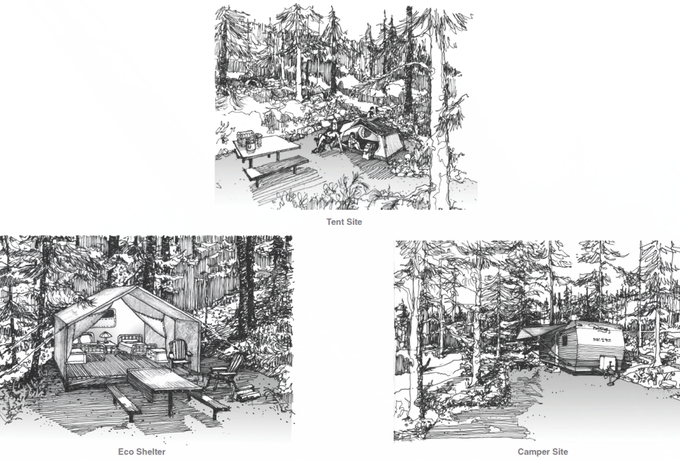
Three types of camping will be available — tent, RV and eco-shelters.
By Kathryn Reed
KINGS BEACH – Pristine isn’t a word developers of the Brockway Campground like to use when describing the 104-acre site. To the average camper pristine might be exactly the word for it.
Campers aren’t going to care how many times it has been logged by Sierra Pacific Industries – the land owner, or the fact that first generation trees don’t exist or that this mixed conifer forest has white fir, red fir, Jeffrey pine, sugar pine and incense cedar. They will be there to relax and play, and will probably never realize 18 percent of the trees that exist today will have been removed to make room for the campground.
What is proposed is a camping experience for a whole new generation.
“The generation coming up hasn’t tended to fire much. They are used to a flick of a switch,” Kurt Krieg with Mountainside Partners told Lake Tahoe News while on a tour of the property. His firm is the developers. “It’s the way camping is going. Propane-gas is better for the environment.”
In other words, instead of wood fire rings at each campsite, there will be shared gas ones. Wood will be allowed – but only used by staff for ranger talks and group activities.
Campers will hardly have to rough it in ways that go beyond not having to light a fire. While tent camping will dominate the 282 campsites, RVs will be allowed and there will be eco-shelters so people don’t have to sleep on the ground.
Plus, there will be dining facilities so cooking over a Coleman stove isn’t necessary. And the pool will be an option instead of the forest to play in.
Krieg said the camping market has changed and that people want these types of amenities. Plus, there will be shuttles provided so people could get to Lake Tahoe or one of the nearby towns without driving themselves.
This area is already a haven for hikers and cyclists, with the Tahoe Rim Trail crossing Fibreboard Freeway. Sixteen miles of trails exist on this side of Highway 267, with another 40 miles on the other side. It would also be possible to ride-hike into Northstar ski resort.
The campground will be seasonal; open about 130 days.
Slivers of Lake Tahoe can be seen from different vantage points. Mount Pluto (the peak at Northstar at 8,617 feet) is a landmark.
Krieg said the campground would not be visible from Kings Beach or Tahoe City.
Mountainside Partners at one time had planned 112 residences on the land. That idea has been scrapped at the urging of planning officials and others.
There is only one main road into the parcel – Fibreboard Freeway (which is a bit of a misnomer of a name) off Highway 267 between Kings Beach and Northstar, so access to emergency vehicles could be an issue. The U.S. Forest Service maintains the road, with the land to the right (1,192 acres) belonging to Sierra Pacific Industries and land to the left being USFS. This road that was built in the 1960s and last improved in the 1980s will be upgraded. The campground entrance will be just more than 1 mile in from 267. There will be one entrance, with a loop system created for the sites as is common at most campgrounds.
Developers have a tentative date of Sept. 23 to present the project to the Tahoe Regional Planning Agency Governing Board. Placer County Board of Supervisors will also have a say in the approval process. An environmental impact study and environmental impact report will be prepared.
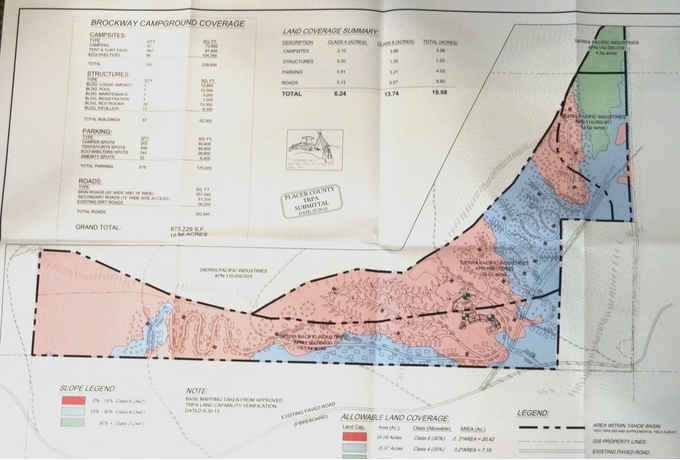
The layout of the proposed campground.
Here is what others shared with Lake Tahoe News about the project:
· Mary Bennington, executive director of the Tahoe Rim Trail Association:“We have mixed reactions to the proposed project. On the positive, it could provide a water source, showers, parking and bear boxes for TRT users and through hikers. Possible negative impacts include, potentially causing a significant increase to the number of users on the sections near Brockway which may then increase maintenance needs, cause user conflicts and change the user experience.”
· Tom Mooers, Sierra Watch:“Can’t really offer a position, because we haven’t seen an actual proposal. But I can offer a comment: Everyone loves camping. But we’ll have to put sentiment aside and take a clear-eyed look at the proposal. We’re talking about a relatively pristine and remote corner of the Tahoe basin, and we’ll have to carefully assess what the resort − with new roads, buildings, lights, sewage hookups, water demand, etc. − would mean to Tahoe, Martis Valley, and beyond.”
· Darcie Goodman-Collins, executive director League to Save Lake Tahoe:“This is not a traditional campground proposal. We are talking about locating accommodation for more than a thousand visitors on 120 acres of forested land in fairly pristine and natural condition, far from existing town centers. It remains to be seen if any development of this scale — regardless of whether it’s a campground, a major hotel or a some other type of larger scale resort complex — could be developed in a manner that is in line with our region’s goals to protect Lake Tahoe and the Tahoe basin’s natural resources.”
· Michael Schwartz, fire chief North Tahoe Fire Protection District, :“Since the fire district is a part of the review process for Brockway Campground, it would be inappropriate for us to comment at this time. While we have had some preliminary discussions with the applicants, Mountain Partners, we have not seen or reviewed plans for the proposed campground. It is important to note that the fire district is not a land use planning agency. However, should the project be approved, the district will be responsible for ensuring that the campground meets the stringent best practices for development in the wildland urban interface and complies with state law and fire code. The district currently serves six campgrounds, so we are familiar with public safety concerns and other issues related to providing emergency services within recreation campgrounds.”
· Alexis Ollar, executive director Mountain Area Preservation:“Mountain Area Preservation has not seen the actual proposal yet from the project applicant, Mountainside Partners. Our initial comments/concerns are focused on the scale of the proposal, 550 campsites located on the ridge of North Lake Tahoe in an undisturbed area adjacent to existing recreation on the Tahoe Rim Trail seems like too intense of a use for the landscape and topography. We are concerned the proposal will add further traffic congestion to Highway 267, creating more green house gas emissions and air pollution impacts for the Lake Tahoe and Martis Valley area. While we understand camping is an allowed use, we are unsure the use is appropriate for the landscape.”
· Kathy Carter, Liberty Utilities:“Utilities do not have a say in growth issues, but are mandated by the CPUC to provide service to any new customers.”
· Sandy Evans Hall, North Lake Tahoe Resort Association: Did not respond.
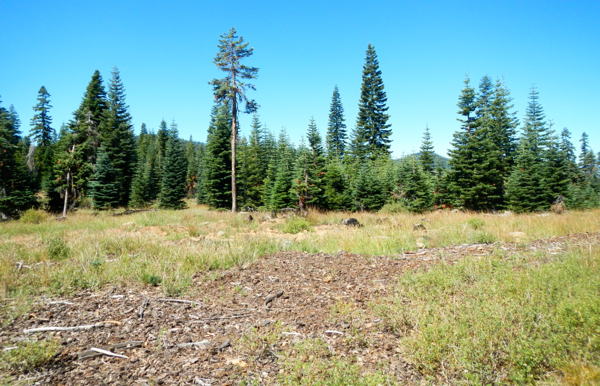
Most of the acreage is covered in conifers, with a few open spots. Photo/LTN
Lake Tahoe News posed the following questions to Blake Riva, managing partner at Mountainside Partners:
LTN: Why was the decision made not to build the 112 units and instead go with a campground?
Riva:We were asked by local agencies to consider a project on the basin lands that did not include traditional residential development. A campground is a permissible use under current zoning, it makes private land available for public use, plus it meets the goal of the Regional Plan update.
LTN: Economically, wouldn’t the permanent housing be more profitable?
Riva:We are excited about the prospect of the campground, as it will offer the public a new opportunity to experience and enjoy the incredible recreation available in North Lake Tahoe in a beautiful, natural setting. Our studies indicate that a campground is a viable business in Lake Tahoe.
LTN: Will the campground be leased to some entity to operate while Sierra Pacific Industries retains ownership of the land? Any idea who that might be?
Riva:We will determine how best to operate the campground once the entitlement process is complete. As the entitlement process is just getting under way, there is plenty of time to consider various alternatives.
LTN: With a swimming pool, coffee shop, general store, pocket parks and other amenities, this won’t be your typical campground. It sounds more like a resort. Can you describe what the area is going to be like? And what type of camper do you anticipate visiting Brockway Campground?
Riva:We anticipate campers who wish to enjoy a great outdoor experience will be interested in staying at the Brockway Campground. The proposal includes a mix of campsites, with the heavy focus on traditional tent camping sites. There would also be sites for campers and yurts or canvas tents that are on a platform, for those who don’t have their own tents or prefer that style of camping.
The inclusion of a general store, gathering areas, a small dining venue, swimming pool are actually the type of amenities that are commonly found in today’s campgrounds. The Tahoe basin and surrounding area have not had any new campgrounds in over two decades.
The idea is to provide those who are camping with the ability to stay at the campground once they arrive if they wish to and use it as their “home base.” They will have access to the basics, i.e. general store for items they may have forgotten at home, the ability to rent a bike to use on the nearby trails accessible from the campground, as well as the ability to take a shuttle to access the recreation, shopping and dining at the lake and in Truckee.
LTN: How many people could stay overnight?
Riva:Industry statistics reflect typical occupancy is 2.5 people per site, on average. Also, it is typical that loops and enclaves are opened and closed on demand. D.L. Bliss and Sugar Pine are two examples.
LTN: How many employees will be needed during peak and non-peak periods? Where do you anticipate they will live? What types of jobs will there be?
Riva: The campground will be seasonal, thus the majority of positions will be seasonal employment. The types of positions could include maintenance, check-in/registration and guest services.
LTN: What exactly are the eco-shelters and how many people would they sleep?
Riva:Eco-shelters can be accommodations such as yurts or canvas tents on a platform. Typically they can accommodate up to 4-6 people per.
LTN: The site allows for 832 campsites. Do you foresee developing the remaining 282 sites at any point?
Riva:No. While permissible use allows for up to 8 campsites per acre (totaling 832 possible sites), our land plan as designed reduces the density proposed to roughly 5 sites per acre. This represents a 34 percent reduction to what is allowable. The 550 sites that have been proposed for the Brockway Campground would be phased over time.
We have had numerous consultants study the land and its topography. While the design is far less than capacity, we feel it will provide a better camping experience.
LTN: According to the USFS and Outdoor Foundation, RV camping nationwide has decreased by 14 percent since 2006 and there has been a 20 percent decrease in non-RV, non-backcountry camping in that same period. With numbers like that, why do you believe this campground will be successful?
Riva:The 2015 North American Camping Report shows some different statistics with regard to camping. Please find the study here.
Existing Tahoe campgrounds are in great demand, and are often fully reserved a year in advance. As there aren’t that many lodging opportunities on the North Shore, and with existing campgrounds in the basin being so popular and often booked well in advance, as well as primarily located on the West and South Shores, the Brockway Campground would offer visitors more opportunities to enjoy a seasonal camping experience in a beautiful, natural setting in North Lake Tahoe.
LTN: Describe what the winter use would be like and how many sites would be open.
Riva: The application for the Brockway Campground as proposed is for summer seasonal use. We have not contemplated winter use, and in any case, the Fibreboard Freeway would remain closed during the winter months.
LTN: The campground site is very close to your company’s planned development of 760 residential units in the Martis Valley that are outside the Lake Tahoe Basin. How would these two projects complement each other or potentially be a conflict? Where is that project in the planning process?
Riva:As the proposed Brockway Campground and Martis Valley West parcel project are two separate, unrelated projects, they will neither complement nor conflict with each other. One is not dependent on the other.
The seasonal nature of the campground, significant buffer between the two, as well as tree retention will provide positive experiences for both campers and homeowners.
LTN: Many people believe this much development on the ridgeline is environmentally unsound. Any comment?
Riva:As with any proposed development project, the Brockway Campground will be subject to a thorough review process. It is important to note that a campground is a permissible use, and is consistent with TRPA’s Regional Plan update mission.
LTN: Both projects will bring added traffic to the area. How will this be mitigated?
Riva:Traffic studies will be completed as part of the environmental review process. Initial studies anticipate over 80 percent of Brockway Campground guests will arrive from Interstate 80, traveling from the north through the Martis Valley and turning off at Brockway Summit on the Fibreboard Freeway to access the campground. As the Brockway Campground is a seasonal use facility, it is also important to note that access to the campground will only be available in the summer. Currently, peak traffic on Highway 267 is experienced during the winter season.
To reduce vehicle trips once guests are on-site, campground guests will have access to shuttle services that will be provided from the campground to/from nearby recreational and shopping locations.
LTN: What are the planned ingresses and egresses to the campground site? Is there a map of this?
Riva:Access to the campground will be via the Fibreboard Freeway, a seasonal, paved road that also provides access to the Watson Lake campground and recreational trails. It will continue to be managed by the U.S. Forest Service.
LTN: What does access to hikers mean? Will new trails be developed? If so, how many miles? And will these be multi-use trails – hikers, cyclists, equestrians, motorized users?
Riva:The Brockway Campground is positioned near the Tahoe Rim Trail, close to Northstar, as well as 56 miles of existing hiking, biking and multi-use trails in the area. There are no plans to develop additional trails at this time. The campground would enhance public access to these trails that are already open for public use and recreation.
Specifically for through hikers on the TRT, the Brockway Campground would offer an opportunity to restock water, supplies, stay overnight and shower. Currently, there are no opportunities to refill water or restock supplies between Tahoe City and the Mt. Rose Wilderness, which accounts for nearly 30 percent of the TRT.
LTN: You have said the response has been “overwhelmingly positive”. Who has said what?
Riva:We have had conversations about the Brockway Campground with the Tahoe Rim Trail Association, Tahoe Area Mountain Biking Association, the Boys & Girls Club of North Lake Tahoe, the North Lake Tahoe Resort Association, North Tahoe Business Association, as well as other local residents, business owners and camping enthusiasts.
LTN: Who do you believe will be the detractors and what do you have to say to counter their arguments?
Riva:While there will always be some who don’t want to see anything change, we were specifically asked by regional environmental groups to consider proposing a permissible use on the basin land, and we’ve done just that. We would like to encourage people to familiarize themselves with the project proposal and ask questions throughout the public process to ensure they have the facts.
LTN: The campground is going to be “green” – is there a campground someplace else doing what you propose?
Riva:California and other Western states are leaders in “green” initiatives. As the first new campground in Lake Tahoe in over 20 years, Brockway Campground will be the most eco-friendly in the region.
LTN: You are proposing gas fire pits. Will there be any wood pits? Will wood be allowed to be burned at all anywhere in the campground? If not, why not? Will there be individual pits or will they all be shared?
Riva:There will be two iconic wood campfire sites located in guest gathering areas that will be managed by staff. Wood will not be allowed to be burned elsewhere in the campground.
As is becoming the industry standard with newly developed campgrounds, the Brockway Campground will provide gas fire pits in an effort to significantly reduce the risk of fire danger. Gas fire pits are substantially more environmentally friendly, and emit far less smoke and air particles than do wood burning fires.
LTN: How will the solar power be generated? What size will the panels be? What will they look like and how will they tie into the natural scenery?
Riva:Solar power will be the ancillary power sources that will be on remote buildings or signs to minimize ground disturbance.
LTN: If the environmental impacts prove to be too great for this project, would you consider going back to the 100-plus luxury units?
Riva:We have suspended the area plan, however we do not anticipate the environmental impacts being significant with mitigation.
LTN: Is additional development planned on other SPI lands in the proposed resort recreation zoning. If so, what?
Riva:At this time, there are no other pending proposals for development, and the area plan has been suspended.
It is important to note that the final resort recreation designation, an area plan and a Regional Plan amendment is not required on the land on which the campground has been proposed. A campground is a permissible use according to the current zoning, and would require only a minor use permit.
LTN: Your company is Mountainside Partners. It used to be East-West Partners, which filed for bankruptcy after building the Ritz-Carlton, Lake Tahoe and Northstar Village. What assurances can you provide that Mountainside Partners won’t suffer the same fate with the campground and Martis Valley projects? How much will the campground project cost? Have you secured financing?
Riva:Mountainside Partners has a strong financial partner committed to funding the Brockway Campground. It will be a phased project built out over time based on market demand.
LTN: When would you like the first campers to be able to book a site? How many phases do you expect and when will it be completed?
Riva:The entitlement process is likely to take anywhere between 12-18 months to complete. The earliest campers might be able to book a site would be the summer of 2018.
LTN: Would you try to build this as Liberty Utilities is doing its upgrades so as to minimize the disturbance to the lands?
Riva:We are always looking to minimize disturbance and share synergies, whether with Calpeco, USFS, CalFire or others.
LTN: With no utilities at the site now, what will it take to get sewer, water, electric and gas to the area and do all the entities have the necessary capacity to accommodate this project as well as the Martis Valley project?
Riva:Water will be secured on site from wells. Since the campground is seasonal it will have propane gas. Electric is an efficient over land run with minimal disturbance. We are anticipating septic for sewer as limited seasonal flows.
LTN: Anything else you would like to add?
Riva:The exciting elements of this project include the fact that camping is for everyone, and the Brockway Campground would provide incredible access for the public to experience the outdoors in North Lake Tahoe. Currently there are 18 campgrounds that represent a total of 2,066 campsites in the Tahoe basin, and only 46 of those campsites are located between Tahoe City and Zephyr Cove. If approved, the Brockway Campground would help bring the camping opportunities in the basin more into balance, and would offer an outdoor experience that is not currently available in North Lake Tahoe.
Report: Nevada homes among most overvalued
By Eli Segall, Las Vegas Sun
Nevada homes not only were the most overvalued in the country at the peak of the housing bubble last decade, but prices are among the most inflated now, new data show.
Homes statewide are 15 percent overvalued, tied for highest in the nation with North Dakota and Hawaii, according to analysts with Fitch Ratings.
Reno homes are 20 percent overvalued; Las Vegas homes, 14 percent.
Mats at Emerald Bay suffocated clams. Photo/LTN file
By Sarah Litz, Reno Gazette-Journal
Protecting Lake Tahoe is more difficult than it looks.
Tahoe’s clarity has decreased, non-native species have increased and algal blooms are threatening the beauty and productivity of the nationally known lake.
However, public agencies have teamed up with scientists, marinas and lakefront homeowners on a new strategy to protect, combat and restore near shore ecosystems in a joint effort between UNR and the Tahoe Resource Conservation District.
The focus of the new funding and strategy is Tahoe’s near shore, an area up to about 50 feet deep, where Tahoe’s 3 million annual visitors now interface with more than 30 non-native species including Asian clams, Eurasian milfoil and several warm-water fish. These species disturb Tahoe’s native ecosystem and food chain, impair the lake’s clarity and clog its marinas, piers and boat propellers.
Placerville courthouse project — boon or boondoggle?
By Joann Eisenbrandt
PLACERVILLE – “Placerville, a Unique Historical Past Forging into a Golden Future.”
Placerville’s letterhead describes the historic Gold Rush city that way. But retaining a reverence for the city’s legendary past while accommodating the demands of an expressway future has proven to be an uncomfortable process, no more so than in the decades-long effort to upgrade Placerville’s courthouse facilities. A recently-filed lawsuit by the Placerville Historic Preservation League has complicated the process once again.
Court services are divided between the historic Main Street courthouse, built in 1912, and a portion of Building C at the El Dorado County Government Center on Fair Lane. Both facilities are undersized and fail to meet a number of physical and security standards. Construction of a new facility on the county’s 8 acres adjacent to the El Dorado County Jail just off Forni Road has been talked about ever since the jail was constructed in 1988. Without a funding source, the plans sat dormant.
In 2002, all California courts came under the management of the state, overseen by the Judicial Council. In 2008, Senate Bill 1407 authorized funding from increased court user fees for consolidation of court services, renovation of existing facilities and construction of new courthouses. A list of “immediate and critical need” projects was created. The new Placerville courthouse project is on that list.
The search for a Placerville project site began. The county offered its property off Forni Road next to the jail, and contacted former state Sen. John Briggs, proposing an option agreement to “swap” 5.2 acres of his adjacent property with part of the county parcel to accommodate the courthouse project. The Administrative Office of the Courts (AOC) reviewed alternative sites such as Ponderosa Road and Cameron Park before they chose this as the preferred location.
Some see plans for this new facility as a boon to the larger Placerville community and an opportunity to jumpstart additional development in the southwestern part of the city around Placerville Drive and Highway 50. Others are convinced it is simply another boondoggle of political cronyism tainted by blatant conflicts of interest on the part of government officials, many of whom own property in the project area.
Placerville Mayor Patti Borelli points to the increased revenue that development in that area will bring.
“We live and die by sales tax,” she told Lake Tahoe News.
Others are concerned that if court services leave the Main Street courthouse, all the corollary government agencies and private businesses that are a large part of the downtown economy, such as the DA’s office, CASA, attorneys and their staffs, will inevitably follow, many relocating around the new facility.
The old courthouse in Placerville needs replacing. Photo/LTN
Making progress
Once the site was chosen, preparation of an environmental impact report under the guidelines of the California Environmental Quality Act (CEQA) was required to identify the project’s potentially-significant environmental impacts, propose mitigation measures to reduce them to “less than significant,” and provide reasons why the project should still go forward even if some impacts could not be fully mitigated.
The EIR analyzed the proposed project with all court services consolidated in a three-story, six-courtroom, 88,000-square-foot facility next to the existing jail, and a reduced size alternative with a two-courtroom facility next to the jail, and some court services remaining in the Main Street courthouse. The larger facility would require acquisition by the county of the adjoining 5.2-acre parcel owned by Briggs. The smaller one would not. After some delays because of state funding issues, a draft EIR was prepared and circulated in October 2014, with the final EIR certified by the Judicial Council on June 10. It selected the larger facility as the “preferred alternative.”
A one-year option agreement between the county and Briggs for his 5.2 acres was first approved by the county in December 2012 and subsequently extended for another year. When it expired on Dec. 18, 2014, it was not renewed, but instead was executed by the county on Feb. 24, 2015, well before the environmental document has been certified. The city in August 2013 made the required determination that the transfer was consistent with their General Plan.
Briggs received a nonrefundable $5,000 for each of the one-year periods. County Counsel Robyn Drivon explained, “Rather than pay more money for an extension, it was felt that the courts were far enough along on the EIR process to provide the assurance that they were on solid footing with the EIR process to reduce the risk of the transfer not taking place. It was recommended to go forward with the exchange.”
The county would next transfer the combined parcels they own to the state for construction of the courthouse. An email from Judicial Council staff confirmed that transfer has not yet taken place.
“We are still in negotiations with the county. Once the details are settled, it still needs to go to the state Public Works Board for approval before we can complete the site acquisition,” the Judicial Council said.
Litigation, potential conflicts stall project
On July 10, the Placerville Historic Preservation League, an unincorporated association, filed a writ of mandate with the San Francisco Superior Court, asking that the EIR be vacated and a new one prepared. The case is being handled by attorney Donald B. Mooney of Davis. It names the Judicial Council as respondent, and El Dorado County, the El Dorado County Board of Supervisors and Briggs as parties in interest. Placerville is not named in the lawsuit.
“The Judicial Council as the named respondent in the lawsuit,” county counsel explains, “will be taking the lead role in this matter and the County will participate and monitor the status and progress of the case.”
A settlement conference is scheduled for Aug. 28 and the administrative record is due Sept. 14.
Briggs, as property owner of the transferred parcel, may also have to produce documents.
The writ claims the EIR didn’t do an adequate job under CEQA to fully analyze and provide mitigations for the project’s environmental impacts to biological resources such as wetlands, rare plants, and protected migratory birds, to traffic and circulation, as well as its, “economic impacts to the businesses in historic Placerville on Main Street that will lead to urban decay and blight.”
Unrelated to the lawsuit are conflict of interest claims. In 2013, an El Dorado County Taxpayers Group letter to the Judicial Council alleged, “John Briggs is developing the entire project known as Ray Lawyer Commercial Subdivision using a combination of local, state money and federal highway government money being funneled through the county government under the guise of the development of a new courthouse. . . The remaining six project parcels and other nearby abutting parcels are held in Ron Briggs (ex-county supervisor) and his son’s name (Brian Briggs, former chairman of the Placerville Planning Commission) will not be required to pay for their normal proportional and equitable share of reimbursement of the heavy master infrastructure improvement costs and off-site improvements totaling tens of millions of dollars.”
The Ray Lawyer Commercial Subdivision was approved by the city, and is within the Western Placerville Interchanges Project area which will widen and improve Forni Road, Placerville Drive, Fair Lane and Ray Lawyer Drive as well as ramps to Highway 50 from these surface streets.
The Judicial Council asked the county to respond to the El Dorado County Taxpayer Group’s allegations, since if unanswered, they could cause the site to be termed “controversial,” which would trigger another layer of approvals and even potential site reconsideration.
Then-County Counsel Ed Knapp responded, “The county is aware of no conflicts that should impair the ability of the county, city of Placerville, and the state to move forward with the construction of this much needed courthouse.”
He noted that then-Supervisor Ron Briggs had recused himself from all county agenda items relating to the courthouse project and Brian Briggs had recused himself from all Placerville Planning Commission meetings where the issue was discussed. John Briggs had assured the county that, “Supervisor Ron Briggs was not beneficially interested in the Briggs Family Trust (the owner of the ‘swapped’ parcel) nor in the parcel at issue.” Attached to the letter were declarations under penalty of perjury by John and Ron Briggs to this effect.
The AOC determined the site was not “controversial” and the project proceeded.
Lack of trust, transparency
Some have alleged that even though the outward appearance of propriety was maintained, there has been considerable pressure and politicking behind the scenes for years to push the courthouse project forward. Kirk Smith of the Placerville Historic Preservation League feels, “Political corruption in this town goes back to the very beginning . . . It’s rarely a situation where somebody’s hands get caught in the cookie jar. What appears to be the case is that politicians back other’s projects.”
Sue Taylor of Save Our County, a group focused on protecting the historic and rural environment of El Dorado County, contends, “I don’t like the whole way (the courthouse project) was processed. There’s a lot of cronyism involved . . . I’m not sure who it’s really benefitting, and I don’t think they’re giving us all the information on the courthouse.”
It’s not just who wins, but also who loses that is at issue. The Main Street courthouse is owned by the county and court services there are provided by the state, but the fact that the 100-plus-year-old-structure sits right in the middle of historic downtown Placerville brings the city inevitably into the mix.
At the March 10, City Council meeting, some speakers accused the city of not doing enough to lobby the Judicial Council to retain court services on Main Street or to keep residents informed as the process unfolded. Many, they said, were unaware of the Nov. 6, 2014, public meeting or that the EIR public comment period had ended Dec. 1, 2014. A petition signed by 60 downtown merchants had been sent to the Judicial Council requesting the EIR comment period be reopened.
City officials, some said, had already decided the relocation of court services was a “done deal” well before the process was concluded. City Manager Cleve Morris told meeting attendees, “On more than one occasion I’ve asked the question whether or not the courthouse could continue downtown. It was emphatic that the state would not use that building as a courthouse in the future. The state has jurisdiction over the court and it’s ultimately their decision over what happens to it.”
Heidi Mayerhofer, owner of the Painted Owl on Main Street, told the council, “Downtown businesses benefit significantly from the functioning of the courthouse . . . did the city make this case on our behalf? If not, it’s not too late.”
Celia Lux, co-owner of The Bookery on Main Street, agreed, “We’ve heard, ‘the sky is falling, the sky is falling’ for 25 years so we don’t take it seriously . . . I would have appreciated the opportunity to make a comment.”
Jackie Neau, a Placerville resident, disagreed. “I hope you wouldn’t reopen the public comment. We all have to pay attention. It is our responsibility to pay attention, read agendas and engage.”
Mayor Patti Borelli told Lake Tahoe News, “I made a trip with Councilwoman (Wendy) Thomas and (Presiding Superior Court) Judge (Suzanne) Kingsbury to San Francisco where (Judge Kingsbury) presented our case to the Judicial Council. We were lobbying to keep it in the city and in El Dorado County.”
Borelli was unsure whether Kingsbury lobbied specifically to retain services in the Main Street courthouse, but added, “We did due diligence.” Because of the current lawsuit, Kingsbury was unable to respond to questions. Councilwoman Thomas was asked to respond, but chose not to.
The Judicial Council is the entity responsible for posting notices regarding preparation of documents, comment periods and public meetings for the courthouse environmental review process. They met all their obligations in this regard.
The Placerville City Council agreed to put an item on the March 24 agenda to consider sending a letter to the Judicial Council from the city requesting an extension of the EIR’s comment period.
Heated conversations
On March 22, there was a meeting at the Cozmic Café on Main Street. Heidi Mayerhofer remembers it starting from a conversation she had with Councilwoman Thomas.
“We came up with the idea to have a meeting with merchants where concerns could be addressed and more information disseminated. She called me and said other City Council members wanted to attend. It became more formal than what I originally wanted,” Mayerhofer said.
The meeting was attended by all five city councilmembers, current El Dorado County Supervisor Brian Veerkamp, former Supervisor Jack Sweeney, City Manager Cleve Morris, City Clerk Susan Zito as well as downtown merchants. An agenda was posted by the city, but no minutes were taken.
At its March 24 meeting, the City Council chose not to request an extension of the EIR comment period, and instead sent a letter to the Judicial Council offering the city’s support of the site next to the county jail and asking for their help in securing funds to repurpose the Main Street courthouse. The letter referenced the merchants’ petition and the two subsequent meetings that it said had, “created good dialogue and the result was overwhelming support for the current proposal to relocate the court operations ….”
Not everyone remembers the March 22 meeting that way. Nancy Duncan, co-owner of The Bookery said, “I wouldn’t say it was overwhelming, no. That wasn’t what I got out of it.”
Kingsbury gave a presentation on March 24 outlining a long list of physical and security problems with the 100-plus-year-old Main Street courthouse. She pointed to the state’s longstanding concerns with use of the building, dating back to 2009 when it declined to have the building deeded over by the county, “finding that nothing could be done to overcome the deficiencies, and they were frankly concerned about the liability ….”
Lake Tahoe News asked the county and the Judicial Council about the liability issue and why, given such serious problems, court services continue in the Main Street courthouse, and well may for the five or more years until a new courthouse is built. Jackie Davenport, assistant court executive officer for the El Dorado County Superior Court, said the liability is “shared,” as the county owns the building and the state is occupying it. County Counsel Drivon agreed, adding, “It’s a courthouse built in 1912 to last a hundred years. There are very few other commercial properties with that lasting power. The alternative doesn’t exist at the moment.” Judicial Council staff noted in an email that, “determinations of liability are fact-specific.” There is an agreement in place between the county and the Judicial Council for the ongoing maintenance of the building.
Kingsbury touched on another issue of concern — the effect of further project delays on continued funding.
“If we don’t go forward on this project,” she told the council, “there are people standing in line. If we are not poised to move on this project, we will lose it.”
Similar concerns had been expressed by City Manager Cleve Morris at the March 10 City Council meeting.
“I’ve heard discussions about whether it even had to stay in El Dorado County. Rancho Cordova was mentioned,” he said.
In a document presented as part of the March 24 staff report, former Supervisor Sweeney said, “I was one of two county supervisors that did the negotiations with the courts for the site. Our first choice and strongest was to keep the courts within the city limits of Placerville. Another alternative was to combine some Sacramento County courts and site it in Rancho Cordova.”
Sue Taylor believes many merchants felt undue pressure that if they did anything to slow down the process, they would be responsible for a $90 million project being lost entirely. Of the Cozmic Café meeting, she says, “It was very intimidating with all the city people.” Mayerhofer recalls an earlier conversation she had with Councilwoman Wendy Thomas. “I was led to believe by Wendy that if the Judicial Council became frustrated with how long the process was taking they would find another alternative.”
In an email to Lake Tahoe News, Judicial Council staff noted with regard to plans to locate the courthouse in Rancho Cordova, “No, this rumored plan was never considered by the Judicial Council.”
As for funding, the Legislature authorizes site acquisition funding in three-year phases, with funding for the new Placerville courthouse project first allocated in 2009. It was reauthorized in 2012 and again in 2015, for a three-year term ending on June 30, 2018.
“Yes,” Judicial Council staff confirmed, “the funding is secure for the entire term of the re-appropriation period.” The project will also retain its status as an “immediate and critical need” priority group project.
Not everyone sees the loss of court services at the Main Street courthouse as entirely negative. Resident Cindy Savage told the City Council, “I also think it’s an opportunity of great magnitude. We have five years to figure out what to do to make it more vibrant, bring more life to downtown Placerville.” Mayor Borelli told Lake Tahoe News, “I see a lot going on (downtown) now, especially on weekends and at night and these are days that the courthouse is closed.”
City Clerk Zito said she was, “excited with the potential of what we could have on Main Street . . . it’s been underutilized by just being a courthouse.”
But repurposing the Main Street courthouse will be expensive. The formation of a joint city-county Blue Ribbon Committee to explore funding options was first proposed in September 2014. The committee will be comprised of three county residents, three city residents and four Placerville business owners, with at least one being from the downtown business district. Due to a poor initial response, the announcement requesting applications had to be posted again. Interviews were held and committee members have been chosen. After formal confirmation by the city and the county this month, the committee will begin meeting.
The Judicial Council put out a request for proposal to find and pay for a firm to assist with the courthouse repurposing process. In addition to acting as facilitator for the Blue Ribbon Committee, the firm will also perform a retail analysis to determine the best use for the courthouse, identify key barriers to re-use, recommend strategies to remove regulatory barriers and identify potential grant funding.
After years of planning, the fate of the new Placerville courthouse project depends on the course the lawsuit challenging the project’s EIR will take. A mandatory settlement conference for all parties to the lawsuit has been set for Aug. 20 at the Sacramento law offices of Remy Moose Manley LLC, the law firm representing the Judicial Council. The goal, the court document states, is to, “attempt in good faith to settle the litigation and the dispute that forms the basis of the litigation.” The outcome of that conference is still uncertain. What is certain is that the successful melding of past and future in this historic Gold Rush community remains a work in progress.