Tighter slot machines might be hurting revenue

By J.D. Morris, Las Vegas Sun

Casino markets in many states have tightened their slot machines over the years, and that could be hurting revenues, according to recent industry-backed research.

The Association of Gaming Equipment Manufacturers on Wednesday announced the results of a report it asked Las Vegas-based Applied Analysis to conduct on the nation’s slot machine industry. Applied Analysis found that, in general, slot hold percentages — which reflect how much of gamblers’ money the machines keep — have reached “all-time highs,” even as slot revenue and wagers remain well below their peaks from before the recession.

In other words, customers don’t gamble as much on slots as they once did, and casinos make less money from the machines but take a greater share of the wagers.

Nevada’s 6.4 percent slot hold last year was higher than it was when slot revenue peaked in 2007, but it was still the lowest of any state examined in the report.

Read the whole story


Ex-Caltrans engineer talks about Tahoe roads

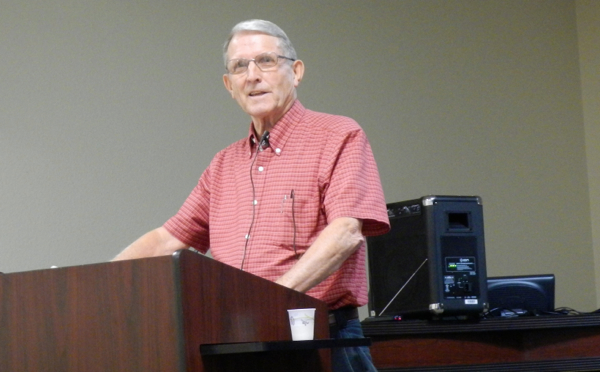
Gene Abshier talks transportation Aug. 12. Photo/Kathryn Reed

Gene Abshier talks transportation. Photo/Kathryn Reed

By Kathryn Reed

If money weren’t an issue, there would likely be a bridge over Emerald Bay today.

Caltrans spent decades studying the idea. It started with the desire by people to have an all-weather route on the West Shore. This is because for about 3½ months a year Highway 89 was closed because of snow.

It was in 1913 that a road was built on that side of the lake. It was 22 miles. At that time it took two days to drive from South Lake Tahoe to Tahoe City, according to Gene Abshier, an engineer in the Marysville Caltrans office for 36 years. Today he is a resident of South Lake Tahoe. Last week he gave a talk about the history of roads in Lake Tahoe.

Improvements to the roads continued until World War II when funding for these types of projects ceased.

It was after the war that California created the freeway and expressway systems. The state was divided in half, with the northern end getting 40 percent of the funding. A caveat was that Caltrans had to spend a minimum of $4 million in each county each year.

This is how in 1965 Highway 50 was widened from 22-foot lanes to 40 foot from Lake Tahoe Airport to 15th Street. It took about seven months to construct.

The 1955 Christmas Eve rockslide closed Highway 89 until the following November. That scar on the mountainside remains today.

In 1956 engineers came up with the idea of a suspension bridge more than 1,800 feet long as well as snow sheds more than 2,000 feet long that would go under the slide.

Each year that passed more alternatives were created until 28 were on the table. Seven included crossing Emerald Bay, snow sheds, viaducts, and three alignments through D.L. Bliss State Park were some of the ideas. Land owners, residents and others were nowhere near agreement on what the best route would be.

Abshier told his boss there was no way they could send Sacramento that many choices. He still has a copy of the report – which was whittled down to eight alternatives – that went to higher ups. It’s more than an inch thick. This was pre-computers. Engineers wrote things and those in the typing pool took over from there.

“It was the thickest and most complex report out of our office,” Abshier said. This was 1969.

With the importance of the document and the level of interest in it, extra copies were ordered – 200 total.

Abshier said 160 ended up in storage. Most of those were sent to a landfill.

There was no money for such an ambitious project. Times were also changing as people started to care more about the environment.


Drought not slowing California development

By Adam Nagourney, New York Times

FOLSOM — Evert W. Palmer has a vision for this city famous for its state prison: 10,200 new homes spread across the rolling hills to the south, bringing in a flood of new jobs, new business and 25,000 more people.

Yes, Palmer, the city manager, is well aware that Folsom Lake, the sole source of water for this Gold Rush outpost near Sacramento, is close to historically low levels, and stands as one of the most disturbing symbols of the four-year drought that has gripped this state. And that Folsom is under orders to reduce its water consumption by 32 percent as part of mandatory statewide urban cutbacks.

But Palmer, like other officials who approved the ambitious plan to expand this city, said he was confident that there was enough water to allow Folsom’s population to grow to nearly 100,000 by 2036. It would be economic folly, he said, to run things any other way.

The drought that has overrun California — forcing severe cutbacks in water for farms, homeowners and businesses — has run up against a welcome economic resurgence that is sweeping across much of the state after a particularly brutal downturn. It is forcing communities to balance a robust demand for new housing with concerns that the drought is not cyclical but rather the start of permanent, more arid conditions caused by global warming.

Read the whole story


Climate change could bring twice as many big El Niños

By Sammy Roth, Desert Sun

Scientists have long wondered whether rising global temperatures will lead to an increase in intense El Niño events, like the one that could bring major storms to Southern California this winter. According to a groundbreaking study published Monday, the answer is a resounding, “Yes.”

If human beings don’t slow their emission of planet-warming greenhouse gases, extreme El Niños could nearly double in frequency — from once every 28 years to once every 16 years on average, the new study found. That could spell trouble for California, which experienced mudslides, flooding and $500 million in damage during an intense El Niño in the late 1990s.

The idea that global warming will lead to stronger El Niños makes perfect sense, said Bill Patzert, a NASA climatologist who was not involved in the study. That’s because El Niños are driven largely by warming water in the tropical Pacific Ocean, which will get especially hot as the world temperatures rise.

An increase in extreme El Niño events will probably be accompanied by an increase in extreme La Niña events, which lead to dry winters in California.

Read the whole story


S. Tahoe prefers punishment over prevention when it comes to dealing with animals in trash

By Kathryn Reed

Bear boxes won’t be mandatory in South Lake Tahoe any time soon.

Instead, the City Council members on Tuesday chose to continue to react to a problem instead of being proactive. The majority of the council believes mandating bear boxes punishes those who are not creating a problem.

The Waste Management Joint Powers Authority has been working for about a year to come up with regulations that would pertain to all three jurisdictions – the city, El Dorado County and Douglas County.

With the council not wanting bear boxes to be necessary with new residential construction or remodels, this conflicts with what El Dorado County already has on the books. At the last JPA meeting, Supervisor Sue Novasel made no indication the county would want to soften its rules.

“It comes down to the property owner, not the property,” Mayor Hal Cole said.

The boxes also count as coverage per the Tahoe Regional Planning Agency.

The JPA board meets in September with the goal of adopting an ordinance. In order for an item to be approved all three members must be in agreement.

“I’m OK with the bear-proof containers and not the box. I think they work just as well,” Councilman Austin Sass said.

John Marchini with South Tahoe Refuse said bears appear to be getting smarter and learning to open the twisty tops.

He also noted it’s not just bears that are getting into people’s garbage. Coyotes, raccoons and dogs are common, with crows doing a bang-up job in spreading litter.

Although STR has changed its protocols to not pick up trash before 7am, people are still leaving garbage out the night before. It’s put in plastic bags and topless cans that can easily become a buffet for wildlife. STR cleans up the mess on trash days. Crews have cameras and can document the situation so the offender is then notified.

Clean Tahoe, the nonprofit that deals with picking up after other people, is also out cleaning up debris.

The council agreed with the JPA’s recommendations for punishment – warning the first time, buy a bear-proof container or pay a fine for the second offense, install a bear box on the third offense.

“It gives us a hammer for repeat offenders,” City Councilwoman JoAnn Connor said. She represents the city on the JPA.

Sass said this protocol contradicts what the vacation rental ordinance says. There was no further discussion and no comment by the city attorney.

The council also likes the idea of mandating commercial entities – including multi-family dwellings – lock dumpsters at dusk or at the close of business.

The plan is also to have an educational component so people can better understand why human food and wildlife are not a good combination.

While the JPA had talked about a loan program for people to buy bear boxes, that idea has been tabled for now.

Who will be responsible for the enforcement – most likely STR; and who will send out citations – most likely individual jurisdictions – still need to be solidified.

—–

In other action:

·      The council agreed at the urging of Planning Commissioner Judy Brown to revisit the historic sign designation criteria so the Trout Farm sign might qualify. The sign is nearly 70-years-old.

·      The city will be sending letters next week to all property owners advising them of the vacation home rental ordinance that takes effect Oct. 1. The letter will also include comprehensive information about how to “leave no impact”.
SLTPD K9 program benefits from donation

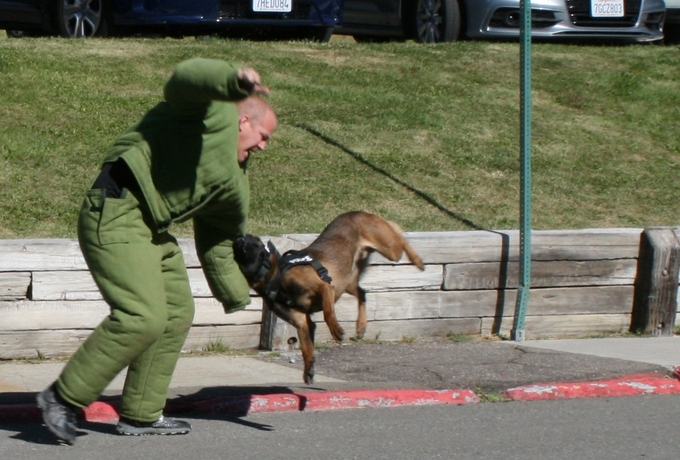
Officer Scott Crevelli and Rici are the newest K9 on the South Lake Tahoe Police Department. Photo/Provided

Officer Scott Crevelli and Rici are partners on the South Lake Tahoe Police Department. Photo/Tracy Franklin

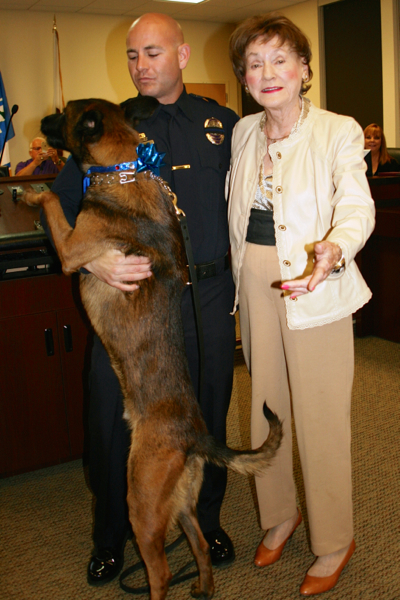
Lisa Maloff paid for Rici, SLTPD's newes dog, along with Officer Scott Crevelli to be trained as his handler. Photo/Tracy Franklin

Lisa Maloff paid for Rici, SLTPD’s newest dog, along with Officer Scott Crevelli to be trained as his handler. Photo/Tracy Franklin

Lisa Maloff knows what it is like to have a police K9 stop a suspect in his tracks.

The South Lake Tahoe resident on Tuesday talked about her experience with a would-be robber who was apprehended with the help of a police dog. She was at the Aug. 18 City Council meeting to be recognized for the contribution she made to the local police department.

Her donation paid for Ricci, a 22-month-old Belgian Malinois, to join the department. The contribution also covers the cost of the dog’s training, a new K9 vehicle, veterinary bills, food, maintenance and continued K9 handler training for a year. Officer Scott Crevelli is Ricci’s handler.

“The K9 program saves lives. I’m so glad our program is healthy,” Mayor Hal Cole said.

Maloff was able see how her money was spent during a demonstration at the airport. Officers set up a scenario where the police dogs had to find a “suspect”.

Also at the meeting, Maloff presented the South Lake Tahoe Police Canine Association with a check for $25,000 to buy a bulletproof vest and jacket for Ricci.

— Lake Tahoe News staff report


Drought sets up ’emergency situation’ for Calif. trees

By Lisa M. Krieger, San Jose Mercury News 

The rush to save water is claiming legions of unintended casualties — California’s trees.

Specimens that have stood tall and strong for decades are stressed and dying because of the drought, as Californians turn off spigots to comply with Gov. Jerry Brown’s mandatory conservation measures.

All over the state — in yards, on median strips and along freeways — ghostly sheaves of brown leaves will be an enduring symbol of the drought, long after winter rains resume. Their loss will reduce habitat, shade and property values, experts say.

So many trees are dying in the fourth year of this historic drought that some cities have begun delivering truckloads of water in an effort to save them.

Read the whole story


10,000 acres in Sierra Nevada protected

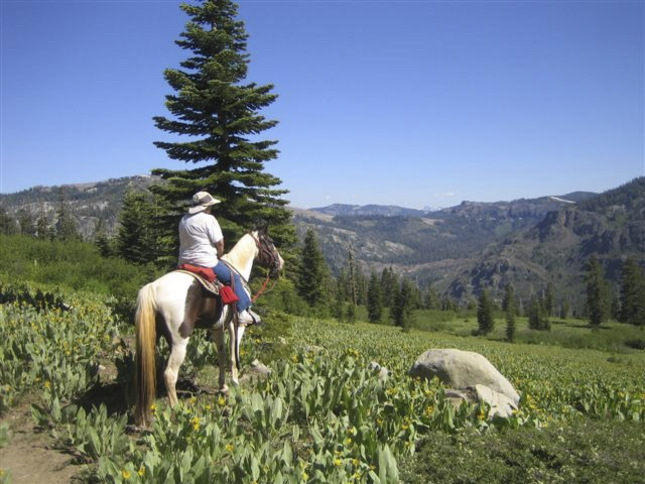
An equestrian rides near Lyons Ridge on the property purchased in the Sierra Nevada by the Northern Sierra Partnership founded by Silicon Valley leaders Jim and Becky Morgan, along with the American River Conservancy and Nature Conservancy.  (American River Conservancy)

Lyons Ridge was purchased by the Northern Sierra Partnership, American River Conservancy and Nature Conservancy. Photo/American River Conservancy

By Paul Rogers, San Jose Mercury News

More than 10,000 acres of scenic meadows, forests and trout streams in the Sierra Nevada 10 miles west of Lake Tahoe have been preserved in a deal in which environmentalists hope to prove that thinning out overgrown forests can increase California’s water supply.

The Northern Sierra Partnership, an environmental group based in Palo Alto and founded by longtime Silicon Valley leaders Jim and Becky Morgan, joined with the Nature Conservancy and the American River Conservancy to buy the land for $10.1 million from Simorg West Forests, a timber company based in Atlanta.

The deal, which closed Aug. 5, preserves a landscape south of Interstate 80 in Placer County adjacent to Granite Chief Wilderness in the Tahoe National Forest. The land contains more than 20 miles of blue ribbon trout streams.

Read the whole story


EDC judge ousted from criminal bench

Dylan Sullivan, right, will join El Dorado County Superior Court Judge Suzanne Kingsbury. Photo/Wendy David

El Dorado County Superior Court Judge Suzanne Kingsbury, left, was at Dylan Sullivan’s election party last year. Photo/Provided

By Kathryn Reed

El Dorado County Superior Court Judge Dylan Sullivan has been removed from all criminal cases and instead will hear civil issues.

The reason for this change has not been disclosed.

Presiding Judge Suzanne Kingsbury, who makes the assignments, deferred comment to the El Dorado County District Attorney’s Office. She would not explain why.

“The legal system is designed so both the District Attorneys Office as well as the Public Defenders Office is offered the opportunity when appropriate to exercise the legal authority to exclude a Superior Court judge from a case. At this time the District Attorneys Office has chosen to utilize this legal right,” Deputy District Attorney David Stevenson told Lake Tahoe News.

The DA’s Office has filed a number of preemptory challenges against Sullivan. However, the reasons are not being disclosed. The DA’s office said Sullivan would be challenged on a case-by-case situation.

These types of challenges are not routine, but neither are they rare, according to legal officials. They must be made in a timely manner and can only be filed once per case.

Filing such a challenge is equivalent to saying one does not believe the judge will be able to handle the case, perhaps for ethical reasons. The attorney doing the challenge does not have to prove bias. While California is not alone in allowing this type of procedure, it is not the norm in most states.

The judge has no recourse and essentially does not get her day in court to prove she is or is not biased or that she is being wrongfully persecuted in a reverse case of bias.

People close to the issue told Lake Tahoe News things came to a head last week with Kingsbury clearing Sullivan’s court calendar starting on Aug. 10. By the end of the week Sullivan was told to go home. This week she has been seen following Judge Nelson Brooks who handles probate, an area of law Sullivan isn’t familiar with. Reports are the two judges will be swapping departments.

Even so, this will not eliminate Sullivan from interacting with deputy district attorneys. They are involved in delinquency and other cases in that department.

“There are judicial ethics that make it difficult for me to comment,” Sullivan told Lake Tahoe News. She would not say anything more.

The normal process if someone has an issue with a judge is to file a complaint with the Commission of Judicial Performance.

“We can’t talk about specific cases. We can’t say who is under investigation,” Victoria Henley, director and chief counsel for the commission, told Lake Tahoe News.

If a challenge for cause were filed, that is when the challenger has to prove bias or misconduct by the judge.

Sullivan, 49, was elected to the job in June 2014. She filled the vacancy of retiring Judge Daniel Proud. She was to begin the job in January, but instead Gov. Jerry Brown appointed her to the seat early. Kingsbury swore her in Sept. 19, 2014.

At that time Kingsbury said she assigned Sullivan to Department 7, the criminal pre-trial department in Placerville, to handle misdemeanor arraignments, hear preliminary matters, traffic issues, and drug court because of Sullivan’s training and experience.


Options for disabled adventurers on rise in Calif.


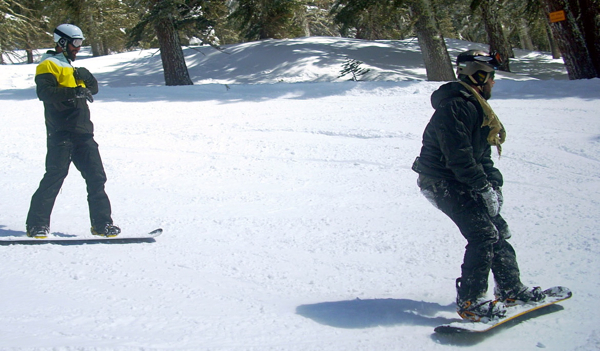
Adaptive Action Sports snowboard coach Chris Koeppe gives Gary Nolte a few pointers as they head down the run. Photo/LTN file

Adaptive Action Sports snowboard coach Chris Koeppe gives Gary Nolte a few pointers as they head down the run. Photo/LTN file

By Ben Egel and Brenna Lyles, Sacramento Bee

Like most state recreation areas, Nevada County’s South Yuba River Park has plenty of trails to hike on. Unlike most others, though, it also has a path to roll on.

About half of the gently sloped, 2.5-mile Independence Trail on the west side of Highway 49 has been renovated for wheelchairs, part of a statewide move to open up rivers, parks and other outdoor spaces to easier use by people with disabilities.

The accessibility push is also being taken on by private travel outfits who have designed packages for the disabled.

In its 37 years of operation, Sacramento whitewater rafting outfitter W.E.T. River Trips has accommodated people with visual and auditory impairments, as well as those with physical and intellectual disabilities. Other local organizations let disabled adventure-seekers try their hand at rock climbing, rope courses, boating, water-skiing and four-wheel off-roading in the warmer months, as well as skiing and snowboarding in the winter.

In the settlement to the 2005 lawsuit Tucker v. State of California Department of Parks & Recreation, the state promised to improve parks access, including creating wheelchair-accessible trails, signs for the blind and captioned educational videos for those with hearing impairments.

Read the whole story