Reeling in the fun — and Kokanee — on Lake Tahoe

Capt. Andrew Lubrano, center, shows Mike Zamarripa and Logan Daniels of Reno the basics of fishing for Kokanee salmon at Lake Tahoe. Photos/Kathryn Reed

Capt. Andrew Lubrano, center, shows Mike Zamarripa and Logan Daniels of Reno the basics of fishing Kokanee salmon. Photos/Kathryn Reed

By Kathryn Reed

CAVE ROCK – “He just gave us the fin and swam away.”

That’s Capt. Andrew Lubrano’s way of saying the fish won that round, time to put some new bait on the hook and cast the line out again.

There was a lot of that going on last Sunday. There were also two happy fishermen who went home to Reno with nine Kokanee salmon. Five per person is the limit.

Trolling near the Cascade area of the South Shore, other boats are doing the same thing. They are all close to the mouth of Taylor Creek, where these salmon will soon make their way upstream to spawn. They will have changed color from blue-green to fiery red, and their jaws will change to be more protruding. One of the fish caught last weekend was already was starting to have its jaw transform.

Now is the time to catch these salmon that call Lake Tahoe home. Normally they are biting between July and the end of September, though they started to do so later this summer.

Lubrano operates Nor-Cal Charters; with three boats in his fleet. The 22-year-old has been fishing on Lake Tahoe since he was 5. He got his captain’s license at age 18 and started the business a year later. Today he is getting his master’s in education administration from Sierra Nevada College, with the goal of being a fishing captain on a seasonal basis.

Once October rolls around it will mostly be mackinaw at the other end of the line. Rainbow and brown trout start biting as it gets cooler. Lake Tahoe is one of the few places where fishing is allowed year-round.

The day starts early for fishing charters at Lake Tahoe.

The day starts early for fishing charters at Lake Tahoe.

Changing the ecosystem

Lubrano said he and other captains believe the drought is contributing to a less robust fishing season because fewer nutrients were carried into the lake with the decreased runoff.

Kokanee aren’t native to Tahoe.

“Kokanee were ‘accidentally’ introduced into Lake Tahoe in 1944 from holding ponds that overflowed at the old Tahoe City Fish Hatchery. Three years after their accidental introduction, the salmon returned to Tahoe City to spawn,” Lisa Herron with the U.S. Forest Service told Lake Tahoe News. “Knowing that the Kokanee would survive in Lake Tahoe, it was decided that the hatchery would do a yearly planting of fingerlings in the tributary streams. These plantings began in 1949. Today, California Department of Fish and Wildlife continues to plant fingerlings in Taylor Creek to maintain a healthy population.”

Between 1963 and 1965, California and Nevada officials introduced mysid shrimp to Tahoe with the belief this would be a food source for the Kokanee and in turn would be a boon to the sport fishing industry. Instead, messing with the ecosystem had the opposite affect.

“This freshwater shrimp has been known to prey on other zooplankton; however, due to the limited food sources in Lake Tahoe, this large omnivorous shrimp increased predation on native zooplankton and led to the near-extinction of the zooplankter Daphnia, an important prey species for Kokanee,” according to the Tahoe Environmental Research Center. “Ironically the introduction of mysis did not only fail as a food source, it also significantly reduced and important natural prey species. This highlights the need for a science-based component when conducting ecosystem management.”

Logan Daniels and Mike Zamarripa show off their catch.

Logan Daniels and Mike Zamarripa show off their catch.

Reeling in the fun

Rods dot the back of the vessel. Eyes are on the lines that have disappeared about 250 down in water that is about 400-feet deep. Lubrano points to one and has either Mike Zamarripa or Logan Daniels reel it in.

“Keep steady pressure. If it pulls hard, slow down, but never stop,” Lubrano says as the men reel in what they hope is a fish at the end.

Lubrano tells the fishermen not to pull on the line because with the Kokanee having such soft lips it will just rip them.

Corn is used as bait – and just one kernel.

“More corn doesn’t mean more fish. If it did, we would use the whole cob,” Lubrano says.

Zamarripa is the last to land a fish, but then comes on strong. It was his line, though, that got the most bites.

Fishing is all about the peacefulness for him. On this particular day there was plenty of that.

The three men talk about different fishing shows. There’s camaraderie among those who fish – even if they’ve just met.

Kokanee salmon are likely to be biting through September.

Kokanee salmon are likely to be biting through September.

Life on the lake

Leaving Cave Rock about 6am it was chilly and the sun was not up. This is one of the few boat ramps at Tahoe that is able to accommodate the cadre of fishing boats because of the lake level. They are lined up waiting for the ranger to unlock the gate.

Soon the ball of yellow came over the mountains and illuminated the lake like a spotlight. Smoke from the fires burning throughout Northern California made it so it was hard to see land at all ends of the lake.

By 8:30am five Kokanee were in the bucket.

And by this time the world beyond fishermen started to come to life on the lake – water skiers, paddleboarders and kayakers.

Still, the peacefulness ensued and the lines continued to be dropped and reeled in until it was time to let the fish swim in their own serenity without a hook in the water.


N.J. court ruling may not stop spread of sports betting

By J.D. Morris, Las Vegas Sun

Efforts to open legal sports books outside Nevada suffered a major setback Tuesday when a federal appeals court denied New Jersey’s attempt to bring betting on athletics to its casinos and racetracks.

Still, the possibility remains that sports books will eventually spread to other states — just on a longer timeline than if New Jersey had been victorious this week.

The 3rd U.S. Circuit Court of Appeals held that New Jersey violated the Professional and Amateur Sports Protection Act in its latest stab at allowing sports books within its borders. The law restricts sports betting to a handful of states, and although limited forms of wagering are allowed elsewhere, Nevada is the only one where patrons can bet on individual games.

Read the whole story


Report: Calif. drivers are the nation’s most stressed

By Gary Richards, San Jose Mercury News

California’s improved economy has brought commutes to an unprecedented slowdown from one end of the state to the other, making drivers here the most stressed out in the nation.

A nationwide report released late Tuesday found that motorists in California’s congested population centers spend nearly two work weeks a year stuck in creep-and-crawl traffic — nearly double the national average.

According to the Texas A&M Transportation Institute and a West Coast traffic organization called Inrix, which surveyed traffic on 471 urban streets and highways across the country, an estimated $160 billion is lost annually in wasted fuel, lost income and lost time across the country while motorists cling to a steering wheel instead of a computer mouse.

The worst area is Washington, D.C., at 82 hours of lost time, but the top 10 is a roadmap from Northern California to Southern California: Los Angeles comes in No. 2 with 80 hours of delays, followed by San Francisco-Oakland with 78, New York at 74 and the San Jose area at 67. Riverside rounds out the top 10 at 59. Compare that to the national average of a measly 42 hours.

Read the whole story


Hues of autumn showing up prematurely

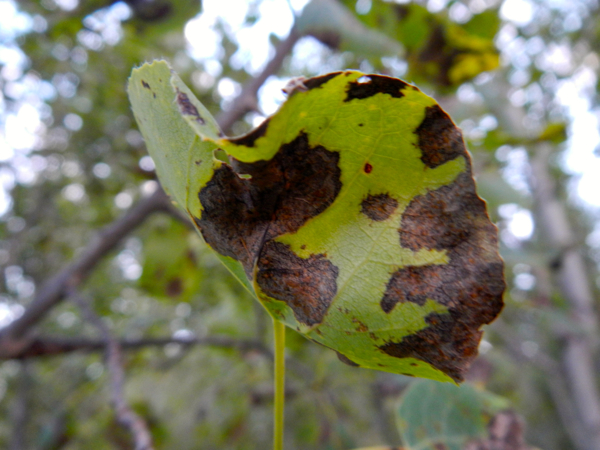
Aspen leaves at Taylor Creek on the South Shore are showing signs of stress from lack of water. Photo/Kathryn Reed

Aspen leaves at Taylor Creek on the South Shore are showing signs of stress from lack of water. Photos/Kathryn Reed

By Susan Wood

If a leaf or a cone falls in the forest, will anyone see the symptoms of change?

That’s the question botanists, foresters, climatologists and arborists may be asking in the age of an unprecedented Western drought.

Come fall, aspens represent the most recognizable tree that changes color in the Sierra Nevada. But from Rabe Meadow to Taylor Creek and Hope Valley to the Carson region, they appear stressed.

It’s August, and many leaves have either fallen to the ground, already prematurely turned yellow, started drooping or have been reduced to a crispy brown in some places.

“We’ve noticed in dry years they start to change color earlier than usual. They’ll run their course a little faster if they don’t get the moisture,” said Kelly Redmond, Western Regional Climate Center climatologist based in Reno, told Lake Tahoe News.

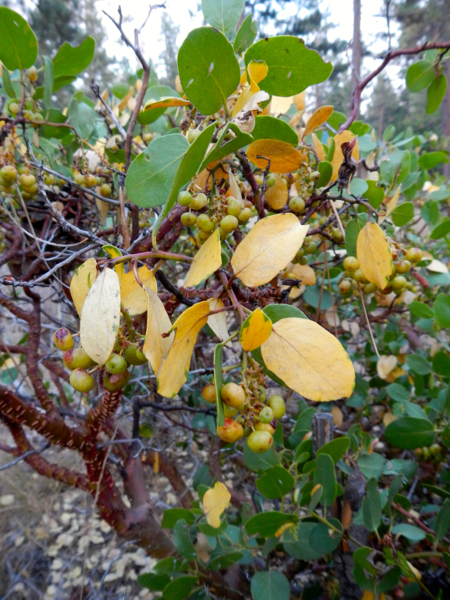
Manzanita bushes are turning yellow.

Manzanita bushes are turning yellow.

Redmond said there are two issues he looks at – timing and color. He’s also noticed this year the shades of colors are dimmer. Although Redmond is a regional El Nino expert, he doesn’t associate the trees trending differently with the weather phenomenon. He does point to drought, but believes more needs to be analyzed to clearly understand “phenology” – the study of plant life cycles and how they’re influenced by seasonal variations of climate.

“The whole business of what makes leaves change is not well established in the climate world,” he said.

Agreeing to some extent is Courtney Rowe, the Lake Tahoe Basin Management Unit forest botanist. She’s seen enough to assume that the aspens as well as our Jeffrey, sugar and lodgepole pines in addition to the white and red firs are in survival of the fittest mode. The willows change early anyway and haven’t deviated from that trend this year.

The aspens will drop leaves that consume too much energy to maintain with a lack of precipitation in the hopes of a better year ahead. Pine trees will unload the cones and needles because they become a pricey commodity.

“The lack of water is a cue to make the decision to get rid of leaves and wait for next year,” Rowe said of the environmental trigger. Dumping the leaves helps to reduce water use and stay alive.

It appears scientists aren’t the only ones noticing the change in the change of seasons.

Lindsay Gusses, who runs the LTBMU visitor center at Taylor Creek for the U.S. Forest Service, said visitors are often asking what is going on with the leaves in the groves characteristic of the South Shore region off Highway 89.

“Now with four years of drought we’re seeing it more and seeing it sooner,” Gusses said.

According to the U.S. Forest Service, 12.5 million trees have died off in California.

The fear is if the drought continues, the trees may produce fewer leaves or seeds, or worse yet, tree mortality could be more prevalent – whether it’s through the seedling dying or the tree itself taking a direct hit. And weaker trees tend to welcome more pathogens like the mountain pine beetle to invade.

The eco genetics of the trees weave their way into interpretive talks at Taylor Creek that Gusses hosts on the Rainbow Trail three times a week. Even children ask about the current conditions and the effects, Gusses said.

“They get curious,” she added.

And the trend travels away from Lake Tahoe.

Sorensen’s Resort in Hope Valley has built a business on mass visitation in the fall to view the leaves changing. Its customer base has already been asking questions about the tree’s abnormal behavior this summer, while noticing the wilted, fallen leaves.

“They seem a little more stressed this year. I think the whole forest is stressed,” Sorensen’s co-owner Patty Brissenden said, putting the whole West Coast into the eco equation.


Calif. seeks to rein in medical pot industry

By Lisa Leff, AP

SAN FRANCISCO — The likelihood that California voters will be asked to legalize recreational marijuana next year is prompting lawmakers to make a serious run at reining in the state’s vast medical marijuana industry — a job they have deferred for nearly two decades.

A pair of bills pending in the California Legislature would create the first statewide regulations for medical marijuana growers, manufacturers of pot-infused products, and distributors such as storefront dispensaries and delivery services.

California authorized marijuana use for health purposes with a 1996 ballot measure that allows doctors to recommend the drug for any ailment, deliberately leaving the specifics for how it should be produced and sold for another day.

With advocates now working to qualify recreational-use initiatives for the November 2016 ballot, that day finally may have arrived.

The state Assembly last month approved a comprehensive licensing and oversight scheme on a bipartisan 62-8 vote. A compromise measure to create the Governor’s Office of Medical Cannabis Regulation, AB 266, is endorsed by both the California Cannabis Industry Association and the California Police Chiefs Association.

“The legalization discussion has definitely changed the tone of the conversation,” said Natasha Minsker, who directs the ACLU of California’s advocacy office in Sacramento. “There is real potential a legalization initiative will set the tone for regulation and taxation, and if the Legislature wants to be involved, now is the time.”

The eleventh-hour effort offers a preview of issues that are likely to surface during a legalization campaign, from concerns over water use and drugged driving to questions around consumer protections and who will be allowed to apply for business licenses.

The bill by Assemblyman Rob Bonta, D-Oakland, requires numerous state agencies to flesh out and enforce a regulatory framework by 2018.

The California Highway Patrol would develop a way to determine when someone is too high to drive, while the Department of Public Health would come up with rules for testing pot products for potency and toxic chemicals and set limits on when individuals with felony convictions or newly arrived in California would be eligible for a license to grow, process, transport or sell medical marijuana.

The bill also would create training standards and labor rights for industry workers — a nod to unions — and preserve the right of local governments to ban cannabis businesses, which is key to maintaining support from the League of California Cities and police chiefs.

“This is something that is greatly needed and long overdue,” said Chula Vista Police Chief David Bejarano, the police association’s president. “We are aware there will be an initiative on the ballot and if it is approved, we will have a good foundation, something to prevent some of the issues we have had with medical marijuana.”

Gov. Jerry Brown, a Democrat who has expressed skepticism about the wisdom of legalizing recreational marijuana use, has not indicated if he would sign the medical marijuana legislation if it reaches his desk.

Sen. Mike McGuire, a first-term Democrat whose 370-mile long coastal district encompasses Northern California’s prime pot-growing regions, blames the Legislature’s years of inaction on continuing skepticism over marijuana’s medical value, law enforcement resistance and industry doubts.

Noting there is no guarantee that California voters will go for full legalization, McGuire introduced his own medical marijuana bill. SB643 would establish an office within the state Business, Consumer Affairs and Housing Agency to license medical marijuana businesses and to develop regulations for how they should operate.

It would also require the California Medical Board to crack down on doctors who issue medical marijuana recommendations without a proper patient exam or valid medical reason for doing so.

“My beef is this: California’s approach to medical marijuana regulation has been impotent and when you allow an industry to grow unregulated for as long as we have with cannabis, we are going to pay the price,” McGuire said. “We are inundated with the impacts of this multi-billion dollar industry and we cannot sacrifice our communities, the environment and patient safety any longer.”


Nevada to buy up to 2.5 mil. rounds of ammo

By Kyle Roerink, Las Vegas Sun

Nevada negotiated an option to buy up to 2.5 million rounds of ammunition for state agencies over the next two years, according to documents and interviews with the Nevada Purchasing Division.

State officials made 55 separate requests for ammunition for 9mm pistols, 12-gauge shotguns, semi-automatic rifles and other firearms as part of a solicitation to vendors across the country, according to bidding documents received by sporting good wholesalers.

Officials described the deal as routine, a way to secure cheap rounds for highway patrol, parole and probation, emergency management, wildlife and other state departments. Several counties, including White Pine and Esmeralda, also took part in the bid, purchasing officials said.

Read the whole story


Brown seeks joint effort to fix roads

By Rachel Swan and John Wildermuth, San Francisco Chronicle

Filling car-shaking potholes and repairing crumbling highways and bridges shouldn’t be a partisan issue, Gov. Jerry Brown said.

Joined by Assembly Speaker Toni Atkins, D-San Diego, Brown used a news conference last week at the Port of Oakland to urge the Legislature’s Republicans and Democrats to work together in a special session he called to find a long-term answer to California’s continuing lack of cash for highway and infrastructure repairs.

California’s current gas tax, which hasn’t been raised since 1994, brings in $2.3 billion a year for repair work, billions short of what state officials say is needed. Compounded over the years, that’s left tens of billions of dollars in deferred maintenance, Brown said.

The gap is only going to get worse. As fuel efficiency increases and more electric and hybrid cars hit the road, gas sales will drop and tax revenue will fall with them.

Read the whole story


Electeds differ on what Tahoe needs

Sens. Dean Heller and Dianne Feinstein show bipartisan and bistate support the Lake Tahoe Restoration Act. Photos/Kathryn Reed

Sens. Dean Heller and Dianne Feinstein show bipartisan and bistate support for the Lake Tahoe Restoration Act. Photos/Kathryn Reed

By Kathryn Reed

ROUND HILL – Lake Tahoe’s congressional delegation wants the feds to spend more money in the basin. But they are divided on how much and where to spend it.

Money, forest health, lake clarity and transportation were the key subjects during the 19th annual Lake Tahoe Environmental Summit at Round Hill Pines on Aug. 24.

Sen. Dean Heller, R-Nev., is seeking $450 million in his Lake Tahoe Restoration Act reauthorization bill, while Rep. Tom McClintock, R-Elk Grove, is asking for $60 million in his bill.

Both include money for forest thinning and aquatic invasive species. The more expensive one will include transportation funds, cash for oversight and spending on other Tahoe environmental programs.

Since the inaugural summit in 1997, $1.8 billion in public and private money has been spent on environmental improvement projects in the basin. The initial push was on lake clarity. In the intervening years what does and could affect the lake’s clarity has changed and grown.

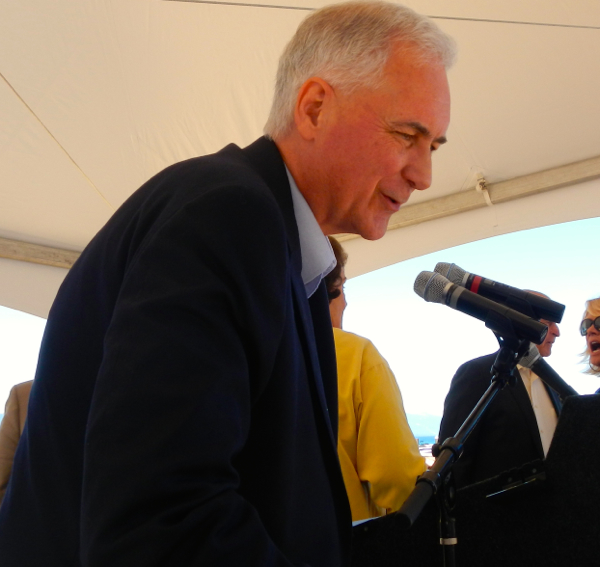
Rep. Tom McClintock, who represents the California side of the basin in the House, has introduced a scaled down bill to help Tahoe.

Rep. Tom McClintock, who represents the California side of the basin in the House, has introduced a scaled down bill to help Tahoe.

The other component that has been added is economic. With a healthy forest and a water body that allows people to see more than 70 feet down, it attracts tourists. Without these components, in some ways the basin becomes just another tree filled area with a potentially brown lake.

Gov. Jerry Brown pointed out that with California and Nevada’s populations expected to grow substantially in the coming years that it is impossible to stick with the status quo when it comes to solving problems.

“We are going to have to engineer at a higher level,” Brown told the more than 300 people in attendance. “We have to fight fires smarter and take care of the forests. We need to de-carbonize.”

McClintock warned, “The greatest environmental threat to Tahoe is a forest fire. The Rim Fire (two years ago near Yosemite) was 80 times larger than Angora.”

He believes since Congress has not approved the larger LT Restoration Act since 2009 that it is time to try a smaller formula and get the critical needs addressed. There are agencies in the basin that concur with this approach.


EDC school superintendent admits to DUI

By Kathryn Reed

Jeremy Meyers, El Dorado County superintendent of schools, was booked at the El Dorado County jail in Placerville on Aug. 22 on driving under the influence charges stemming from an incident in June. This was a condition of having pleaded no contest to the charges, which is the same as a guilty plea when it comes to sentencing.

He admitted that on June 9 he was driving under the influence with a blood alcohol level of more than 0.08 percent.

Jeremy Meyers

Jeremy Meyers

Although the booking statement from the weekend says there were drug charges, the criminal complaint from the district attorney does not. The latter is what ultimately matters and is what the court used for the sentencing guidelines.

The court process has been completed. All that remains is for Meyers to go through a first time DUI offenders’ course, which can take up to 18 weeks. He will also be on probation for four years.

“He was sentenced to five days in jail. That was probably because of the blood alcohol. He was treated no different than anyone else,” David Stevenson with the El Dorado County District Attorney’s Office told Lake Tahoe News.

He was, however, allowed on the night of the infraction to be released into the custody of his wife and friend instead of being taken to jail. The California Highway Patrol cited him that night when they pulled him over on Highway 49.

“I sincerely apologize for this personal mistake. I have already accepted responsibility and am personally dealing with my error in judgment. Most importantly, I want everyone to know that this will not interfere with the great work of EDCOE in continuing to provide quality education for all of the children and families in our county,” Meyers, 44, said in a prepared statement issued by his attorney.

Paul Zappettini, Meyers’ attorney, told Lake Tahoe News alternative sentencing allowed Meyers not to have to spend a night in jail.

“The El Dorado County Office of Education is aware that county Superintendent Jeremy Meyers was cited for driving under the influence. He is dealing with this matter on a personal basis. EDCOE will continue to focus on delivering quality service and support to the community,” Dina Gentry, spokeswoman for the office of ed, told Lake Tahoe News.

Meyers was first appointed by the school board to the position effective July 1, 2013. He was taking over for Vicki Barber who retired. At the time Meyers was the deputy superintendent. In June 2014 he ran unopposed for a four-year term.


Bentley delivers memorable performance

Dierks Bentley puts on a rousing performance Aug. 23 at Harveys. Photos/Kathryn Reed

Dierks Bentley puts on a rousing performance Aug. 23 at Harveys. Photos/Kathryn Reed

By Kathryn Reed

STATELINE – Dressed in his signature tight T-shirt with biceps bulging as he stroked the guitar, there is no doubt why People magazine earlier this year named Dierks Bentley country’s hottest guy.

However, Kip Moore, the third opening act, might have a good chance to usurp that title from Bentley.

For those who weren’t admiring Bentley’s physique, there was plenty to applaud about his music in the 15-set plus, two encore show at Harveys on Aug. 23. It was a mix of soulful and playful lyrics.

Bentley’s music has garnered him 12 Grammy nominations.

Life hasn’t always been so great for Dierks Bentley. This is obvious from the lyrics on his latest album “Riser” that was released in 2014. It’s a bit introspective, a bit spiritual and definitely memorable.

The rough stretch, though, produced three No. 1 singles — “I Hold On”, “Drunk On A Plane” and “Say You Do.”

A few "pilots" were in the audience Sunday, including one who was invited on to the stage during "Drunk on a Plane".

A few “pilots” were in the audience Sunday, including one who was invited on to the stage during “Drunk on a Plane”.

Fans Sunday night at Harveys knew the lyrics as well as the country star. It was like a sing-along at times.

“Riser” – Bentleys seventh album – was released the year after his father died and his third child was born. “Riser” is a song about resilience and determination, and is where the album title comes from.

On his website, Bentely says, “Life in general has a way of knocking you down. It’s different reasons for different folks – could be personal reasons, could be family reasons, your job, drugs, alcohol. That song really applies to anybody that’s lived. There have always been those moments when we have to get back up and get on our feet. They are defining moments … breakthrough moments.”

On Sunday night – while he played “Riser” and “I Hold On” to the appreciative audience, it was obvious there was something more to the songs than just lyrics. You could feel the passion and sentiment Bentley has for the words he is singing.

Several times he mentioned how this was his first trip to the area – adding he wants to come back.

Before the star took to the stage Kip Moore, Maddie & Tae, and Canaan Smith warmed up the nearly full house. Bentley brought each of them on stage to sing with him.         

If Bentley’s singing career ends anytime soon he has a fallback plan. In July 2016 he will open his fourth Whiskey Row restaurant. This one will be in Las Vegas. They started in his home state of Arizona where there are eateries in Tempe and Scottsdale, there is also one in Chicago.