Sandoval to put 3-week trade mission to work

By Michelle Rindels, AP

CARSON CITY —  Gov. Brian Sandoval and more than 60 business, government and education officials recently returned from a three-week trade mission to England, Ireland, Germany, Poland and Italy. The visit included meetings with dignitaries, tours of car factories and receptions bringing together Nevada and European tourism officials.

As a result of their visit, state officials vow to put some things in place:

Exchange programs

Sandoval signed three separate agreements calling for worker exchange programs between Nevadan and German advanced manufacturing companies in Leipzig, the state of Saxony, and Saxony Anhelt. Steve Hill of the Governor’s Office of Economic Development said experienced workers from German companies would spend a year working in similar Nevada companies and vice versa.

The participating companies would pay workers a salary, but Nevada might pay for their airfare to and from Germany.

Hill said he hopes to kick off the program by the end of this year at companies such as aircraft parts manufacturers and companies in the medical industry. He estimates it will start with about five participants and grow over time to facilitate an exchange of best practices between companies in the two countries.

“We also think it would help create a stronger bond between Nevada and Germany over time,” Hill said. “If we were doing this on a fairly regular basis with a few handfuls of people, you’d have a communication and a cultural connection. You’d end up with 100 people who had lived in Germany for a year.”

Water management partnership

Managing scarce water resources was a key discussion topic during the trade mission, especially in Dublin, Ireland, which is home to IBM’s Smarter Cities initiative.

Hill said IBM and the Water Center for Excellence — a Nevada entity that connects the state’s water researchers with businesses that can use their expertise — are partnering to create an energy management service.

Water agencies are huge electricity consumers because they must use power to maintain pressure in their water lines and circulate the water to prevent stagnation. The partnership will explore more efficient ways to use energy, drawing on massive amounts of raw data about electricity use and water pressure collected by the Southern Nevada Water Authority.

Hill said the collaboration could lead to a commercial software and data analytics service that could help other water authorities optimize their electricity use.

If successful, the project could be lucrative for the water authority and bring royalties to the research institutions working on it. It’s unclear when the software might be ready for market, Hill said.

Better workforce development

Sandoval praised the workforce training initiatives he saw in Germany and among automakers there.

He said the trip inspired him to move Nevada state Superintendent Dale Erquiaga into a newly created job as the governor’s Chief Strategy Officer. Erquiaga’s role will be implementing legislation passed in the spring and ensuring that Nevada’s K-12 education programs and workforce development efforts align to meet the needs of companies moving to the state.

“For a governor to take a state superintendent of schools directly into the office, that should send a very strong message about how much K-12 education and workforce development … is a priority for me,” Sandoval said.

More Polish connections

Trade mission attendees say they were impressed by Poland, which has become aggressive in developing its economy since the fall of Communism.

“Their appreciation and enthusiasm for capitalism and entrepreneurism is contagious,” Hill said.

An agreement Sandoval signed clears the way for Poland to open a trade office at the University of Nevada, Reno’s Innovation Center. The partnership aims to help Polish businesses break into the American market and vice versa.

“They feel they have a lot of companies in Poland that would want to move here, but it’s hard for them to go in cold,” Hill said.

The Polish American Chamber of Commerce also announced it will move its annual conference to Las Vegas from Chicago.

Another trade mission to Poland is in the works. The Governor’s Office of Economic Development recently received a $300,000 grant from the U.S. Small Business Administration that will use to help business representatives visit Poland in May 2016. There will be a trip to China in March 2016.


S. Lake Tahoe creates recreation opportunities beyond what Mother Nature provides

Bijou Community Park is a continual work in progress with the focus on locals' recreation desires. Photos/Jessie Marchesseau

Bijou Park is a continual work in progress with the focus on locals’ recreation desires. Photos/Jessie Marchesseau

Publisher’s note: This is one in a series of stories Lake Tahoe News will be running leading up to the 50th anniversary of South Lake Tahoe on Nov. 30.

slt 50th logoBy Jessie Marchesseau

The mountains, forests and lake surrounding South Lake Tahoe serve as a playground, of sorts, for residents and visitors. However, it’s hard to hold swim lessons in a lake that sometimes has waves and often feels like ice water. Beaches are more convenient and enjoyable when they offer parking spaces, restrooms and a cold beverage. It’s easier, or at least more comfortable, to have a family picnic when there are picnic tables. And hoping it gets cold enough to freeze the water in the marina doesn’t make for a consistent ice rink.

So, while South Lake Tahoe may inherently offer a variety of outdoor activities, the natural environment is not an adequate substitute for traditional public parks and recreation facilities. During the last 50 years, the city of South Lake Tahoe has taken on the task of creating and maintaining public recreation opportunities the environment cannot.

The first city park was Regan Beach. Construction began in 1959 when it was dubbed Lakeshore Park, before South Lake Tahoe was even incorporated. The city acquired the park not long after its incorporation in 1965. Ever since, the city of South Lake Tahoe has made a continual effort to create and maintain public parks and recreation facilities.

After 50 years of planning and implementing, the current South Lake Tahoe parks and recreation facilities are as follows:
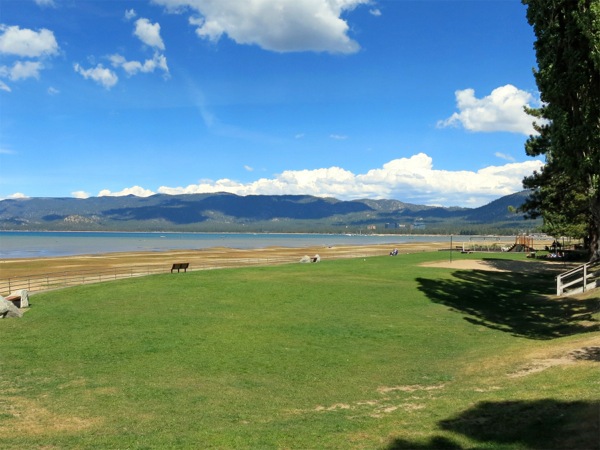
Regan Beach is due for another upgrade.

Regan Beach is due for another upgrade.

Regan Beach

Location: the intersection of Sacramento and Lakeview avenues

Size: 2.5 acres

Original construction date: 1959

Regan Beach is the city of South Lake Tahoe’s oldest beach facility, acquired by the city in the mid-1960s. A tot lot playground was added to the park in the summer of 1970. It was constructed almost entirely with donated hours and materials.

In the ’70s, lifeguards were regularly on duty during the summer months at Regan Beach, as well as many of the other beaches in town. The city, however, stopped hiring lifeguards after California’s Proposition 13 impacted public funds in 1978.

Later, in 1984, the city started the ball rolling on a six-year, $1.6 million renovation project at Regan Beach.

Three years later, the beach gained an additional 100 feet of lake frontage when the city spent $425,000 on an additional half acre of lakefront land. With water levels much higher than they are now, the retaining wall and lakeshore were badly eroded and in poor condition. Significant erosion control work was completed on the existing park and the newly acquired shoreline. The restoration project also included new walkways, stairways and fencing.

By 1989, the playground equipment was old and worn, so it was replaced, and a sand volleyball court was also added to the park.

Funding for this six-year project came from a number of sources: Lahontan Regional Water Quality Control Board provided almost $445,000; the city of South Lake Tahoe, nearly $200,000; California Tahoe Conservancy, $855,000; and $100,000 in state bond funds.

After that major project, not much happened at Regan Beach until a dog water park was added in 2009.

Now, the park is once again in line for a major remodel. The building that houses the bathrooms and concessions has a leaky roof and is in a state of serious disrepair, and the retaining wall is once again crumbling. What exactly is in store for Regan Beach has yet to be decided, but planning is in the works. City Manager Nancy Kerry hopes to have between $1.5 million and $2 million to dedicate to the project.

Park amenities:

  • Large grass area
  • Beach
  • Large parking lot
  • Observation deck
  • Food and drink concessions (Memorial Day through Labor Day)
  • Restroom
  • Playground
  • Sand volleyball court
  • Picnic tables
  • Dog water park.

Lakeview Commons has transformed recreation opportunities in South Lake Tahoe. Photos/Jessie Marchesseau

Lakeview Commons has transformed recreation opportunities in South Lake Tahoe.

El Dorado Beach-Lakeview Commons

Location: the corner of Highway 50 and Lakeview Avenue

Size: 2 acres

Original construction date: 1968

Unlike other parks, El Dorado Beach is not actually owned by the city of South Lake Tahoe. It is part of a 56-acre parcel owned by El Dorado County for which the city signed a 55-year lease in 1968. El Dorado Beach is only 2 of those acres, the remainder lies across the street where the campground, senior center, museum and county library are located.

The city has been almost continuously making small changes and improvements to El Dorado Beach since the lease was signed in 1968. But the first significant improvements started in 1974 when bathrooms were installed across Lakeview Avenue from the beach. The boat launch and tunnel were also proposed that year and then subsequently constructed in 1976 for $380,000, mostly funded by a grant.

Like Regan Beach, El Dorado Beach once had lifeguards on duty, but that practice was also abandoned in 1978.

In 1988, the city purchased a 2.2-acre parcel off of Harrison Avenue where an old motel stood. Over the course of the next 15 years, the building was razed, oil tank mitigated and the property restored to a state suitable to build a parking lot on. The project was funded with $1 million from the California Tahoe Conservancy.

In 1989, Frank’s at the Lake, a concession cart opened at the beach. After that, a concession cart or trailer was stationed at the beach each summer; though no permanent concession structure existed until the Lakeview Commons project was completed more than 20 years later.

The boat ramp was redone in 1991, thanks to $313,000 from the California Boating and Waterways Commission. The commission also agreed to nearly $450,000 in grant money for the construction of the parking lot across the street in 2002, the same year the city put in a new 200-foot retaining wall. The parking lot was completed in 2006.

But all of these improvement projects were minor in comparison to the Lakeview Commons project which broke ground in 2010. The $6 million project funded by the CTC took nearly a decade to get off the ground, then ran into a legal snag soon after construction began. The project was stalled for a short time, but resumed and, in all, took just less than two years to complete.

Finished in 2012, the Lakeview Commons project included extensive landscape and stone terracing, retaining walls, a ramp for beach accessibility, restrooms, improved walkways, general landscaping and an improved picnic area. This was the first portion of a much larger project to improve the entire leased 56 acres.

Amenities:

  • Bike trail
  • Two parking lots
  • Sandy beach
  • Food concession
  • Kayak and water toy concession
  • Boat ramp/launch
  • Floating dock (not currently in use due to low water)
  • Large picnic area, including tables and BBQs
  • Large grass area
  • Restroom
  • Swim area (non-boating).

The pool at the rec center is popular year-round.

The pool at the rec center is popular year-round.

South Lake Tahoe Recreation Complex

Location: 1176 and 1180 Rufus Allen Blvd.

Original construction date: 1975

In 1972, El Dorado County granted the city of South Lake Tahoe the title to 15.48 acres on which to build a recreation center. Plans for the center were drawn up and revealed to the public in 1973. By the summer of 1975, the people of South Lake Tahoe had a $1.8 million recreation and swim center.

The center consists of a 25-yard indoor pool with a retractable roof for the summer months, a weight room, locker rooms, a gymnasium-multipurpose room, kitchen, offices and various smaller multipurpose rooms.

An ice skating rink adjacent to the center was proposed that same year, but the proposal failed due to deed restrictions imposed by the county. At that time, the city was sponsoring a public ice rink in the Tahoe Keys Marina, but the existence and quality of ice was entirely dependent on weather. An ice rink near the rec center was later included in the parks and recreation master plan of 1977. However, it would be another 20 years before the area saw the likes of an actual ice skating rink, and 25 before South Lake Tahoe had an ice arena.

It was not until 1995 that the construction of an ice skating rink on the land adjacent to the recreation and swim center was finally approved. The city agreed to a 30-year lease with the Tahoe Ice Skating Association for the 1-acre parcel. A new outdoor rink was built and opened in January 1997. It closed in March of that year due to warm weather and did not reopen the following winter. The lease was revoked, and the rink sat idle and barricaded for years.

In 2001, construction began on the indoor ice arena. Doors opened in May 2002. The ice arena was remarkably successful, and the city ran it until they were forced to downsize in 2011. The arena was leased to outside operators and continues to thrive. In 2013, it became home to a Junior A hockey team, the Tahoe Blue.

The recreation and swim center has undergone various maintenance projects over the years: new fiberglass in the pool, new retractable roofs, energy upgrades such as lighting and heating systems, roof repairs, new weight room equipment, and more. A playground, sand volleyball court and basketball court were installed outside. However, in the 40 years since it was built, the center has not received any extensive renovations. The building is dilapidated and much of the equipment and amenities are sorely outdated. This is why the recreation and swim center has earned a spot on the city of South Lake Tahoe’s new parks and recreation master plan. No decisions have been made yet as to what will happen to the building, but discussions are under way.

Amenities:

  • Recreation and swim center
    • 25-yard indoor/outdoor year-round swimming pool
    • Locker rooms/shower facilities
    • Multipurpose gymnasium
    • Kitchen
    • Various meeting rooms
    • Crafts room
    • Weight room
  • Ice Arena
    • Indoor ice skating rink with bleachers
    • Food concessions and eating area
    • Ice skate rentals
    • Locker rooms
  • Outside facilities
    • Outside mini park/playground
    • Outdoor sand volleyball court
    • Outdoor basketball court
    • Picnic area.

Golf has been played in South Lake Tahoe for nearly a century.

Golf has been played in South Lake Tahoe for nearly a century.

Bijou Community Park and Golf Course

Location: Park – 1201 Al Tahoe Blvd.; Golf course – 3464 Fairway Ave.

Size: 153 acres

Original construction date: Park — 1992; Golf course — 1920

In 1982, the city of South Lake Tahoe purchased 153 acres from the Johnson family for $371,000. Most of the acreage was undeveloped meadow and forest land, but the 9-hole golf course on the property had been in use since 1920 when both the greens and the tees were made of sand, and the fairways were mowed with a horse-drawn mower.

Knowing they wanted a park aimed at residents more than tourists, the city began what would be nearly a decade of planning. In 1988, a sign was installed at the entrance of Bijou Park reading “the beginning of something wonderful in our community.” Park construction began in 1990, and when it officially opened in 1992, nearly 5,000 people showed up.

Bijou Park is a cornucopia of recreational activities. It seems facilities are continually being added at the request of the community. Most recently, a bike park has been under construction. The bicycle park, consisting of pump tracks, a BMX track, a terrain park and a kids’ learning facility will take up about 5 acres of the park. It will join a skateboard park originally built in 1996, and rebuilt in 2008. Next to that is the basketball court which was retrofitted to also be a roller derby rink.

Back in 1994, a park maintenance staff member proposed the idea of a disc golf course at the park. He was given permission to set one up on a trial basis. By 1995, 27 disc baskets made of plastic drums and old street sign poles had been installed. By 1998, each hole had an official tournament-approved basket. Disc golf is now one of Bijou Park’s most popular activities.

A 40,000-square-foot dog park, opened in 2008, now occupies a portion of land where an archery range once existed. The dog park was such a success, a separate dog agility course was installed in 2013.

It seems Bijou Park, more than any other city park, is a frequent the recipient of private donations of time, labor, money and materials. Citizens passionate about their recreational activities have been given opportunities at Bijou Community Park and stepped up to the challenge.

A great deal of fund raising has been conducted for Bijou Park projects. For years throughout the ’90s, a Bijou Community Park gift catalog circulated so people could easily purchase gifts for the park. This resulted in more than $200,000 in gifts. Soroptimist, Kiwanis and Rotary clubs donated money and built picnic shelters. Tens of thousands of dollars were collected in private donations. The local Lucky grocery store donated $8,500. While the city and state still contributed a combined amount of more than $1 million to the project, the amount of community involvement and generosity is impressive.

As for the golf course, a concessionaire ran it until 1990 when the city parks and recreation department took it over. It was still a fairly rudimentary course at that time. Over the next two years, they purchased maintenance equipment, installed a sprinkler system, planted grass, resurfaced greens with Astroturf and planted trees. The small course became more playable, more popular and profitable.

Amenities:

  • 9-hole golf course
  • 36-acre park
  • 27-hole disc golf course
  • Skateboard park
  • Sand volleyball courts
  • Basketball court/roller derby track
  • Fenced dog park
  • Dog agility course
  • Outdoor fitness course
  • Historic railroad exhibit
  • Restrooms
  • Concession facility (not always open)
  • Two covered gazebos with barbecue pits and picnic tables
  • Playground equipment
  • Bike park (currently under construction)
  • Open meadow land open to the public.

Linear Park parallels Highway 50; providing more than just a sidewalk.

Linear Park parallels Highway 50; providing more than just a sidewalk.

Linear Park

Location: along the north side of Highway 50 from Wildwood Avenue to Pioneer Trail

Size: half mile

Original construction date: 2000

More of a greenbelt than an actual park, Linear Park lies between Highway 50 and the Tahoe Meadows subdivision. In 1996, the city began talks with the property owners of Tahoe Meadows to create a mutually agreed upon plan that would both allow the city to create a bike path along that stretch of the highway and provide a buffer zone between the road and the private properties.

The land, which stretches from the Holiday Inn to McDonald’s, is 2,700 linear feet. The agreement required the city to build a Class 1 bike trail on the property, but also build a fence separating the park from the subdivision, install lighting and landscape the entire area.

Possibly the most notable feature of the park is the white statue of a Washoe woman. The statue, created by artist Arnold Aragon was installed on the property in 2000. The statue’s pedestal later began to crumble and was replaced by the now-defunct Core 24 Charities in 2005. The group also planted 1,000 daffodil bulbs around the new pedestal. A plaque was installed by the city explaining the meaning of the Washoe woman statue in 2009.

Even small parks require maintenance, and in 2013, Linear Park was completely redone, a project costing more than $500,000.

Amenities:

  • Bike trail.

Bonanza Park offers people near the Y a place to play.

Bonanza Park offers people near the Y a place to play.

Bonanza Park

Location: 1209 Bonanza Ave.

Size: 1 acre

Original construction date: 2012

South Lake Tahoe’s newest park, near the Y, was once a rundown hotel. Edgewood Companies, in an effort to acquire more tourist accommodation units for their Edgewood Lodge project, purchased the property and transformed it into a public park. The city was granted ownership of the park, and Edgewood Companies was granted the tourist accommodation units.

Amenities:

  • Large grass area
  • Walking path
  • Playground equipment
  • Half-court basketball
  • Horseshoe toss
  • Picnic tables

Building and maintaining parks in South Lake Tahoe is a non-stop process of planning, funding, building and planning some more. But the results of these efforts have provided the community with places to gather, places to play, places to learn and even more places from which to enjoy our beautiful surroundings here in South Lake Tahoe.


Dams may be answer to future droughts

By Carolyn Lochhead, San Francisco Chronicle

Driven by drought, California stands ready to build a water system for the 21st century. Ideas are flowing: conservation, recycling, desalination, aquifer recharge, floodplain restoration, storm water capture.

But the biggest, most expensive, most popular item of all is the foundation of the 20th century water system — dams. Even if El Niño rains bring a bounty of water to the state this winter, the momentum for dam building is unlikely to fade.

Farmers stand to benefit. So do many urban users. The losers would be people like Anita Lodge.

Lodge, 58, clings to the last remnant of a Gold Rush homestead deep in the San Joaquin River Gorge 33 miles north of Fresno, where her ancestors mined ore by wheelbarrow and her mother hung laundry on the willows. Now the 7-acre spread is surrounded by a federal preserve alive with bears and bobcats, herons and eagles, and in spring, a profusion of wildflowers.

Behind a bend downstream lies a linchpin of California’s water system: Friant Dam, snaring the river on its path from the Sierra foothills to Fresno and the San Joaquin Valley. Completed in 1942, Friant can hold 520,500 acre-feet of water for farmers and cities in the southern San Joaquin Valley. That’s almost twice what the 2.6 million customers of the Hetch Hetchy system used in a year, even before drought-prompted conservation measures kicked in.

Read the whole story


Crews use sensors, cameras to track fire’s behavior

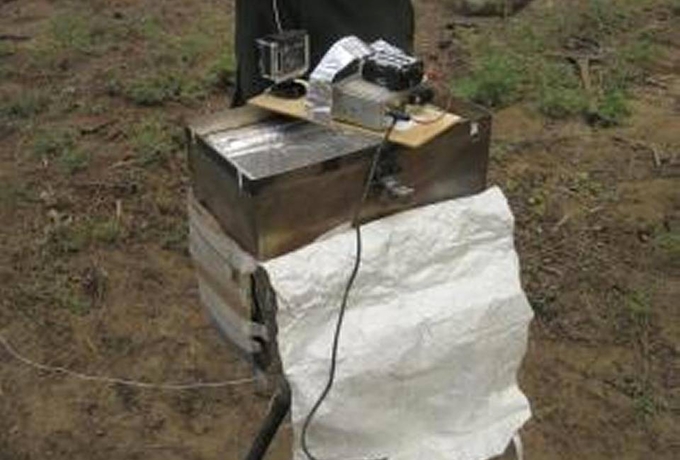
Some of the equipment used by the Fire Behavior Assessment Team in and around the Rough fire, near Kings Canyon National Park. Data recorded by the equipment may help prevent future wildfires. U.S. Forest Service Read more here: http://www.fresnobee.com/news/local/article32600712.html#storylink=cpy

Equipment used by the Fire Behavior Assessment Team. Photo/U.S. Forest Service

By Rory Appleton, Fresno Bee

A special firefighting team with the Sierra National Forest hiked into the mouth of the 56,900-acre Rough Fire on Thursday to drop special equipment in the blaze’s path, and data recorded by the equipment may help prevent future wildfires.

Rough Fire public information officer Shawn Lenske hiked alongside the 10-man Fire Behavior Assessment Team as the firefighters made their way to within a mile of the wildfire, which is now the second largest currently burning in California. The team placed sensors that monitor temperature and wind conditions as well as GoPro cameras at several locations in the Rough Fire’s path.

Lenske, who also works as a firefighter in Los Angeles, said the team members dropped one set of sensors and cameras in an area that had recently burned and another in an area that has never burned.

Firefighters hope to learn just how effective proscribed burns and brush clearing are in slowing the path of a large wildfire and use that information to adjust recommended preventive measures for community members in areas at risk of fire.

Read the whole story


Developer fighting to keep Liberty Utilities’ Douglas County solar plant proposal alive

By Anne Knowles

The developer of a solar project rejected by Douglas County last month is contesting the county’s ruling.

Greenstone Renewables LLC filed a petition for judicial review of the Douglas County Commissioners’ decision to uphold an appeal of the special use permit allowing Greenstone to build a 20-megawatt, 260-acre solar plant on Muller Lane in Minden.

The permit had been granted by the Douglas County Planning Commission in May and then appealed by Steve and Mary Walker, whose residential parcel borders the planned facility’s site.

During a long and contentious public meeting on July 2, the commissioners upheld the appeal, effectively killing the solar project.

Greenstone’s petition alleges that by supporting the appeal the county acted “capriciously and arbitrarily” and that in the process Greenstone was denied “substantive and procedural due process rights” resulting in “real and significant damages.”

The 34-page petition outlines the project’s history, including the county staff’s recommendation to the Planning Commission to approve, and the Walkers’ subsequent appeal.

The petition alleges county commissioners and the Walkers, which it repeatedly describes as long-time lobbyists for the county, had opportunity to discuss the solar project on an ex parte basis — that is, without Greenstone present.

Specifically, the developer claims that in a meeting with Vice Chairwoman Nancy McDermid, the commissioner said she considered the solar project a “visual blight” and would be sure to submit into the record two aspirational documents — the Open Space Plan and the Valley Vision Plan — even though neither plan, unlike the county’s master plan, has legal status and had not been included in the Walkers’ appeal.

The petition then claims the Walkers were allowed to submit additional material after the appeal deadline, including a reference to the two vision plans, which were cited by commissioners during the decision to uphold the appeal.

The Walkers disagree.

“The record of the Douglas County Board of County Commissioners was very clear. It was a 5-0 vote which was firmly grounded in the fact the Greenstone solar industrial plant application did not meet the requirements of the Douglas County Master Plan,” Mary Walker told Lake Tahoe News.

The petition contends Greenstone’s project met all the requirements set out by the county, including disclosure of a possible, on-site battery storage facility, which became a bone of contention during the July 2 commission meeting when commissioners said they were unaware of it.

Douglas County District Court Judge Tod Young will be conducting the review, which should take between six and nine months, according to Cynthea Gregory, deputy district attorney for the county.

The next step is for Greenstone, with the coordination of the county, to submit to the court the entire record, including commissions’ meeting minutes, email and other documents, and for the county to file its opposition to the petition.

The judge will then decide if there is “substantial evidence” to support the commissioners’ decision, said Gregory.

Greenstone did not respond to a request for comment on the suit.


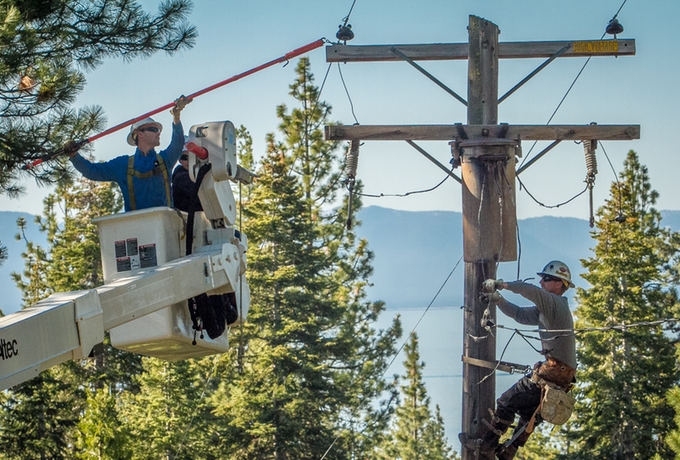
A crew from Liberty Energy replaces a transformer in Tahoe City, Calif., on June 5th, 2014.

Liberty Utilities would like to use more power from renewable sources. Photo/Provided

Meanwhile, Liberty Utilities, which had signed a preliminary power purchase agreement with Greenstone, is looking elsewhere for solar power in order to meet its next compliance goal set by California’s renewable energy portfolio.

“At this time, Liberty Utilities is not pursuing the Minden solar project,” Travis Johnson, Liberty’s director of utility planning and business development, told Lake Tahoe News.

The power company, which serves customers in Truckee, Alpine County and the California side of Lake Tahoe, is hoping to bump up the power generated by a second project its pursuing.

In April, Liberty applied to the California Public Utilities Commission to operate two solar projects, the 20 MW facility in Minden and a 40 MW plant in Luning, an unincorporated, small town about 140 miles southeast of Minden and 80 miles northwest of Tonopah.

The Luning project process has gone more smoothly. The operation is to be built entirely on Bureau of Land Management land in a much more remote area of Nevada. (The town has 38 registered voters, according to Mineral County, where Luning is located.)

In late July, the BLM approved the 560-acre project. Mineral County had already granted it a special use permit in 2014 and was able to review and comment during the BLM approval process, according to Laura Miner, business development manager, at Invenergy LLC, the project developer. (Liberty plans to purchase the facility from Invenergy once it is built.)

After the Minden plant was nixed, Liberty amended its application with the CPUC to increase the Luning plant capacity from 40 MW to 50 MW.

Johnson said the plant was originally designed for 50 MW but the company was shooting for a combined total between the two projects of 60 MW to meet the RPS.

“We sized our solar projects at 60 megawatts to get us close to compliance,” said Johnson. “Luning can’t do 60 megawatts on its own, it can only do 50 megawatts. We’re hoping for a CPUC decision by the fourth quarter.”

Johnson said he’s optimistic the project will be approved. The filing was protested by the CPUC’s Office of Ratepayer Advocates in a routine procedure to guarantee ratepayers are represented.

“ORA thoroughly reviewed Liberty’s application, and entered into settlement negotiations with Liberty Utilities to resolve our concerns.  The Motion for Settlement will be filed this week,” Lisa-Marie Salvacion with ORA told Lake Tahoe News in an email.

If the Luning project is approved, construction will start in early 2016 and Liberty should be producing power by the end of the year.

That will bring Liberty’s portfolio to 25 percent renewable, up from 22 percent currently, but the RPS requires the company to use 27 percent by 2017.

So, assuming no other projects go online before then, Liberty will acquire the other 2 percent from NV Energy.

Liberty and NV Energy have a new power purchase agreement that goes into effect January 2016. The new PPA, if approved by the CPUC, eliminates all coal-fired energy from Liberty’s portfolio.

The new PPA will save Liberty $2.34 million through a reduction in demand charges, improvements in system transmission, solar credits and drop in costs due to elimination of coal, according to Rich Salgo, Liberty Utilities vice president of operations.

Liberty is also awaiting CPUC approval for a 17.34 percent rate increase. The increase would go into effect in January 2016 and raise $13.6 million to cover costs associated with the distribution of power to its 49,000 customers.


Calif. congressional Dems push for state climate bills

By Devin Henry, The Hill

Democrats in the California congressional delegation are urging state lawmakers to pass two sweeping environmental bills this legislative session.

Sens. Dianne Feinstein and Barbara Boxer sent a letter to members of the California Assembly on Wednesday urging them to pass the bills before their legislative session ends next month.

House Democratic Leader Nancy Pelosi and 25 other congressional Democrats endorsed the measures on Friday, as well. Lawmakers are considering a bill that would codify Gov. Jerry Brown’s climate goals into law and another to cut the state’s oil consumption over the next 15 years.

Read the whole story


Big month for water conservation in Calif.

By Bettina Boxall and Rosanna Xia, Los Angeles Times

After Gov. Jerry Brown ordered a 25 percent reduction in urban water use statewide, regulators spent much of the spring chastising water districts for not conserving enough during California’s stubborn drought.

Data released Thursday suggest the message is getting through.

Californians cut back their urban water use last month by nearly a third compared with July 2013, aided by rare summer storms and stepped-up local enforcement. And the number of water districts deemed to be severely out of step with the state’s demands — those falling 15 percentage points or more short of their conservation goal — dropped sharply.

The 31 percent statewide reduction is even better than the 27 percent recorded in June, the first month the targets were in effect. And so far state officials have not needed to carry out their threat of stiff fines to get the attention of local agencies.

Read the whole story


Hotel taxes bright spot in SLT budget

By Kathryn Reed

An unexpected spike in the cost of retiree pension benefits and a continual declining value of some redevelopment properties is being offset by a substantial increase in transient occupancy taxes in South Lake Tahoe.

All of this means the 2015-16 budget that takes effect Oct. 1 is balanced. And while legally the city has to have a balanced budget, it is being done so without borrowing from other funds.

The City Council on Sept. 1 will hear a presentation on the budget, with adoption likely two weeks later.

CalPERS has rejiggered how it calculates what public agencies must contribute. Just to make the police and fire department retiree costs South Lake Tahoe has to come up with another $1.2 million.

“They don’t have to have a good return on their investments. They just send us a bill,” City Manager Nancy Kerry said of how CalPERS operates.

Earlier this week CalPERS announced a 2.4 percent return on its investments, which is much lower than what most entities are posting. Because these are defined benefits, retirees are guaranteed a set dollar amount no matter what CalPERS has in the bank. This means the entities where the retirees worked must make up the difference. This is unlike the private sector, which mostly has 401(k) plans where workers deal with market volatility, not the business.

The other big thing throwing a wrench into the city’s coffers is the value of condos at the Marriott Grand Residence. The price per condo is $183,776. This compares to the Timber Lodge condos across the sidewalk that are selling for $502,836. Grand Residence has 199 units, while Timber Cove has 264. At the former, they are sold as 13-week intervals, with 940 parcels on the tax rolls. Timber Lodge is mostly weekly timeshares, with 11,703 taxable parcels.

While every place else in the city limits the assessed value is going up, that is not the case for the Marriott properties that anchor the Heavenly Village. There has been a 43 percent drop in value from fiscal year 2009-10 to FY 14-15. Half of the decline in property value in the redevelopment area – which runs from Ski Run Boulevard to the state line – is from the Marriott properties.

There is a $100 million difference between the assessed values of the two Marriotts. Part of this has to do with there being a number of foreclosures at the Grand Residence as well as the ownership criteria. Plus, Marriott has restructured the value of the properties with a point system that is helping to keep the value down.

City officials are in talks with the assessors’ office to see if anything can be done to have the numbers be more reflective of the true value.

Kerry does not anticipate the same thing happening when the Chateau hotel-condos open in 2017. For now, that site is all one parcel and therefore is assessed as one property. With the project calling for a 32-room hotel-condo with full ownership, the developer would have to seek separate parcel numbers after build out.

While the city always wants more money in the bank, a big concern with any decreased value in the redevelopment is that $180 million is still owed in bond debt. This includes principal and interest. It should be paid off in 2038. Property taxes pay for the debt as well as TOT.

Even though the city is not reaping as much in property taxes from these parcels, throughout the jurisdiction the transient occupancy tax collection has been well above what was anticipated. TOT is up 20 percent – or more than $2 million – from what was forecasted.

Much of that will be reinvested in fields as a joint project with Lake Tahoe Community College and Lake Tahoe Unified School District.

The other big piece in this budget and those going forward is how the city revamped it’s health care costs in the last year.

“Were it not for the changes in the health care program, we’d be facing deficits today. Decisions to completely revamp the health care benefit structure reduced annual costs by over $1 million and reduced our unfunded liabilities by 73 percent,” Kerry said. “Without these changes, regardless of TOT increases, regardless of growth in the economy, etc., we’d be in deficits today.”

One thing Kerry plans to stress at Tuesday’s meeting is that if the city is to continue in its quest to be a recreation destination that it will take more money beyond current revenues to upgrade facilities. This may mean going to the voters in 2016 for a tax – be it increasing the hotel tax or a new amusement-recreation tax. The goal would be to dedicate that revenue stream to recreation, with the tourist bearing the burden.

Kerry’s presentation will also include a note of caution as the city looks to the future. Monetary issues run in cycles, with many forecasting 2017 as when the next recession may hit – though not necessarily like the Great Recession.

“The value of looking ahead is to mitigate the risks,” Kerry told Lake Tahoe News.

This means being conservative with spending, while also looking at how to generate sustainable revenue. The latter, the city believes, is through offering quality recreation facilities for locals and tourists.

—–

Note:

  • The council meeting starts at 9am Sept. 1 at Lake Tahoe Airport.


Partnership to test if forest thinning can grow groundwater

By Edward Ortiz, Sacramento Bee

The purchase of 10,000 acres of watershed land west of Lake Tahoe is slated to launch a living laboratory testing whether the answer to drought lies in fewer trees.

Research by the environmental group the Nature Conservancy has shown that thinning forests of small- to medium-size trees and bushes allows forests to trap more rain because it lets more water run off to streams and into groundwater stores. In winter, thinned areas may also allow more snow to be deposited on the forest floor as snowpack, said Edward Smith, a forest ecologist with the Nature Conservancy.

The Palo Alto-based Northern Sierra Partnership, which includes the conservancy, seeks to put that theory into practice on former logging land it’s bought for $10.1 million about 10 miles west of Lake Tahoe and south of Interstate 80 in Placer County. It’s one of the largest pieces of unprotected land south of Donner Summit and the Tahoe National Forest.

Read the whole story


Co-op to close; thousands in Nev. without insurance

By Jackie Valley, Las Vegas Sun

The Nevada Health Co-Op, a consumer-owned and operated health plan created under the Affordable Care Act, is going out of business because of high costs, state officials announced Wednesday.

Consumers insured by the co-op will be covered through Dec. 31, said Janel Davis, spokeswoman for the Silver State Health Insurance Exchange. The Board of Directors for the co-op, which received $65.9 million worth of solvency loans from the federal government, voted to cease operations effective Jan. 1.

The co-op is one of five insurance carriers offered through the Silver State Health Insurance Exchange, which was established by the Affordable Care Act. Participants in the Nevada Health Co-Op were asked to choose other insurance providers when an open enrollment period beings in November.

Read the whole story