SLT, STPUD at odds over franchise agreement
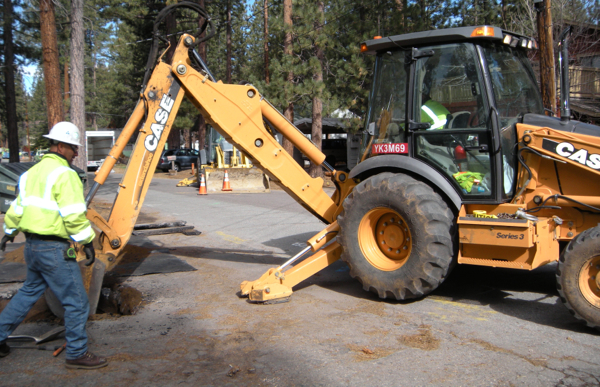
South Tahoe PUD does not currently pay a fee for having its water and sewer lines on South Lake Tahoe property. Photo/LTN file

South Tahoe PUD does not pay a fee to have its water and sewer lines on South Lake Tahoe property. Photo/LTN file

By Kathryn Reed

South Lake Tahoe since earlier this summer has been paying South Tahoe Public Utility District for water and sewer just like any other customer. South Tahoe PUD, though, is not paying the city a franchise agreement like all the other water companies in town.

If the city has its way, there will be franchise deal in place – and soon. South Lake Tahoe officials want to correct what they see as a 50-year-old problem.

“It’s a standard practice that utilities pay for the right to use a city’s property,” City Manager Nancy Kerry told Lake Tahoe News.

Tahoe Keys, Lukins and Lakeside water districts all pay 2 percent of their gross revenues to the city per their franchise agreements. South Tahoe PUD never has. When STPUD acquired smaller water districts that were paying the fee, the practice stopped. The city never pursued its right to those dollars.

The city in 1966 – just after becoming incorporated – entered into 50-year franchise agreements with the various water districts. Those all expire at the end of this year.

City Attorney Tom Watson told Lake Tahoe News that state law allows cities to create an ordinance – like South Lake Tahoe has – to impose the franchise fee.

The city has been talking with the four water districts about 10-year franchise agreements, with the goal of treating them all the same. The council will likely discuss the issue Oct. 20.

South Tahoe PUD has the topic on Thursday’s agenda. The Sept. 3 item is to discuss the proposed franchise agreement and direct staff.

“Since we have not seen anything at all at this point, I would rather not speculate on possibilities. We have chosen not to begin any research or analysis until we actually see what is proposed,” STPUD General Manager Richard Solbrig told Lake Tahoe News.

However, according to city officials the two entities have been discussing the issue for several months. The last meeting was Monday, though an agreement was not reached.

The contract the two had expired at the end of July. Former City Manager Dave Jinkens negotiated it at a time when the district was doing a lot of work in the redevelopment area near Stateline. It included free water and sewer for the city, while the district paid nothing.

Kerry said not paying a water-sewer bill saved the city about $100,000 a year. She added that STPUD is saving about $500,000 a year by not having a franchise agreement.

Franchise agreements between municipalities and utility companies are fairly routine. The whole point is that the utilities are essentially renting space owned by the city – albeit underground in this case – in order to operate their business.

Kerry said the proposal that will be before the council this fall is to have the STPUD franchise fee be dedicated to the replacement of roads. Money from the other water districts goes toward the broader public works budget.

STPUD does not have a franchise agreement with El Dorado County. Lake Tahoe News on Aug. 28 asked El Dorado County Counsel Robyn Drivon about any agreements with West Slope water providers. She said she would look into it, but has not responded.

—–

Notes:

·      The STPUD board meeting is Sept. 3 at 2pm, 1275 Meadow Crest Drive, South Lake Tahoe.

·      Also on the agenda are formal mutual aid agreements with Tahoe Keys and Lukins. “The agreement will provide the backup reliability sought by the state inspector. The agreements should be virtually identical, except for any differences in the physical connections,” Solbrig said.




Water conservation comes with unintended consquences

By Matt Stevens, Los Angeles Times

Under orders to slash water use amid a historic drought, cities and towns across the state saved about 75 billion gallons in July, eclipsing Gov. Jerry Brown’s once-daunting order for a 25% reduction.

But, in a paradox of conservation, water agencies say the unprecedented savings — 31% in July over July 2013 — are causing or compounding a slew of problems.

Sanitation districts are yanking tree roots out of manholes and stepping up maintenance on their pipes to prevent corrosion and the spread of odors. And when people use less potable water, officials say, there’s less wastewater available to recycle.

Water suppliers, meanwhile, say the dramatic decrease in consumption has created multimillion-dollar revenue shortfalls.

Read the whole story


5 million people left Calif. in the last decade

By Phillip Reese, Sacramento Bee

An unprecedented number of Californians left for other states during the last decade, according to new tax return data from the Internal Revenue Service.

About 5 million Californians left between 2004 and 2013. Roughly 3.9 million people came here from other states during that period, for a net population loss of more than 1 million people.


Read the whole story


SLT nixes idea of rec center as homeless facility

By Kathryn Reed

The South Lake Tahoe Recreation Center is off the table as a resource for the homeless to stay warm during the winter.

That was the direction the City Council took Tuesday after much discussion and a presentation by the Tahoe Homeless Coalition.

A group of individuals has come together to establish a warm room that would be open Nov. 1-April 30 between 8:30pm and 6:30am. It would be for adults without pets.

The coalition came to the council Sept. 1 with the goal of securing access to the rec center on select nights through the winter season for people to seek refuge from the cold. It would not be open every night, but only when the temperature was projected to reach a certain level.

Councilwoman Wendy David was the only member who wanted the rec center to be used in this manner. (Councilmember Tom Davis was absent until the afternoon budget presentation.) The other three believe there would be a conflict between users, didn’t want people kicked out into the cold at dawn, and had other concerns.

All four, though, agreed there is a need for a warm room. They also support using a city facility if appropriate. Councilman Austin Sass even advocated for using taxpayer money to house the people in a $20/night hotel when needed.

The council ultimately decided to appoint Councilmembers JoAnn Conner and David to a committee to work with the homeless coalition to find an answer.

Representatives from Temple Bat Yam and Unity at the Lake spoke of offering their facilities as a backup to the rec center, but had their own constraints for not being able to use their facilities on a regular basis.

In other action:

·      The council voted to create a policy where money could be given to nonprofits on a case-by-case basis for economic development and political advocacy. Cash cannot be given to social organizations. The vote was 3-1, with Conner voting no.

·      The council adopted a policy to decide who will be inducted into the Champions Plaza at Lakeview Commons. The Parks and Recreation Commission will be the panel making the decision based on the criteria and an application that must be submitted. Individual or team names will be etched on paving stones. Still to be determined is the funding source for the bricks.

·      The idea of a key for the city was brought forward, but died for lack of desire to move forward.

·      Sept. 19 is the city’s 50th anniversary parade from Al Tahoe Boulevard to the Y. The two southbound lanes of Highway 50 will be used. Sept. 4 at 5pm is now the deadline to apply. There are more than 50 entities participating – including walking groups, floats and vehicles. The theme is Past, Present and Future.

·      Nov. 11 is the city’s gala at Lake Tahoe Resort Hotel. The city is putting in $15,000 to lower the cost to about $65 per ticket. It’s expected 250 people will attend. A book about the city’s first 50 years is being created by Bona Fide Books in Meyers; cost is $25.


Researchers: Drought, heat waves more likely to mix

By Karen Kaplan, Los Angeles Times

A drought can make a hot day hotter, while a heat wave can make dry conditions even drier. Now scientists are making the case that heat waves and droughts have become more likely to overlap throughout most of the United States.

In fact, the longer and hotter the heat wave, the bigger the jump in the odds that it coincided with drought conditions, according to a study published Monday in the Proceedings of the National Academy of Sciences.

“Despite an apparent hiatus in rising temperature and no significant trend in droughts, we show a substantial increase in concurrent droughts and heatwaves across most parts of the United States,” wrote Omid Mazdiyasni and Amir AghaKouchak, who study climate and hydrology trends at UC Irvine.

Read the whole story


For athletes, the risk of too much water

By Gretchen Reynolds, New York Times

Are we, with the best of intentions, putting young athletes at risk when we urge them to drink lots of fluids during steamy sports practices and games?

A report about overhydration in sports suggests that under certain circumstances the answer is yes, and that the consequences for young athletes can be — and in several tragic cases already have been — severe and even fatal.


According to the latest science, dehydration during sports is rarely if ever dangerous, but overhydration undeniably is.

Hyponatremia occurs when someone consumes so much fluid that his or her body can’t rid itself of the surplus through sweating or urination. As a result, water levels rise in the bloodstream and sodium levels, diluted, fall. Osmosis then draws water from the blood into the surrounding cells of the body to equalize sodium levels there, and those cells begin to swell like water balloons. If this process occurs in the brain, it can be lethal.

Read the whole story


Meyers plan to move onto environmental review

By Kathryn Reed

The vote by the El Dorado County Board of Supervisors on Monday regarding the Meyers Area Plan reflected that of the community – it wasn’t unanimous – just like there isn’t consensus among residents as to what should be done.

Many of the 17 people who spoke Aug. 31 believed it was necessary to talk more before moving on to the environmental phase. Just as many said it was time to take the next step.

Ultimately, the board voted 3-1 to start the environmental review. Supervisor Shiva Frentzen was the dissenting voice. Supervisor Sue Novasel was not part of the discussion or vote, having recused herself because she owns property in the area.

In the 3½ years that the Meyers Area Plan has been discussed three area plans on the South Shore have been completed. The Meyers plan is at least two years from being complete because it could take that long for the environmental documents to be finalized. The time frame will in part be determined by the level of review that is conducted. Then there will be five opportunities for the public to comment. Ultimately the Tahoe Regional Planning Agency Governing Board will have the final say.

One of Frentzen’s hang-ups was not knowing how much the process would cost the county going forward. An environmental impact report could cost more than $100,000. She wanted a guarantee there would be a return on investment for that outlay of cash. It’s not something anyone can guarantee.

El Dorado County planner Brendan Ferry on Aug. 31 addresses the Board of Supervisors about the Meyers plan as about 30 people listen. Photo/Kathryn Reed

El Dorado County planner Brendan Ferry on Aug. 31 advises supervisors about the Meyers plan as about 30 people listen. Photo/Kathryn Reed

Brendan Ferry, county planner, pointed out that the county is not in the development business. While he said a goal of the plan is to attract economic development, there is no guarantee this will occur.

Fear of a large-scale development has gripped this small South Shore enclave ever since Norma Santiago when she was supervisor spearheaded the Catalyst project. That project was dead in the water almost as soon as it came to life. But just the thought of something of that magnitude still strikes fear with many.

However, many who spoke on Monday said it was apt to be locals who initiate any new development in Meyers.

Still, one thing that divides those who live there is whether a motel or bed and breakfast ought to be built. Currently, other than camping, there is no place for tourists to sleep in Meyers. The criteria in the proposed plan would allow for some sort of lodging – something the existing 1993 plan can no longer accommodate based on zoning regulations and commodities distributions.

            The current plan, which is the fourth draft, contains:

·      42-foot height limit; this is the same as what’s in the 1993 plan.

·      34,150-square-feet of commercial floor area, with 17,500 dedicated to small businesses. The 1993 plan had 25,400 square feet. The difference is that Bob Dog Pizza did not use as much CFA as anticipated.

·      30 units per acre for a lodging property, 20 units per acre for multi-family residential; 1993 plan had 40 and 15 units per acre, respectively.

·      One level of incentives for potential developers; 1993 plan had no incentives.

·      Meyers Advisory Council will either be elected or appointed, be a formal body and must adhere to open meeting laws; 1993 had a loose knit group with zero power.

·      4 California Tahoe Conservancy lots will be classified recreation, while 5 will retain current zoning to allow for potential development.

The next step is for county officials – with the help of their legal staff and Tahoe Regional Planning Agency – to determine the level of environmental review.

—–

  In other action:

·      The board heard a presentation about the Community Wildfire Protection Plan, a basinwide effort to make the area less prone to catastrophic wildfire.  When Supervisor Frentzen asked why the basin doesn’t have small fire safe councils, Lake Valley Fire Chief Gareth Harris chose not to tell her about the misappropriation of funds and how many contractors still have not been paid.

·      South Lake Tahoe City Manager Nancy Kerry and marketing guru Carl Ribaudo talked about the legacy principles, which are designed to get all parties – public and private – on board with a shared vision for the area even if the means to get to the end is different. The overriding desire is to leave a legacy of sorts.


Climate-change bills in Calif. go down to the wire

By Jessica Calefati, San Jose Mercury News

SACRAMENTO — With the deadline for lawmakers to finish their work less than two weeks away, Gov. Jerry Brown and state Senate leader Kevin de León are working feverishly to pass what they call the year’s most important legislation — measures that both men believe will enhance their political legacies.

The bills, which would dramatically reduce the state’s reliance on oil and help to combat climate change, have been praised by everyone from Pope Francis to President Obama to the world’s leading scientists. If enacted, the legislation would set international precedent and cement California’s reputation as a leader in the fight against global warming.

But standing in the way is one of Sacramento’s most powerful lobbies, the oil and gas industry, which has spent millions of dollars on advertising that paints a dystopian vision of the future: an out-of-control bureaucracy that would have the power to ration gasoline, punish SUV owners and limit the number of miles Californians drive.

Read the whole story


Birders on quest to document all Tahoe species

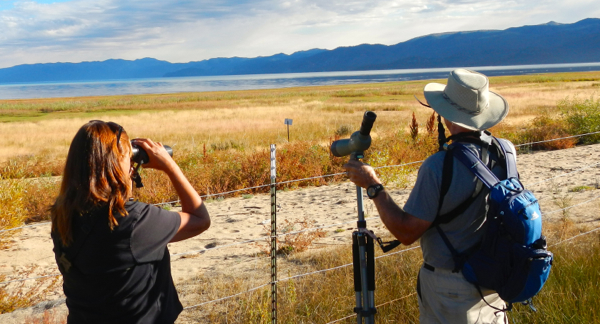
Jenny and Bob Sweatt look for shorebirds Aug. 26 near the Upper Truckee Marsh. Photo/Kathryn Reed

Jenny and Bob Sweatt look for shorebirds Aug. 26 near the Upper Truckee Marsh. Photo/Kathryn Reed

By Kathryn Reed

It’s quiet except for the sounds of birds. To the untrained ear the songs they sing all sound the same. For birders it’s like they can communicate with these feathered friends.

American coot with baby. Photo/Jenny Sweatt

American coot with baby. Photo/Jenny Sweatt

Even without seeing the animal, experienced birders know what lurks above or is hiding in the brush. It’s not uncommon that birds are heard before they are seen.

This is part of the wonder of birding.

With scopes, binoculars, cameras and guidebooks in hand, several birders were out last Wednesday in the Upper Truckee Marsh. This locale, to many in the know, is the birding paradise of the Lake Tahoe Basin.

American kestral Photo/Jenny Sweatt

American kestral
Photo/Jenny Sweatt

Within two hours one day last week Jenny and Bob Sweatt saw a black Phoebe, yellow-rumped warblers, kildeer, spotted sandpipers, plover, Northern harrier, coots, white faced ibis, Caspian terns, least sandpiper, sora, peregrine falcon and a few more.

The South Lake Tahoe couple is atop the leader board in the Tahoe Big Year competition being put on by the Tahoe Institute for Natural Science. The goal is to identify as many birds as possible in the basin this calendar year. She is at 204 and he is at 203, with Lori Allessio the next closest at 198. This is the inaugural year for the Tahoe Big Year.

There are more than 300 species in the basin.

Avocet Photo/Jenny Sweatt

Avocet
Photo/Jenny Sweatt

“We call it an adrenaline rush when we see a bird for the first time. It’s really exciting,” Jenny Sweatt told Lake Tahoe News.

They go out every day for four to six hours a day. They admit it helps to be retired. But they also aren’t bored by it.

“We used to be those people laughing at birders. And now we are one of them,” Bob Sweatt told Lake Tahoe News.

Dowitcher Photo/Jenny Sweatt

Dowitcher
Photo/Jenny Sweatt

They take their binoculars wherever they go. They say birding is addicting. Until this year it’s not something they did.

While they don’t know all the calls of the birds, apps on their phones help identify the animals.

The duo has taken pictures of every bird they’ve seen. Sending them in to TINS helps with identification.

They took a picture of a juvenile Caspian tern with bands on its legs. This means a research group is tracking it. They’ve submitted the band codes to the organization’s website in hopes of learning where the tern has been so far.

Birding every day allows the couple the opportunity to see the landscape change – the water level fluctuate, flowers bloom and die, migratory birds come and go, people frolicking.

Bald eagle Photo/Jenny Sweatt

Bald eagle
Photo/Jenny Sweatt

Camaraderie exists among the birders. They discuss what they’ve seen and what they think they’ve seen. Last Wednesday the Sweatts ran into Don and Lynn Harriman. The South Tahoe couple lead free bird watching excursions from the end of San Francisco Avenue every Wednesday at 8am. TINS has been leading bird walks this summer, too.

Yellow headed blackbird Photo/Jenny Sweatt

Yellow headed blackbird
Photo/Jenny Sweatt

“We see a lot of migrating shorebirds, resting and refueling here before heading on to Mexico or South America. We see dogs flushing out and chasing shorebirds, scaring them down the beach, only to have another dog scare them back again,” Jenny Sweatt told Lake Tahoe News. “There are also some airplanes and touring companies who drop down and buzz the shoreline, scattering birds in all directions. People should give some consideration to birds and their amazing but stressful journey. Let them rest.”

Mostly, though, there is a sense of serenity in the morning. It’s the birds and their watchers.

“Every bird has something amazing about them,” Bob Sweatt said.


CalPERS looks to cut financial risk

By Melody Petersen, Los Angeles Times

California taxpayers have never paid more for public worker pensions, but it’s still not enough to cover the rising number of retirement checks written by the state’s largest pension plan.

Even before the stock market’s recent fall, staffers at the California Public Employees’ Retirement System were worried about what they call “negative cash flows.”

The shortfalls — which totaled $5 billion last year — are created when contributions from taxpayers and public employees who are still working aren’t enough to cover monthly checks sent to retirees.

To make up the difference, CalPERS must liquidate investments.


Because the more conservative investments are expected to reduce CalPERS’ future financial returns, taxpayers would have to pick up even more of the cost of workers’ pensions.

Read the whole story