EDC ed board takes no action regarding supe

By Kathryn Reed and Joann Eisenbrandt

Jeremy Meyers, superintendent of the El Dorado County Office of Education, was not at Tuesday’s special board meeting where he was the only agenda item.

He did write a letter to the board and had spoken to each member before the meeting.

“As you know, as elected county superintendent, I am not employed by the board, nor does the board evaluate my performance. As such, I believe there is not an appropriate role for me to play at this board’s meeting,” he wrote.

Jeremy Meyers

Jeremy Meyers

The letter was read into the record Sept. 15 by board President John Lane.

David Gerard, who is the attorney representing the board and the superintendent, cited a state Attorney General’s opinion stating it would not be a conflict of interest for him to represent both entities.

Tuesday’s special meeting was called to discuss what, if any, recourse the board might have in handling Meyers’ DUI from earlier this summer.

A California Highway Patrol officer found Meyers asleep in a construction zone on Highway 49 at 2:45pm June 9, less than three hours after he left a board meeting. The CHP recorded Meyers’ blood alcohol level at nearly twice the legal limit. He pleaded no contest to driving under the influence with a blood alcohol level of just more than 0.08.

A judge sentenced Meyers to five days in county jail that was then commuted to five days of home arrest.

In the letter to the board, Meyers wrote, “The home arrest portion of my sentence was done on personal time, not on work time. I will continue to separate my personal matter from my responsibilities as the county superintendent.”

Unlike an employee who has differentiated work and personal time, an elected official does not have a set number of work hours. Even when they are away from the office they are still accountable to the people who put them in office – the public.

Meyers did not return or decline any of his nearly $200,000 annual salary for the five days he was on house arrest.

He was driving his own vehicle at the time of his DUI. He drives his own vehicle for work and is reimbursed for mileage by the county. As is normal with a DUI arrest, Meyers’ driver’s license now restricts him to drive only for work, which given the nature of his position could be almost anywhere at anytime.

Board member Heidi Weiland, who had initiated the special meeting, asked if the county office of ed’s drug-free work environment policy mentions alcohol. It does. It says one cannot possess, use, or be under the influence of a controlled substance at a school or other district workplace. Meyers was not accused of being under the influence at a work site.

About two dozen people attended Tuesday’s 45-minute meeting in Placerville – a much larger number than is usual. Seven of them spoke.

Nick Ridout, a part-time teacher for the county, asked the board not to play politics. He adamantly defended Meyers, calling him “an honorable man and a good human being.”

A couple others echoed that sentiment.

Sherri Lum-Alarcon, though, said there should be consequences for what Meyers did, especially because he is in education.

Ken Cater, who used to work for the county Probation Department, said Meyers being released to his wife and not taken to jail was “not a sweetheart deal. It was pretty much standard stuff.”

Instead of being taken directly to jail, Meyers was released to the custody of his wife. Law enforcement officials not with probation have told Lake Tahoe News it is “highly unusual” for that to have occurred.

Girard explained in detail the relationship between the board and superintendent, all of whom are elected.

“Neither is superior over the other. They each have their own responsibilities,” Girard said. “They work as a partnership. The education codes lay out what each does. They work together in a give and take. Both are responsible to the electorate.”

The board had little to say, with members Georgie Knight and Debbie Akin saying nothing.

“I clearly understand our role. I have complete faith that Jeremy will act in the county’s best interest,” board Vice Chairman Rich Fischer said.

Lane added, “I second what Rich said.”

Meyers concluded his letter to the board by saying, “It is my belief the integrity of the elected office of the county superintendent and the elected board of education is best served by recognizing the separate functions and duties of each.”

Lane asked if the board wanted to take any action; no one responded and the meeting was adjourned.


Poll: Politics at local level pointless

By Cathleen Decker, Los Angeles Times

Disdain and disgust have been common sentiments when it comes to Americans’ views of the national political environment. But local government was supposed to be the safe haven, where things got done in a more neighborly way, with a lot less frustration than, say, dealing with the groaning bureaucracies of the IRS or Veterans Affairs.

It hasn’t worked out that way, exactly.

In a somewhat surprising twist, a new USC Dornsife/California Community Foundation/Los Angeles Times poll on community involvement suggests tension between California voters and their local governments.

A quarter or more of California voters say their elected officials are not responsive to their needs, a figure larger than might have been expected years ago. Voters cast a broad brush of negativity about the usefulness of volunteering for or giving money to political candidates and politicians.

Read the whole story


Calif. wildfires — worst may be yet to come

By Paul Rogers, San Jose Mercury News

Summer officially ends next week, but California’s devastating wildfire season will almost certainly rage on.

As of Monday, three enormous blazes — the Valley Fire in Lake, Napa and Sonoma counties; the Rough Fire in the Sierra National Forest in Fresno County; and the Butte Fire, burning in Amador and Calaveras counties — had already charred 270,000 acres, an area 10 times the size of the city of San Francisco.

Experts said at least another month, possibly two, of extreme fire risk remains before hoped-for El Niño winter rains could begin to dampen dry grasses, shrubs and trees all over California.

And, if history is any indication, the most destructive fires can come in October, when conditions are their driest. Major infernos like the 1991 Oakland Hills Fire, which killed 25 people and destroyed 2,843 homes, and the 2003 Cedar Fire and the 2007 Witch Fire, which together burned nearly 3,500 homes in San Diego County, all began in October.


Through Monday, 738,516 acres had burned in California in 2015, a 75 percent increase from the same date last year, and a 37 percent increase when compared to the five-year average.

Read the whole story


Busy Tahoe summer equates to big money

The Beacon restaurant at Camp Richardson is party central for much of the summer. Photos/Susan Wood

The Beacon restaurant at Camp Richardson is party central for much of the summer. Photos/Susan Wood

By Susan Wood

You weren’t seeing a mirage this summer.

The vehicle backups on Lake Tahoe roads were not caused so much by heavy road construction, but by travelers who were frequenting the tourist destination in large numbers this summer. And according to tourism officials and stakeholders, there are multiple reasons they were coming to the mountains.

Some may think tearing up the infrastructure would deter tourists because fewer lanes mean slower traffic, thus delaying the fun. But in the case of the Lake Tahoe Visitors Authority’s marketing efforts, it brings people in because travelers welcome an improved South Shore when they consider a destination for their vacations.

“Our focus has been renovations, and redevelopment projects are under way. In our market, word has gotten out about Tahoe’s improvement projects, and that’s powerful in the media,” LTVA Executive Director Carol Chaplin told Lake Tahoe News. “Definitely we think visitation is up. There are a lot of factors, but I haven’t talked to anyone who isn’t pleased – how much so depends on who you talk to.”

Chaplin estimated a 15 to 20 percent leap in lodging and restaurant receipts compared to 2014. The summer campaign increased LTVA’s website visits by 240 percent. In July alone, the LTVA reported 45,000 visits a week.
And an even more welcome sign: Hotel booking windows are longer in terms of advance notice and length of stay. This means more mid-week business – something all tourism-related businesses strive for.

Attributable factors vary, but one the LTVA has kept its eye on is its inaugural promotion to the San Diego market. This requires getting in the head of the average vacationer. The San Francisco Bay Area market will always be a cash cow for Lake Tahoe, but San Diego is whole new terrain. It takes more than three times the drive time to get here, or it requires paying for airfare. It’s simple math — the bigger the investment, the longer the investment in time staying here.

A market area split by a drive or fly option has been lucrative at first glance.

“We’re hitting the sweet spot on that,” Chaplin said.

And beyond gas prices being down, the events seem to fuel the interest. Recreation-oriented — including the adventurous, extreme kind — have been popping up like spring wildflowers. An old favorite golf event – the American Century Championship – celebrated its best attendance ever at 41,800.

“Generally speaking, travel is up and international travel is up,” she added.

All over the West, the trend for more traveling has increased.

Getting a parking spot at one of the beaches was tough at times.

Getting a parking spot at one of the beaches was tough at times. Photo/Susan Wood

People are on the move

Summer lodging occupancy is up 8 percent, with revenue rising 14 percent May through October, according to Denver-based DestiMetrics. The travel data research firm collects data from 19 western mountain destination resorts in six Western states.

“The robust numbers this month not only illustrate strength in both occupancy and rates but successful and sustained growth in summer business for mountain communities,” company Director Ralf Garrison said in a statement. “It’s pretty clear that mountain travel, as a whole, is strong and resilient despite weather challenges including everything from drought to excessive rainy patterns that have been experienced in different regions this summer.”

In California, the State Parks system has seen an overall estimated increase of up to 10 percent this summer. Some venues such as Donner State Park have enjoyed at least a 30 percent increase in visitors, with Emerald Bay leading the way at a 40 percent leap in receipts this year compared to the previous one. State Parks get revenue from parking, visitor centers and campground bookings.

“This is one of the busiest summers some of our rangers have ever seen,” parks spokesman Scott Elliott said.
One of the biggest reasons for the push to travel is pent up demand. Tourists who may have been still stinging from the recession along with a lingering, slow-to-recover job market are fed up with waiting to travel.

North Shore looking good

“As a destination, we’re running 75 percent occupancy – and that’s doing great,” North Lake Tahoe Resort Association spokesman J.T. Thompson told Lake Tahoe News.

Thompson indicated the North Shore is up 20 percent in pre-bookings – another notable positive trend. Pre-bookings translate to reservations made up to six months in advance. Those are usually reflective of more mid-week business, coinciding with South Shore trends.

“We know we’re going to get the Bay Area, but we’re hitting Los Angeles and Southern California and seeing the rewards for it,” he said.

Beyond the specific target market push, other factors abound for more tourist traffic such as spectacular warm weather compared to extremely hot temperatures. With that, you take the celebration of the continued emergence of human-powered events. Combine that with Lake Tahoe’s natural beauty, and it’s a recipe for business success.

And unlike other areas of California struggling with drought, Thompson believes the dry conditions may have helped lake visitation to varying degrees. First, fewer skiers prompted by less snow last winter pushed vacations to spring and summer. Then, there’s the mere lack of water everywhere else.

“We have a lot of water (in comparison),” he said.

Non-motorized water sports don't need to worry about the drought as much as motor boats. Photo/LTN file

Non-motorized water sports don’t need to worry about the drought as much as motor boats. Photo/LTN file

Just change watercraft

Even with a lower water level at the lake, there’s opportunity.

It’s location, location, location coupled with activity trends for Inn by the Lake General Manager Jeremy Agnew. He has seen a huge uptick in business stemming from the blockbuster popularity of standup paddleboarding. SUP requires little water underneath. That said, power boats are driven out farther on the lake, thus creating a serene experience as peaceful as hiking on water.

El Dorado Beach is a hotspot for the sport, and Inn by the Lake is feet away as the host hotel for the SUP races.
Agnew cited a surge in recreational warriors, international tourists and more childfree couples traveling in mid-August when the school year starts.

The numbers seem to add up.

Money coming in

According to South Lake Tahoe, the last transient occupancy tax collections recorded for June showed a year-over-year increase from $1.08 million to $1.27 million in receipts. Rooms rented comparing the same month year-to-year show a leap in city bookings from 54,548 to this year at 59,041.

“It’s been crazy this year. It started in February with people coming up because we didn’t have snow, but they liked that they didn’t have to drive in it,” Agnew said.

Ditto, said Tom Turner, who owns restaurants on the South Shore, east side and Truckee. Although his Caliente eatery traffic was tied up in the Kings Beach roadwork mess, that restaurant along with Riva Grill (South Lake Tahoe) and Bar of America (Truckee) witnessed “more people eating and drinking instead of skiing,” he noted.

Bob Hassett, who runs the Camp Richardson, Timber Cove, Lakeside and now Round Hill Pines marinas, enjoyed a decent showing on his water taxi. He pointed out how people would cart their bikes from one section of the lake to another.
The increased traffic overall offset the occasional challenges experienced by the lake’s lower-than-usual water level near shore. Improvise. His staff would simply negotiate the boats out 200 yards to help the watercraft renters.

“It’s been a good summer. There were definitely a lot of people in town, and I’m happy to see that. People were pleasantly surprised they could even get on the lake and heard marinas are closed. We’ve tried to get the word out there’s plenty of water out there,” he told Lake Tahoe News.

Hassett went as far as to say business revenue at the marinas, which mainly represents boat rentals, is back to where it was at pre-recession standards in 2008.

This experience may coincide to a completely different South Shore business.

With five years under her belt, Paige Rice who runs Tahoe Best Friends said she’s had the “best summer ever.”

The doggie day care service has been busy throughout the summer for overnight business, and that goes way beyond the locals. Some people decide to travel with their pets and stay wherever without worrying about whether the lodging establishment takes pets or not. They’ll even visit their dogs during the day to check in with them.

She averages 25 daytime dog visits and 20 overnight.

“And it’s consistently growing,” Rice said.

She’s not alone.

Sandy Cole has owned the Simple Bliss Vegan Café in the middle of South Lake Tahoe for three years and experienced a surge in business this summer to the tune of doing two-to-three times the traffic than in previous years.

“It’s been amazing. I grew up here, and I haven’t seen it like this for a while,” she said, noting the best times are the hottest. In particular, when Sacramento hits 100 degrees, Tahoe represents an ideal escape.

“I’d be up here too if I lived somewhere else,” Cole quipped.


Reno’s divorce history digitized

By Guy Clifton, Reno Gazette-Journal

For much of his life, crooner Frank Sinatra had a notoriously prickly relationship with the press, but when he came to Reno in August of 1951, Old Blue Eyes was downright cheerful.

Apparently, divorce will do that for some guys.

It was a big month and a big year for Reno divorce. Not only was Sinatra “singing for his supper,” at the Riverside Hotel as he established residency, actress Rita Hayworth came to town to divorce Prince Aly Khan.

Their stories and hundreds more are told on a website developed by Special Collections at the UNR and funded through a grant from the Institute for Museum and Library Services.

The collection includes more than 500 photographs, and more than 500 additional items that include oral histories, audio clips, film clips, newspaper articles, magazines, books, divorce ranch ledgers and a variety of other items.

Read the whole story


Sierra Nevada snowpack at a 500-year low

By Cheryl Katz, National Geographic

From frustrated snowboarders to migrating birds arriving at shriveled wetlands to wildfires raging through national parks, the Sierra Nevada’s lack of snow has transformed just about every aspect of life in California. Farmers, fish, forests, gardeners, hikers, boaters, and more depend on Sierra snow for water.

But now it’s clear that the “snow fail” in the 400-mile long mountain range has reached epic proportions: This year’s snowpack is the driest it’s been in at least 500 years, according to new research published Monday.

This stark finding comes from an analysis of more than 1,500 California blue oak tree rings dating back to the early 1500s, when Spanish explorers were just beginning their conquest of the state.

Read the whole story


Storytelling extravaganza rolling into Tahoe

WordWave is a compilation of events that will bring storytellers from across the nation to Lake Tahoe for a three-day literary festival that goes well beyond traditional book readings.

It is Oct. 9-11 at Valhalla on the South Shore. Details about the various events are online as is the opportunity to purchase tickets, however some things are free.

Lake Tahoe News asked WordWave founder Kim Wyatt to share what the three-day event is all about. Besides being the force behind the literary event, Wyatt is owner of Bona Fide Books, an independent publishing house based in Meyers.

Kim Wyatt

Kim Wyatt

LTN: How did the concept of WordWave come about?

Kim Wyatt: I was tabling with Jennifer Basye Sander at the AWP conference in Seattle. There were 10,000 writers there and we talked about how great it would be to have a literary event in South Lake Tahoe. We liked the model of San Francisco’s Lit Quake, a weeklong lit event, and wondered if it might be feasible for Tahoe. And we came up with WordWave.

LTN: What do you hope to achieve by having this three-day festival of story on the South Shore?

KW: Of course we want people to come out to the Tallac Historic Site and hear great writers. But my personal goal is to highlight the fantastic talent we have in the region. The Sierra Showcase will feature Suzanne Roberts, Michael Makley , June Saraceno from Sierra Nevada College, Michael Branch (High Country News), Ann Marie Brown and Jeremy Evans to name a few. These are writers getting national recognition. And Reno’s poet laureate, Gailmarie Pahmeier, will also make an appearance.

LTN: Do people need to be a writer or voracious reader to enjoy the event?

KW: No. We didn’t want it to feel like an excusive literary event, so we opened it up to storytellers in general, including plays. We held a playwriting contest, and received entries from around the world. We’re excited to launch three new one-act plays on Oct. 10 at the Boathouse Theater – how cool is that? NEA storytelling fellow and Paiute elder Ralph Burns will talk about oral storytelling, and Washoe drummer Ben Rupert will present on drumming. Christian Kiefer (author of “The Animals”) will present on songwriting. There is also a novel writing camp for kids, and Maker’s Station. So, there is something for everyone — we want to encourage everyone to either tell their story, or at least see the value of storytelling.

LTN: How did you decide which authors to invite?

KW: Jennifer suggested Garth Stein, who wrote “The Art of Racing in the Rain,” and when we mentioned of to a few people, they were thrilled. He had just published a book about a mansion in the woods, so we decided to have our fundraiser at the Grand Hall with Garth. A local programming committee—me, Bruce Rettig, and Suzanne Roberts—put out a call for abstracts to regional writers, and we got a great response, which shaped our Sierra Showcase. We decided to round it out with Pam Houston, Gayle Brandeis, and Camille Dungy, because they are great writers and teachers.

LTN: There is a nice mix of local and internationally known authors-panelists. Do you see this being more than a locals’ event?

KW: Absolutely. I go to writing events all over the country, and nobody else has our lake. It’s the perfect site for a writer’s getaway. I think WordWave could be an annual event that draws people from all over.

LTN: Please explain what the Timber Ball—Steampunk in the Woods event is all about.

KW: The Tall Timber Ball—Steampunk in the Woods is our fundraiser. We wanted to have a really fun, swinging party that was somewhat literary, and steampunk has its roots in Jules Verne. So there is a costume element, and we will be awarding a prize to the best look. Think Edwardian Burner. And rather than sit around banquet tables, we want people to move. So we hired a steampunk DJ who will spin electroswing—just try sitting still!—and the steampunk décor and our “curious” auction will have people talking. And there is a photo booth. Big fun. (You can pick up steampunk garb at Gaia-Licious here in town. They have goggles with wings!)

LTNThe Makers Station is more hands-on and a different side of storytelling. What will people be able to do here? In this day of writing and reading on electronic devices, why is the history of print important?

KW: People will be able to create their own books at the Maker’s Station. And Ben Rupert will demo drum making, another form of storytelling.

The history of print is important because the book is the most democratic invention ever created—anyone can get their hands on a book and connect. Books teach us and help us feel less alone. The invention of the printing press radicalized the world, bringing literacy and education to the masses. You really don’t want to get me started ….

LTN: How many submissions did you get for the one-act play competition? How were they whittled down to the winners? How many will be read that Saturday night?

KW: We received 193 submissions to the one-act play competition, a huge success. Three brand new plays will be premiered on Oct. 10, and at least two of the playwrights will come in for rehearsal.

LTN: Prices are reasonable – from free to $100 for the Steampunk. Is the money being raised enough to cover the expenses or are sponsors helping or is there a nonprofit component?

KW: We were committed from the beginning to have a free event, a public day with great events for readers and writers. Our hope is that the Steampunk Ball will cover expenses, but we have also received a lot of support from the community. We have a great pool of volunteers, with Denise Haerr heading up our hospitality committee. Valhalla Tahoe is our fiscal sponsor, and will receive a percentage of the proceeds.

Our fabulous sponsors include the LTVA, Valhalla Tahoe, the Friends of the Library, the Soroptimist International of Tahoe Sierra, the Rotary Club of South Lake Tahoe, Paula Foley, Lennard and Cynthia Brown-Carlson, and Ronda and MJ Schaer and so many more. Organist David Brock is also hosting a fundraiser for WordWave. So we’re trying really hard to make it happen and exceed expectations.

LTN: Do you anticipate this being an annual event? If so, would you mind sharing what might change in coming years?

KW: Yes, absolutely. We’ll have to evaluate after this year and see what people liked, and want more of.

LTN: Is there anything else you would like to add?

KW: Just that I am super happy to be able to contribute to the cultural scene in South Lake Tahoe. There is mad talent here that everyone should know about. And that I hope people will come out for WordWave! There is something for every budget and every taste. I just want to get people excited about reading, and about telling their stories—it matters that we do.

— Lake Tahoe News staff report


Scientists conduct drought study in 6 western states

By Keith Ridler, AP

BOISE, Idaho — Federal scientists are conducting a low-flow stream study in six western states in an attempt to gain insights that could help resource managers better allocate scarce water supplies during future droughts.

U.S. Geological Survey workers are measuring flows and temperatures through September in nearly 500 streams mostly in upper tributaries in Idaho, California, Nevada, Oregon, Utah and Washington.

The report could ultimately be used for everything from deciding how much water to release from dams, how many cattle to allow on grazing allotments, how much water will be available for farmers in irrigation districts and decisions about rivers that contain fish protected under the Endangered Species Act.

“If water managers can understand which streams are most vulnerable it helps them target efforts for drought relief,” said Chris Konrad, a research hydrologist with the federal agency and the study’s project chief.

The spring snowpack in the West in 2015 was much lower than long-term averages, and many rivers in the region are now at historically low flows.

What is especially unusual about the low snowpack, Konrad said, is that many areas received average amounts of precipitation. However, it came down as rain rather than snow, meaning it immediately ran through basins rather than forming a high-elevation snowpack that functions as a kind of reservoir slowly melting through the summer to replenish streams.

“This is pretty extreme by historical standards,” Konrad said. “I don’t know that we can expect this kind of year frequently. But at the same time, we also know climate models are telling us we should expect warmer winters and in some years less snowpack. If we see one year like this, it’s likely that we’ll see more years like this.”

One of the key goals of the $465,000 study is to determine which basins are most vulnerable to a low snowpack and which basins have the kind of geology that can mitigate a lack of snow with groundwater.

About 160 of the streams are in Idaho.

“Groundwater can act kind of like a buffer,” said Dave Evetts, data chief at the Geological Survey’s Idaho Water Science Center. “They’re going to know based on snowpack and precipitation amounts which areas may be impacted more severely by that kind of drought situation.”

That kind of information could be used by the U.S. Bureau of Land Management when it comes to grazing allotments or setting stream flows where fish are present in water rights agreements, agency spokeswoman Jessica Gardetto said.

“We use a lot of USGS products and studies,” she said. “We incorporate a lot of their data into our NEPA (National Environmental Policy Act) reports.”

Brian Sauer, water operations manager for the Middle Snake River field office with the Bureau of Reclamation, said the additional information could be helpful in knowing how much water to expect in the spring when managers are trying to fill reservoirs but also leave space to protect against downstream flooding. It could be especially helpful following a winter like 2015.

“It’s possible that more rain than snow could make us operate slightly differently,” Sauer said.
Joel Fenolio, senior water manager for the Upper Columbia with the U.S. Army Corps of Engineers, said one year won’t change how the agency operates dams. But he said the agency would be interested in the USGS report for 2015.

“It was a challenging winter to figure out total water supply,” he said. “There was a lot of precipitation, but it didn’t build as snow like is usually does. It just kept running off.”
Another key component of the study is tracking water temperature. Many species of fish, some with federal protections, can’t survive in warm water.

Geological Survey officials say the report will be published in 2016.


Study: Longer school lunch is healthier

By Karen Kaplan, Los Angeles Times

In the continuing quest to improve the health quotient of school lunches, experts have proposed fancy chefs, cutesy lunch boxes and smiley-faced stickers. Now comes a more straightforward suggestion – just make the lunch period longer.

The idea that schools could persuade kids to eat better without making a single change to their cafeteria menus may sound like pie in the sky, but its proponents have some data to back them up. After analyzing the eating habits of 1,001 elementary and middle school students in Boston-area schools, researchers found that the more time students had to finish their lunches, the more fruits and vegetables they ate and the more milk they drank.

One of the six schools that participated in the Modifying Eating and Lifestyles at School – or MEALS – study gave students as little as 20 minutes for lunch. Some of that time had to be spent getting to the cafeteria and standing in line when they got there. By the time they finally sat down with their trays, some kids had only 10 minutes to eat.

Read the whole story


Star Lake — a stellar hike in the Sierra

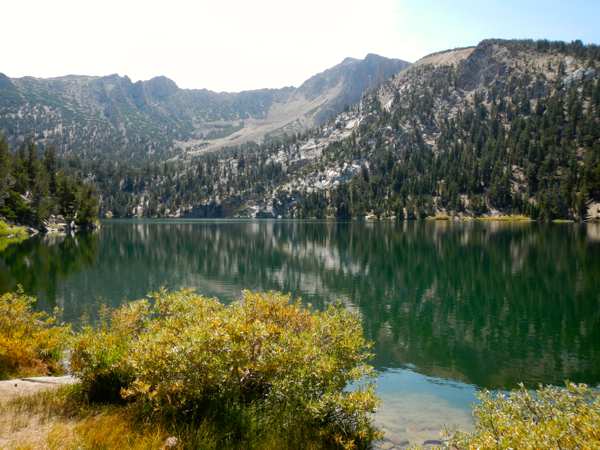
Star Lake is at an elevation of more than 9,000 feet. Photos/Kathryn Reed

Star Lake is at an elevation of more than 9,000 feet. Photos/Kathryn Reed

By Kathryn Reed

“Are we there yet?” is never a good question because inevitably the answer is “no” and the destination is still a ways off.

Such was the case with the hike to Star Lake a week ago. High Meadow trailhead is up, straight up, no switchbacks, on an old pitted road that is more suitable for a four-wheel drive vehicle than legs.

Enduring this stretch of trail, though, was well worth it. Star Lake is a jewel in the Sierra. As Rosemary said, it must have gotten it’s name from being so high it’s like the stars would be within reach if it had been nightfall.

The lake is at 9,100 feet.

Carolyn, who was wearing her FitBit, recorded 35,375 steps for the entire hike (which included walking around her house that morning) – as well as having logged 14.53 miles.

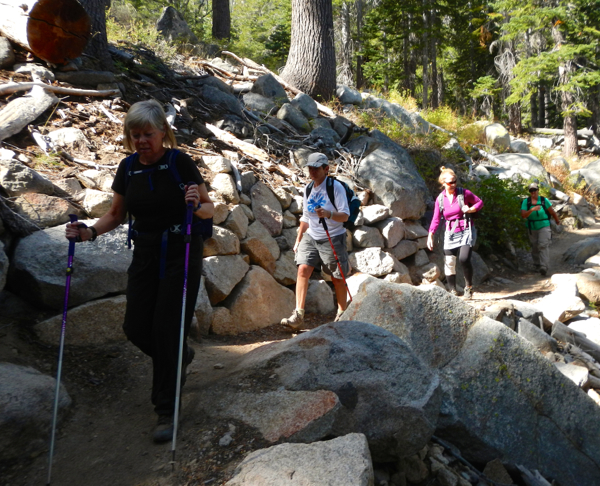
Carolyn, Rosemary, Brenda and Sue on their way to Star Lake.

Carolyn, Rosemary, Brenda and Sue on their way to Star Lake.

Before reaching High Meadow we turned off to the right toward Star Lake. (There’s now a sign there.) The trail became single-track, more gradual – even level at times, with the lodgepole and Jeffrey pines being interspersed with some juniper trees higher up. At one point the five of us walked through a quartz field; not a common sight in Tahoe.

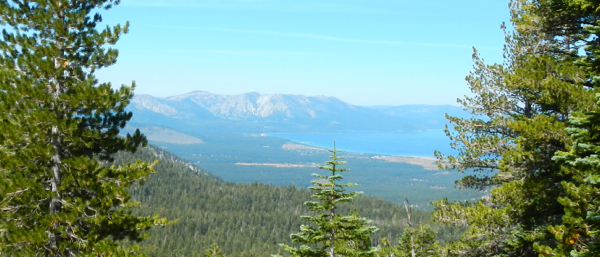
Intermittently views of Lake Tahoe and the entire South Shore unfolded below us.

Water flows in a couple spots, which AJ was appreciative of.

Our destination – Star Lake – was too cold for our gang to swim in, but that didn’t stop others from cooling off. A couple tents were in the area, with openings to views of the jagged mountains surrounding the lake. Plenty of beach-like areas surround the water – perfect for a lunch break.

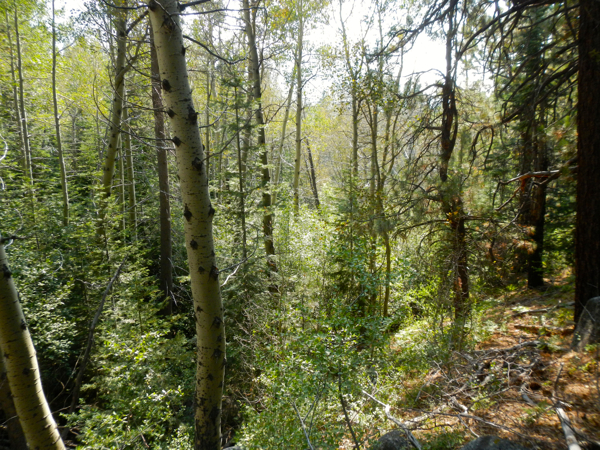
A fertile environment, including numerous ferns, along Cold Creek.

A fertile environment, including numerous ferns, along Cold Creek.

We were able to make a loop to avoid the road on the way back. We turned right toward the meadow on our way out.

The U.S. Forest service in 2012 completed a three-year, $2 million restoration of the meadow that realigned Cold Creek to more of its natural meander.

A slew of trails are in the area – including the Tahoe Rim Trail. It’s popular with mountain bikers. But one needs to be in good shape and able to navigate challenging terrain.

“After three seasons of work, the Monument Pass trail was completed in 2014. The trail connects from High Meadows to the Tahoe Rim Trail at Monument Pass with interesting rock formations, aspen groves, and views of Lake Tahoe.  The Star Lake Trail was completed in 2012 and was rerouted from the original road, which was overly steep with a fall line alignment. The trail gently climbs for approximately 3.8 miles to Star Lake and the Tahoe Rim Trail,” Garrett Villanueva, trails expert with the USFS, told Lake Tahoe News.

Monument Peak – which is the backside of Heavenly Mountain Resort – is on one side of the meadow at 10,067 feet. The meadow is at an elevation of 7,834 feet. Across the other side of the meadow are Freel, Jobs and Jobs Sister.

Lake Tahoe from the trail.

Lake Tahoe from the trail.

The foliage is more dense and lush along the Cold Creek trail. Near the top the aspens look healthy, whereas closer to the bottom the leaves have black splotches, with many branches barren. Still, this is so much prettier than the road we went up on in the morning. It’s also longer, but well worth it.

There were more “Are we there yets?” on the way down, but no one was complaining about having spent another glorious day hiking in Lake Tahoe.

—–

Getting there:

From South Lake Tahoe – get onto Pioneer Trail. Turn onto High Meadow Drive. This is the corner where Sierra House Elementary is. Drive as far as you can. Take the main trail that looks like a road.