Panelists empower women to be change makers
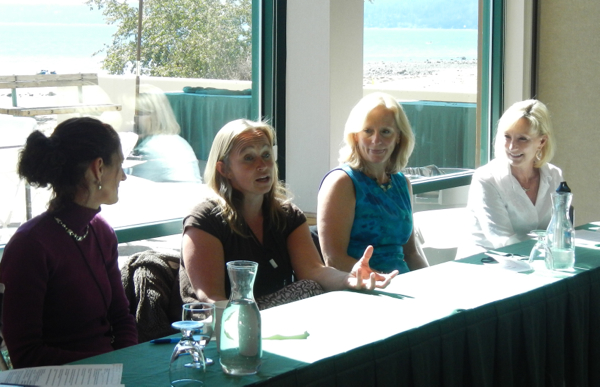
Talking about how to get things done when it seems impossible are, from left, Rebecca Bryson, Kathy Haven, Kristin York and Cindy Gustafson. Photos/LTN

Talking about how to get things done when it seems impossible are, from left, Rebecca Bryson, Kathy Haven, Kristin York and Cindy Gustafson. Photos/LTN

By Kathryn Reed

KINGS BEACH – Creating change is not always an easy undertaking – whether it’s personal or professional. But if it is to happen, it has to start with the individual.

That was the overriding message Oct. 2 as more than 100 people attended a daylong retreat in Kings Beach.

Women as Change Makers was designed to have an impact on women in the greater Lake Tahoe area by providing a series of diverse workshops. Rayona Sharpnack of the Institute for Women’s Leadership was the keynote speaker, focusing on getting women to not be afraid to make positive changes in their lives.

The breakout sessions included:

·       Making the Impossible Possible: Changing Systems Within Systems

·       Global Change Makers

·       Men as Partners to Women as Change Makers

·       Sowing the Seeds of Local Food Systems

·       The Art of Storytelling

·       Getting it Done: Lessons from Female Innovators and Entrepreneurs.

The all-day event was a fundraiser for Zawadisha, an organization started by local Jen Gurecki that provides small loans for items with big impact to women in rural Kenya.

Tenacity and collaboration are two traits that kept surfacing during the Making the Impossible Possible panel discussion.

“It’s not just the how and what. It’s the why. I think women are great persuaders,” Cindy Gustafson, general manager of Tahoe City Public Utility District said. “Persuasion is not just talking, it’s also listening.”

She said to get things done it takes passion, persuasion, patience and persistence.

There was a time when putting in sidewalks in Tahoe City was met with so much resistance that others would have moved on to the next project. Not Gustafson. She put the four P’s to work and eventually got the sidewalks put in.

Joining her in imparting ideas about how to overcome obstacles to get things done were Rebecca Bryson with Lake Tahoe Sustainability Collaborative, Kathy Haven, Bijou Community School two-way immersion program, and Kristin York, Sierra Business Council.

York stressed the need to find common ground to establish a working relationship so the differences could more easily be overcome.

Bryson has found that stories and emotions can paint a more poignant picture than just a bunch of facts and figures.

Haven touched on needing to know one’s audience and change the delivery of the message to suit particular groups.

“Change is scary, but it’s the only constant we have,” York said. “Sometimes detractors make the project better.”

Oftentimes people foresee an idea meaning more work. Coming in willing to do some of the heavy lifting could help the idea come to fruition.
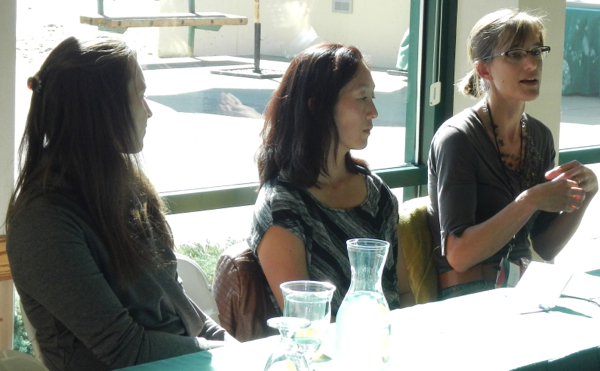
Michelle McLean, from left, SunMie Won an d Jana Vanderhaar discuss the imporance of local food systems.

Michelle McLean, from left, SunMie Won and Jana Vanderhaar discuss the importance of local food systems.

In the Sowing the Seeds of Local Food Systems talk the discussion centered on getting back to our agrarian roots.

“A lot of people don’t have basic cooking skills,” SunMie Won of Slow Food Lake Tahoe said. “A lot of food is heated or just assembled.”

Jana Vanderhaar with Verdant Connections and Michelle McLean of the Sierra House Elementary School growing dome project joined Won in promoting growing food locally.

McLean said parents at the South Shore school didn’t think their children would eat what was grown in the dome. At first the kids didn’t want to touch the soil, they were scared of bees and worms. They had to be taught this is how food is made – it doesn’t just come from a grocery store.

“This is life. It’s what we need to get back to,” McLean said.

The program is so successful in its first year full year that students are eagerly eating what they have sown, and no longer have a problem getting dirty to do the work needed to keep the domes alive.

“We’ve become so far removed from our food that we are scared of processing our own food,” Vanderhaar said.

She raises chickens and rabbits. The former for eggs and meat, and the latter for their meat, as well. She is the one who handles the butchering and preparation of the animals.

While all three admit growing edibles in the Tahoe-Truckee area is challenging, they also pointed out how it can be done with good results. While some in the audience were looking for a sure bet about what to grow and how to do it, the panelists said there is no foolproof way of farming in this climate or elevation, that it is a continual learning experience.

What they also all stressed is the need to know where one’s food comes from – and the backyard is the way to ensure it is the freshest.

“Planting seeds really empowers everyone,” Won said.


Millions in CalFire prevention funds not spent

By Jim Miller, Sacramento Bee

Amid a drought that has created bone-dry conditions across much of California’s wildland area, a state fire prevention account has ended recent fiscal years with tens of millions of dollars unspent.

The money has been generated by a contentious, 4-year-old fee pushed through by Gov. Jerry Brown and legislative Democrats over the objections of Republicans and rural property owners. The state collected more than $300 million through June and spent about $260 million, including roughly $228 million on administration and statewide prevention activities, vegetation clearing, defensible space inspections and other programs. About $22 million went to a state tax agency to cover collection costs.

But as fires burned hundreds of thousands of acres this year, the state ended the fiscal year in June with an estimated $43 million in fee money left over.

More than 800,000 property owners pay the fee, most of them $117.33 a year for each habitable structure.

Read the whole story


More jobs and fewer people, but limp raises

By Associated Press

WASHINGTON — Companies have posted a record number of job openings just when a diminished proportion of Americans are either working or looking for work.

That combination ought to push up pay. Yet it hasn’t worked out that way, at least not yet. Wage growth actually dipped in September.

The ongoing mystery of sluggish pay growth is important to everyone who wants a raise. It’s also frustrating for the Federal Reserve, which wants to see the steady job gains of the past several years translate into higher pay. This would boost the Fed’s confidence that the economy’s growth is sustainable and that inflation will return to the central bank’s 2 percent target.

U.S. businesses certainly seem interested in hiring. There were nearly 5.8 million open jobs at the end of July, the most since record-keeping began in 2000. At the depths of the recession in 2009, that figure was barely above 3 million.

Yet on Friday, the government’s monthly jobs report showed that the percentage of people in the workforce — those who either have a job or are looking for one — reached a 38-year low of 62.4 percent.

Why? Because many Americans who were once unemployed have become discouraged, returned to school or chosen to stay home, in some cases to care for relatives. Their exodus has helped shrink the unemployment rate to a seven-year low of 5.1 percent. That’s because people who aren’t actively looking for a job aren’t counted as unemployed.

So with fewer Americans on the hunt, employers, who face a record number of advertised jobs, should be feeling pressure to raise pay. But average wages in September rose just 2.2 percent from a year earlier, a tepid pace far below the 3.5 percent gain typical of a healthy economy.

One likely reason pay isn’t growing faster, economists say, is that the low unemployment rate overstates the job market’s strength. That is, some people who the government thinks have “dropped out” and whom it no longer counts as unemployed would actually take a good job if it were available. If those people had left the workforce permanently, employers would be compelled to offer more pay to draw from a smaller pool of potential hires.

If so, this has implications for the Fed’s interest-rate policies, economists say: It suggests that the Fed should keep rates lower for longer. Stronger economic growth and more robust hiring could spur more discouraged workers to look for a job. Only then might pay levels broadly increase.


Kids go outdoors to learn about plants, animals

By Kathryn Reed

A lagoon that looks more like a mudflat became a wealth of scientific discovery for Tahoe Valley Elementary School students.

“I learned how to keep water clean,” third-grader Sabrieo Parker said. She also learned that certain weeds could be bad for native fish.

Students throughout Lake Tahoe Unified School District spent last week and will spend part of this week getting out of the classroom to learn about their environment.

“The biggest message was when you have invasive species it hurts native species,” Adilene Negrete with the U.S. Forest Service said.

This is true of plants and animals.

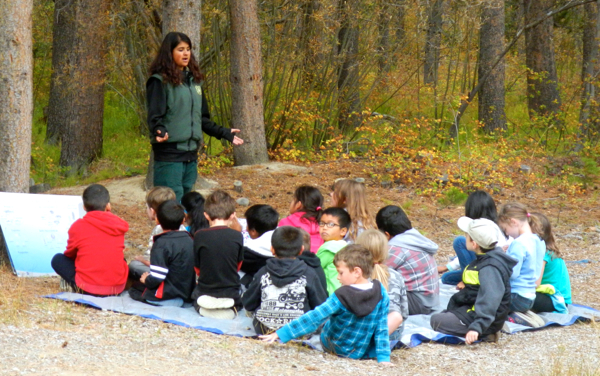
Adilene Negrete with the U.S. Forest Service teaches students about aquatic invasive species. Photo/Kathryn Reed

Adilene Negrete with the USFS teaches students about aquatic invasive species. Photo/Kathryn Reed

Savannah Rudroff with the League to Save Lake Tahoe was imparting information about plants in the area – primarily Eurasian milfoil and curlyleaf pondweed – that are not native.

A magnifying glass allowed the students to see the plants in greater detail. Then they got to color them – a step in reinforcing what they look like, with the idea they will be able to identify them outside the classroom experience.

Besides learning about specific fish and plants, the youngsters also broadened their vocabulary – learning what native, non-native and invasive mean.

Instruction is geared toward the appropriate grade level, with K-5 part of the outdoor classroom.

Also helping educate kids, though not necessarily each day, are representatives from the Tahoe Regional Planning Agency, South Tahoe Public Utility District, Lake Tahoe Humane Society, Tahoe Institute for Natural Science, Sugar Pine Foundation and community volunteers.

Each outing was as close as possible to the actual school site. This was designed to allow teachers to go to the location to further the learning experience.

For TVES kids it mean walking outside the back gate to the area near the Tahoe Keys lagoon.

This is the fourth year Beth Quandt, science outreach coordinator for the district, has put together this program.

“All the activities get kids to see what is going on in their environment,” Quandt told Lake Tahoe News.

Each lesson is age appropriate, with the curriculum growing from one level to the next.


Brown signs legislation to protect minorities from racial profiling and excessive force

By Patrick McGreevy, Los Angeles Times

In the wake of national public anger over killings by police in New York, Ferguson, Mo., and elsewhere, landmark California legislation to protect minorities from racial profiling and excessive force won Gov. Jerry Brown’s signature Saturday.

At the same time, the governor issued a blunt warning against the proliferation of laws criminalizing behavior as he rejected a trio of proposals intended to bar the misuse of unmanned drones.

In a forceful veto message, Brown said lawmakers were unnecessarily complicating California’s criminal code, which he said had grown to more than 5,000 provisions “covering every conceivable form of human misbehavior.”

Read the whole story


Why Americans eat like animals

By Abigail Carroll

American eaters, they’re like a pack of animals, hustling dinner in 10 minutes or less. It sounds like a recent complaint, but in fact it comes from 1864, when the Englishman John Francis Campbell was startled at the rapidity with which fellow steamboat passengers consumed their meals as they floated down the Ohio River. They were quick as foxhounds over their food, he marveled. Because service was family style, you risked leaving the table hungry if you failed to keep up. And Campbell wasn’t sure this speed such a good thing.

As this anecdote suggests, Americans’ affinity for hurried consumption—along with plenty of criticism for this tendency—go back a long way, at least as far back as when Campbell and his fellow passengers were journeying. The steady pursuit of efficiency, which informed new methods of travel, agriculture, and manufacturing, also informed American eating and has indelibly molded the modern American meal.

The trend was pervasive in 19th century, when European travelers often wrote amusingly of the swiftness with which Americans “dispatched” their food. They referred to meals at hotels as being “swallowed” or “gone through.” An Englishman at a hotel in Washington noted that boarders breakfasted in five minutes, while another Englishman, having learned the American way, recorded that he proudly rushed to the table to contribute his “strenuous efforts to the work of destruction”—that is, the destruction of several dishes, if not also of his digestion.

Why did 19th-century Americans have a penchant for hustling their meals? Most of the Europeans who commented on our gustatory speed failed to tender an explanation, though one observer accounted for it simply as “part of the go-ahead character of the people.” It was true: Americans were on the go, especially come the Industrial Revolution, which drove the growth of cities and changed the nature of work for a broad swath of the population. When factory clocks began to replace agricultural rhythms, meals underwent a thorough re-organization and deep transformation.

Workers in cities could no longer return home for a midday meal because of the increasing distance between work and home and the decreasing amount of time allotted for a midday recess. So dinner shifted to the evening, and a new meal emerged to fill the void: lunch. The idea here was a glorified snack, a stopgap between breakfast and dinner. Cold food was quick food, so it fit the bill, as did handheld items such as sandwiches, which didn’t require cooking, cleanup, or the use of utensils. If you wanted soup or hash or a slice of pie, you could visit one of the new cafeteria-style restaurants called quick lunches—pioneers of food service efficiency. From the one-arm joint (where you sat at a one-person table and didn’t have to waste time in conversation) to the automat (where you acquired food from a kind of giant vending machine and didn’t have to deal with wait staff or a cashier), fast food options of the late 19th and early 20th centuries abounded. They saved you time, and time was money.

Alternatively, some office workers chose to avoid the hassle of the quick lunch by eating a light meal from home at their desks. In 1904, Good Housekeeping profiled one such luncher who, complaining that his mind did not work as clearly for the first hour or two after a hot midday dinner, had shifted from restaurant meals to a sandwich prepared by his wife. “After eating in my office,” he explained, “I have a quiet hour to work without being bothered by the clamorous clients that infest a down-town law office at all other hours of the day.” For him, lunching light and alone meant productivity and peace.

Companies knew that time was money, and executives began to worry that quick lunch restaurants might cause workers to become sluggish from indigestion, reducing their productivity and compromising their profitability. Cold lunches brought from home also came under criticism because the science of the day found warm food to be more easily digested. “Neither dinner pail nor quick lunch … sends employees back to work in the afternoon with anything like the spirit with which they came in the morning,” noted Elmer Henry Fish in his 1920 managerial text, How To Manage Men. The solution was company lunchrooms that did more than serve free coffee (though that was a start); they also offered a selection of hot items at or near cost. These would fuel workers appropriately while keeping them on the premises, sparing them the stresses of undue hurry.

Breakfast underwent a similar transformation, turning lighter and quicker in the mid- to late 19th century—and efficiency became its hallmark. When reformers such as Sylvester Graham and William Andrus Alcott started promoting bread made from unbolted flour along with vegetarianism as a panacea for all manner of bodily ills, their primary aim was to improve Americans’ failing health—especially of the digestive sort. But the new, lighter, grain-based breakfast they promoted also happened to feed Americans’ desire for convenience, and convenience oiled the engines of profit.

John Harvey Kellogg of Corn Flakes fame invented a product he baptized Granola, his first cereal, not just to find a novel way of serving whole wheat at his sanitarium, but also to save time. “It was very difficult to prepare cereals,” he noted, looking back on his busy medical school life in New York City, where he had rented a small third-story room. “It should be possible to purchase cereals at groceries already cooked and ready to eat.” Instant cereal was the answer—you just added milk. Toast became a convenience food when sliced bread and pop-up toasters appeared on the scene, and it fit perfectly into the new breakfast model, upholding the twin pillars of convenience and health. While a traditional farmer’s breakfast demanded precious time and was likely to overtax the desk-worker’s digestive powers, ultimately reducing his output, cereal and toast saved time and kept your body fit for sedentary tasks.

The American pursuit of efficiency continues to shape our meals today, especially breakfast and lunch. Take, for example, the decline of Kellogg’s. Breakfast cereal was once a godsend for busy mothers, but now, as Devin Leonard reports in Bloomberg Businessweek, “Many people grab something on the way to work and devour it in their cars or at their desks while checking email.” Fast food breakfast sandwiches, single-serving yogurts, smoothies-to-go, and individually wrapped breakfast bars are taking the place of cereal and toast, and as they do, the drive for convenience carves the morning meal into an even more mobile, snack-like, and efficient eating occasion. Given our increasing interest in grazing, lunch is also looking less like a meal and more like a snack.

While many people who are disillusioned with the modern food system and our fragmented relationship with food are calling for a return to the art of the traditional meal, convenience continues to shape the way we eat. Perhaps this is because work has always shaped the way we eat, and what better way to make good on one’s time than to skip the hassle of meals altogether and simply fortify oneself with snacks? Or so the logic goes. In the 1830s, the Frenchman Alexis de Tocqueville noted the “feverish ardor” with which Americans seek to improve their well-being, and in this pursuit, he remarked, “they show themselves constantly tormented by a vague fear of not having chosen the shortest route.” Arguably, when it comes to eating, snacks and snack-like meals are “the shortest route.” In the era of industrialization, ideas about efficiency not only transformed the way we travel, work, farm, and manufacture, but also the way we eat. We Americans are still making our gustatory decisions with efficiency in mind.

Abigail Carroll is the author of “Three Squares: The Invention of the American Meal”. She has taught at Boston University, and she lives and writes in Vermont. She wrote this for What It Means to Be American, a national conversation hosted by the Smithsonian and Zócalo Public Square.


Marathon founder not ready to hand off baton

This marks the 20th year of the Lake Tahoe Marathon. Photo/Provided

This marks the 20th year of the Lake Tahoe Marathon. Photo/Provided

By Susan Wood

It may take as much dedication, stamina and love for the sport to run marathon operations as it does to compete in one.

When athlete extraordinaire Julie Moss finished the marathon of the Ironman in Hawaii in 1982 by crawling, six-time champion Mark Allen was so moved, he married her. It was one of the most unforgettable moments in sports.

And those endorphins can be just as important in the joint venture of a business deal, the hallmark of American society.

Locally, just ask Lake Tahoe Marathon founder and race director Les Wright – or even runner, adventure-sport guru Sean Sweeney. Sweeney, 48, and his business partner Jason Collin wanted to last year follow in the footsteps of Wright, now 73, and manage the high altitude marathon known for its stunning views and multitude of auxiliary running events. (It starts Oct. 8.)

But after an enduring more than a year of negotiations and rewrites beginning in March 2014, the deal fell apart.

Wright declined to comment on what happened. Sweeney, however, provided a bit of the high-road account.

Sweeney expressed interest in stepping in to take it over years ago. Wright, according to Sweeney, seemed interested enough to put together a contract involving an exit strategy and 15 concessions including one in which Wright would remain the race director and get paid.

“We spent a lot of time and a lot of energy, and we had an influx of new ideas,” said Sweeney, who also works in the Sierra-at-Tahoe marketing department.

Sweeney believes having 26 events “diluted” the weekend’s main event for the marathon purist.

“He has a lot going on,” Sweeney said. “We wanted to learn from him. But it was going on 14 months, and (he and his wife Cara) were going on vacation. We told him: ‘Vacation or not, if you don’t sign, we’re not interested.’”

Wright declined to sign, and the offer was pulled off the table.

“I’m probably never going to retire,” Wright admitted to Lake Tahoe News. This year is the 20th anniversary of the marathon.

Wright started the Lake Tahoe Marathon upon retiring from Lake Tahoe Unified School District as a physical education teacher at age 53.

“I did all those things I wanted to do when I retired – golf, fished, scuba and running. Then, I said: ‘I’m bored. I’m going to start a marathon,’” he recalled saying to himself in 1995.

Where to place the route was the big question.

He always noticed the captivating stretch along Lake Tahoe’s West Shore from Tahoe City to South Lake Tahoe.

“The beauty of that road gives me chills,” Wright said.

He put out fliers for the September event, and “it just took off from there,” he reflected back on the early beginnings. The first year brought out 250 runners. The next year, 1,300 people signed up. The high mark was 2,800 entries set a few years ago.

Collectively, the event rakes in about $20,000 in proceeds that are earmarked to groups such as Tahoe Arts Project, Valhalla and Tahoe-area schools. Volunteers work the 18 aid stations on the 26-mile route starting at a not-for-the-faint-of-heart 6,227 feet with a 2,000-foot elevation gain. It now ends at Lakeside Beach after two decades of ending at Pope Beach.

Along the way for the Thursday through Sunday extravaganza, Wright has added events – to the point the collage may seem overwhelming to the average participant. There’s the Tahoe Triple (three marathons in three days), Trifecta (three half marathons and a full marathon involving the East Shore.) Tack on a 10K, a swim-run duathlon, standup paddleboarding and kayak races as well as two pumpkin fun runs. In addition, a four-person marathon relay has been added to entice those not wanting to tackle a 26-miler or even half the distance.

“A lot of people will like to do that,” he said.

Overall, about 2,000 people have signed up this year for the multitude of events.

Race director Les Wright fires the start gun. Photo/Provided

Race director Les Wright fires the start gun. Photo/Provided

“No matter when I do it, there’s a conflict,” Wright said, illustrating the focus of events at Lake Tahoe in recent years. The events have been in September and October.

And under the guise of “there’s a reason for everything,” Sweeney and Collin have excelled in their own right by launching Epic Tahoe Adventures, a company that specializes in events to cultivate athletic prowess.

One successful event is the Rock Tahoe Half Marathon scheduled on June 18. With 2016 being its second year, the event has already signed up 500 participants and may take up to 3,000. The first year brought out 2,000 runners. Its slogan “run-rock-recover” goes well with Tahoe’s work-hard, play-hard mantra.

Add in a little techno benefit such as participant access to a recorded clip of themselves on the course, and the half marathon set on the East Shore has an appeal all its own. For starters, the website received more than 800,000 hits – 30,000 in the first two hours, according to Sweeney.

And more is in store from Sweeney’s athletic company.

This could be all good news to a runner like Brenda Knox, a Tahoe Mountain Miler.

“The race is well done. When I finished (this) year’s, I signed up immediately after,” said Knox, who has also competed in the Lake Tahoe Marathon. She’s “not a fan” of shuttles, so seeks out ways to avoid them. This year’s Rock Tahoe Half Marathon fit the bill.

And according to Lake Tahoe Visitors Authority Executive Director Carol Chaplin, there’s room around the lake for both events.

“In some ways, the two events are not comparable,” she said.

Chaplin pointed out how Rock Tahoe is a half and Lake Tahoe Marathon is a half, as well as a full version, along with other events.

Also, one is scheduled in June, while the other is slated in October.

Better yet, both events go hand in hand with Tahoe tourism stakeholders’ quest to make “outdoor recreation pretty much the focus,” Chaplin said.

“Whether there’s growth potential, we can’t answer that now. But I do think this area can support these two events. They don’t compete. We support more than one music event – as long as it’s not on the same weekend,” she said.


Plastic bag manufacturers file second Calif. measure

By Associated Press

Plastic bag manufacturers filed a second ballot measure on Friday in California’s fight over a statewide plastic bag ban.

The American Progressive Bag Alliance, which represents bag manufacturers, proposed an initiative that would require bag fees estimated at more than $400 million a year go into an environmental fund rather than be kept by grocers.

California’s first-in-the-nation state ban on plastic shopping bags was put on hold this year when the trade group placed the issue before voters on the November 2016 ballot.

If voters uphold the ban, grocers will be allowed to charge a fee of at least 10 cents for using paper bags.

Under the new initiative, voters will be asked to direct those fees from grocers and retailers into an environmental protection fund.

“While we are confident California voters will reject the statewide bag ban scam at the ballot in 2016, we know that 84 percent of people believe that bag fees in general should go to a public purpose, instead of increasing profit margins for grocers,” said Lee Califf, executive director of the plastic bag alliance.

Supporters of the ban have criticized manufacturers for spending millions on the referendum campaign to continue selling single-use plastic bags. A message left with Californians vs. Big Plastic, a coalition of environmental, labor and business groups supporting the plastic bag ban, wasn’t immediately returned Friday afternoon.

Gov. Jerry Brown signed the bag ban after one of the fiercest legislative battles of 2014, pitting bag-makers against environmentalists. It was scheduled to be phased in starting in July at large grocery stores and supermarkets as a way to cut down on litter and protect marine life.

The bag alliance said the ban will cost manufacturing jobs and boost profits for grocers, who can charge customers a premium for bags now given away for free.
Environmental activists have successfully pushed plastic bag bans in cities across the U.S., including Chicago, Seattle and Austin, Texas. Hawaii also is on track to have a de facto statewide ban, with all counties approving prohibitions.

More than 100 cities and counties in California, including Los Angeles and San Francisco, already have such bans. Several other California local governments plan to move forward with their own bans as a result of the referendum, including San Diego, Santa Barbara County, Sacramento, Oceanside and American Canyon.


EPA sets stricter standard for ozone

By Amy Harder, Wall Street Journal

WASHINGTON—Environmental regulators significantly lowered a national limit for a smog-causing pollutant Thursday, in an attempted compromise that left some businesses relieved and environmental and health leaders upset the initiative wasn’t stronger.

The Environmental Protection Agency set a limit of 70 parts per billion for ground-level ozone, which is created by emissions released into the air by manufacturing plants, utilities and vehicles, down from the current level of 75 parts per billion. In a draft released in 2014, the agency proposed a standard between 65 and 70 parts per billion.

Still, the move prompted criticism from business executives who didn’t want the EPA to change the limit at all, and from environmental and health groups that said it wasn’t tough enough.

Read the wholes story


Tax increases likely in Douglas County’s future

Douglas County wants to increase revenues so it can improve infrastructure. Photo/LTN

Douglas County wants to increase revenues so it can improve infrastructure. Photo/LTN

By Kathryn Reed

Douglas County commissioners will be faced with three tax related issues at a special meeting next week.

Sales and excise fuel taxes are likely to increase as well as the fee various utility companies pay. The county believes these tax increases will allow it to pursue state and federal dollars for projects – namely transportation – that require matching funds.

“As surrounding communities such as Carson City invest in their future, we need to plan for Douglas County’s future as well. It is imperative we ensure the safety of our residents for generations to come, while maintaining a financially stable, highly livable community for all of us to enjoy,” Jim Nichols, county manager, said in regards to why the hikes are necessary.

Commissioners can make the decision Oct. 5 without going to the voters. This is because Nevada statutes allow county commissioners to impose some of these taxes. The sales tax is proposed to go from 7.1 percent to 7.35 percent. That rate would exist indefinitely or until commissioners vote for a different percentage.

Douglas County Manager Jim Nichols believes increased taxes will keep the county solvent.

Douglas County Manager Jim Nichols believes increased taxes will keep the county solvent.

Projections are this will bring in $1.5 million to county coffers. The additional sales tax revenue would be earmarked for street and highway construction, and maintenance, as well as pedestrian amenities that would include trails.

“The proposed new sales tax will be treated similar to our PALS tax, it is a separate tax component in our property tax rate. What the county receives will be based on the actual collections in the county. The other component of the sales taxes we receive, and the biggest, is consolidated at the state level and then distributed. Douglas County is called a receiving county, which means we receive more from the state than we contribute of the consolidated funds,” Nichols explained.

Sales tax represents about 21 percent of this year’s general fund revenues.

Douglas County voters in 2018 will be asked to approve an additional one-half percent sales tax increase.

“The voters are being asked to consider a 0.5 percent increase to aid in addressing some of the connectivity projects identified for implementation. This tax increase would be in lieu of the 2.5 percent utility operator fee increase,” Nichols told Lake Tahoe News. Per Nevada statutes this particular tax has to go to voters.

It’s estimated to bring in $3 million per year. Some of that money could go toward public transit, whereas the first sales tax increase cannot be used for that per state law.

The 2.5 percent fee on utility operators is also on Monday’s agenda. The surcharge will be 0.5 percent on natural gas, 2.5 percent on electricity and 2.5 percent on telecommunications. These utility operators are already paying a 2.5 percent tax to the county.

“It is important to note that this fee increase would only go into effect if the proposed 0.5 percent sales tax is not approved by the voters (in 2018). If the utility operator fee increase is enacted, it could be used to leverage additional funds for regional transit and various transportation construction projects,” Nichols said. The county expects the utility fee to generate $1.6 million per year.

The utility fee does not alter the franchise agreements the county has with the various entities.

Currently, the county has 4 cents per gallon excise tax on fuel that was implemented by commissioners in 2001. What is on next week’s agenda is an additional 5 cents gas tax. The projected $900,000 it would generate is designated for road maintenance and to leverage funds for transportation construction projects.

While the state of Nevada prides itself on being tax friendly, counties are being faced with less revenue flowing from Carson City to their coffers and therefore need a way to pay the bills.

“Douglas County has an opportunity to address many of the transportation issues in the county, some of which are safety hazards to our children, bicyclists, pedestrians and drivers. In addition we can implement many of the projects identified in our Master Plan, Transportation Plan, the Valley Vision, South Shore Vision and other related documents. We can do this by leveraging grant funds if we have a match to make us competitive,” Nichols said. “We can also achieve full funding for regional road maintenance. We would be joining many of our surrounding communities that already have these and higher taxes in place and yet they are still considered tax friendly.”

—–

Notes:

·       The meeting is Oct. 5 at 1pm at the Douglas County Historic Courthouse, 1616 8th St., Minden.