Strongest El Nino in decades may mess with everything

By Brian K. Sullivan, BloombergBusiness

It has choked Singapore with smoke, triggered Pacific typhoons and left Vietnamese coffee growers staring nervously at dwindling reservoirs. In Africa, cocoa farmers are blaming it for bad harvests, and in the Americas, it has Argentines bracing for lower milk production and Californians believing that rain is finally, mercifully on the way.

El Nino is back and in a big way.

Its effects are just beginning in much of the world — for the most part, it hasn’t really reached North America — and yet it’s already shaping up potentially as one of the three strongest El Nino patterns since record-keeping began in 1950. It will dominate weather’s many twists and turns through the end of this year and well into next. And it’s causing gyrations in everything from the price of Colombian coffee to the fate of cold-water fish.

Read the whole story


Ex-federal official: Dams are ‘dinosaurs’

A barge-mounted excavator hammers away at Glines Canyon Dam, the largest dam removal in U.S. history. Elwha River, Olympic National Park, Washington in a scene from DAMNATION. Photo: Ben Knight

A barge-mounted excavator hammers away at Glines Canyon Dam in Washington, the largest dam removal in U.S. history. Photo/Ben Knight

By Anne Knowles

MINDEN — Dams and other surface storage are “dinosaurs.”

That’s according to Daniel P. Beard, the former commissioner of the U.S. Bureau of Reclamation, the government agency responsible for building and maintaining 475 dams across the country.

Beard spoke before and after a showing of the 90-minute documentary “Dam Nation” at the CVIC Hall here Oct. 21, hosted by University of Nevada Cooperative Extension and GreenACTnv, a local nonprofit promoting sustainable energy.

Dan Beard

Dan Beard

“They are the least effective way to deal with today’s problems,” according to Beard. “What we need to do is stop wasting water and promote water conservation and reuse. It is the cheapest, easiest solution to our water problem.”

Beard said Californians have already saved more water since Gov. Jerry Brown ordered cutbacks in April than would be produced by two proposed multibillion dollar dam projects in the Sacramento Valley and San Joaquin River Gorge.

“California conservation has demonstrated there is tremendous slack in the system,” Beard said.

He said we need to rethink the way water is priced in order to encourage conservation.

“We don’t hesitate to spend $3 for a half liter of water at the airport, yet somehow in our homes we expect we should get a lot of water and it should be cheap,” he said.

Beard also cited Australia where a 12-year drought forced the country to change its water law.

“Our water laws are irrational, first in time and use it or lose,” said Beard.

He said as a result water authorities such as the Southern Nevada Water Authority “circumvent” the law and buy up ranches and farms for the water rights.

SNWA spent $79 million to buy seven ranches in Southern Nevada a decade ago with the eventual goal of using the ranches’ groundwater to serve Las Vegas. The water authority grazes 11,000 sheep and cattle on the 960,000 acres.

Beard said he laughed when he read that the Nevada Legislature in the 2015 session could not pass a bill requiring vested water rights holders to prove their claims in an effort to inventory the state’s water supply.

Beard, who served as commissioner of the Bureau of Reclamation from 1993 to 1995, is the author of the recently published book “Deadbeat Dams,” in which he calls for the elimination of the Bureau of Reclamation and the removal of the Glen Canyon Dam.

The Glen Canyon Dam was built by USBR in the 1960s on the Colorado River in northern Arizona to provide water to the growing southwest. The dam filled the canyon to create Lake Powell and has been widely opposed ever since.

Beard said about 1,100 of the nation’s dams have been removed, mostly smaller ones. Larger dams cost millions to dismantle, such as Elwha Dam in Washington, the demolition of which is featured in the dam documentary.

Elwha Dam’s removal cost $350 million, said Beard.

Beard was the keynote speaker earlier Wednesday at a meeting of the Carson River Coalition in Carson City.


’15 in commanding lead for Earth’s hottest year on record

By Jason Samenow, Washington Post

Planet Earth is on a high temperature record-breaking tear this year, which shows no sign of relenting. 2015 is, by far, on track to become the warmest year in recorded history.

NOAA reports this week the globally-averaged temperature for September 2015 was the warmest of all previous Septembers on record, dating back to 1880, and by an unprecedented margin of 0.19 degrees.

September is the fifth straight month of 2015 to set a record high. Seven of nine months this year have ranked as top warmest.

Read the whole story


Lake Tahoe to host women, men Tour of California professional cyclists in 2016

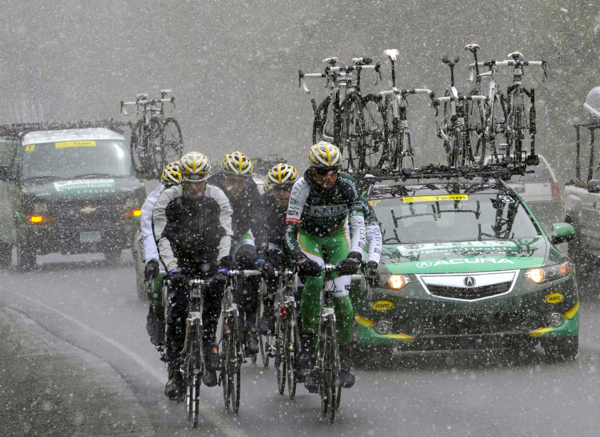
After the Tahoe stage of the Amgen bike tour was cancelled due to weather Sunday May 15, 2011 members of Team Kelly Benefits Strategies-Optumheal Th (U.S.A.) took a ride in near white-out conditions near Cave Rock. 

Tour of California organizers are confident snow will not be an issue in Tahoe like it was in 2011. Photo/Lisa J. Tolda/Copyright

By Kathryn Reed

Expect snow in May 2016 – Amgen’s Tour of California bike race is coming back to Lake Tahoe.

The men and women will be riding on the same day – May 19. The women’s stage 1 will start and finish at Heavenly Mountain Resort, and the men will complete stage 5 at the California Lodge after leaving from Lodi.

“The iconic landscape of the lake and everything else around it add a lot of beauty and glamour around the race. It shows off our state in the best light,” Michael Roth, with AEG, told Lake Tahoe News. “The biggest challenge is to continue to challenge the riders with a tougher course and I think they all appreciate that.”

AEG produces the multiday event that is now in its 11th year.
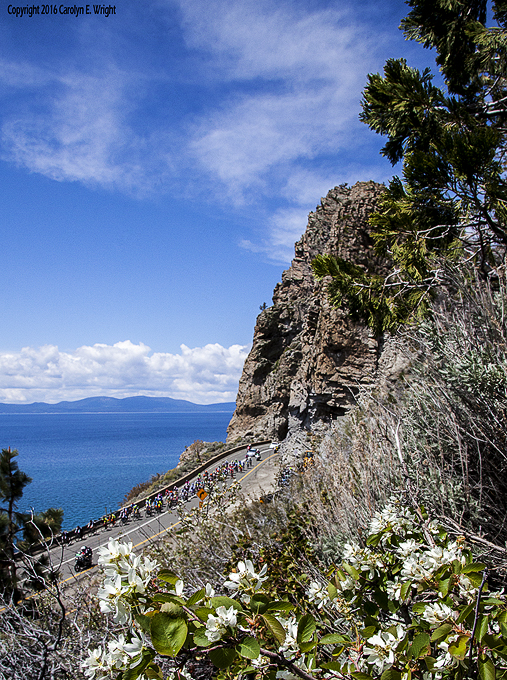
Tahoe-only views like cyclists coming through Cave Rock and the challenges of the route keep the area popular with riders and race promoters. Photo Copyright 2015 Carolyn E. Wright

Tahoe-only views like cyclists coming through Cave Rock and the challenges of the route keep the area popular with riders and race promoters. Photo Copyright 2015 Carolyn E. Wright

Sir Bradley Wiggins of Britain is the only confirmed cyclist. He won the race in 2014, which he did while being the reigning Olympic champion.

“He will be getting ready for his fourth Olympics in 2016. His road to the Olympics will come through California,” Roth said.

Other athletes who will be competing will be announced after the first of the year.

With the men’s race starting in Southern California a week later than previous years, organizers have their fingers crossed this will help when it comes to weather. This is the second year for a south to north route.

“A lot of times we get the question ‘Are the men ever coming back?’ A lot has to do with geography. When the start is in Sacramento or Santa Rosa it doesn’t make a lot of sense to come east,” Carol Chaplin, executive director of the Lake Tahoe Visitors Authority, told Lake Tahoe News.

Snow has been an issue each of the two times the race has come to Tahoe. In 2011, the men were to start near Stateline and finish at Northstar, with the second stage leaving from Squaw Valley. The two Tahoe area starts were aborted because snow was falling.

This past May it was touch-and-go as the women were getting loosened up for the start from the Cal Lodge at Heavenly. Mother Nature finally cooperated with skies becoming blue and the temperatures rising enough to give the green light. This year the women had two days of racing on the South Shore.

2015 proved Tahoe isn’t the only place where it snows in May. The men’s and women’s time trials had to be moved from Big Bear Lake because of the white stuff.

The threat of snow clearly isn’t keeping organizers away from Tahoe.

The men will ride about 800 miles between 12 host cities from May 15-22. They start in San Diego and end in Sacramento.

The women compete May 19-22, covering about 200 miles. The race will be the first U.S. event on the inaugural UCI Women’s WorldTour.

New this year is the men and women will be riding from the same start locations, but not on identical courses so they are not actually competing against each other.
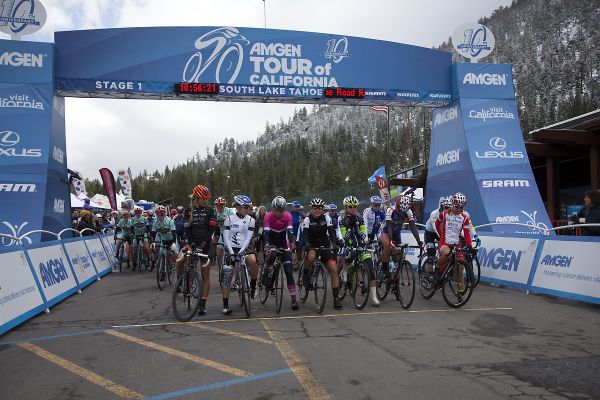
As in 2015, the women in 2016 will start from Heavenly Mountain Resort's California Lodge. Photo/Carolyn E. Wright/Copyright

As in 2015, the women in 2016 will start from Heavenly Mountain Resort’s Cal Lodge. Photo Copyright 2015 Carolyn E. Wright

The exact routes will not be released until later this year. However, with North Lake Tahoe Resort Association being a partner with the Lake Tahoe Visitors Authority in promoting the Tahoe aspect of the race, it is obvious the cyclists will be hitting the North Shore.

This year the women did the 72 miles around the lake and then finished with the steep climb up Keller Road in South Lake Tahoe. Another loop around the lake is being planned for 2016.

For the men, coming from the Central Valley the scenic route would be to come up Highway 88 over Carson and Luther passes. This keeps Highway 50 over Echo Summit, the main route for vehicles into the South Shore, open without delays.

Most likely the women will start and finish before the men arrive.

The next day – May 20 – is the time trials for the women and men. The riders and the 1,000-person entourage for the tour will drive to Folsom from South Lake Tahoe.

“It’s a great challenge for us to come up with the courses every year. We find new areas and locations to feature,” Roth said. “Part of the thing that makes this race so popular is that we continue to expose the race to new communities and we continue to bring it back to the communities that have supported it the most.”

One thing that makes an event like this different than other professional sports is the ability to meet the athletes before and after they ride, as well as participate on the same terrain they are on. Many of the riders hang out afterward at what becomes a party at the finish.

The lifestyle festival will be in the parking lot of the Cal Lodge. It is expected to be larger next year because South Lake Tahoe is hosting the two competitions, plus the men’s sponsors will be in town with booths. There will be VIP tents, which anyone can pay for that experience.

For those who aren’t in one of the host cities, the event is televised. ASO is AEG’s broadcast partner. This is the same company that for years has produced the Tour de France. The Tour of California is televised internationally, with more than 200 network affiliates part of the coverage.

“We do it primarily because it helps send the message that we are a great place for both elite athletes and recreational riders to come and enjoy spectacular scenery and really good riding,” Chaplin said. “We are also hopeful that it drives incremental overnight stays and there is an economic impact through the event.”

Recreationists lack transit options in Tahoe

By Jessie Marchesseau

This summer the Tahoe Rim Trail Association led the Connecting Tahoe Rim Trail Users to Transportation Alternatives project to study who was using the trail, what mode of transportation they used to get there, whether or not they were using two vehicles as shuttles (which equals even more miles driven) and whether or not they would use transit if it were available.

Results showed 86 percent of hikers arrived by car, 34 percent drove two vehicles in order to self-shuttle, and 59 percent indicated they would consider using transit if it were available. The project went on to examine what transit is currently available, what other communities are doing with similar situations, the alternatives going forward and finally made recommendations as to future transit policies and projects.

Mary Bennington, TRTA executive director, was pleased to announce that since they completed the study, transit stops have already been established in both directions at the Spooner Summit trailheads. The TRTA is also working on creating a TRT app that would help hikers plan and arrange trail access.

Public transit, specifically as it relates to people getting to trailheads, was the subject of the Oct. 21 Tahoe Talks Brown Bag Lunch Series put on by the Tahoe Metropolitan Planning Organization at Lake Tahoe Community College.

The series is designed as a lunchtime forum for residents to learn about and discuss topics affecting the community such as transportation, the environment and economic issues.

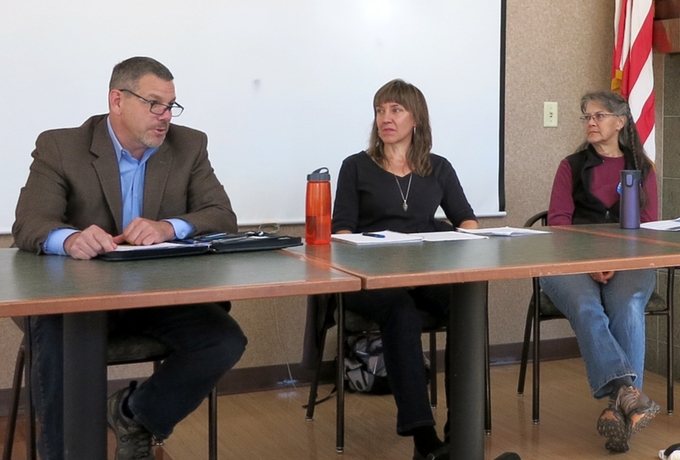
George Fink, Anjanette Hoefer, and Mary Bennington talk Oct. 21 about transit in Tahoe for recreationists. Photo/Jessie Marchesseau

George Fink, Anjanette Hoefer, and Mary Bennington talk Oct. 21 about transit in Lake Tahoe for those accessing trails. Photo/Jessie Marchesseau

This month’s Tahoe Talk was the first in a two-part series to be continued Nov. 18. The speaker panel consisted of Bennington; George Fink, transit system program manager for Tahoe Transportation District; and Anjanette Hoefer, supervisory civil engineer with the U.S. Forest Service. David Reichel, wilderness education coordinator for LTCC, acted as the moderator.

Bennington echoed what the other two panelists had said before her: there is a lot of opportunity here for public and private shuttle services.

Fink focused his short presentation on the importance of public transit and the need for it here in Lake Tahoe, in addition to the need for some changes to our existing system, such as a way for buses to transport more bicycles since an increasing number of riders are bringing their bikes along. (TTD is considering purchasing bike trailers to pull behind the smaller buses). He also discussed issues with transportation funding. Getting dollars for transit is difficult in general, but there are a number of circumstances at work in Tahoe which make it even harder.

Government money for transit is unpredictable, at best, and unquestionably inadequate. There are federal, state and local taxes allocated to transit uses, but they don’t add up to enough to make significant improvements to systems nationwide, and definitely not here in Tahoe.

Tahoe is unique in its transit needs for a number of reasons: first of all, the basin is located in two states, five counties and one city. No individual jurisdiction wants to pay for the transit services in other counties, and California doesn’t want to pay for transit in Nevada and vice versa. This makes funding public transportation from one side of the lake to the other complicated as it crosses so many boundary lines.

Another issue unique to Lake Tahoe is the huge lake right in the middle of the community. There is no central area or hub where everything disperses from like there is in Mammoth, Park City or Breckenridge. Recreation opportunities are located all along the highway that encircles the lake. As a result, adequate transportation to trailheads and recreation areas requires covering a lot more miles.

And finally, there is the issue of only about 50,000 people living in the Lake Tahoe Basin and somewhere in the neighborhood of 400,000 using the facilities. Tourism drives the local economy, but most tourists are not residents. Therefore a lot of the people using the roads and transportation services are not paying into county funds used to finance them.

But, Hoefer pointed out, not all transportation has to be provided by government services. Offering shuttles to and from popular trailheads could be a commercial opportunity for local businesses. She said the Forest Service is looking into creating some sort of permitting system for such services between its trailheads.

“With the public transportation, as you can see, there’s limited funding,” Hoefer said. “We can’t get people from everyplace within the basin to the trailheads they want to be. And there’s an opportunity for commercial providers to provide that, and we want to help work on ‘what does that look like, and how do we do it?’”

The floor was also opened to the 30 or so people in attendance to ask questions and share ideas. Some of the other suggestions/topics touched on included a shuttle to Echo Summit and/or Echo Lake, a Fallen Leaf Lake shuttle, a scenic bus or trolley tour encouraging tourists to ride rather than drive all the way around the lake, a ferry system, how to inform tourists of public transit opportunities, what to do about parking lots for people riding these shuttles, how to get more bikes on buses, and possible ways to get money for implementing any of these ideas.

There is also another side of the issue to consider: would public transit and easy access to trailheads cause overuse of certain areas and trails, ultimately damaging the forests and environment in the long run? It’s a question which can only be answered when and if any of this actually comes to fruition.

Part 2 of the Tahoe Talks Brown Bag Lunch Series on Transit: What’s in Store for Transit North and South? will be Nov. 18, noon-1:30pm in the Aspen Room at LTCC.


Study: Western wildfires threaten water supplies

By Bill Theobald, USA Today

WASHINGTON — The risk of severe wildfires in the West also threatens the region’s increasingly scarce water supply, a study finds.

The study, released Wednesday by the American Forest Foundation, highlights that wildfires are not just a public lands issue. Private and family lands also are at high risk, the study found, and much of that land is in critical watersheds.

“Unless we figure out how to treat all the lands … we are all at risk,” said Tom Martin, president and CEO of the foundation, noting that efforts to maintain healthy forests as a fire-prevention measure have focused mostly on public lands.

He said the foundation, which promotes stewardship by family forest owners, launched the study because it wanted to learn more about how the two biggest issues in the West right now — water shortages caused by extreme drought and the severe wildfire season — are related.

Read the whole story


Public-land transfer proponents may have violated lobbying laws

By Joshua Zaffos, High Country News

The central organization that advocates for Western states to take over federal public lands, Utah state Rep. Ken Ivory’s American Lands Council, is apparently running roughshod over state legislative rules.

The Colorado secretary of state announced last week that it has “reasonable grounds to believe” the ALC may have violated state lobbying and disclosure rules for failing to report political spending or to register as a lobbyist. The ALC, which leads the West-wide movement to transfer federal lands to states’ control, emailed Colorado supporters this spring to build backing for a bill that would have created a county commissioner-led task force to study the benefits of public-lands transfer to the state of Colorado. (The Senate bill failed by one vote.) The ALC has ushered similar bills through nearly every Western state legislature, with varying success.

The notice of possible violations followed an April complaint from Colorado Ethics Watch, a nonprofit watchdog group.

Read the whole story


Feds to regulate recreational drones

By Craig Whitlock, Washington Post

Federal regulators said Monday that they will require recreational drone users to register their aircraft with the government for the first time in an attempt to track rogue flying robots that are increasingly posing a threat to aviation safety.

The decision to compel drone owners to register their aircraft represents a policy shift by the Obama administration and a tacit admission by the Federal Aviation Administration that it has been unable to safely integrate the popular remote-controlled planes into the national airspace.

U.S. officials said they still need to sort out the basic details of the registration system — which they hope to set up within two months — but concluded that they had to take swift action to cope with a surge in sales of inexpensive, simple-to-fly drones that are interfering with regular air traffic.

Read the whole story


Sign issues dominate SLT council meeting

South Lake Tahoe councilmembers want to spend the winter crafting law to allow this sign to remain in town. Photo/Provided

South Lake Tahoe councilmembers want to craft law to allow this sign to remain in town. Photo/Provided

By Kathryn Reed

Signs – the fee for a permit and one that doesn’t meet the letter of the law – were hot topics at the Tuesday South Lake Tahoe City Council meeting.

A unanimous vote by the South Lake Tahoe City Council on Oct. 20 immediately reduced the fee for sign permits.

It’s an issue that arose after the council earlier this year changed the entire fee schedule. The goal in doing so was to have the fees reflect what it costs staff to deal with the particular issue. (Recreation is the main area the council agreed should be subsidized and not meet the true cost standard.)

What was approved earlier this year was a sign permit fee of $878. All councilmembers voted for that rate. It was reduced Tuesday to be $120 for a minor sign and up to $300 for a sign permit that is more involved.

No one councilmember championed the cause for the reduction, but instead they all agreed from the get-go when it was pointed out to them that it was excessive.

Work began in July for the fee to be changed. It went to the Planning Commission in September.

Other changes make the sign ordinance more like TRPA’s policy.

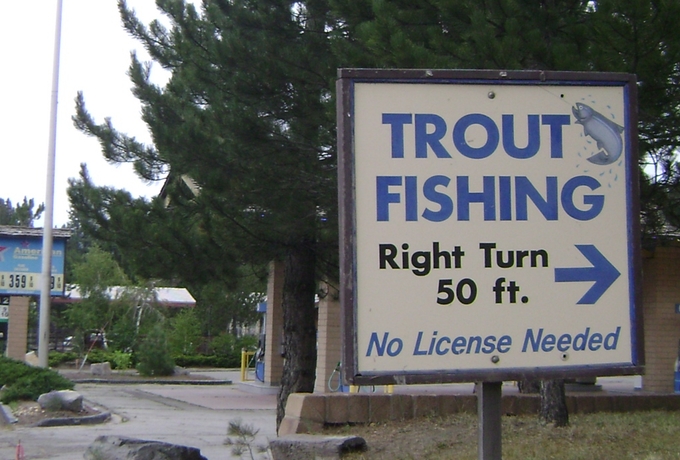
Also discussed at the meeting was the possibility of allowing Tahoe Trout Farm to keep its seasonal sign on the American Legion property on Highway 50. It is there when the farm is open, which this year was April 28-Oct. 1. The farm has been operating since 1946 – 19 years before the city was incorporated.

It does not meet city or Tahoe Regional Planning Agency regulations; neither allows off-site signs. The issue went to the Planning Commission. But there is nothing in city code to allow the sign.

The council agreed to uphold the Planning Commission’s decision to not allow the sign, but also directed staff to come back before spring with a proposal that would allow the sign to stay.

This is even though owner Jim Vallier admitted social media is what is driving people to his business, which he has owned for four years. He boasted to the council that the trout farm has gone from 60th to 12th place on TripAdvisor for things to do in South Lake Tahoe.

Kathy Vaughan, who lives across from the farm, wants the sign to stay, too.

“Let’s not eliminate old Tahoe. Keep that sign out there,” she told the council.

The city does allow for directional signs and local unique signs. The latter is more historical in nature, but the word “historical” is not used because it would trigger state involvement.

Councilwoman JoAnnConner said put an arrow on the sign and make it directional. It’s not that simple. After all, the sign already has an arrow on it.

The council wants to make other changes to the sign ordinance. At a future meeting the electeds will consider changing when sandwich boards can be put on the sidewalk. The Oct. 20 vote changed it to 5pm on Fridays. Councilmembers Tom Davis and Conner advocated to bump that to 2pm. The other three had no appetite to change it at this week’s meeting, and voted down the motion. Still, Davis and Conner only needed each other’s OK to have it brought back as a separate item down the road.

Also coming back will be whether businesses may use umbrellas with logos on them. Conforming to Tahoe Regional Planning Agency regs will be necessary. Graphic elements and the like will also have to be considered.

—–

In other action:

·      The council agreed to bring back the plastic bag ordinance that took effect Oct. 15 as it pertains to retail establishments.

·      Councilwoman Wendy David announced the Cal-Tahoe JPA that handles ambulance service for South Lake Tahoe and Lake Valley fire departments voted not to renew the contract with El Dorado County when it expires in 2019. Solutions are still being worked on.

·      Councilman Austin Sass noted the Tahoe Transportation District staff will be presenting updates on the loop road to Douglas County and South Lake Tahoe officials later this fall.

·      The council voted 4-1 to establish the Community Play Consortium Joint Powers Authority with Lake Tahoe Community College and Lake Tahoe Unified School District. Councilwoman Conner abstained. She and David, the two on the subcommittee, went back and forth as though they had not been at the same meetings at which the agreements were crafted.


Drought-stressed Calif. forests face a radical shift

By Thomas Curwen, Los Angeles Times

Biologist Greg Asner first heard the numbers in April, but they did little to prepare him for what he saw.

The Forest Service had estimated that nearly 12.5 million trees in the state’s southern and central forests were dead. But as Asner peered down upon the same forests from his airplane at 6,000 feet, he saw something far worse.

California’s drought-parched landscape was poised for a radical transformation. Much of the low-elevation forests near Mt. Pinos in the Los Padres National Forest and in Pinnacles National Park were going to disappear if trends continued.

A scientist with the Carnegie Institution for Science, Asner has a practiced eye for forest health, and with instruments aboard his plane that give him X-ray eyes into the foliage, he is able to assess not just dead trees but trees so stressed by the drought that their death is likely.

Read the whole story