Mental health issues a concern in S. Lake Tahoe

By Kathryn Reed

There is no magic pill to cure mental illness. There is no one-size-fits-all diagnosis. There is no single cause.

The complexities of the illness and limited resources in South Lake Tahoe can exacerbate the problem or delay diagnosis. And being in a small town may mean those in need feel intimidated about asking for help for fear they will be mocked or run into the person who is helping them at the grocery store or elsewhere. Added to the equation, Medi-Cal options are limited.

These were some of the revelations to come out of last week’s mental health workshop sponsored by Tahoe Regional Young Professionals at Lake Tahoe Community College. Panelists were Cheyenne Lane with Tahoe Youth & Family Services, Sabrina Owen from El Dorado County Mental Health Services, and Betsy Glass, social worker with Barton Health.

Lane has noticed that while her agency’s crisis line is receiving fewer calls, experts don’t believe this is because the need has diminished.

“I think now we need something more like a text help line. We would get more younger people to talk to us,” Lane said.

With there being no psychiatrist in South Lake Tahoe, Barton Health uses telemedicine to reach specialists. This month Barton started offering telepsychology as well. Patients are able to interact with these medical professionals remotely and in turn receive care and prescriptions.

TED Talks are another resource, according to the panelists. This is for those in need of help and those wanting to learn what can be done.

Cheyenne Lane with Tahoe Youth & Family Services, Sabrina Owen from El Dorado County Mental Health Services, and Betsy Glass, social worker with Barton Health.

Cheyenne Lane with Tahoe Youth & Family Services, from left, Sabrina Owen from El Dorado County Mental Health Services, and Betsy Glass, social worker with Barton Health, talk about metal health issues. Photo/LTN

All three said it’s imperative for each member of society to learn compassion, to listen to people and then try to provide help. Help can be a shoulder to cry on, getting the person care or alerting authorities.

Those with mental health issues are prone to hurting themselves as well as others – sometimes fatally either by committing suicide or homicide.

Owen said car accidents don’t always get recorded as a suicide or the deliberate killing of someone else. Without a note left behind or a survivor to tell the story, these deaths get labeled merely as a vehicle “accident”.

About one-third of the audience admitted to having had thoughts of suicide in the past. The professionals guessed even more sitting there were afraid to raise their hands.

Depression is a mental issue with many gradients to it. It is something everyone will experience. It’s the degree and how one copes with it that varies so greatly.

“A lot of times people with mental health issues are always in a state of anxiety,” Lane said.

How a past trauma translates to mental health issues is a relatively new area of study. Glass said conversations and studies about physiological impact on mental health are just starting.

Trauma could be a car accident, military experience, sexual abuse, childhood upbringing or something else.

“Your history affects how you respond to current situations,” Owen said.

The presenters noted that on the South Shore the level of poverty (more than 60 percent of students in Lake Tahoe Unified School District qualify for a reduced or free lunch) is contributing to mental health issues. It may be manifested with alcohol or other drug use, domestic violence or child abuse.

Poverty often means poor nutrition and living conditions. This can all lead to stress. Stress is a mental issue and can escalate into unhealthy situations.

Lane said one of the problems with today’s society is people are desensitized.

People seem to accept certain behaviors that a few years ago would have come with consequences for the aggressor.

“When we are in pain we hurt others. We hurt ourselves,” Glass said.

Mental issues also can come in the form of bullying and lashing out. That type of inflicted pain is harder to define. It’s something akin to knowing what pornography is when one sees it, but not always being able define it cerebrally. Mentally stable individuals don’t routinely act in a bullying manner.

“Bullies are often diagnosed with anti-social personalities,” Owen said.

She said children who are bullied tend to have issues as adults.

But it’s not just adults who have mental health issues.

According to the gun-control advocacy group Everytown Gun Safety, there were an average of two shootings a month in K-12 schools in 2013.

There is a growing desire by some in law enforcement and mental health circles for the media to not use the names of the shooter. This way their deadly act is not glamorized. For the media, though, the First Amendment is a concern.

Owen said it’s important to talk about what goes on, but at the same there is a need to be careful what the media shows.

School shootings aren’t just something local law enforcement deals with. The FBI has a behavior-analysis team working with schools that have identified students they believe pose a potential threat. The federal government has also made $45 million available for armed school resource officers.

South Tahoe High School for years has had such an officer on campus – at least sporadically.

California requires all law enforcement officers to receive some training in how to handle calls involving mental health issues. A select number of El Dorado County sheriff’s deputies have received extra training to be more specialized in these types of situations.

—–

Notes:

·      South Lake Tahoe 24-hour crisis hot line – 530.544.2219.

·      National 24-hour crisis hot line – 800.273.8255.

·      There will be a free Mental Health First Aid for Youth class through Barton University on Nov. 22 from 8am-4pm. For more info, go online.


The offshore game of online sports betting

By James Glanz, Agustin Armendariz and Walt Bognaich, New York Times

Hard by the High Line, in a vintage industrial building with a Romanesque arch, lights flash on powerful computers in row after row of metal cabinets and cages. Power lines connect the equipment to diesel generators on the roof. Cables route data through the building to conduits beneath New York City streets.

This is one small corner of the Internet, unremarkable except for the confluence of two facts: Sports betting is largely illegal in the United States. And this Manhattan building, on 10th Avenue in Chelsea, is one node in a vast network used by a major offshore sports book — ever faster, ever more sophisticated and harder to track or regulate.

The network is traversed by United States customers of pinnaclesports.com, a hugely successful Internet sports-gambling company with headquarters until recently in a shopworn hotel in the tiny Caribbean island nation of Curaçao. The unlikely chief of Pinnacle Sports is a granddaughter of a former North Dakota governor who famously engaged in a bit of Cold War diplomacy with Nikita S. Khrushchev.

For years, offshore sports books like Pinnacle have used technology and other means to keep prosecutors at bay. In the United States, field agents are arrested, money is forfeited and the illegal gambling rings are seemingly dismantled. Yet they rise again, with different street soldiers and a new arsenal of deception. The one constant is the Internet, which allows for the electronic brain of these sports books to evolve, beyond the reach of American prosecutors.

This pattern raises a persistent question: Are the successes of law enforcement tantamount to cutting off a lizard’s tail only to see it grow again, and if so, is the battle even worth fighting? Is the better way — with gambling increasingly woven into the fabric of American sports — to simply legalize it so it can be regulated?

Read the whole story


Reward for water conservation is higher utility bills

By Sharon Bernstein, Reuters

Their lawns dry and their trees on the verge of dying, Californians have dramatically cut water use during the state’s relentless drought, only to learn that many local utilities are hiking rates to make up for the lost revenue.

Water providers in Los Angeles, the San Francisco Bay Area and other parts of the state have recently told customers that rates will go up at least temporarily, as utilities struggle to pay for building and repairing pipes, buying water and other costs, even as customers cut back.

“Droughts are costly for water agencies,” said Lisa Lien Mager, spokeswoman for the Association of California Water Agencies. “Revenues are being affected by the mandatory conservation but at the same time costs are going up.”

Read the whole story


S. Lake Tahoe picks airport plans with flexibility

By Joann Eisenbrandt

The South Lake Tahoe City Council last week took the next step in the Airport Master Plan process by selecting the preferred airfield and land side alternatives which will determine the future configuration of the airport. This update of the 1992 Master Plan looks out 20 years and determines not only the types of aircraft using the airport, but also potential non-aeronautical uses of airport property.

Michael Hotaling of C&S Companies, the Airport Master Plan consultants, went over the steps in the process for the council during the Oct. 20 presentation.

Hotaling reviewed their analysis to date, noting that there would be relatively modest growth for Lake Tahoe Airport in the next 20 years and that due to a shift in the aircraft industry the return of commercial service to Tahoe in the near term was unlikely. In August 2014, the council decided to release the airport’s Part 139 certificate for commercial service and embrace the general aviation alternative as the airport’s best future use.

He termed this meeting the “decision-making” step where the City Council chooses the preferred airport configuration, which will then go through an environmental review under CEQA.

There were seven airfield alternatives and four land side alternatives that were studied. They ranged from no-action through middle ground alternatives that combined retaining flexibility for future airfield uses with releasing some of the land for non-aeronautical uses to bring in needed revenue, to the most expensive alternatives releasing little land and requiring major airfield and taxiway changes to accommodate larger planes and possible commercial service in the future.

After reviewing choices made by the public at an earlier public meeting where residents chose preferred alternatives by placing dots on maps, as well as a more technical analysis of the alternatives using the EOS (Economic Vitality, Operational Efficiency, Natural Resource Conservation and Social Responsibility) scoring scale the consultants recommended Alternative 2C.

The council expressed concern that some of the land designated for release to non-aeronautical uses would not work for that purpose because of terrain and steep slopes. They reviewed the alternatives and came up with a blended alternative 2B/C allowing for the most potential non-aeronautical uses such as warehousing, a fly-in campground, or a training center for the Forest Service, which could bring in added airport revenue while retaining airfield flexibility. The release of land for non-aeronautical uses will require review and approval by the FAA.

The consultants will now complete the Airport Layout Plan (ALP) and publish a draft final report. A CEQA analysis is then performed. This is a separate process for which the city will put out a request for proposal. City Manager Nancy Kerry said either C&S Companies or a new consultant could be chosen to undertake this analysis. The ALP is then adopted by the City Council and goes to the FAA for approval. Hotaling estimated this process will take about a year. Once the ALP is approved by the FAA the airport becomes eligible to receive federal grant funding.


Lawmakers demand plan for collecting El Niño water

By Sarah D. Wire, Los Angeles Times

The Republican members of California’s delegation are demanding a government plan to store the deluge of water that could come with El Niño this winter.

Fourteen GOP lawmakers sent a letter to President Obama and Gov. Jerry Brown on Thursday asking for specifics about how federal and state agencies expect to capture, save and transport water.

A new federal forecast released last week showed El Niño is continuing to strengthen, with experts saying it’s on track to potentially produce record rainfall across the state.

Read the whole story


Calif. needs a million grads with bachelor’s by ’25

By Kathryn Baron, Hechinger Report

MODESTO — When Emily Littleton was growing up, she was often awoken at night by the sound of her younger sister wheezing and struggling for breath from an asthma attack. Littleton would grab the nebulizer, hook it up for her sister and get her dad.

The experience remained deeply rooted in Littleton’s memory, resurfacing several years after she graduated from high school as a calling for a career. The first time she attended community college, Littleton said she vacillated from major to major finally earning a two-year degree in natural sciences. Then, while working at an assisted living facility, she heard about the respiratory therapy program at Modesto Junior College, and her past echoed, directing her choice of a career. In December, Littleton and her 23 classmates will graduate with their associate’s degrees.

But those degrees are already on the verge of becoming obsolete as respiratory therapy and other skilled fields increasingly require a higher level of education in order to meet rapidly expanding demands for greater technical know-how and knowledge. An associate’s degree just won’t cut it anymore.

“I’ve been watching with great concern the fact that many employers who previously required associate degree level training now require bachelor’s degree level training,” said Constance Carroll, chancellor of the San Diego Community College District.

Carroll helped launch a campaign to make it easier for students to earn bachelor’s degrees in these key areas. Last year, after two failed efforts, the state Legislature gave the go-ahead for some community colleges to offer bachelor’s degrees on a limited basis.

Read the whole story


Casey’s catering to locals with laid back feel

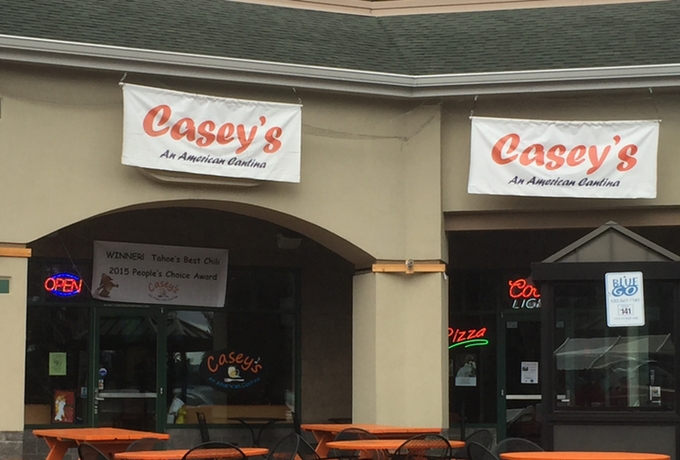
Casey's next to the Round Hill Safeway is becoming a distinct locals' hangout. Photo/LTN

Casey’s next to the Round Hill Safeway is becoming a locals’ hangout. Photo/LTN

By Kathryn Reed

Restaurant, sports bar, entertainment venue — Casey’s in the Round Hill Shopping Center is trying to have a little bit of something for everyone.

And now it can boast of having award-winning chili after chef Jorge Gonzalez won a cook-off last month in the Carson Valley. That same chili, which is a recipe Gonzalez created, is served at the South Shore restaurant.

Every Thursday at Casey’s a different nonprofit benefits from those bowls of chili, as a portion of the proceeds go to the charity.

For Tom Gallatin this is his first foray into the restaurant business. Prior to February, when he took over what was Coyote Grill, Gallatin had been an entrepreneur and an engineer in the tech industry. He has been in Tahoe since 2010 when he retired.

“I never owned a restaurant or small business before, but felt I knew what it was like to be a customer and understood things from the customers’ standpoint,” Gallatin told Lake Tahoe News.

Locals are hanging out at Casey’s regularly, but out-of-towners are also finding their way to the casual establishment.

First order of business for Gallatin was to improve the quality of food by changing suppliers and reducing prices. The menu was also altered a bit. He calls it “American comfort food with a Mexican section.”

The restaurant was remodeled at the get-go, now the bar is about to be overhauled. Starting Nov. 2 the eatery will be closed for a few days while a red granite bar top is installed with cherry wood on the front.

The layout changes are designed to improve service.

The beer system – with 10 taps – will all be new. Beer will be stored in the back with lines overhead in the ceiling, with a special cooling system. An inverted T structure will hang down over the top of the bar. The brass plumbing system will have lights around it so it will be the first thing people see.

Adjacent to where the food and drinks are served is what is called the living room. Down the road it will be revamped, too. This is where McAvoy Layne impersonates Mark Twain on the first Saturday of each month ($20 includes first drink), where on Sundays it becomes an open mic venue, and people can plan their special events.

With eight televisions, multiple sporting events are likely to be on.

The restaurant gets its name from the family dog Casey who died last year at age 23.

—–

Notes:

·       Address: 212 Elks Point Road, Round Hill.

·       Phone: 775-586-1822

·       Hours: 8am-9pm

·       More info is available online.


Mourners gather for S. Lake Tahoe officer, wife

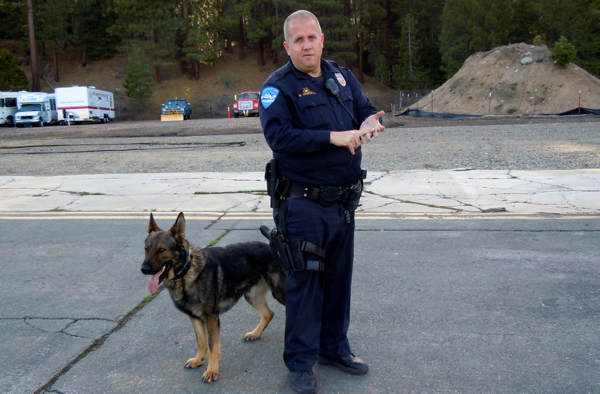
Mark Hounsell was a K9 handler during part of his tenure at South Lake Tahoe Police Department. Photo/LTN file

Mark Hounsell was a K9 handler during part of his tenure at South Lake Tahoe Police Department. Photo/LTN file

By Seth A. Richardson, Reno Gazette-Journal

A procession of police officers, firefighters, family and friends escorted Mark and Jeanne Hounsell underneath a flag hanging high over Stephanie Way in Minden to their memorial service.

Mr. Hounsell, 42, and Mrs. Hounsell, 34, died Oct. 17 in a rollover accident on Highway 50 near Fallon. Laura Fisher, 33, of Washington, Ill., also perished in the crash.

Mourners gathered at LifePoint Church on Saturday to remember the Hounsells. Media were not permitted to enter the service. Dozens of cars, police and civilian alike, were adorned with commemorative stickers that looked like the Chicago Cubs logo – Mr. Hounsell’s favorite team – with “MH 189” for his initials and badge number.

Read the whole story


Tahoe artist’s paintings dance to nature’s rhythms

By Amanda Horn, Reno Gazette-Journal

Ascending the stairs to the second floor of the Nevada Museum of Art, Donald W. Reynolds Center for the Visual Arts, E. L. Wiegand Gallery fuels anticipation for the visual symphony playing in the galleries above. A leftward glance through the glass into the second floor hallway reveals a stunning cerulean canvas flanked by whimsical golden flowers. The bold, colorful, 6-foot-5-inch painting dances on the wall, an affirmation that “Tahoe: A Visual History” evokes a mellifluous tone.

The eye-catching painting seems oddly familiar. Though you may not recognize the vista, the sentiment conveyed by Phyllis Shafer’s Above Cave Rock resonates at a subtle level. Shafer, one of 175 artists represented by 400 artworks in the Nevada Museum of Art feature exhibition, “Tahoe: A Visual History,” is part of a select group of Tahoe-based contemporary artists included in the museumwide show.

Since 1994 Shafer has taught art at Lake Tahoe Community College in South Lake Tahoe. The job prompted her relocation from the San Francisco Bay Area. This beloved artist has called Tahoe home ever since. She now co-chairs the art department and directs the college’s art galleries.

Read the whole story


Opinion: Bullying needs to be abolished

By Nancy Kerry

Recent articles and studies across America provide evidence that bullies are costly to our society. Bullies in the schoolyard have resulted in a substantial increase of suicide among children. After the 1999 Columbine massacre, the federal government passed anti-bullying legislation that swiftly swept across the nation with similar legislation adopted by all states.

However, most of those laws apply specifically to schools.

Nancy Kerry

Nancy Kerry

It is thought that by the time we become adults and enter the workforce, we would have matured enough to treat each other with respect, professionalism, and communicate effectively. Unfortunately, that isn’t always the case as evidenced by the need for anti-harassment laws.

A bully in the workplace can do substantial damage to an organization. Bullying is harassment and is just as costly in the workplace as the schoolyard, if not more so. Bullying is most often demonstrated in abuse of authority by those in leadership positions; it results in high turnover, lost productivity, emotional damage to those victimized, stress claims against employers and millions in settlements paid by employers who failed to take action.

The Declaration of Independence was adopted 239 years ago, setting forth the foundation of principles guiding our government as to how we should respect one another. Although the United States is much more complicated today, the tenets remain the same: “We hold these truths to be self-evident, that all men are created equal, that they are endowed by their Creator with certain unalienable Rights that among these are Life, Liberty and the pursuit of Happiness.”

What does the right to “life, liberty and the pursuit of happiness” mean in the workplace? It includes the right to pursue one’s civil liberties; it means employees have the right to enjoy a workplace free from harassment, bullying and discrimination. Following the 1883 Pendleton Act, it also means the right for government employees to retain employment based on competency instead of political connections and influence.

The evidence of bullying is found by listening to the receiver’s point of view, not the bully. A bully will likely have many friends and family members who don’t agree with a victim’s perspective of the conduct because they may not have experienced the same behavior. Bullies often deflect the concerns of those who have the courage to confront them and typically characterize their victims as complainers.

An employee who finds themselves bullied at work often has little recourse. It’s very difficult to prove your perspective; after-all it is the victim’s opinion of the conduct that is at issue. Multiple people witnessing the same conduct will have multiple perspectives. When the bully is a supervisor or leader in an organization, the perceived risk by the employee for reporting is increased. When it is from the highest level in the organization, the risk is real. As a result, employees are reluctant to speak up about the abuse they have suffered.

Workplace bullying is more prevalent than most employers realize. A 2014 study by the Workplace Bullying Institute found that nearly one-third of all employees experienced abusive conduct at work; “72 percent of employers deny, discount, rationalize or defend the conduct and in the absence of legal prohibitions against it, employers are failing to take responsibility for its prevention and correction.” Sometimes, a bully is not aware of the impact of their behavior, which is why it’s important for employers to address the issues early on to provide opportunity for change. If the behavior doesn’t improve, corrective actions will likely intensify. A person who fails to acknowledge how their behavior impacts and causes harm others may either be a bully or become one if left uncorrected.

A bully may defend their behavior as just being “their style” of communicating. Outside of an employment situation, their style may only be a societal harm. However, in the workplace, it’s not acceptable and can result in litigation for an employer. Being rude is not the same as being a bully; a bully is abusive. Abusive bullying behavior is typically persistent, aggressive, denigrating, hostile and intimidating. A bully seeks to shift a real or perceived imbalance of power through the misuse of their authority creating a climate of fear among employees. A bully will often strive to dominate with tactics to humiliate and belittle others using both subtle and blatant threats to restrain efforts to stand against such treatment.

When the behavior is a persistent pattern of conduct, it interferes with the employee’s ability to perform their jobs to the best of their ability. When it’s pervasive, it affects the organization’s legitimate business interests and undermines confidence. When it’s left unaddressed, the bullying may increase and victims can experience a variety of illnesses including anxiety, depression, migraines, stomach ailments and worse.

Whether bullying is illegal or not, it is the employer’s moral and leadership responsibility to protect their employees from all forms of harassment. Occasionally, all it takes is a conversation so everyone is aware of the problem and changes can be made. If that doesn’t work, putting an end to bullying in the workplace should be a high priority for every employer.

Nancy Kerry is the city manager of South Lake Tahoe.

—–

Publisher’s note: Lake Tahoe News has chosen not to allow comments on this article because of all the bullies who troll this site. If anyone wants to respond, there is always the option to write your own letter/column with your full name attached to it. Send it to info@LakeTahoeNews.net for consideration.