Ski resorts saying no to drones

By Anna Callaghan, Outside

Helmet-mounted GoPros have become a common sight at ski areas. The next step: ski-run footage shot from drones. As UAVs get more accessible and affordable (the Federal Aviation Administration predicts 1 million drones will be sold during the holidays this year), some organizations fear they could become just as ubiquitous as—but more dangerous than—action cams.

That’s why the National Ski Area Association (NSAA), the trade association for 330 ski areas in the United States and Canada, released a sample policy that bans drones without prior authorization. An overwhelming majority of the organization’s resorts, from Aspen to Jackson Hole, have already put that ban in place, or soon will.

“Drone technology is relatively new, and given that ski areas tend to be at high altitude and in cold climates, which affects the battery life of drones, their reliability remains untested,” says Dave Byrd, director of risk and regulatory affairs at the NSAA. “We’re also concerned that they may crash into chairlift towers, fall onto people, or startle people because of their noise and cause collisions. Also, having noisy drones flying all over the place goes against the grain of the sort of skiing-in-nature experience.”

Read the whole story


Barton doc outlines breast cancer facts

By Kathryn Reed

STATELINE – Even without a family history or other factors, nearly 13 of out every 100 women will get breast cancer. While family history is the No. 1 risk factor, 85 percent of breast cancer cases involve people with no family history.

The good news is the number of people diagnosed with breast cancer and those dying from it are declining. In large part this has to do with better screenings, improved surgical options, as well as advanced radiation and chemotherapy treatments.

Still, the American Cancer Society predicts there will be 231,840 new breast cancer cases this year and 40,000 deaths because of the disease.

These are stats that Amanda Weavil shared with Soroptimist International of South Lake Tahoe last week as part of what was Breast Cancer Awareness Month. Weavil is an obgyn with Barton Health.

Women between 50 and 55 are most at risk, while more white women are diagnosed with the disease. However, more black women die from breast cancer, Weavil said.

Modified risks – things women may have some control over – include:

·      Breast feeding – decreased risk

·      More than two alcoholic beverages a day – increased risk

·      Obesity – increased risk

·      Physically active – decreased risk

·      Oral contraceptive for more than five years – increased risk

·      Menopause after 55 – increased risk

·      Menstruation before 12 – increased risk

·      Never having kids – increased risk

·      Smoker – increased risk

·      Abortion – no bearing

·      Antiperspirants – no bearing.

Tomosynthesis is the newest technology for testing for breast cancer. It’s a type of mammogram. Barton will have the technology after the first of the year. The machine is being paid for by the Barton Auxiliary.

Barton Women’s Health, who Weavil works for, will be bringing on a third obgyn this month.

While the American Cancer Society came out with new recommendations in October when it comes to what age to begin breast screens (age 45), when to stop having them annually (55) and said self-exams are not worthy, Weavil said not all medical organizations are in agreement. The American College of Surgeons and American College of Obstetrics and Gynecology are expected to issue their guidelines after the first of the year.

For Weavil, she is sticking with the old regulations until the other two organizations weigh in. That includes the first mammogram at 40 and monthly self-exams.


Coyote hunt critics try again for Nev. ban

By Jeff DeLong, Reno Gazette-Journal

Opponents of coyote-hunting contests are trying once again to ban the practice in Nevada.

Four critics of what they describe as “gratuitous slaughter” have petitioned the Nevada Wildlife Commission to outlaw a controversial practice that gives cash or other awards to hunters who kill the most coyotes during so-called “coyote call” events.

After a lengthy hearing last March, the commission voted overwhelmingly to deny a similar petition. Critics have prepared a second document they hope will bring success.

Read the whole story


Controlled fires could save forests and fight climate change

By Conor Gearin, NOVA Next

Forestry managers face what seems like an unavoidable tradeoff. Controlled burns in Western forests reduce the risk of wildfire but release carbon dioxide, contributing to climate change. But a team of ecologists recently showed that controlled burns can actually benefit the climate in the long term.

Since the 1960s, attempts to suppress natural low-intensity fires led to forests overgrown with small trees and loaded with dead leaves. These act as fuels that easily accelerate a small fire into a forest-clearing inferno, though burning some fuel when winds are low and humidity is high—making a wildfire unlikely—can help prevent future disasters.

In 2012, calculations suggested that restoring low-intensity fire would release more carbon than not burning. However, new computer simulations of wildfire behavior over several decades showed that prescribed burns and vegetation thinning can both reduce the risk of wildfire and trap more carbon in tree growth than an untreated forest.

Read the whole story


Finding inspiration on a Tahoe mountaintop

Sunrise on Mount Tallac is worth the climb no matter the hour. Photo/Kathryn Reed

Sunrise on Mount Tallac is worth the climb no matter the hour one has to start. Photo/Kathryn Reed

By Kathryn Reed

As the sky was getting light we could see our destination just a few steps away. We had made it in time to meet our goal.

It was the best sunrise I have ever seen.

Sitting atop Mount Tallac at 9,735 as the sun comes over the mountains and shines all her glory onto Lake Tahoe is something to behold. Pictures don’t adequately capture all the hues Mother Nature paints across the sky.

The wispy clouds seemed liked jewels – necklaces and bracelets to accessorize the spectacle that was unfolding before us.

What a birthday gift.
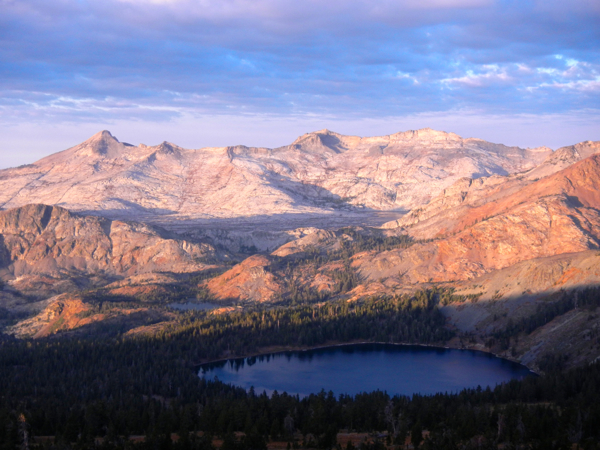
Gilmore Lake from the top of Mount Tallac. Photo/Kathryn Reed

Gilmore Lake from the top of Mount Tallac. Photo/Kathryn Reed

I wanted to do something memorable for my 50th birthday this year – in addition to my gift to myself of a three-day tennis camp last spring with my great friend Carolyn. It was important my actual birthday weekend be Tahoe-centric.

Climbing Mount Tallac under a full moon and being at the peak for sunrise are two things I’ve thought about doing for some time. Why not do both in one hike? My birthday weekend in September happened to be a full moon. Perfect.

I invited a few friends to make the trek with me. Two took me up on the adventure. Darla – who I’ve known since third grade – came up from the Bay Area, and Kele – a friend since we were in our 20s when we worked in Tahoe the first time I lived here – came down from Oregon. We left the house about 1am that Saturday and we were hiking 30 minutes later.

It was a good thing we all had headlamps because the full moon was not of much assistance. The trees were in the way of that natural light. Then it eventually set and we were left in total darkness.

At times we shut off our lights to be dazzled by the Milky Way. This was a show unto itself. Most people only see something like this in a planetarium. It might be the only reason I would ever consider another attempt at backpacking.
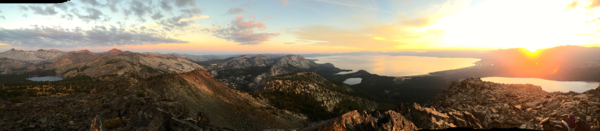
Desolation Wilderness lives up to its name.

Desolation Wilderness lives up to its name. Photo/Kathryn Reed

I don’t take the stars I see for granted from my backyard, but this truly was more magical with zero ambient light.

Big spiders – and several of them – were the main wildlife out at this hour. And for whatever reason they were right on the trail. (They didn’t look like friends of Charlotte’s, but we still let them be.)

To say everything looks different in the dark is stating the obvious. Thank goodness for trail markers, otherwise who knows where we would have ended up. It was only near Gilmore Lake that we were unsure of the route. We figured it out on the second attempt.

We had started at the Glen Alpine Springs trailhead because this is the least steep of the routes. It is, however, the longest at about 12 miles round trip.  We thought it wiser to go the easier route in the dark.
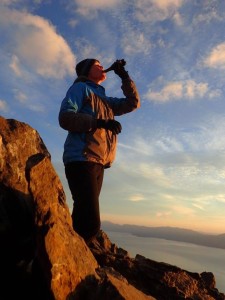
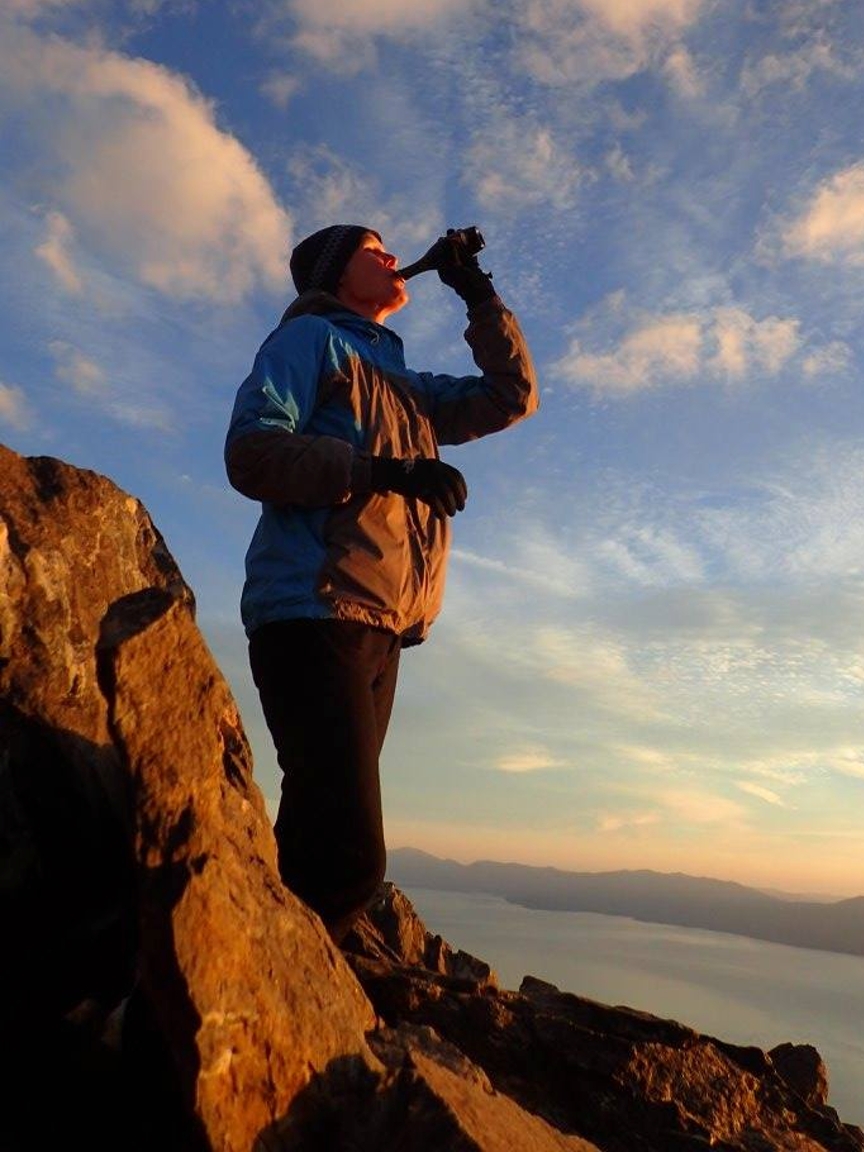
Drinking to the accomplishment and to being 50. Photo/Darla Sadler

Drinking to the accomplishment and to being 50. Photo/Darla Sadler

The summit, well, it’s one of those special places that can touch one’s soul. For many reasons it was more magical this time. It was so wonderful that there were only four other people up there. (Other times it has been so congested with people yakking on their cell phones that it was hard to know this was wilderness.) They were celebrating a 25th birthday and thought it was cool 50-year-olds were doing the same thing.

And while they briefly made me feel my age, we proved age has a thing on youth. We gave them all of our hand warmers because we had gloves (they weren’t prepared for the cold) and we were the ones with Prosecco to toast the occasion (they didn’t have anything to celebrate with).

It was a toast to Tahoe, friendship, a great 50 years and a future of unknown possibilities.

—–

Getting there:

From South Lake Tahoe take Highway 89 north. Turn left on Fallen Leaf Lake Road. Weave around to where it dead-ends at the trailhead.

Fill out a permit and start hiking.


Tahoe properties part of Caesars unit that is for sale

By Tracy Rucinski, Reuters

When a bankrupt operating unit of Caesars Entertainment went on the market in October, the package consisted of 38 casinos, including Harrah’s Lake Tahoe and Harveys in Stateline. But those watching the sale have focused more on what isn’t being offered.

Potential bidders for CEOC, a casino-operating unit of Caesars Entertainment would be wading into the middle of a costly and complicated bankruptcy, and they note that Caesars has left key assets – including a crucial piece of its big-data customer loyalty program – out of the package.

The offering comes at a time when consumer spending is rising, making regional gaming assets once again desirable.

Analysts and some junior creditors have suggested, however, that Caesars isn’t serious about selling its CEOC operating unit and expressed doubt that the offering will attract any bidders.

Read the whole story


Brown declares emergency for dying trees

By David Siders, Sacramento Bee

Lamenting “the worst epidemic of tree mortality” in the state’s modern history, Gov. Jerry Brown on Friday sought federal aid to remove dead trees from California forests and called for more controlled burns to reduce the risk of wildfire.

The declaration, including a controversial exemption from environmental reviews, comes amid California’s ongoing drought and a bark beetle infestation that has killed millions of trees weakened by lack of water.

Brown said the die-off exacerbates the risk of wildfires and the threat of erosion. He ordered state agencies to remove dead or dying trees from high-hazard areas and said his administration will work with federal authorities to expand controlled burns.

Read the whole story


Expert: Warm winter with rain for Tahoe

By Kathryn Reed

INCLINE VILLAGE – El Nino is already here. Now it’s a matter of waiting to see what the ramifications of it will be to the greater Lake Tahoe area.

This particular El Nino is on target to be comparable to 1982-83 and 1997-98 – the biggest ones in the last 100 years.

This was some of the information Kelly Redmond, regional climatologist for the Western United States with the Desert Research Institute, shared with more than 150 people during a lecture at the Tahoe Environmental Research Center in Incline Village on Oct. 29.

El Nino is the warming of the ocean waters. Everything else is a consequence of an El Nino. They tend to peak in the winter.

During El Ninos the jet stream drops south because the atmosphere reacts to the warming ocean. More moisture goes to Southern California, often leaving the Northwest dry. The Lake Tahoe-Reno area is often bypassed in normal El Nino years.

One thing that is different in the ocean now compared to the previous two large El Ninos are the two blobs sitting off the west coast of North America. Redmond said in his career he has not seen anything like this before. How they might affect El Nino is unknown.

El Nino is not a sure bet to create a banner snow year to Tahoe. Photo/LTN file

El Nino is not a sure bet to create a banner snow year. Photo/LTN file

“There is little to suggest that a big El Nino causes more snow,” Redmond said. “We tend to get more extreme events.”

While moisture of any kind is welcome after four years of drought, if it comes in the form of rain, that could impact the local economy and water storage down stream. Tahoe is missing about a year’s worth of precipitation. That means it would take the equivalent of two year’s of wet stuff to make things normal.

Normal is a relative word for these parts. Redmond said this area has the most variable precipitation in the United States.

“It goes up and down tremendously,” he said while a chart depicting that fact was shown on the screen. “This is why you need reservoirs to balance things out.”

The models are also indicating this will be a warm winter, though not as warm as last year. This in turn will mean the snow line will be higher. More rain than snow is likely to be the end result.

“How the precipitation falls makes quite a bit of difference. Snow is free storage,” Redmond said. “There are 2½ to three Shasta dams worth of water just sitting there. It wasn’t there this year.”

Snow needs freezing overnight temperatures to keep its consistency. It needs a break from the melting sun. But that hasn’t been happening of late. The trend is that the overnight temps are steadily increasing. This is especially true in the spring.

Data from 1948-2015 for the months of October to March show the average freezing level in the basin being 8,700. Last winter it was 2,000 feet higher than that.


Online sales set to soar 11% this holiday season

By Ananya Bhattacharya, CNN Money

This Thanksgiving, bargains will be at your fingertips — literally.

For the first time, the majority of holiday shoppers will turn to their mobile phones to browse online retail sites this shopping season, according to Adobe’s new holiday shopping forecast. Mobile will account for almost a third of online sales.

Total online sales are projected to be up 11 percent since last year, totaling $83 billion, Adobe predicted. Cyber Monday is set to rake in a record $3 billion this year.

Read the whole story


Mental health advocates request scrutiny of health insurance mega mergers

By Carolyn Y. Johnson, Washington Post

Advocates are asking regulators to carefully scrutinize two massive health insurance mergers to make sure they won’t harm some of the most vulnerable people in the health care system: mentally ill people, who already struggle to get access to treatment in many places.

The proposed mergers would turn the top five insurers in the country into the top three, combining Aetna with Humana and Cigna with Anthem. The billion dollar deals will have uncertain effects on consumers, which have been a point of debate. Some argue that larger insurers will be able to take advantage of economies of scale to negotiate better prices with hospitals, while others worry that bigger companies will drive up premiums for consumers and reduce choice, particularly in certain geographic areas.

What gets easily left out of that conversation — and many conversations about health care — is mental health. Although the Affordable Care Act put in place a parity requirement that care for depression or schizophrenia be covered, advocates worry about inequalities that could be exacerbated as insurers grow larger and face less competition.

Read the whole story