‘Food studies’ elevates subject beyond the plate

By Kristin Reynolds and Julian Agyeman

Well-known New York restaurateur Danny Meyer announced recently that he intends to eliminate tipping at his New York restaurants with an across-the-board increase in prices to fund “hospitality.” Meanwhile, fast food workers, nationally, have been fighting for a $15 minimum wage. A recent series in the Los Angeles Times revealed how farm workers in Mexico—many of them children—have endured rat-infested camps while picking tomatoes.

We are all starting to realize that a plate of food is never just a plate of food. There is a whole set of issues beyond gastronomy or foodie trends—labor, what to do with food waste, water scarcity, and international trade agreements, to name a few. Food touches almost everything in our society today. “Food studies” is a growing academic field that seeks to understand and to improve these systems.

There’s no question that demand is there. The number of undergraduate degree programs in food studies in the United States is growing. One of the first began at New York University in 1996, inspired by a master’s program in gastronomy (the study of relationships between food and human culture) at Boston University that began a few years earlier. By 2013, there were at least a dozen four-year colleges and universities nationwide offering a major, minor, or concentration in food studies. Hostos Community College in the South Bronx will soon launch an associate’s degree in food studies, making it one of the first two-year programs in the country to take a liberal arts approach, rather than one of professional development (e.g., culinary or horticulture training). The study of food is no longer a small specialty interest.

Student interest has often (though not exclusively) driven the development of food studies. UC Davis’ Sustainable Agriculture and Food Systems major, which produced its first graduates in 2013, was designed by a committee of faculty and students drawing inspiration from the campus’ 35-year-old student farm. At the New School in New York, students often design their own food studies projects in elective courses and the school’s new food studies degree program. At Tufts University, the Friedman Justice League, a student organization, has been pushing for more courses in food justice—that is, social justice related to food and agriculture—as well as more student and faculty diversity at the Friedman School of Nutrition and Science Policy.

Such interest points to the double task of good food studies education. It is crucial for students to learn about the complex issues in the food system—say, the controversy over genetically modified organisms (dangerous to human health or the answer to global food insecurity?), or the problems of food production under climate change (extreme weather events like drought and floods make agriculture more economically risky, thereby prompting migration from rural to urban areas or across national borders). But it is equally important to help students develop the analytical, interpersonal, and leadership skills to change food systems for the better. How well do food studies programs position graduates to create change? Do they prepare students for work in the growing sector of “good food”? Are the people enrolled in food studies programs representative of those who work for low wages in the food system? Or those most affected by injustices like racial discrimination? Or those who have experienced the economic challenges of agricultural communities?

Marion Nestle, a public health expert and NYU faculty member (no relation to the Nestlé food company), has written about the parallels between food studies and the food movement, a loose coalition of interests involved variously in a more socially just and ecologically sustainable food system. Scholarly work has been useful to activist initiatives beyond the academy on important issues: for example, improving school food or teaching about corporate influence over agricultural production. In many cases, academics have also engaged with food movements by lending research skills to community-led initiatives, helping to document patterns of food inaccessibility, or providing information needed to successfully advocate for policy change.

If food studies is to continue to be responsive to the growing food justice movement, graduates need to be able to translate concepts of social justice and food to post-college careers. This is all the more important for students of color and working-class students who may have experienced firsthand the food injustices that are examined conceptually in the classroom. Studies of food and social justice should help all students understand the dynamics of injustice while also shifting the demographics of both the movement and the related economy.

People are thinking about food in ways that go beyond what we eat. Photo/Carolyn E. Wright

People are thinking about food in ways that go beyond simply eating. Photo Copyright 2015 Carolyn E. Wright

Food studies can do three important things to make this happen:

·      First, critical analysis of the food system should be part of food studies courses and programs. Rather than fostering simple mastery of food-system facts (for example, how many more mouths we will have to feed by mid-century), programs should help students develop deep understandings about the social and political structures underlying food and environmental injustices (for example, how global political patterns foster food shortages in low-income countries).

·      Degree programs should also be designed to help graduates obtain and create “good food jobs” – jobs that pay a living wage, offer safe working conditions, promote sustainable economic development, and make healthier food more accessible to all. Food studies graduates may in fact create their own jobs, devising new ways to address food challenges as they evolve. (The New York City Food Policy Center has offered recommendations for how the mayor’s office could create 10,000 new good food jobs in the city by 2020.) Yet while some students may possess the economic and/or social capital to do this, many also face an immediate need to pay the bills. While helping to foster an expanded good food jobs sector, food studies programs should prepare students to identify and obtain jobs that are safe, financially viable, and fair.

·      Finally, food studies should be accessible to students whose communities bear the brunt of food inequities – communities of color and low-income communities in both urban and rural areas – so they can gain skills to lead change. Institutions with a higher proportion of low-income students and students of color should consider creating or expanding food-related degree programs. Colleges and universities with existing food studies programs should strive to make entry more feasible for lower income students through targeted grants and scholarships. Food studies faculty should ensure that curricula address the diverse educational and professional development interests and needs of all students.

Many of the programs cited here are already doing many of these things. And there is also room for growth. Food studies could thus help respond to the broad need for more socially and environmentally just food systems and help communities that have experienced injustices for too long already. This would be transformational food systems education at its best.

Kristin Reynolds is visiting assistant professor in environmental studies and food studies at the New School in New York City, and the author of the forthcoming book, “Beyond the Kale: Urban Agriculture and Social Justice Activism in New York City”. Julian Agyeman is a professor of urban and environmental policy and planning at Tufts University in Medford, Mass.


Senate blocks bill to undercut EPA clean water rules

By Mary Clare Jalonick, AP

WASHINGTON — Democrats have blocked a Senate bill that would have forced the Obama administration to withdraw new federal rules to protect smaller streams, tributaries and wetlands from development and pollution.

Supporters of the legislation — and opponents of the rules — did not get the 60 votes needed Tuesday to stop debate and consider the bill. The vote was 57-41, meaning Democrats have blocked the bill, for now.

Most Democrats argue that the Obama administration rules will safeguard drinking water for 117 million Americans and say they should remain in place. The White House threatened a veto of the bill, saying the regulations are “essential to ensure clean water for future generations.”

Republicans and a handful of Democrats from rural states say they fear a steady uptick in federal regulation of every stream and ditch. Senate Majority Leader Mitch McConnell, R-Ky., said on the Senate floor that the regulations are “a cynical and overbearing power grab dressed awkwardly as some clean water measure.”

The Senate bill, similar to legislation passed by the House earlier this year, would force the Environmental Protection Agency to withdraw and rewrite the rules. Four Democrats voted with Republicans on the measure — Sens. Heidi Heitkamp of North Dakota, Claire McCaskill of Missouri, Joe Manchin of West Virginia and Joe Donnelly of Indiana.

Opponents of the rules said they would continue to fight them. Shortly after Democrats blocked the bill, the Senate voted to proceed to a so-called “resolution of disapproval” sponsored by Iowa Sen. Joni Ernst that would scrap the rules if signed into law. Only a simple majority is needed to pass the resolution.

The White House issued a second veto threat against that resolution, saying it would “sow confusion and invite conflict at a time when our communities and businesses need clarity and certainty around clean water regulation.”

Federal courts have already put the rules on hold as they consider a number of lawsuits that were filed immediately after the EPA and the U.S. Army Corps of Engineers issued the regulations in May.

The rules clarify which smaller waterways fall under federal protection after two Supreme Court rulings left the reach of the Clean Water Act uncertain. Those decisions in 2001 and 2006 left 60 percent of the nation’s streams and millions of acres of wetlands without clear federal protection, according to the EPA, causing confusion for landowners and government officials.

The EPA says the new rules would force a permitting process only if a business or landowner took steps that would pollute or destroy the affected waters — those with a “direct and significant” connection to larger bodies of water downstream that are already protected. For example, that could include tributaries that show evidence of flowing water.

Farm and business groups are among the rules’ chief opponents, and more than half the states have sued the government in an attempt to block them. Officials from states such as Georgia, New Mexico and Wisconsin have suggested the regulations could be harmful to farmers and landowners who might have to pay for extra permits or redesign their property to manage small bodies of water on their private land.

The EPA has argued the criticism is overblown. Since the rules were originally proposed last year, the agency has been working to clear up some misconceptions, like some critics’ assertions that average backyard puddles would be regulated. Current exemptions from the Clean Water Act for farming practices, including plowing, seeding and the movement of livestock, among other things, will continue.

Republicans and landowners concerned about the rules’ reach say they believe they won’t eventually go into effect.

“While we may have fallen short today, this is not the end of this issue,” said Wyoming Sen. John Barrasso, the GOP sponsor of the bill. “One way or another, Republicans won’t stop until this rule is withdrawn or the courts ultimately strike it down for good.”


Health officials: Don’t eat Dungeness crab

By Nanette Asimov and Paolo Lucchesi, San Francisco Chronicle

Do not — repeat, not — eat crab caught along much of the California coast until further notice. That’s the stunning message issued Tuesday by health officials just days before Saturday’s start of the recreational crab season, which may be delayed.

The California Department of Public Health is warning that potentially deadly levels of domoic acid have been found in Dungeness crab and rock crab caught along the coastline between Oregon and the southern border of Santa Barbara County.

As a result, the state Office of Environmental Health Hazard Assessment is recommending the Dungeness season be delayed and the rock crab fishery be closed.

Read the whole story


Heroin near epidemic status in S. Lake Tahoe

SLEDNET agents confiscated this gun and at the same bust found a syringe in warm water to keep the heroin from solidifying.

SLEDNET agents confiscated this gun and at the same bust found a syringe in warm water to keep the heroin from solidifying.

By Kathryn Reed

Heroin is the No. 1 drug problem in South Lake Tahoe.

“It’s the biggest issue of law enforcement,” Russell Liles, a detective with South Lake El Dorado Narcotics Enforcement Team, said. “Once you do it, your biggest goal is to get more.”

It’s that initial rush that people want to keep reliving. The side effects and coming off the high are physically wrenching. It’s why people keep reaching for the next needle. Even if the user started by snorting, eventually they seem to go for an injection because reaching the state of euphoria is faster that way.

Liles on Nov. 3 spoke to the local drug coalition about the growing epidemic.

Black tar heroin is mostly what is found locally. Users are predominantly men between the ages of 18 and 25 who started the habit by first becoming addicted to prescription medication. They are doing five to 10 points a day at a cost of more $100/day.

Seldom do they have jobs because it’s near impossible to function at a coherent level being that high. Committing crime is how they pay for their heroin habit, Liles said.

But this issue isn’t new to the South Shore. Lake Tahoe News ran a two-part series about heroin in February 2012. It was the same story then – prescription opiate leads to addiction that leads to heroin. Heroin is an opiate coming from the poppy plant.

“Nearly 50 percent of young people who are injecting heroin reported abusing prescription opiates before using it,” Liles said.

Prescriptions run out, heroin is easier to get and it can be cheaper.

Liles said the people using might surprise people. Some come from good families. They had other plans for their lives. The addiction, though, became too strong.

In the last four years what Liles has noticed is more users are people one year out of high school.

The National Institutes of Health says, “Our data show that the demographic composition of heroin users entering treatment has shifted over the last 50 years such that heroin use has changed from an inner-city, minority-centered problem to one that has a more widespread geographical distribution, involving primarily white men and women in their late 20s living outside of large urban areas.”

And more people are dying from overdosing on heroin. In 2013, 8,260 people died, which is four times the number in 2000.

The local drug coalition has been focused on getting unused and expired prescription drugs out of homes. A drop off location is at the South Lake Tahoe Police Department.

The annual Drug Store Project is an all-day reality based drug education workshop for sixth-graders on the South Shore. Prescription drug use is the main component of the event.

Liles said the best thing people can do is educate young people to the dangers.

President Obama is proposing spending $133 million to increase access to drug treatment and prevention programs.

New drug laws aren’t helping the guys with the badges. Proposition 47 was passed last year by California voters. It made possession of heroin, cocaine, illegal prescriptions, concentrated cannabis, and methamphetamine all misdemeanors. Officers have the choice to arrest the person or cite him, like a traffic infraction.

If the District Attorney’s Office chooses to prosecute the case, the defendant is often out on bail or on his own recognizance until a deal is reached or the trial starts. If convicted, the person faces at most a year in county jail and even then people are often let out for good behavior.

South Lake Tahoe Police Chief Brian Uhler was an opponent to Proposition 47 before it was passed and continues to be. He has written about how it puts more criminals on the streets, which has increased some criminal activity in town.

California is not alone in rejiggering penalty guidelines. Penalties for nonviolent drug crimes were reduced by the U.S. Sentencing Commission in April 2014. Because that change could be applied retroactively, last month it was announced that the Justice Department would be releasing about 6,000 federal prison inmates who were serving time for being nonviolent drug dealers.

Liles said the reason SLEDNET doesn’t want the names used in heroin arrests is because it negatively impacts ongoing investigations.

Heroin users are a close-knit group. They don’t readily welcome others into the circle. That is why it is hard for narcotics officers to penetrate the inner sanctums, and therefore difficult to arrest the dealers.

Local heroin dealers tend to be white men between 25 and 35 years old who are able move an ounce of heroin every few days. They get their supply from Stockton, Modesto or Reno. Mexican drug cartels are turning to heroin from pot because the profit is greater. Plus, now it’s so easy to get marijuana in the U.S. without importing it and a lot of users prefer the weed that is grown indoors to outdoor cultivation.

Local heroin dealers are also unemployed. And they are often armed.

A heroin ounce is considered 25 grams, which is about 250 doses. This costs about $1,800. Dealers can turn that into about $3,750 on the street. Why they aren’t rolling in money is that they are also users. It’s not like the heyday of cocaine where dealers were flush with cash because they didn’t use the product they were peddling.


Efficiency of buildings key to meeting climate goals

By Stephanie Pincetl

In energy, we are learning how to make the invisible visible.

We now know that cities are responsible for 70 percent of the globe’s green house gas emissions (GHG). We know that 60 percent of those urban GHG emissions comes from cars, trucks, and other forms of transportation, with the remaining 40 percent coming from building energy use – electricity and natural gas to heat and cool.

But we don’t know many of the particulars about energy use in buildings. How much do different types of buildings, or different aged buildings, or various other social and demographic factors contribute to energy use? How much does each building, and how much do different parts of the building, use energy? Even with modeling to give us some data, we don’t know energy use down to the meter-by-meter, building-by-building level. While we know that car emissions reporting has been fraudulent, we at least have a sense of emissions by make and by year. That’s not so for buildings, and that leaves a gaping hole in what we know; it’s like not knowing the difference between the emissions of a diesel truck compared to a hybrid car.

The county of Los Angeles and UCLA’s California Center for Sustainable Communities Institute of the Environment and Sustainability, which I direct, are determined to fill this void. We need to understand building energy use so we can make the right investments to reduce building energy use, and the emissions. After four years of technical, scientific, and legal efforts, and after participating in California Public Utility Commission proceedings to enable greater data access, UCLA obtained address-level data under a non-disclosure agreement with the PUC.  UCLA and the county have developed an interactive web energy atlas as a result .

It’s the first such interactive atlas in the country. (New York City built a map prototype at the ZIP code level in 2012.) Our atlas provides an innovative platform to build and share knowledge of the actual energy use of buildings by neighborhood, city, building type, use, age, size, and demographics of residents.

Such an atlas was overdue. About $13 billion in investments in energy conservation and efficiency have been made in California since 2002, paid for by private utility ratepayers through their bills. Taxpayers, utilities, and the government need to know what efforts have been effective in changing the amount of energy used in buildings, and what has not worked; local governments also needed a way to account for Green House Gas emissions in a precise manner – which buildings are the most significant in energy use? The website has a contact address where users can send in their own discoveries in investigating the website – patterns across the landscape, some unexpected correlations or other insights.

In assembling, analyzing and aggregating all the data, we came up with a number of surprising findings.

For example: Malibu residents use 10 times more energy per capita than residents of Bell, in southeast LA County. But the buildings in Bell are far less energy-efficient, using more energy per square foot than those in Malibu. And Compton actually has the highest median per square foot consumption in the region. The atlas also shows energy use by building-age categories. The highest energy-using buildings were uniformly built before 1950, and the lowest from 1990 onward, perhaps proof that our building standards are working.

Those findings have major implications for interventions at a building and neighborhood level that could generate big and rapid energy efficiency gains.  Knowing the specifics of buildings makes it possible to target investments where and when they will make the most impact. The atlas also points out that existing efforts to improve efficiency – like smart meters with time-of-use pricing that changes depending on the time and season — might be useless if your building has massive structural inefficiencies.

But the implications are still broader. Why, for instance, should we force individuals to decide between turning off their refrigerator or their air conditioner when their buildings themselves are energy hogs?

Buildings are becoming more important in reaching climate targets, and should be included in December’s Paris climate change talks. And Gov. Jerry Brown has just signed, a new law that requires California to reduce greenhouse gas emissions 40 percent below 1990 levels by 2030. The only way we’ll get to that goal is by looking more closely at individual buildings. It will also greatly improve the wellbeing of people who live, work, learn, and play in them.

Stephanie Pincetl is director of the California Center for Sustainable Communities Institute of the Environment and Sustainability at UCLA.


Snowmaking won’t save Lake Tahoe ski resorts if the overnight temperatures keep rising

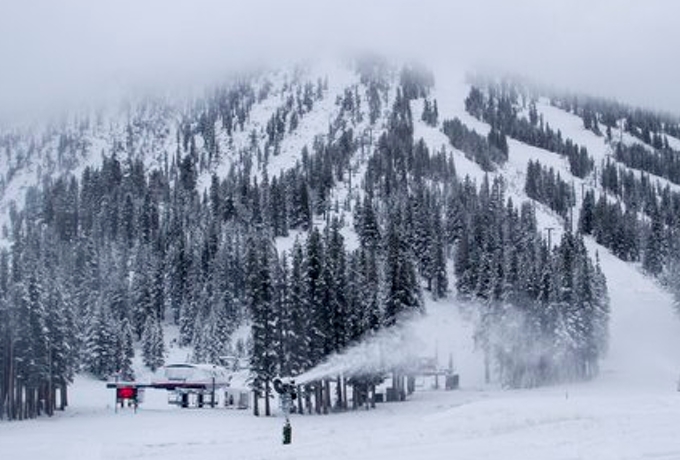
Snowmaking and Mother Nature are allowing Mt. Rose to be the first resort in the greater Lake Tahoe area to open this season. Photo/Provided

Snowmaking and Mother Nature are allowing Mt. Rose to be the first resort in the greater Lake Tahoe area to open this season. Photo/Provided

By Anne Knowles

Mt. Rose Ski Tahoe kicks off the ski season today, optimistic this season will be a return to normal after a foot of snow fell Monday.

“El Niño typically bodes well for Mt. Rose. This is shaping up to be like ’97, a warm October followed by a successful snow year,” said Mike Pierce, head of marketing at the Nevada resort, referring to 1997 when the Truckee River overflowed and Reno was flooded. “We’re due to break the cycle.”

Pierce isn’t alone in thinking this way.

OpenSnow, a group of local weather forecasters, says there is a 60 to 70 percent chance of above average snowfall in California and Nevada this winter.

“I’m hopeful with El Niño. We got almost 12 inches (Tuesday), heavy base type snow that’s good to have this time of year,” Barrett Burghard, senior manager of snow services at Heavenly Mountain Resort, told Lake Tahoe News. “Last year was the toughest season. But we’ve seen these cycles. Hopefully we’ll have three to four years of good moisture.”

Still, no one knows for sure. The National Weather Service’s Climate Prediction Center currently projects a 33 percent chance Lake Tahoe will have above average precipitation this winter, but it’s hard to know if most of it will be in the form rain or snow only at the highest elevations, 8,000 to 9,000 feet.

“There is little to suggest that a big El Niño causes more snow,” said Kelly Redmond, regional climatologist for the Western United States with the Desert Research Institute, at a recent Incline Village talk. “We tend to get more extreme events.”

At the same time, NWS says there is an even greater chance — 40 percent — temperatures in the basin will be above average. That creates problems not only for precipitation, but also for snowmaking, which the resorts have depended on to make it through the last few seasons.

Snowmaking is most productive and energy efficient, and costs less and consumes less water, the lower the temperature.

No one can control the temperature, which is key, but resorts have invested millions of dollars on more advanced snowmaking equipment in the last few years.

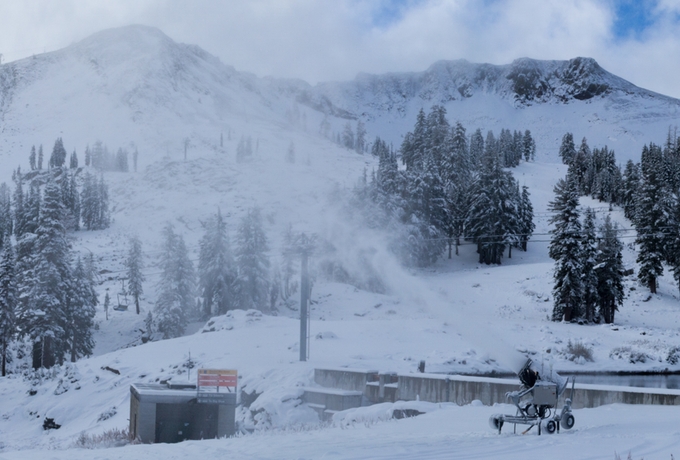
Squaw Valley has spent millions of dollars to ensure its slopes are covered in white. Photo/Provided

Squaw Valley’s attention to snowmaking dramatically changed when KSL took over ownership. Photo/Provided

Squaw Valley, for example, has spent $8 million in the past five years to upgrade its equipment. The resort says it can operate up to 20 new snowmaking guns with the same amount of compressed air required by a single old gun and make nine times as much snow as it could 10 years ago.

On Tuesday, Squaw spent the day making snow, thanks to a big drop in the temperature. Plans are to open Nov. 25.

Mt. Rose operates 25 SMI Snowmakers’ PoleCat snow guns, Pierce said, which can cover up to 25 percent of its trails. A dozen are fixed; 13 are mobile and hook into hydrants throughout the resort, which tap into an onsite well.

“We’ve been buying water rights for the last 20 years,” Pierce told Lake Tahoe News.

The snowmaking allowed the resort to operate from Nov. 8 to April 19 last season when it received just 167 inches of snow, about half the average.

Heavenly, owned by Vail Resorts, has invested heavily in an elaborate snowmaking operation that allows it to cover more than two-thirds of its 97 trails.

“The biggest change we’ve seen is energy efficiency,” said Heavenly’s Burghard, including more efficient guns and advanced compressor controllers.

This season Heavenly is testing a GPS-based depth sensor attached to PistenBully snowcat that may more precisely measure the snow.

“But as far as the temperatures go, there’s not a lot we can do,” Burghard said.

He said there are additives to aid snowmaking at higher temperatures, but Heavenly doesn’t use them.

“They’re not costly, but we’re in the Lake Tahoe watershed and we’re reluctant to use them,” Burghard said.

Heavenly buys its water for snowmaking from South Tahoe Public Utility District and Kingsbury Grade Improvement District.

Andrew Strain, vice president of planning and government affairs for Heavenly, suggested Nevada look at allowing the use of effluent for snowmaking at mountain resorts not on the lake. He said this during testimony at a state-sponsored drought summit in Carson City in September.

Snowbowl, a ski resort in Arizona, began making snow using effluent in 2013.

The Nevada Department of Environmental Protection has a standing committee on water reuse which is in the early stages of looking at that possibility, according to JoAnn Kittrell, public information manager for the Department of Conservation and Natural Resources.

“It’s tricky for Tahoe. Even as a base, it may have too many nutrients,” Kittrell said. “It might have to be treated to drinking water levels. Then it becomes a question of being cost prohibitive.”


Severe obesity a billion dollar taxpayer issue

By Soumya Karlamangla, Los Angeles Times

We know obesity increases your risk of having high blood pressure, getting diabetes and being diagnosed with certain cancers. Now it turns out it can also increase costs for your state government.

A study published Monday in the journal Health Affairs found that medical care associated with severe obesity cost state-run health programs $8 billion in 2013. California’s program for the poor, known as Medi-Cal, took the biggest hit, spending $1.3 billion that year on severe obesity-related care.

Though the obesity epidemic in America has garnered a lot of attention, there hasn’t been enough focus on severe obesity, which has much bigger health risks and associated costs, said Michael Long, study author and assistant professor of prevention and community health at the Milken Institute School of Public Health atGeorge Washington University.

Read the whole story


Energy firm plans Nevada’s power future

By Kyle Roerink, Las Vegas Sun

Next month, regulators will decide on a proposal for how NV Energy will supply customers with power in the future.

Known as the integrated resource plan, the power company’s proposal is a pitch made every three years to regulators about the company’s long-term strategy. The state’s energy gurus have been debating since June.

Last week, officials representing gaming, renewable energy, conservation groups, state bureaucrats and NV Energy huddled at the Public Utilities Commission office to testify on the nearly 5,000-page plan.

The commission will decide on a final plan by Dec. 28.

Read the whole story


LTUSD superintendent backs out of recreation deal with LTCC, SLT; board never voted on it

  By Kathryn Reed

Lake Tahoe Unified School District’s board has never had the opportunity to vote on whether it wants to be part of a consortium with Lake Tahoe Community College and the city of South Lake Tahoe that would manage and maintain ball fields.

Instead, Superintendent Jim Tarwater made the decision to back out of the deal that has been talked about since at least last spring.

“I don’t know that it is really a policy decision,” LTUSD board President Barbara Bannar told Lake Tahoe News. “It doesn’t involve the education of our children. When you look at what benefit the children in the school district get from being part of the JPA it was minimal at that point if any.” Plus, she cited the growing attorney costs for a reason to put an end to the discussions.

The college board and City Council both voted on and for the creation of the JPA – believing the decision to enter the joint powers agreement is a matter for electeds to decide, not the hired leaders of the organizations.

The college and city are going forward with the JPA without LTUSD. They were the original creators of the JPA, with LTUSD being a late addition – and now a recent subtraction. Separate agreements will need to be written to incorporate the K-12 district into the equation, though, because it is still a player without being JPA member.

The reason all three entities were initially creating the JPA was to consolidate the management and operation of ball fields. The recreation master plan calls for a blended approach instead of individual entities; ultimately making it easier on the user.

Less than two months ago LTUSD Superintendent Jim Tarwater was set to take the JPA to the board. He told Lake Tahoe News this week that the reason to forego the JPA is that the district could not afford all the maintenance that was proposed.

“They need more maintenance than what I can do,” Tarwater said.

“The board doesn’t need to vote on it,” he said of the JPA.

An agreement from earlier this year has LTUSD being required to maintain the fields on its property instead of the city doing so. In turn, the city is subsidizing this operation by $100,000 to be a community partner and recognizing adult leagues also use these fields.

Had LTUSD joined the JPA, it would have gotten the $50,000 for maintenance that comes from Measures S/R for the community play field at the college. That full amount has never been used and is carried over each year. It’s anticipated the new fields to be built adjacent to that field will use up the balance of the $50,000. This is allowable based on the original recreation measure calling for multiple fields at that location.

LTCC will now be responsible for the maintenance of the current and future fields in that area.

The current field and proposed fields are in part owned by all three public agencies. The JPA was to have managed all of them. Now easement agreements with LTUSD must be devised.

The JPA was a discussion item at last week’s LTUSD board meeting. The board at the time seemed open to the JPA idea. But it wasn’t an action item.

A day later Tarwater sent an email to City Manager Nancy Kerry and LTCC President Kindred Murillo saying the district would not be part of the JPA. This came after the three had a conference call that morning that Tarwater referenced. The email cites the lack of a guarantee of the baseball field immediately being built as the reason to not enter the JPA.

“There is no guarantee that a new baseball field will be built. For these and other reasons, the LTUSD has decided, after careful thought and consideration, to decline the offer to be a member of the JPA,” Tarwater wrote. While he makes it seem like this was a district decision, it was in fact his decision alone. “One [stet] behalf of LTUSD Board of Education, I hope that the Community Play Consortium is successful.”

There is no guarantee which field will be built when because this is something the City Council must vote on. That will take place in January when it is better known what the coffers look like. The city has about $1.2 million – it may turn out to be more – to build the fields. Cost estimates are being worked on now. The goal is at a minimum one field will break ground next year.

The college is investing $1.6 million to renovate the current field, with Measure R contributing $300,000 to that cause. That, too, will occur in 2016.

LTUSD, even without being a party to the JPA, will continue to do all the scheduling for the community ball fields. It is possible the district and other entities would become JPA board members down the road.


Companies stacking deck of justice with arbitration

By Jessica Silver-Greenberg and Robert Gebeloff, New York Times

On Page 5 of a credit-card contract used by American Express, beneath an explainer on interest rates and late fees, past the details about annual membership, is a clause that most customers probably miss. If cardholders have a problem with their account, American Express explains, the company “may elect to resolve any claim by individual arbitration.”

Those nine words are at the center of a far-reaching power play orchestrated by U.S. corporations, an investigation by the New York Times has found.

By inserting individual arbitration clauses into a soaring number of consumer and employment contracts, companies can circumvent the courts, and bar customers from joining together in class-action lawsuits, realistically the only tool citizens have to fight illegal or deceitful business practices.

Over the last few years, it has become increasingly difficult to apply for a credit card, get cellphone, cable or Internet service, or shop online without agreeing to private arbitration. The same applies to getting a job, renting a car, or placing a relative in a nursing home.

Among the class-action challenges thrown out because of such a clause was one brought by Time Warner customers over charges they said mysteriously appeared on their cable bills, and another against a travel booking website accused of conspiring to fix hotel prices. A top executive at Goldman Sachs who sued on behalf of bankers claiming sex discrimination was also blocked, as were African-American employees at Taco Bell restaurants alleging a pattern of discrimination.

Read the whole story