Medical marijuana cards growing in Nev.

By Chanelle Bessette, Reno Gazette-Journal

As the medical marijuana industry booms in Nevada so does the demand for patient cards.

Medical cannabis was legalized in Nevada in 2000, but it took 15 years for storefronts to open, with the first Nevada dispensary opening in Sparks in July. Now, with more dispensaries open in Reno and Las Vegas, the Division of Public and Behavioral Health has seen a spike in the number of applications throughout the state.

In October 2014, Nevada had 6,541 active patient cards. As of last month, that number has nearly doubled to 12,091, with 549 additional applications pending.

The application process for a card in Nevada is completely on paper, so potential patients have to request an application either via mail or in person in Carson City.

Read the whole story


Heavenly, Northstar conditions wow skiers

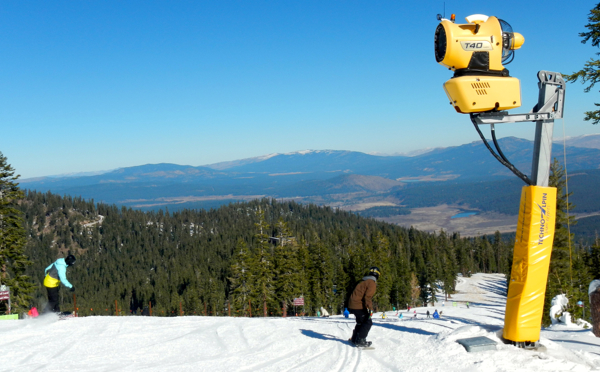
Snowmaking along with Mother Nature allowed Northstar to open earlier than normal. Photos/Kathryn Reed

Snowmaking along with Mother Nature allowed Northstar to open earlier than normal. Photos/Kathryn Reed

By Kathryn Reed

TRUCKEE – Smiles and praise for the conditions dominated the conversations about opening day at Northstar and Heavenly on Saturday.

Jim Lamore, director of mountain operations at Northstar, was giddy and proud when talking about the coverage – bark-to-bark – meaning the whole run has snow, it’s not just a strip of white.

“Even if we get a warm spell, we are in great shape,” Lamore told Lake Tahoe News.

The depth on Nov. 15 ranged from 18 inches to 4 feet. That’s plenty for the groomers to move around to make sure no obstacles are showing.

Northstar skiers were treated to an extra early opening on Saturday when Beth Howard, general manager of the resort, said get the gondola running. This was 20 minutes before what was supposed to be the official 8:30am opening. The 100 or so people in line didn’t mind.

Jim Lamore, mountain operations director at Northstar, is ecstatic with how much terrain is open.

Jim Lamore, mountain operations director at Northstar, is ecstatic with how much terrain is open.

Howard had tested the slopes the day before so she knew what the guests were about to experience.

“I’m pleasantly surprised,” Matt Hunstock of Santa Rosa said of the conditions. Even though he didn’t ski a single day last season, he likes coming back to Northstar – noting the guest services are better here than other places.

Ian Balmer of Australia was lucky the resort opened a week earlier than originally planned because he was flying home that night. For mid-November he was impressed with the amount of snow.

The Truckee resort is open top-to-bottom with seven lifts and 14 features in the Pinball terrain park.

“We have the biggest footprint in Lake Tahoe by far,” Lamore boasted.

Changing where the snow guns are working has made a difference.

Heavenly on Saturday had the gondola, Tamarack Express, Dipper Express, Comet and Big Easy running. This is quite a contrast to a year ago when the resort opened a week later with just the terrain off Tamarack skiable with manmade snow.

Blue skies and 50-degree weather for opening day will be replaced with snowy 30-degree temps on Day 2.

Blue skies and 50-degree weather for opening day will be replaced with snowy 30-degree temps on Day 2.

Jerry Klosterboer has been buying season passes at Heavenly since the 1978-79 season. This is the first time he remembers skiing two weeks before Thanksgiving. Passes then were $425 and day passes were $23, so it took a lot more ski days to have the pass paid for compared to today. He paid $459 for his pass this year; a single-day ticket for today is $94.

Yohei Takami of Concord was excited to be skiing on some natural snow so early.

“The snow is good. This is typical Heavenly snow. I’m pretty happy with the conditions,” Adam Oliff of San Jose said.

While the coverage is good at both resorts, a clear sign it is early season conditions is the lack of tree skiing. Northstar kept a few areas ungroomed so riders could get a taste of powder next to the groomers.

With another storm expected to drop a foot of white stuff today at the higher elevations, it is only going help all of the Tahoe resorts.


Bill would limit for-profit colleges’ access to federal funds

By Bobby Caina Calvan, Reveal

The White House this week put its weight behind legislation seeking to rein in for-profit schools siphoning hundreds of millions of taxpayer dollars annually by preying on veterans and military personnel eligible for the GI Bill and military tuition assistance programs.

Using Veterans Day as a backdrop, the Obama administration announced its support for a Democratic bill dubbed the Protecting Our Students and Taxpayers Act of 2015. The proposal would close loopholes and reinstate tougher eligibility rules for federal education money.

In remarks at Arlington National Cemetery, President Obama noted the importance of the GI Bill in fulfilling the country’s promise to repay the sacrifice of veterans.

“That’s why we’ve helped more than 1.5 million veterans and their families pursue an education under the Post-9/11 GI bill,” he said. ”That’s why we worked to make sure that every state now provides veterans and their families with in-state tuition. … And today, the veterans’ unemployment rate is down to 3.9 percent – even lower than the national average.”

The legislation seeks to transform the so-called 90/10 rule into an 85-to-15 split, forcing schools to rely less on federal funds if they want to continue participating in federal student aid programs. Under existing law, a for-profit college must get at least 10 percent of its revenue from nonfederal student aid funds to qualify for the Department of Education’s loan and grant programs.

But the GI Bill and military tuition assistance programs are not counted as part of that 90 percent, a loophole the proposed legislation seeks to close.

“This loophole has created a perverse incentive for some for-profit colleges to seek out and aggressively – and, sometimes, deceptively – enroll service members and veterans to skirt the law,” Ted Mitchell, the Obama administration’s undersecretary for education, said in statement.

“The intent of the law is simple: Quality for-profit programs should be able to secure funding that is not solely from the federal government,” he said.

In addition, the White House announced that it has an agreement in place with the Department of Veterans Affairs and the Federal Trade Commission for measures that “strengthen enforcement against schools that engage in deceptive or misleading advertising, sales, or enrollment practices towards Veterans.”

A Reveal investigation published in June showed how the University of Phoenix, for one, sidestepped an executive order by Obama meant to prevent for-profit colleges from gaining preferential access to military bases.

Since taking effect in 2009, the Post-9/11 GI Bill has served more than 1.5 million veterans and provided $57 billion for tuition, books and other education-related expenses.

This money has become an important source of revenue for many for-profit schools. The country’s largest for-profit school, the University of Phoenix, has reaped more than $1.2 billion in GI Bill money since 2009. Last year alone, it received $345 million to educate Iraq and Afghanistan veterans, along with $20 million in tuition assistance from the Pentagon.

Last month, the Department of Defense barred university officials from recruiting at military installations and placed the school on probation. Until that probation is lifted, the university is forbidden from enrolling new students under the Pentagon’s tuition assistance program.

The switch from 10 to 15 percent would not be new. Congress instituted the 85/15 standard in 1992 after investigations uncovered evidence of fraud and abuse. Six years later, that rule was relaxed to the current 90/10 standard.

“This high threshold allows far too much federal money to funnel to an industry that often provides a greater return on taxpayer investment to its administrators and investors than it does to its students,” said Sen. Dick Durbin of Illinois, who joined three other Senate Democrats in sponsoring the bill.

It may seem like a small change. But last year, a Reveal investigation found that nearly 300 schools reportedly fall in the gap between 85 and 90 percent.

Another 133 for-profit schools would violate the 90/10 cap if the GI Bill loophole were closed. These schools were almost completely subsidized by taxpayers, receiving more than 90 percent of their revenue from a combination of Pell Grants, Stafford Loans, GI Bill funds for veterans and Department of Defense tuition assistance to active duty military.

“It is imperative that we remove the dollar sign from the backs of veterans and servicemembers by closing this egregious loophole,” said Walter Ochinko, policy director for the nonprofit organization Veterans Education Success.

The proposed legislation faces a near-certain death if its sponsors and the White House cannot get some Republicans to sign on.

“We haven’t had any in the past, and no indication that will change. However, we are always hopeful and Senator Durbin thinks that this is an issue both parties should be able to get behind,” Durbin’s spokeswoman, Christina Mulka, said in an email.

Similar House measures have failed.

The Senate Bill, co-sponsored by Sen. Jack Reed of Rhode Island, Sen. Richard Blumenthal of Connecticut and Sen. Elizabeth Warren of Massachusetts, would:

  • Kick off for-profit schools after a year of noncompliance with the 85/15 formula, instead of allowing them two years under the current 90/10 law.
  • Bar schools from what the senators consider accounting tricks that calculate unpaid school-sponsored student loans as revenues, even if the loan goes unpaid. Only actual payments would be counted as revenue.

As part of its educational initiatives for veterans, the Obama administration also announced today that veterans and their dependents are now eligible for in-state tuition in all 50 states, as well as in the District of Columbia and Puerto Rico.

It also said the Department of Veterans Affairs is launching a redesigned website providing information on graduation rates and other factors to make it easier for veterans to compare schools.

In addition to his call for reinstating the 85/15 rule, Obama urged Congress to approve legislation that would require schools receiving GI Bill money to meet accreditation standards for certain programs, including law, teaching, nursing, criminal justice, psychology and health fields.

And the president pressed for passage of a bill that would reinstate GI Bill benefits to veterans enrolled in schools that shut down. The proposal followed the implosion of Corinthian Colleges, which filed for bankruptcy protection earlier this year. Once one of the country’s largest for-profit schools, it left about 16,000 students looking for other options when it shuttered its 30 remaining campuses.




Calif. economy is booming, but is still No. 1 in poverty

By Chris Kirkham, Los Angeles Times

From a quick glance at the headline numbers, California’s economy looks to be in its strongest shape in years.

Over the last four years, California has added jobs at a rate faster than all but six other states, and faster than the U.S. overall.

The state unemployment rate is at 5.9 percent, the lowest since November 2007, and significantly below the 25-year average of 7.5 percent.

California has added jobs at a faster rate than the rest of the country in recent years.


But that swift economic growth hasn’t improved the fortunes of California’s poorest. The state’s official poverty rate (based on a federal threshold of $24,230 for a family of four) is at 16.4 percent, according to the most recent census data from 2014, up from 12.4 percent in 2007.

Read the whole story


Lake Tahoe once was a mecca for fishermen

Fishing at Lake Tahoe remains popular. Photo/LTN file

Fishing at Lake Tahoe remains popular. Photo/LTN file

By Kathryn Reed

CAMP RICHARDSON – Despite people continually messing with the ecosystem, fishing remains a vibrant part of Lake Tahoe’s allure.

In the 1800s the area was known for the abundance of fish and their size.

Native Americans knew this well before the white man came to the basin. The Indians tended to fish the streams and tributaries more than the main lake.

They used spears and other methods to catch fish. It was common to fish during spawning season. That practice ended when the white man chased them away, saying this was the worst time to fish. It was white fish and Lahontan cutthroat trout that were the main catches. Some of it was dried and traded with other tribes.

David Long, an environmental consultant, discussed the history of fishing at Lake Tahoe on Nov. 10 at the Camp Richardson Lodge as a guest speaker for the Lake Tahoe Historical Society.

There are reports of a trio of brothers catching 165 fish in one day that was then sold to a Truckee hotel. In 1894, 40 tons of trout were caught in the first month of fishing season. During spawning season it was impossible to cross a stream without killing some fish.

William Pomin holds the record for largest cutthroat trout caught at Lake Tahoe – 31½ pounds in 1911. Robert Aronsen on June 21, 1974, caught the record lake trout – 31 pounds, 6 ounces; Kokanee salmon record was set by William Bush on July 20, 2013 – 5 pounds, 2 ounces.

Mining and timber severely impacted the fishing at Lake Tahoe. Streams were degraded as trout nests were disturbed by the lumber practices at the time. Temporary dams changed the flow of water. Fish ladders were not always built. Saw dust was thrown into the Truckee River.

Long said the introduction of most of the nonnative species was to help grow bigger fish, to enhance the food web. For the most part the opposite happened.

The crayfish are one of many creatures in Lake Tahoe that are not native. They were introduced in the 1800s.

“The unintended consequence is the crayfish ate the fish eggs more efficiently than the fish ate the crayfish,” Long said.

In 1916 Lahontan cutthroat trout were still the predominant fish. But the nonnatives eventually won out and the cutthroat was eliminated by the late 1930s. There are multiple agencies working to reintroduce the cutthroat to Lake Tahoe and its tributaries, which has not been welcome by all.

California introduced rainbow trout in 1877, with Nevada doing so in 1893.

Brook trout came in 1877 or 1878.

Lake trout, or mackinaw, were introduced by Nevada in 1888. California planted them at Fallen Leaf Lake in 1894.

“It was a controversial planting,” Long explained. “California didn’t want fish eating fish. Nevada said so what.”

In 1896 Brown trout were introduced.

It was in 1917 that commercial fishing was banned at Lake Tahoe. That order was lifted a couple years ago to allow crayfish to be harvested. Sport fishing is still allowed, but the size and quantity of what’s caught has been declining.


El Niño: ‘One storm after another like a conveyor belt’

Early snow in Lake Tahoe has people cross country skiing at lake level. Photo/LTN

Early snow in Lake Tahoe has people cross country skiing at lake level. Photo/LTN

By Rosanna Xia and Rong-Gong Lin II, Los Angeles Times

The strong El Niño in the Pacific Ocean is becoming even more powerful, setting the stage for an unusually wet winter in California that could bring heavy rains by January, climate experts said.

The National Weather Service’s Climate Prediction Center said El Niño is already strong and mature, and is forecast to continue gaining strength. This El Niño is expected to be among the three strongest on record since 1950.

Generally, El Niño doesn’t peak in California until January, February and March, Patzert said. That’s when Californians should expect “mudslides, heavy rainfall, one storm after another like a conveyor belt.”

Read the whole story


Extending Prop. 30 comes with consequences

By Jerry Nickelsburg

In 2012 voters passed Proposition 30—an initiative to raise taxes and take state government finances out of crisis mode. However, the new taxes, primarily falling on the top income earners in California, did not purport to be a cure for the underlying problem. Rather, the rationale was to give the state some breathing room. And Proposition 30 came with an expiration date, 2018.

Now it looks like Prop. 30 might have an even longer life. Last month, the California Teacher’s Association—the union representing more than 300,000 teachers—filed an initiative to extend Prop. 30’s temporary income tax surcharges until the year 2030. The rationale according to Gale Kaufman, strategist for the initiative, is to “keep our state budget balanced, and prevent devastating cuts to programs affecting students, seniors, working families and health care.”

Caption: Data from California Department of Finance, BEA.gov, UCLA Anderson Forecast

Source: Data from California Department of Finance, BEA.gov, UCLA Anderson Forecast

Unfortunately, economics and the available empirical evidence suggest there is a large risk that Prop. 30 will produce the exact opposite outcome from that suggested by Kaufman.

There are two issues that voters must consider before deciding whether to accept this risk.  The first is the difference in incentives between a temporary and a permanent increase in income taxes. The second is the different impact a tax may have at different points in the business cycle.

When Prop. 30 was proposed, it was billed as a temporary tax increase to bail the state and its schools out of a recession-induced financial crisis. In the political campaign Gov. Jerry Brown said: “It’s about putting money into California’s schools or taking money out of it … there is no third way.”

At the time, opponents warned of a mass exodus of high-income earners from the state were Prop. 30 to be enacted, since the income tax hikes were restricted to those who earned at least $250,000 a year. California has become increasingly dependent on such high-income earners for tax revenues. Income taxes paid by the top 1 percent of income earners grew from 33 percent of the total in 1994 to more than 50 percent in 2012, the first year of the Prop. 30 tax surcharges. But the exodus did not happen. Most high-earners stayed, more came, and they and the Golden State have prospered.

Why were the doomsayers wrong? It’s not easy to say. There are no data on this; nor are there data on the difference between a temporary Prop. 30-like tax increase and a permanent one.

However, we do know that people react differently when presented with the same policy if they think there is a crisis (let’s all pitch in and solve this) or if they think it is business as usual (why am I contributing this amount?). These questions of context and timing must inform how we think about extending Prop. 30.

For example, will there be a significant move of Californians to Seattle–where there are no income taxes—if Prop. 30 income tax surcharges are made effectively permanent? If the answer is yes, then it could well be the case that state tax revenues would decline as high-income earners and their employees depart, offsetting gains from the higher taxes on those who stay put. This is a difficult but essential forecasting problem facing the voters as they consider the extension of Prop. 30.

Another forecasting problem involves the fact that income taxes apply to earned income, and in a recession income declines. A recession is coming. When? We do not know, but it is coming and tax revenues will necessarily decline when that occurs. Importantly, when it does, California’s high-income earners will once again take a greater hit to their income than the balance of the state. The heavier the reliance on them to fund state government, the greater the cuts will be to the same programs that Kaufman cited.

But then shouldn’t the state extend Prop. 30 income taxes to cover this impending shortfall? The unfortunate answer is no. Income that does not exist because of a recession yields the same revenue regardless of the marginal tax rate—zero.

In fact, an extension of Prop 30. could make the situation worse than it was during the Schwarzenegger and Davis budget crises. Our current greater dependence on high-income earners to balance the state budget makes us more not less vulnerable. It is one key reason why the three bond rating agencies, Fitch, S&P, and Moody’s, rate California bonds as relatively high-risk investments compared to those of other states.

The close and deleterious relationship between the unstable incomes of high-income earners and California’s public finances dates back to Gov. Ronald Reagan’s progressive tax law, which itself was supposed to be temporary. Ever since then, when rich people have done badly, so has the state. The impact was not pronounced in the early years (1967-90) because the California economy was dominated by large manufacturing firms, which paid middle-class wages to their workers. As innovation, technology, and their concomitant entrepreneurial activity replaced large-scale manufacturing, the importance of high-income earners soared.

The income of the new entrepreneurial class is quite different than their high-income predecessors. In good times, these entrepreneurs and their team rake in profits. Their companies issue IPOs, they exercise stock options, and they receive generous bonuses.  But when the economy tanks, so do their incomes. It is just not the same as, for example, a 15 percent reduction in the workforce at the GM plant in Van Nuys hitting revenues. It is a virtual wipeout of a major source of revenue.

And so actual deficits–that is, an excess of general fund spending over general fund revenues (not counting savings from previous years)—have, even adjusting for inflation, grown dramatically. There is nothing in the revenue structure to suggest today is any different from the recent past.

One counterargument is that the state now has a “rainy day” fund thanks to Proposition 2 approved by voters in 2014. The current budget projects between $3 billion and $4 billion in the rainy day fund at the end of the fiscal year. It cannot be more because of Proposition 98’s education-funding requirements and because of budgets that dedicate some of the increased income to restoring expenditures cut at the time of the previous recession.

The important question then becomes: When compared to previous deficits, is this rainy day fund sufficient? A dispassionate reading would suggest it is not even close. Do we remember the $26 billion deficit of 2009? One estimate, using data from the 1991 recession, found that states need rainy day funds equal to about one-third of their budgets. For California, that would mean a rainy day fund of roughly $40 billion—10 times as large as today’s rainy day fund. A much milder recession than the last one, with heavier reliance on high-income earners, wipes the rainy day fund out and then some.

There are two questions any discussion of an extension to Prop. 30 must address. First, will permanent increases in taxes on entrepreneurs, the source of California’s rapid recovery from the last recession, leave the state bereft of many of them for the next recovery? Second, will increasing volatility in state tax revenues over the business cycle be a harbinger of what will happen in the next recession?

I would suggest that the answer to both questions is yes and the initiative to extend Prop. 30 taxes, rather than solving a problem, creates a worse one.

A better alternative would be to change the tax system such that it generates a smoother revenue stream available to the general fund over the business cycle and prevents the kinds of drastic cuts we have become accustomed to. There are many ways of doing this that preserve progressivity in the tax structure, but the extension of Prop. 30 is not one of them.

Jerry Nickelsburg is adjunct professor of economics at the UCLA Anderson School of Management, and senior economist for the UCLA Anderson Forecast.


Loft designed to be a magical experience in SLT

Bryan Kambitsch was assembling the crystal chandelier one piece at a time. Photos/Kathryn Reed

Bryan Kambitsch assembles the chandelier for the The Loft Theatre one piece at a time. Photos/Kathryn Reed

By Kathryn Reed

It takes some imagination to appreciate what The Loft will be like in a month. The hum of machinery echoes through the vacant building. A hole has been punched through the third floor of the parking garage.

Contractors are busy working their magic to create what will be an original South Lake Tahoe entertainment venue. About $1 million is being spent to turn what had been a vacant section of the Heavenly Village into what will be part theater, part restaurant and part lounge.

The Loft is Paul Reder’s baby. Reder, who runs PR Entertainment on the South Shore, is known for having brought Fusion magic shows to Stateline starting in 2003. Magic Fusion is the show that will take center stage at The Loft.

The Loft Theatre is above the cinema entrance at Heavenly Village. Rendering/Provided

The Loft Theatre is above the cinema entrance at Heavenly Village. Rendering/Provided

Reder and Tony Clark are the producers, with Clark also being the star. He will be the main attraction for the first 60 to 90 days. Twice Clark has earned magician of the year accolades from the International Magicians Society. In 2010, the two won the Merlin Award for producer of the year. In the world of magic this is like winning an Academy Award.

“We will rotate world-class performers through Magic Fusion through Tony’s direction,” Reder told Lake Tahoe News. “You are not going to see the same show twice because a lot of what is done is based on the audience.”

Shows are designed to be appealing to all ages. The 107-seat theater is intimate. It is awash in red, will have floor to ceiling curtains. Comfort was placed ahead of capacity when it came to choosing the seats, Reder said.

A large television will be above the stage so people have a close-up view of the magician’s hands to see every trick as it unfolds.

A construction team works at the third floor parking garage entrance to The Loft.

A construction team works at the third floor parking garage entrance to The Loft.

What is unique with this stage is that it is two sided. When the magic is happening in the theater, bar and restaurant patrons will see what looks like a repurposed barn door. It will open when the theater is dark to become a stage for bands or other entertainment.

To the left of that door will be the glass wine case. Farther left is the seated bar area, which will be backlit in gold. High-end wines and handcrafted cocktails are being touted.

Two indoor fireplaces, overstuffed couches and metal chain dividers for intimacy – for couples or groups – are incorporated into the design.

Paul Reder has been a part of the South Shore entertainment industry for decades.

Paul Reder has been a part of the South Shore entertainment industry for decades.

Environmental entertainers will be sauntering through the restaurant and lounge. They will perform slight of hand magic so even if people aren’t seeing a show that night they get a taste for the main attraction.

There are two entrances to The Loft. The ground floor, where the box office will be located, is across from the ice rink in the middle of storefronts between Starbucks and the movie theater. Stairs and an elevator will take people to the third floor.

This entrance will immediately say magic based on memorabilia that will decorate the walls.

The other way to enter is via the third floor of the parking garage.

One of Reder’s desires was to have the work be done by locals.

Architect Brian Shinault had 5,700-square-feet of space to work with. It is an extremely horizontal shape.

Carpenters working for general contractor Mike Bailey were busy this week getting the room ready for the Dec. 11 install of all the furniture and accessories. On Monday, Bryan Kambitsch was assembling the crystal chandelier one piece at a time.

Carol Faccinetti is the interior designer.

Her approach to any project is to ask a lot of questions so she can transform the area to her client’s liking. With The Loft, it is a bit retro and vintage, with leather, iron and reclaimed wood.

“I really don’t think there is a lounge space like this in Tahoe,” Faccinetti told Lake Tahoe News. “It has a whole urban look, with pipes showing in the ceiling. I like the materials and the product. It will be a fun space.”

Lisa Devincenzi-Miller has the executive chef duties. She owns Capisce in Round Hill. The Italian recipes she brings to the table are family secrets passed down from her great-grandmother.

“Nothing is out of a box,” Reder said. It’s fresh food made daily, with ingredients often being imported from Italy.

With this being on the California side, it means no smoking or gaming anywhere inside.

The theater seats 107 people. Rendering/Provided

The theater seats 107 people. Rendering/Provided

Reder has a 10-year lease with a five-year option from Gary Casteel of Trans Sierra Investments, who owns the Heavenly Village. The two have known each other for years and have talked about creating something like this for at least a decade.

“At this point they are exceeding our expectations,” Casteel told Lake Tahoe News.

He believes The Loft will round out the amenities offered at the village that locals and tourists will enjoy.

“We have become more of a lifestyle center and downtown district for South Lake Tahoe,” Casteel said of the entire village.

While the venue will open in mid-December, not all the work will be done by then. Plans are to move the bungee jumping apparatus that is set up in the summer to another part of the village. This area will then be transformed into outdoor seating for Loft guests, which will likely include fire pits.

There is one tiny balcony that a couple people could stand on to look out onto the ice rink. This was designed to make it look like the Marriott properties. Reder and Casteel one day would like to explore making this a functional deck area.

The Loft will have a soft opening Dec. 15 for the restaurant and lounge. The first magic show is set for Dec. 19.

—–

Notes:

·      Tickets are available online.

·      There will be an 8pm show on Monday and Tuesday, 7 and 9pm shows Thursday-Sunday. The theater is dark Wednesdays.

·      There will be a special New Year’s Eve package.

·      The restaurant and lounge will be open seven days from 4pm-2am.

·      Loft guests will pay $1/hour in the garage instead of the regular $3.75/hour.


Gaming association will search for ‘rational alternative’ to sports betting law

By J.D. Morris, Las Vegas Sun

Calling it a “major shift” in the casino industry’s approach to gambling on sports, the American Gaming Association today revealed plans to assemble a group focused on carving out a potential new path for the legal sports betting industry.

The Washington, D.C.-based casino lobbying group said it will create a “broad coalition” charged with figuring out whether there is a “rational alternative” to existing sports betting law.

The association was vague about what that alternative could be but said it may include regulation, strong protections for consumers and “robust tools for law enforcement” to put an end to illegal sports betting.

Read the whole story


EDC schools chief hasn’t worked since DUI arrest

By Diana Lambert, Sacramento Bee

El Dorado County schools chief Jeremy Meyers hasn’t returned to work since he was arrested Thursday for allegedly driving drunk for the second time this year, and the county Office of Education does not have an official explanation for his absence.

Meyers, 45, allegedly had a blood alcohol content of 0.19 percent, more than twice the legal limit of 0.08 percent, according to the CHP. He was arrested after he crashed his truck into a utility box at about 2pm and was suspected of driving while intoxicated.

County Office of Education spokeswoman Dina Gentry said Tuesday she doesn’t have any information about when Meyers plans to return to his duties. She had no information on whether he has contacted anyone at the office about his plans. As an elected official, Meyers can set his own hours.

Read the whole story