Sensory overload with BC’s natural beauty
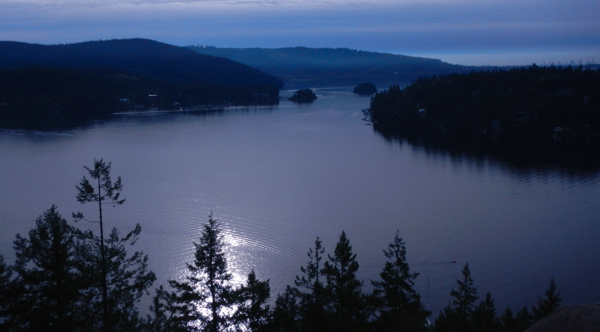
View from Quarry Rock in British Columbia. Photos/Kathryn Reed

View from Quarry Rock in British Columbia. Photos/Kathryn Reed

By Kathryn Reed

VANCOUVER, British Columbia – For people who can’t decide if they prefer the ocean, mountains, or city, Vancouver is the place to visit.

A certain vibrancy fills this Canadian city of 603,502 people. It’s easy to walk throughout downtown. Then there is the natural beauty that is reminiscent of the Sierra.

A long weekend last month barely scratched the surface of what there is to see and do. Fortunately I had my good friends Kim and Dan to play tour guide. I had driven through Vancouver in January 2010 to get to Whistler, but didn’t stop.
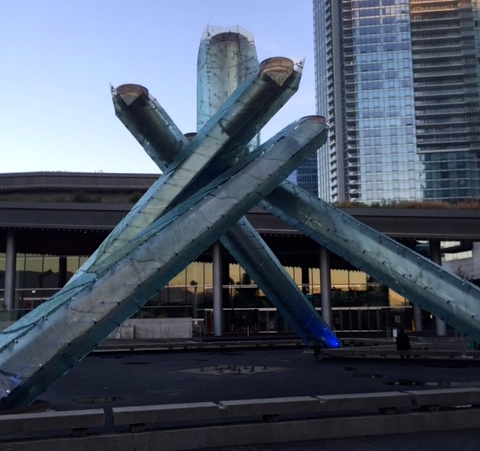
The flame is rarely seen at the Olympic cauldron along the Vancouver watefront.

The flame is rarely seen at the Olympic cauldron along the Vancouver waterfront.

There are few overt signs the Olympics were here nearly six years ago. A stop on the train from the airport to downtown has some reference to the Games, but my friends said all the Olympic Village housing is now condos.

Near the waterfront, in Jack Poole Plaza, is the glass and steel cauldron for the Olympic flame. It was relighted during part of the Sochi Games last year. It costs about $5,000 to light it for four hours, so it is mostly dark.

Seaplanes dot the harbor unlike any water city I’ve been too. It shows the common choice of transport to get to neighboring islands.
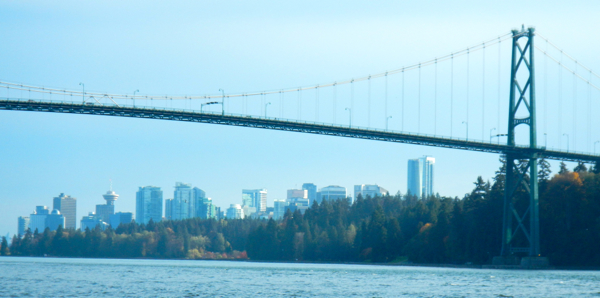
Lions Gate Bridge was completed in 1938.

Lions Gate Bridge was completed in 1938.

My friends live on the other side of the 77-year-old Lions Gate Bridge. I had to agree with their description of it – it’s like crossing the San Francisco Bay Bridge, except instead of being dropped into Oakland it’s more like Tahoe.

At the end of their street is a forest. While we didn’t do it, going up would have delivered us to Cypress Mountain where the Olympic snowboarding events were staged.

Canadian maple leaf

Canadian maple leaf

We went on a few walks/mini hikes in the region. One was the 2.4-mile round-trip trek to Quarry Rock from Deep Cove. This is a little town on what is called the North Shore. Walking through the woods it’s lush. It’s almost tropical.

Vancouver gets an average of 57.3 inches of rain a year. To put this in perspective, Sacramento averages 21 inches a year.
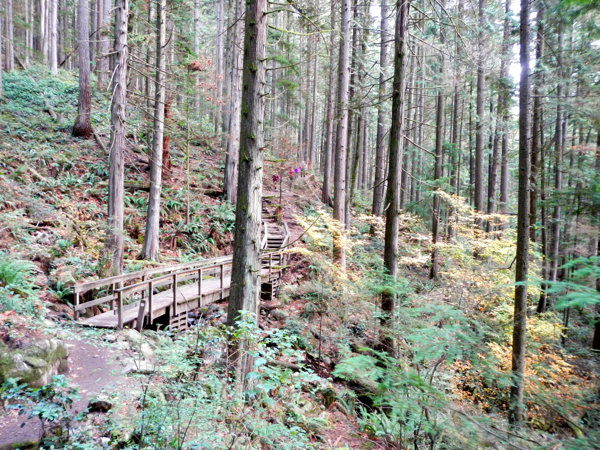
Beauty is everywhere on the way to Quarry Rock.

Views along on the way to Quarry Rock.

Beauty is everywhere. What is nice it that it isn’t super dense, so it’s possible to see the forest through the trees. Hemlock and Douglas fir are the predominant trees. And those Canadian maple leaves, they are huge – bigger than any I have seen in New England.

The end, well, it’s just stunning. The rock provides views of fjords that make this oasis of the world so captivating.
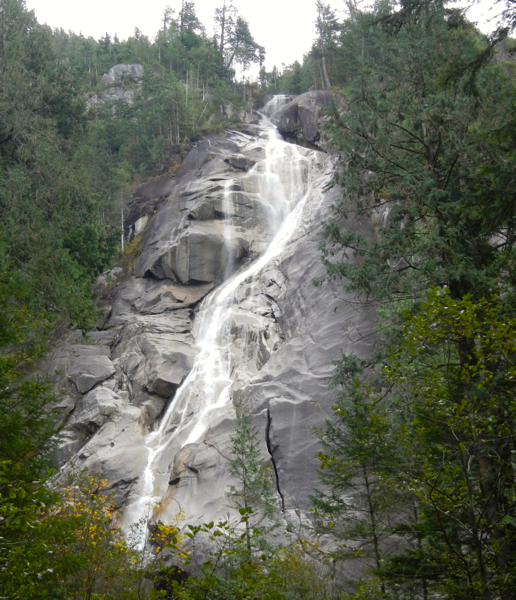
Shannon Falls

Shannon Falls

Another day we took a little road trip toward Whistler. We stopped in Squamish where Shannon Falls is located. The Sea to Sky Highway, which was overhauled for the Olympics, is worth driving on even without a destination.

The falls drop nearly 1,100 feet – making it the third tallest falls in British Columbia. It’s like a ribbon of white rushing water.

From here we could have hiked Sawamus Chief, but the brewery sounded better. It’s easy here to get distracted by good beer. It’s a nice reward after enjoying the outdoors.


Government borrowing means payback time – someday

By Jim Miller, Sacramento Bee

There is no such thing as free money.

That chestnut of fiscal wisdom sometimes gets overlooked amid local or statewide campaigns to authorize borrowing to pay for public works projects, avoid spending cuts, or cover other endeavors without raising taxes.

But a huge new set of government borrowing data from the California Treasurer’s Office for the first time details how government entities – from the state on down to counties, cities and special districts – planned to repay $1.5 trillion in bonds sold since the mid-1980s.

Some of the borrowing has been financed with special taxes, or from the growth in property tax revenue in now-defunct redevelopment areas.

Read the whole story


Court docs show big business of daily fantasy sports

By Michael Virtanen, AP

ALBANY, N.Y. — Documents filed at the court examining the legality of daily fantasy sports in New York show a rapidly growing national business built on billions in entry fees.

An estimate by DraftKings says the industry will take in up to $4 billion in entry fees in the United States this year, and could reach up to $20 billion in 2017.

Daily fantasy companies like FanDuel and DraftKings generally charge roughly 10 percent of each wager for hosting games.

The insights into the industry are contained within court exhibits as the companies fight New York Attorney General Eric Schneiderman, who is attempting to halt what he considers illegal gambling under state law. A hearing is scheduled Wednesday in Manhattan before a state judge.

The companies say their games are legal and based on player skill.

New York is just one of several states where the daily fantasy sports industry is facing recent scrutiny. Several states that don’t have specific prohibitions are considering new regulations or laws.

The companies caught the New York attorney general’s attention with their ad blitzes this year around the start of the NFL season.

“The growth in (daily fantasy sports) advertising has been as spectacular as it was sudden,” the attorney general wrote in his motion for an injunction. “Advertising reached a peak in the weeks leading up to the 2015 NFL season, when it became nearly impossible to watch televised sports without encountering a (daily fantasy sports) commercial.”

A spreadsheet collected by investigators shows FanDuel and DraftKings spent $34 million on TV advertising with NBC and Comcast through Oct. 28 this year, compared with $3.2 million in 2014. In another court document, the attorney general said FanDuel has spent more than $75 million this year on all ads, saying it was “paying out over $2 billion dollars this year” and “anybody can play, anybody can succeed.”

U.S. entry fees were $20 million in 2011 and are expected to reach up to $10 billion next year, the DraftKings market estimate said.

Another document submitted to the court by the attorney general says the U.S. has a market of 63 million male sports fans between 21 and 50 years old, including 25 million fantasy sports players. They are described as passionate about sports, white collar, having high disposable income and “underserved by social and skill game developers.”

Both companies say they have hundreds of thousands of customers in New York.

New York-based FanDuel was forced to stop taking deposits from New Yorkers late last week, saying its bank and processors were deterred by Schneiderman’s efforts. It stopped letting customers in New York enter contests on Tuesday.

Both say they remain committed to ensuring their customers can keep playing and will argue their position Wednesday.


Impacts of Martis Valley project questioned

This map shows where the proposed development would go. Map/Provided

This map shows where the proposed development would go. Map/Provided

By Kathryn Reed

KINGS BEACH – Developers tout the preservation of thousands of acres of open space and the reduction of houses that would be built in addition to permanently retiring 600 units.

Opponents question the impacts to the Lake Tahoe Basin, which this development would border, overall traffic, air quality and other environmental concerns.

The Martis Valley West plan would transfer residential and commercial uses from the east parcel to the west parcel, preserving the 6,376-acre east parcel.

On Nov. 19 the Placer County Planning Commission heard the pros and cons of the proposal. The commission was taking input and not voting on anything. The draft environmental impact report is being circulated for public comment.

Sierra Pacific Industries owns the land, with Mountainside Partners the developers. The 760 units proposed to be built are outside of the Lake Tahoe Basin.

Kurt Krieg with Mountainside Partners told the commission that when it comes to visual issues the studies show “less than significant impacts”. Traffic, he said, will not be a problem now that fewer units than what the land is zoned for will be built, thus having a 35 percent reduction in vehicle mile trips than if there had been full build-out. As for water, the site has wells that can be tapped. Krieg also pointed out that stormwater does not flow into the Tahoe basin.

He noted a study by the Conservation Biology Institute that backed up his assertions.

Blake Riva, principal with the company, went over some numbers:

·       50,000 acres of contiguous open space from Martis Valley through the Mount Rose Wilderness Area;

·       24,000 acres of open space in the Tahoe basin;

·       1,360 residential units currently zoned for the east parcel;

·       40 miles of existing private trails would become public.

The benefits, though, don’t outweigh the negatives, according opponents.

The League to Save Lake, Tahoe Area Sierra Club, Friends of the West Shore and others all asked for the draft EIR to be rewritten with more detail and then be recirculated.

“My overarching statement is this EIR is the most confusing I’ve ever reviewed,” Tahoe Vista resident Ellie Waller told the commission. This is from a woman who is well-versed in reading these types of documents. “The placement of cumulative impacts in the executive summary and not having a separate chapter like most EIRs is a prime example.”

A theme among the 10 people who spoke was cumulative impacts. Most said the information in the draft EIR is not substantive enough. And when people wanted to bring up the adjacent proposed Brockway Campground the chair of the commission, Ken Denio, didn’t want to hear those concerns. He wanted to only hear about the draft EIR. But the people’s point was the cumulative impacts section is so minimal it does not allow a robust discussion about what they perceive as real impacts.

“It is really astounding that this project will take the level of service from a D to an F. F is gridlock,” Laurel Ames with the local Sierra Club said of the traffic impacts.

Jennifer Quashnick with Friends of the West Shore questioned how the environmental document could look at traffic as though only 20 percent of homes would be occupied. She said even if these are predominately second homes, there is still the real possibility they could be full on many weekends.

One person asked for the entrance to not be on Highway 267 if possible.

Loren Enstad, who was fire chief of North Lake Tahoe Fire District from 1980-99, said firefighting resources are already stretched and that this project will add to the problem.

As for visual impacts, Anne Nichols with North Tahoe Preservation Alliance, said, “If you can see the lake, the lake can see you.”

While this project is outside of Lake Tahoe, the basin will be impacted. People have asked the Tahoe Regional Planning Agency to weigh in, but have not had that request acknowledged by the bi-state planning agency.

—–

Notes:

·      Comments will be accepted until Dec. 22 at 5pm; email them to cdraecs@placer.ca.gov. The extension makes it a 60-day comment period instead of 45 days.

·       The draft EIR is online.


Sandoval ranks among most popular governors

By Sean Whaley, Las Vegas Review-Journal

CARSON CITY — Gov. Brian Sandoval may be suffering some political fallout for the $1.4 billion tax plan he pushed through the 2015 Legislature, but a poll of Nevada voters shows he is one of the most popular governors in the country.

The public opinion survey of all 50 governors by Morning Consult shows Sandoval with a 66 percent approval rating. Another 20 percent disapprove of the second-term Republican governor while 14 percent did not know. Morning Consult is a politics and polling publication based in Washington.

The results are from 740 registered Nevada voters with a margin of error of plus or minus 3.6 percentage points. The polling was conducted over the course of several months, from May to November.

Read the whole story


Realities of prescription drug abuse

By Amy Rothermel, Deseret News

Prescription medications are part of millions of Americans’ daily existence — at least 60 percent of Americans take at least one prescription drug according to the National Council on Alcoholism and Drug Dependence, Inc. While medications can be helpful and even life-saving, some are addictive and have a high abuse potential.

According to the Centers for Disease Control and Prevention, drug abuse was the top cause of injury death in the United States in 2013. Amazingly, this means more Utahns died from overdosing on prescription drugs than in traffic accidents.

Some people start taking these medications as prescribed for legitimate pain but end up becoming addicted to them.

Read the whole story


Young scientists prove theories with creativity

Ruby Hackett tests the best surface for a Hot Wheel to go the fastest. Photos/Kathryn Reed

Ruby Hackett tests the best surface for a Hot Wheel to go the fastest. Photos/Kathryn Reed

By Kathryn Reed

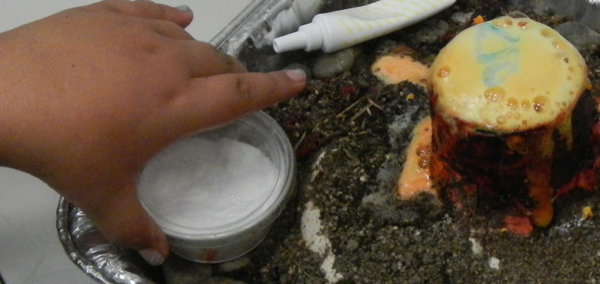
Yarelly Hernandez was all business when it came to explaining why the volcano was exploding.

The yellow lava spilled forth just as she intended. That’s what happens when baking soda, water and dish soap are combined. A little food coloring added to the drama.

The Bijou Community School first-grader was showing off her project during the annual science fair. The multipurpose room became a science lab the afternoon of Nov. 19. The only thing missing was white lab coats.

Each student had to start with a question. From there a hypothesis was developed. The materials they used had to be listed. The results were documented as well as their conclusion.

For the students in the two-way immersion program their projects were all done in Spanish.

“They are talking and building a vocabulary in science,” teacher Laura Chappel told Lake Tahoe News.

The whole process started about three weeks ago when a packet about the event and what was expected was sent home. Parents could help, but the students were to do the bulk of the work.

Yarelly Hernandez  uses baking soda to make her volcano erupt.

Yarelly Hernandez uses baking soda to make her volcano erupt.

Presentations were made before their peers in class. On Thursday it was time show off their expertise to parents, teachers, classmates and school board members who roamed the room.

Ruby Hackett had a Hot Wheels contraption where she shot a car on a track to see how fast it would go in various conditions. It was a definite Tahoe-esque test to see if the vehicle went faster on dry conditions or with salt water. The brine solution was the fastest surface.

For Diego Palacios he wanted to create lava lamps.

“I learned vegetable oil and water never mix because of the molecules,” Diego told Lake Tahoe News.

He came up with the idea for the project by doing some research on the Internet.

Diego combined water, oil and antacid tablets to get a fizzy sensation that resembled lava lamps. Food coloring completed the effect.


Nev. students outscore expectations, but few tested

By Trevon Milliard, Reno Gazette-Journal

Students performed better than expected on Nevada’s new and more challenging standardized tests aligned to Common Core, but state officials are taking the results with a grain of salt.

“We can’t make an inference of how the state really performed,” said interim State Superintendent of Public Instruction Steve Canavero, releasing 2015 scores to public schools on Tuesday with many caveats.

The state – like all others across the nation – must annually test all third through eighth grade students in math and English language arts, but only a third of Nevada’s 213,500 students did so this spring. Schools were plagued by repeated crashes to the online exams, with both the testing company and test-maker unable to fix the problem.

Read the whole story


Billions depend on water from shrinking snowpacks

By Sindya N. Bhanoo, New York Times

Snowpacks are a vital source of water for humans, but they may shrink in some regions as the climate warms. A study estimates how changes in showfall will affect water supplies.

Justin S. Mankin, an earth scientist at Columbia University, and his colleagues analyzed 421 drainage basins in the Northern Hemisphere that depend on rainfall and snowmelt, and then combined the data with several different climate models.

They found that 97 basins, currently serving 2 billion people, depend heavily on snowmelt. The scientists calculated that the likelihood the basins would receive less snow in the coming century was 67 percent.

Read the whole story


Integrated transit in Tahoe far from reality

Tahoe City's transit center   is an integral component of the North Shore bus system. Photo/Provided

Tahoe City’s transit center is an integral component of the North Shore bus system. Photo/Provided

By Kathryn Reed

Free, integrated regional transit in the Lake Tahoe Basin is the ultimate goal of those who are in the business of getting people out of their vehicles and those who are involved with tourism.

Money is the hurdle that still needs to be cleared in order for that dream to become a reality.

That was the message from a panel of four who spoke Nov. 18 during the monthly Tahoe Talks Brown Bag Lunch Series at Lake Tahoe Community College. George Fink with Tahoe Transportation District, Sandy Evans-Hall of North Lake Tahoe Visitors Authority, Tom Fortune from Heavenly Mountain Resort and Jaime Wright with the Truckee-North Tahoe Transit Management Association touched on a range of transit issues during the discussion.

Heavenly provides free transit for skiers and employees when they are working. The bus is also free to anyone who gets on those particular buses.

Fortune said a future goal is to use the 1,200 spaces at California Lodge in the summer as a park and ride, with buses then going to Heavenly Village where guests would take the gondola up to the resort’s rope courses and other amenities.

The North Shore and Truckee are combining their resources. TART now stands for Truckee Tahoe Area Regional Transit. Buses are painted the same for the most part, with the Truckee ones having a little more green to embrace the town’s green initiative and Tahoe buses having blue to recognize keeping the lake blue. One phone number will be used.

This all eliminates confusion for riders who don’t understand the geographic boundaries of towns and states.

Panelists reiterated the need for a seamless system.

Joanne Marchetta, executive director of the Tahoe Regional Planning Agency, said that will be hard to do with one city, five counties and two states. It was pointed out how ski resorts can’t even figure out how to cooperate to get riders to the various resorts using shared transit.

Evans-Hall said it is time to look at transit as an amenity. She said that is what other resort destinations are doing – and it’s paying off. People are parking once and not getting in their vehicles until their vacation is over.

South Lake Tahoe City Councilman Austin Sass, who is also on the TTD board, said, “We are a parking deficient town. The long-term solution to get people out of their cars is to have parking.”

To pay for free transit in places like Park City, Vail and Steamboat a variety of taxes have been put in place. They range from hotel to recreation to lift ticket to sales taxes.

Placer County is looking at raising its transient occupancy and sales taxes.

When TOT is raised it can be done so with 50 percent plus one voter passing it. If the funds were to be earmarked for something specific, like transit, it then requires a two-thirds majority. How some jurisdictions are getting around this is to put the TOT to a vote and having a secondary question asking voters to prioritize where the money goes.

North Shore did a study that says it would cost $7.2 million to run a free transit system with buses stopping every 30 minutes. The bus system today has a budget of $4.5 million. The consultants said it is likely the difference would be made up in the first year based on the increase of people coming to the area and spending money.

Evans-Hall and her people are moving in that direction, with the goal of having free bus service in five years.

The South Shore isn’t anywhere close to doing the same.

Fink said the goals on this end of the lake with BlueGo are to have buses go to Meyers and into neighborhoods.