Invasive clams a threat to Sand Harbor

By Anne Knowles

CARSON CITY — Nevada officials are worried about the arrival of Asian clams at Sand Harbor.

Charles Donohue, administrator and state land registrar for the Nevada Division of State Lands, said a small population of the invasive species has been detected at the popular Lake Tahoe beach. On Nov. 30he was addressing the Nevada Legislature’s interim committee that oversees the Tahoe Regional Planning Agency and Marlette Lake water system.

He told Lake Tahoe News two age classes of the clam were recently discovered by a graduate student at UC Davis after an initial review cleared the area.

Donohue said there was some speculation that the clams ended up there via discharge from the ballast of a boat that had traveled somewhere where the clams are commonly found. They have been in Lake Tahoe since 2002.

They are about 2 to 3 centimeters, with some 1-2 millimeters – like a grain of sand. They produce calcium – which Lake Tahoe doesn’t naturally have much of. Calcium is needed for quagga mussels to survive and thrive; that is one species that has yet to be detected in Lake Tahoe.

Donohue said an assessment will soon be made and, if necessary, a quick mitigation before the clams can do any near shore damage.

“Sand Harbor is a treasure,” Donohue said.

Amy Berry, chief executive officer of the Tahoe Fund, after hearing Donohue’s presentation, said the Asian clam mitigation could become one of the group’s projects for 2016.

She said two projects the nonprofit may do next year are acquisition of Johnson Meadows in the upper Truckee River and adding lookouts to Taylor Creek.

For 2017, the group is considering work on the Incline Flume Trail.

The Legislative Committee for the Review and Oversight of the Tahoe Regional Planning Agency and the Marlette Lake Water System meets six times during the interim. The remaining meetings will be at Lake Tahoe.

After its work, the committee can submit 10 bill draft requests to the 2017 Legislature.


TTD steering loop road project to completion

The city-county street looping to the left behind the casinos may one day be Highway 50. Photo/Provided

The city-county street looping to the left behind the casinos may one day be Highway 50. Photo/Provided

By Kathryn Reed

Planning for the South Shore’s loop road is nearing the finish line, with no intention of going to the voters even if that were a possibility.

Carl Hasty, executive director for the Tahoe Transportation District – the lead agency for the project, believes between the information that has been provided and the future opportunities for the public to weigh in that people have had ample opportunity to voice their opinions.

This bi-state agency, if it were to get the go-ahead from the California and Nevada departments of transportation, could reroute Highway 50 behind Harrah’s Lake Tahoe and MontBleu casinos and turn the current highway into a city street without South Lake Tahoe’s blessing. TTD is a federal entity that has a higher level of authority than a city or county.

The City Council could put an advisory question to voters asking if they want the loop road or not. The outcome, though, would not be a mandate. The council could still support or not support the project, and TTD doesn’t have to listen to the voters or the council.

It could hurt TTD if the council were to come out against the project because it would likely make it more difficult to get federal funding.

And if eminent domain were needed to acquire property, TTD would need the city to make that happen. It would take four out of the five council members to reverse current policy that bans the use of eminent domain.

The goal of TTD is to turn just more than a mile of the current Highway 50 at the state line into a road managed by South Lake Tahoe and Douglas County, and make the current local street behind the casinos into a highway. The purpose is to make the commercial area more walkable and inviting.

Hasty did not know if the realignment would save drivers time. The focus is on flow. He also could not tell Lake Tahoe News what the speed limits on the respective roads might be. Today there are four traffic lights on Highway 50 in the stretch that will be affected. The new route would have two, at Heavenly Way and Harrah’s.

Tuesday night was the most recent opportunity for people to give input. More than 100 people spent time Dec. 1 at Lake Tahoe Resort Hotel looking at the five alternatives, including one to do nothing. People were asked based on the exhibits what they thought of the possibility of affordable housing, mixed use buildings, gateway features, site options and if they had any general comments to make.

Mike Riley has been listening to the loop road talk for 20 years. He called Tuesday’s presentation the best he has seen to date. He supports the concept, but is worried about the people who would be displaced, and wonders who will be responsible for the upkeep of the trail from MontBleu to Van Sickle Bi-State Park.

Mark Cuthright has driven Lake Parkway-Montreal Road (the roads that could become a federal highway) after it snows. The grade makes it sketchy, he said. He questions the logic of having people on that stretch of road instead of the flat and straight highway of today.

For Dave Kurtzman, he likes the mix of affordable housing, and the possibility of getting federal money to make it a reality.

For all of this to come to fruition as TTD envisions, no properties on the Nevada side would be adversely affected. On the California side it’s a completely different story. Multiple residences and businesses would be bulldozed, likely starting before the current easterly intersection of Highway 50 and Pioneer Trail in South Lake Tahoe and then going back toward Montreal Road.

Mike McKeen, who owns the property where Naked Fish and Powder House are located, was initially a staunch opponent of project, going so far as to create signs saying as much that were outside the businesses. Today he is a proponent, envisioning a revamping of his property.

His biggest concern now is where people will park if the new commercial and residential structures are built.

For Hasty, what he likes is the evolution of the plan into what he calls a true community revitalization project.

—–

Notes:

·      South Lake Tahoe City Council will get an update on the project Dec. 7. The meeting at Lake Tahoe Airport starts at 9am.

·      There will be an open house Jan. 26 from 5-7pm at Lake Tahoe Resort Hotel.

·      The draft environmental studies are expected to be released in the first quarter of 2016. People will have 60 days to comment.


Olympic Valley residents end bid to incorporate

By Kathryn Reed

Proponents to incorporate Olympic Valley have given up the fight to do so.

“All eight members of our board voted unanimously to withdraw our petition. Given the impasse with LAFCO combined with opposition by Placer County, plus stiff and heavily funded opposition from Squaw Valley Ski Holdings, we saw no way to continue moving forward,” Fred Ilfeld, board chair of Incorporate Olympic Valley (IOV), said in a statement Dec. 1.

The process to incorporate started in spring 2013. It was a reaction to the large-scale development proposed at the base of Squaw Valley ski resort, and a desire to have a louder voice and control in matters that affected the residents. The county seat is Auburn – where supervisors make the decisions.

Squaw Valley Ski Holdings, a subsidiary of KSL Capital Partners, runs Squaw Valley and Alpine Meadows ski resorts as well as the village at Squaw. In 2012, the company proposed a massive overhaul of the village that would include more housing, a water park and other features that residents balked at. Those plans have since been scaled back.

The company has spent at least a half a million dollars to stop incorporation.

“The decision by IOV to withdraw their petition for incorporation is a step in the right direction for the future of Olympic Valley. Creating a new town would have been a risky proposition, not just for the people and businesses of Olympic Valley, but for the community of North Lake Tahoe. We now have the opportunity to move forward in a positive way, and to work together as a cohesive community to maintain our mountain culture and have a dialogue on how we can join together in tackling some of the challenges and concerns that prompted this initiative,” Andy Wirth,president and CEO of Squaw Valley Ski Holdings and representative of Save Olympic Valley, said in a statement.

About 1,000 people live in what would have been the city of Olympic Valley. IOV wanted to take the issue of incorporation to the voters. There are about 560 registered voters.

Backers believe they have the financial wherewithal to be a viable city, citing data from the sate Controllers Office. However, the Placer County LAFCO board had to OK the idea before it could go to voters. That office has been adamantly against incorporation.

“Although IOV has suggested that the proposed town of Olympic Valley would be financially viable, the facts simply did not support that conclusion,” said Matthew Newman, co-founder of Blue Sky Consulting Group. “In their effort to show that the town could work financially, IOV proposed to capture all of the benefits of development in the form of higher tax revenues while simultaneously seeking to avoid the increased costs that new development would bring in the form of increased law enforcement services and more work for planners and the community development department.”

While this latest round is over, the larger fight for greater representation is not.

“Although the petition withdrawal marks the end of the current chapter of the incorporation effort, it introduces the possibility of the next chapter of community building and regional self-governance,” organizers said in a press release. “Hopes and expectations remain high that a broader community effort will compel Placer County to address the needs of North Tahoe region and respond to the call for more local input and autonomy. In this regard, IOV board members are open to sharing their recent experience with their neighbors and to exploring such a possibility for regional self-determination.”


Daily dose of ecotherapy eases stress in kids

By Katie Arnold, Outside

Every few months my daughter’s public elementary school, like schools all around the country, practices emergency lockdown measures. “If there’s a bear outside, we go into our closet and turn off the lights,” my daughter, who’s 7, explained to me after the most recent drill. “We lie on the floor and put backpacks on our heads, all squished together. We’re not allowed to talk because bears are much stronger than people and can crash through the windows and get us. We have to stay in the closet for an hour until it’s safe.”

As a second-grader, my daughter and her classmates are still too young to know exactly what–or who—they’re defending against. Bears, of course, aren’t nearly as grave a danger facing school children as gun violence, as this fall’s deadly school shooting at Umpqua Community College in Oregon reminded us. The tragedy was the 295th mass shooting in the U.S. this year, on the 274th day of the year.

Even when school violence happens across the country to children and people we don’t know, the trauma affects us all, to varying degrees.

What we can do is help them cope and try to ensure that the recent spate of violence—and attacks that may occur in the future—don’t leave them with lasting emotional trauma. Among the common-sense strategies the Department of Interior recommends in the aftermath of a national tragedy: talking to your children about their fears, limiting their exposure to television and online news coverage, creating a safe environment at home, and resuming normal physical activities.

There’s another proven way to ease concerns and treat trauma: ecotherapy. That’s the term coined in the mid-1990s for using nature to promote psychological healing. “Nature therapies are being used very successfully to ease both emotional and physical trauma, and stress is one more form of this,” says Linda Buzzell, co-editor of the book “Ecotherapy: and a psychotherapist at Pacifica Graduate Institute in Santa Barbara.

Read the whole story


Nevada lawmakers not letting bankrupt fire safe council fiasco go without a fight with feds

The tree removal project in 2011 at Lake Christopher in South Lake Tahoe got caught up the fire safe council money debacle. Photo/LTN file

The tree removal project in 2011 at Lake Christopher in South Lake Tahoe got caught up the fire safe council money debacle. Photo/LTN file

By Anne Knowles

CARSON CITY — Despite efforts by the Nevada Legislature to press the federal government for money, fire districts, contractors and some homeowners in the Lake Tahoe Basin remain unpaid for $3.4 million in fuels reduction work completed as long ago as 2010.

“It’s been over half a decade. It is absolutely absurd, just unbelievable what’s going on,” Nevada state Sen. James Settelmeyer, R-Minden, said Monday during a meeting of the Legislature’s interim committee that oversees the Tahoe Regional Planning Agency and Marlette Lake Water System.

The fuels reduction work was to be paid for through grants from the U.S. Bureau of Land Management and the U.S. Forest Service administered by the Nevada Fire Safe Council.

But starting in 2010 the NVSFC became slow to pay contractors and the U.S. Department of Agriculture’s Office of Inspector General investigated the group after receiving a tip in July 2011. Lake Tahoe News broke the story that summer.

The OIG released a report in January 2012 saying it found that the NVFSC inappropriately deposited money from multiple grants into a single bank account and recommended that all funds be frozen until NVSFC performed audits and demonstrated it was acting properly.

Eventually, NVSFC filed for bankruptcy and its case remains mired in the courts.

Michael Brown, fire chief for the North Lake Tahoe Fire District, testified at the Nov. 30 committee meeting saying that the fire chiefs of the Lake Tahoe Basin conducted their own investigation and found that NVSFC had used USFS money to pay for BLM-funded projects.

“No criminal activity was ever uncovered by the audits and investigations. They co-mingled the funds and paid out with grants that should have been paid out with other grants,” Brown told the committee.

The fire districts and the money owed each include Lake Valley Fire Protection District, $248,759; Meeks Bay Fire Protection District, $403,378; North Lake Tahoe Fire Protection District, $635,118; North Tahoe Fire Protection District, $379,666; and Tahoe Douglas Fire Protection District, $386,440.

More than a dozen contractors are owed, most for between $10,000 and $20,000 and one, Kimball Tree Service of South Lake Tahoe, for $100,015.

“We’ll survive,” said Brown, referring to the fire districts. “It’s the contractors not surviving. I got two calls just last week asking about the payments. One is out of business and the other is just hanging on.”

Still, the fire districts have suffered, too. Brown told Lake Tahoe News that while his firefighting and emergency response team is holding steady at 52 employees, he has had to reduce his fuels reduction team from 60 workers to 36.

During this year’s legislative session, the Nevada Legislature passed Assembly Joint Resolution 3, urging Congress to facilitate the release of the money.

The committee passed a motion Monday to send a letter to the state’s congressional delegation to update the interim committee on the funds.

“I support the letter,” Assemblywoman Robin Titus, R-Wellington, said. “But I am concerned sending letters is an exercise in futility.”


Drought squeezes duck hunters – could be bad news for fowl

By Ryan Sabalow, Sacramento Bee

RICHVALE — At 5am on a recent Tuesday in Northern California’s rice country, headlamps and pickup lights illuminated a flurry of movement off a turnout along a rural Butte County highway.

A half dozen men tugged on camouflage chest waders, coats and caps, and loaded shotguns and equipment onto waiting ATVs. Around them, a couple of Labrador retrievers bounded around the group with excitement.

Greg Galli, the owner of River Valley Outfitters, directed the flow, readying his clients for a windy morning of duck and goose hunting. Galli would lead the men into rice fields that have been flooded post-harvest, in part to serve as resting ground for the mass migration of birds making their annual winter trek south along the Pacific Flyway. Galli, who leases hunting blinds from Sacramento Valley farmers, has had a busy fall.

“Our day-shoot blinds are doing triple what they normally do,” Galli said, “because most people don’t have water in their duck clubs.”

Largely lost in the statewide discussion about fallowed crops, depleted reservoirs and brown lawns, is the impact of California’s drought on hunting. The succession of four dry years has dried up many of the natural marshes and rice fields used by the estimated 55,000 people who hunt waterfowl in California. While the number of duck hunters has stayed relatively steady overall in recent years, some of the state’s larger refuges have seen a marked decline in hunter usage.

As land available to hunters shrinks, there’s more at stake than increased competition for access to remaining wetlands. State officials point to implications for the state’s rural economy – and ultimately for waterfowl.

Read the whole story


Single digit temps not setting any records

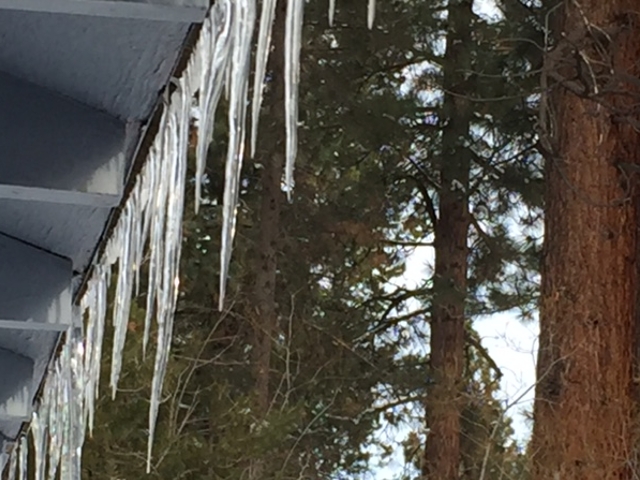
It's so cold in Tahoe icicles aren't even melting. Photo/LTN

It’s so cold in Tahoe icicles aren’t even melting. Photo/LTN

By Kathryn Reed

Furnaces may be in overdrive and woodpiles dwindling because of the cold in Lake Tahoe, but no records are being set.

The low Sunday in South Lake Tahoe was 0 degrees. The record for Nov. 29 is minus 9 set in 2010. On Nov. 28 the low was minus 1, while the record from 1972 is minus 2.

In Tahoe City, Sunday’s low of 6 missed tying the record by two degrees. That 4-degree record was set on Nov. 29, 1975. The Nov. 28 low was 7; the record of 5 was established in 1975.

“Last week we had that cold storm go through and it just lingered around for a few days. We haven’t been able to warm up because partly the snow cover and lack of wind, and no warm air mass,” meteorologist Mark Deutschendorf with the National Weather Service in Reno told Lake Tahoe News.

While the forecast is far from a heat wave, Monday’s overnight low in South Lake is expected to be 19 degrees. Daytime highs will be in the 40s, with Wednesday reaching the 50s before the next storm blows in on Thursday.

Deutschendorf called it a “quick shot of winter”, with typical December temps returning for the weekend.

The late Thursday-early Friday system is expected to drop 2 to 4 inches of snow at lake level, with 6-12 inches at higher elevations.


Opinion: SLT — 50 golden years and counting

Publisher’s note: This is the final article in the series of stories about South Lake Tahoe’s 50th anniversary. The other stories may be accessed by going to the top of the page, select Special Projects, then SLT Turns 50.

slt 50th logoBy Wendy David

Leftovers are in the refrigerator and the feelings of gratefulness for being alive, having snow, wonderful snow and living in South Lake Tahoe are keeping me warm in spite of the cold temperature outside. We are fortunate indeed.

Fifty years ago today, I imagine many of the feelings were the same, but with a bit more excitement as the city of South Lake Tahoe was born. Happy Birthday South Lake Tahoe. As the only incorporated city in the Lake Tahoe Basin even 50 years later, the achievements of our forefathers are even more momentous and appreciated by all of us whom have followed.

My family came for vacation in June 1973, spent a month enjoying all the outdoor fun that a young family of four could have. At the end of July, we decided to stay. Staying and making South Lake Tahoe our home meant a commitment to investing in the future of our community. As the years passed we helped as new businesses were started, youth sports were initiated and expanded, bonds were promoted and passed, amenities were added and South Lake Tahoe grew and matured.

Those that came to ski “just for the winter” bought homes, became parents, perhaps started a business and became leaders. Some of those leaders retired and moved to the sunshine. Children grew up. Some stayed and many left. New leaders emerged, loving South Lake Tahoe too, having the same dreams for their children as those of the previous generation. Our past has been celebrated all year as we thank and remember the people, the projects, the accomplishments and the evolution of the last 50 years of our city.

Wendy David

Wendy David

We have learned much in the last 50 years. We have learned that we cannot depend on the gaming industry to sustain our local economy. We certainly know our winter weather, or should I say the absence of such, can be devastating to our economy. We learned we are a community that cares for each other through good and bad times, as evidenced by the way we leveraged our collective resources during the Great Recession and every other recession: through a landslide that closed Highway 50 for months; through the devastation and loss of the Angora Fire; and in the good times we’ve come together to celebrate.

The flight of our middle class as home prices soared and families cashed in on the windfall also changed our community. We lost 25 percent of our school age population and some of our schools closed. Our neighborhoods changed from local, full-time families dominating ownership to having 75 percent of our homes owned by second homeowners. Change is indeed the only constant.

The past is written and the future is yet to be. We are fortunate to be a part of the future for South Lake Tahoe today.

We are fortunate to be more collaborative than ever as we plan for the future.  The TRPA adoption of a new Regional Plan that allows for a higher level of cooperation and partnership is leading the way. Douglas County, El Dorado County, the city of South Lake Tahoe and our public and private partners have been working on establishing a Legacy Action Plan together that will guide our future with shared goals.

The city of South Lake Tahoe is an integral leader declaring we are a premier recreation destination foremost. We are committing our efforts and investments in this priority. This goal includes the exciting expansion of our bike trail system and our new community play consortium in partnership with Lake Tahoe Community College. The consortium will add up to three additional fields at the college and renovate the existing soccer field, creating a central sports complex.  In addition, we are continuing our progress on the master plan for the renovation of Regan Beach and will be inviting our community to help us envision a new city of South Lake Tahoe Recreation Complex on Rufus Allen Boulevard.

We continue our strong focus of economic development that improves our city. A citywide area plan will provide economic opportunities, and provide incentives toward improving the built and the natural environment. We will revitalize our hotel districts, implement our Tahoe Valley Area Plan, continue to invest in private and public partnerships while also continuing to restore and protect our neighborhoods and watersheds. We will encourage and incentivize partnerships and projects that will remove development from and restore environmentally sensitive areas.

I am often asked these two questions about being on the City Council. First question: Why did you run? The answer is simple. I have lived in and loved my community for more than four decades and want it to shine as it should. Second question: Are you crazy? Answer: I guess you need to be a little crazy to believe that you can make a positive difference. I extend the invitation out to join in being a little crazy with the rest of us in creating a bright future for our city as we begin our second 50 years.

This city is yours and at 50 years young, even with some of its age showing, and ours too, we have a very bright future together. Here’s to you on your 50th, South Lake Tahoe. Cheers!

Wendy David is mayor pro tem of South Lake Tahoe.


Climate change warnings go beyond weather shifts

By Chris Mooney, Washington Post

ELEUTHERA, Bahamas — Standing atop a 60-foot cliff overlooking the Atlantic, James Hansen — the retired NASA scientist sometimes dubbed the “father of global warming” — examines two small rocks through a magnifying glass. Towering above him is the source of one of the shards: a huge boulder from a pair locals call “the Cow and the Bull,” the largest of which is estimated to weigh more than 1,000 tons.

The two giants have long been tourist attractions along this rocky coast. Perched not far from the edge of a steep cliff that plunges down into blue water, they raise an obvious question: How did they get up here?

Compounding the mystery, these two are among a series of giant boulders arranged in an almost perfect line across a narrow part of this 110-mile-long, wishbone-shaped island.

Hansen and Paul Hearty — a wiry, hammer-slinging geologist from the University of North Carolina at Wilmington who has joined him here as a guide — have a theory about these rocks. It’s so provocative — and, frankly, terrifying — that some critics wonder whether the man who helped spawn the whole debate about the dangers of climate change has finally gone too far.

The idea is that Earth’s climate went through a warming period just over 100,000 years ago that was similar in many ways to the warming now attributed to the actions of man. And the changes during that period were so catastrophic, they spawned massively powerful superstorms, causing violent ocean waves that simply lifted the boulders from below and deposited them atop this cliff.

If this is true, the effort kicking off in Paris this week to hold the world’s nations to strict climate targets may be even more urgent than most people realize.

Read the whole story


Roundabout snowshoe delivers awesome views

Views along the Roundabout trail are expansive, with Mount Tallac a constant icon. Photos/Kathryn Reed

Views along the Roundabout trail are expansive, with Mount Tallac a constant icon. Photos/Kathryn Reed

By Kathryn Reed

Solitude. Blue. Calm. Incredible. Inspirational. Awe.

This are just a few of the words that came to mind as I sat looking at Lake Tahoe from the top of Gunbarrel at Heavenly Mountain Resort last Saturday.

Now is the time to snowshoe at Heavenly – before the entire mountain is open to skiers and snowboarders.

Roundabout lives up to its name. The circuitous route is usually the easy way down the mountain to California Lodge. Going up on snowshoes, ascending about 1,600 feet to an elevation of more than 8,200 feet cannot be described as easy. The beauty, though, takes one’s breath away – or maybe it was the climb or the altitude.

AJ makes her way down Gunbarrel.

AJ makes her way down Gunbarrel.

This would be an impossible snowshoe during the ski season. Too many people are on skis on what seems like a narrow path. On snowshoes its like being on a road – wide, with plenty of room.

With the recent snow, conditions are apt to be different. A week ago it was dirt and slick to begin with. Snowshoes were not needed until crossing World Cup. The need for snowshoes a week ago was to have the claws grip the icy, hard pack spots. There were a few bare stretches, but the snowshoes stayed on.

While it wasn’t necessary to have poles, it would be a good idea for anyone with knee or balance issues.

Much of the trail is graded from a snowcat.

Much of the trail is graded from a snowcat.

Other than the crunching of the snowshoes against the terrain there was silence. Be sure to pause to hear the stillness and appreciate the beauty that seems to change at every corner. Various views of Lake Tahoe spill forth. Mount Tallac and Pyramid Peak standout at various times. The casinos, while dominant in some ways, seem so insignificant from this vantage point.

The amount of snow at Powderbowl looks like this chairlift will be spinning in no time.

The end point is the top of Gunbarrel and the tram. This is one view I never get tired of seeing. The whole lake unfolds in a breathtaking view that almost seems surreal.

Instead of going back the same way it’s time to see what it’s like to snowshoe The Face. A zigzag approach seems best so as not to tumble and become a snowball that careens to the bottom. It took some patience and focus because some rocks weren’t far beneath the snow.

Looking out onto the South Shore from the top of Gunbarrel and the tram at Heavenly.

Looking out onto the South Shore from the top of Gunbarrel and the tram at Heavenly.

At times the snow was powdery – making the snowshoes a much-needed tool. Too bad the poles were in the garage. Other spots are crusty, making the trek more of a challenge.

Instead of going all the way down this route, just like on skis, it’s possible to hookup with Roundabout to make it out on a less steep grade.

Roundabout is a great hike in the summer, too. Even then it’s rare to see other people.

—–

Getting there:

From Highway 50 in South Lake Tahoe turn onto Ski Run Boulevard. Turn left on Needle Peak Road, right on Wildwood Avenue, left on Saddle Road, right on Keller Road, and a right on Sherman Way. The road dead-ends at Sherman. There is a gate there. Just start walking.